21
78) Which ionic compound would be expected to have the highest lattice energy?
A) Li2O
B) Na2O2
C) KO2
D) RbO2
79) What is the most likely charge on an ion of phosphorus, P?
A) 5-
B) 3-
C) 3+
D) 5+
80) Which element can form more than one kind of monatomic ion?
A) Ca
B) Cl
C) Cr
D) Cs
81) Which element can form more than one kind of monatomic ion?
A) S
B) Se
C) Sn
82) What are the names of the ions Ba2+, Sn2+, and Se2-?
A) barium, tin, and selenium
B) barium, tin(II), and selenide
C) barium(II), tin(II), and selenium(II-)
D) barous, stannous, and selenide
83) What is the charge on the Cr in the ionic compound Cr2O3?
A) 2-
B) 1+
C) 2+
D) 3+
84) Li2S is named
A) lithium disulfide.
B) lithium sulfide.
C) lithium(II) sulfide.
D) lithium sulfur.
85) The correct name for Mn(C is
A) manganese(IV) acetate
B) manganese(II) acetate
C) manganese(1V) carbonate
D) manganese(II) carbonate
86) The correct chemical formula for manganese(IV) acetate is
A) Mn(C
B) Mn(
C) Mn(
D) Mn(
87) What is the chemical formula for strontium hydride?
A) SrH2
B) SrOH
C) SrOH2
D) Sr(OH)2
88) The chemical formula for calcium nitride is
A) Ca(NO3)2.
B) Ca(NO2)2.
C) Ca3N2.
D) CaN2.
89) The chemical formula for the sulfite ion is
A) S–.
B) S2-.
C) SO32-.
D) SO42-.
90) The thiosulfate ion is
A) HS–.
B) HSO42-.
C) SO52-.
D) S2O32-.
91) The ion NO2– is named
A) nitrate ion.
B) nitrite ion.
C) nitrogen dioxide ion.
D) nitrogen(II) oxide ion.
92) The ions ClO4–, ClO3–, ClO2–, and ClO– are named respectively
A) hypochlorate, chlorate, chlorite, perchlorite.
B) hypochlorite, chlorite, chlorate, perchlorate.
C) perchlorate, chlorate, chlorite, hypochlorite.
D) perchlorite, chlorite, chlorate, hypochlorate.
93) What is the chemical formula for strontium hydroxide?
A) SrH2
B) SrOH
C) SrOH2
D) Sr(OH)2
94) What is the chemical formula for iron(II) phosphate?
A) Fe2P
B) Fe2PO4
C) Fe3P2
D) Fe3(PO4)2
95) KH2PO4 is
A) hydropotassium phosphate.
B) potassium dihydrogen phosphate.
C) potassium diphosphate.
D) potassium hydrogen(II) phosphate.
96) The compound, Cu(ClO3)2, is named
A) copper chlorate(II).
B) copper(I) chlorate.
C) copper(I) chlorate(II).
D) copper(II) chlorate.
97) The chemical formula for potassium peroxide is
A) KOH.
B) KO2.
C) K2O.
D) K2O2.
98) Which alkali metal forms preferentially an oxide rather than a peroxide or superoxide?
A) Li
B) Na
C) K
D) Rb
99) Which alkali metal forms preferentially a peroxide and superoxide?
A) Li
B) Na
C) K
D) Mg
100) Which is not a chemical reaction of the alkali metal sodium?
A) 4 Na(s) + 2 O2(g) → 2 Na2O(s) + Na2O2(s)
B) 2 Na(s) + 2 NH3(l) → 2 NaNH2(sol) + H2(g)
C) 2 Na(s) + Cl2(g) → 2 NaCl(s)
D) 2 Na(s) + 2 H2O(l) → 2 NaOH(aq) + H2(g)
101) Which of the following statements is incorrect about the alkaline earth metals?
A) Melting points generally decrease as one descends the group.
B) Densities are less than those of the corresponding alkali elements of the same period.
C) Ionic radii of the M2+ ion increases as one descends the group.
D) The first ionization energy is less than that of the second ionization energy.
102) Which is not generally considered to be a chemical reaction of the alkaline earth metal
calcium?
A) Ca(s) + Cl2(g) → CaCl2(s)
B) 2 Ca(s) + 2 H2O(l) → 2 Ca(OH)2(aq) + H2(g)
C) 6 Ca(s) + 2 N2(g) → 2 Ca3N2(s)
D) Ca(s) + O2(g) → CaO2(s)
103) Which is not generally considered to be a chemical reaction of the alkaline earth metal
magnesium?
A) 2 Mg(g) + O2(g) → 2 MgO(s) at room temperature
B) 3 Mg(s) + N2(g) → Mg3N2(s) at elevated temperatures
C) Mg(s) + 2 H2O(l) → Mg(OH)2(s) + H2(g) at room temperature
D) Mg(s) + F2(g) → MgF2(s) at room temperature
27
104) Which alkaline earth metal reacts the most vigorously with water at room temperature?
A) Be
B) Ca
C) Ba
D) Sr
105) Group 2A metals tend to be somewhat less reactive than alkali metals, and the order of their
reactivity is
A) Ba > Sr > Ca > Mg > Be.
B) Be > Mg > Ca > Sr > Ba.
C) Ca > Mg > Be > Ba > Sr.
D) Sr > Ca > Mg > Be > Ba.
106) Predict the product(s) when the reactants Be(s) + Br2(l) are mixed.
A) BeBr(s)
B) BeBr2(s)
C) Be2Br(s)
D) BeBr3(s)
107) Which of the following elements is a liquid at room temperature?
A) fluorine
B) chlorine
C) bromine
D) iodine
108) Which of the following elements is a solid at room temperature?
A) fluorine
B) chlorine
C) bromine
D) iodine
109) Which group of elements are found as diatomic molecules?
A) alkali metals
28
B) alkaline earth metals
C) halogens
D) noble gases
110) Metals tend to react with the halogens to form metal halides. What is the reactivity order for
the halogens?
A) F2 > Cl2 > Br2 > I2
B) Cl2 > F2 > Br2 > I2
C) Br2 > I2 > Cl2 > F2
D) I2 > Br2 > Cl2 > F2
111) Which of the hydrogen halide acids is used to etch glass?
A) HF
B) HCl
C) HBr
D) HI
112) Which of the following statements about helium is inconsistent with its chemistry?
A) A helium oxygen mixture is used as a deep-sea diving gas instead of compressed air.
B) In its liquid form it is used as a cryogenic coolant for superconductors.
C) It is one of the more reactive elements of its group.
D) Its melting point is -272.2°C and its boiling point is -268.9°C.
113) Which statement is inconsistent with the chemistry of the noble gases?
A) Both helium and radon are radioactive.
B) Helium and neon are both lighter than air.
C) Neon and argon are used in decorative or designer lights.
D) Xenon and krypton react with fluorine to form fluorides.
Use the periodic table below to answer the following questions.
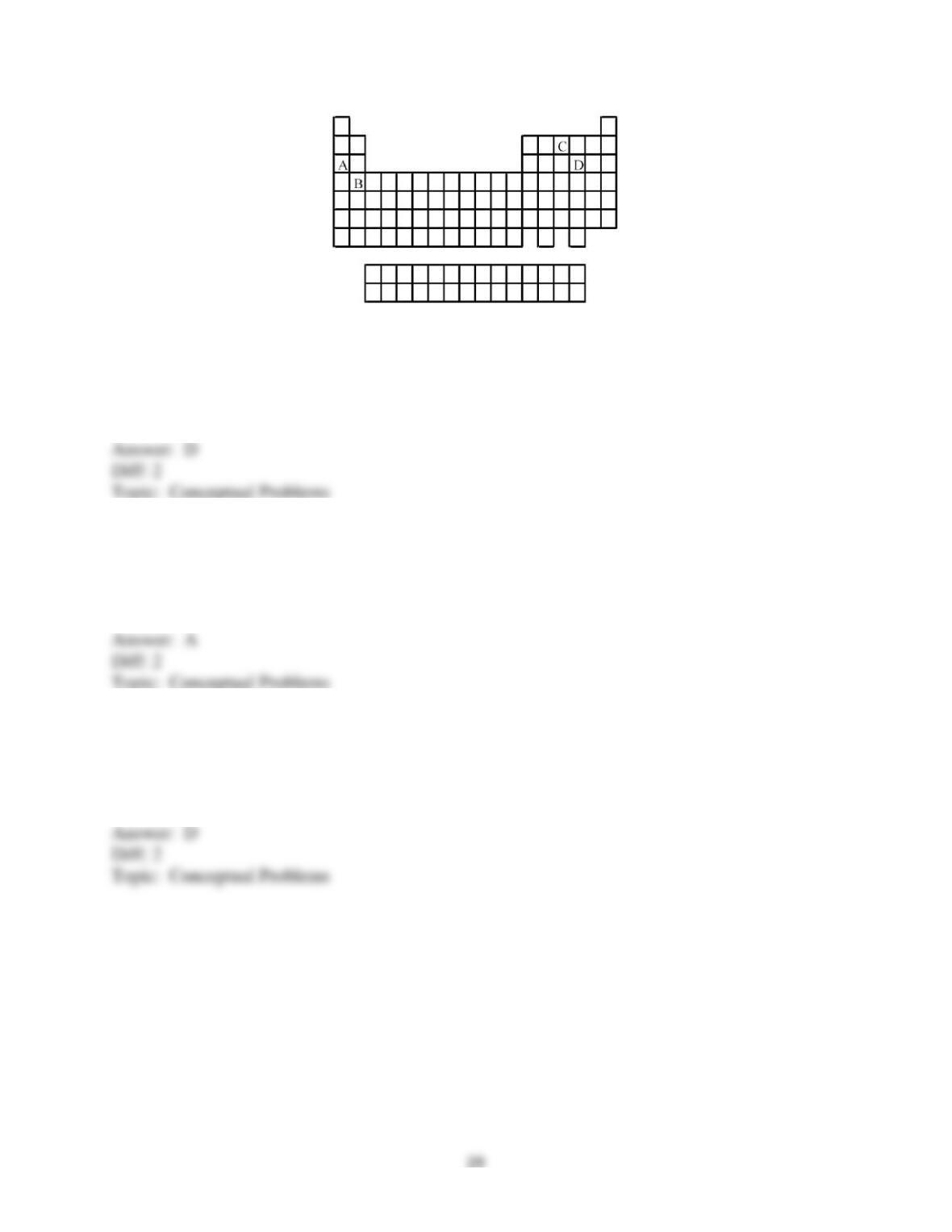
114) Which elements commonly form anions?
A) A and B
B) A and C
C) B and D
D) C and D
115) Which elements commonly form cations?
A) A and B
B) A and C
C) B and D
D) C and D
116) Which elements commonly form covalent bonds?
A) A and B
B) A and C
C) B and D
D) C and D
30
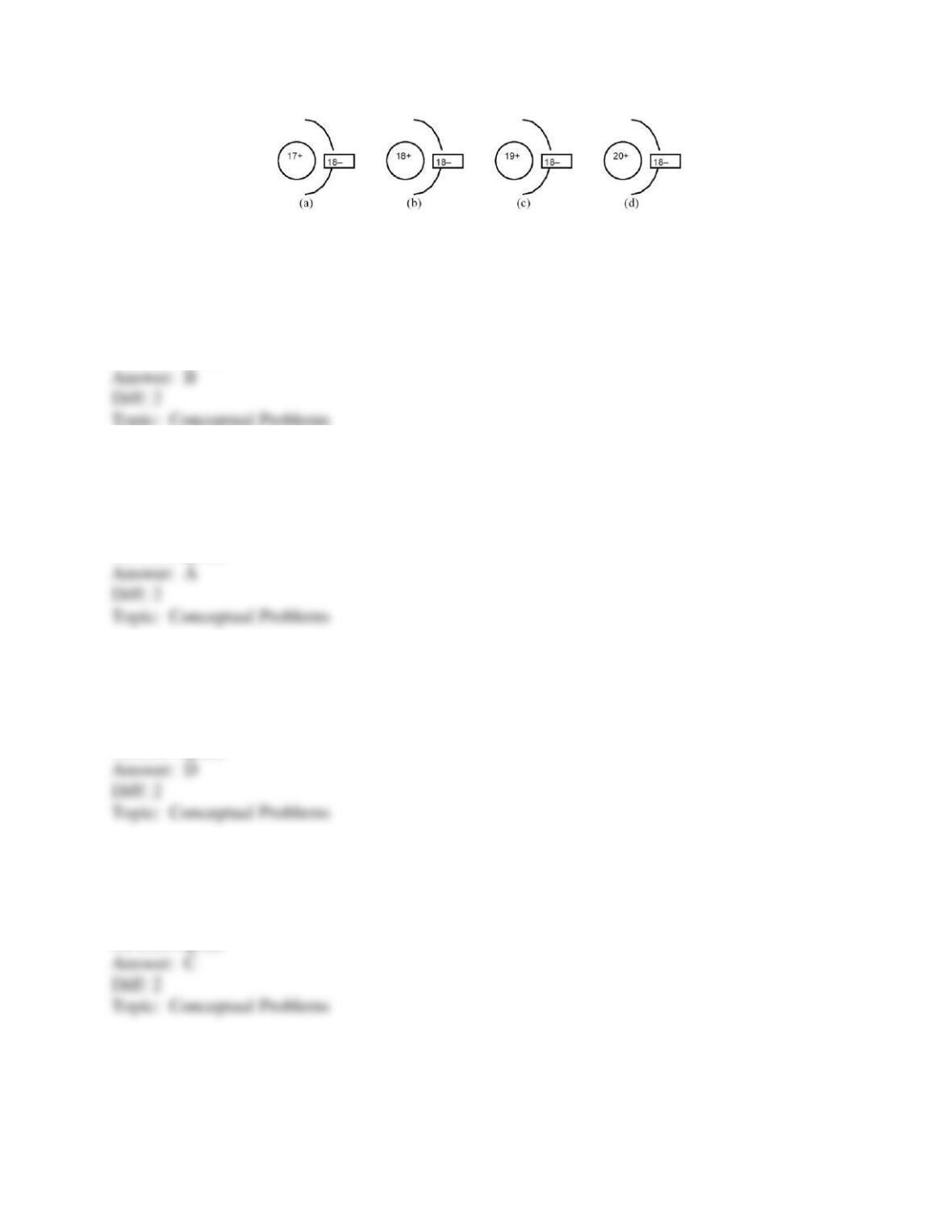
117) Which of the above drawings represents an Ar atom?
A) drawing (a)
B) drawing (b)
C) drawing (c)
D) drawing (d)
118) Which of the above drawings represents a Cl– ion?
A) drawing (a)
B) drawing (b)
C) drawing (c)
D) drawing (d)
119) Which of the above drawings represents a Ca2+ ion?
A) drawing (a)
B) drawing (b)
C) drawing (c)
D) drawing (d)
120) Which of the above drawings represents a K+ ion?
A) drawing (a)
B) drawing (b)
C) drawing (c)
D) drawing (d)
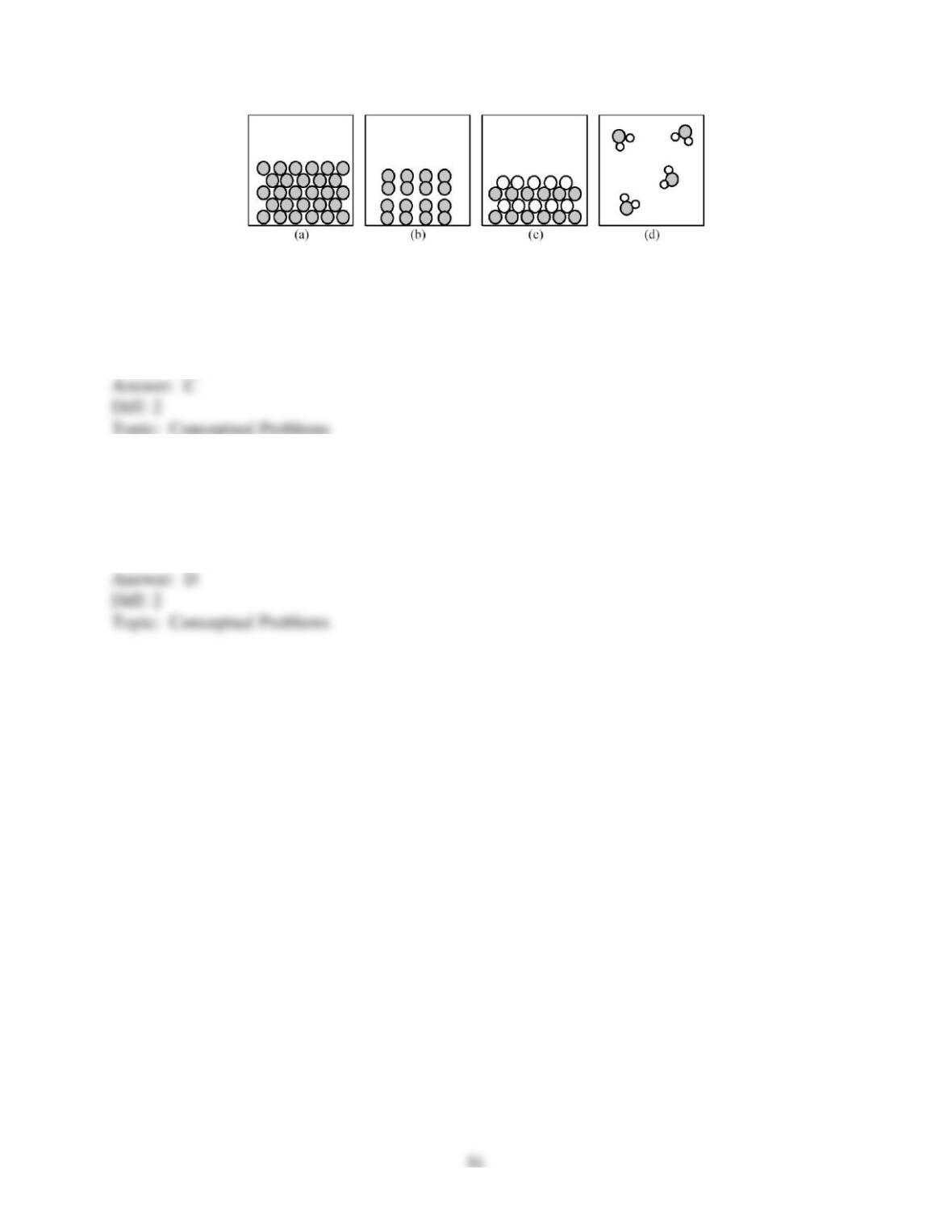
121) Which of the above pictures best represents a solid ionic compound?
A) picture (a)
B) picture (b)
C) picture (c)
D) picture (d)
122) Which of the above pictures best represents a gaseous covalent compound?
A) picture (a)
B) picture (b)
C) picture (c)
D) picture (d)
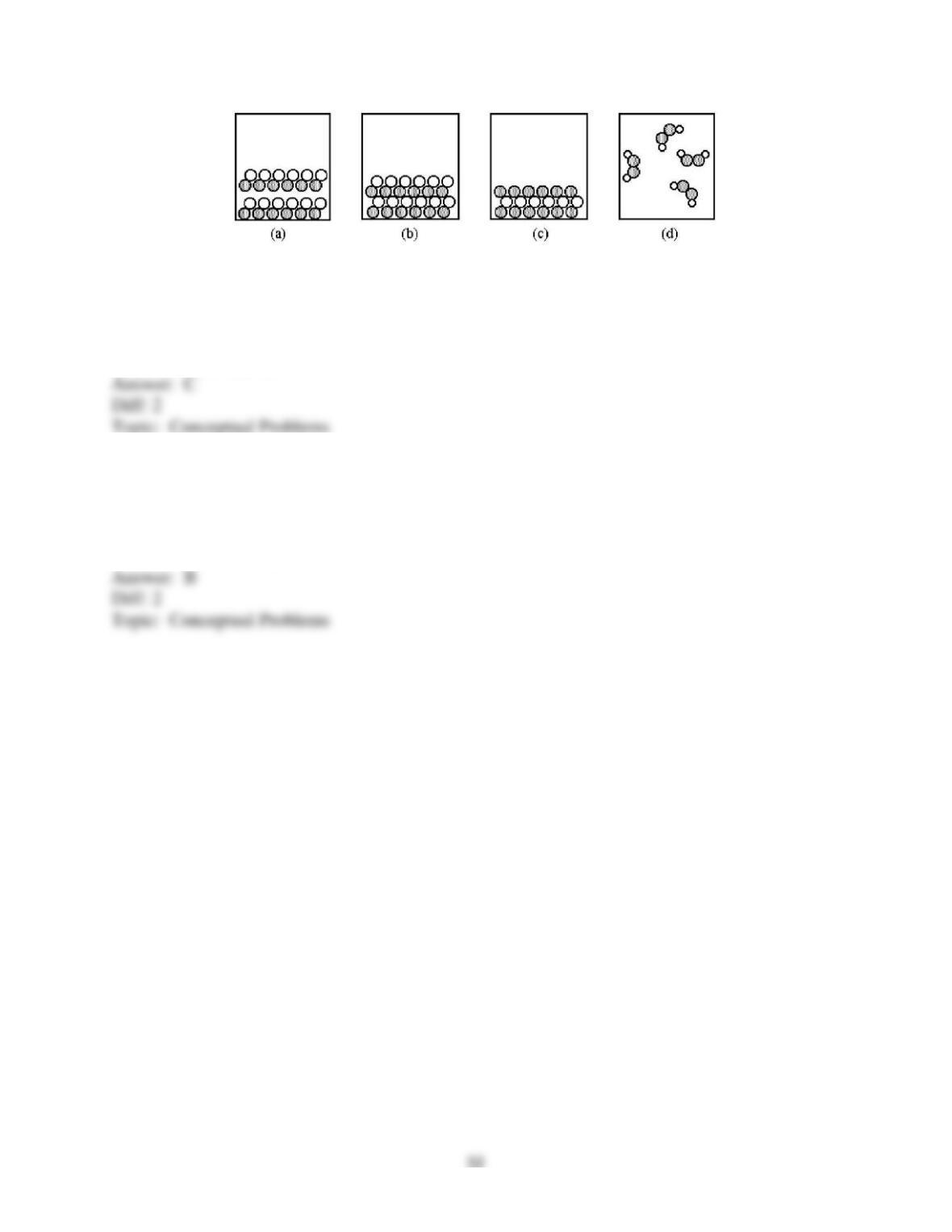
123) Which of the above pictures are more likely to represent ionic compounds?
A) pictures (a) and (b)
B) pictures (a) and (d)
C) pictures (b) and (c)
D) pictures (b) and (d)
124) Which of the above pictures are more likely to represent covalent compounds?
A) pictures (a) and (b)
B) pictures (a) and (d)
C) pictures (b) and (c)
D) pictures (b) and (d)
33
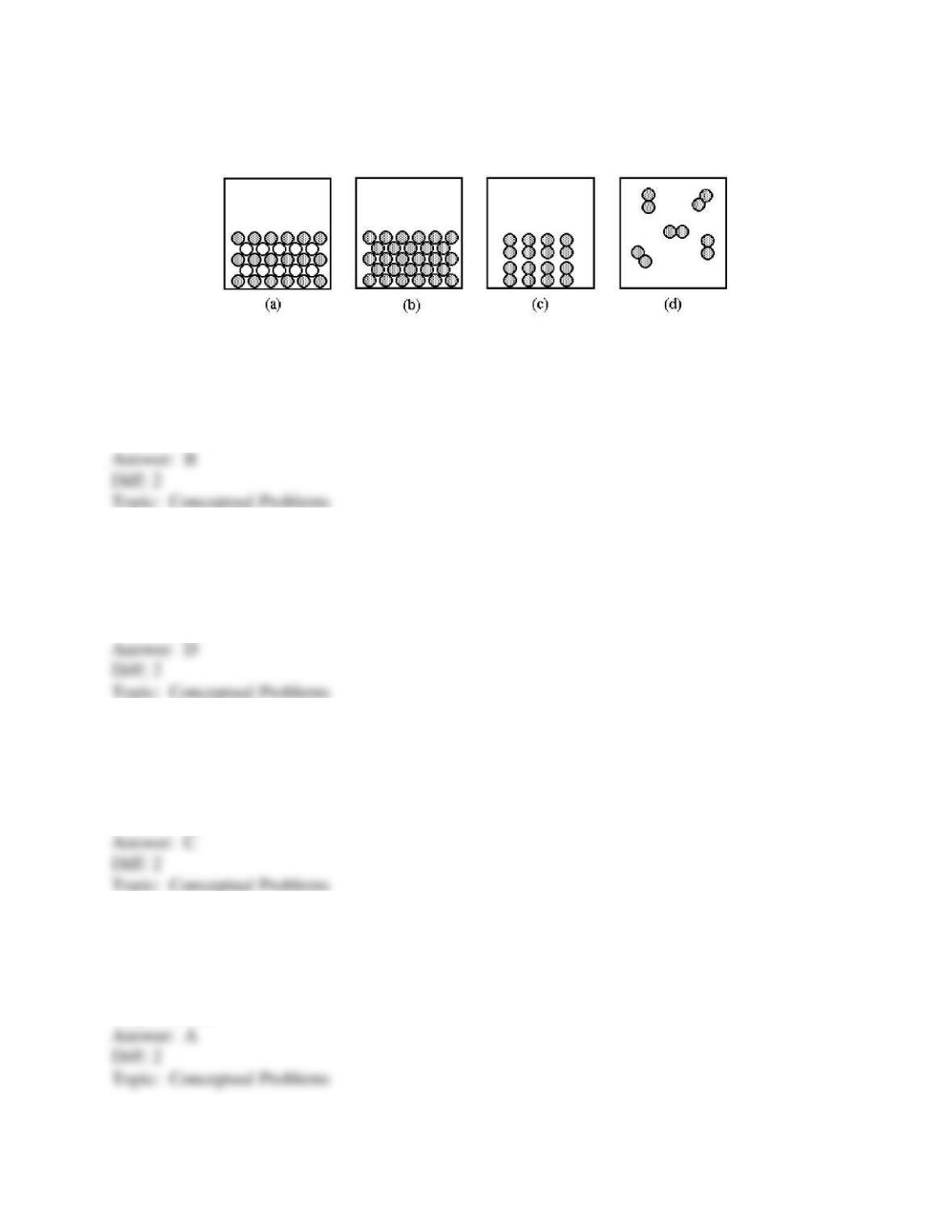
Each of the pictures (a)-(d) represents one of the following substances at 25°C: potassium,
fluorine, iodine, potassium fluoride, not necessarily in that order.
125) Which picture corresponds to potassium?
A) picture (a)
B) picture (b)
C) picture (c)
D) picture (d)
126) Which picture corresponds to fluorine?
A) picture (a)
B) picture (b)
C) picture (c)
D) picture (d)
127) Which picture corresponds to iodine?
A) picture (a)
B) picture (b)
C) picture (c)
D) picture (d)
128) Which picture corresponds to potassium fluoride?
A) picture (a)
B) picture (b)
C) picture (c)
D) picture (d)
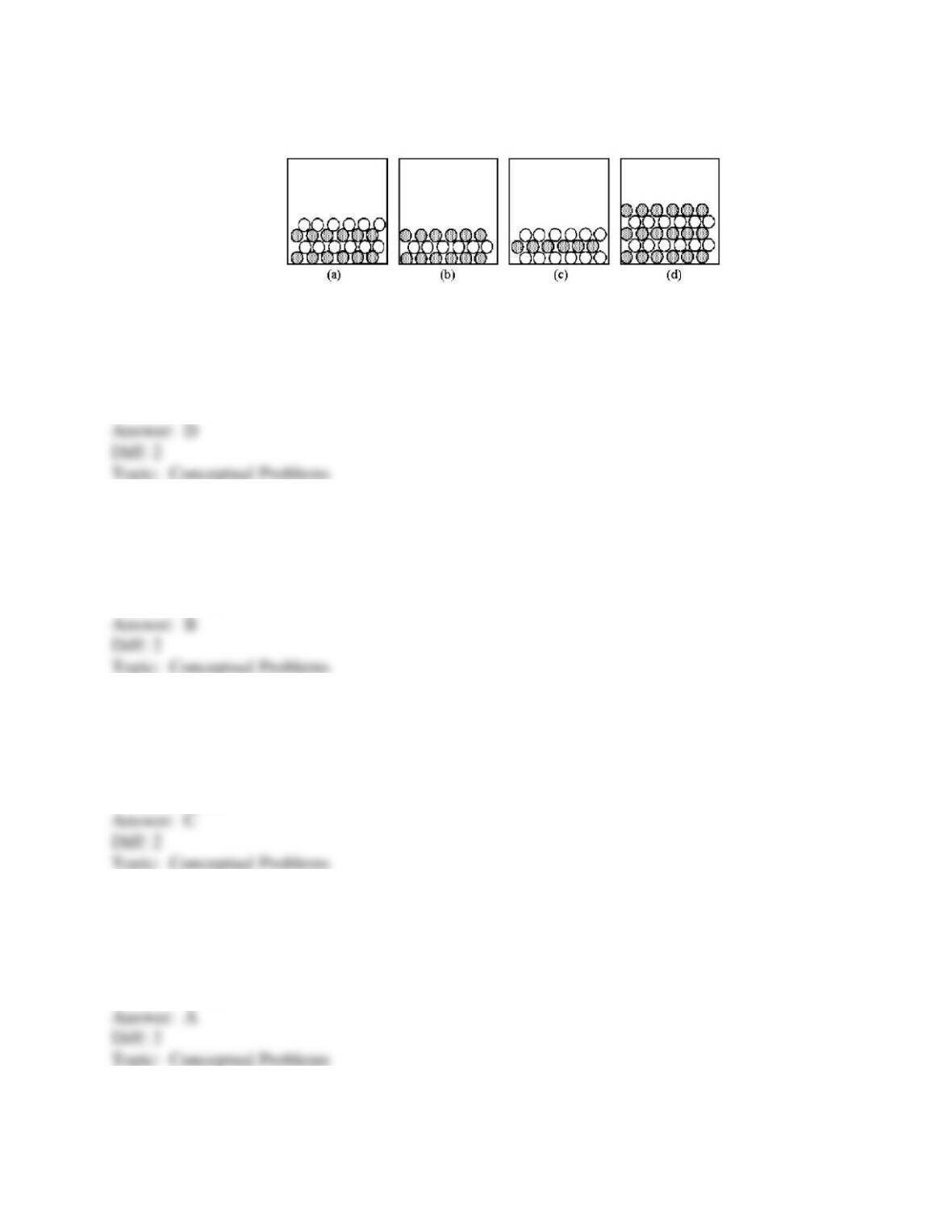
In the following drawings, shaded spheres represent cations and unshaded spheres represent
34
anions.
129) Which drawing represents the ionic compound Mg3(PO4)2?
A) drawing (a)
B) drawing (b)
C) drawing (c)
D) drawing (d)
130) Which drawing represents the ionic compound Na2CO3?
A) drawing (a)
B) drawing (b)
C) drawing (c)
D) drawing (d)
131) Which drawing represents the ionic compound CaCl2?
A) drawing (a)
B) drawing (b)
C) drawing (c)
D) drawing (d)
132) Which drawing represents the ionic compound KNO3?
A) drawing (a)
B) drawing (b)
C) drawing (c)
D) drawing (d)
133) Which drawing represents the ionic compound NH4ClO4?
A) drawing (a)
35
B) drawing (b)
C) drawing (c)
D) drawing (d)
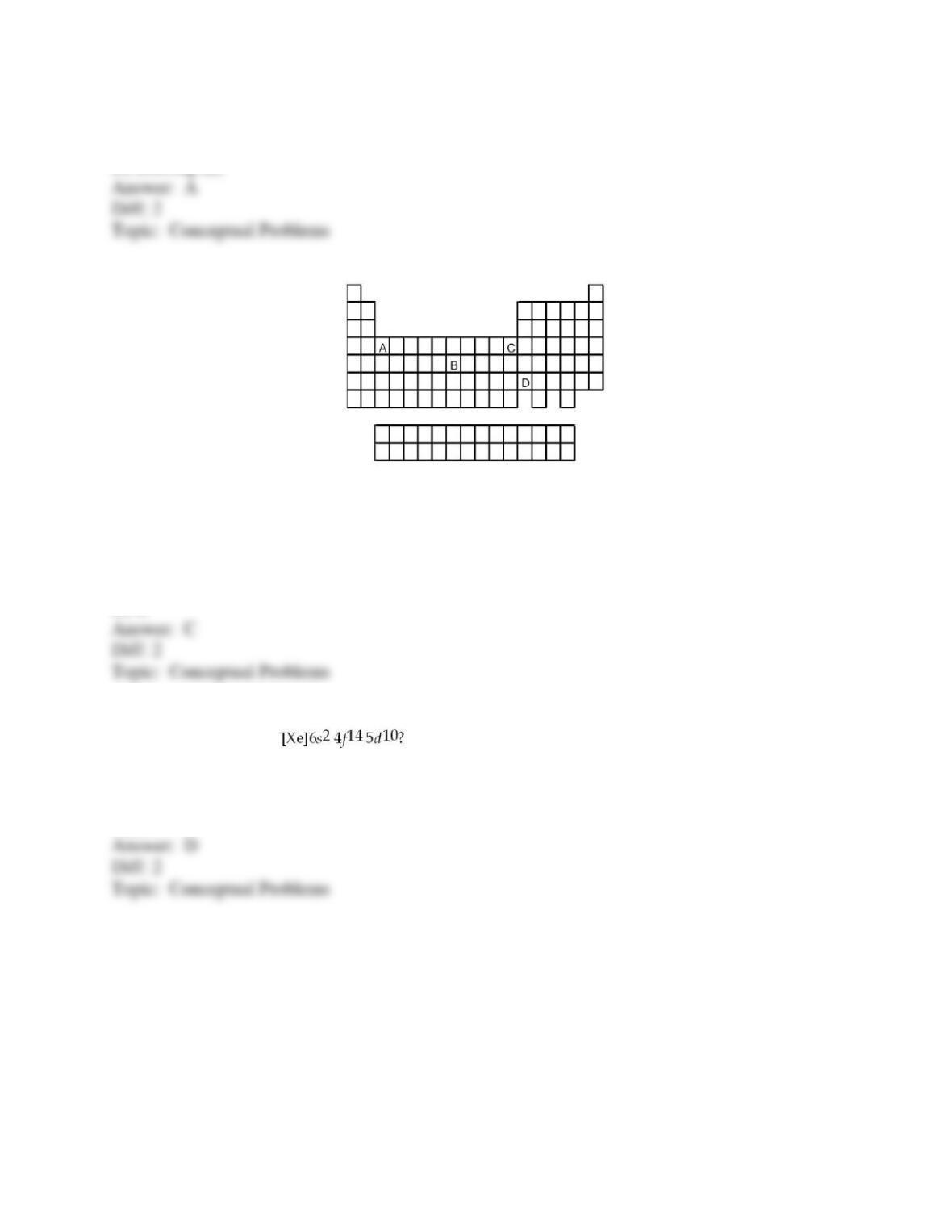
134) Which element, indicated by letter on the periodic table above, has a 2+ ion with the
electron configuration [Ar]3d10?
A) A
B) B
C) C
D) D
135) Which element, indicated by letter on the periodic table above, has a 1+ ion with the
electron configuration
A) A
B) B
C) C
D) D
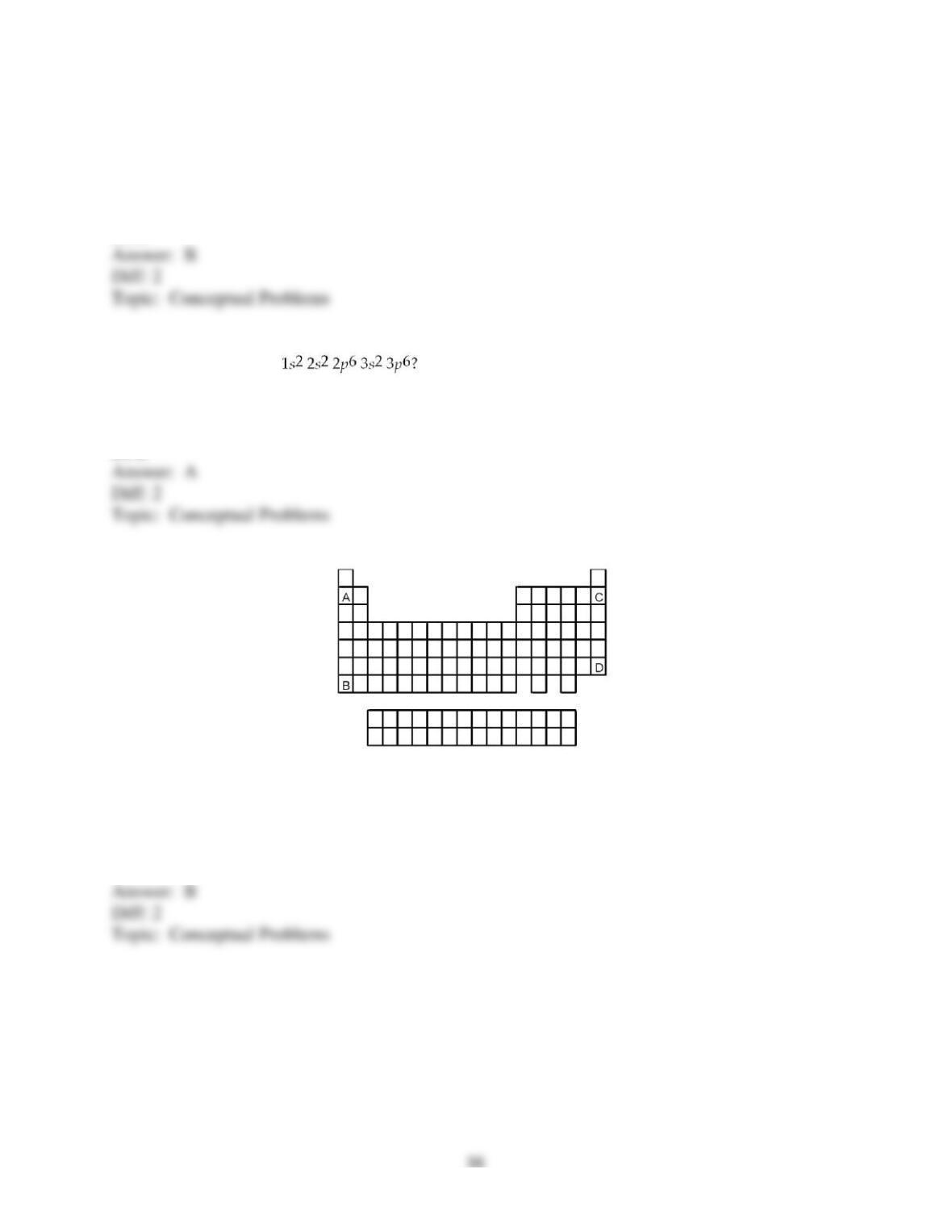
136) Which element, indicated by letter on the periodic table above, has a 3+ ion with the
electron configuration [Kr]4d5?
A) A
B) B
C) C
D) D
137) Which element, indicated by letter on the periodic table above, has a 3+ ion with the
electron configuration
A) A
B) B
C) C
D) D
138) Atoms of which element, indicated by letter on the periodic table, are expected to have the
largest atomic radius?
A) A
B) B
C) C
D) D
139) Atoms of which element, indicated by letter on the periodic table, is expected to have the
smallest atomic radius?
A) A
B) B
C) C
D) D
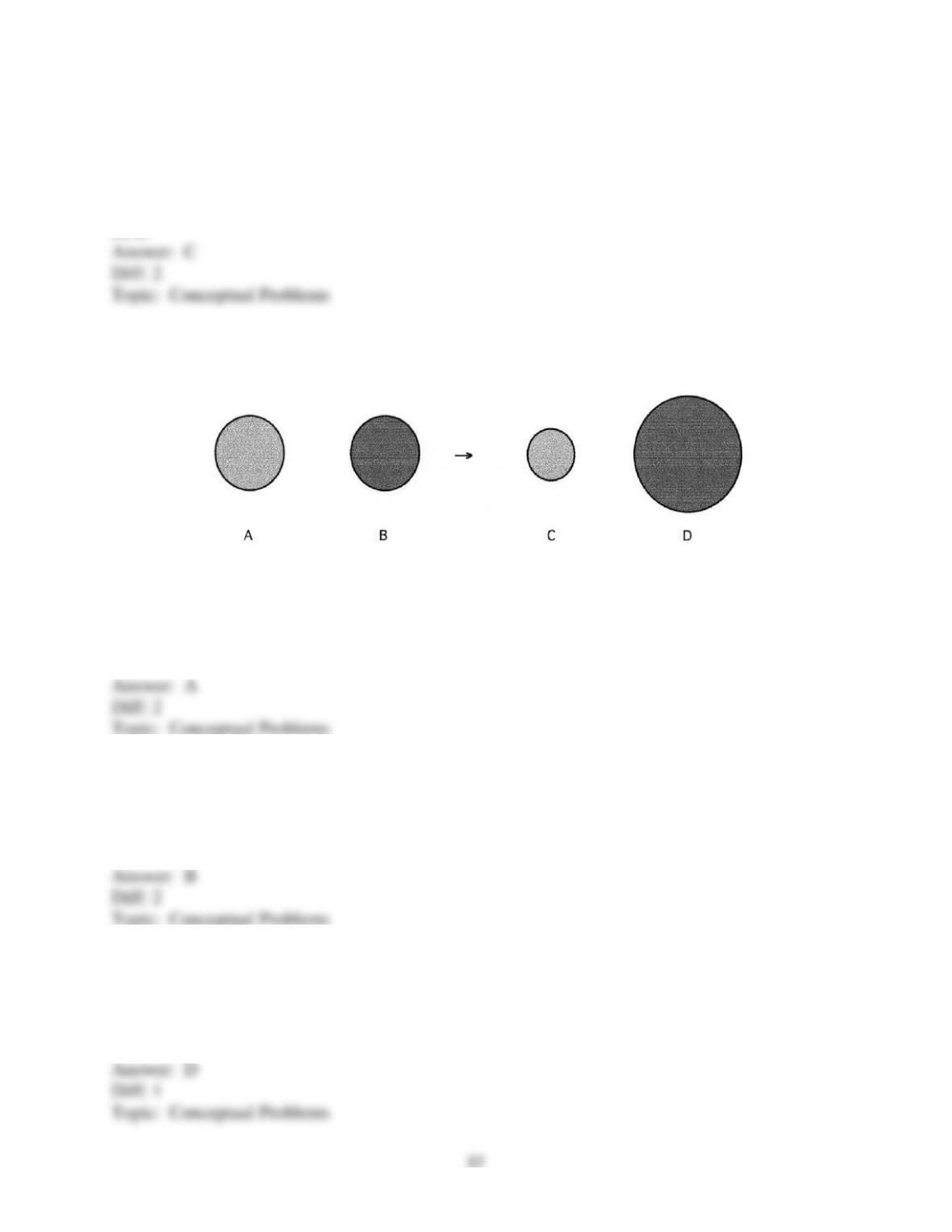
The following four spheres represent a metal atom, a nonmetal atom, a monatomic anion and a
monatomic cation, not necessarily in that order.
140) In the reaction shown, which sphere most likely represents the metal atom?
A) A
B) B
C) C
D) D
141) In the reaction shown, which sphere most likely represents the nonmetal atom?
A) A
B) B
C) C
D) D
142) In the reaction shown, which sphere most likely represents the monatomic anion?
A) A
B) B
C) C
D) D
38
143) In the reaction shown, which sphere most likely represents the monatomic cation?
A) A
B) B
C) C
D) D
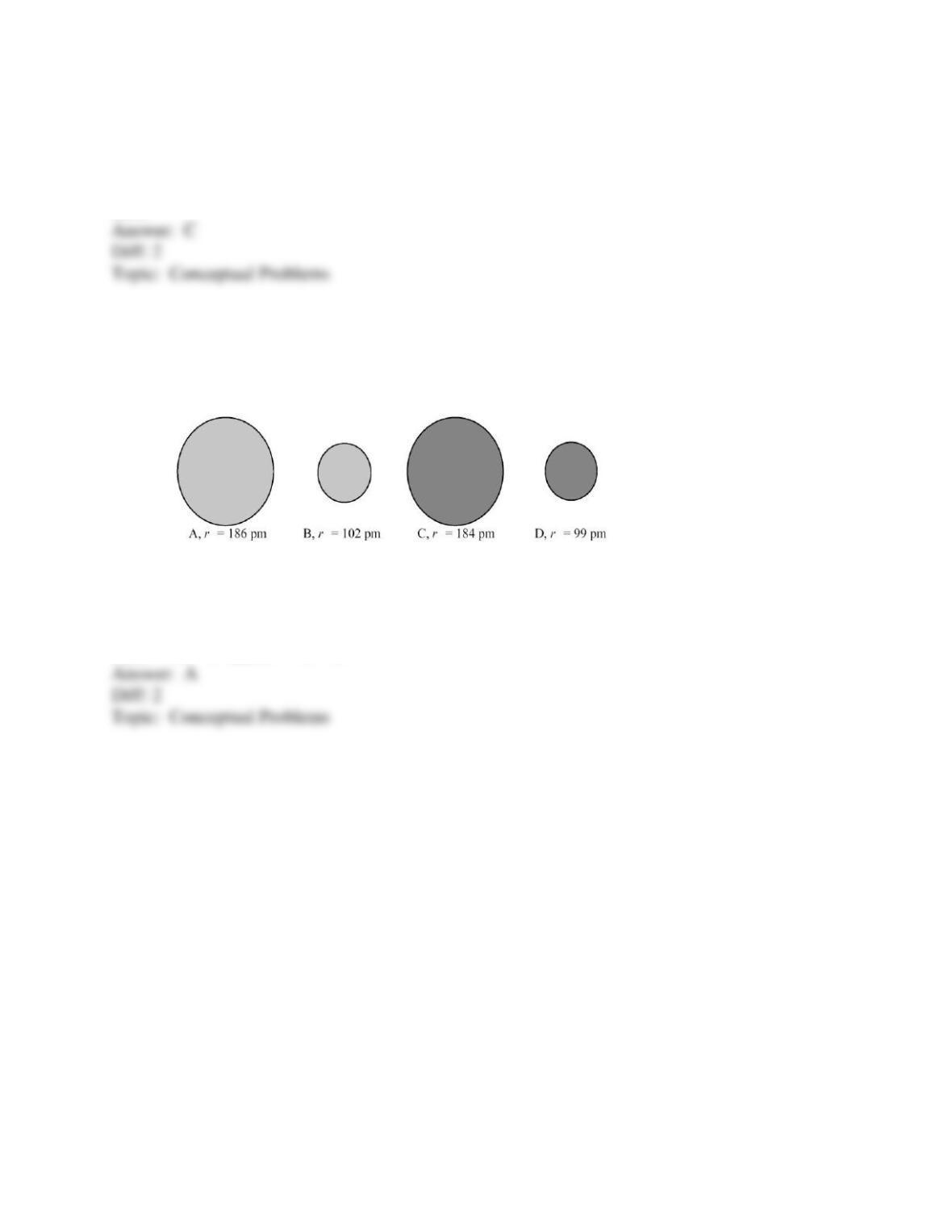
144) The following four spheres represent a Na atom, a Na+ ion, a Cl atom, and a Cl– ion, not
necessarily in that order. Use your knowledge about the relative sizes of atoms, cations, and
anions to determine which of the following sets of reactions is most consistent with the sizes of
the atoms and ions shown below.
A) A → B + e– and C → D + e–
B) A → B + e– and D → C + e–
C) B → A + e– and C → D + e–
D) B → A + e– and D → C + e–