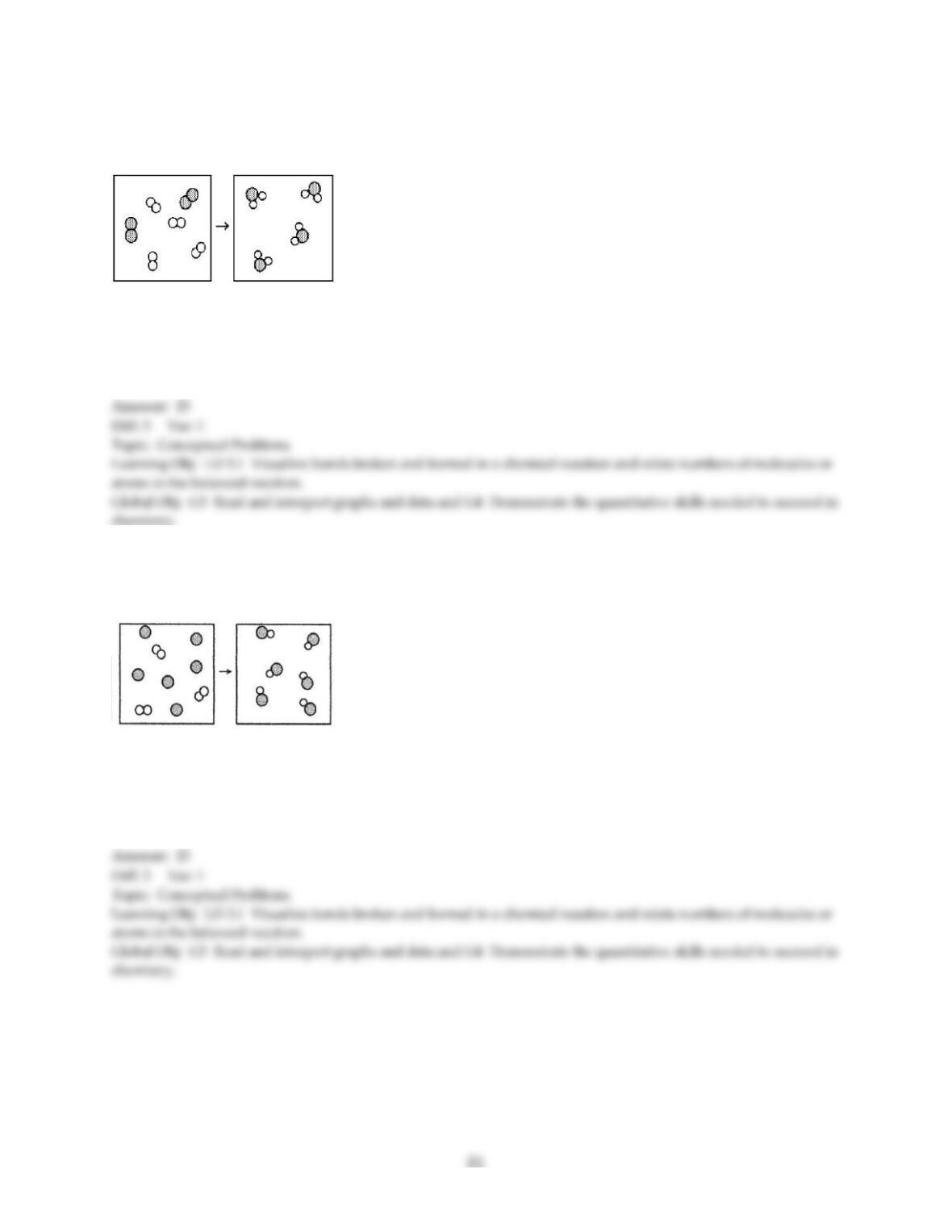
66) What is the balanced chemical equation for the reaction of element A (unshaded spheres) with
element B (shaded spheres) as represented below?
A) A + B → AB
B) 4A + 2B → 4AB
C) A2 + B2 → A2B
D) 2A2 + B2 → 2A2B
67) What is the balanced chemical equation for the reaction of element A (unshaded spheres) with
element B (shaded spheres) as represented below?
A) A + B → AB
B) A + 3B → 3AB
C) A2 + B → AB
D) A2 + 2B → 2AB
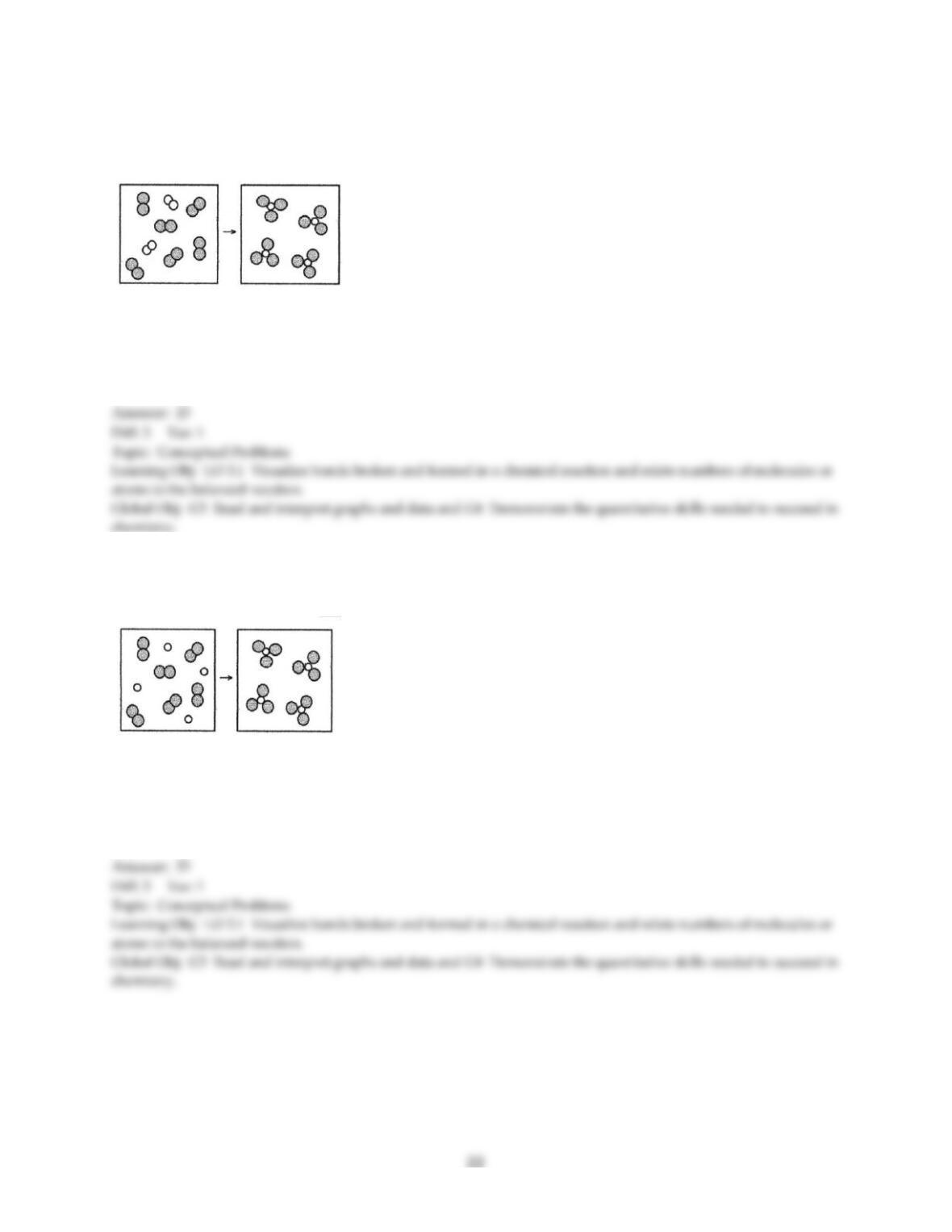
68) What is the balanced chemical equation for the reaction of element A (unshaded spheres) with
element B (shaded spheres) as represented below?
A) A + B → AB
B) A + 3B → 2AB
C) A2 + B2 → AB3
D) A2 + 3B2 → 2AB3
69) What is the balanced chemical equation for the reaction of element A (unshaded spheres) with
element B (shaded spheres) as represented below?
A) A + B → AB
B) 2A + 3B → 2AB
C) A + B2 → AB3
D) 2A + 3B2 → 2AB3
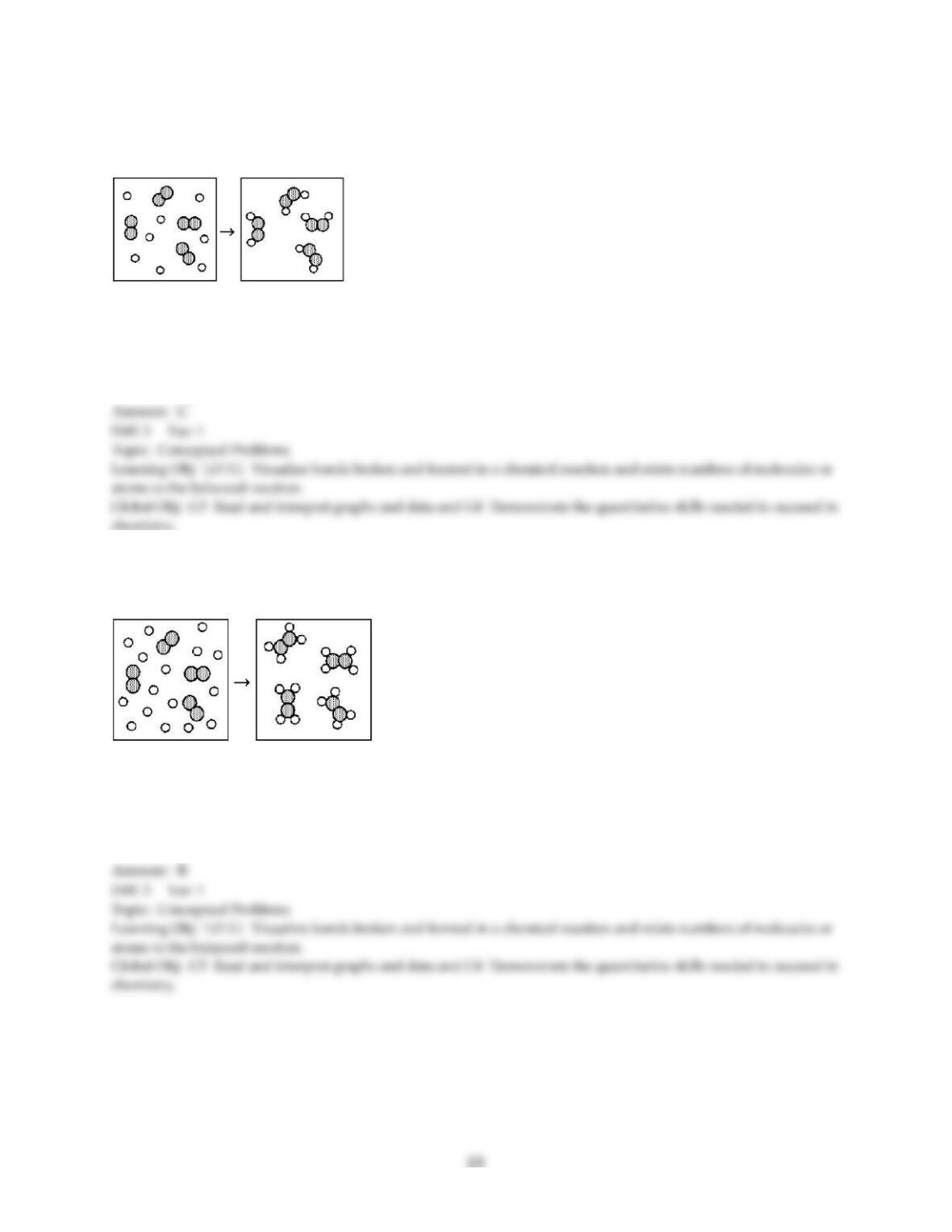
70) Reaction of A (unshaded spheres) with B2 (shaded spheres) is shown schematically in the following
diagram. Which equation best describes the stoichiometry of the reaction?
A) A2 + 2 B → A2B2
B) 8 A + 4 B2 → 4 A2B2
C) 2 A + B2 → A2B2
D) 4 A + 4 B2 → 4 A2B2
71) Reaction of A (unshaded spheres) with B2 (shaded spheres) is shown schematically in the following
diagram. Which equation best describes the stoichiometry of the reaction?
A) 4 A + B2 → 8 A2B
B) 4 A + B2 → A4B2
C) 16 A + 4 B2 → 8 A2B
D) 16 A + 4 B2 → 4 A4B2
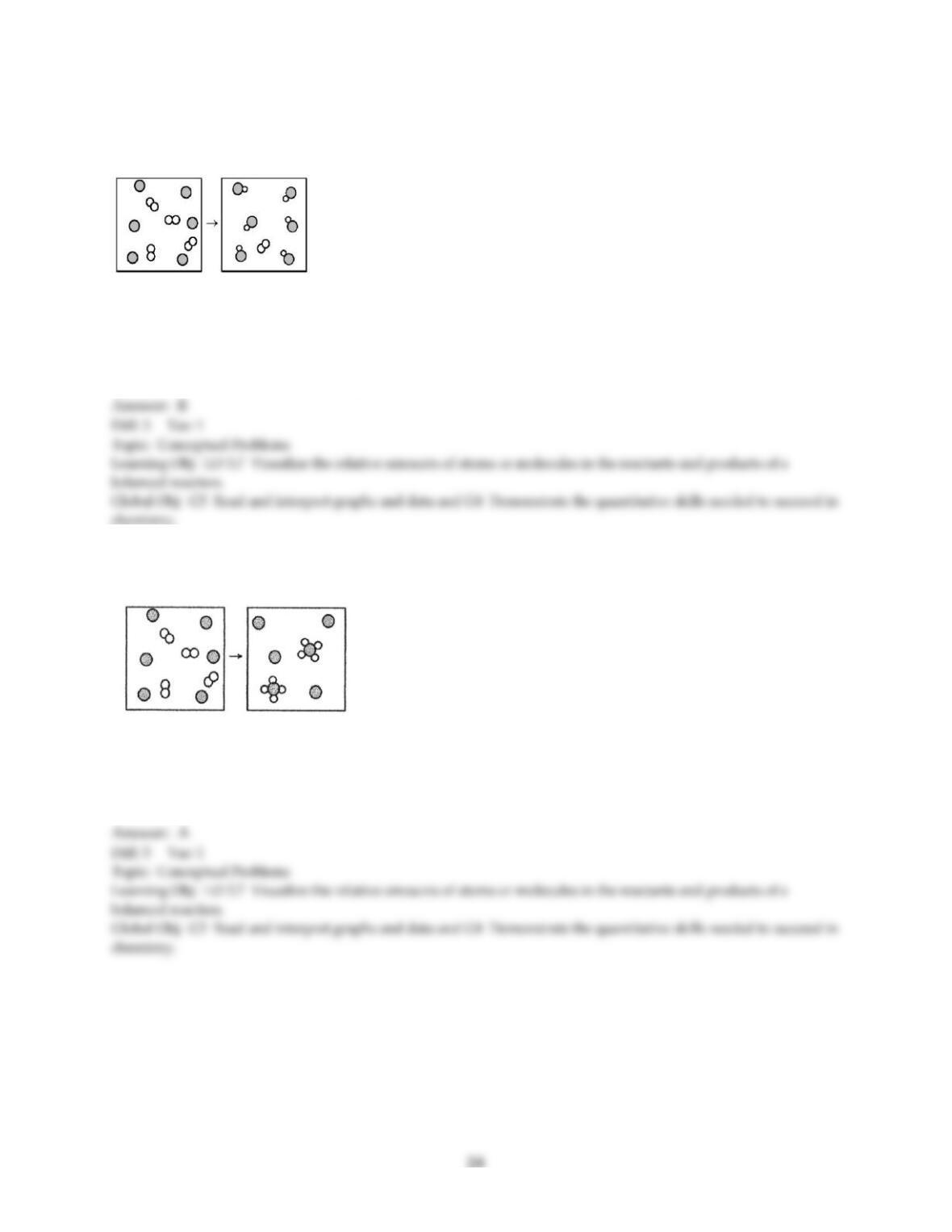
72) The following diagram represents the reaction of A (unshaded spheres) with B (shaded spheres).
What is the balanced chemical equation for this reaction, and what is the limiting reactant?
A) A2 + 2B → 2AB; A2 is the limiting reactant.
B) A2 + 2B → 2AB; B is the limiting reactant.
C) 4A2 + 6B → 6AB; A2 is the limiting reactant.
D) 4A2 + 6B → 6AB; B is the limiting reactant.
73) The following diagram represents the reaction of A2 (unshaded spheres) with B (shaded spheres).
What is the balanced chemical equation for this reaction, and what is the limiting reactant?
A) 2A2 + B → A4B; A2 is the limiting reactant.
B) 2A2 + B → A4B; B is the limiting reactant.
C) 4A2 + 6B → 2A4B; A2 is the limiting reactant.
D) 4A2 + 6B → 2A4B; B is the limiting reactant.
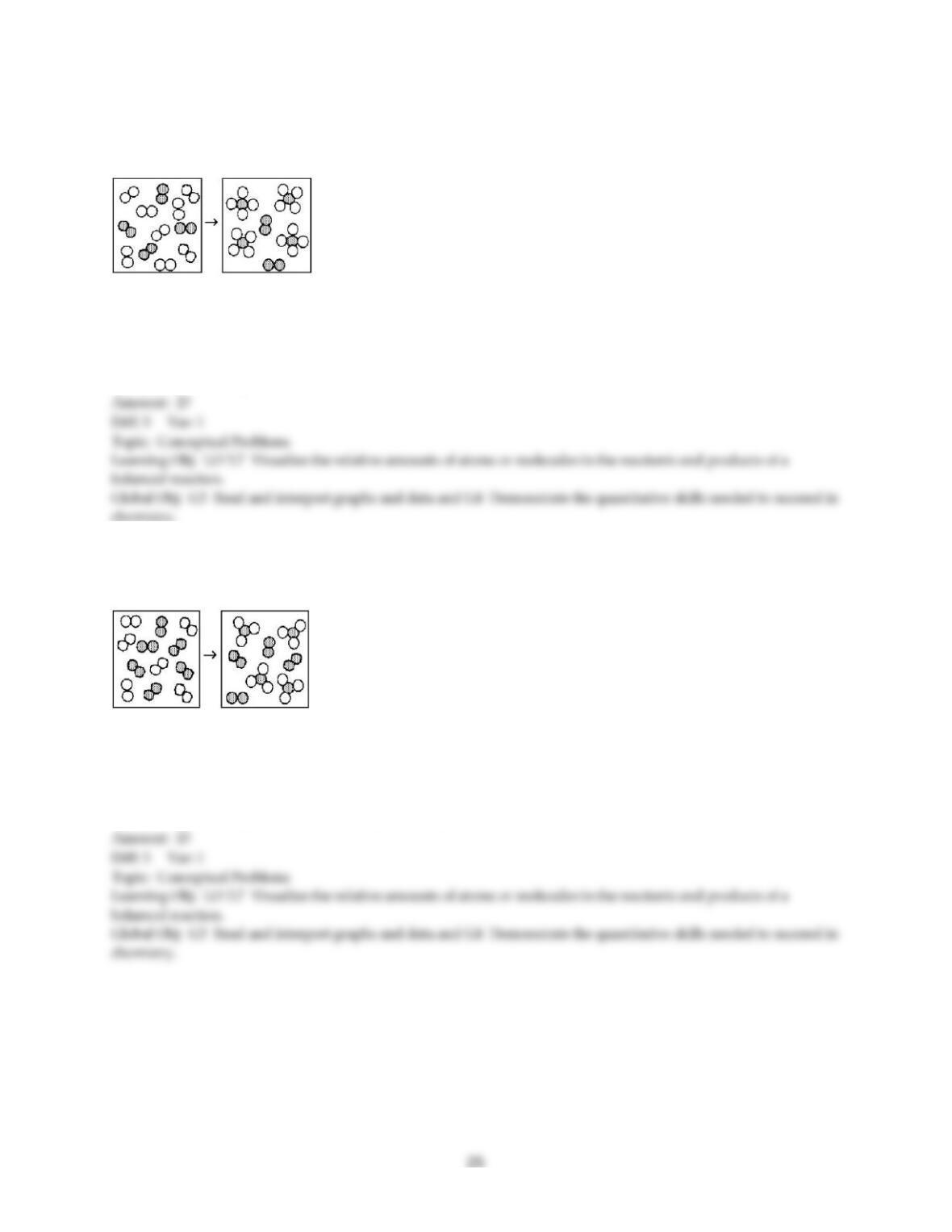
74) The following diagrams represent the reaction of A2 (shaded spheres) with B2 (unshaded spheres).
Identify the limiting reactant and write a balanced equation for the reaction.
A) A2 is the limiting reactant; A + 4 B → AB4.
B) A2 is the limiting reactant; A2 + 4 B2 → 2 AB4.
C) B2 is the limiting reactant; A + 4 B → AB4.
D) B2 is the limiting reactant; A2 + 4 B2 → 2 AB4.
75) The following diagrams represent the reaction of A2 (shaded spheres) with B2 (unshaded spheres).
Identify the limiting reactant and write a balanced equation for the reaction.
A) A2 is the limiting reactant; A + 3 B → AB3.
B) A2 is the limiting reactant; A2 + 3 B2 → 2 AB3.
C) B2 is the limiting reactant; A + 3 B → AB3.
D) B2 is the limiting reactant; A2 + 3 B2 → 2 AB3.
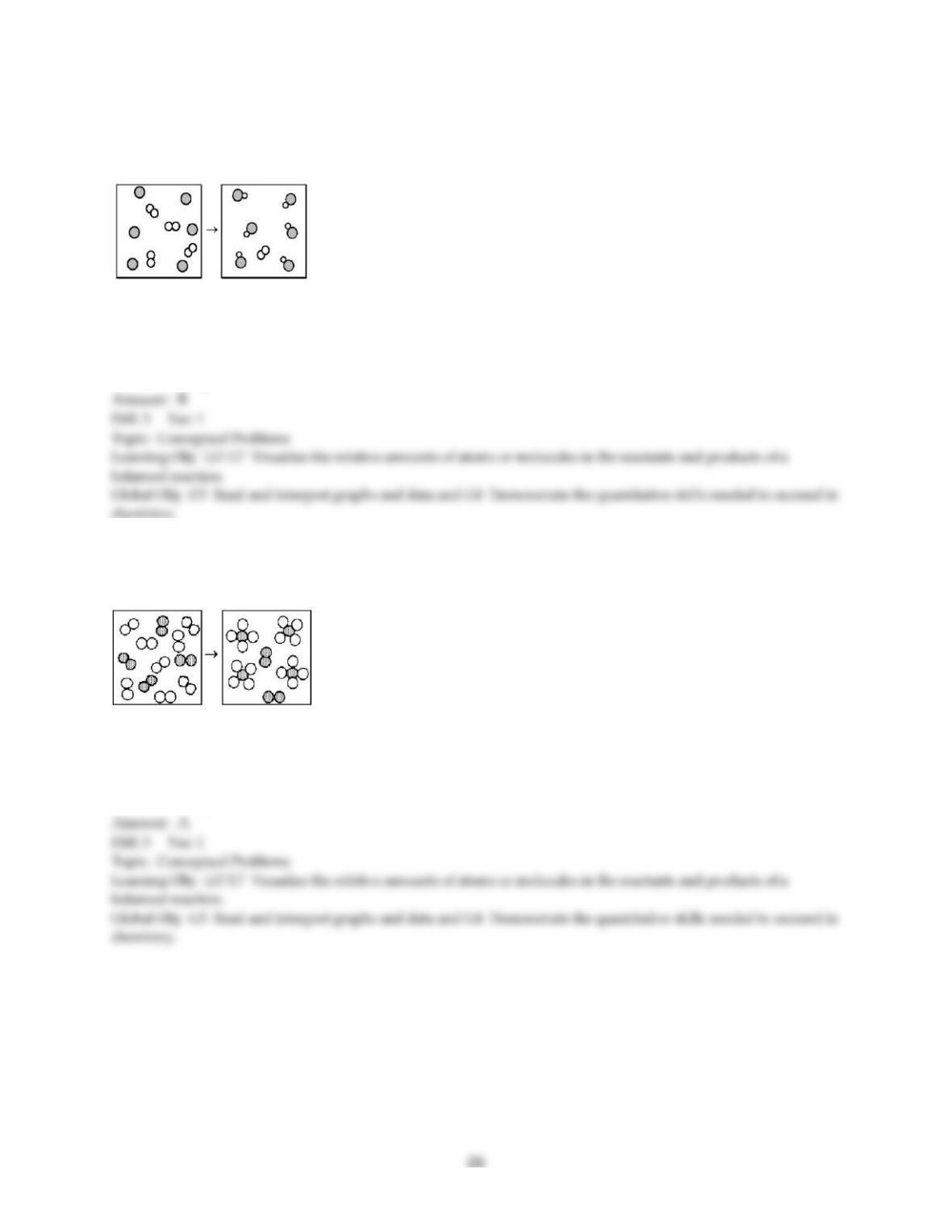
76) The following diagram represents the reaction of A2 (unshaded spheres) with B (shaded spheres).
How many moles of product can be produced from the reaction of 1.0 mol of A2 and 1.0 mol of B?
A) 0.5 mol of product
B) 1.0 mol of product
C) 3.0 mol of product
D) 6.0 mol of product
77) The following diagram represents the reaction of A2 (unshaded spheres) with B2 (shaded spheres).
How many moles of product can be produced from the reaction of 1.0 mol of A2 and 1.0 mol of B2?
A) 0.5 mol of product
B) 1.0 mol of product
C) 2.0 mol of product
D) 4.0 mol of product
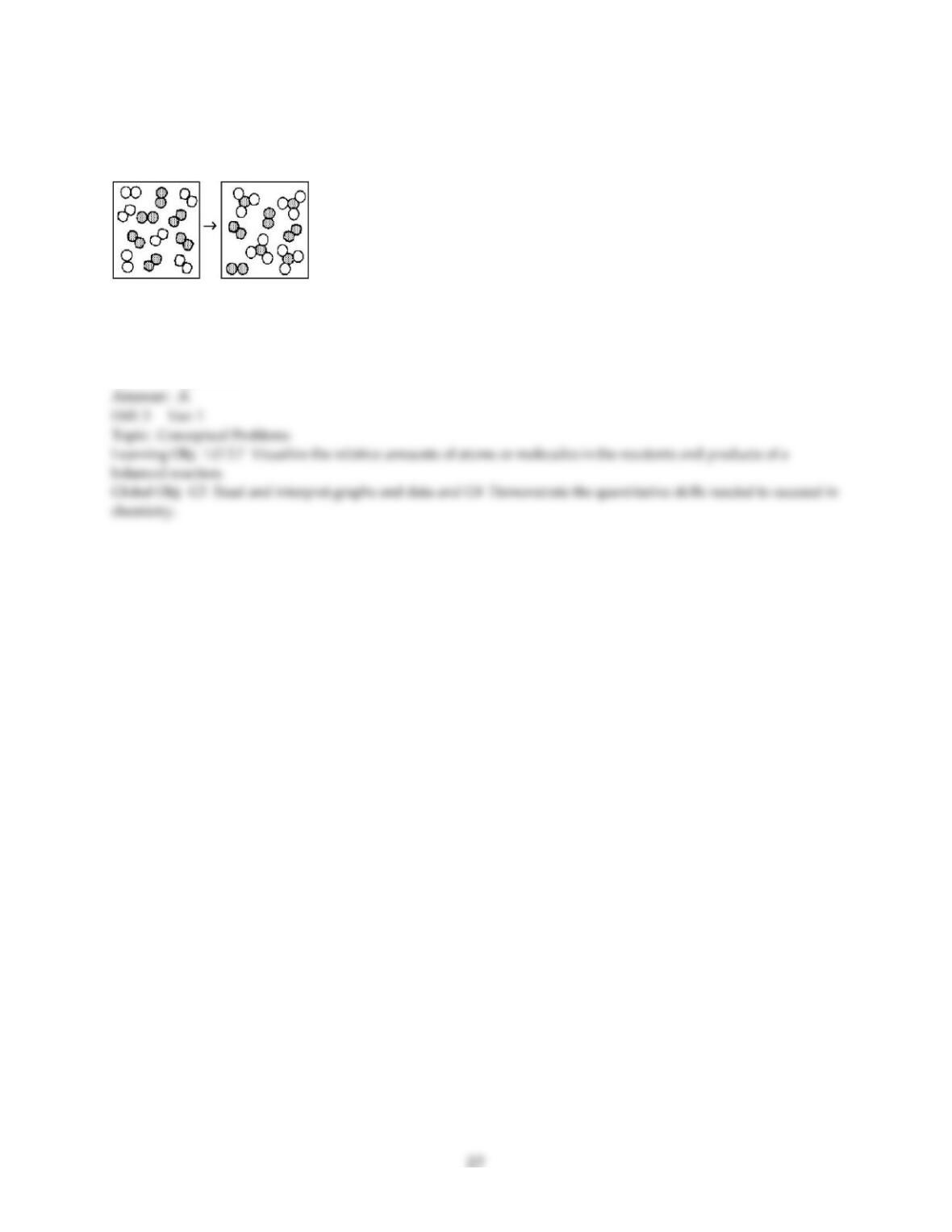
78) The following diagrams represent the reaction of A2 (shaded spheres) with B2 (unshaded spheres).
How many moles of product can be made from 1.0 mol of A2 and 1.0 mol of B2?
A) 0.67 mol product
B) 1.0 mol product
C) 2.0 mol product
D) 3.0 mol product
3.2 Algorithmic Questions
1) What is the stoichiometric coefficient for oxygen when the following equation is balanced using the
lowest whole-number coefficients?
________ C3H6O2(l) + ________ O2(g) → ________ CO2(g) + ________ H2O(l)
A) 1
B) 3
C) 5
D) 7
2) Aluminum metal reacts with aqueous copper(II) sulfate to form aqueous aluminum sulfate and copper
metal. What is the stoichiometric coefficient for aluminum when the chemical equation is balanced using
the lowest whole-number stoichiometric coefficients?
A) 1
B) 2
C) 3
D) 4
3) Aluminum metal reacts with aqueous iron(II) chloride to form aqueous aluminum chloride and iron
metal. What is the stoichiometric coefficient for iron when the chemical equation is balanced using the
lowest whole-number stoichiometric coefficients?
A) 0
B) 3
C) 5
D) 8
4) Strontium phosphate reacts with sulfuric acid to form strontium sulfate and phosphoric acid. What is
the coefficient for sulfuric acid when the equation is balanced using the lowest whole-numbered
coefficients?
A) 1
B) 2
C) 3
D) none of these
5) What is the stoichiometric coefficient for water when the following equation is balanced using the
lowest whole-number coefficients?
________ C3H8O(l) + ________ O2(g) → ________ CO2(g) + ________ H2O(l)
A) 3
B) 7
C) 6
D) 8
6) What is the molar mass of nitrogen gas?
A) 14.0 g/mol
B) 28.0 g/mol
C) 6.02 × 10²³ g/mol
D) 1.20 × 10²³ g/mol
7) What is the mass of a single astatine molecule, At2?
A) 3.49 × 10⁻²² g
B) 6.97 × 10⁻²² g
C) 210 g
D) 420 g
8) What is the mass of 0.500 mol of carbon tetrafluoride, CF4?
A) 5.68 × 10⁻³ g
B) 44.0 g
C) 88.0 g
D) 176 g
9) How many moles are there in 4.00 g of ethanol, CH3CH2OH?
A) 0.00543 mol
B) 0.0870 mol
C) 11.5 mol
D) 184 mol
10) How many Fe(II) ions are there in 5.00 g of FeSO4?
A) 5.46 × 10⁻²⁶ iron(II) ions
B) 1.98 × 10²² iron(II) ions
C) 1.83 × 1025 iron(II) ions
D) 4.58 × 1026 iron(II) ions
11) What is the mass of 9.00 × 10²² molecules of NH3?
A) 0.00878 g
B) 0.393 g
C) 2.55 g
D) 114 g
12) How many oxygen atoms are there in 6.00 g of sodium dichromate, Na2Cr2O7?
A) 0.160 oxygen atoms
B) 1.97 × 10²¹ oxygen atoms
C) 1.37 × 10²² oxygen atoms
D) 9.65 × 10²² oxygen atoms
13) How many chloride ions are there in 3.00 mol of aluminum chloride?
A) 3.00 chloride ions
B) 9.00 chloride ions
C) 1.81 × 1024 chloride ions
D) 5.42 × 1024 chloride ions
14) What is the molar mass of pentane if 4.18 × 10¹⁶ molecules of pentane weigh 5.00 μg?
A) 72.0 g/mol
B) 139 g/mol
C) 288 g/mol
D) 347 g/mol
15) What mass of ammonia, N H3, contains the same number of molecules as 3.00 g of
trichlorofluoromethane, CCl3F?
A) 0.0412 g
B) 0.371 g
C) 2.69 g
D) 24.2 g
16) What mass of sulfur hexafluoride, SF6, has the same number of fluorine atoms as 25.0 g of oxygen
difluoride, OF2?
A) 0.901 g
B) 8.33 g
C) 22.5 g
D) 203 g
17) How many anions are there in 4.50 g of MgBr2?
A) 1.47 × 10²² anions
B) 2.94 × 10²² anions
C) 2.46 × 1025 anions
D) 4.93 × 1025 anions
18) How many cations are there in 50.0 g of sodium phosphate?
A) 1.84 × 10²³ cations
B) 5.51 × 10²³ cations
C) 1.97 × 1024 cations
D) 5.92 × 1024 cations
19) Which of the following has the greatest mass?
A) 1.55 × 10²³ molecules of O2
B) 4.00 g of O2
C) 0.125 mol of O2
D) All of these have the same mass.
20) Which of the following has the smallest mass?
A) 1.40 × 1024 molecules of I2
B) 340. g of Cl2
C) 10.0 mol of F2
D) 0.200 kg of Br2
21) How many moles of CuO can be produced from 1.80 mol of Cu2O in the following reaction?
2 Cu2O(s) + O2(g) → 4 CuO(s)
A) 0.900 mol
B) 1.80 mol
C) 3.60 mol
D) 7.20 mol
22) How many moles of O2 react with 3.600 mol of Cu2O in the following reaction?
2 Cu2O(s) + O2(g) → 4 CuO(s)
A) 7.200 mol
B) 3.600 mol
C) 1.800 mol
D) 5.400 mol
23) How many moles of BCl3 are needed to produce 15.0 g of HCl(aq) in the following reaction?
BCl3(g) + 3 H2O(l) → 3 HCl(aq) + B(OH)3(aq)
A) 0.137 mol
B) 0.411 mol
C) 1.23 mol
D) 7.29 mol
24) How many moles of H2O are needed to produce 15.0 g of HCl(aq) in the following reaction?
BCl3(g) + 3 H2O(l) → 3 HCl(aq) + B(OH)3(aq)
A) 0.412 mol
B) 0.137 mol
C) 5.0 mol
D) 35.0 mol
25) How many grams of calcium chloride are needed to produce 5.00 g of potassium chloride?
CaCl2(aq) + K2CO3(aq) → 2 KCl(aq) + CaCO3(aq)
A) 0.269 g
B) 3.72 g
C) 7.44 g
D) 14.9 g
26) Balance the chemical equation given below, and determine the number of moles of iodine that reacts
with 10.0 g of aluminum.
________ Al(s) + ________ I2(s) → ________ Al2I6(s)
A) 0.247 mol
B) 0.556 mol
C) 0.741 mol
D) 1.11 mol
27) Balance the chemical equation given below, and determine the number of grams of MgO are needed
to produce 25.0 g of Fe2O3.
________ MgO(s) + ________ Fe(s) → ________ Fe2O3(s) + ________ Mg(s)
A) 0.0528 g
B) 2.10 g
C) 6.31 g
D) 18.9 g