Divide using synthetic division.
41)
x5+x3– 5
x – 2
41)
A)
x4+ 2x3+ 5x2+ 10x + 20 +35
x – 2
B)
x4+ 3x2+1
x – 2
C)
x4+ 2x3+ 4x2+ 9x + 18 +31
x – 2
D)
x4+ 3 +1
x – 2
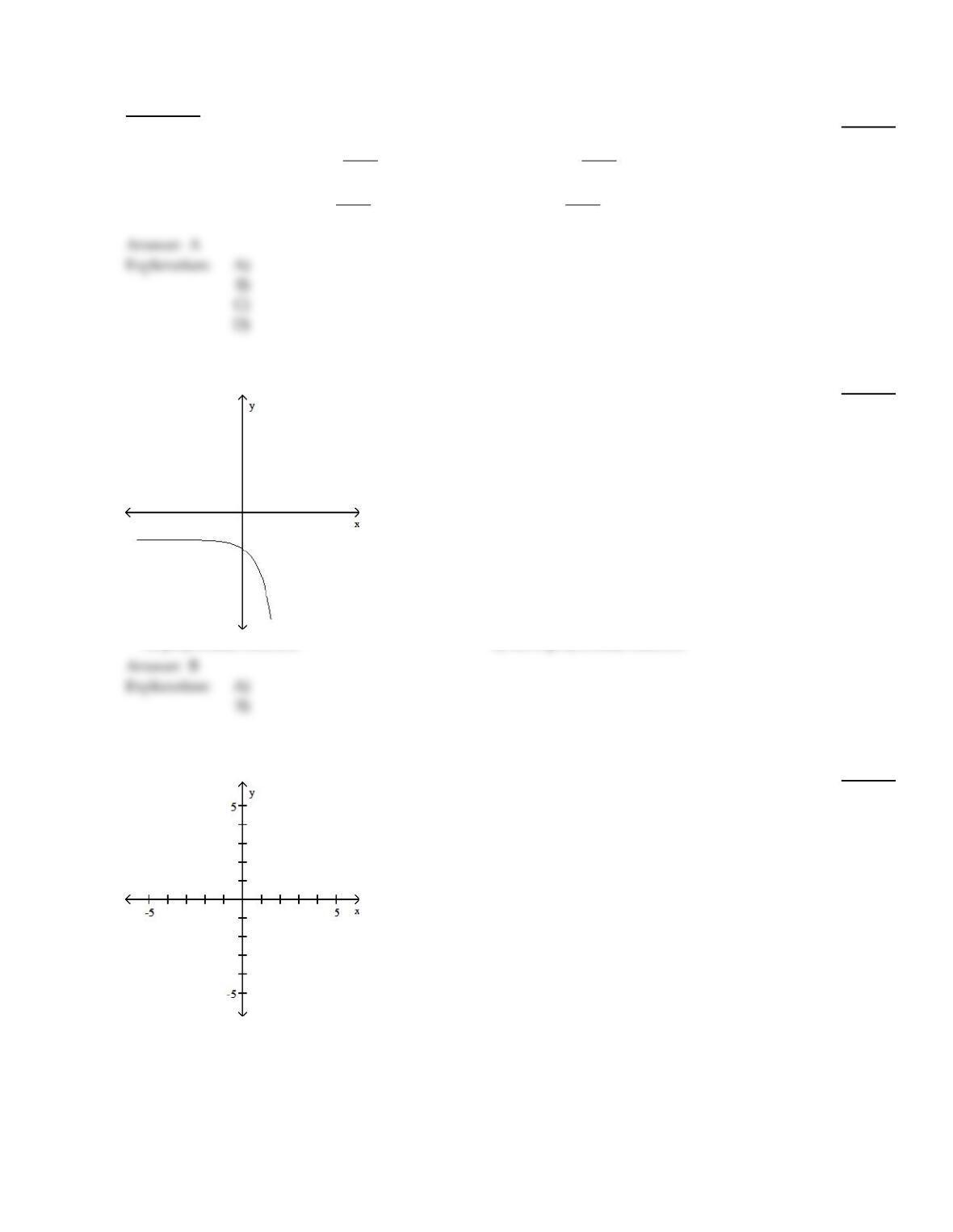
Determine whether the graph shown is the graph of a polynomial function.
42)
42)
A)
polynomial function
B)
not a polynomial function
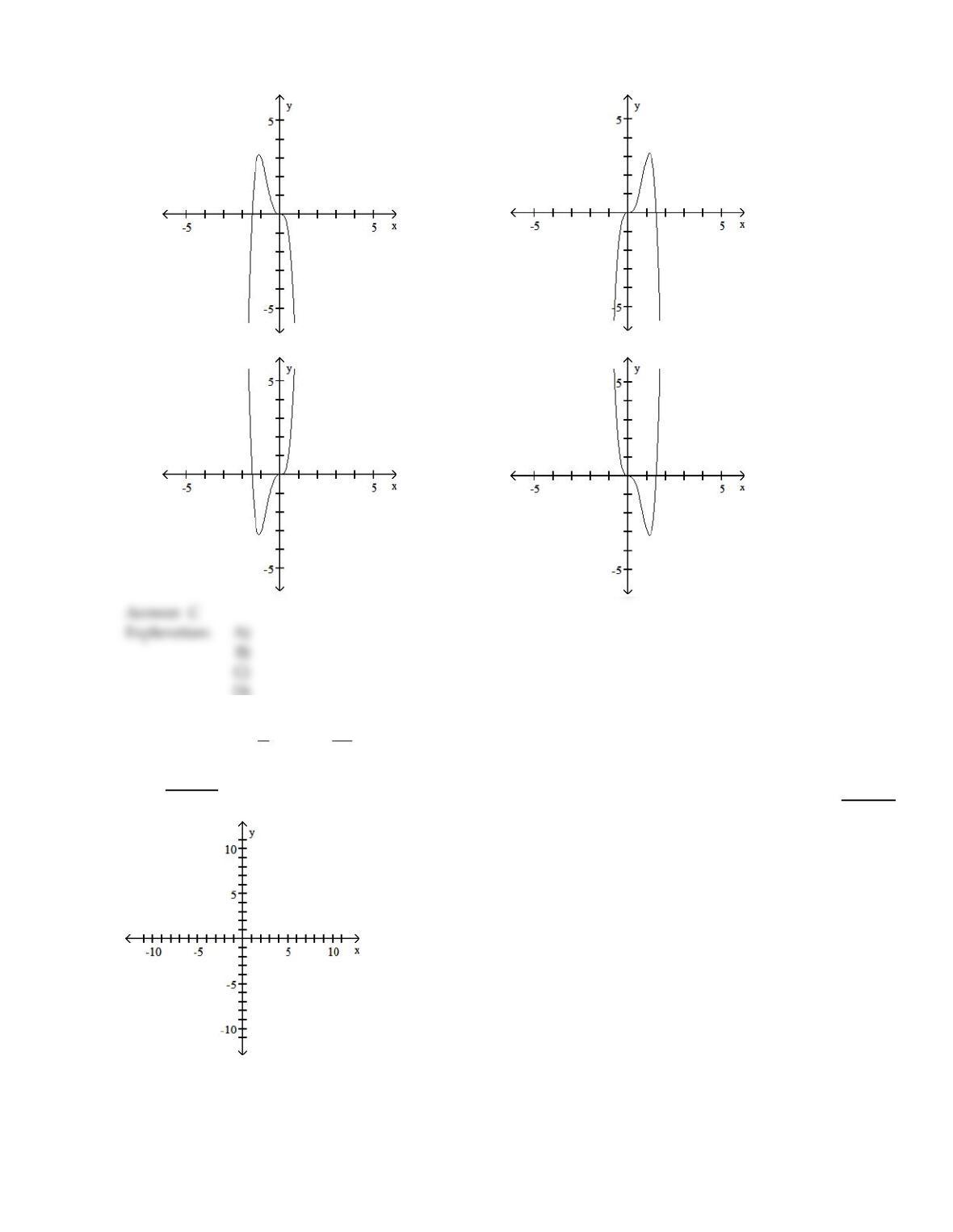
Graph the polynomial function.
43)
f(x) =6x4+ 9x3
43)
21
A)
B)
C)
D)
D)
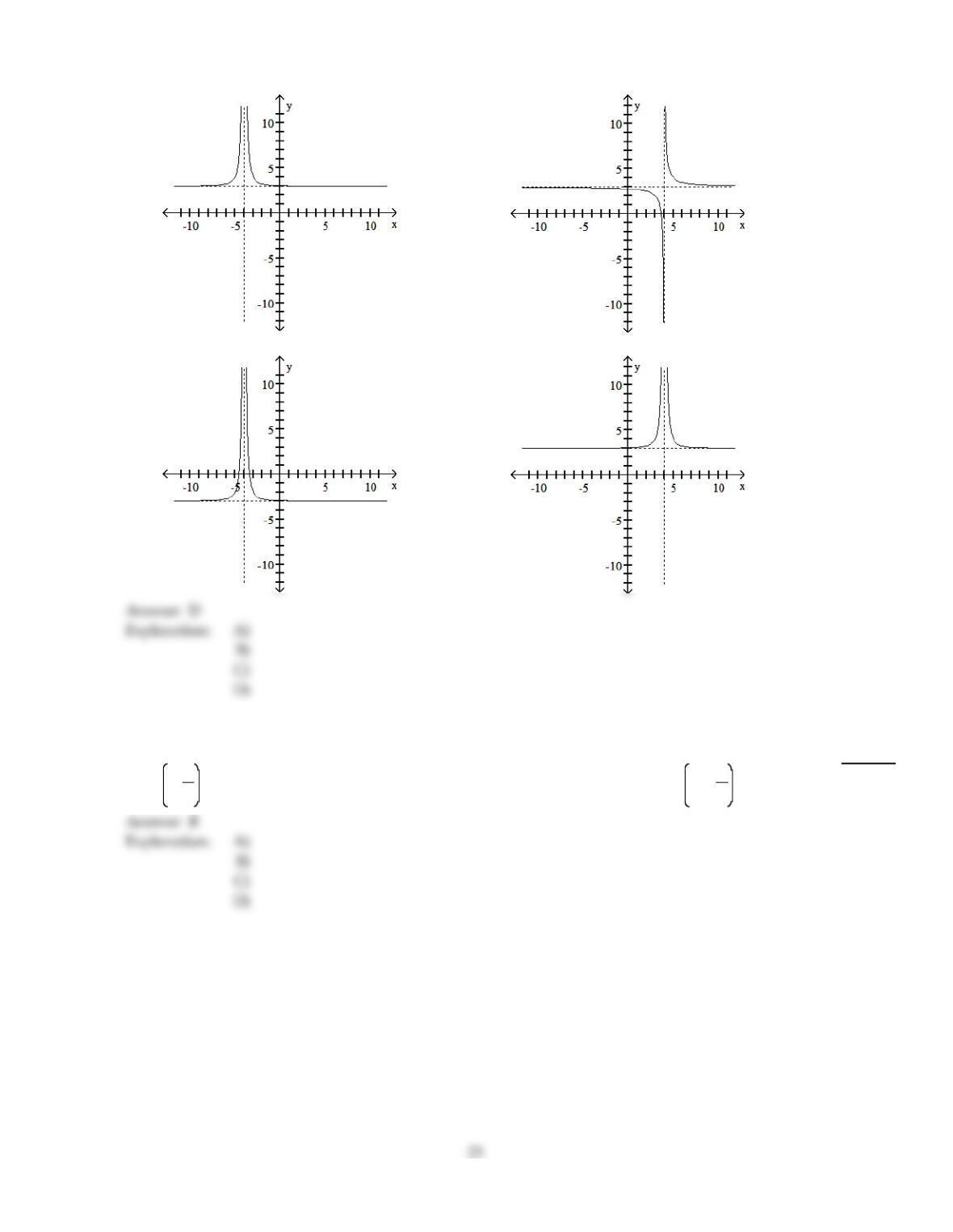
Use transformations of f(x) =1
x or f(x) =1
x2 to graph the rational function.
44)
f(x) =1
(x – 4)2+3
44)
22
A)
B)
C)
D)
Find the y–intercept for the graph of the quadratic function.
45)
f(x) =4x2– 3x – 7
45)
A)
0, 7
4
B)
(0, –7)
C)
(0, 7)
D)
0, –7
4
Find the indicated intercept(s) of the graph of the function.
46)
y–intercept of f(x) =x2– 15
x2+ 8x – 14
46)
A)
(0, 15)
B)
0, 15
14
C)
0, –14
15
D)
none
Write an equation that expresses the relationship. Use k for the constant of proportionality.
47)
x varies directly as y and inversely as the square of z.
47)
A)
x+y–z2= k
B)
x=ky
z2
C)
xyz2= k
D)
x=kz2
y
Find the zeros for the polynomial function and give the multiplicity for each zero. State whether the graph crosses the
x–axis or touches the x–axis and turns around, at each zero.
48)
f(x) =3(x + 2)(x + 5)2
48)
A)
–2, multiplicity 1, touches x–axis and turns around; –5, multiplicity 2, crosses x–axis
B)
2, multiplicity 1, touches x–axis and turns around; 5, multiplicity 2, crosses x–axis
C)
–2, multiplicity 1, crosses x–axis; –5, multiplicity 2, touches x–axis and turns around
D)
2, multiplicity 1, crosses x–axis; 5, multiplicity 2, touches x–axis and turns around
Write an equation that expresses the relationship. Use k for the constant of proportionality.
49)
w varies directly as the square of x and inversely as y.
49)
A)
w= kx2y
B)
w=kx2
y
C)
w= k +x2–y2
D)
w=ky
x2
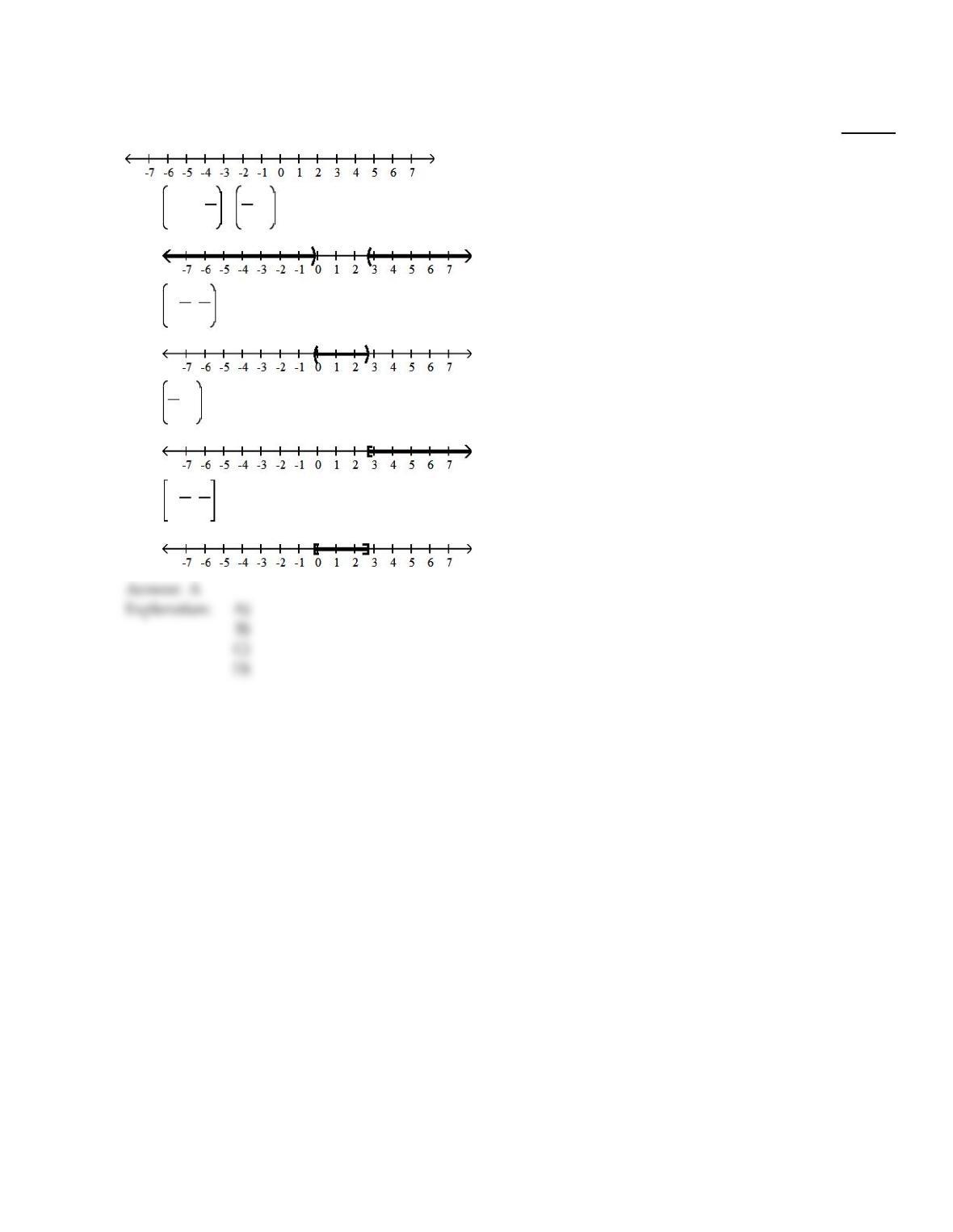
Solve the polynomial inequality and graph the solution set on a number line. Express the solution set in interval
notation.
50)
(6z + 1)(3z – 8) > 0
50)
A)
–, –1
68
3,
B)
–1
6, 8
3
C)
8
3,
D)
–1
6, 8
3
25
Find the zeros for the polynomial function and give the multiplicity for each zero. State whether the graph crosses the
x–axis or touches the x–axis and turns around, at each zero.
51)
f(x) =1
3x4(x2– 3)(x + 8)
51)
A)
0, multiplicity 4, touches x–axis and turns around;
–8, multiplicity 1, crosses x–axis
3, multiplicity 2, touches x–axis and turns around
B)
0, multiplicity 4, touches x–axis and turns around;
–8, multiplicity 1, crosses x–axis;
3, multiplicity 1, crosses x–axis;
–3, multiplicity 1, crosses x–axis
C)
0, multiplicity 4, touches x–axis and turns around;
–8, multiplicity 1, crosses x–axis
D)
0, multiplicity 4, crosses x–axis;
–8, multiplicity 1, touches x–axis and turns around;
3, multiplicity 1, touches x–axis and turns around;
–3, multiplicity 1, touches x–axis and turns around
Solve the problem.
52)
A ball is thrown vertically upward with an initial velocity of 192 feet per second. The distance in
feet of the ball from the ground after t seconds is s =192t – 16t2. For what interval of time is the ball
more than 432 above the ground?
52)
A)
between 5.5 and 6.5 seconds
B)
between 9 and 15 seconds
C)
between 3 and 9 seconds
D)
between 2.5 and 9.5 seconds
53)
A ball is thrown vertically upward with an initial velocity of 160 feet per second. The distance in
feet of the ball from the ground after t seconds is s =160t – 16t2. For what intervals of time is the
ball less than 384 above the ground (after it is tossed until it returns to the ground)?
53)
A)
between 0 and 4 seconds and between 6 and 10 seconds
B)
between 0 and 4.5 seconds and between 5.5 and 10 seconds
C)
between 4 and 6 seconds
D)
between 0 and 3.5 seconds and between 6.5 and 10 seconds
Find a rational zero of the polynomial function and use it to find all the zeros of the function.
54)
f(x) =x3– 8x2– x + 8
54)
A)
{1, 2, 4}
B)
{–1, 2, –4}
C)
{1, –1, 8}
D)
{1, –1, –8}
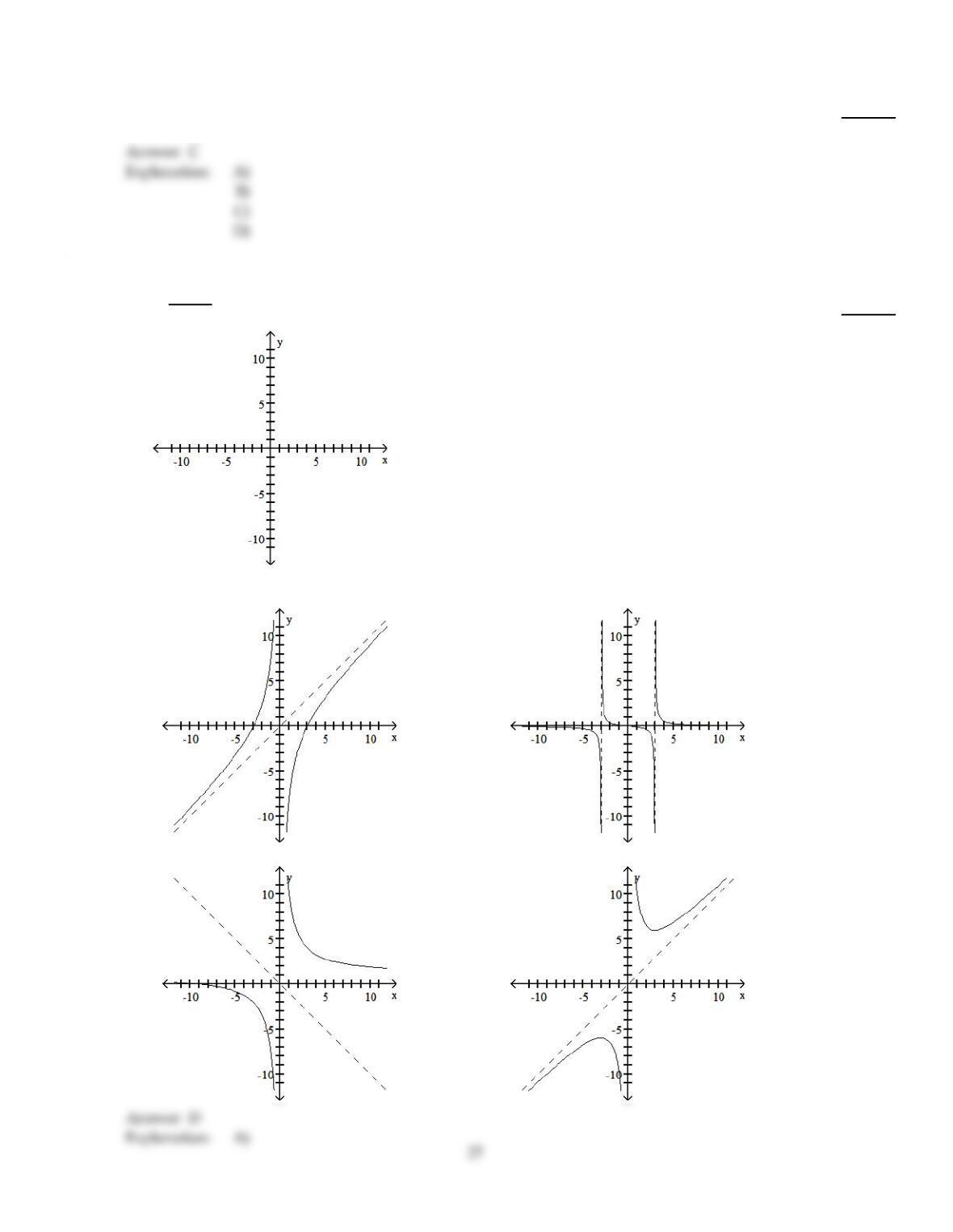
Graph the function.
55)
f(x) =x2+9
x
55)
A)
B)
C)
D)
Solve the problem.
56)
You drive 120 miles along a scenic highway and then take a 22–mile bike ride. Your driving rate is
4 times your cycling rate. Suppose you have no more than a total of 5 hours for driving and cycling.
Let x represent your cycling rate in miles per hour. Use a rational inequality to determine the
possible values of x.
56)
A)
x 10.4 mph
B)
x 63.5 mph
C)
x 10.4 mph
D)
x 25.1 mph
Determine whether the graph shown is the graph of a polynomial function.
57)
57)
A)
polynomial function
B)
not a polynomial function
Find the range of the quadratic function.
58)
f(x) = 11(x –2)2+ 7
58)
A)
[–7, )
B)
[2, )
C)
[7, )
D)
(–, 7]
28
Find the coordinates of the vertex for the parabola defined by the given quadratic function.
59)
f(x) =6– (x + 4)2
59)
A)
(6, –4)
B)
(6, 4)
C)
(–4, 6)
D)
(4, 6)
60)
f(x) = 11(x –4)2+ 5
60)
A)
(–4, 5)
B)
(5, –4)
C)
(11, 4)
D)
(4, 5)
Find a rational zero of the polynomial function and use it to find all the zeros of the function.
61)
f(x) =x3+ 2x2– 9x – 18
61)
A)
{–3, 2, 3}
B)
{–2}
C)
{–3}
D)
{–3, –2, 3}
Find the degree of the polynomial function.
62)
–15x3– 7x2– 8x + 2y4– 5
62)
A)
10
B)
–15
C)
3
D)
4
Solve the problem.
63)
A herd of moose is introduced to a wildlife refuge. The number of moose, N(t), after t years is
described by the polynomial function N(t) = – t3+24t +80. Use the Leading Coefficient Test to
determine the graph’s end behavior. What does this mean about what will eventually happen to
the moose population?
63)
A)
The moose population in the refuge will grow out of control.
B)
The moose population in the refuge will die out.
C)
The moose population in the refuge will reach a constant amount greater than 0.
D)
The moose population in the refuge will be displaced by “oil” wells.
Use the vertex and intercepts to sketch the graph of the quadratic function.
29
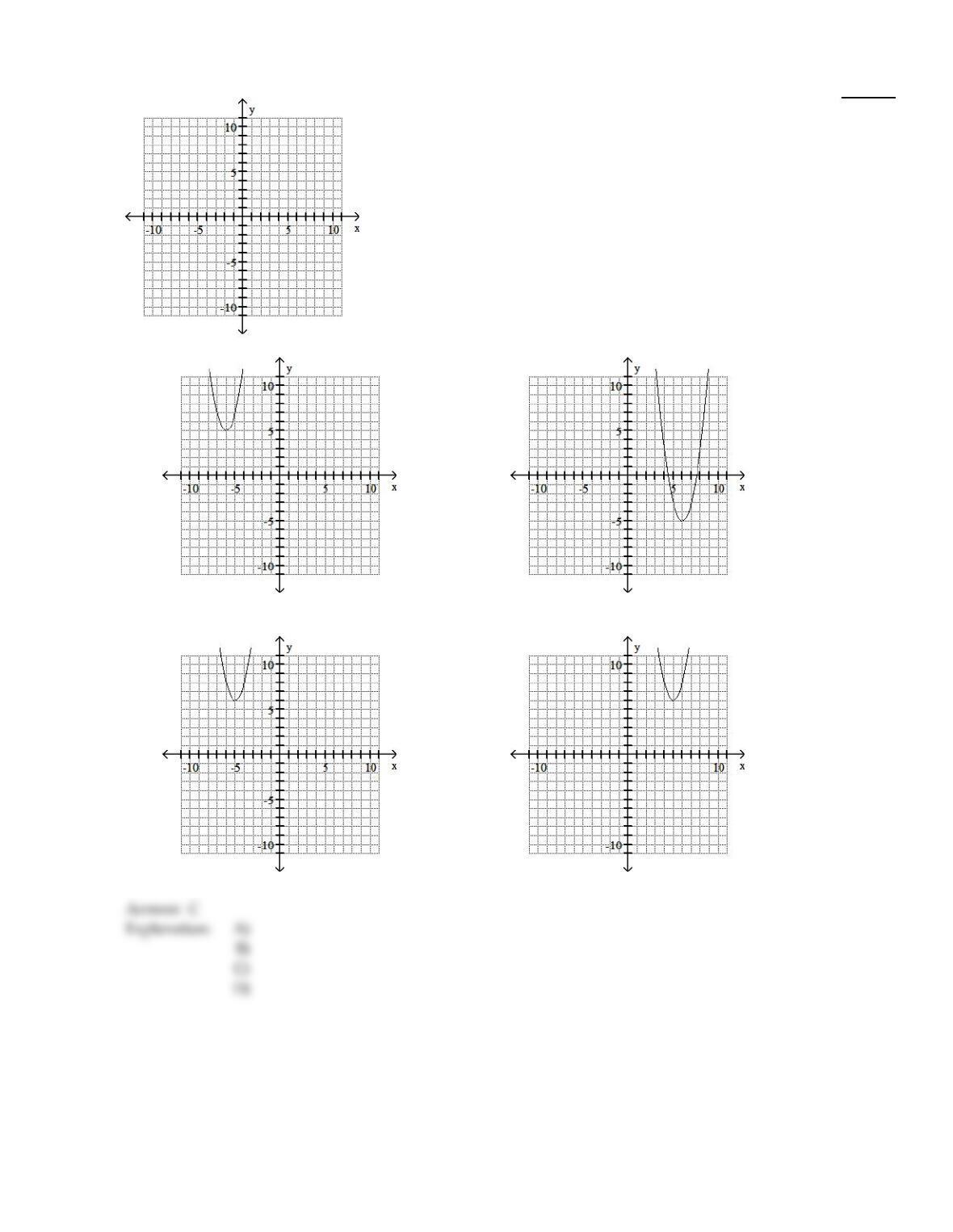
64)
f(x) =2x2+ 20x + 56
64)
A)
B)
C)
D)
30
Divide using synthetic division.
65)
(x2+ 16x + 61) ÷ (x + 7)
65)
A)
x + 10
B)
x + 9
x + 7
C)
x + 9 –2
x + 7
D)
x + 9 +2
x + 7
Determine whether the given quadratic function has a minimum value or maximum value. Then find the coordinates of
the minimum or maximum point.
66)
f(x) = – 2x2+ 6x
66)
A)
minimum; 3
2, 9
2
B)
maximum; 3
2, 9
2
C)
minimum; –3
2, –9
2
D)
maximum; –3
2, –9
2
Solve the problem.
67)
The sum of 81 times a number and the reciprocal of the number is positive. Find the numbers
which satisfy this condition.
67)
A)
any number greater than 1
9
B)
any number greater than 0
C)
any number between –1
9 and 1
9
D)
any number between 0 and 1
9
Graph the polynomial function.
31
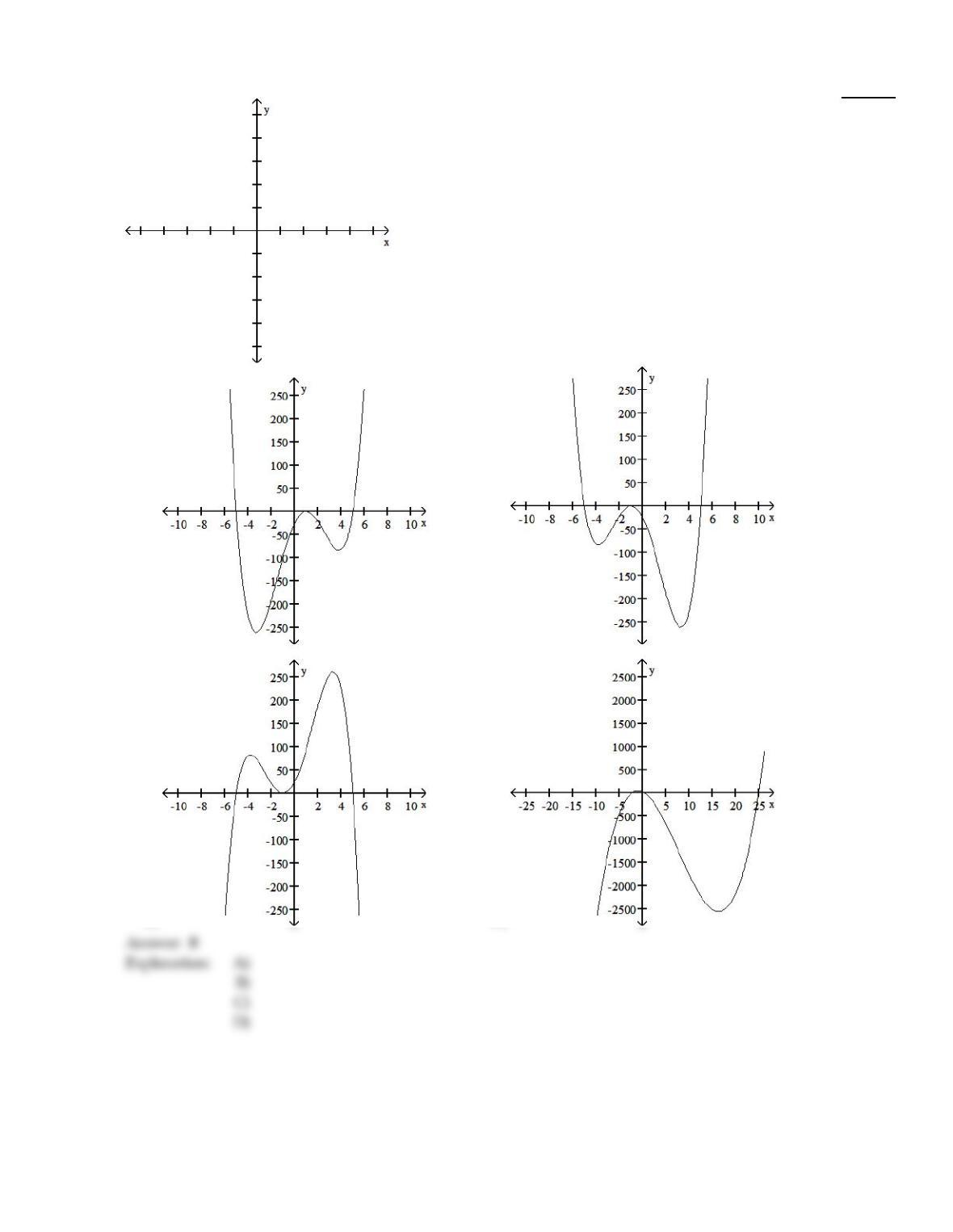
68)
f(x) =(x + 1)2(x2–25)
68)
A)
B)
C)
D)
32
Solve the problem.
69)
Is there origin symmetry for the rational function f(x) =9x2– 2
–8x2+ 1 ?
69)
A)
Yes
B)
No
70)
In one U.S. city, the quadratic function f(x) =0.0042x2–0.46x +36.44 models the median, or
average, age, y, at which men were first married x years after 1900. In which year was this average
age at a minimum? (Round to the nearest year.) What was the average age at first marriage for that
year? (Round to the nearest tenth.)
70)
A)
1953, 36 years old
B)
1955, 23.8 years old
C)
1955, 49 years old
D)
1936, 49 years old
B
Solve the polynomial equation. In order to obtain the first root, use synthetic division to test the possible rational roots.
71)
x3– 5x2+ 17x – 13 = 0
71)
A)
{1, 3+2i, 3–2i}
B)
{–1, 2+5, 4–5}
C)
{1, 3+5, 3–5}
D)
{1, 2+3i, 2–3i}
D
33
B
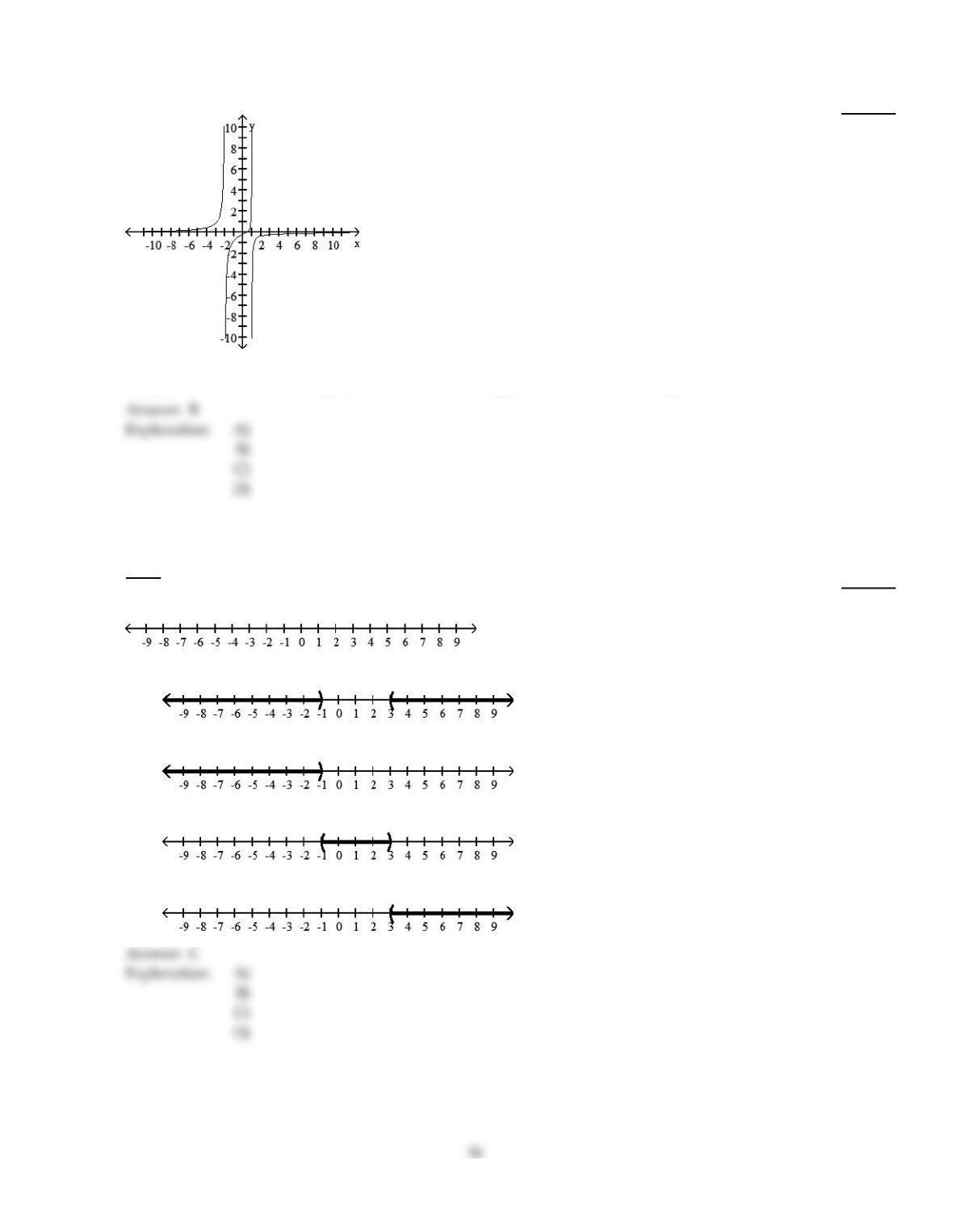
Use the graph of the rational function shown to complete the statement.
72)
As x–2–, f(x)
?
72)
A)
2
B)
+
C)
0
D)
–
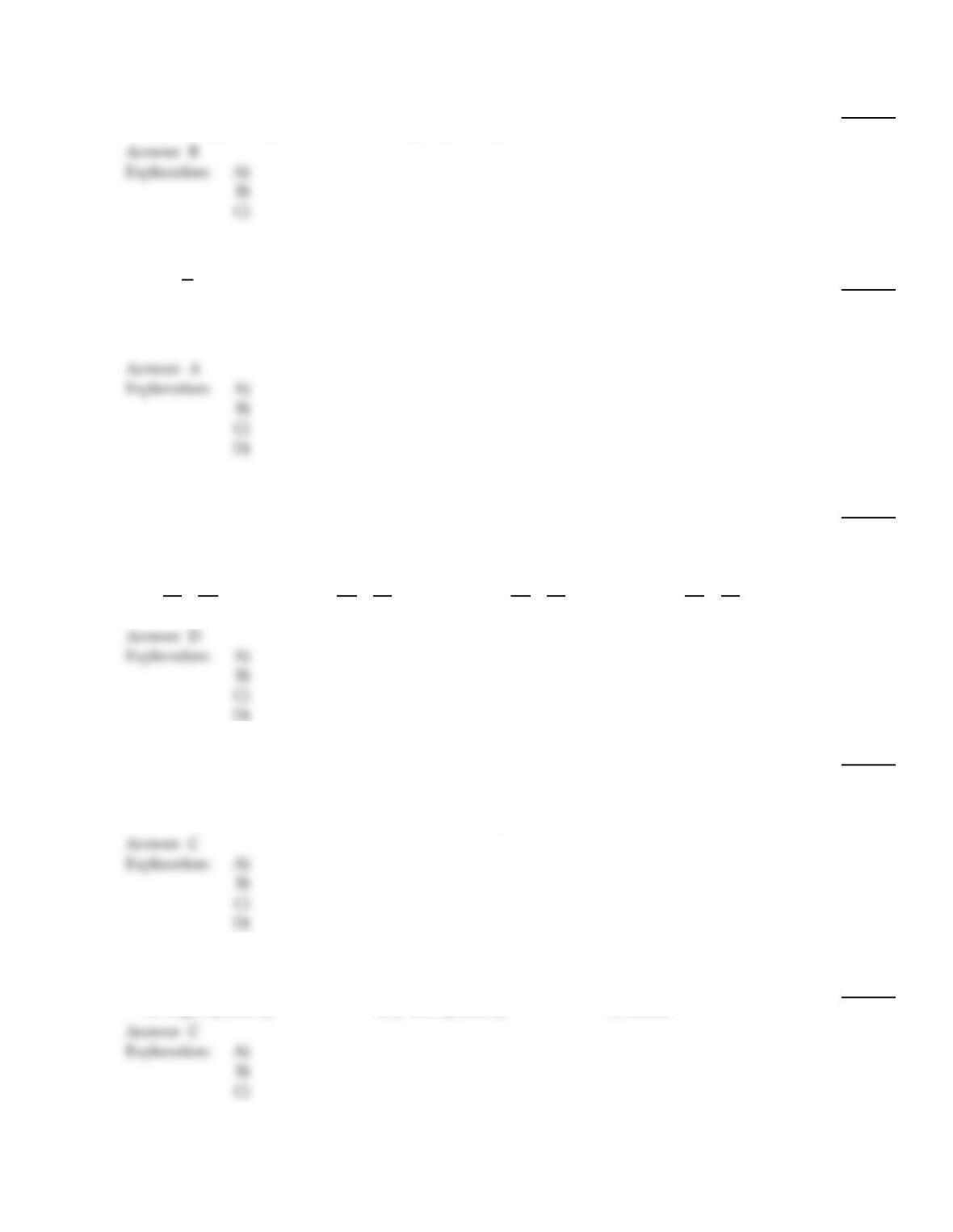
Solve the rational inequality and graph the solution set on a real number line. Express the solution set in interval
notation.
73)
x – 3
x + 1 < 0
73)
A)
(–, –1) or (3, )
B)
(–, –1)
C)
(–1, 3)
D)
(3, )
Determine whether the graph of the polynomial has y–axis symmetry, origin symmetry, or neither.
74)
f(x) = x(2–x2)
74)
A)
y–axis symmetry
B)
origin symmetry
C)
neither
Find an nth degree polynomial function with real coefficients satisfying the given conditions.
75)
n = 4; 3, 1
2, and 3+ 2i are zeros; f(1) =32
75)
A)
f(x) = – 4x4+ 38x3– 142x2+ 218x – 78
B)
f(x) =2x4– 19x3+ 71x2+ 218x – 78
C)
f(x) = – 6x4+ 57x3– 213x2+ 327x – 117
D)
f(x) = – 2x4+ 38x3– 142x2+ 218x – 78
Solve the problem.
76)
You drive 98 miles along a scenic highway and then take a 22–mile bike ride. Your driving rate is 3
times your cycling rate. Suppose you have no more than a total of 7 hours for driving and cycling.
Let x represent your cycling rate in miles per hour. Write a rational inequality that can be used to
determine the possible values of x. Do not simplify and do not solve the inequality.
76)
A)
98
x+22
3x 7
B)
98
3x +22
x7
C)
3x
98 +x
22 7
D)
98
3x +22
x7
77)
A developer wants to enclose a rectangular grassy lot that borders a city street for parking. If the
developer has 332 feet of fencing and does not fence the side along the street, what is the largest
area that can be enclosed?
77)
A)
27,556 ft2
B)
20,667 ft2
C)
13,778 ft2
D)
6889 ft2
Determine whether the graph of the polynomial has y–axis symmetry, origin symmetry, or neither.
78)
f(x) = – x2(x +8)(x2– 1)
78)
A)
origin symmetry
B)
y–axis symmetry
C)
neither
35
Use the Rational Zero Theorem to list all possible rational zeros for the given function.
79)
f(x) =x5–6x2+3x +3
79)
A)
± 1, ±3
B)
±3, ±1
3
C)
±1
6, ±1
2, ±3
D)
± 1, ±1
3
Find the range of the quadratic function.
80)
f(x) = x2+ 7
80)
A)
[7, )
B)
[–7, )
C)
[0, )
D)
(–, 7]
Find the slant asymptote, if any, of the graph of the rational function.
81)
f(x) =8x2
4x2+ 6
81)
A)
y = x +2
B)
y =8x
C)
y = x + 8
D)
no slant asymptote
Determine whether the graph of the polynomial has y–axis symmetry, origin symmetry, or neither.
82)
f(x) =x4–4x2
82)
A)
y–axis symmetry
B)
origin symmetry
C)
neither
Determine whether the function is a polynomial function.
83)
f(x) =x5/4 –x3+ 9
83)
A)
Yes
B)
No
36
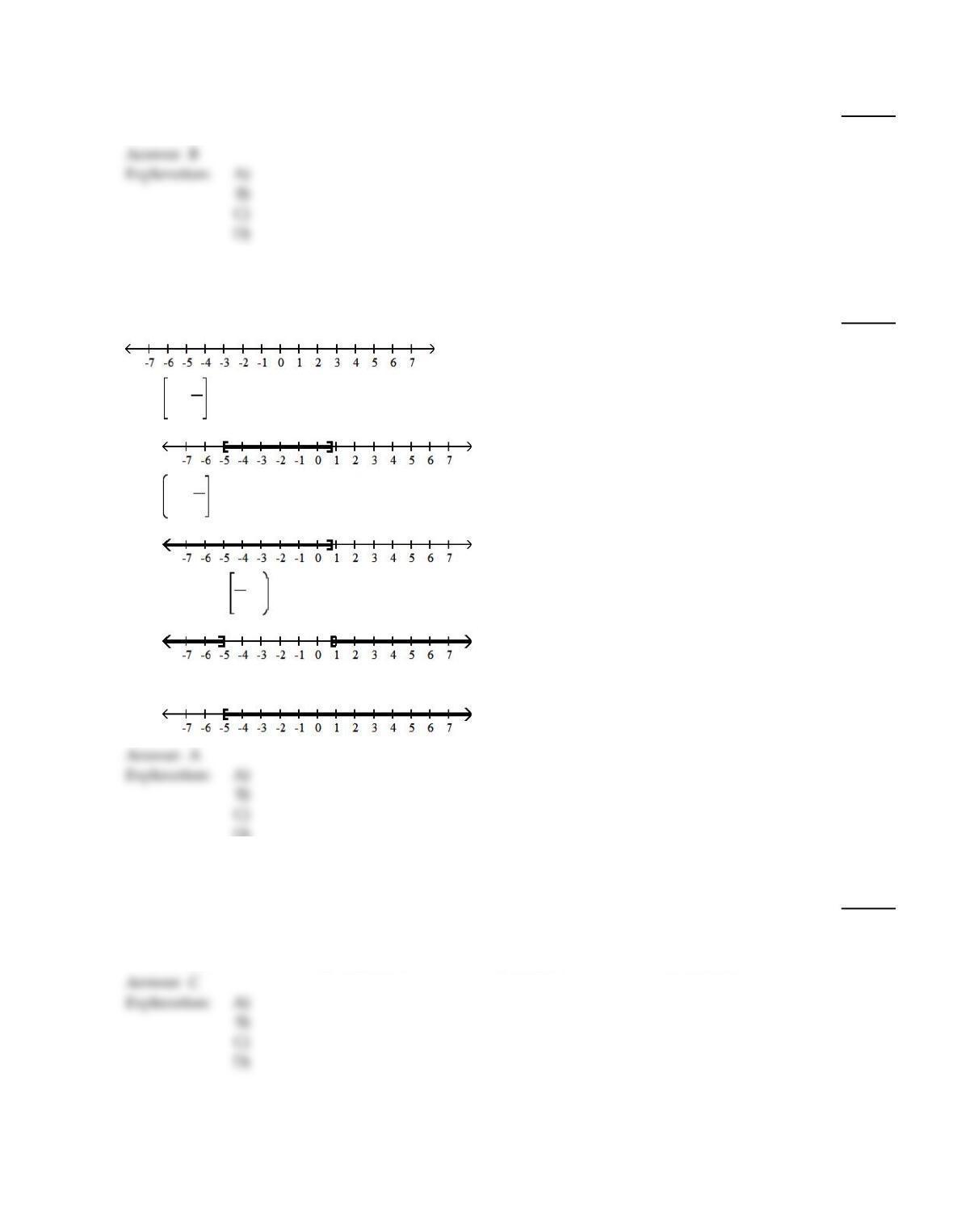
Divide using long division.
84)
(–6x3+ 4x2+ 17x + 5) ÷ (3x + 1)
84)
A)
x2– 2x – 5
B)
–2x2+ 2x + 5
C)
x2+ 2x + 5
D)
–2x2+ 5
Solve the polynomial inequality and graph the solution set on a number line. Express the solution set in interval
notation.
85)
(4x – 3)(x + 5)
0
85)
A)
–5, 3
4
B)
–, 3
4
C)
(–, –5] 3
4,
D)
[–5, )
D)
Solve the problem.
86)
The manufacturer of a CD player has found that the revenue R (in dollars) is R(p) = – 4p2+1560p,
when the unit price is p dollars. If the manufacturer sets the price p to maximize revenue, what is
the maximum revenue to the nearest whole dollar?
86)
A)
$304,200
B)
$1,216,800
C)
$152,100
D)
$608,400
D)
37
D)
Use Descartes’s Rule of Signs to determine the possible number of positive and negative real zeros for the given function.
87)
f(x) = – 4x5–10x4–5x3+3x2+ x +20
87)
A)
1 positive zero, 4 or 2 negative zeros
B)
1 positive zero, 3 or 1 negative zeros
C)
1 positive zero, 2 or 0 negative zeros
D)
1 positive zero, 4, 3 or 1 negative zeros
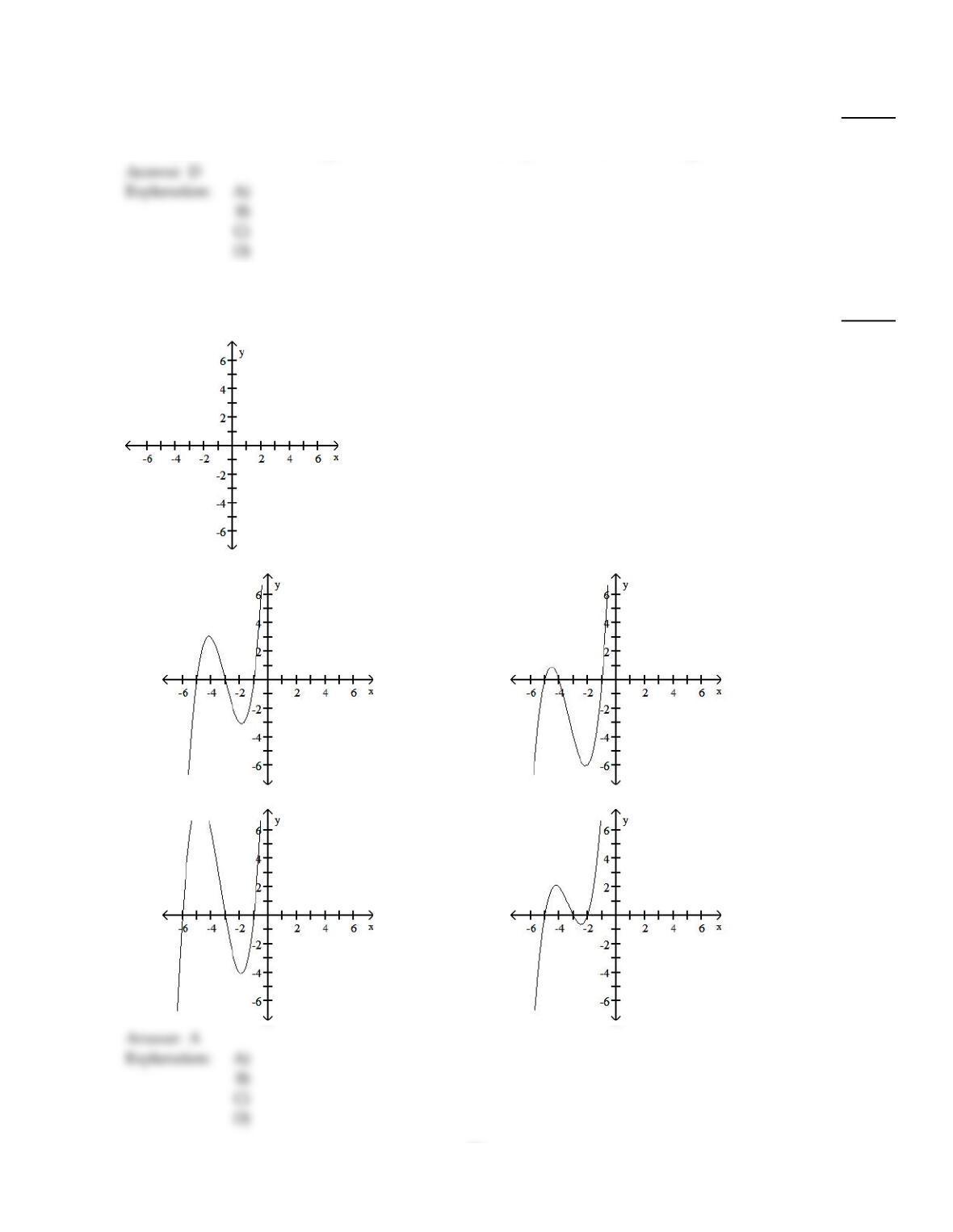
Graph the polynomial function.
88)
f(x) = (x + 1)(x + 3)(x + 5)
88)
A)
B)
C)
D)
38
Find the indicated intercept(s) of the graph of the function.
89)
x–intercepts of f(x) =(x – 7)(2x + 5)
x2+ 2x – 5
89)
A)
(–7, 0) and 5
2, 0
B)
(7, 0) and (–5, 0)
C)
(7, 0) and –5
2, 0
D)
none
Find the range of the quadratic function.
90)
f(x) = – 5x2+ 15x
90)
A)
(–, 45
4]
B)
(–, –3
2]
C)
(–, 3
2]
D)
(–, –45
4]
A
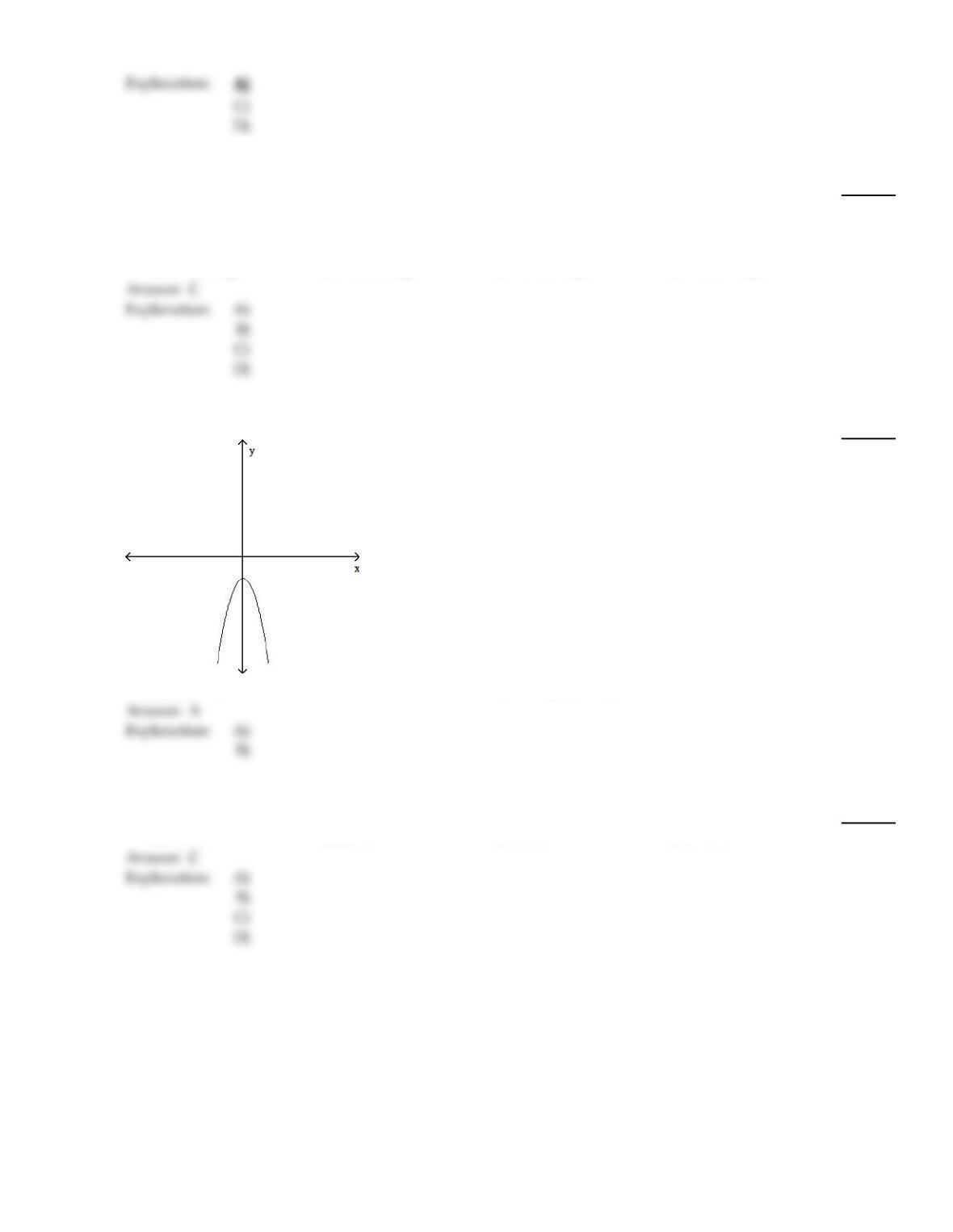
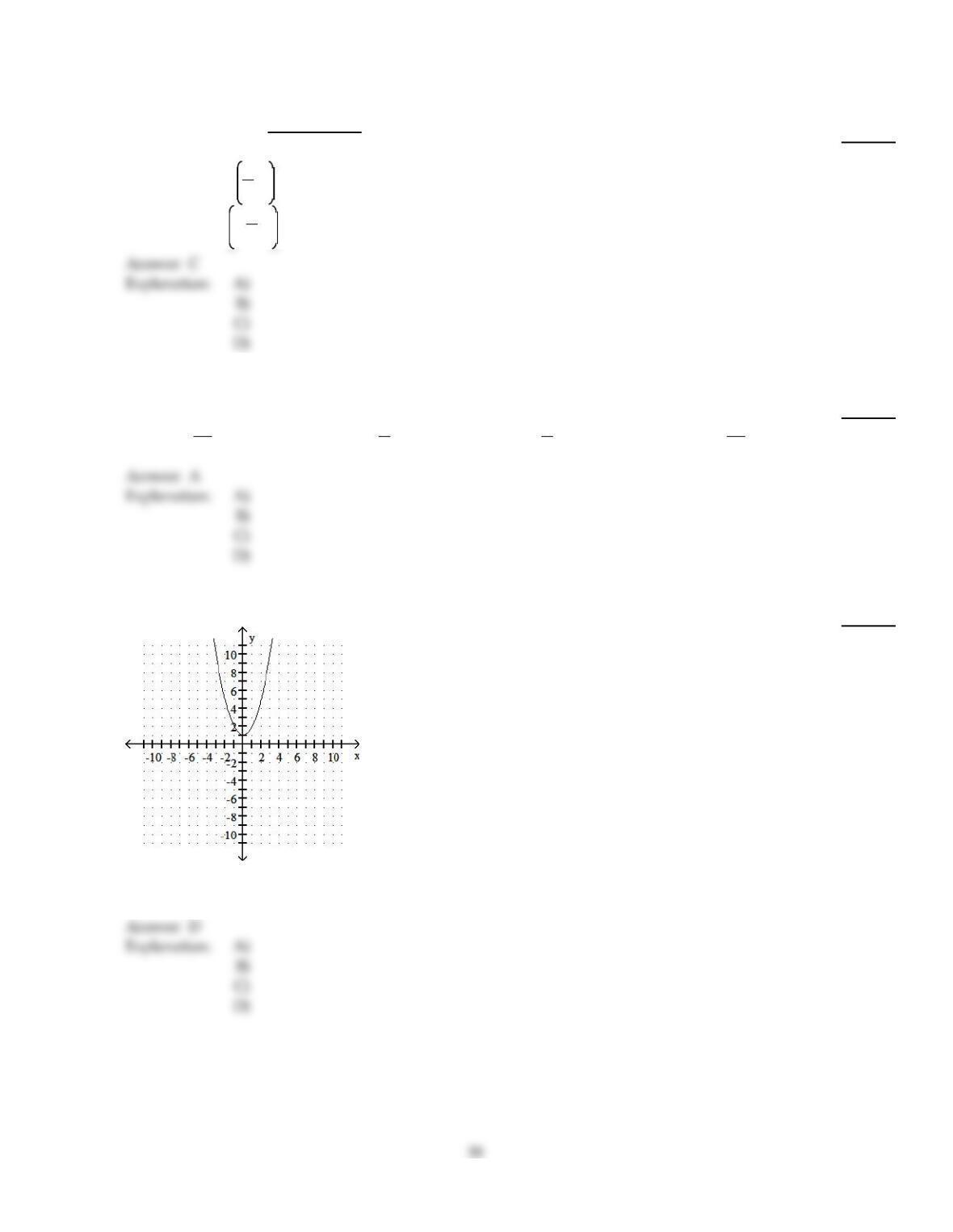
The graph of a quadratic function is given. Determine the function’s equation.
91)
91)
A)
f(x) =x2–2x +1
B)
g(x) =x2+2x +1
C)
h(x) =x2–1
D)
j(x) =x2+1
D
C
Solve the problem.
92)
For a resistor in a direct current circuit that does not vary its resistance, the power that a resistor
must dissipate is directly proportional to the square of the voltage across the resistor. The resistor
must dissipate 1
16 watt of power when the voltage across the resistor is 8 volts. Find the power
that the resistor must dissipate when the voltage across it is 16 volts.
92)
A)
1
2 watt
B)
1
4 watt
C)
4 watts
D)
1
8 watt
Write an equation that expresses the relationship. Use k as the constant of variation.
93)
d varies inversely as the square of b.
93)
A)
d=b
k
B)
d=k
b
C)
d=b2
k
D)
d=k
b2
D)
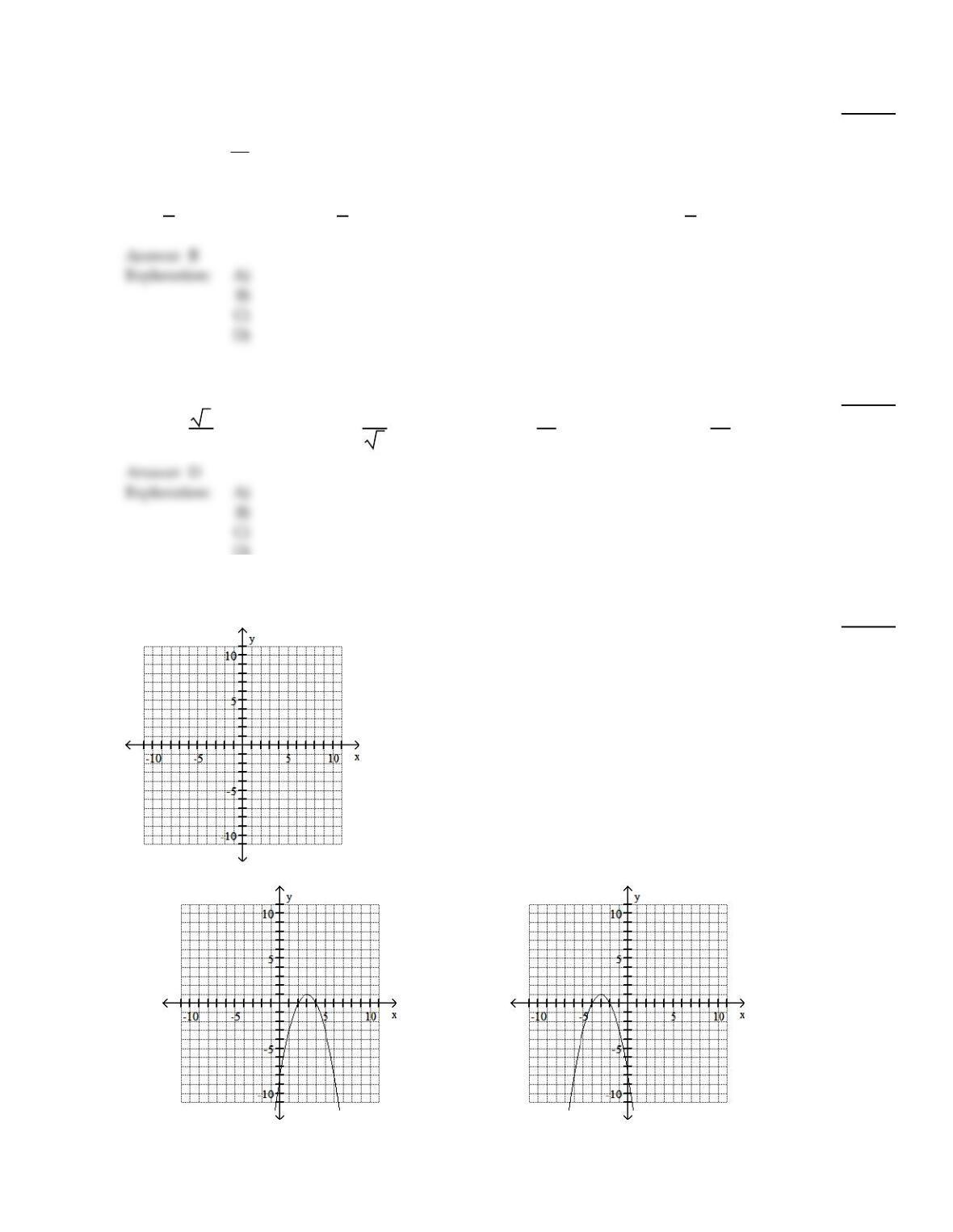
Use the vertex and intercepts to sketch the graph of the quadratic function.
94)
f(x) =x2+ 6x + 8
94)
A)
B)
40
D)