75)
The money price of a good is also known as its
75)
A)
absolute price.
B)
case price.
C)
relative price.
D)
subjective price.
76)
The law of supply states that other things being equal
76)
A)
supply will increase to meet demand if demand increases.
B)
supply will increase if productivity increases.
C)
as price increases, quantity supplied increases.
D)
supply creates its own demand.
77)
Other things being equal, an increase in the price of a good leads to a decrease in the amount
people purchase. This is known as
77)
A)
equilibrium.
B)
the law of supply.
C)
the law of demand.
D)
ceteris paribus.
78)
In general, any ceteris paribus determinant of supply that is favorable to production will
78)
A)
shift the supply curve to the left.
B)
cause a movement along the supply curve.
C)
shift the supply curve to the right.
D)
shift the demand curve to the left.
79)
A change in quantity demanded
79)
A)
is a movement along the demand curve.
B)
can be either a shift or a movement along the demand curve.
C)
is caused when there is a change in a ceteris paribus factor.
D)
is a shift of the demand curve.
80)
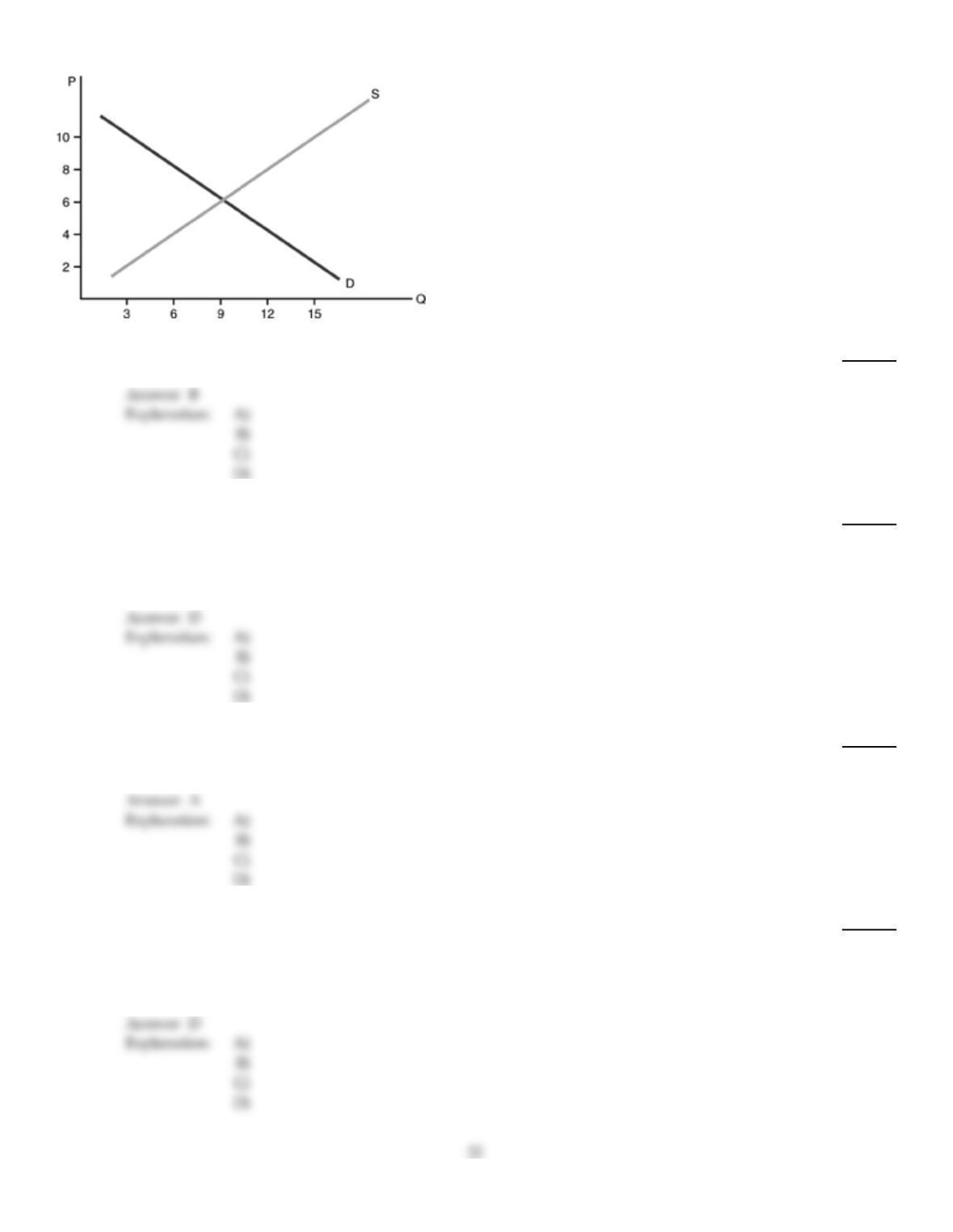
Refer to the above figure. The equilibrium price and quantity are
80)
A)
$2 and 12 units.
B)
$6 and 9 units.
C)
$8 and 6 units.
D)
$10 and 1 unit.
81)
According to the law of demand, the quantity demanded of a good is related to
81)
A)
any factor that affects the decision of an individual consumer but not the market.
B)
the average price of all goods.
C)
income.
D)
the relative price of that good.
D
82)
By summing the quantities demanded by individuals at each price we obtain the
82)
A)
market demand curve.
B)
individual demand curve.
C)
equilibrium price.
D)
market supply curve.
A
83)
The concept of “demand” in economics refers to
83)
A)
changes in people’s consumption behavior over time.
B)
how changes in the prices of all goods affect people’s buying behavior.
C)
the different types of goods and services that people of different income levels want to buy.
D)
the different quantities of a good or service people will buy at different possible prices.
D
B
84)
If Apple’s iTunes Music Store increases its “fee” for its music downloads, the law of demand predicts
that
84)
A)
the number of iTunes music downloads would decrease.
B)
iTunes music supply would change but demand would not.
C)
the number of iTunes music downloads would increase.
D)
there would be no change in the demand for iTunes music downloads.
85)
The statement “other things being equal” in the law of demand means all of the following remain
constant EXCEPT
85)
A)
the price of the good concerned in the law of demand.
B)
the prices of substitutes.
C)
tastes and preferences.
D)
consumer income.
A
Quantity Quantity
Price Demanded Supplied
$50 300 0
$55 220 80
$60 150 150
$65 90 230
$70 30 300
86)
Using the above table, at a price of $70, there is
86)
A)
a shortage of 150 units.
B)
a shortage of 120 units.
C)
a surplus of 270 units.
D)
a surplus of 150 units.
C
87)
When the term “price” is used in the law of demand, price refers to
87)
A)
the absolute price of the good.
B)
the price of the good relative to the price of another good.
C)
the nominal price of the good relative to its nominal price in the previous year.
D)
the dollar price of the good.
B
A
88)
Another name for a surplus is
88)
A)
excess quantity demanded.
B)
equilibrium.
C)
market clearing.
D)
excess quantity supplied.
89)
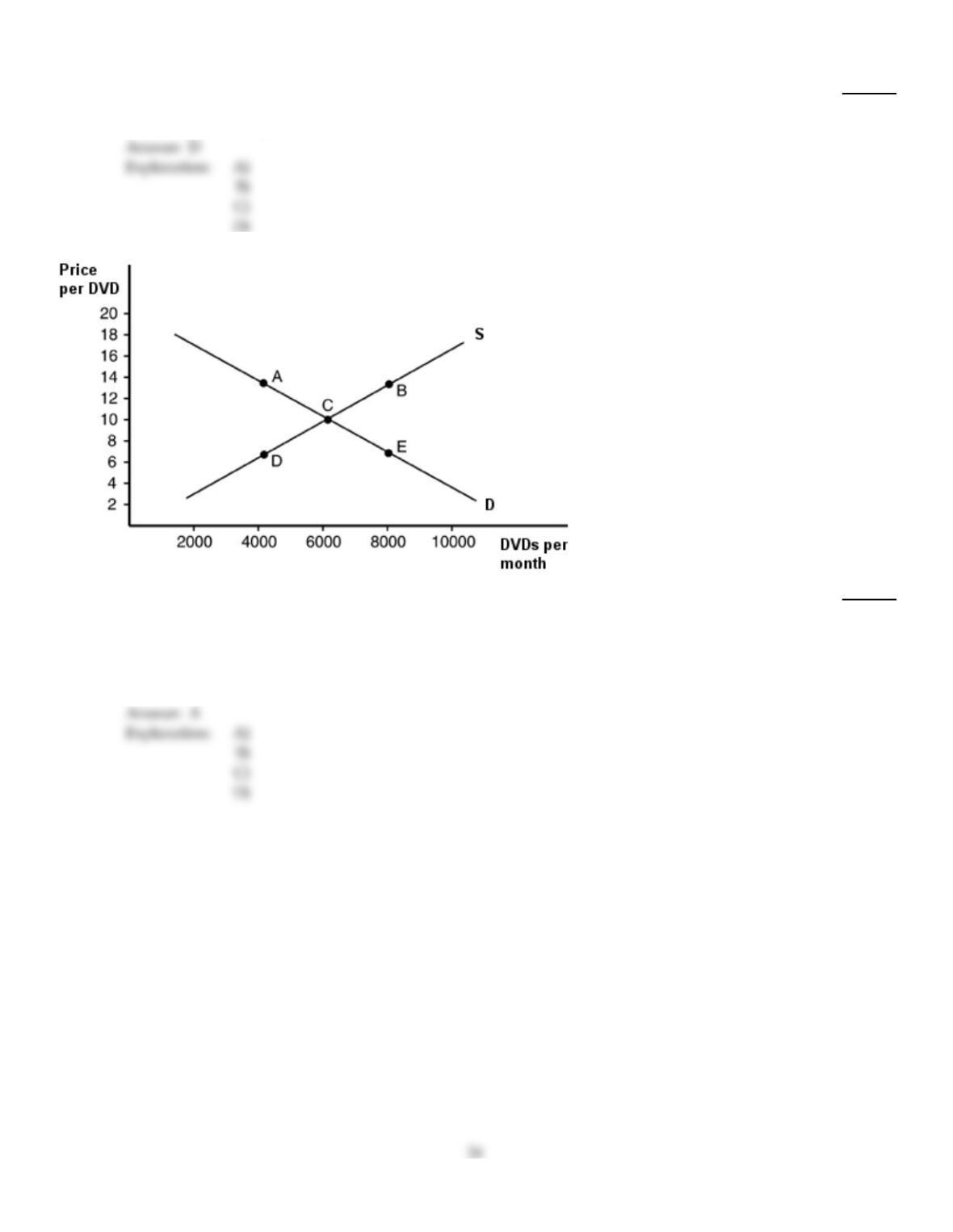
Suppose a change takes place and the new equilibrium is at point A in the above figure. This
change could have been caused by
89)
A)
an increase in the per–unit tax on CDs.
B)
a decrease in the income of consumers.
C)
a reduction in the price of CD players.
D)
a reduction in the wages paid to workers in the CD industry.
A
D
Quantity Quantity
Price Demanded Supplied
$50 300 0
$55 220 80
$60 150 150
$65 90 230
$70 30 300
90)
Using the above table, the market clearing price is ________ and equilibrium quantity is ________.
90)
A)
$55; 80
B)
$70; 150
C)
$60; 150
D)
$150; 150
91)
Which of the following is a non–price determinant of demand?
91)
A)
prices of related goods and services
B)
tastes and preferences
C)
income
D)
All of the above are correct.
92)
According to the above figure, a shortage will occur at a price at which
92)
A)
quantity supplied exceeds quantity demanded.
B)
quantity demanded exceeds quantity supplied.
C)
quantity demanded equals quantity supplied.
D)
government sets a price above equilibrium.
93)
An increase in the quantity demanded is shown by
93)
A)
a movement up along a demand curve.
B)
a leftward shift of the demand curve.
C)
a movement down along a demand curve.
D)
a rightward shift of the demand curve.
94)
Which of the following causes a decrease in demand for a normal good?
94)
A)
increase in price of a substitute
B)
increase in price of a complement
C)
increase in income
D)
increase in price
95)
The money price of a good is that price
95)
A)
that would clear the market.
B)
expressed in today’s dollars.
C)
expressed in purchasing power against a common item like bread.
D)
expressed in constant 2005 dollars.
Price per Quantity Demanded Quantity Supplied
Constant–of Constant–Quality of Constant–Quality
Quality Unit Units per Year Units per Year
$1.00 1,000 200
2.00 800 400
3.00 600 600
4.00 400 800
5.00 200 1,000
96)
In a free market economy, the market clearing (equilibrium) price in the above table would adjust
to
96)
A)
$4.
B)
$1.
C)
$3.
D)
$5.
97)
What would happen in the market for prescription drugs if people begin to view over–the–counter
remedies as a good substitute for prescription medications?
97)
A)
Prescription medications will become an inferior good.
B)
There is an upward movement along the demand curve for prescription medications.
C)
The demand for prescription medications will decrease.
D)
There is a downward movement along the demand curve for prescription medications.
Price Quantity Demanded
Per DVD Buyer 1 Buyer 2 Buyer 3 Buyer 4
$20 0 0 1 0
18 0 1 3 0
16 1 2 5 1
14 2 4 7 3
12 3 6 9 6
10 4 8 11 10
8 5 11 13 15
98)
Refer to the above table. What is the market quantity demanded of DVDs at a price of $12?
98)
A)
12
B)
6
C)
9
D)
24
99)
An indirect or inverse relationship between price and quantity demanded is
99)
A)
a supply curve.
B)
the market clearing price.
C)
a change in demand.
D)
a demand curve.
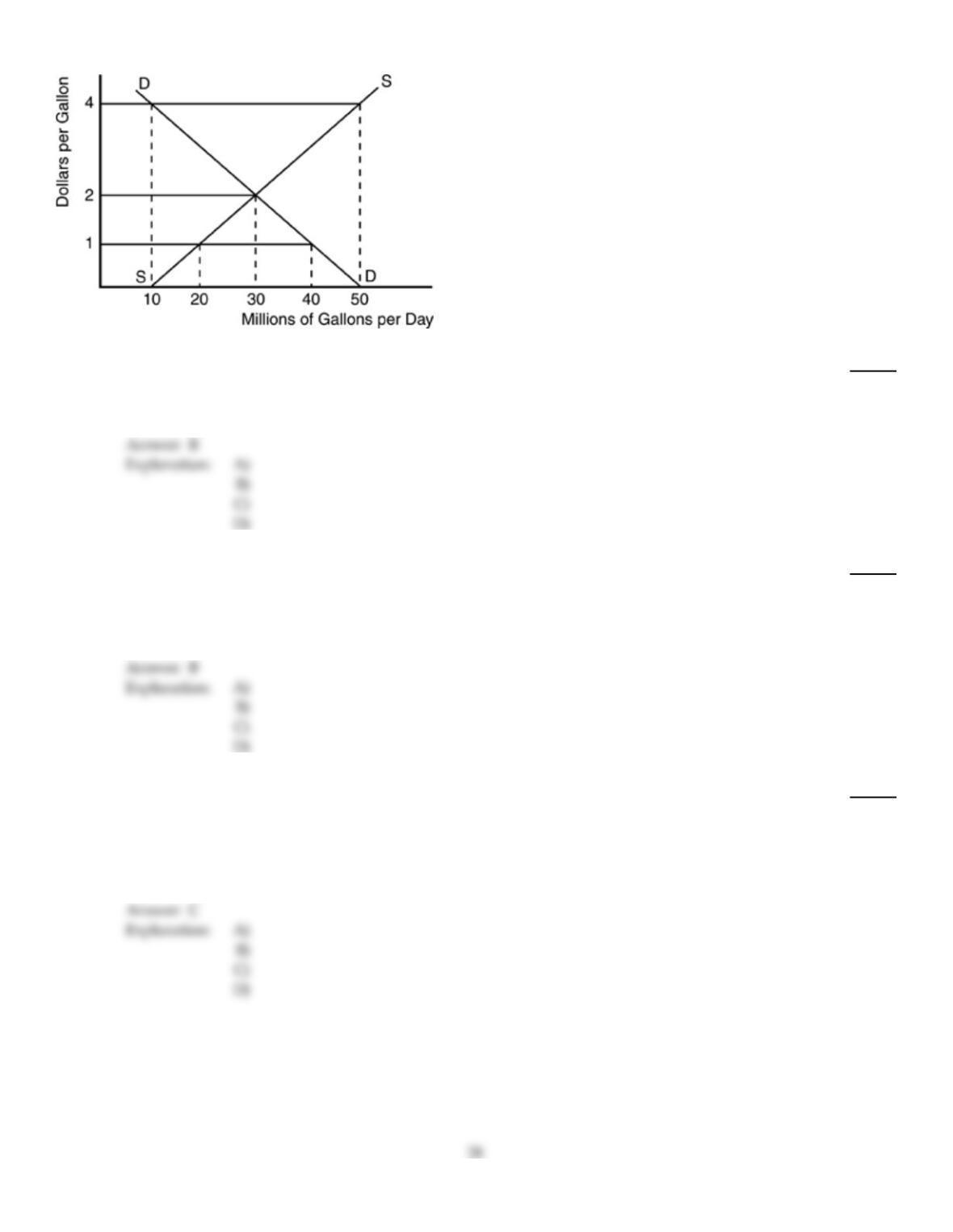
100)
In a free market, the market price and quantity in the above figure will adjust to equilibrium values
of
100)
A)
$1 per gallon and 50 million gallons.
B)
$2 per gallon and 30 million gallons.
C)
$2 per gallon and 60 million gallons.
D)
$4 per gallon and 10 million gallons.
101)
When income rises
101)
A)
demand for a normal good falls.
B)
demand for a normal good rises.
C)
quantity of a normal good demanded rises.
D)
demand for an inferior good rises.
102)
If a scalper for the Super Bowl is able to charge $10,000 for a front–row seat, this suggests that
102)
A)
at the regular price, there is a surplus of Super Bowl tickets.
B)
at the regular price, the quantity of Super Bowl tickets demanded equals the quantity
supplied.
C)
at the regular price, there is a shortage of Super Bowl tickets.
D)
the scalper is making the football fan worse off.
103)
Which of the following is a non–price determinant of supply?
103)
A)
the number of consumers
B)
consumers’ incomes
C)
the price of related goods consumers may buy
D)
technological advances in production
104)
An increase in supply will occur when
104)
A)
the demand curve shifts downward to the left.
B)
the supply curve shifts downward to the right.
C)
the demand curve shifts upward to the right.
D)
the supply curve shifts upward to the left.
105)
Suppose the price of cement goes up in the United States. What happens in the market for new
homes?
105)
A)
Demand shifts to the right.
B)
Supply shifts downward and to the right.
C)
Supply shifts upward and to the left.
D)
Demand shifts left.
106)
There is a 15 percent increase in the price of lumber used by a firm that builds new homes. This
causes
106)
A)
a decrease in the quantity of new homes supplied.
B)
a decrease in the supply of new homes.
C)
an increase of the quantity supplied of new homes.
D)
an increase in the supply of new homes.
107)
When the amount supplied is greater at each price, there is a(n)
107)
A)
rightward shift in the supply curve.
B)
upward movement along the supply curve.
C)
downward movement along the supply curve.
D)
leftward shift in the supply curve.
108)
Suppose that the price of wheat is above its equilibrium price. You would expect to see
108)
A)
an increase in quantity demanded because of the high price.
B)
a shortage on the market that causes prices to increase further.
C)
a leftward shift of the demand curve because of the high price.
D)
sellers begin to lower their prices because of the surplus of wheat.
D
109)
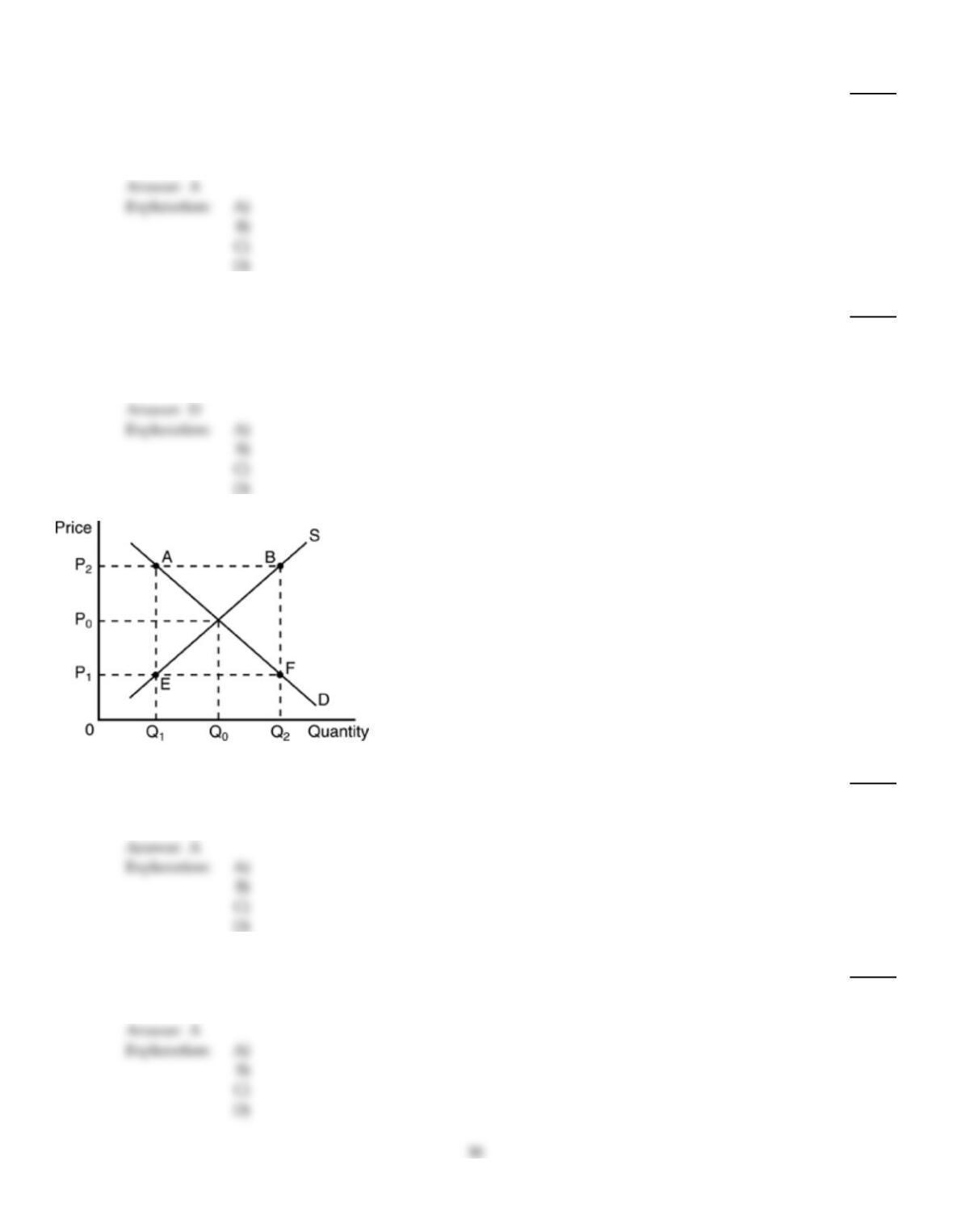
If the market price rises from P0 to P2 in the above figure, then there is a
109)
A)
surplus equal to the distance Q1, Q2.
B)
shortage equal to the distance Q0, Q2.
C)
shortage equal to the distance Q1, Q2.
D)
surplus equal to the distance Q0, Q2.
A
110)
An increase in demand is represented by a
110)
A)
shift of the demand curve to the right.
B)
movement up the demand curve.
C)
movement down the demand curve.
D)
shift of the demand curve to the left.
A
A
111)
Equilibrium in a market occurs when
111)
A)
demand and supply indicate a small surplus of a good.
B)
quantity supplied and quantity demanded are equal at the market clearing price.
C)
the market price leads to a decrease in quantity demanded.
D)
price is at its minimum.
112)
The market clearing price is
112)
A)
the lowest price at which a positive quantity supplied exists.
B)
the price which eliminates excess quantity supplied or excess quantity demanded.
C)
the price which leaves an excess quantity supplied.
D)
the price which leaves an excess quantity demanded.
B
113)
If the price of airline travel in Europe falls and the demand for train travel in Europe also falls, then
the two goods are
113)
A)
substitutes.
B)
inferior goods.
C)
normal goods.
D)
complements.
A
B
114)
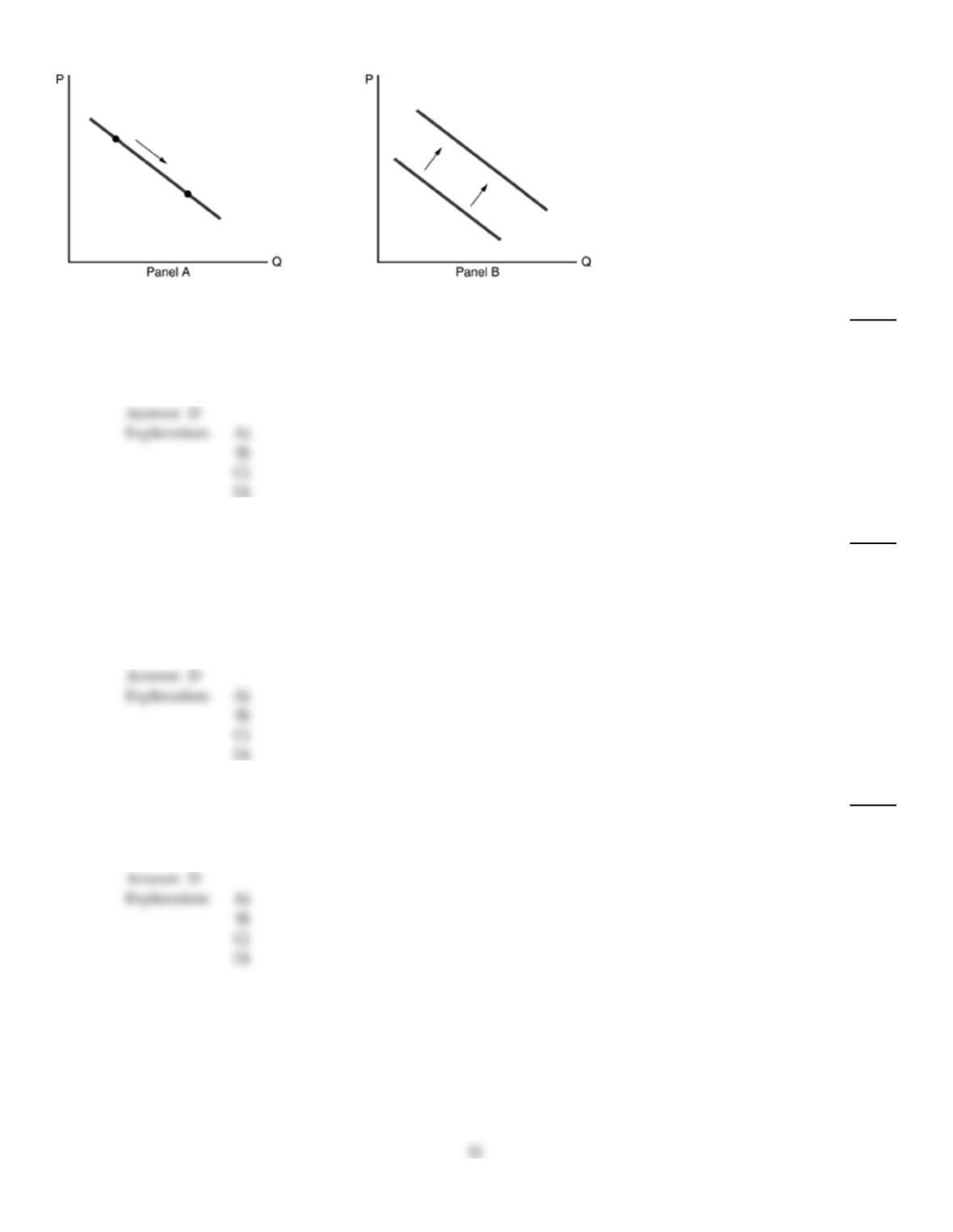
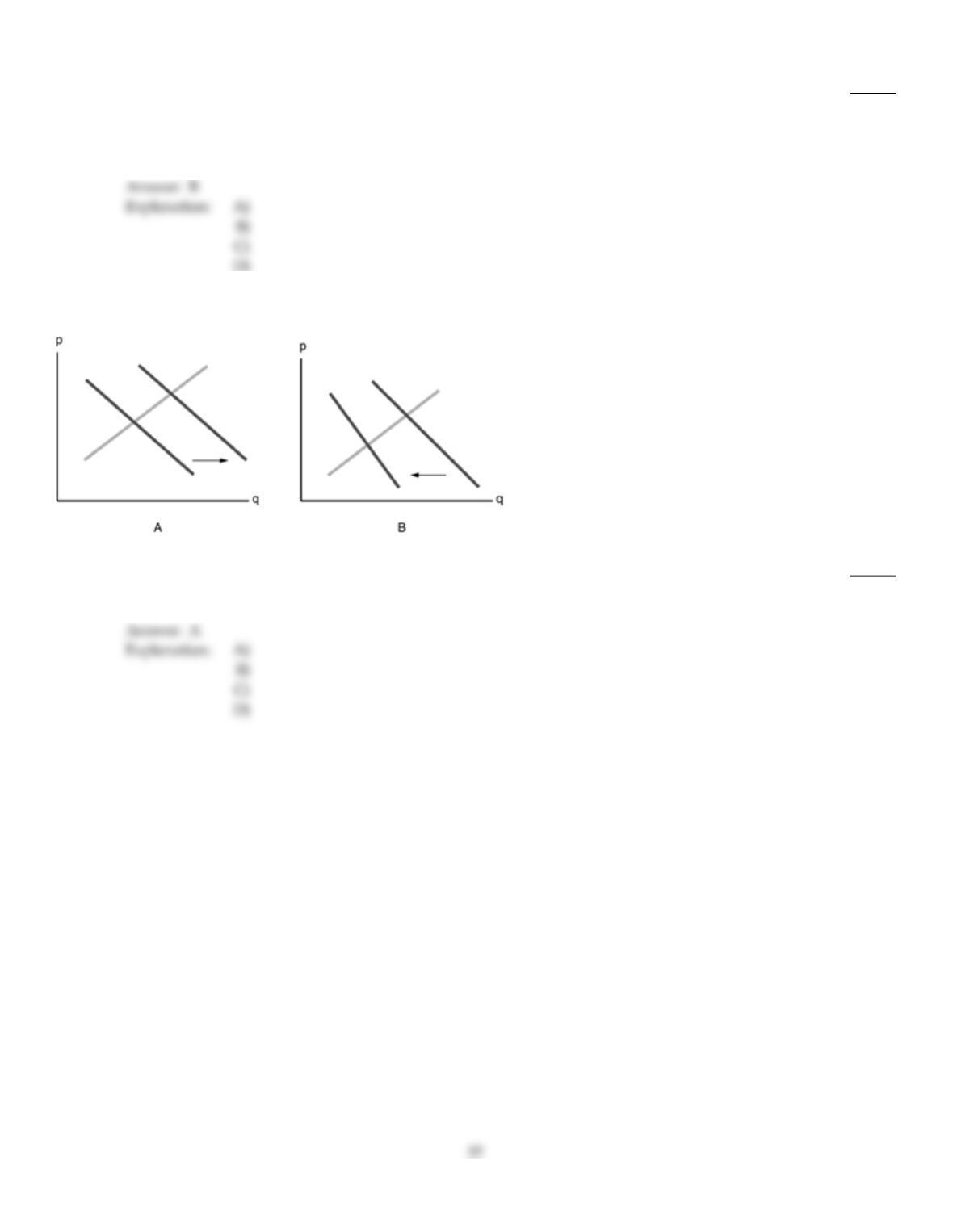
Refer to the above figure. Which of the following statements is TRUE?
114)
A)
Both Panels A and B show an increase in demand.
B)
Panel A shows a decrease in demand and Panel B shows an increase in demand.
C)
Panel A shows a change in demand and Panel B shows a change in quantity demanded.
D)
Panel A shows a change in quantity demanded and Panel B shows a change in demand.
115)
Suppose a shortage for good X exists. Given this information, we know that
115)
A)
the price of good X will tend to fall toward the equilibrium level.
B)
a government price floor should be imposed above the current price so that the market can
work more effectively.
C)
a government price ceiling should be imposed above the current price so that the market can
work more effectively.
D)
the price of good X will tend to rise toward the equilibrium level.
116)
We observe that people buy less steak and more potatoes when the price of steak relative to
potatoes increases. This indicates that steak and potatoes are
116)
A)
unrelated goods.
B)
complements.
C)
inferior goods.
D)
substitutes.
117)
What type of relationship does the law of demand demonstrate?
117)
A)
static
B)
positive
C)
inverse
D)
direct
118)
Refer to the above figure. Which diagram shows the effect on the market of Corn Flakes when the
demand for Corn Flakes has increased?
118)
A)
graph C
B)
graph D
C)
neither graph
D)
both graphs
119)
A demand curve
119)
A)
can slope up or down depending on the tastes of the consumer.
B)
is vertical for necessities, upward sloping for luxury goods, and downward sloping for all
other goods.
C)
slopes down because of the inverse relationship between price and quantity demanded.
D)
slopes up because of the direct relationship between price and quantity demanded.
120)
When a rise in the price of one item results in a decrease in the demand for another good, then the
two goods are
120)
A)
satisfying the law of supply.
B)
complementary goods.
C)
inferior goods.
D)
substitute goods.
121)
If two goods, J and K, are complements, then which of the following statements is FALSE?
121)
A)
A decrease in the price of K causes an increase in the demand for J.
B)
When the quantity demanded of J increases, the demand for K increases.
C)
An increase in the price of J causes the demand for K to rise.
D)
They are consumed together.
122)
When producers anticipate that the price of their product will increase in the future
122)
A)
the supply curve will shift to the left.
B)
the current production will move along on the supply curve.
C)
the supply curve will shift to the right.
D)
they will immediately lobby Congress to adjust prices now.
Supplier 1 Supplier 2 Supplier 3
Quantity Supplied Quantity Supplied Quantity Supplied
Price (thousands) (thousands) (thousands)
8 11 720
7 8 615
6 5 510
5 2 4 5
123)
Refer to the above table. The market quantity supplied when the price is $6 is
123)
A)
20.
B)
10.
C)
5.
D)
0.
124)
A schedule of amounts of a good that people will purchase at various prices during a specific time
period holding other factors constant is
124)
A)
supply.
B)
demand.
C)
the market clearing price.
D)
a market.
125)
According to the law of demand
125)
A)
people buy more of a good when the price falls.
B)
people buy more of a good when their income rises.
C)
people buy more of a good when the price rises.
D)
people buy more of a good when the relative price rises.
126)
At a market clearing price
126)
A)
the quantity demanded will just equal the quantity supplied.
B)
the demand function will shift outward.
C)
there will be an excess quantity demanded.
D)
there will be a tendency for price to rise over time.
A
127)
An expected increase in the future price of automobiles will lead to
127)
A)
an outward shift in demand for automobiles today.
B)
a reduction in the demand for gasoline today.
C)
no predictable impact on today’s demand for automobiles.
D)
a movement down the demand schedule for automobiles.
A
128)
According to the law of demand, other things being equal
128)
A)
when the price a good goes up, then people buy less of that good.
B)
when the price a good goes up, then people buy more of that good.
C)
when people’s income goes up, then they buy more of a good.
D)
when people’s income goes up, then they buy less of a good.
A
A
129)
When there is an excess quantity of a product supplied, there will be
129)
A)
incentives for consumers to leave the market.
B)
upward pressure on the price of labor.
C)
a tendency for price of the product to fall.
D)
a tendency for price of the product to increase.
130)
If there is a decline in the price of milk, an input in the production of ice cream, then there will be
a(n)
130)
A)
decrease in the quantity of ice cream supplied and a movement up along the supply curve.
B)
decrease in the supply of ice cream and a leftward shift of the supply curve.
C)
increase in the supply of ice cream and a rightward shift of the supply curve.
D)
increase in the quantity of ice cream supplied and a movement down along the supply curve.
Quantity of Quantity of
Price DVDs DVDs
per CD Demanded Supplied
per Month per Month
$20 500 9000
18 1000 6000
16 1500 4500
14 2000 3500
12 2500 2500
10 3000 1500
83500 800
64000 100
131)
According to the above table, at a price of $16 per DVD, there is
131)
A)
a shortage of 3000 DVDs.
B)
an equilibrium.
C)
a shortage of 1500 DVDs.
D)
a surplus of 3000 DVDs.
132)
A market is in equilibrium when
132)
A)
the equilibrium price is below the market price.
B)
the quantity demanded equals the quantity supplied at the market clearing price.
C)
the horizontal axis crosses the vertical axis.
D)
buyers do not desire for the price to be any lower.
133)
Refer to the above figure. Suppose that Cheerios and Apple Jacks are substitutes. Which diagram
shows the effect on the demand for Cheerios when the price of Apple Jacks cereal has increased?
133)
A)
A
B)
B
C)
neither graph
D)
both graphs
134)
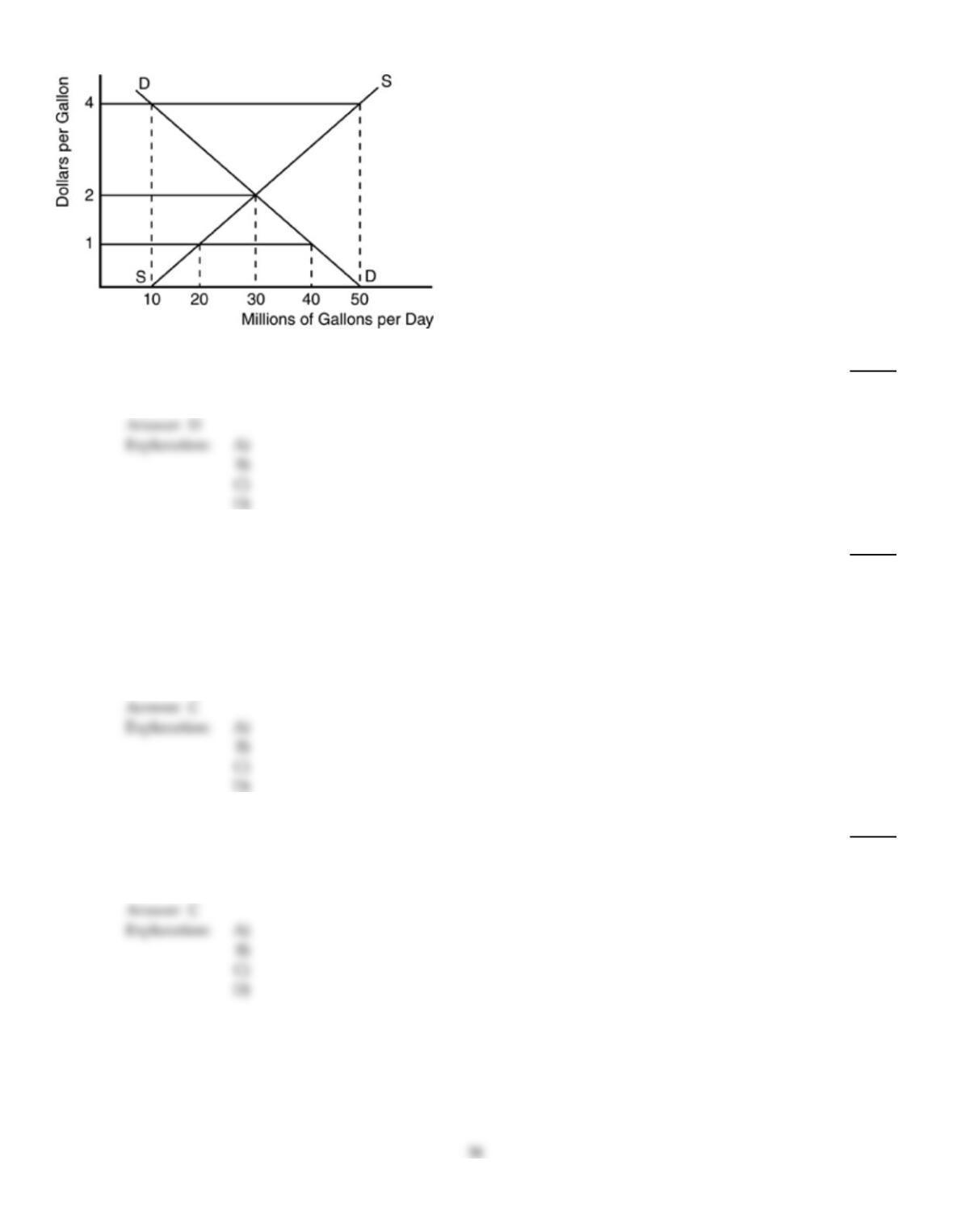
In the above figure, a surplus exists in the gasoline market when the price is
134)
A)
below $2/gallon.
B)
$2/gallon.
C)
$1/gallon.
D)
$4/gallon.
135)
After the price of smartphone apps falls, Justin buys fewer flash drives but he buys a new
smartphone. For Justin
135)
A)
smartphone apps, flash drives, and smartphones are not all complements.
B)
smartphone apps and flash drives are complements, and smartphone apps and smartphones
are substitutes.
C)
smartphone apps and flash drives are substitutes, and smartphone apps and smartphones are
complements.
D)
smartphone apps, flash drives, and smartphones are all complements.
136)
The law of demand includes the statement “other things being equal.” These other things include all
of the following EXCEPT
136)
A)
tastes.
B)
the price of related goods.
C)
the price of the good itself.
D)
incomes.
137)
If the demand of a good is inversely related to income, it must be
137)
A)
a bad good.
B)
a normal good.
C)
an inferior good.
D)
an everyday product.
138)
Total market supply can be derived by
138)
A)
looking at the changes in the price of raw materials needed to produce the product.
B)
horizontally summing individual supply curves at each and every price level.
C)
vertically summing individual supply curves at the current technology level.
D)
adding up the largest quantity demanded at various prices.
139)
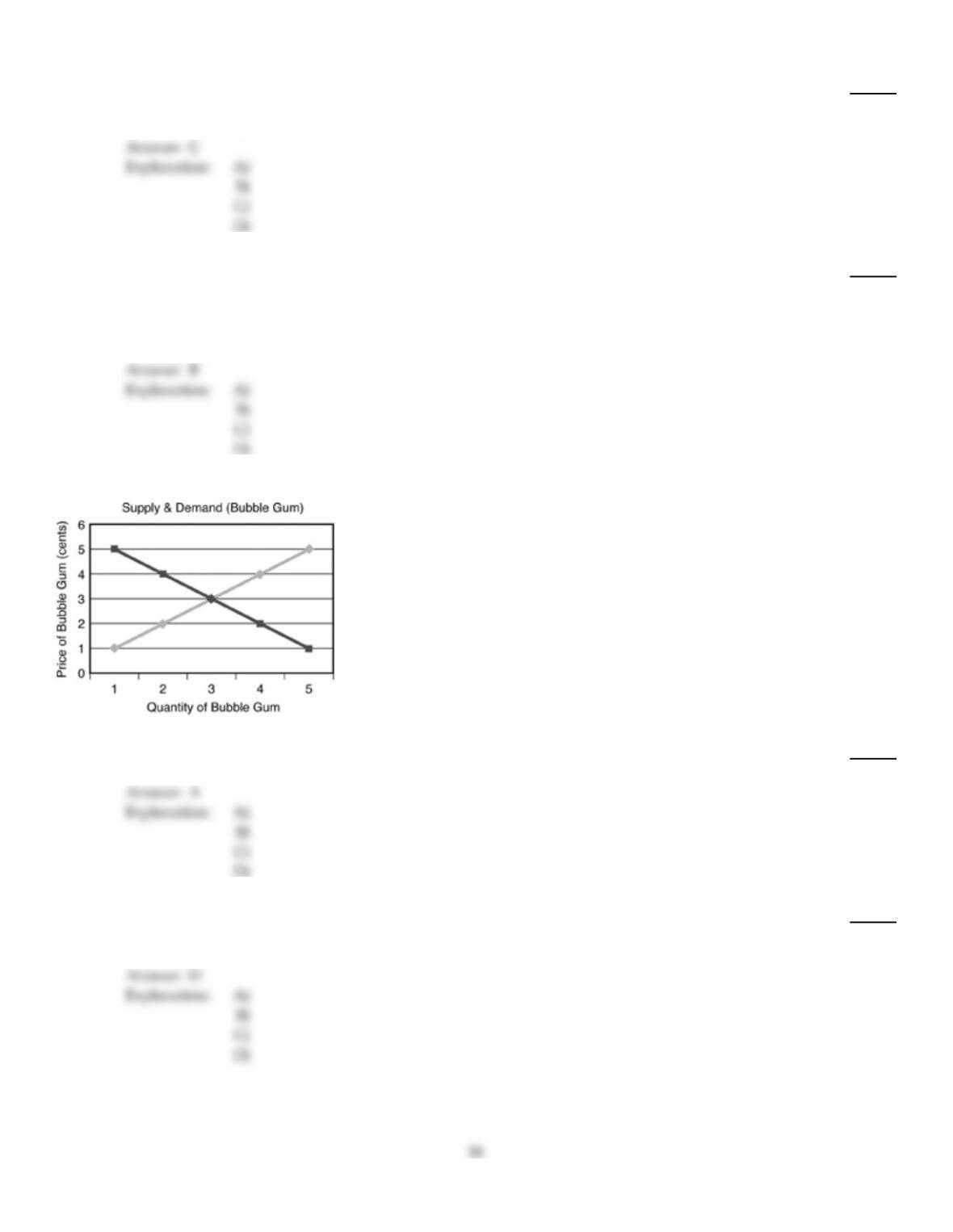
Refer to the above figure. At a price of four cents, the quantity of bubble gum supplied will be
139)
A)
4.
B)
3.
C)
5.
D)
2.
140)
A demand curve is a graphical representation of
140)
A)
relative prices.
B)
consumer tastes.
C)
national income.
D)
the demand schedule.
141)
A supply schedule
141)
A)
is a table reflecting the inverse relationship between price and quantity supplied.
B)
shows what happens to quantity supplied when price is held constant.
C)
can be used to generate a supply curve.
D)
all of the above.
142)
As John’s income has increased, he has purchased fewer hamburgers. Hamburgers are
142)
A)
leading to a rightward shift in John’s demand curve for hamburgers.
B)
not following the law of demand.
C)
a normal good for John.
D)
an inferior good for John.
143)
Assuming coffee and cola are substitutes, if the price of coffee rises
143)
A)
the demand curve for coffee will shift to the right.
B)
the demand curve for coffee will shift to the left.
C)
there is a movement along the demand curve for cola.
D)
the demand curve for cola will shift to the right.
144)
A fundamental principle in demand analysis is that a change in price leads to
144)
A)
a leftward shift of the demand curve.
B)
a complementary movement on the supply curve.
C)
a rightward shift of the demand curve.
D)
a movement along the demand curve.