106. The intermingling of performance of one period with that of preceding or succeeding periods is
characteristic of which basis of accounting?
Cash basis Accrual basis
107. The net income for a period and the financial position at the end of the period are
108. The accrual basis of accounting is often contrasted with the cash basis of accounting. Which of the
following is/are true of the cash basis of accounting?
109. The _____ are linked (that is, they articulate) through the shareholders’ equity account, Retained
Earnings.

110. Solve for the unknown item for each of the following independent situations.
CASE A
CASE B
CASE C
Total assets
A
400
600
Contributed capital
100
150
C
Total revenues
400
300
400
Total liabilities
600
B
250
Beginning retained earnings
(50)
100
100
Total expenses
250
350
200
Dividends
0
50
0
111. The accounting records for Pocket’s Restaurant Supply contained the following data for the current year:
Sales
$547,500
Cost of goods sold
223,800
Interest revenue
6,500
Rent revenue
3,600
Administrative expense
141,300
Selling expense
133,600
Interest expense
15,400
Income tax expense
8,100
Loss on sale of warehouse
6,500
Required:
Prepare both a single-step and a multi-step income statement for Campbell’s for the current year.
Sales revenue
$547,500
Interest revenue
6,500
Rent revenue
3,600
Total revenues and gains
$557,600
Cost of goods sold
223,800
Administrative expense
141,300
Selling expense
133,600
Interest expense
15,400
Loss on sale of warehouse
6,500
Income taxes
8,100
Total expenses and losses
528,700
Net Income
$ 28,900
Sales revenue
$547,500
Less: Cost of Goods Sold
223,800
Gross Profit
$323,700
Less: Administrative expense
141,300
Selling expense
133,600
274,900
Operating income
48,800
Other income and gain and losses
Interest revenue
6,500
Rent revenue
3,600
Interest expense
(15,400)
Loss on sale of warehouse
(6,500)
(11,800)
Income before income taxes
37,000
Income taxes
(8,100)
Net income after income taxes
$ 28,900
112. (CMA adapted, Dec 95 #5) The conceptual framework of accounting theory governs the recognition of
revenue and expenses. Revenue is generally recognized at the point of sale; however, under special
circumstances, bases other than the point of sale are used for the recognition of revenue. Costs are generally
recognized as expenses at the time of product sale; however, there are guidelines for recognizing expenses by
other criteria. Accountants must be familiar with these concepts when determining the earnings of a company.
Required:
a.
Explain why the point of
sale is generally used as the
basis for revenue
recognition.
b.
Two other acceptable bases
for the recognition of
revenue are: (a) recognizing
revenue when cash is
received; and (b)
recognizing revenue
periodically during
production. For each of
these two alternatives,
1.
Discuss the accounting methods used and the rationale for their use.
2.
Give an example of the circumstances when each method should be used.
c.
For each of the following
circumstances, explain the
rationale for expense
recognition.
1.
Recognizing costs as expenses at the time of sale.
2.
Treating costs as expenses of a period rather than assigning the costs to an asset.
3.
Assigning expenses to specific accounting periods on the basis of the systematic and rational allocation of asset
costs.
113. Certain merchandise that a firm may acquire may be inventory or supplies. Accounting treats them
differently as to the matching criteria used.
Required:
a.
Describe the situation where merchandise would be considered inventory. How would the firm account for the costs of the
merchandise?
b.
Describe the situation where merchandise would be considered supplies. How would the firm account for the costs of the merchandise?

114. The following cash-basis income statement has been prepared for the first year of business.
Avalanche,
Inc.
Statement of
Cash Receipts
and
Expenditures
For the Year
Ending
December 31,
Year 1
Cash Receipts
from Sales of
Merchandise
$25,000
Less:
Cash Expenditures for Merchandise and
Services
Merchandise
$10,000
Salaries
5,000
Rent
7,000
Total Cash Expenditures
22,000
Excess of
Cash Receipts
over Cash
Expenditures
$ 3,000
At year-end, the firm had inventory with a cost of $2,000 remaining. Also, customers owed $1,000 for goods that had already been delivered. The
utilities for December were $500 and were billed to but not yet paid by the company. The rent of $3,500 for January, Year 2, was paid in December,
Year 1.
Required:
Prepare an accrual-basis income statement for the year.
Sales
Revenue
$26,000
Less:
Expenses
Cost of Goods Sold
$8,000
Salaries Expense
5,000
Rent Expense
3,500
Net Income
$ 9,000
115. Cookie and Clark incorporate as CC Designs, Inc. on January 1, Year 1. CC Designs creates custom wall
finishes and sells painting products. The following transactions occur during January.
a.
Clark contributes cash of $75,000 and receives 15,000 shares of $1 par value stock.
b.
Cookie contributes $35,000 cash, office furniture with a value of $5,000, and computer equipment with a value of $10,000 and receives
15,000 shares of $1 par value stock. The furniture and equipment is expected to last 5 years and has no salvage value.
c.
On January 2, $10,000 of painting products were purchased. CC paid $8,000 cash with the remaining amount on account.
d.
During January, painting products are sold for $8,000 cash. The cost of the products is $2,000.
e.
Additional painting products with a value of $5,000 are sold, with a cost of $1,500, but the cash is not collected as of January 31st. It is
expected that the $5,000 will be collected in full by February 15th.
f.
Clark is paid a salary of $2,000.
g.
CC paid $1,200 for January and February rent.
Required:
Prepare appropriate accrual basis journal entries.

116. Assume that a firm uses the accrual basis of accounting. For each of the following independent cases,
indicate the amount of revenue the firm recognizes for the month of August.
a.
Collects $2,000 in July for merchandise to be delivered in August.
b.
Collects $1,200 in May for subscriptions that will be delivered during the next twelve months (beginning in May).
c.
Collects $800 in August for merchandise sold and delivered in July.
d.
Collects $2,400 interest on a 6-month certificate of deposit, which matures on August 15th.
e.
Sells $3,000 of merchandise on account in August. The firm allows a 2% discount for payment prior to 30 days and customers take the
discount.
117. Parson Services Corporation was organized on January 1, Year 8. The unadjusted trial balance on
December 31, Year 8 after recording transactions that occurred during Year 8 is as follows.
Parson Services Corporation
Unadjusted Trial Balance
December 31, Year 8
Debit
Credit
Cash
$125,000
Fees Receivable
112,000
Notes Receivable
115,000
Office Supplies Inventory
11,800
Prepaid Insurance
12,200
Furniture and Equipment
155,000
Accumulated Depreciation
0
Accounts Payable
$113,000
Common Stock
365,000
Fee Revenues
195,000
Rent Expense
19,500
Office Salaries Expense
122,500
$673,000
$673,000
Below is the income statement for Year 8 that was prepared after making appropriate adjusting entries for Year 8.
Parson Services
Corporation
Income Statement
For the Year Ended
December 31, Year 8
1.
Fee Revenues
$199,400
2.
Interest Revenue on Notes Receivable
11,500
Total Revenues
$210,900
3.
Depreciation Expense
(15,500)
4.
Rent Expense
(18,700)
5.
Insurance Expense
(11,800)
6.
Office Supplies Expense
(11,500)
7.
Office Salaries Expense
(124,000)
Net Income
$ 29,400
Required:
Give the adjusting entries that Parson Services Corporation must have made at the end of Year 8 for each of the seven income statement accounts.
You may express the adjusting entries either in the form of journal entries or T accounts.
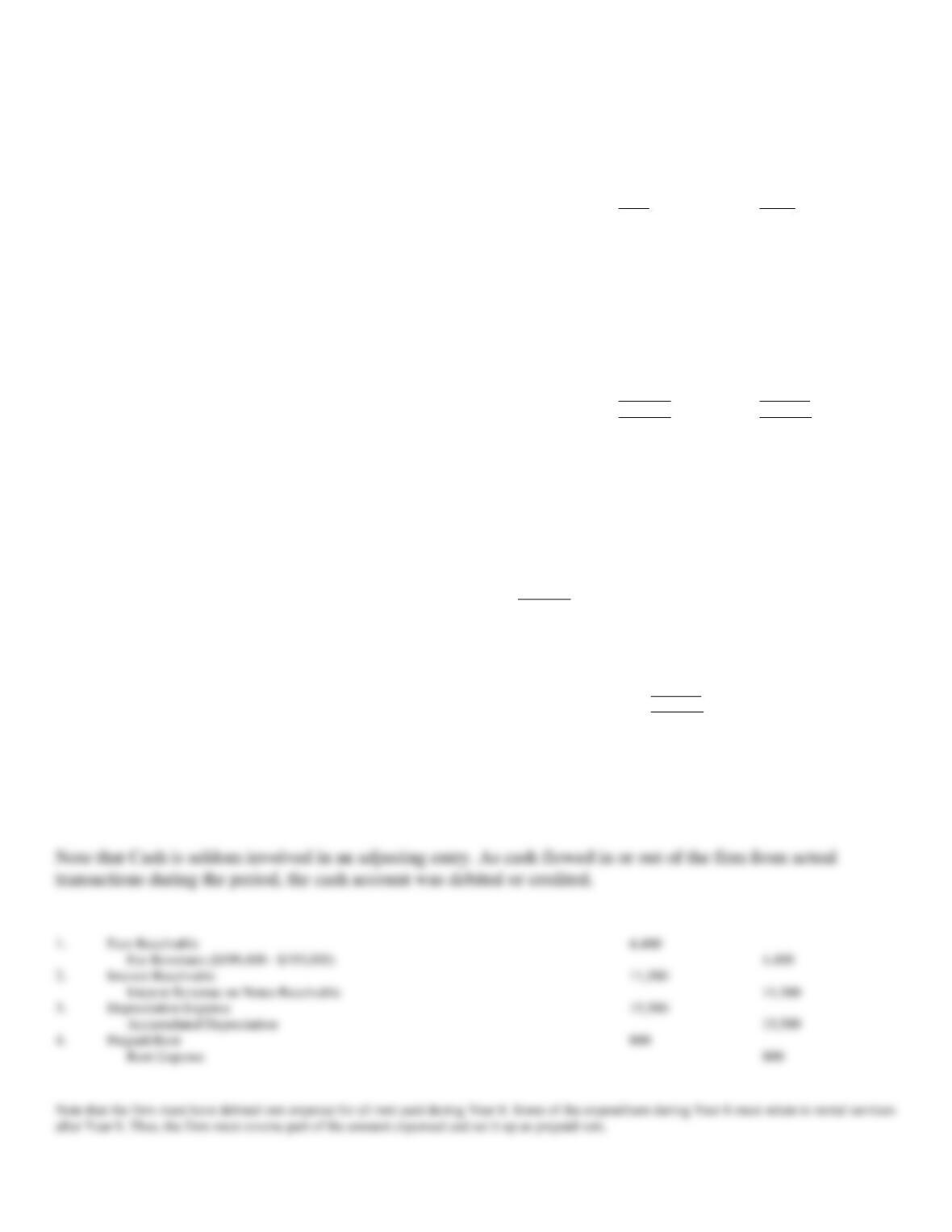
1.
Fees Receivable
4,400
Fee Revenues ($199,400 – $195,000)
4,400
2.
Interest Receivable
11,500
Interest Revenue on Notes Receivable
11,500
3.
Depreciation Expense
15,500
Accumulated Depreciation
15,500
4.
Prepaid Rent
800
Rent Expense
800
118. Humana Corporation neglected to make various adjusting entries on December 31, Year 8. Indicate the
effects on assets, liabilities, and shareholders’ equity on December 31, Year 8 of failing to adjust for the
following independent items as appropriate, using the notation O/S (overstated), U/S (understated), and No (no
effect). Also, give the amount of the effect. Ignore income tax implications. Use the following format:
Effect of Errors or
Omissions on
December 31, Year 8
Balance Sheet
Assets
Liabilities
Shareholders’ Equity
Item
Direction
Amount
Direction
Amount
Direction
Amount
a.
On December 15, Year 8, Humana Corporation received a $1,400 advance from a customer for products to be manufactured and
delivered in January, Year 9. The firm recorded the advance by debiting Cash and crediting Sales Revenue and has made no adjusting
entry as of December 31, Year 8.
b.
On July 1, Year 8, Humana Corporation acquired a machine for $5,000 and recorded the acquisition by debiting Cost of Goods Sold and
crediting Cash. The machine has a five-year useful life and zero estimated salvage value.
c.
On November 1, Year 8, Humana Corporation received a $2,000 note receivable from a customer in settlement of an accounts
receivable. It debited Notes Receivable and credited Accounts Receivable upon receipt of the note. The note is a six-month note due
April 30, Year 9 and bears interest at an annual rate of 12 percent. Humana Corporation made no other entries related to this note during
Year 8.
d.
Humana Corporation paid its annual insurance premium of $1,200 on October 1, Year 8, the first day of the year of coverage. It debited
Prepaid Insurance $900, debited Insurance Expense $300, and credited Cash for $1,200. It made no other entries related to this
insurance during Year 8.
e.
The Board of Directors of Humana Corporation declared a dividend of $1,500 on December 31, Year 8. The dividend will be paid on
January 15, Year 9. Humana Corporation neglected to record the dividend declaration.
f.
On December 1, Year 8, Humana Corporation purchased a machine on account for $50,000, debiting Machinery and crediting Accounts
Payable for $50,000. Ten days later, the account was paid and the company took the allowed 2 percent discount. Cash was credited
$49,000, Miscellaneous Revenue was credited $1,000, and Accounts Payable was debited $50,000. It is the policy of Humana
Corporation to record cash discounts taken as a reduction in the cost of assets. On December 28, Year 8, the machine was installed for
$4,000 in cash; Maintenance Expense was debited and Cash was credited for $4,000. The machine started operation on January 1, Year
9. As the machine was not placed into operation until January 1, Year 9, as appropriate, no depreciation expense was recorded for Year
8.
Assets
Liabilities
Shareholders’ Equity
Item
Direction
Amount
Direction
Amount
Direction
Amount
U
$1,400
O
$1,400
U
$4,500
U
$4,500
U
$ 40
U
$ 40
U
$3,000
U
$3,000
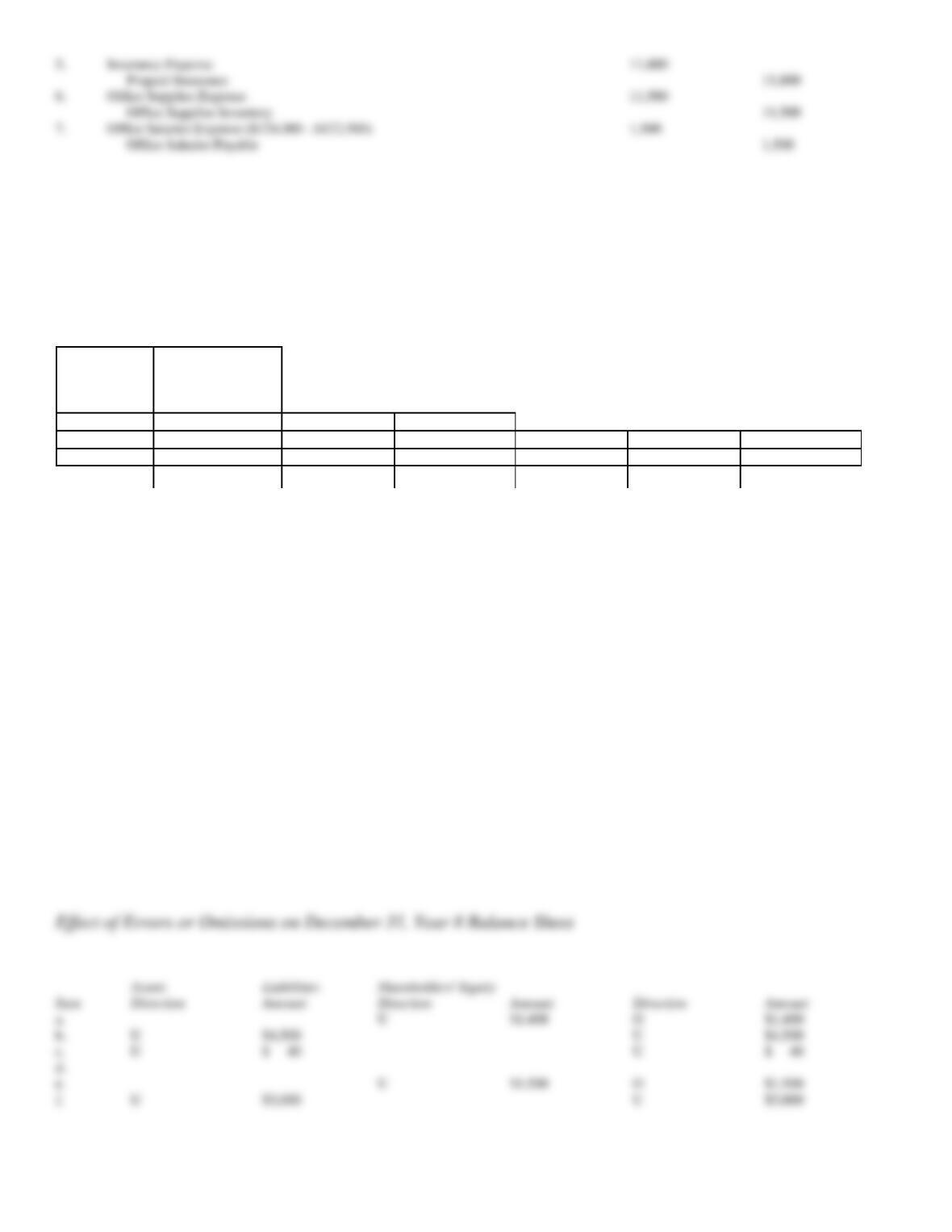
Insurance Expense
11,800
Prepaid Insurance
11,800
Office Supplies Expense
11,500
Office Supplies Inventory
11,500
Office Salaries Expense ($124,000 – $122,500)
1,500
Office Salaries Payable
1,500

119. Entries for the following items were either omitted or recorded incorrectly in preparing the financial
statements for Year 4. Indicate the amount and nature [understatement (U), overstatement (O), no effect (N)] of
the effect of the omission on total assets, total liabilities, and net income for Year 4. Ignore income tax effects.
Use the following format:
Total Assets
Total Liabilities
Net Income
a.
The company received a payment of $4,600 from a customer for an order that the company has not yet produced. It credited the $4,600 to
sales revenue.
b.
The company failed to record a dividend of $5,000 that was declared but not yet paid.
c.
The company repaid a loan of $5,000 to the bank. It recorded the transaction in the appropriate accounts but in the amount of $50,000. The
company has accounted for all interest on the loan correctly.
d.
The ending balance of finished goods inventory was incorrectly recorded at $4,000 more than its proper balance due to a mistake in taking
a physical inventory.
e.
The company correctly entered a stock issue of $22,000 on December 31, Year 4, in the cash account but mistakenly credited it to Bonds
Payable.
f.
On the basis of an incorrect report from the company’s credit collection agency, specific accounts receivable of $2,700 were written off,
but are actually expected to be collectible accounts. The company correctly made a provision for estimated uncollectible accounts for year
4.
Total Assets
Total Liabilities
Net Income
b.
N
U; $5,000
N
U; $45,000
U; $45,000
N
d.
O; $4,000
N
O; $4,000
N
N
N