64)
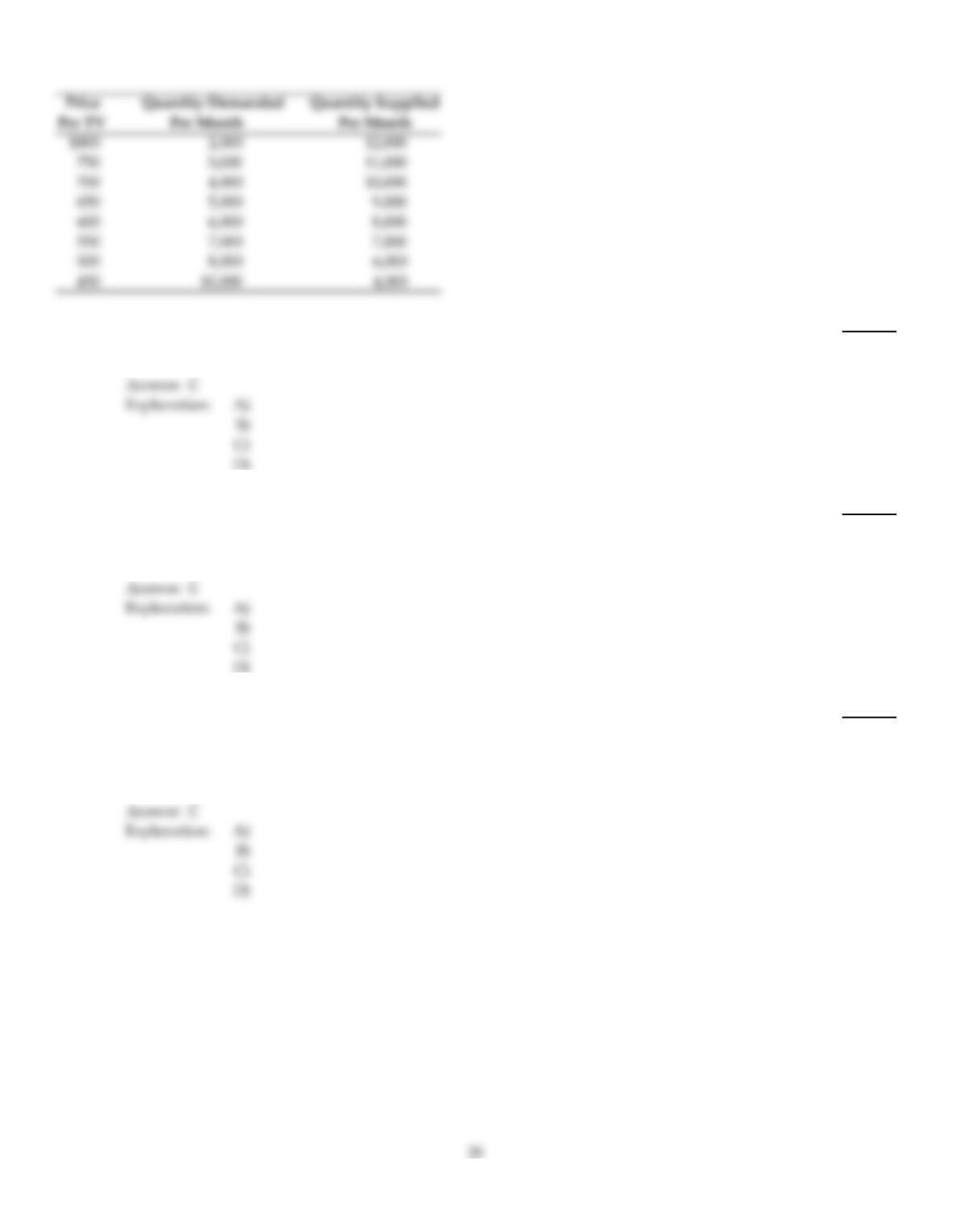
Refer to the above table. At a price of $450, there is an
64)
A)
excess quantity demanded of 9,000 TVs.
B)
equilibrium.
C)
excess quantity demanded of 6,000 TVs.
D)
excess quantity supplied of 4,000 TVs.
65)
Suppose it is discovered that consumption of butter leads to a longer life. This information would
lead to
65)
A)
a decrease in quantity demanded.
B)
a decrease in demand.
C)
an increase in demand.
D)
an increase in quantity demanded.
66)
John increases his consumption of Good X and Good Y when his income increases. For John
66)
A)
Good X and Good Y are complement goods.
B)
Good X is an inferior good.
C)
Good X and Y are normal goods
D)
Good X and Good Y are substitute goods.
67)
The price of a new textbook increases from $75 to $90 while the price of used copies of the textbook
increases from $50 to $65. Other things equal, we would expect to observe
67)
A)
the demand for the new textbook to increase while the demand for the used textbook to
decrease.
B)
the quantity demanded of both to fall.
C)
the quantity demanded of the used textbook to decrease and the quantity demanded of the
new textbook to increase.
D)
the quantity demanded of the used textbook to increase while the quantity demanded of the
new textbook to fall.
68)
The equilibrium or market clearing price occurs at the point at which
68)
A)
the supply curve intersects the horizontal axis.
B)
the demand curve intersects the vertical axis.
C)
there is a shortage of the desired good.
D)
quantity demanded equals quantity supplied.
69)
When income rises,
69)
A)
demand for a normal good falls.
B)
demand for an inferior good rises.
C)
quantity of a normal good demanded rises.
D)
demand for a normal good rises.
70)
Kariuki decreases his consumption of grapes after his income goes up. For Kariuki
70)
A)
grapes and income are substitute goods.
B)
grapes are an inferior good.
C)
grapes and income are complementary goods.
D)
grapes are a superior good.
71)
A subsidy to carrot farmers will
71)
A)
increase the supply of carrots.
B)
decrease the quantity of carrots supplied.
C)
increase the quantity of carrots demanded.
D)
leave both the supply and demand of carrots unchanged.
72)
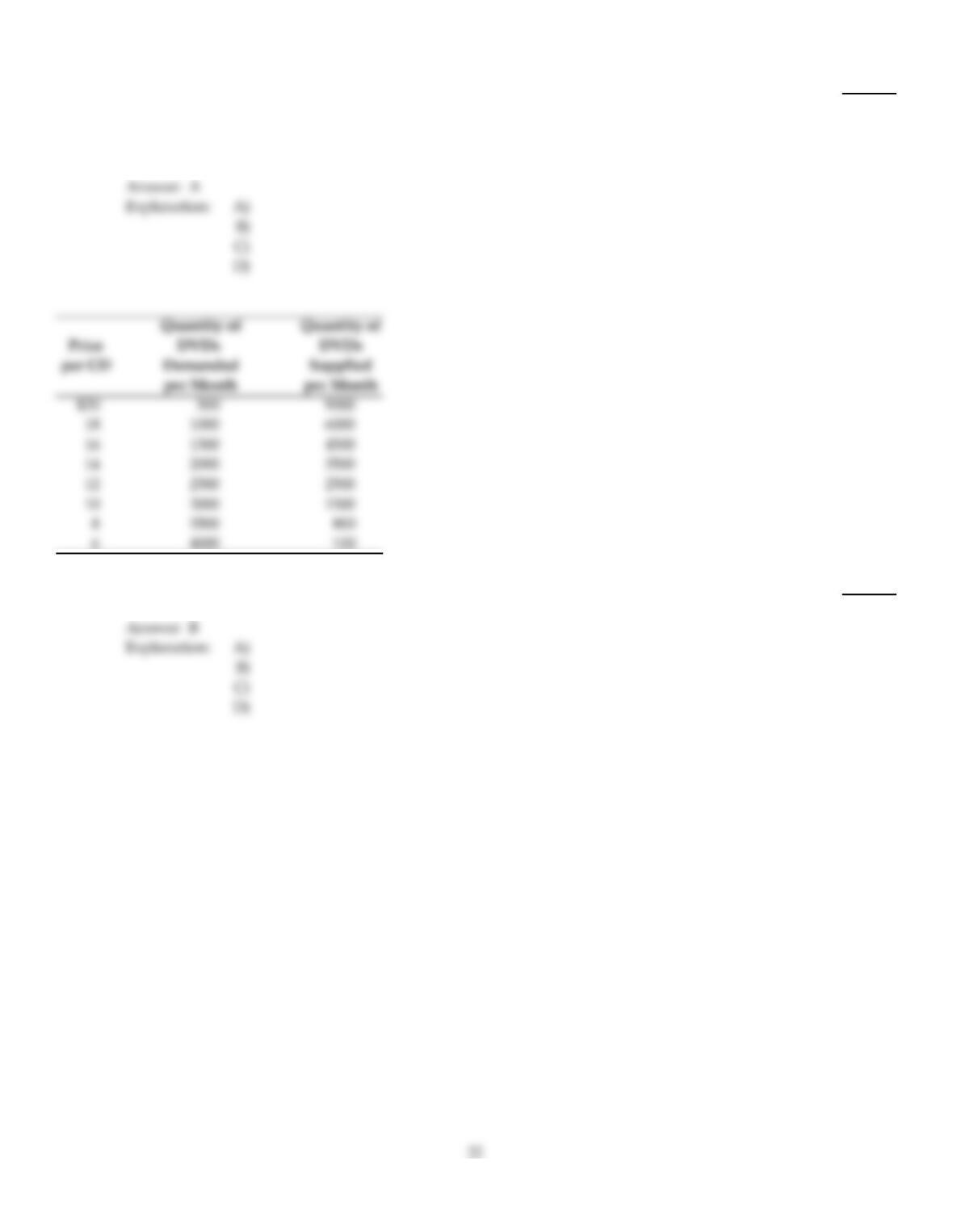
According to the above table, the equilibrium price of DVDs is
72)
A)
$14.
B)
$12.
C)
$16.
D)
$10.
73)
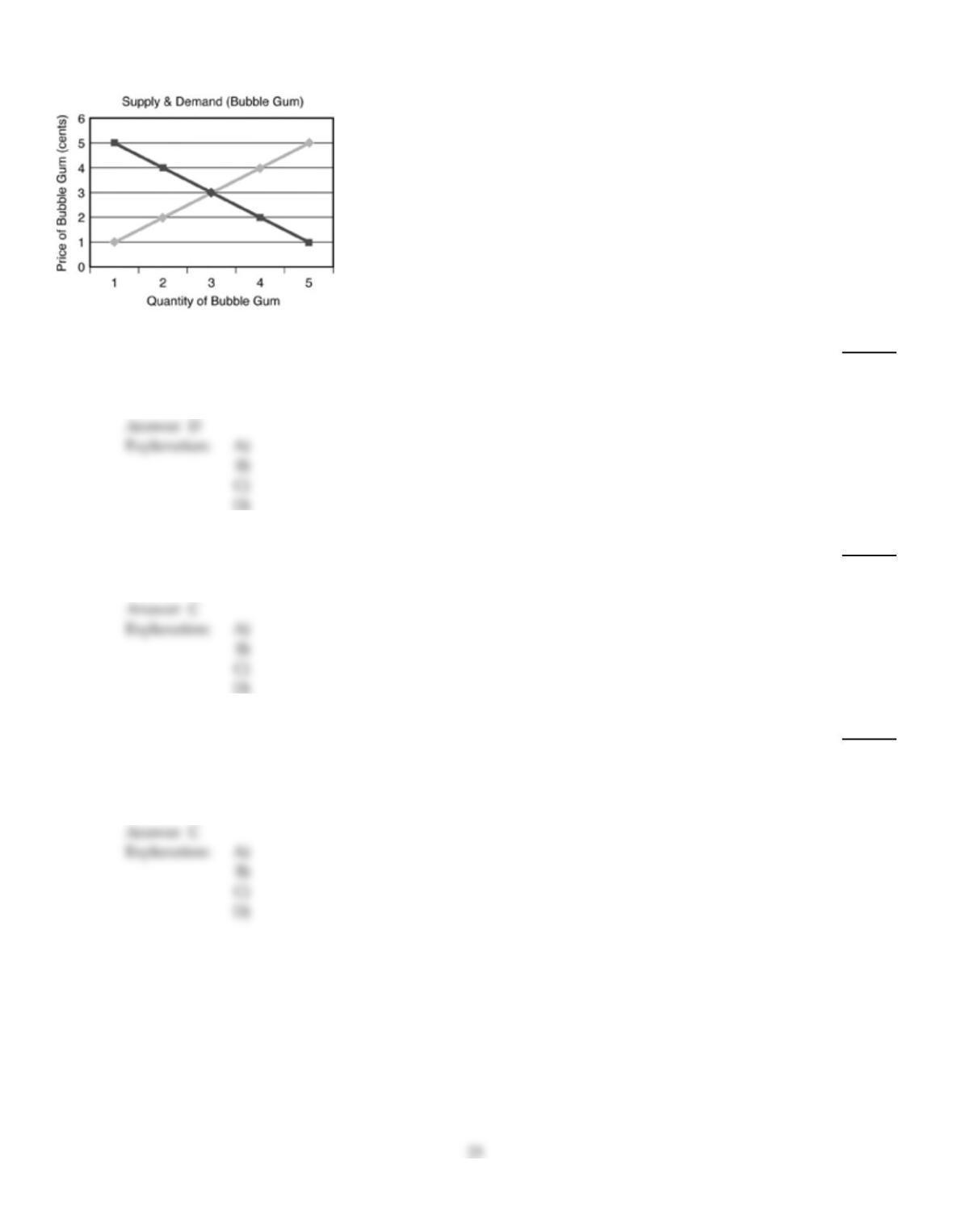
Refer to the above figure. At a price of three cents, a(n) ________ of bubble gum will exist in the
market.
73)
A)
surplus
B)
shortage
C)
excess quantity supplied
D)
equilibrium quantity
74)
The supply curve has a
74)
A)
negative slope.
B)
slope equal to –1.
C)
positive slope.
D)
undefined slope.
75)
At a market clearing price,
75)
A)
there will be a tendency for price to rise over time.
B)
there will be an excess quantity demanded.
C)
the quantity demanded will just equal the quantity supplied.
D)
the demand function will shift outward.
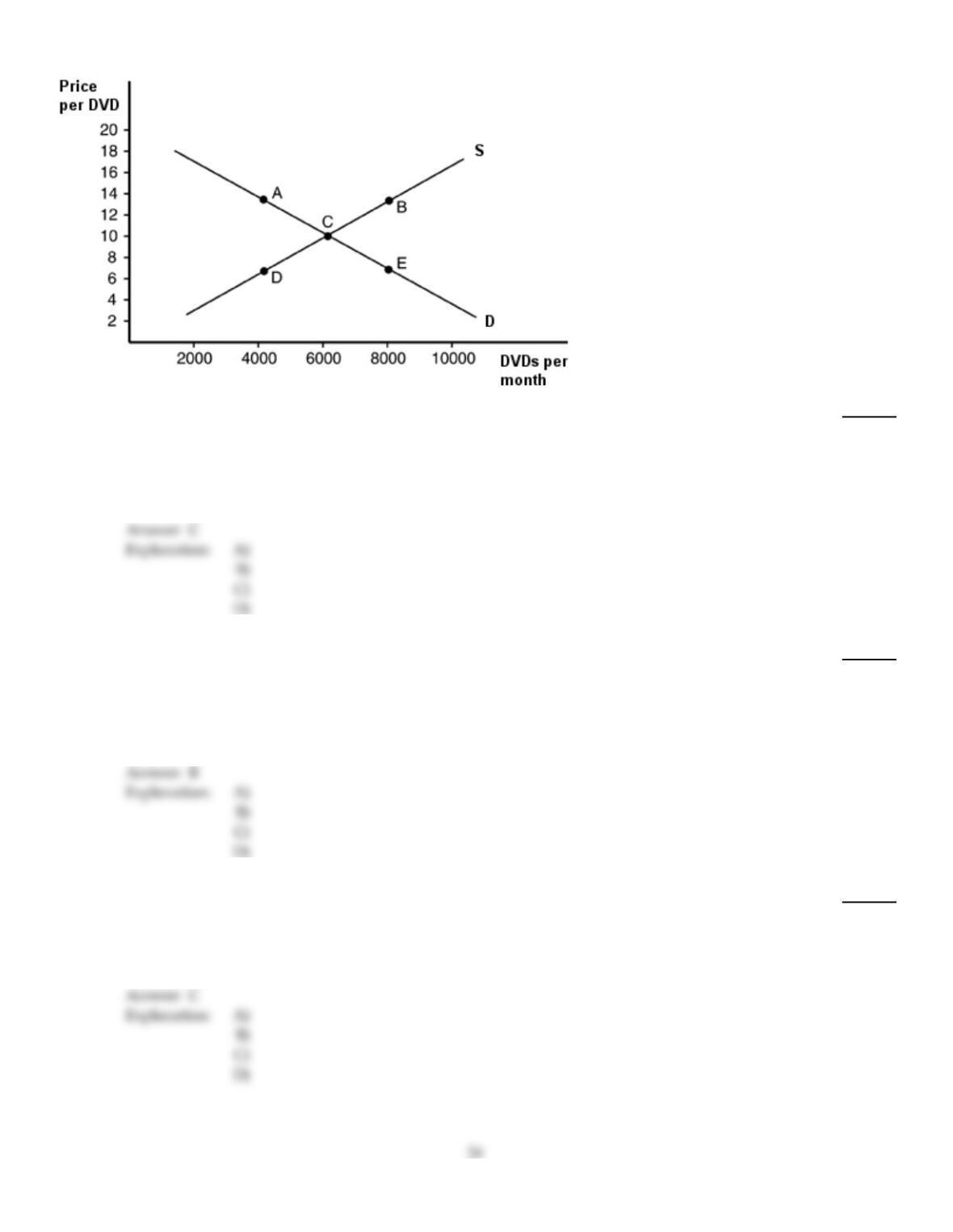
76)
Suppose a change takes place and the new equilibrium is at point A in the above figure. This
change could have been caused by
76)
A)
a reduction in the price of CD players.
B)
a decrease in the income of consumers.
C)
an increase in the per–unit tax on CDs.
D)
a reduction in the wages paid to workers in the CD industry.
77)
Gasoline prices in the United States decreased significantly between 2008 and 2009. A decrease in
the price of gasoline, holding other things constant, will cause which of the following to occur?
77)
A)
decrease the demand for gasoline.
B)
increase the quantity of gasoline demanded.
C)
decrease the quantity of gasoline demanded.
D)
increase the demand for gasoline.
B
78)
When the amount supplied is greater at each price, there is a(n)
78)
A)
leftward shift in the supply curve.
B)
upward movement along the supply curve.
C)
rightward shift in the supply curve.
D)
downward movement along the supply curve.
C
C
79)
In economic terminology, a normal good is a good
79)
A)
that is liked only by normal people.
B)
for which demand increases when price increases.
C)
for which demand increases when income increases.
D)
on which a monetary value cannot be placed.
80)
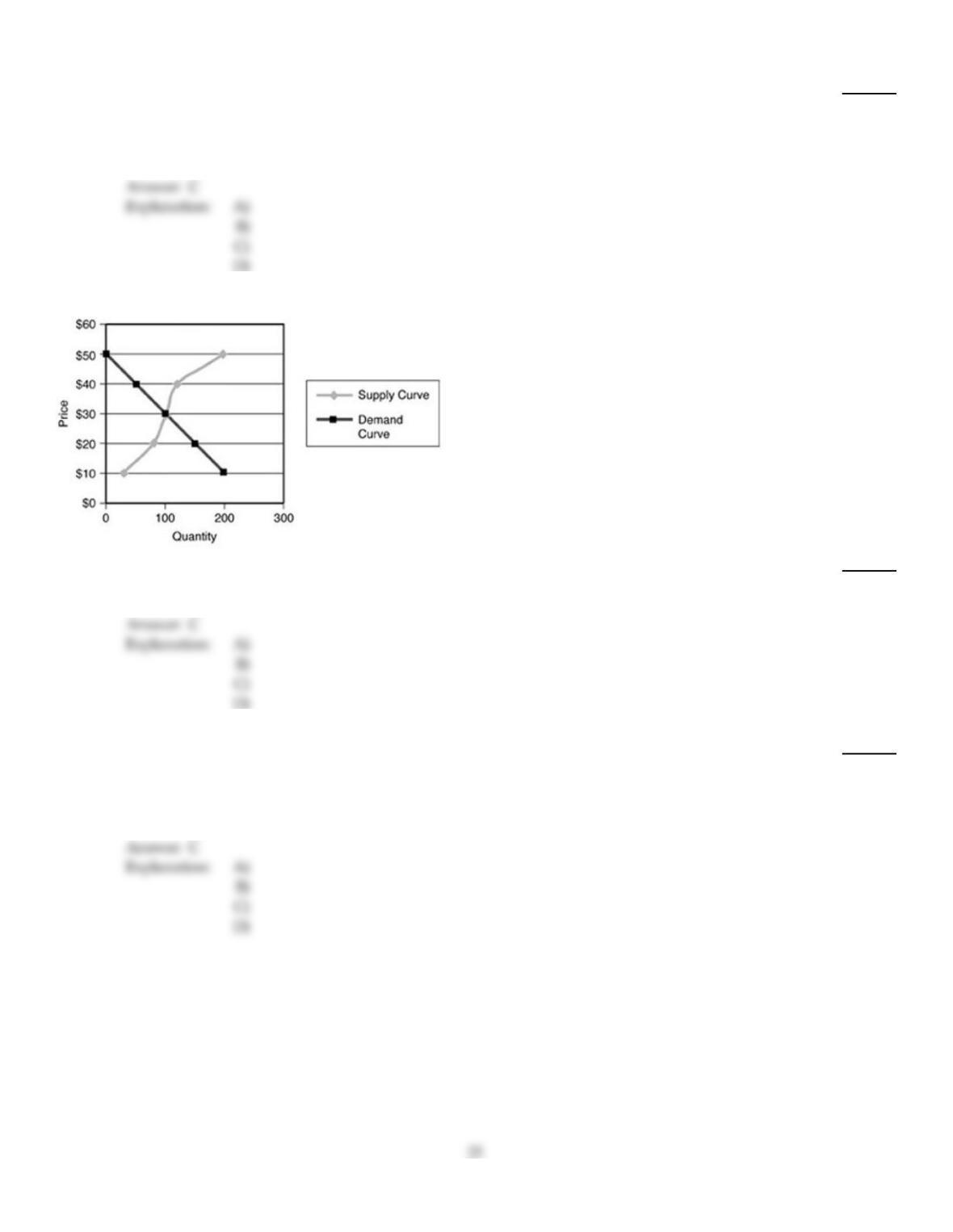
In the above figure, if the price is equal to $50, there is
80)
A)
an inadequate supply of 100 units.
B)
an excess quantity demanded of 50 units.
C)
a surplus of 200 units.
D)
a shortage of 100 units.
81)
A shortage exists
81)
A)
when quantity supplied is greater than quantity demanded.
B)
at the market clearing price.
C)
when quantity supplied is less than quantity demanded.
D)
in equilibrium.
82)
The price of a gallon of gasoline increased from $2.00 to $2.25 while the price of a ride on the city
bus increased from 50 cents to 75 cents. The relative price of riding the city bus
82)
A)
decreased from 4.0 to 3.0.
B)
stayed constant at 4.0.
C)
increased from 0.25 to 0.6.
D)
stayed constant at 0.25.
83)
Suppose that milk producers expect that the price of milk is going to drop next week. This would
cause
83)
A)
the selling price of milk to rise today.
B)
an increase in the demand for milk today.
C)
a decrease in the supply of milk today.
D)
an increase in the supply of milk today.
D
84)
Ceteris paribus, as the price of a good or service increases,
84)
A)
people will buy less of it.
B)
people will want less of it.
C)
people will buy more of it.
D)
people will want more of it.
A
85)
By summing the quantities demanded by individuals at each price we obtain the
85)
A)
market supply curve.
B)
individual demand curve.
C)
market demand curve.
D)
equilibrium price.
C
86)
The market supply curve is found by
86)
A)
horizontally summing up the supply curves of individual firms.
B)
estimating what the supply curve would be of one huge firm large enough to serve the entire
market.
C)
surveys of consumer groups.
D)
vertically summing up the equilibrium prices of individual firms.
A
C
87)
A change in the ceteris paribus conditions for supply will lead to a
87)
A)
change in quantity supplied.
B)
change in quantity supplied and a change in supply.
C)
change in how consumers view the quality of the good.
D)
change in supply.
88)
The price that we observe in the market is
88)
A)
the relative price.
B)
the money price.
C)
a substitute.
D)
the law of demand.
89)
Four points on a demand schedule are given: $12, 2 units; $10, 1 unit; $15, 1.5 units; and $2, 4 units.
Which combination is inconsistent with the law of demand?
89)
A)
$10 and 1 unit
B)
$15 and 1.5 units
C)
$2 and 4 units
D)
$12 and 2 units
90)
Graphically, the market supply curve is obtained by
90)
A)
changing the ceteris paribus conditions.
B)
vertically summing quantity supplied at various prices for individual producers.
C)
a change in quantity supplied.
D)
horizontally summing quantity supplied at various prices for individual producers.
91)
In economic terminology, an inferior good is a good
91)
A)
that has no monetary value.
B)
for which demand increases as income decreases.
C)
that no one will purchase.
D)
that doesn’t work properly.
92)
If the price of margarine falls, the demand for butter will
92)
A)
rise at first and then fall.
B)
decrease.
C)
remain unchanged.
D)
increase.
93)
If bagels and croissants are substitute goods, which of the following is likely to occur if the price of
bagels has decreased?
93)
A)
The demand curve for croissants shifts to the left.
B)
The demand curve for croissants shifts to the right.
C)
The demand curve for bagels shifts to the right.
D)
A leftward movement along the bagel demand curve.
A
94)
A change in quantity demanded
94)
A)
can be either a shift or a movement along the demand curve.
B)
is a shift of the demand curve.
C)
is caused when there is a change in a ceteris paribus factor.
D)
is a movement along the demand curve.
D
95)
A market demand curve is found by
95)
A)
adding the prices and the quantities demanded by a consumer.
B)
adding the quantities demanded for each individual consumer at each price.
C)
adding the prices each consumer would pay for each quantity.
D)
taking the demand curve of the “representative” consumer.
B
B
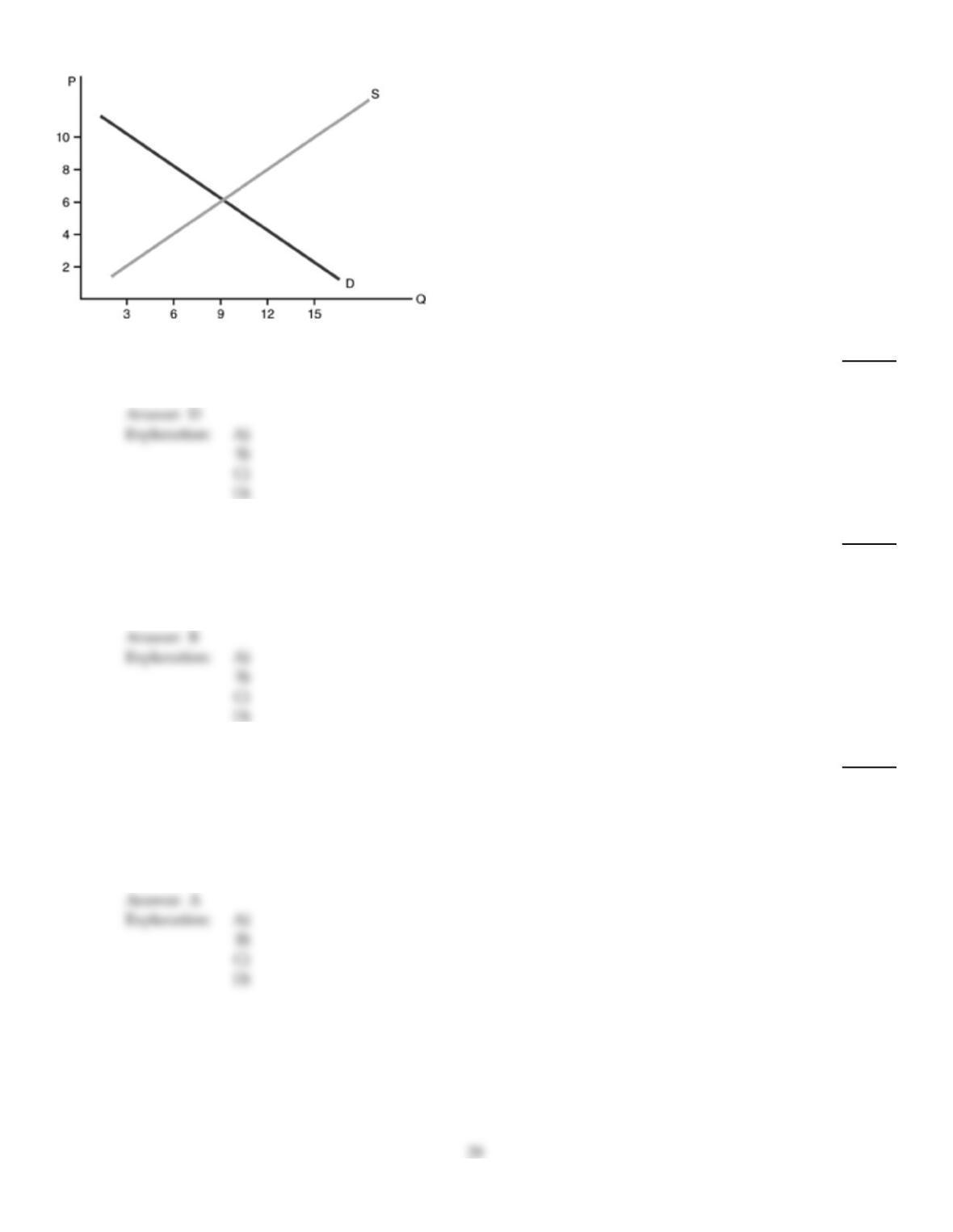
96)
Refer to the above figure. Excess quantity demanded will exist when
96)
A)
quantity demanded equals 3.
B)
the price equals $6.
C)
the price equals $10.
D)
the price is between $0 and $6.
97)
The law of demand states that there is
97)
A)
an inverse relationship between income and quantity demanded, ceteris paribus.
B)
an inverse relationship between price and quantity demanded, ceteris paribus.
C)
a direct relationship between income and quantity demanded, ceteris paribus.
D)
no relationship between taste and quantity demanded, ceteris paribus.
B
98)
After the price of music downloads falls, Phil buys fewer CDs and buys a new MP3 player. For
Phil,
98)
A)
music downloads and CDs are substitutes, and music downloads and MP3 players are
complements.
B)
music downloads, MP3 players, and CDs are all substitutes.
C)
music downloads, MP3 players, and CDs are all complements.
D)
music downloads and CDs are complements, and MP3 players and CDs are substitutes
A
D
99)
If two goods, J and K, are complements, then which of the following statements is FALSE?
99)
A)
An increase in the price of J causes the demand for K to rise.
B)
A decrease in the price of K causes an increase in the demand for J.
C)
They are consumed together.
D)
When the quantity demanded of J increases, the demand for K increases.
100)
What type of relationship does the law of demand demonstrate?
100)
A)
inverse
B)
positive
C)
direct
D)
static
SHORT ANSWER. Write the word or phrase that best completes each statement or answers the question.
101)
State the law of demand and illustrate it. Explain what is meant by the term “price” in the
law of demand.
101)
102)
What information is provided by a demand curve? What variables are measured along the
axes of the graph?
102)
103)
Briefly discuss the determinants of supply other than price.
103)
104)
Briefly discuss the determinants of demand other than price.
104)
105)
How is the market supply curve found? In what ways is the process similar to the way the
market demand curve is determined? In what ways are they different?
105)
106)
In 1950, a phone call at a pay phone cost 5 cents and a first–class stamp cost 3 cents. Today,
those prices are 50 cents and 44 cents respectively. What has happened to the price of each
good relative to the other? What has happened to the price of each good relative to all
other goods?
106)
107)
Explain why there is a direct relationship between price and quantity supplied.
107)
108)
“A shortage is the same thing as scarcity.” Do you agree or disagree with this statement?
Why? What can cause a shortage to disappear in a market? What can cause scarcity to
disappear?
108)
109)
Distinguish between a change in demand and a change in quantity demanded.
109)
110)
Distinguish between a change in quantity supplied and a change in supply.
110)
111)
Given a market equilibrium point, explain, using the concepts of demand and supply, how
it is achieved.
111)
112)
How is the equilibrium price determined? What happens if the price is above the
equilibrium price? What happens if the price is below the equilibrium price?
112)
113)
What is the difference between a normal good and an inferior good? How does this relate
to the demand curve?
113)
114)
Explain how a market demand curve is found.
114)
115)
State the law of supply and explain it.
115)
Answer Key
Testname: C3
Answer Key
Testname: C3
Answer Key
Testname: C3
36
Answer Key
Testname: C3
37