Chapter 3 The Database Management System Concept
3-12
4. An example of an entity set would be all of the cars for sale at an automobile
dealership.
5. An attribute of the records of a file that has unique values can be referred to as the
key field.
6. A file is a collection of records of the same structure.
7. A simple linear file is structured in a tree-like manner.
8. The term record occurrence refers to one particular record in a file.
9. A read or retrieve operation is the only one of the four fundamental operations that
can be performed on a file that does change the data.
10. Sequential access means the retrieval of a single record of a file based on one or more
values of a field or a combination of fields in the file.
Chapter 3 The Database Management System Concept
11. In physical sequential access, the records of a file are retrieved in order based on the
values of one or a combination of the fields.
12. There are three basic ways of retrieving data: sequential access, interrupted access,
and direct access.
13. Prior to the development of the database concept, data was often held redundantly in
multiple files.
14. Prior to the development of the database concept, programs usually had to be
modified if the file structures that they accessed were modified.
15. Prior to the development of the database concept, there was no data redundancy
within individual files.
16. In the database concept, each application has its own, private database.
17. Today, data is considered to be a manageable resource along with money, personnel,
and plant and equipment.
18. Data integration refers to the ability to store data in a non-redundant fashion.
19. Data redundancy refers to the same fact about the business environment being stored
more than once within an information system.
20. Data redundancy is a positive feature of an information system.
21. The amount of data redundancy has no bearing on the amount of time it takes to
update the data.
22. Data integrity problems result from the incorrect updating of redundant data.
23. Redundant data can occur across multiple files but not within individual files.
24. The problems caused by redundant data within individual files are the same problems
caused by redundant data across multiple files.
25. A particular data value appearing multiple times in a column of a file always indicates
redundant data.
26. Combining files to achieve data integration can introduce data redundancy.
27. Integrating data in a set of non-redundant files requires a multi-file access.
28. Anomalies occur when two different kinds of data (data describing two entities) are
merged into one file.
29. The deletion anomaly can cause a loss of data.
30. A database management system is a software utility that stresses the storage of non-
redundant data without the expectation of providing a data integration capability.
31. A database management system can store data non-redundantly while also providing
a data integration capability.
32. Database management systems are expected to handle binary relationships but not
unary or ternary relationships.
33. Database management systems must be able to handle unary, binary, and ternary
relationships without introducing data redundancy or other problems.
34. Database management systems leave data control issues such as security, backup and
recovery, and concurrency control to the application programmer to deal with.
35. Security, backup and recovery, and concurrency are issues that are common to all
databases and so should be handled by the DBMS.
36. In a data independent environment, changes to data structures necessitate little or no
changes to the programs that use the data.
37. The primary approach to database management today is the network approach.
3-17
38. Because of how critical the database concept is, several hundred approaches to the
problem of providing both non-redundant data storage and a data integration
capability have been devised.
Problems
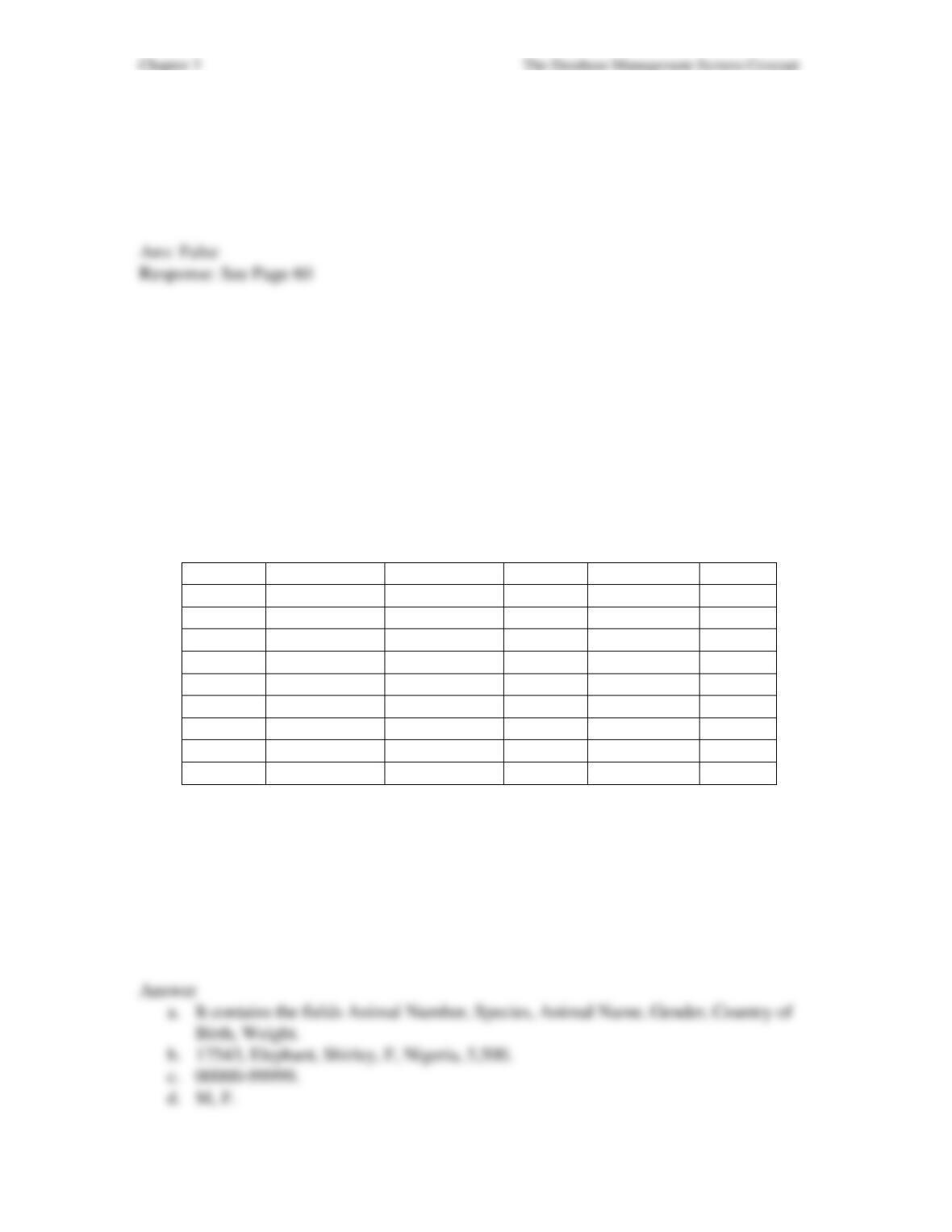
The following Animal File from the Central Zoo will be used in several of the following
questions. The left–hand column of relative record numbers is there to facilitate answering
the questions.
Animal
Number
Species
Animal
Name
Gender
Country of
Birth
Weight
1
13648
Elephant
Jumbo
M
Uganda
6,000
2
14990
Kangaroo
Fred
M
Australia
200
3
17543
Elephant
Shirley
F
Nigeria
5,500
4
20165
Giraffe
Necky
F
USA
500
5
23743
Giraffe
High Top
F
USA
600
6
27579
Panda
Fluffy
M
China
250
7
32565
Elephant
Large Louie
M
India
7,000
8
34871
Grizzly Bear
Doris
F
Canada
1,500
9
35993
Lion
King
M
USA
580
10
38578
Tiger
Stripes
F
India
470
Animal file
1. Records and fields in the Animal file.
a. Describe the file’s record type.
b. Show a record occurrence.
c. Describe the set or range of values that the Animal Number field can take.
d. Describe the set or range of values that the Gender field can take.
3-18
2. Assume that the records of the Animal file are physically stored in the order shown.
a. Retrieve all of the records of the file physically sequentially.
b. Retrieve all of the records of the file logically sequentially based on the Animal
Name field.
c. Retrieve all of the records of the file logically sequentially based on the Animal
Number field.
d. Retrieve all of the records of the file logically sequentially based on the Weight
field.
e. Perform a direct retrieval of the records with an Animal Number field value of
34871.
f. Perform a direct retrieval of the records with a Country of Birth field value of USA.
Answer
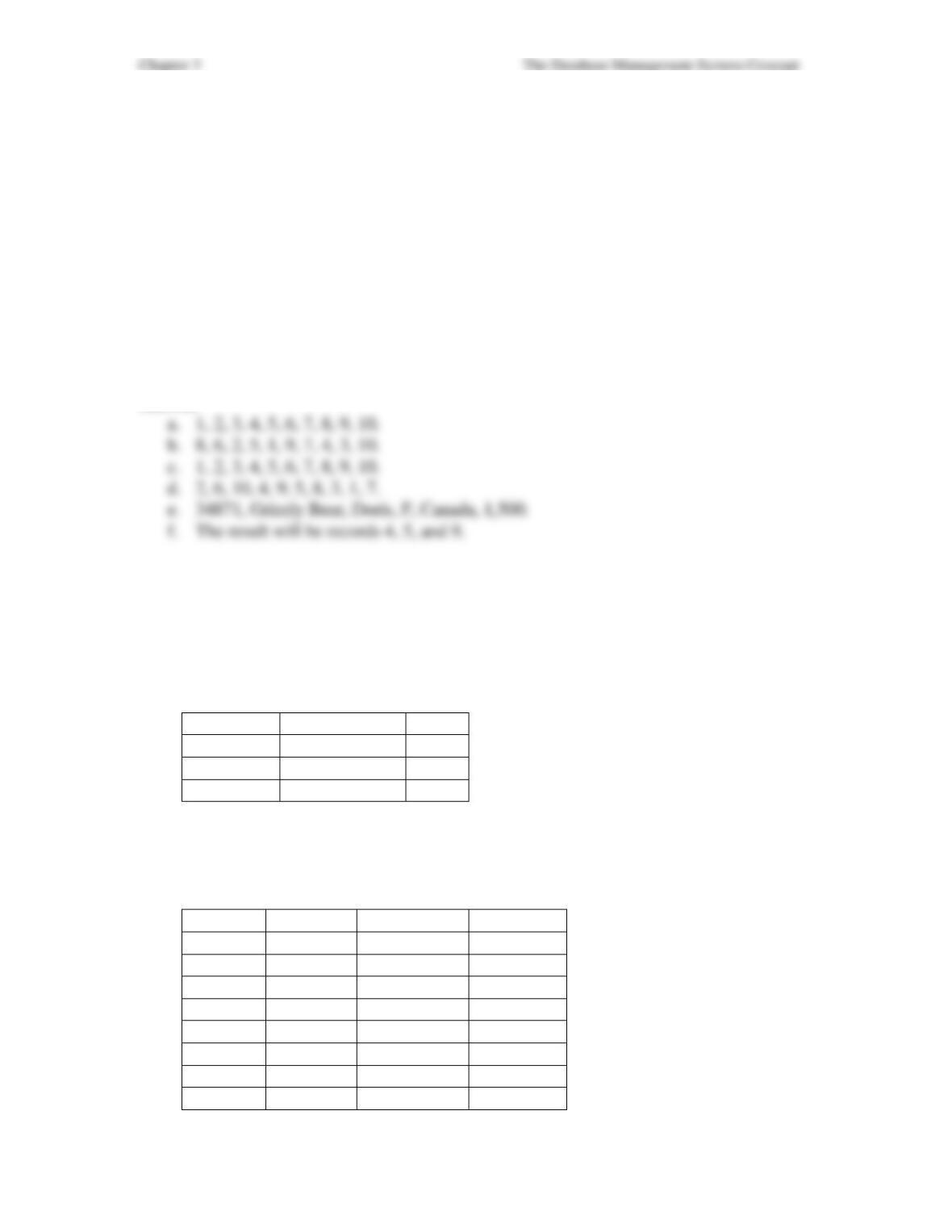
3. Consider the following Animal and Enclosure files from the Central Zoo. The left-hand
column of relative record numbers is there to facilitate answering some of the questions.
Enclosure
Number
Type
Size
1
0347
Glass Cage
400
2
0636
Fenced Yard
1500
3
0912
Natural Area
2000
4
1483
Fenced Yard
1650
Enclosure file
Animal
Number
Species
Animal
Name
Enclosure
Number
1
13648
Elephant
Jumbo
1483
2
15273
Giraffe
Stretch
0912
3
17543
Elephant
Shirley
0636
4
20165
Giraffe
Necky
0912
5
23743
Giraffe
High Top
0912
6
27579
Panda
Fluffy
0347
7
32565
Elephant
Large Louie
1483
8
33837
Elephant
Charley
0636
9
36340
Panda
Huggy
0347
Chapter 3 The Database Management System Concept
3-19
10
40436
Giraffe
Sarah
0912
Animal file
a. 0912 appears as an enclosure number in record 3 of the Enclosure file and in records
2, 4, 5, and 10 of the Animal file. Does this constitute redundant data? Explain.
b. Why does the Enclosure Number field appear in both files?
c. What would you have to do to find the type of enclosure in which animal number
33837 is kept?
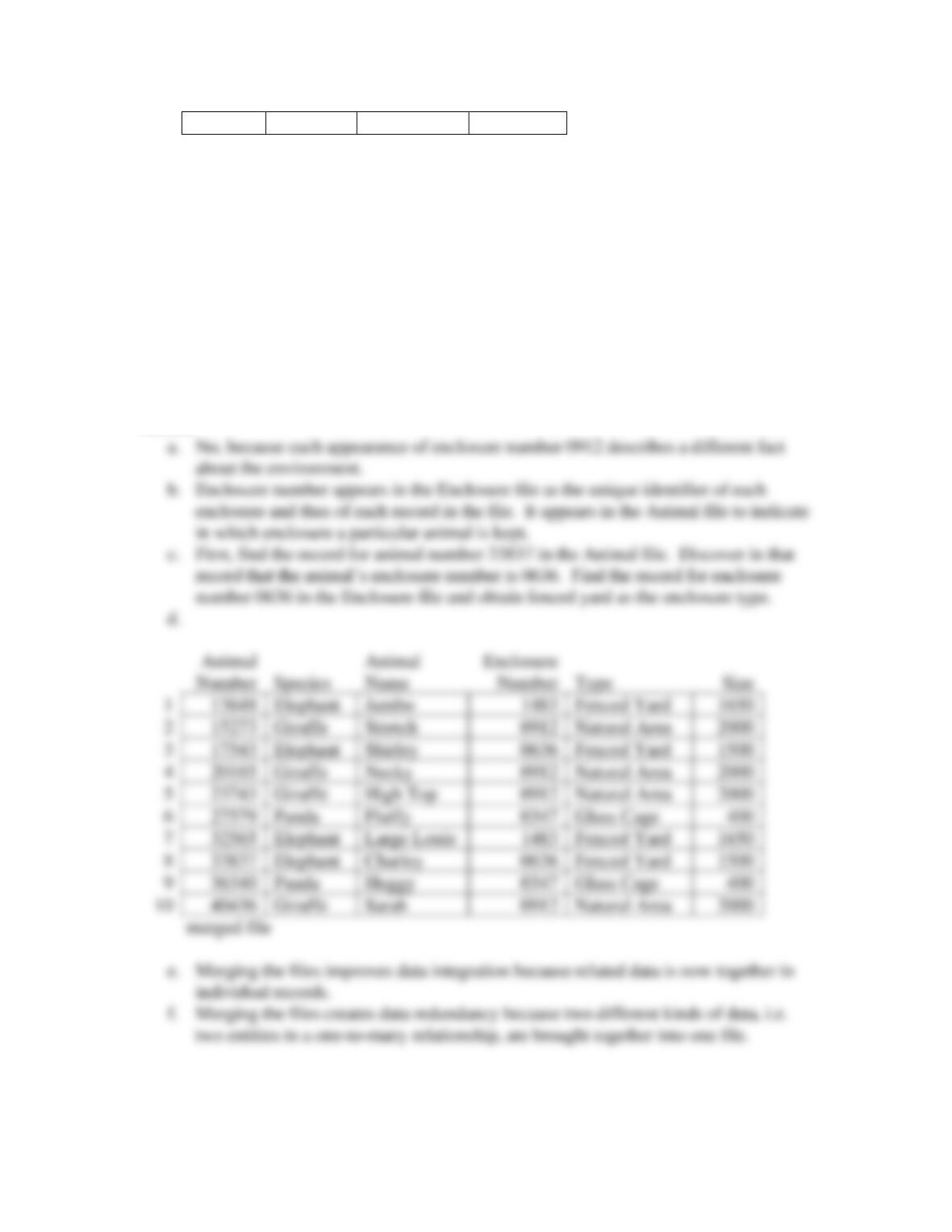
d. Merge the two files into one based on which records of one file are related to which
records of the other file.
e. How does merging the two files into one affect data integration?
f. How does merging the two files into one affect data redundancy?
Answer
Chapter 3 The Database Management System Concept
3-20
The following Airplane File from Grand Travel Airlines will be used in several of the
following questions. The left-hand column of relative record numbers is there to facilitate
answering the questions.
Airplane
Number
Manufacturer
Model
Passenger
Capacity
Year
Built
1
04653
Boeing
767
280
1988
2
06997
Boeing
747
325
1976
3
10582
Airbus
A320
256
1997
4
13160
Canadair
CRJ
54
2001
5
16420
Canadair
CRJ
54
2001
6
19521
Airbus
A300
220
1980
7
22663
Boeing
767
265
1999
8
23964
Airbus
A320
256
1998
9
28352
Boeing
767
280
1989
10
34801
Canadair
CRJ
58
2002
Airplane file
4. Records and fields in the Airplane file.
a. Describe the file’s record type.
b. Show a record occurrence.
c. Describe the set or range of values that the Airplane Number field can take.
d. Describe the set or range of values that the Manufacturer field can take.
Answer
5. Assume that the records of the Airplane file are physically stored in the order shown.
a. Retrieve all of the records of the file physically sequentially.
b. Retrieve all of the records of the file logically sequentially based on the
Manufacturer field.
c. Retrieve all of the records of the file logically sequentially based on the Airplane
Number field.
Chapter 3 The Database Management System Concept
3-21
d. Retrieve all of the records of the file logically sequentially based on the Year Built
field.
e. Perform a direct retrieval of the records with an Airplane Number field value of
22663.
f. Perform a direct retrieval of the records with a Manufacturer field value of Boeing.
Answer
6. Consider the following Airplane and Flight files from Grand Travel Airlines. The
unique identifier for flights is the combination of flight number and date. Arrival and
departure times are actual, not scheduled, times. The left-hand column of relative record
numbers is there to facilitate answering some of the questions.
Airplane
Number
Manufacturer
Model
Passenger
Capacity
Year
Built
1
04653
Boeing
767
280
1988
2
10582
Airbus
A320
256
1997
3
16420
Canadair
CRJ
54
2001
4
22663
Boeing
767
265
1999
5
28352
Boeing
767
280
1989
Airplane file
Flight
Number
Date
Departure
Time
Arrival
Time
Airplane
Number
1
005
11/15/2003
2:14PM
4:20PM
22663
2
018
01/24/2004
11:00AM
1:32PM
10582
3
032
11/15/2003
9:03AM
10:30AM
16420
4
032
11/16/2003
8:57:AM
10:23AM
16420
5
032
11/17/2003
9:00AM
10:33AM
16420
6
120
01/24/2004
7:52PM
9:34PM
16420
7
120
01/28/2004
7:51PM
9:57PM
16420
8
154
11/15/2003
12:58PM
3:30PM
10582
9
197
02//12/2004
5:03PM
7:22PM
22663
10
197
02//13/2004
5:00PM
7:31PM
28352
11
197
02//14/2004
5:03PM
8:45PM
04653
12
197
02//15/2004
5:00PM
7:28PM
22663
Flight file
Chapter 3 The Database Management System Concept
3-22
a. 16420 appears as an airplane number in record 3 of the Airplane file and in records
3, 4, 5, 6, and 7 of the Flight file. Does this constitute redundant data? Explain.
b. Why does the Airplane Number field appear in both files?
c. What would you have to do to find the name of the manufacturer of the airplane
used for flight 197 on 02/13/2004?
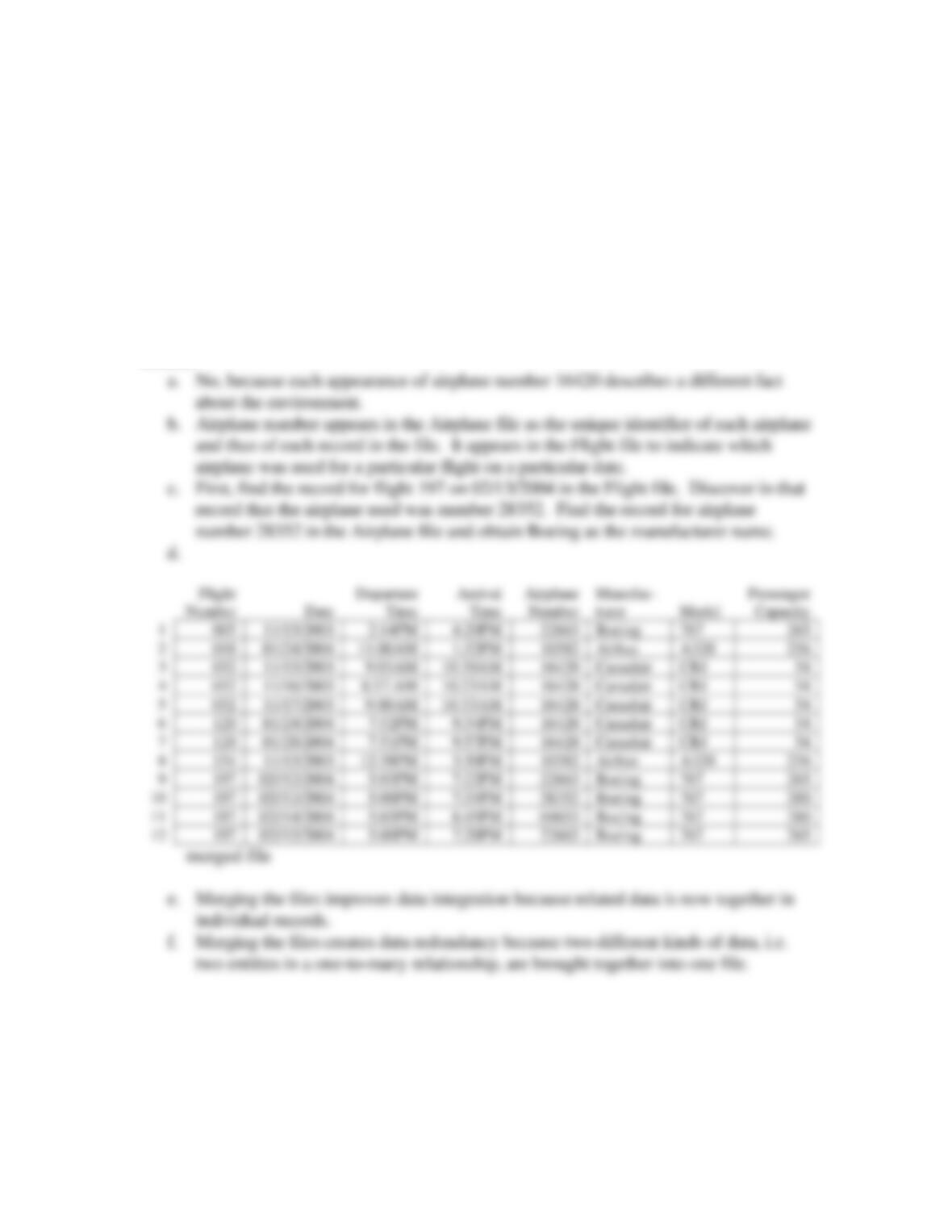
d. Merge the two files into one based on which records of one file are related to which
records of the other file.
e. How does merging the two files into one affect data integration?
f. How does merging the two files into one affect data redundancy?
Answer