5) What is the difference between an “increase in supply” and an “increase in quantity supplied”?
A) There is no difference between the two terms; they both refer to a shift of the supply curve.
B) There is no difference between the two terms; they both refer to a movement along a given
supply curve.
C) An “increase in supply” means the supply curve has shifted to the right while an “increase in
quantity supplied” means at any given price supply has increased.
D) An “increase in supply” means the supply curve has shifted to the right while an “increase in
quantity supplied” refers to a movement along a given supply curve in response to an increase in
price.
6) One would speak of a change in the quantity of a good supplied, rather than a change in
supply, if
A) supplier expectations about future prices change.
B) the price of the good changes.
C) the cost of producing the good changes.
D) prices of substitutes in production change.
7) Which of the following would cause a decrease in the supply of milk?
A) an increase in the price of cookies (assuming that milk and cookies are complements)
B) a decrease in the price of milk
C) an increase the price of a product that producers sell instead of milk
D) an increase in the number of firms that produce milk
8) In October, market analysts predict that the price of platinum will fall in November. What
happens in the platinum market in October, holding everything else constant?
A) The supply curve shifts to the right.
B) The supply curve shifts to the left.
C) The quantity demanded and the quantity supplied of platinum increase.
D) The demand curve shifts to the right.
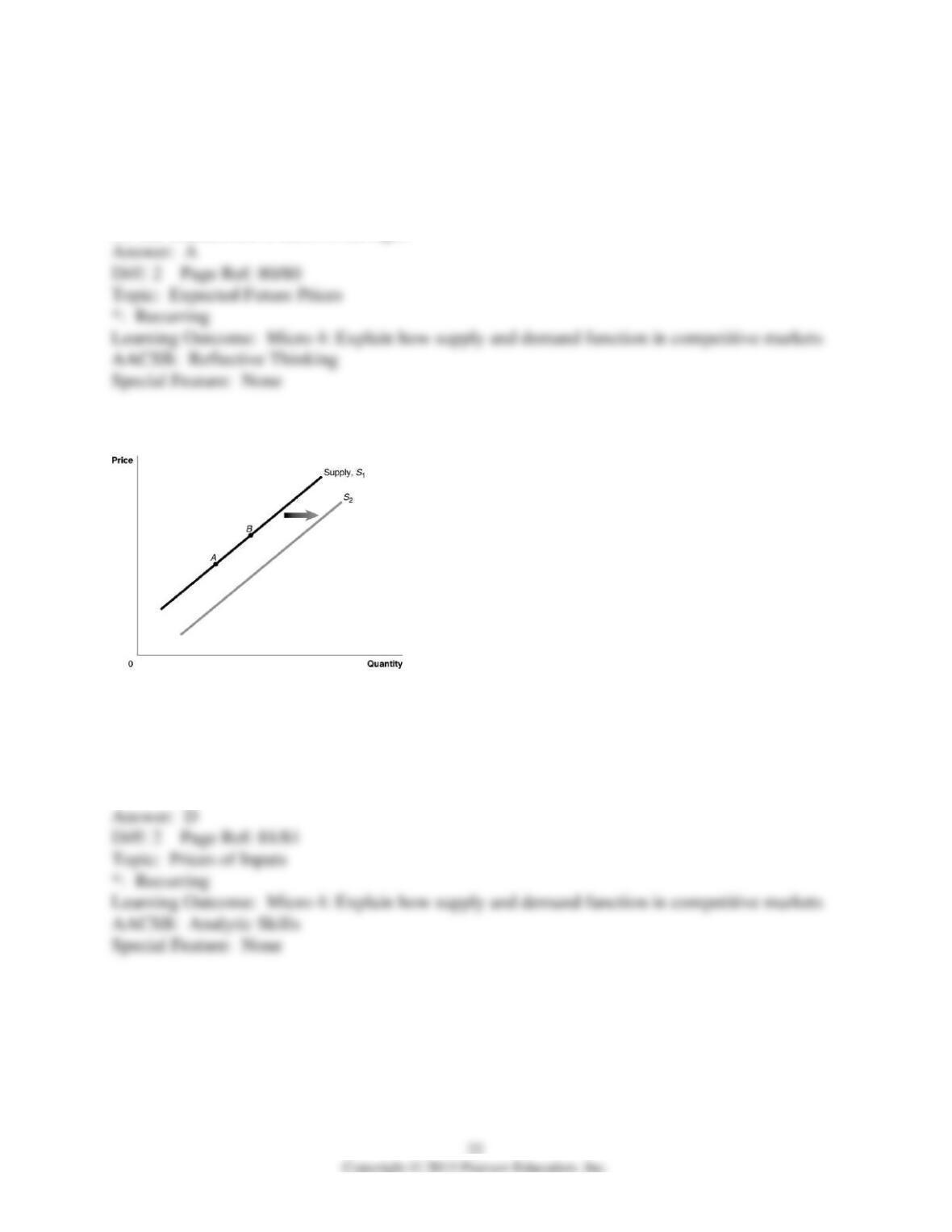
Figure 3-2
9) Refer to Figure 3-2. An increase in price of inputs would be represented by a movement from
A) A to B.
B) B to A.
C) S1 to S2.
D) S2 to S1.
10) Refer to Figure 3-2. An increase in the number of firms in the market would be represented
by a movement from
A) A to B.
B) B to A.
C) S1 to S2.
D) S2 to S1.
11) Refer to Figure 3-2. An increase in the price of substitutes in production would be
represented by a movement from
A) A to B.
B) B to A.
C) S1 to S2.
D) S2 to S1.
12) Refer to Figure 3-2. A decrease in the price of the product would be represented by a
movement from
A) A to B.
B) B to A.
C) S1 to S2.
D) S2 to S1.
13) In October 2005, the U.S. Fish and Wildlife Service banned the importation of beluga caviar,
the most prized of caviars, from the Caspian Sea. What happened in the market for caviar in the
U.S.?
A) The supply curve shifted to the left.
B) The supply curve shifted to the right.
C) The demand curve shifted to the right.
D) The demand curve shifted to the left.
14) Danielle Ocean pays for monthly pool maintenance for her home swimming pool. Last week
the owner of the pool service informed Danielle that he will have to raise his monthly service fee
because of increases in the price of pool chemicals. How is the market for pool maintenance
services affected by this?
A) There is an increase in the supply of pool maintenance services.
B) There is a decrease in the demand for pool maintenance services.
C) There is a decrease in the quantity of pool maintenance services supplied.
D) There is a decrease in the supply of pool maintenance services.
15) The popularity of digital cameras has enticed large discount stores like Wal-Mart and Costco
to offer digital photo printing services. How does this affect the digital photo printing market?
A) The demand curve for digital photo printing services shifts to the right.
B) The demand curve for digital photo printing services shifts to the left.
C) The supply curve for digital photo printing services shifts to the right.
D) The supply curve for digital photo printing services shifts to the left.
16) Ranchers can raise either cattle or sheep on their land. Which of the following would cause
the supply of sheep to increase?
A) an increase in the price of sheep
B) a decrease in the price of cattle
C) an increase in the demand for cattle
D) an increase in the price of sheep feed
17) Which of the following would shift the supply curve for MP3 players to the right?
A) an increase in the price of a substitute in production
B) an increase in consumer income (assuming that all MP3 players are normal goods)
C) a decrease in the number of firms that produce MP3 players
D) a decrease in the price of an input used to produce MP3 players
18) If a firm has an incentive to increase supply now and decrease supply in the future, the firm
expects that the
A) price of its product will be lower in the future than it is today.
B) price of its product will be higher in the future than it is today.
C) price of inputs will be lower in the future than they are today.
D) demand for the product will be lower in the future than it is today.
19) If a firm expects that the price of its product will be higher in the future than it is today
A) the firm will go out of business.
B) the firm has an incentive to increase supply now and decrease supply in the future.
C) the firm has an incentive to decrease quantity supplied now and increase quantity supplied in
the future.
D) the firm has an incentive to decrease supply now and increase supply in the future.
20) The supply curve for watches
A) shows the supply of watches consumers are willing and able to buy at any given price.
B) is downward sloping.
C) shows the relationship between the quantity of watches firms are willing and able to supply
and the quantity of watches consumers are willing and able to purchase.
D) shows the relationship between the price of watches and the quantity of watches supplied.
21) A decrease in the price of GPS systems will result in
A) a smaller quantity of GPS systems supplied.
B) a larger quantity of GPS systems supplied.
C) a decrease in the demand for GPS systems.
D) an increase in the supply of GPS systems.
22) An increase in the number of firms in a market will cause the quantity of a good supplied to
increase.
23) A change in supply is represented by a shift of the supply curve.
24) An increase in the quantity of a product supplied is caused by an increase in the price of the
product.
25) Quantity supplied refers to the amount of a good or service that a firm is willing and able to
supply at a given price.
26) What is the law of supply? What does this law imply about the shape of the supply curve?
27) From a supply perspective, what impact would an increase in the price of motorcycles have
on the market for motorcycles?
28) Indicate whether each of the following situations would shift the supply curve to the left, to
the right, or not at all.
a. An increase in the number of firms in the market
b. An increase in the current price of the product
c. A decrease in productivity
d. An increase in the expected future price of a product
e. A decrease in the price of an input
3.3 Market Equilibrium: Putting Demand and Supply Together
1) Which of the following is the correct way to describe equilibrium in a market?
A) At equilibrium, demand equals supply.
B) At equilibrium, quantity demanded equals quantity supplied.
C) At equilibrium, market forces no longer apply.
D) At equilibrium, scarcity is eliminated.
2) At a product’s equilibrium price
A) the product’s demand curve is the same as the product’s supply curve.
B) the quantity of the product demanded is greater than the quantity of the product supplied.
C) the quantity of the product demanded is less than the quantity of the product supplied.
D) the product’s demand curve crosses the product’s supply curve.
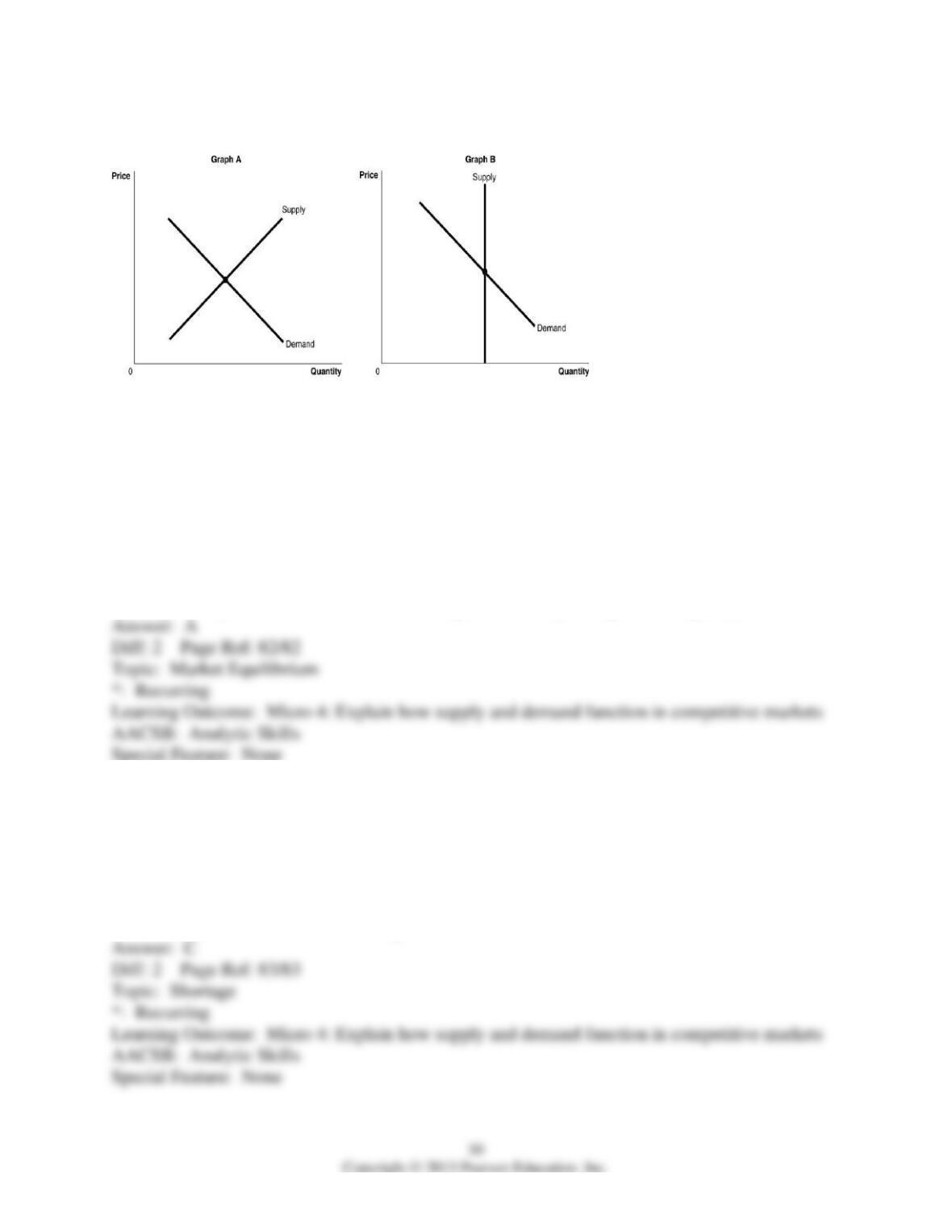
Figure 3-3
3) Refer to Figure 3-3. The figure above shows the supply and demand curves for two markets:
the market for original Picasso paintings and the market for designer jeans. Which graph most
likely represents which market?
A) Graph B represents the market for original Picasso paintings and Graph A represents the
market for designer jeans.
B) Graph A represents the market for original Picasso paintings and Graph B represents the
market for designer jeans.
C) Graph A represents both the market for original Picasso paintings and designer jeans.
D) Graph B represents both the market for original Picasso paintings and designer jeans.
4) In 2004, hurricanes damaged a large portion of Florida’s orange crop. As a result of this, many
orange growers were not able to supply fruit to the market. At the pre-hurricane equilibrium
price (i.e., at the initial equilibrium price), we would expect to see
A) a surplus of oranges.
B) the quantity demanded equal to the quantity supplied.
C) a shortage of oranges.
D) an increase in the demand for oranges.
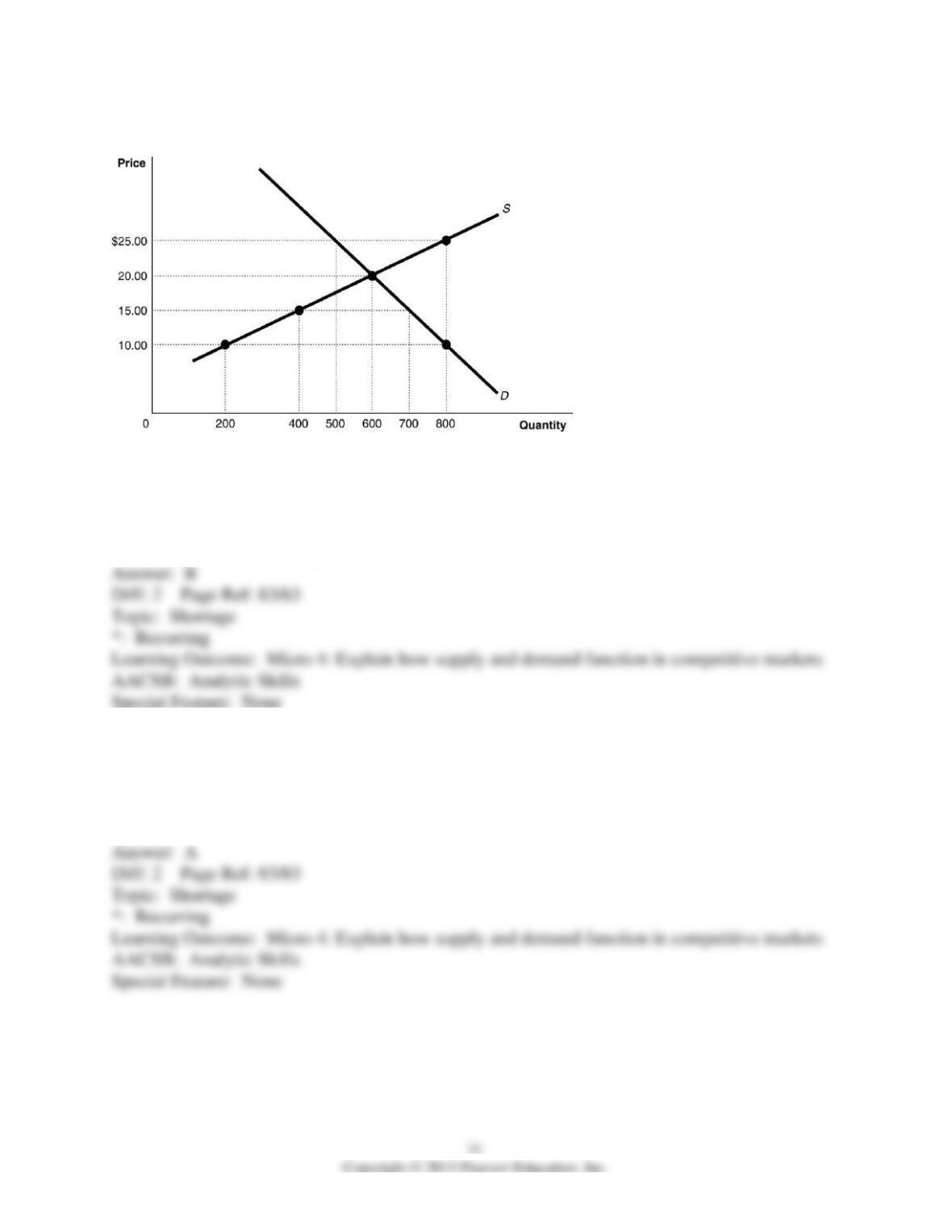
Figure 3-4
5) Refer to Figure 3-4. If the price is $10,
A) there would be a surplus of 600 units.
B) there would be a shortage of 600 units.
C) there would be a surplus of 200 units.
D) there would be a shortage of 200 units.
6) Refer to Figure 3-4. At a price of $10, how many units will be sold?
A) 200
B) 400
C) 600
D) 800
7) Refer to Figure 3-4. If the current market price is $10, the market will achieve equilibrium by
A) a price increase, increasing the supply and decreasing the demand.
B) a price decrease, decreasing the supply and increasing the demand.
C) a price decrease, decreasing the quantity supplied and increasing the quantity demanded.
D) a price increase, increasing the quantity supplied and decreasing the quantity demanded.
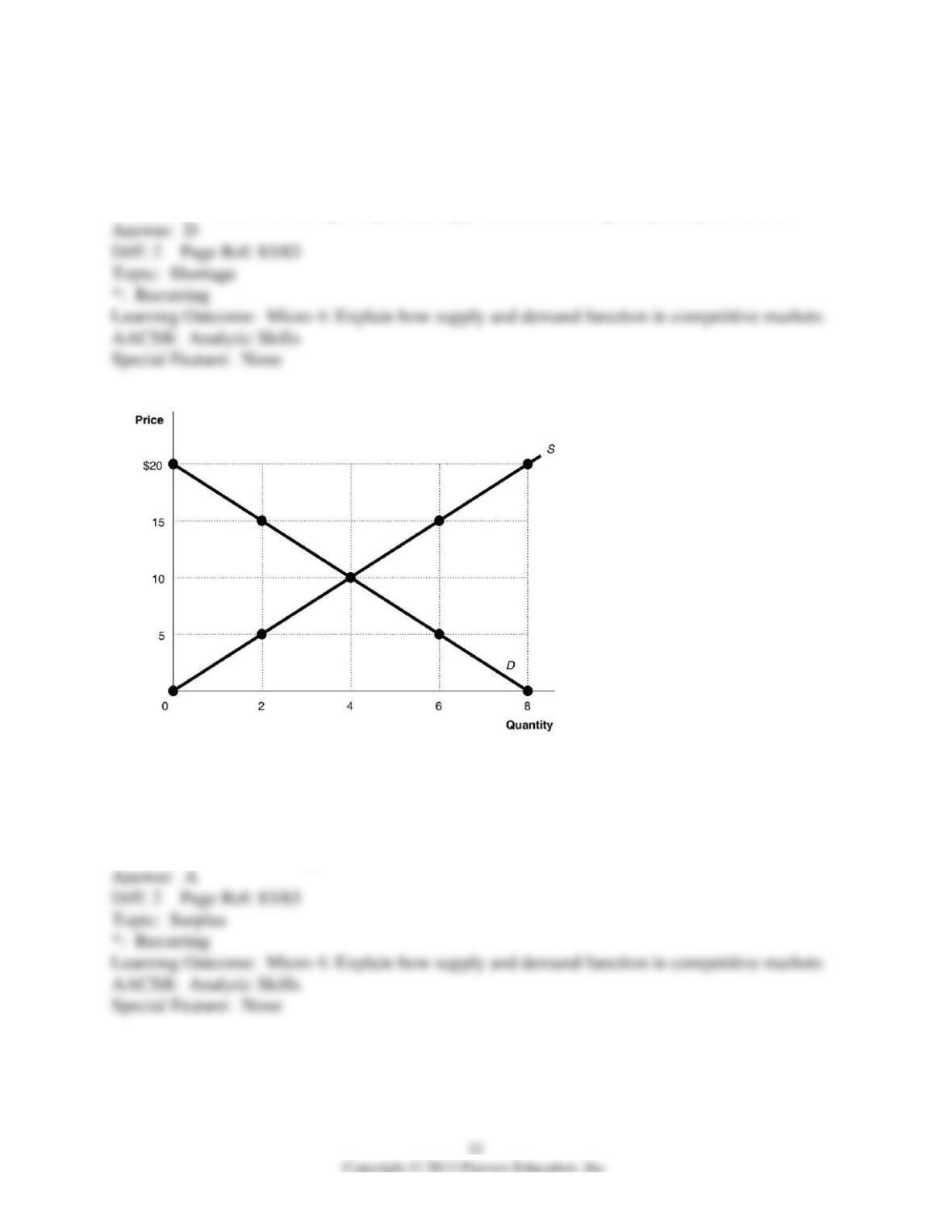
Figure 3-5
8) Refer to Figure 3-5. At a price of $15,
A) there would be a surplus of 4 units.
B) there would be a shortage of 2 units.
C) there would be a surplus of 6 units.
D) there would be a shortage of 4 units.
9) Refer to Figure 3-5. At a price of $5, the quantity sold
A) is 2 units.
B) is 4 units.
C) is 6 units.
D) cannot be determined.
10) Refer to Figure 3-5. In a free market such as that depicted above, a surplus is eliminated by
A) a price increase, increasing the supply and decreasing the demand.
B) a price decrease, decreasing the supply and increasing the demand.
C) a price decrease, decreasing the quantity supplied and increasing the quantity demanded.
D) a price increase, increasing the quantity supplied and decreasing the quantity demanded.
11) Assume there is a shortage in the market for digital music players. Which of the following
statements correctly describes this situation?
A) The demand for digital music players is greater than the supply of digital music players.
B) Some consumers will be unable to obtain digital music players at the market price and will
have an incentive to offer to buy the product at a higher price.
C) The price of digital music players will rise in response to the shortage; as the price rises the
quantity demanded will increase and the quantity supplied will decrease.
D) the shortage will cause an increase in the equilibrium price of digital music players.
12) In a perfectly competitive market, there are ________ buyers and ________ sellers.
A) many; few
B) few; many
C) many; many
D) few; few
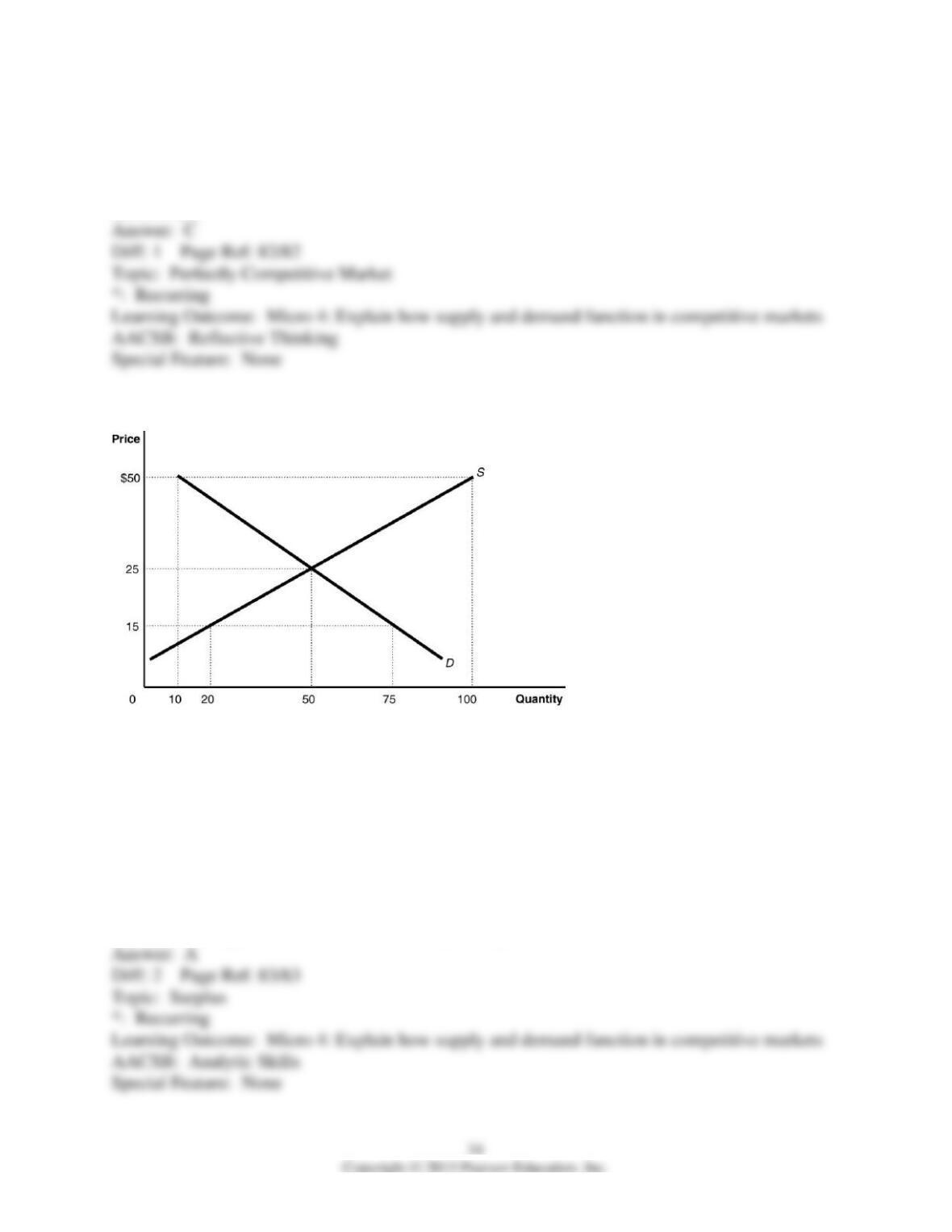
Figure 3-6
13) Refer to Figure 3-6. The figure above represents the market for canvas tote bags. Assume
that the market price is $35. Which of the following statement is true?
A) There is a surplus that will cause the price to decrease; quantity demanded will then increase
and quantity supplied will decrease until the price equals $25.
B) There is a surplus that will cause the price to decrease; quantity supplied will then increase
and quantity demanded will decrease until the price equals $25.
C) There will be a surplus that will cause the price to decrease; demand will then increase and
supply will decrease until the price equals $25.
D) There is a surplus that will cause the price to increase; quantity demanded will then decrease
and quantity supplied will increase until the price equals $25.
14) Refer to Figure 3-6. The figure above represents the market for canvas tote bags. Assume
that the price of tote bags is $15. At this price:
A) the quantity demanded exceeds the quantity supplied of tote bags by 75. The price will
eventually rise to $25 where quantity demanded will equal quantity supplied.
B) the demand exceeds the supply of tote bags by 55. Some consumers will have an incentive to
offer to buy tote bags at a higher price.
C) there is a shortage, equal to 55 tote bags, that will be eliminated when the price rises to $25.
D) there is a shortage equal to 55 tote bags; the price of tote bags will rise until demand is equal
to supply.
15) Refer to Figure 3-6. The figure above represents the market for canvas tote bags. Compare
the conditions in the market when the price is $50 and when the price is $35. Which of the
following describes how the market differs at these prices?
A) At each price there is a surplus; the surplus is greater at $35 than at $50.
B) The difference between quantity supplied and quantity demanded is greater at $50 than at
$35.
C) At each price there is a surplus; firms will lower the equilibrium price in order to eliminate
the surplus.
D) At each price the supply of tote bags exceeds that demand for tote bags.
16) If, for a product, the quantity supplied exceeds the quantity demanded, the market price will
fall until
A) the quantity demanded exceeds the quantity supplied. The market will then be in equilibrium.
B) quantity demanded equals quantity supplied. The equilibrium price will then be lower than
the market price.
C) all consumers will be able to afford the product.
D) quantity demanded equals quantity supplied. The market price will then equal the
equilibrium price.
17) Which of the following is evidence of a surplus of bananas?
A) Firms raise the price of bananas.
B) The price of bananas is lowered in order to increase sales.
C) The equilibrium price of bananas rises due to an increase in demand.
D) The quantity demanded of bananas is greater than the quantity supplied.
18) Auctions in recent years have resulted in higher prices paid for letters written by John Wilkes
Booth than those written by Abraham Lincoln. Which of the following events would cause the
price differences in these letters to get smaller?
A) The demand for Booth letters decreases.
B) The supply of Lincoln letters increases.
C) The demand for Lincoln letters increases and the supply of Booth letters increases.
D) The demand for Lincoln letters decreases and the demand for Booth letters increases..
19) Auctions in recent years have resulted in higher prices paid for letters written by John Wilkes
Booth than those written by Abraham Lincoln. What is a reason for this difference in price?
A) There is a surplus of letters written by Booth and a shortage of letters written by Lincoln.
B) Many people are more fascinated by villains and anti-heroes than by heroic figures.
C) There are more letters available for collectors to buy that were written by Lincoln than there
are letters that were written by Booth.
D) Booth was a well-known actor; the demand for his letters rose as wealthy actors attempted to
buy them.
20) In response to a surplus the market price of a good will fall; as the price falls, the quantity
demanded will increase and quantity supplies will decrease until equilibrium is reached.
21) Scarcity is defined as the situation that exists when the quantity demanded for a good is
greater than the quantity supplied.
22) Market equilibrium occurs where supply equals demand.
23) Nearly a quarter of China’s 1.3 billion people are under the age of 15. How will this affect
high school enrollment over the next fifteen years? The labor market over the next fifteen years?
24) In 2004, hurricanes destroyed a large portion of Florida’s grapefruit crop. How did this affect
the market price and market quantity of grapefruit?
25) If the price of a product is above equilibrium, what forces it down?
Table 3-2
Price per
Bushel
Quantity
Demanded
(bushels)
Quantity
Supplied
(bushels)
$3
30,000
0
6
26,000
4,000
9
22,000
9,000
12
18,000
12,000
15
15,000
15,000
18
12,000
22,000
21
8,000
28,000
24
4,000
36,000
26) Refer to Table 3-2. The table contains information about the corn market. Use the table to
answer the following questions.
a. What are the equilibrium price and quantity of corn?
b. Suppose the prevailing price is $9 per bushel. Is there a shortage or a surplus in the market?
c. What is the quantity of the shortage or surplus?
d. How many bushels will be sold if the market price is $9 per bushel?
e. If the market price is $9 per bushel, what must happen to restore equilibrium in the market?
f. At what price will suppliers be able to sell 22,000 bushels of corn?
g. Suppose the market price is $21 per bushel. Is there a shortage or a surplus in the market?
h. What is the quantity of the shortage or surplus?
i. How many bushels will be sold if the market price is $21 per bushel?
j. If the market price is $21 per bushel, what must happen to restore equilibrium in the market?