61. Chambliss Corp.’s total assets at the end of last year were $305,000 and its EBIT was 62,500. What
was its basic earning power (BEP)?
a.
18.49%
b.
19.47%
c.
20.49%
d.
21.52%
e.
22.59%
62. Nikko Corp.’s total common equity at the end of last year was $305,000 and its net income after taxes
was $60,000. What was its ROE?
a.
16.87%
b.
17.75%
c.
18.69%
d.
19.67%
e.
20.66%
63. An investor is considering starting a new business. The company would require $475,000 of assets,
and it would be financed entirely with common stock. The investor will go forward only if she thinks
the firm can provide a 13.5% return on the invested capital, which means that the firm must have an
ROE of 13.5%. How much net income must be expected to warrant starting the business?
a.
$52,230
b.
$54,979
c.
$57,873
d.
$60,919
e.
$64,125
64. Vang Corp.’s stock price at the end of last year was $33.50 and its earnings per share for the year were
$2.30. What was its P/E ratio?
a.
13.84
b.
14.57
c.
15.29
d.
16.06
e.
16.86
65. Lindley Corp.’s stock price at the end of last year was $33.50, and its book value per share was $25.00.
What was its market/book ratio?
a.
1.34
b.
1.41
c.
1.48
d.
1.55
e.
1.63
66. Northwest Lumber had a profit margin of 5.25%, a total assets turnover of 1.5, and an equity multiplier
of 1.8. What was the firm’s ROE?
a.
12.79%
b.
13.47%
c.
14.18%
d.
14.88%
e.
15.63%
67. Bostian, Inc. has total assets of $625,000. Its total debt outstanding is $185,000. The Board of
Directors has directed the CFO to move towards a debt-to-assets ratio of 55%. How much debt must
the company add or subtract to achieve the target debt ratio?
a.
$158,750
b.
$166,688
c.
$175,022
d.
$183,773
e.
$192,962
68. Emerson Inc.’s would like to undertake a policy of paying out 45% of its income. Its latest net income
was $1,250,000, and it had 225,000 shares outstanding. What dividend per share should it declare?
a.
$2.14
b.
$2.26
c.
$2.38
d.
$2.50
e.
$2.63
69. Aziz Industries has sales of $100,000 and accounts receivable of $11,500, and it gives its customers 30
days to pay. The industry average DSO is 27 days, based on a 365-day year. If the company changes
its credit and collection policy sufficiently to cause its DSO to fall to the industry average, and if it
earns 8.0% on any cash freed-up by this change, how would that affect its net income, assuming other
things are held constant?
a.
$267.34
b.
$281.41
c.
$296.22
d.
$311.81
e.
$328.22
70. Heaton Corp. sells on terms that allow customers 45 days to pay for merchandise. Its sales last year
were $425,000, and its year-end receivables were $60,000. If its DSO is less than the 45-day credit
period, then customers are paying on time. Otherwise, they are paying late. By how much are
customers paying early or late? Base your answer on this equation: DSO − Credit period = days early
or late, and use a 365-day year when calculating the DSO. A positive answer indicates late payments,
while a negative answer indicates early payments.
a.
6.20
b.
6.53
c.
6.86
d.
7.20
e.
7.56
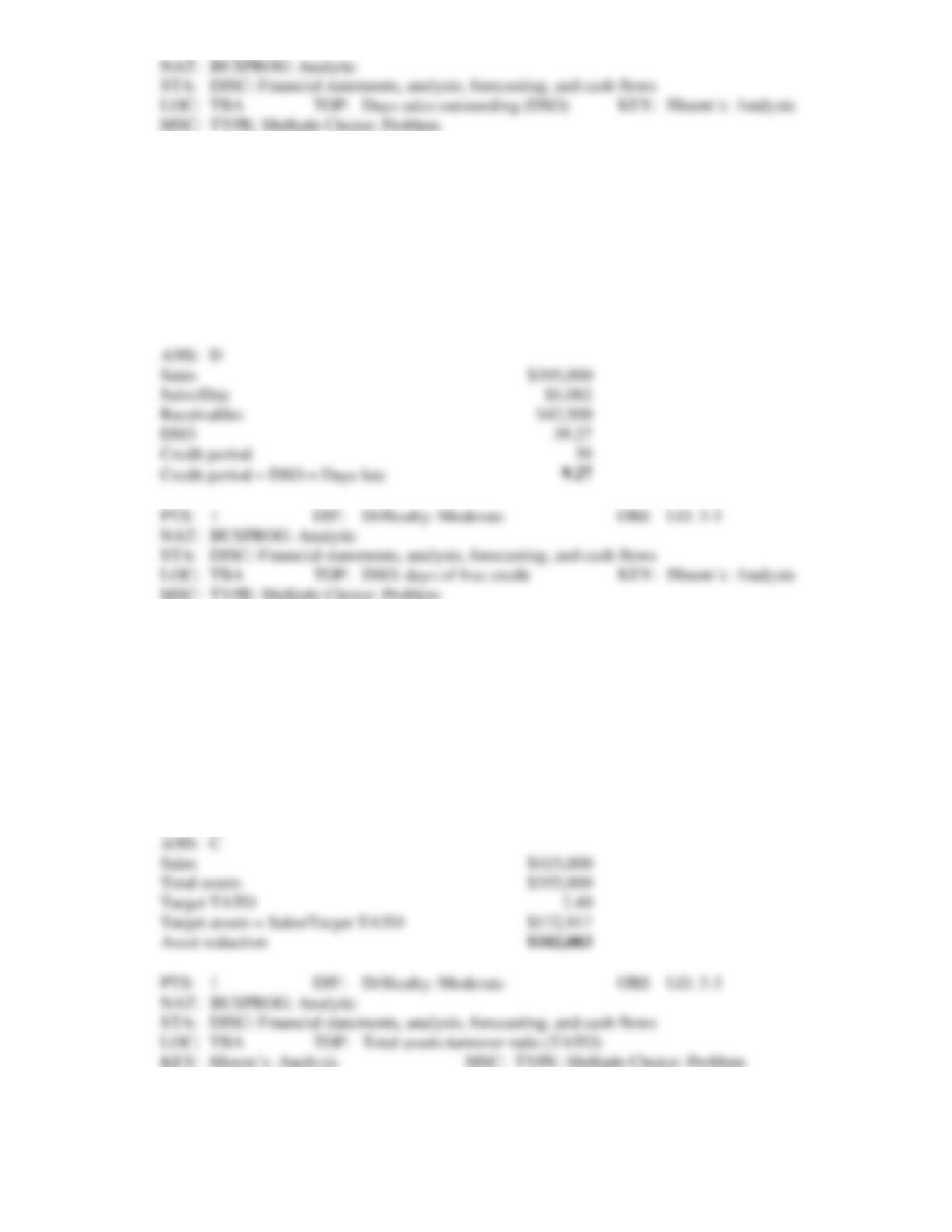
71. Harper Corp.’s sales last year were $395,000, and its year-end receivables were $42,500. Harper sells
on terms that call for customers to pay 30 days after the purchase, but many delay payment beyond
Day 30. On average, how many days late do customers pay? Base your answer on this equation: DSO
− Allowed credit period = Average days late, and use a 365-day year when calculating the DSO.
a.
7.95
b.
8.37
c.
8.81
d.
9.27
e.
9.74
72. Bonner Corp.’s sales last year were $415,000, and its year-end total assets were $355,000. The average
firm in the industry has a total assets turnover ratio (TATO) of 2.4. Bonner’s new CFO believes the
firm has excess assets that can be sold so as to bring the TATO down to the industry average without
affecting sales. By how much must the assets be reduced to bring the TATO to the industry average,
holding sales constant?
a.
$164,330
b.
$172,979
c.
$182,083
d.
$191,188
e.
$200,747
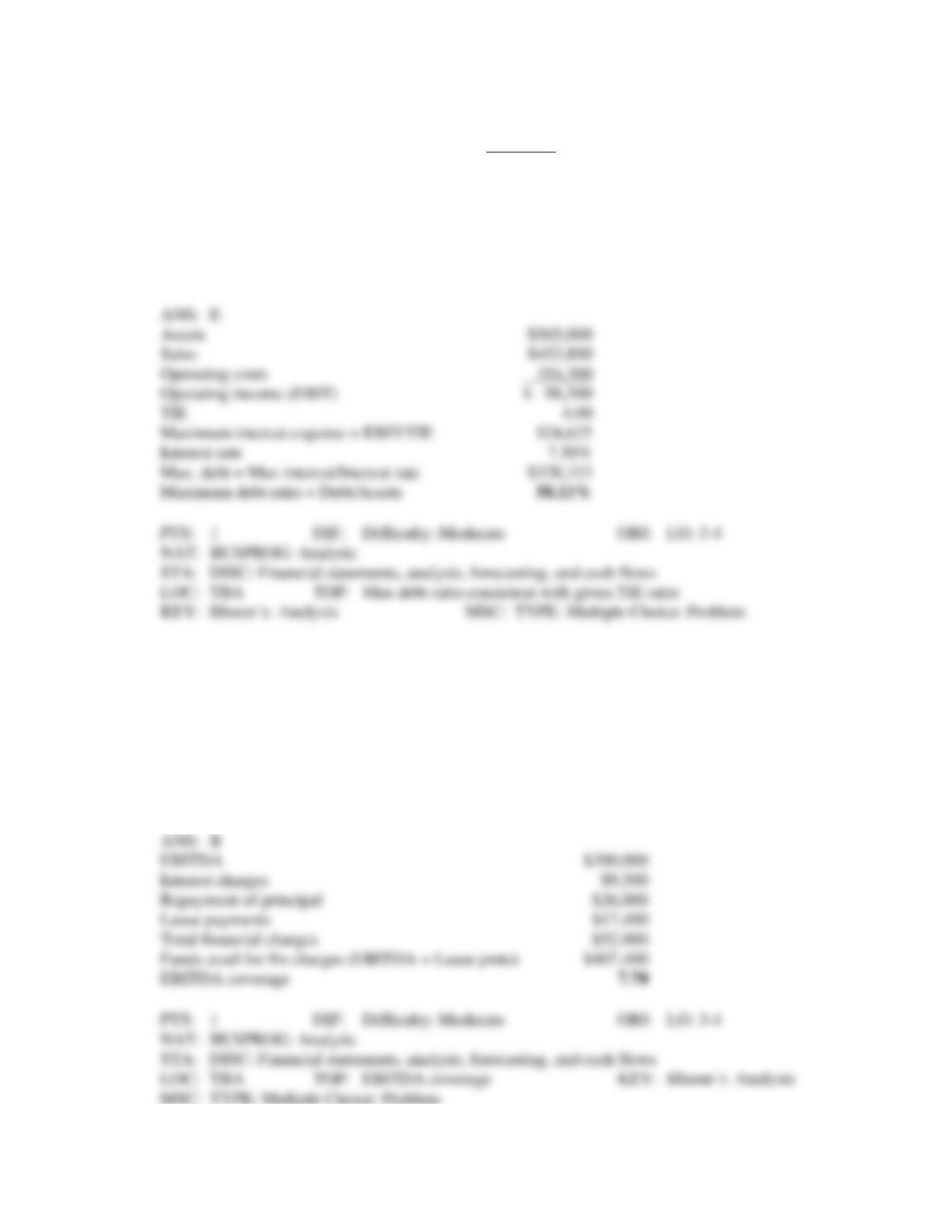
73. A new firm is developing its business plan. It will require $565,000 of assets, and it projects $452,800
of sales and $354,300 of operating costs for the first year. Management is quite sure of these numbers
because of contracts with its customers and suppliers. It can borrow at a rate of 7.5%, but the bank
requires it to have a TIE of at least 4.0, and if the TIE falls below this level the bank will call in the
loan and the firm will go bankrupt. What is the maximum debt-to–assets ratio the firm can use? (Hint:
Find the maximum dollars of interest, then the debt that produces that interest, and then the related
debt ratio.)
a.
47.33%
b.
49.82%
c.
52.45%
d.
55.21%
e.
58.11%
74. Ziebart Corp.’s EBITDA last year was $390,000 ( = EBIT + depreciation + amortization), its interest
charges were $9,500, it had to repay $26,000 of long-term debt, and it had to make a payment of
$17,400 under a long-term lease. The firm had no amortization charges. What was the EBITDA
coverage ratio?
a.
7.32
b.
7.70
c.
8.09
d.
8.49
e.
8.92
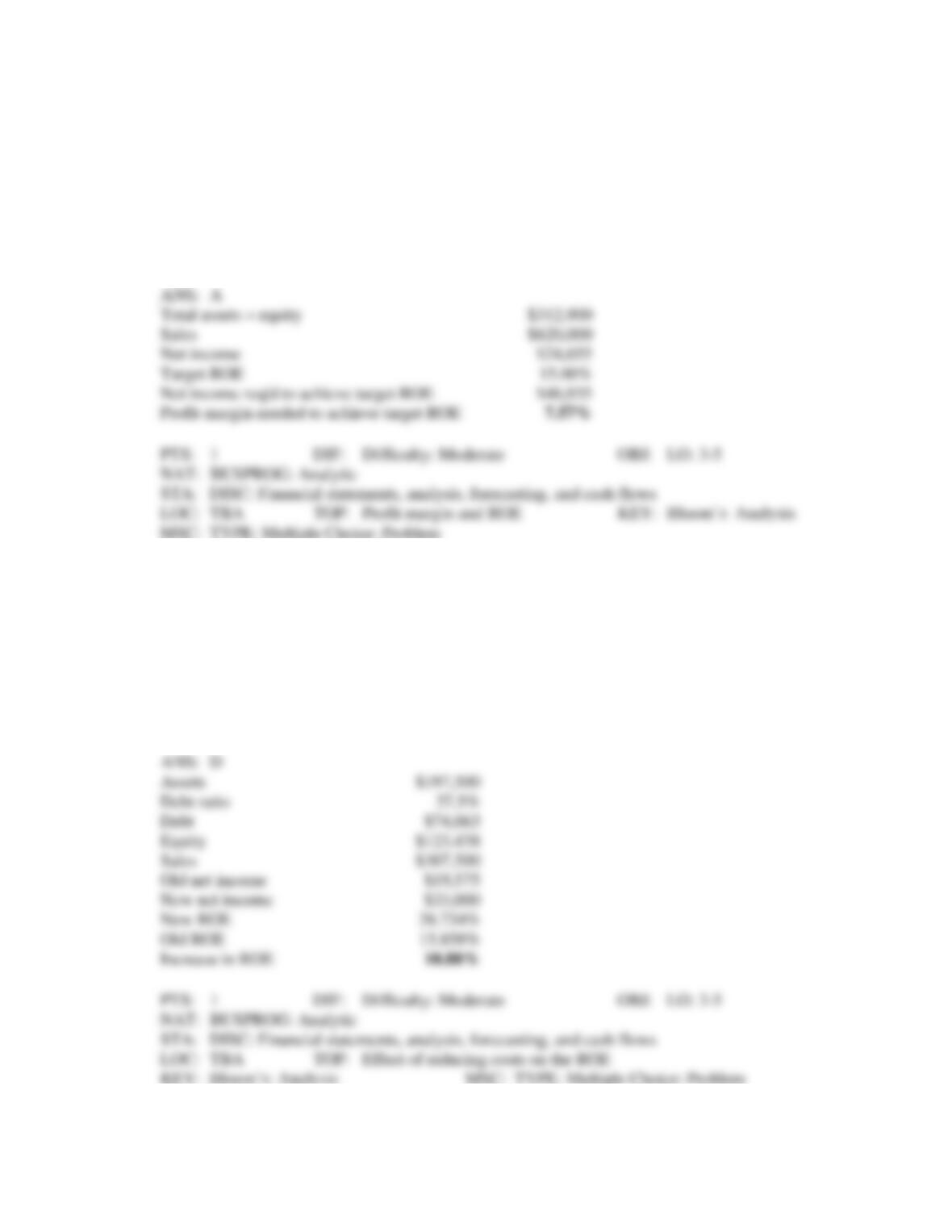
75. LeCompte Corp. has $312,900 of assets, and it uses only common equity capital (zero debt). Its sales
for the last year were $620,000, and its net income after taxes was $24,655. Stockholders recently
voted in a new management team that has promised to lower costs and get the return on equity up to
15%. What profit margin would LeCompte need in order to achieve the 15% ROE, holding everything
else constant?
a.
7.57%
b.
7.95%
c.
8.35%
d.
8.76%
e.
9.20%
76. Last year Urbana Corp. had $197,500 of assets, $307,500 of sales, $19,575 of net income, and a
debt-to-total-assets ratio of 37.5%. The new CFO believes a new computer program will enable it to
reduce costs and thus raise net income to $33,000. Assets, sales, and the debt ratio would not be
affected. By how much would the cost reduction improve the ROE?
a.
9.32%
b.
9.82%
c.
10.33%
d.
10.88%
e.
11.42%
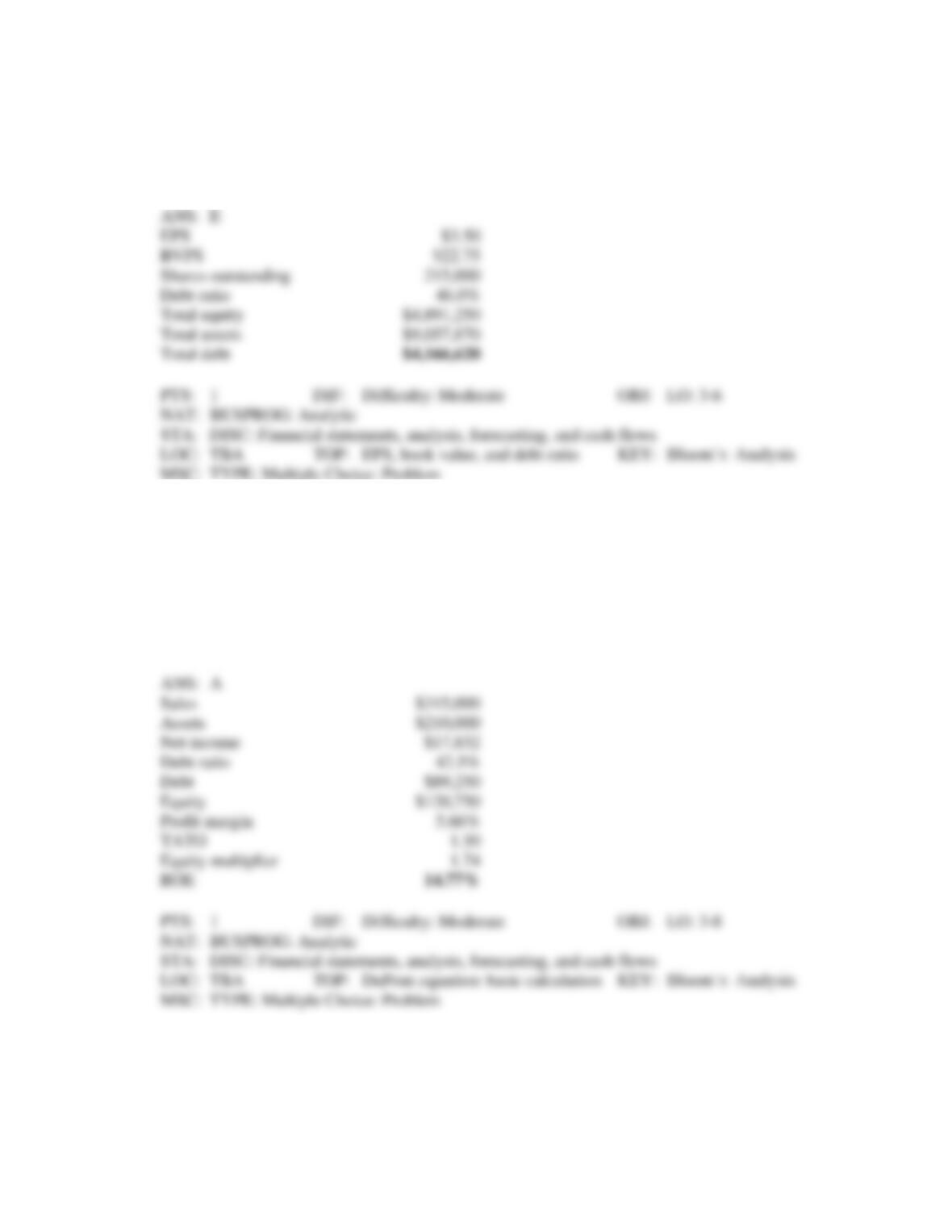
77. Stewart Inc.’s latest EPS was $3.50, its book value per share was $22.75, it had 215,000 shares
outstanding, and its debt-to–assets ratio was 46%. How much debt was outstanding?
a.
$3,393,738
b.
$3,572,356
c.
$3,760,375
d.
$3,958,289
e.
$4,166,620
78. Last year Vaughn Corp. had sales of $315,000 and a net income of $17,832, and its year-end assets
were $210,000. The firm’s total-debt-to-total-assets ratio was 42.5%. Based on the DuPont equation,
what was Vaughn’s ROE?
a.
14.77%
b.
15.51%
c.
16.28%
d.
17.10%
e.
17.95%
79. Last year Central Chemicals had sales of $205,000, assets of $127,500, a profit margin of 5.3%, and an
equity multiplier of 1.2. The CFO believes that the company could reduce its assets by $21,000
without affecting either sales or costs. Had it reduced its assets in this amount, and had the
debt-to-assets ratio, sales, and costs remained constant, by how much would the ROE have changed?
a.
1.81%
b.
2.02%
c.
2.22%
d.
2.44%
e.
2.68%
80. Last year Mason Inc. had a total assets turnover of 1.33 and an equity multiplier of 1.75. Its sales were
$195,000 and its net income was $10,549. The CFO believes that the company could have operated
more efficiently, lowered its costs, and increased its net income by $5,250 without changing its sales,
assets, or capital structure. Had it cut costs and increased its net income in this amount, by how much
would the ROE have changed?
a.
5.66%
b.
5.95%
c.
6.27%
d.
6.58%
e.
6.91%
81. Last year Rosenberg Corp. had $195,000 of assets, $18,775 of net income, and a debt-to-total-assets
ratio of 32%. Now suppose the new CFO convinces the president to increase the debt ratio to 48%.
Sales and total assets will not be affected, but interest expenses would increase. However, the CFO
believes that better cost controls would be sufficient to offset the higher interest expense and thus keep
net income unchanged. By how much would the change in the capital structure improve the ROE?
a.
4.36%
b.
4.57%
c.
4.80%
d.
5.04%
e.
5.30%
82. Last year Altman Corp. had $205,000 of assets, $303,500 of sales, $18,250 of net income, and a
debt-to-total-assets ratio of 41%. The new CFO believes the firm has excessive fixed assets and
inventory that could be sold, enabling it to reduce its total assets to $152,500. Sales, costs, and net
income would not be affected, and the firm would maintain the 41% debt ratio. By how much would
the reduction in assets improve the ROE?
a.
4.69%
b.
4.93%
c.
5.19%
d.
5.45%
e.
5.73%
83. Muscarella Inc. has the following balance sheet and income statement data:
Cash
$ 14,000
Accounts payable
$ 42,000
Receivables
70,000
Other current liabilities
28,000
Inventories
210,000
Total CL
$ 70,000
Total CA
$294,000
Long-term debt
70,000
Net fixed assets
126,000
Common equity
280,000
Total assets
$420,000
Total liab. and equity
$420,000
Sales
$280,000
Net income
$ 21,000
The new CFO thinks that inventories are excessive and could be lowered sufficiently to cause the
current ratio to equal the industry average, 2.70, without affecting either sales or net income.
Assuming that inventories are sold off and not replaced to get the current ratio to the target level, and
that the funds generated are used to buy back common stock at book value, by how much would the
ROE change?
a.
4.28%
b.
4.50%
c.
4.73%
d.
4.96%
e.
5.21%
Sales
$280,000
Net income
Actual current ratio
Target current ratio
ORIGINAL BALANCE SHEET
Cash
Accounts payable
Receivables
Other current liabilities
Inventories
$210,000
Long-term debt
$ 70,000
Net fixed assets
$126,000
Common equity
$280,000
Total assets
$420,000
Total liab. and equity
$420,000
NI/Equity = ROE:
Inv. at target CR
$105,000
this amount
New common equity
$175,000
New ROE
84. Last year Swensen Corp. had sales of $303,225, operating costs of $267,500, and year-end assets of
$195,000. The debt-to-total-assets ratio was 27%, the interest rate on the debt was 8.2%, and the firm’s
tax rate was 37%. The new CFO wants to see how the ROE would have been affected if the firm had
used a 45% debt ratio. Assume that sales and total assets would not be affected, and that the interest
rate and tax rate would both remain constant. By how much would the ROE change in response to the
change in the capital structure?
a.
2.08%
b.
2.32%
c.
2.57%
d.
2.86%
e.
3.14%
85. For the coming year, Crane Inc. is considering two financial plans. Management expects sales to be
$301,770, operating costs to be $266,545, assets to be $200,000, and its tax rate to be 35%. Under Plan
A it would use 25% debt and 75% common equity. The interest rate on the debt would be 8.8%, but
the TIE ratio would have to be kept at 4.00 or more. Under Plan B the maximum debt that met the TIE
constraint would be employed. Assuming that sales, operating costs, assets, the interest rate, and the
tax rate would all remain constant, by how much would the ROE change in response to the change in
the capital structure?
a.
3.83%
b.
4.02%
c.
4.22%
d.
4.43%
e.
4.65%
86. Refer to Exhibit 3.1. What is the firm’s current ratio?
a.
0.97
b.
1.08
c.
1.20
d.
1.33
e.
1.47
87. Refer to Exhibit 3.1. What is the firm’s quick ratio?
a.
0.49
b.
0.61
c.
0.73
d.
0.87
e.
1.05
88. Refer to Exhibit 3.1. What is the firm’s days sales outstanding? Assume a 360-day year for this
calculation.
a.
48.17
b.
50.71
c.
53.38
d.
56.19
e.
59.14
89. Refer to Exhibit 3.1. What is the firm’s total assets turnover?
a.
0.90
b.
1.12
c.
1.40
d.
1.68
e.
2.02
90. Refer to Exhibit 3.1. What is the firm’s inventory turnover ratio?
a.
4.17
b.
4.38
c.
4.59
d.
5.82
e.
5.07
91. Refer to Exhibit 3.1. What is the firm’s TIE?
a.
1.94
b.
2.15
c.
2.39
d.
2.66
e.
2.93
92. Refer to Exhibit 3.1. What is the firm’s EBITDA coverage?
a.
3.29
b.
3.46
c.
3.64
d.
3.82
e.
4.01
93. Refer to Exhibit 3.1. What is the firm’s debt-to–assets ratio?
a.
45.93%
b.
51.03%
c.
56.70%
d.
63.00%
e.
70.00%
94. Refer to Exhibit 3.1. What is the firm’s ROA?
a.
2.70%
b.
2.97%
c.
3.26%
d.
3.59%
e.
3.95%
95. Refer to Exhibit 3.1. What is the firm’s ROE?
a.
8.54%
b.
8.99%
c.
9.44%
d.
9.91%
e.
10.41%
96. Refer to Exhibit 3.1. What is the firm’s BEP?
a.
6.00%
b.
6.32%
c.
6.65%
d.
6.98%
e.
7.33%
97. Refer to Exhibit 3.1. What is the firm’s profit margin?
a.
1.40%
b.
1.56%
c.
1.73%
d.
1.93%
e.
2.12%
98. Refer to Exhibit 3.1. What is the firm’s dividends per share?
a.
$2.62
b.
$2.91
c.
$3.20
d.
$3.53
e.
$3.88
99. Refer to Exhibit 3.1. What is the firm’s cash flow per share?
a.
$10.06
b.
$10.59
c.
$11.15
d.
$11.74
e.
$12.35
100. Refer to Exhibit 3.1. What is the firm’s EPS?
a.
$5.84
b.
$6.15
c.
$6.47
d.
$6.80
e.
$7.14
101. Refer to Exhibit 3.1. What is the firm’s P/E ratio?
a.
12.0
b.
12.6
c.
13.2
d.
13.9
e.
14.6
102. Refer to Exhibit 3.1. What is the firm’s book value per share?
a.
$61.73
b.
$64.98
c.
$68.40
d.
$72.00
e.
$75.60
103. Refer to Exhibit 3.1. What is the firm’s market-to-book ratio?
a.
0.56
b.
0.66
c.
0.78
d.
0.92
e.
1.08
104. Refer to Exhibit 3.1. What is the firm’s equity multiplier?
a.
3.33
b.
3.50
c.
3.68
d.
3.86
e.
4.05