80. On a cost-volume-profit graph, the break-even point is where
81. Which of the following is not an assumption used to prepare a cost-volume-profit graph?
82. Which of the following is not an assumption of a cost-volume-profit analysis?
83. If variable costs per unit decrease, sales volume at the break-even point will
84. If fixed costs increase, the break-even point in units will
85. If the selling price per unit increases, the break-even point in units will
86. If the contribution margin per unit decreases, the break-even point in units
87. If the contribution margin ratio increases, the break-even point in sales dollars will
88. Which of the following can be considered a measure of risk in cost-volume-profit analysis?
89. Sales can decline before losses are incurred by how much?
90. Firm X and Firm Y are competitors within the same industry. Firm X produces its product using large
amounts of direct labor. Firm Y has replaced direct labor with investment in machinery. Projected sales for both
firms are 15% LESS than in the prior year. Which statement regarding projected profits is TRUE?
91. Operating leverage is
92. A “what–if” technique that examines the impact of changes in underlying assumptions on an answer is
93. Figure 3-6.
Shorter Company had originally expected to earn operating income of $130,000 in the coming year. Shorter’s
degree of operating leverage is 2.4. Recently, Shorter revised its plans and now expects to increase sales by
20% next year.
Refer to Figure 3-6. What is the percent change in operating income expected by Shorter in the coming year?
94. Figure 3-6.
Shorter Company had originally expected to earn operating income of $130,000 in the coming year. Shorter’s
degree of operating leverage is 2.4. Recently, Shorter revised its plans and now expects to increase sales by
20% next year.
Refer to Figure 3-6. What is Shorter’s revised expected operating income for the coming year?
95. Biggers Company expects the following results for the next accounting period:
Sales
$240,000
Variable costs
$135,000
Fixed costs
$40,000
Expected production and sales in units
3,000
The sales manager believes sales could be increased by 400 units if advertising expenditures were increased by $10,000. If advertising expenditures
are increased and sales increase by 400 units, the effect on operating income will be a
96. Figure 3-7.
A company provided the following data:
Selling price per unit
$60
Variable cost per unit
$40
Total fixed costs
$400,000
97. Figure 3-7.
A company provided the following data:
Selling price per unit
$60
Variable cost per unit
$40
Total fixed costs
$400,000
Refer to Figure 3-7. How many units must be sold to earn a profit of $40,000?
98. Figure 3-8.
A company provided the following data:
Sales
$540,000
Variable costs
$378,000
Fixed costs
$120,000
Expected production and sales in units
40,000
Refer to Figure 3-8. What is the break-even point in sales dollars?
99. Figure 3-8.
A company provided the following data:
Sales
$540,000
Variable costs
$378,000
Fixed costs
$120,000
Expected production and sales in units
40,000
Refer to Figure 3-8. How much sales in dollars is necessary to generate a profit of $30,000?
100. If sales remain the same and the margin of safety increases, which of the following is true?
101. The formula used to calculate the number of units needed in order to earn a desired profit is
102. Contribution margin ratio can be calculated in all of the following ways except
103. The formula that can be used to calculate sales dollars necessary in order to earn a desired profit is
104. The ____ measures the percentage change in profits resulting from a percentage change in sales.
105. Degree of operating leverage is calculated as
106. Operating leverage is the relative mix of
107. The ratio of fixed expenses to the contribution margin ratio is the
108. A profit-volume graph visually portrays the relationship between
109. The profit-volume graph
110. The cost-volume-profit graph
111. The cost-volume-profit graph
112. Match each item with the correct statement below.
1. Sales revenue minus total variable cost or price minus
changes in sales volume.
5
2. A measure of the sensitivity of profit changes to
eliminated.
1
3. Fixed costs that are directly traceable to a given
segment and, consequently, disappear if the segment is
changes in profits as sales activity changes.
4
4. The use of fixed costs to extract higher percentage
being sold by an organization.
8
5. The relative combination of products(or services)
2
6. Fixed expenses that cannot be directly traced to
individual segments and that are unaffected by the
Degree of operating
volume.
6
8. The point where total sales revenue equals total cost.
7
7. The units sold or expected to be sold or sales revenue
earned or expected to be earned above the break-even
113. Given the following numbers from Webster company, match the correct value with its appropriate term.
Webster Company sells a product for $20. Unit cost information is as follows:
Direct materials
$7
Direct labor
$3
Variable overhead
$4
Fixed overhead
$1
Webster normally produces 50,000 units and the fixed overhead rate is based on this amount. Fixed selling and administrative expense is $37,000.
1. Variable cost per unit
1
2. Breakeven point (in dollars)
5
3. Contribution margin ratio
6
4. Variable cost ratio
4
5. Contribution margin per unit
3
6. Breakeven quantity (in units)
2
114. Match each item with the correct statement below.
1. variable cost per unit
slope of cost line
1
unit
2
3. break-even point
5
2. the selling price per
4. measured in units
point where the total revenue line and the total cost line
3
115.
Fry Company
Projected Income Statement
For the Current Year Ending December 31
Sales (12,000 units)
$240,000
Less variable costs:
Variable manufacturing costs
$60,000
Variable selling costs
36,000
Total variable costs
96,000
Contribution margin
$144,000
Less fixed costs:
Fixed manufacturing costs
$85,000
Fixed selling and administrative costs
35,000
Total fixed costs
120,000
Operating income
$ 24,000
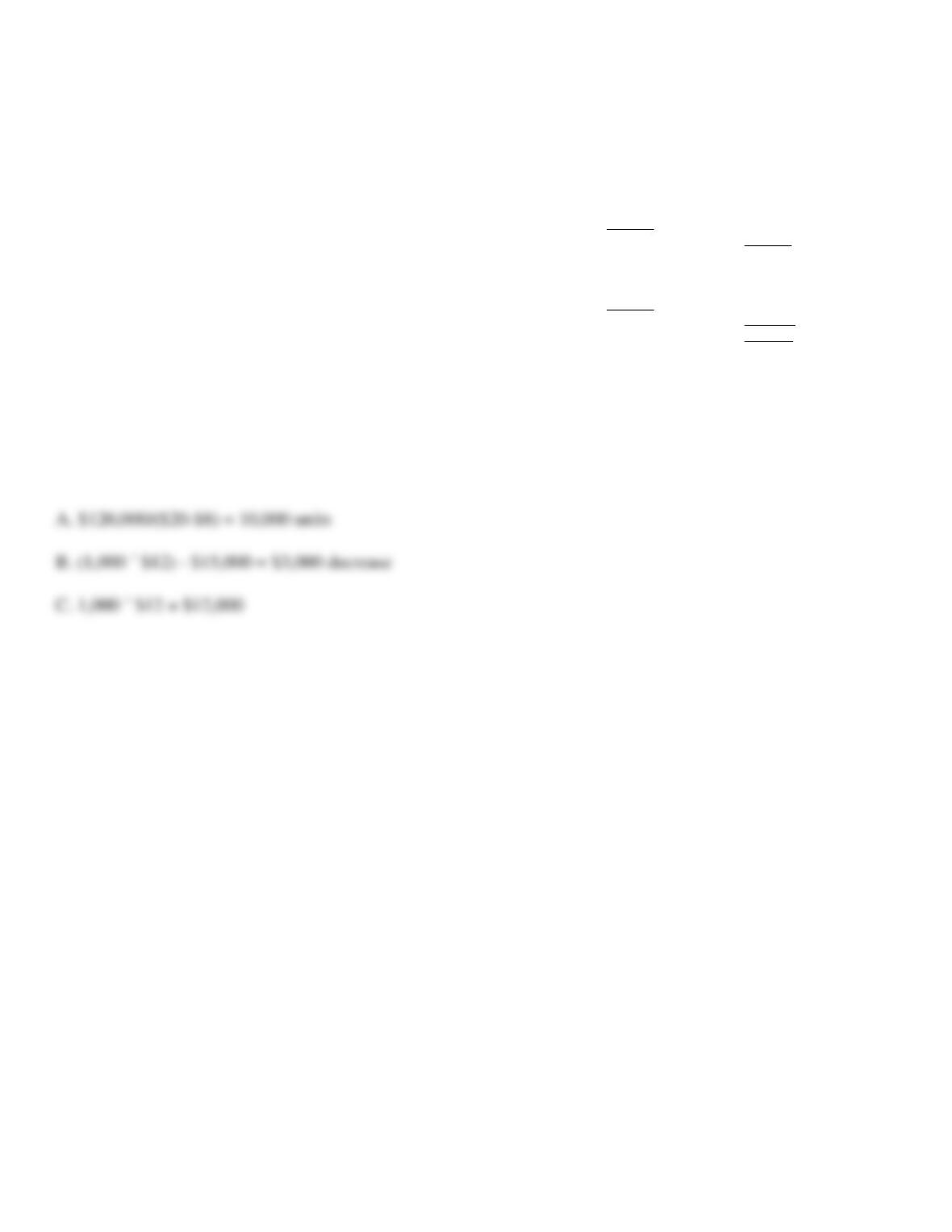
A. Determine the break-even point in sales dollars.
B. The sales manager believed the company could increase sales by 1,000 units if advertising expenditures were increased by $15,000. By how much
will operating income increase or decrease if the advertising is increased as suggested?
C. What is the maximum amount the company could pay for advertising if the advertising would increase sales by 1,000 units?
116. The Lauren Company manufactures two products. Information about the two product lines for the year is
as follows:
Product X
Product Y
Selling price per unit
$70
$100
Variable costs per unit
30
40
Contribution margin per unit
$40
$60
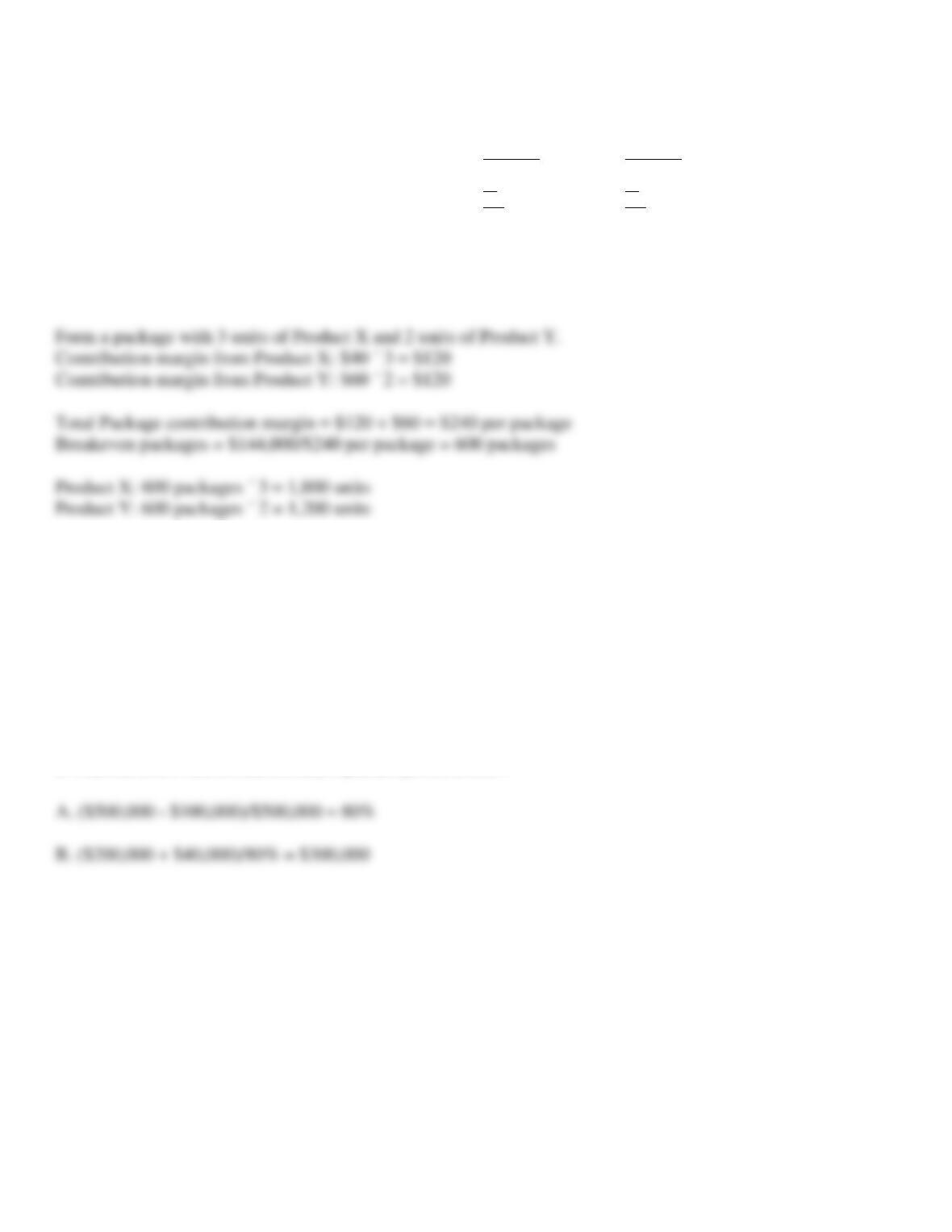
The company expects fixed costs to be $144,000. The firm expects 60 percent of its sales (in units) to be Product X.
Required: Determine the break-even point in units for both Product X and Product Y.
117. A company provided the following information:
Sales
$500,000
Variable costs
$100,000
Fixed costs
$200,000
A. What is the contribution margin ratio?
B. What is the level of sales in dollars necessary to generate a profit of $40,000?
118. Aaron Company provided the following data for next month:
Selling price per unit
$400
Variable manufacturing costs per unit
$100
Fixed manufacturing costs per unit
$80
Variable selling costs per unit
$60
Fixed selling costs per unit
$40
Expected production and sales
1,800 units
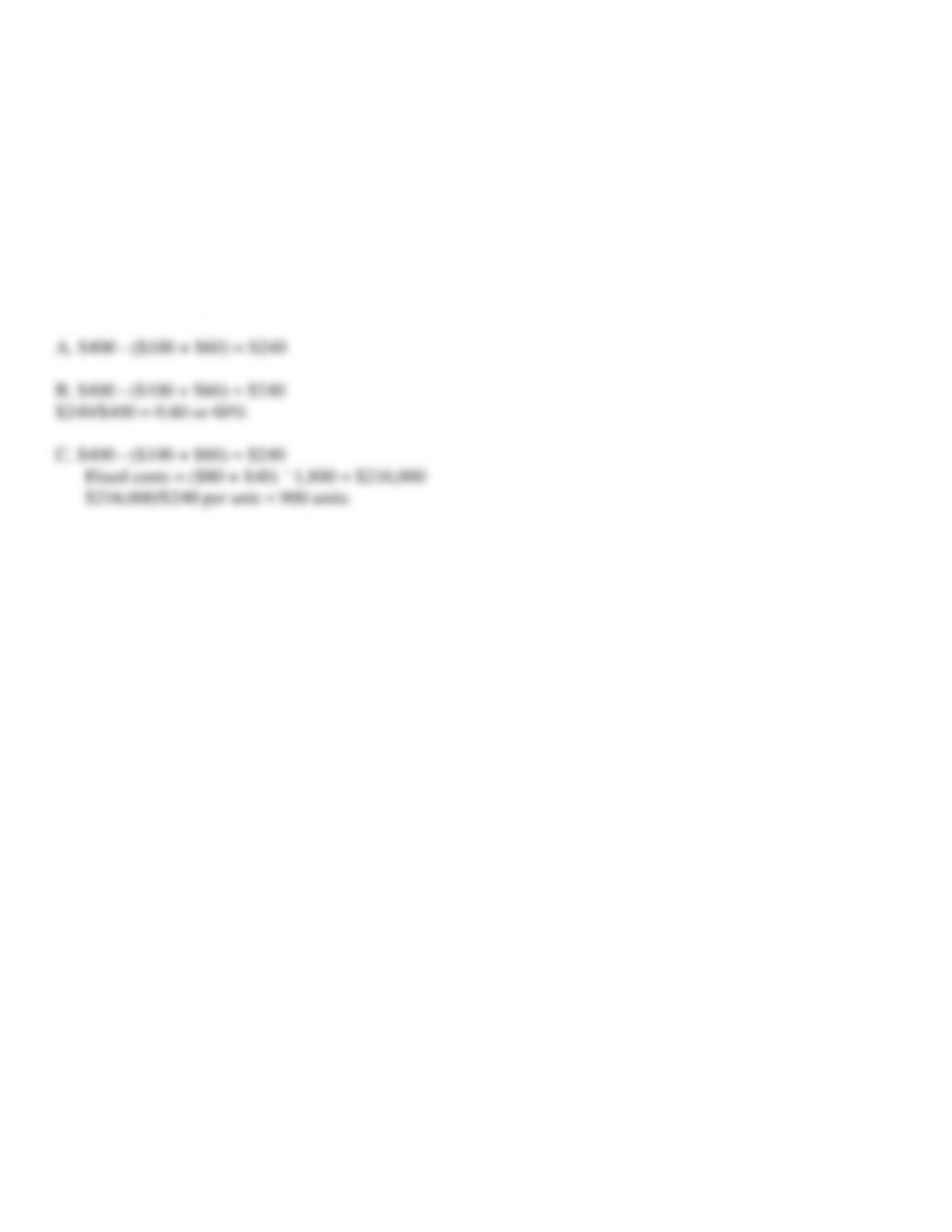
A. What is contribution margin per unit?
B. What is the contribution margin ratio?
C. What is the breakeven point in units?
119. Thomas Corporation developed the following income statement using a contribution margin approach:
Thomas Corporation
Projected Income Statement
For the Current Year Ending December 31
Sales
$750,000
Less variable costs:
Variable manufacturing costs
$280,000
Variable selling costs
120,000
Total variable costs
$400,000
Contribution margin
$350,000
Less fixed costs:
Fixed manufacturing costs
$130,000
Fixed selling and administrative costs
80,000
Total fixed costs
$210,000
Operating income
$140,000
The projected income statement was based on sales of 100,000 units. Thomas has the capacity to produce 120,000 units during the year.
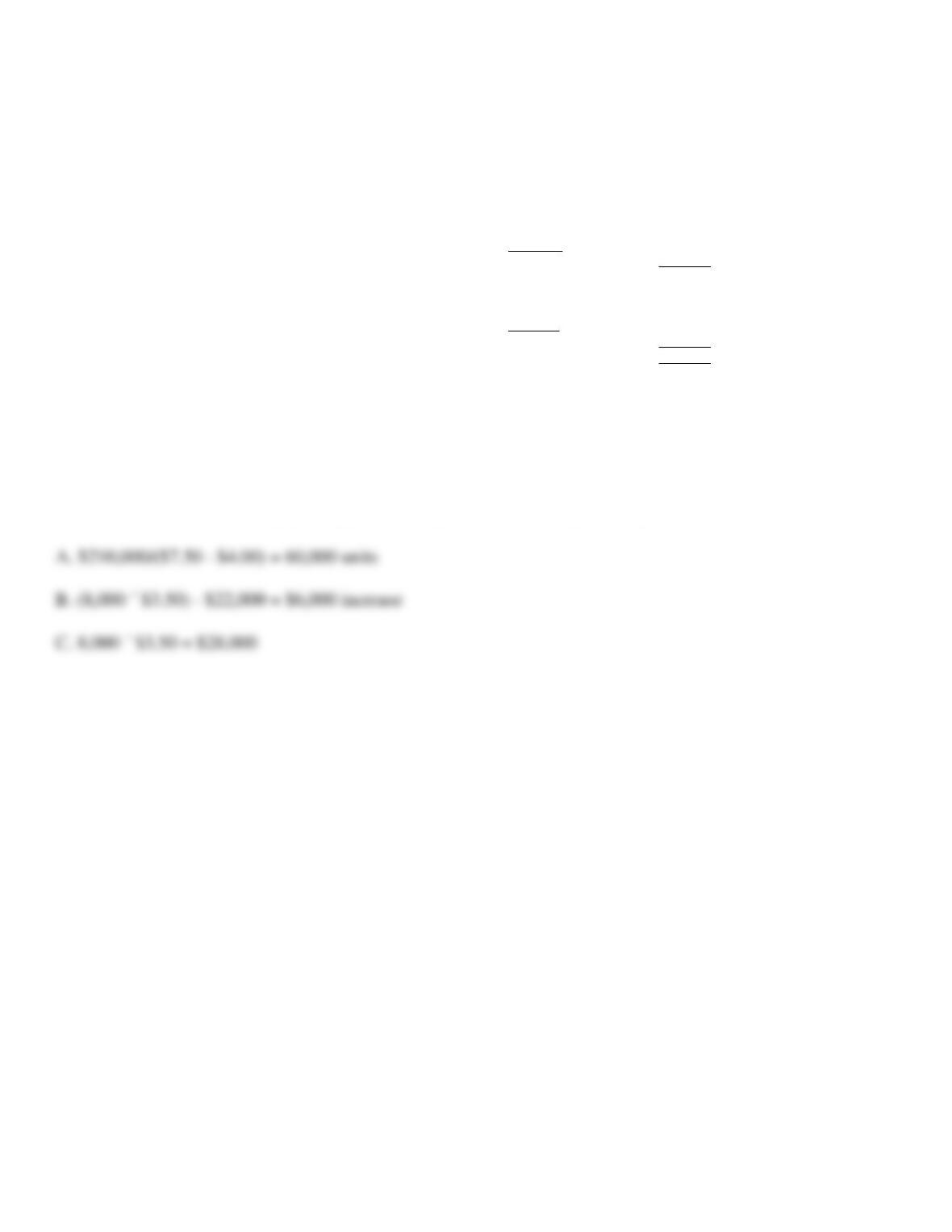
A. Determine the break-even point in units.
B. The sales manager believes the company could increase sales by 8,000 units if advertising expenditures were increased by $22,000. By how much
will income increase or decrease if this plan is put into effect?
What is the maximum amount the company could pay for advertising if the sales would really increase by 8,000 units?
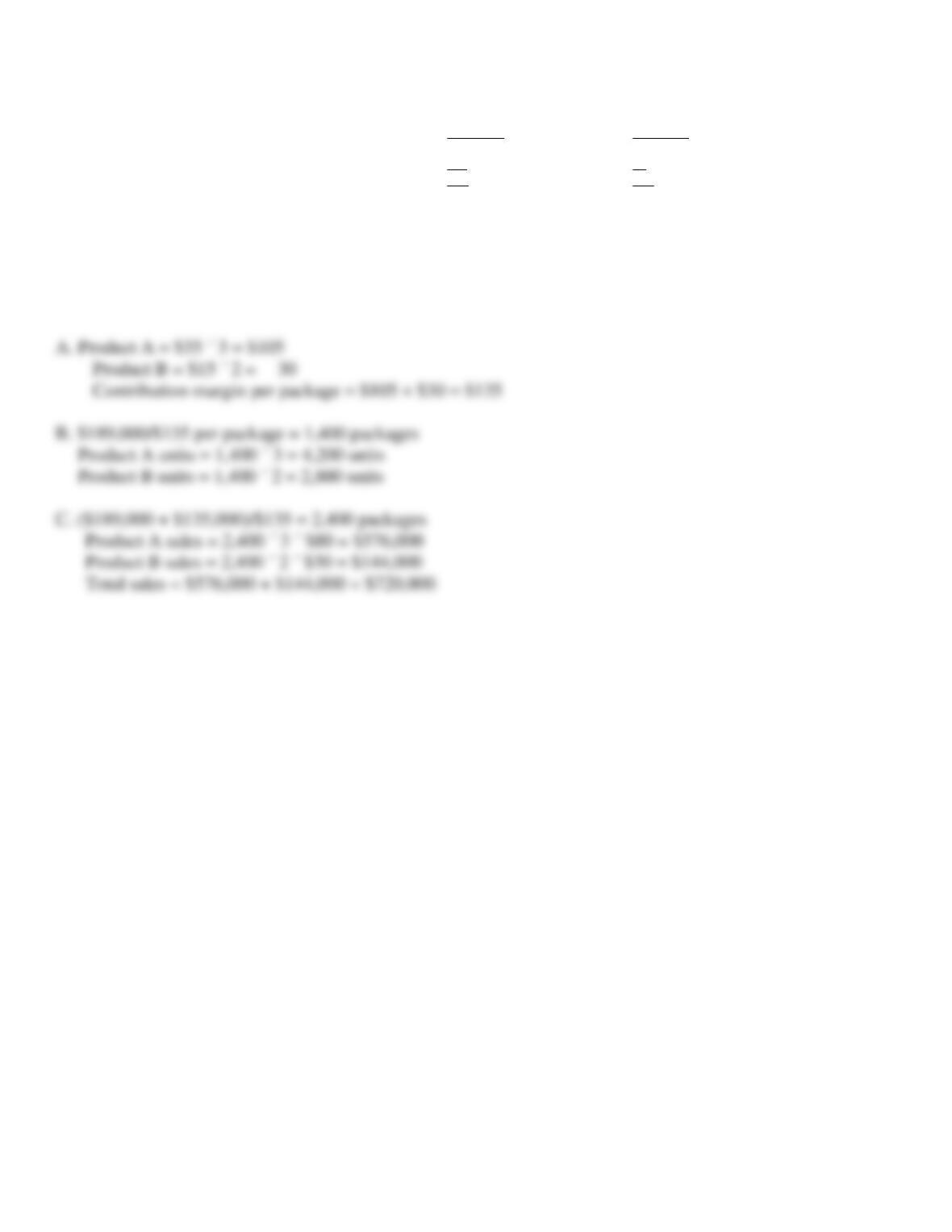
120. The Noble Company manufactures two products. Information about the two product is as follows:
Product A
Product B
Selling price per unit
$80
$30
Variable costs per unit
45
15
Contribution margin per unit
$35
$15
The company expects fixed costs to be $189,000. The firm expects 60 percent of its sales (in units) to be Product A (a sales mix of 3:2).
A. Calculate the contribution margin per package.
B. Determine the breakeven point in units for Products A and B.
C. Determine the level of sales (in dollars) necessary to generate operating income of $135,000.
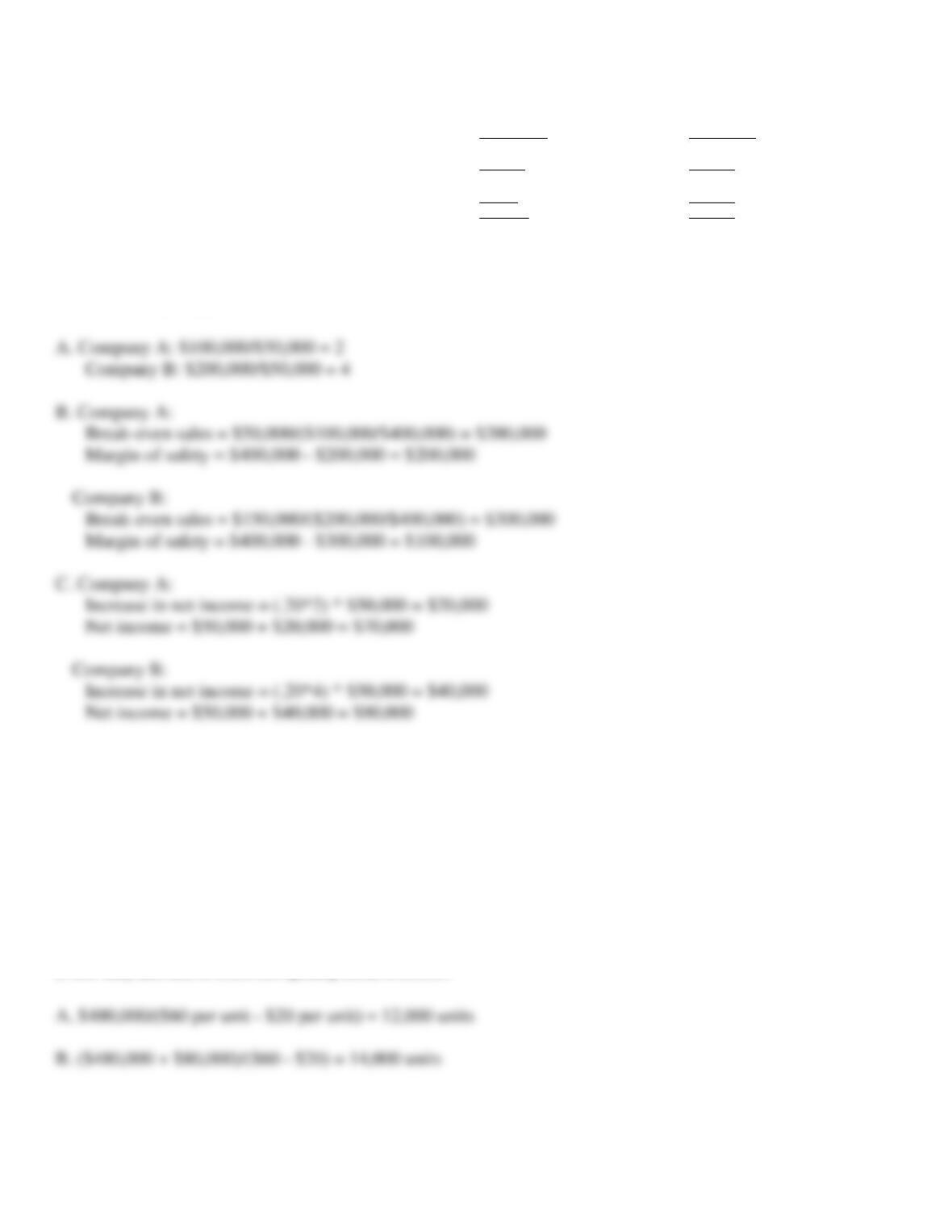
121. Income statements for two different companies in the same industry are as follows:
Company A
Company B
Sales
$400,000
$400,000
Less: Variable costs
300,000
200,000
Contribution margin
$100,000
$200,000
Less: Fixed costs
50,000
150,000
Operating income
$ 50,000
$50,000
A. Calculate the degree of operating leverage for each firm.
B. Calculate the margin of safety in dollars for each firm.
C. Determine the operating income for each firm if sales increase by 20%.
122. The following information was extracted from the accounting records of MVP Corporation:
Selling price per unit
$60
Variable cost per unit
$20
Total fixed costs
$480,000
A. What is MVP’s break-even point in units?
B. How many units must be sold to earn operating income of $80,000?
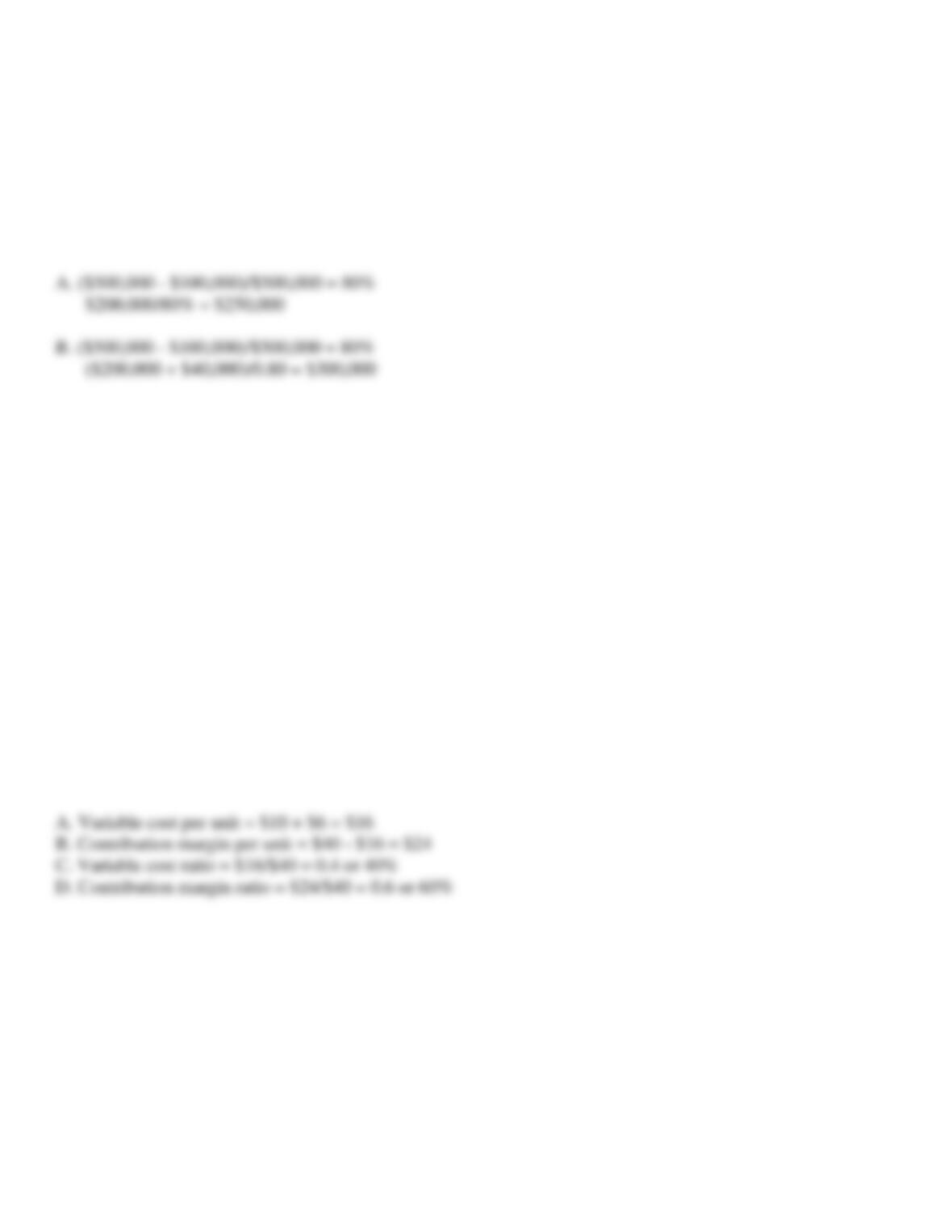
123. Information for Crisby Company is as follows:
Sales
$500,000
Variable costs
$100,000
Fixed costs
$200,000
A. What is the break-even point in sales dollars
B. What sales (in dollars) are needed to generate operating income of $40,000?
124. Figure 3-9.
Newman Company expects to produce and sell 2,000 units next month. Data on costs follows:
Per unit costs:
Selling price
$40
Variable manufacturing costs
$10
Variable selling costs
$6
Total costs:
Fixed manufacturing costs
$16,000
Fixed selling costs
$8,000
A. What is the variable cost per unit?
B. What is contribution margin per unit?
C. What is the variable cost ratio?
D. What is the contribution margin ratio?
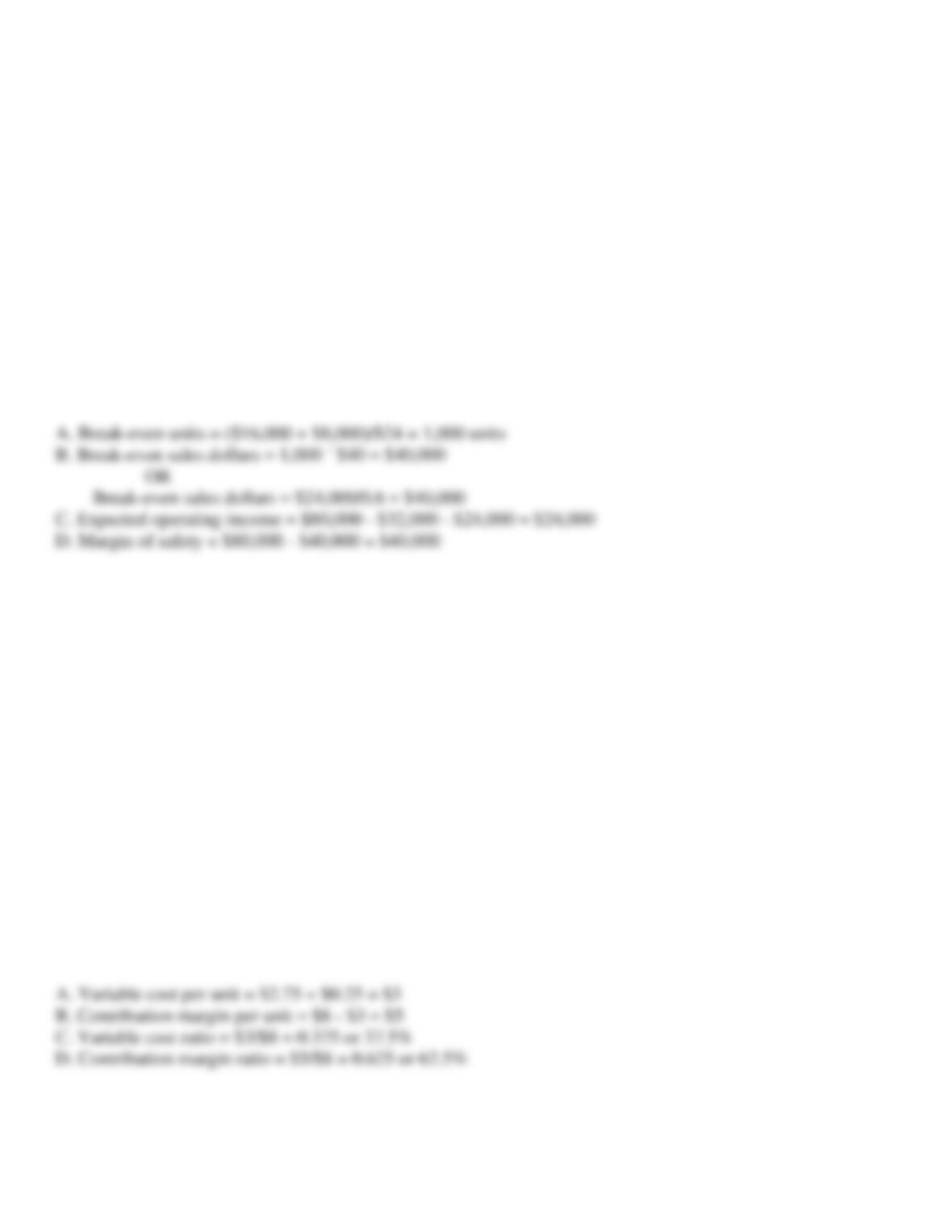
125. Figure 3-9.
Newman Company expects to produce and sell 2,000 units next month. Data on costs follows:
Per unit costs:
Selling price
$40
Variable manufacturing costs
$10
Variable selling costs
$6
Total costs:
Fixed manufacturing costs
$16,000
Fixed selling costs
$8,000
A. What is the break-even point in units?
B. What is the break-even point in sales dollars?
C. What is the expected operating income for next month?
D. What is the margin of safety in dollars?
126. Figure 3-10.
McCallen Company expects to produce and sell 500 units next month. Data on costs follows:
Per unit costs:
Selling price
$8
Variable manufacturing costs
$2.75
Variable selling costs
$0.25
Total costs:
Fixed manufacturing costs
$1,000
Fixed selling costs
$125
A. What is the variable cost per unit?
B. What is contribution margin per unit?
C. What is the variable cost ratio?
D. What is the contribution margin ratio?
127. Figure 3-10.
McCallen Company expects to produce and sell 500 units next month. Data on costs follows:
Per unit costs:
Selling price
$8
Variable manufacturing costs
$2.75
Variable selling costs
$0.25
Total costs:
Fixed manufacturing costs
$1,000
Fixed selling costs
$125
A. What is the break-even point in units?
B. What is the break-even point in sales dollars?
C. What is the expected operating income for next month?
D. What is the margin of safety in dollars?
128. Explain why cost-volume-profit analysis can be useful to managers.
129. What are the assumptions underlying cost-volume-profit analysis?
Some of the assumptions are as follows:
1.
The analysis assumes a linear revenue function and a linear cost function.
3.
The analysis assumes that what is produced is actually sold.
130. How can a multi-product firm determine its break-even point?