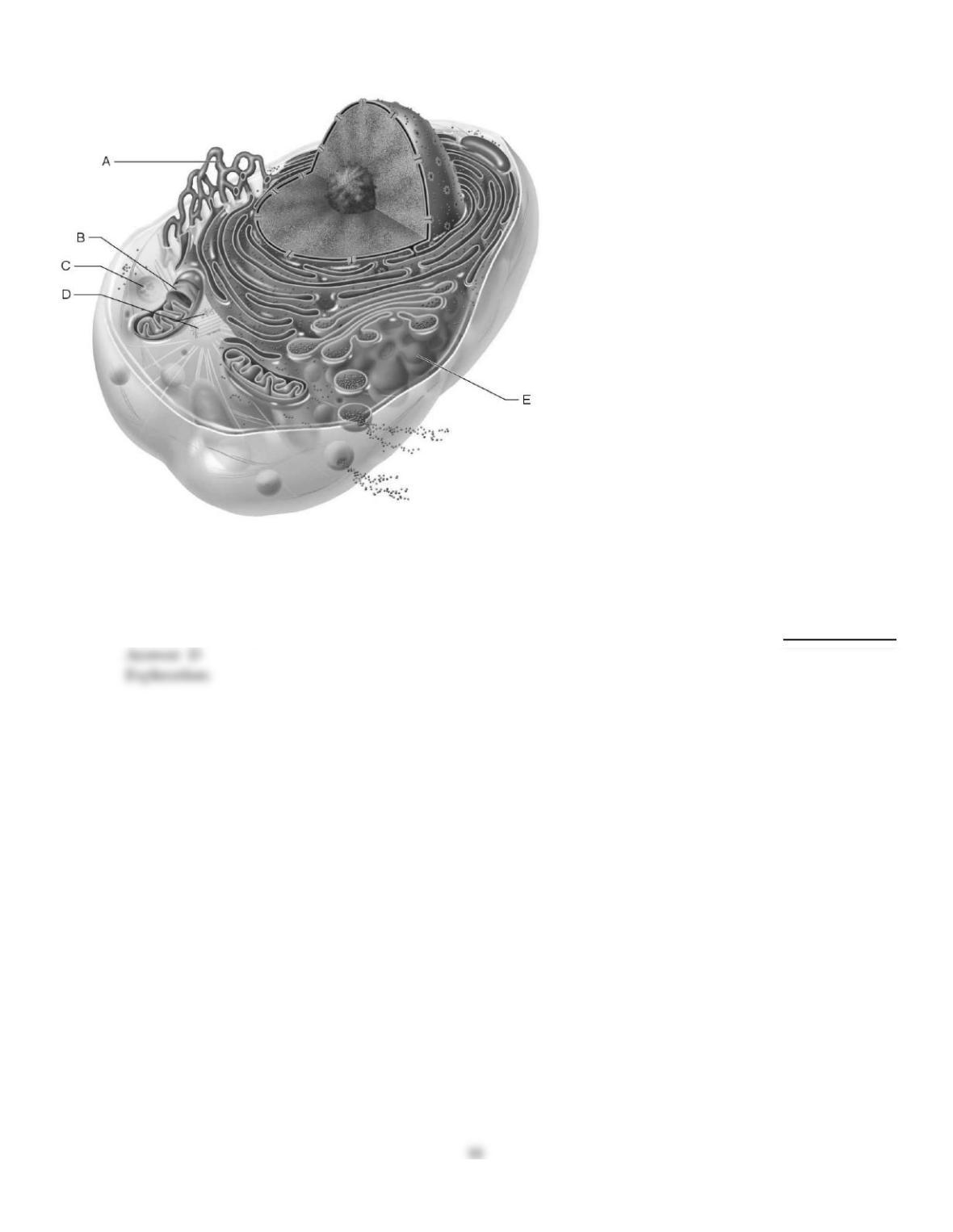
Figure 3.1
Using Figure 3.1, match the following:
64)
Forms the mitotic spindle.
64)
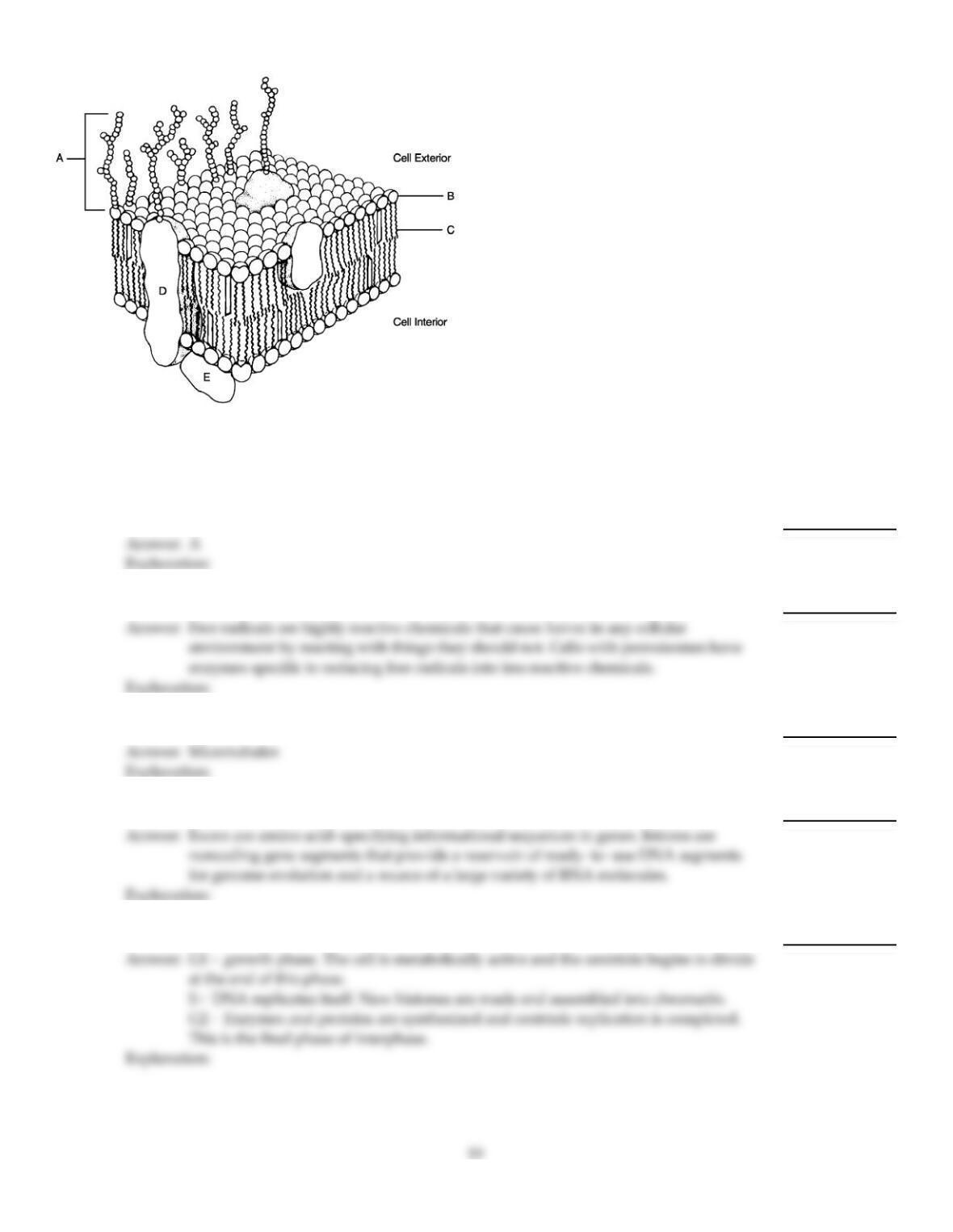
Figure 3.2
Using Figure 3.2, match the following:
65)
Glycocalyx.
65)
66)
Why are free radicals so dangerous to cells, and how are they dealt with by the body?
66)
67)
________ are hollow tubes made of spherical protein subunits called tubulins.
67)
68)
What are cell exons and introns?
68)
69)
Briefly name the subphases of interphase and tell what they do.
69)
70)
What are nucleolar organizer regions?
70)
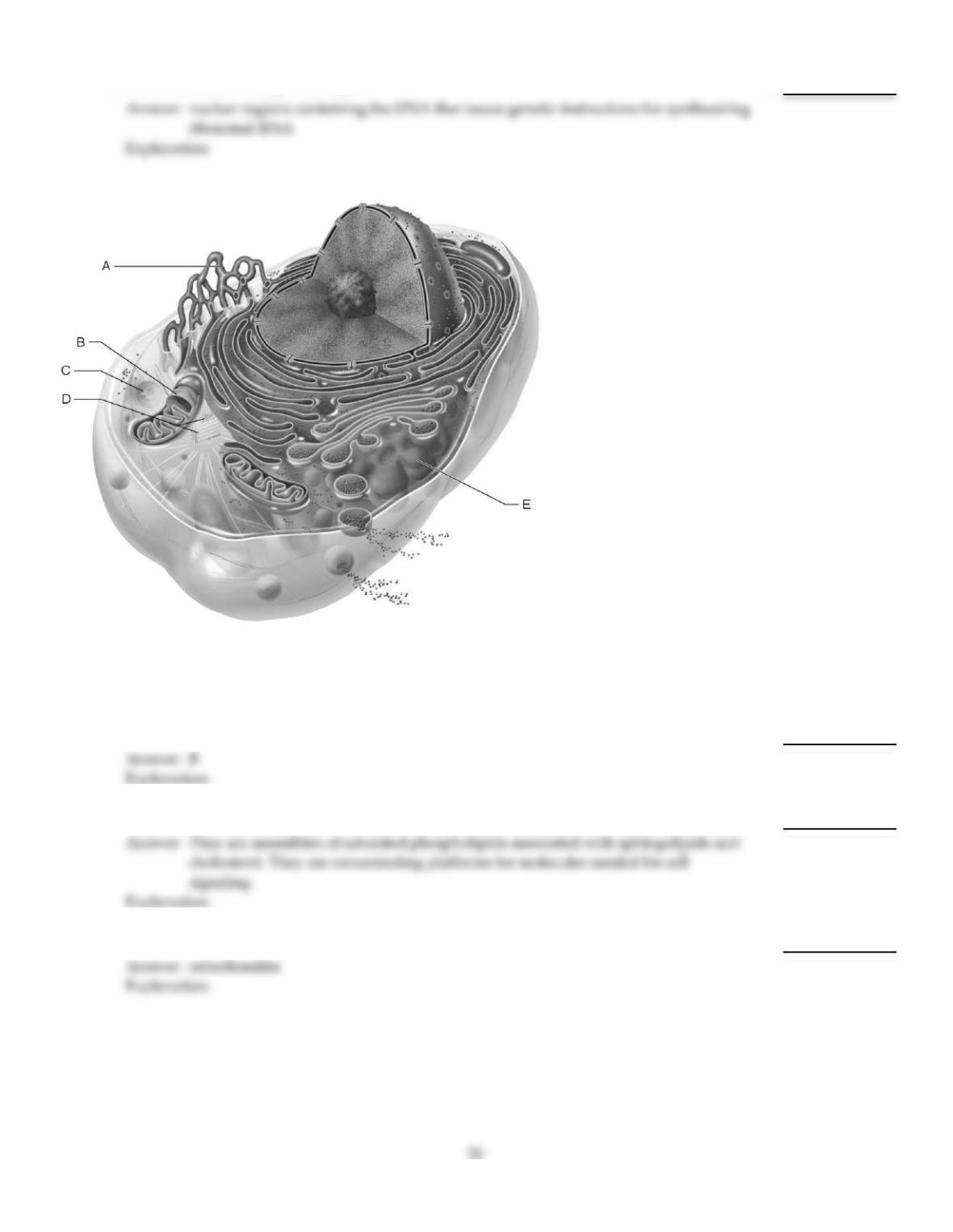
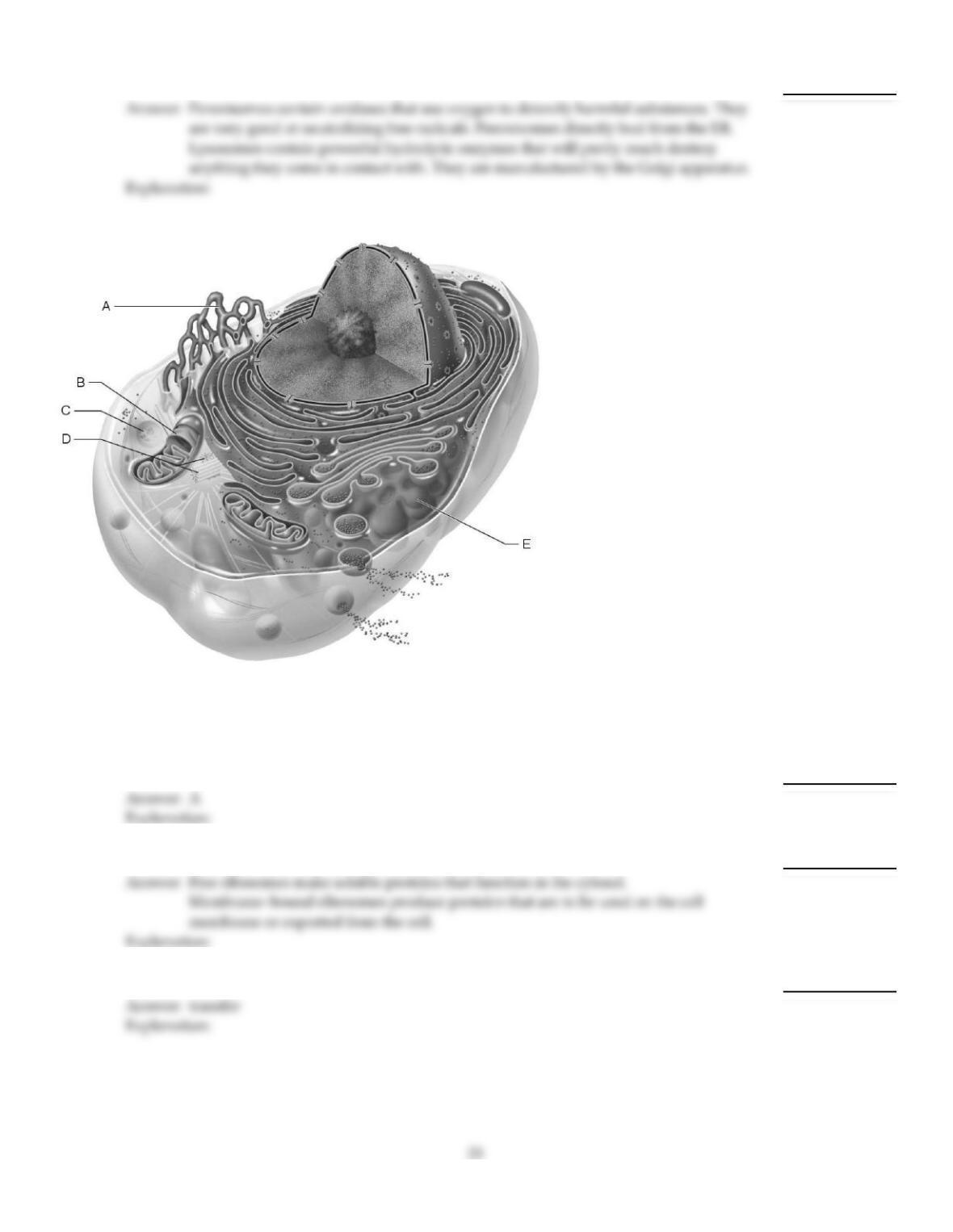
Figure 3.1
Using Figure 3.1, match the following:
71)
Produces ATP aerobically.
71)
72)
What are lipid rafts? What are their functions?
72)
73)
Aerobic cellular respiration occurs in the ________.
73)
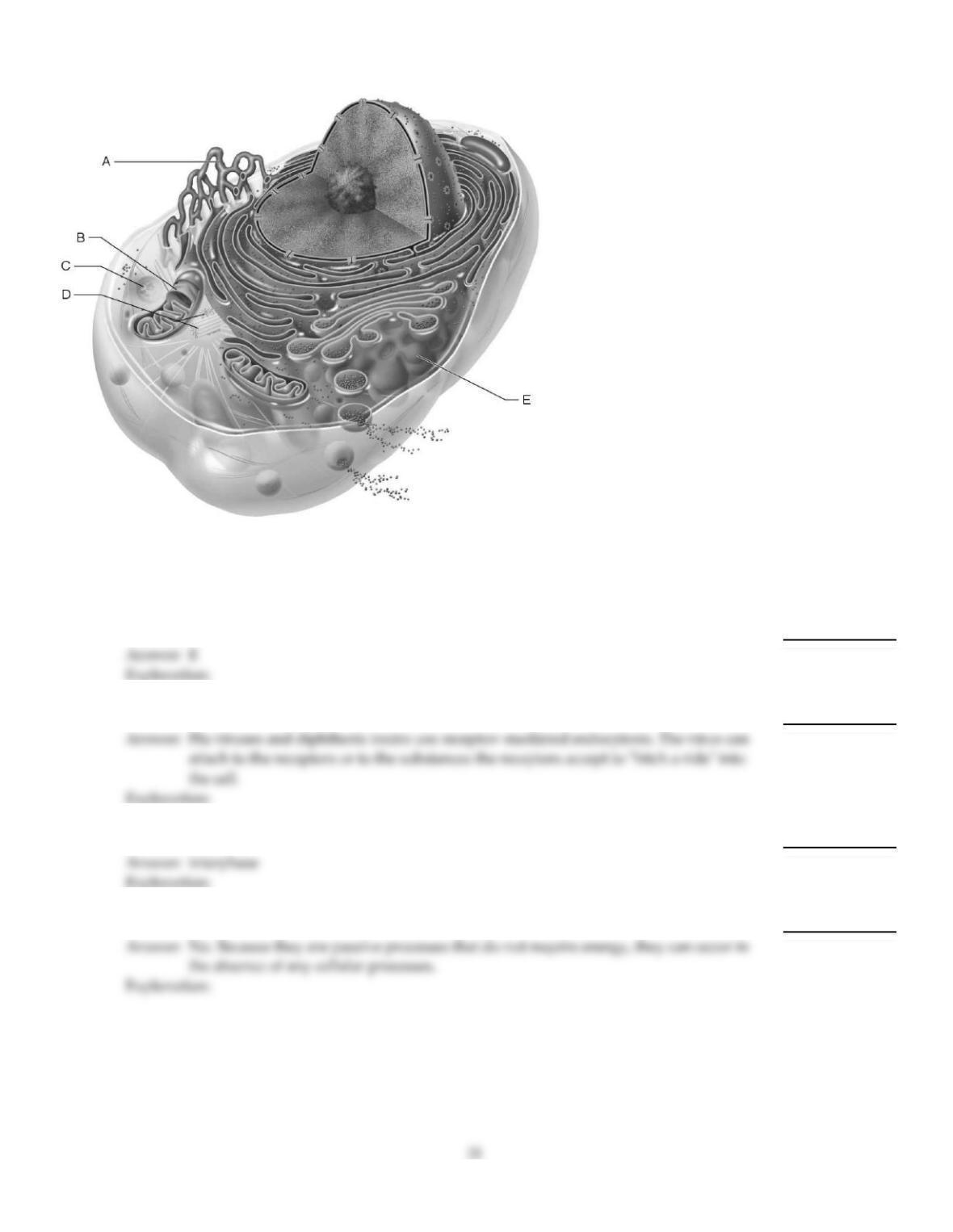
Figure 3.1
Using Figure 3.1, match the following:
74)
Packages proteins for insertion in the cell membrane or for exocytosis.
74)
75)
What is the common route of entry for flu viruses into a cell?
75)
76)
The metabolic or growth phase of a cell life cycle is called ________.
76)
77)
Are Brownian motion, diffusion, and osmosis seen only in living tissue?
77)
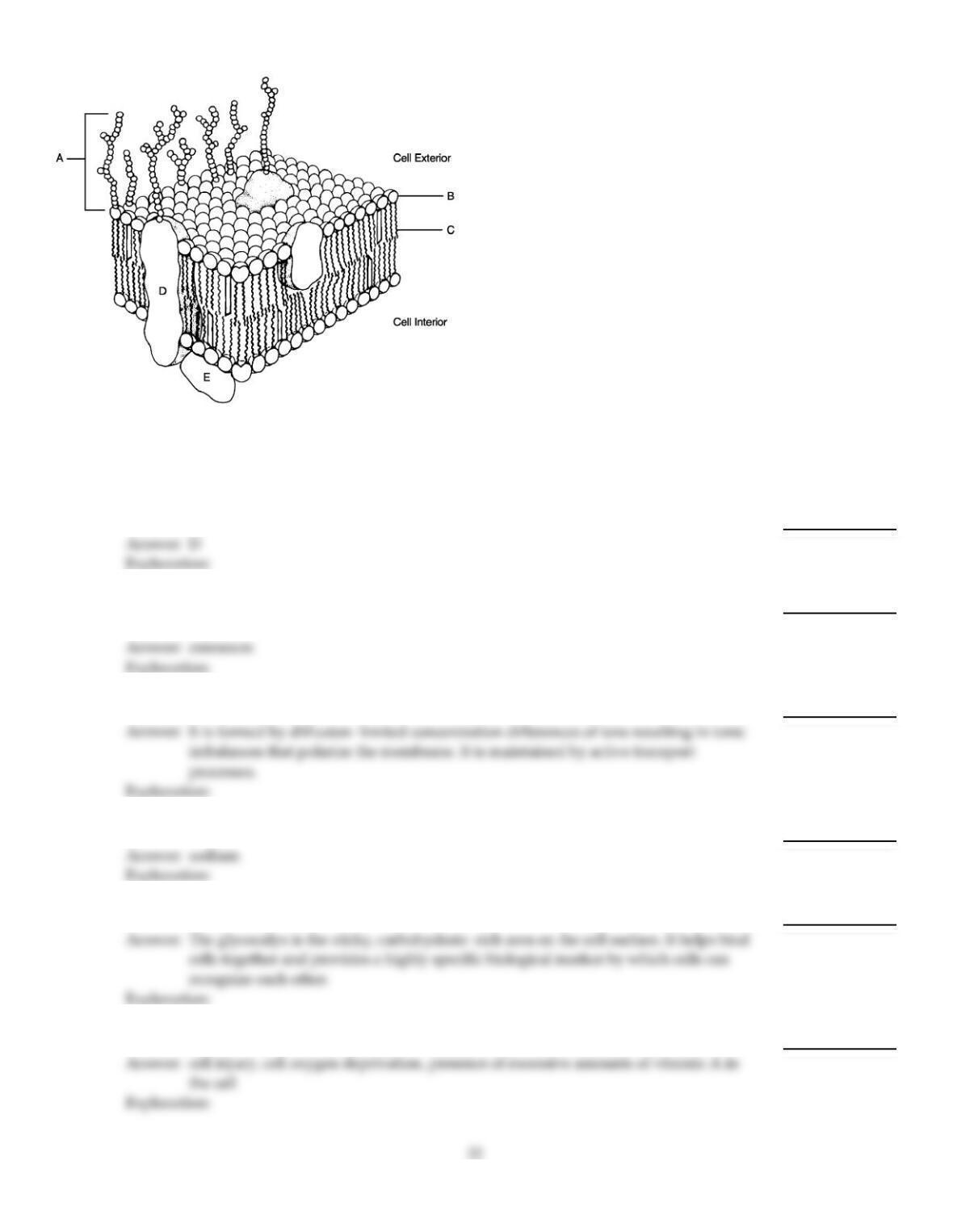
Figure 3.2
Using Figure 3.2, match the following:
78)
Integral protein.
78)
79)
Hollow cylinders that connect plasma membranes composed of transmembrane protein
are called ________.
79)
80)
How is the resting potential formed? How is it maintained?
80)
81)
The most common extracellular ion is ________.
81)
82)
Briefly describe the glycocalyx and its functions.
82)
83)
What factors contribute to the fragility of the lysosome and subsequent cell autolysis?
83)
84)
How are peroxisomes different from lysosomes?
84)
Figure 3.1
Using Figure 3.1, match the following:
85)
Site of synthesis of lipid and steroid molecules.
85)
86)
How are the products of free ribosomes different from membrane–bound ribosomes?
86)
87)
The RNA that has an anticodon and attaches to a specific amino acid is ________ RNA.
87)
88)
Why can we say that cells are protein factories?
88)
TRUE/FALSE. Write ‘T’ if the statement is true and ‘F’ if the statement is false.
89)
Aquaporins are believed to be present in red blood cells and kidney tubules, but not in any other
cells in the body.
89)
90)
In osmosis, movement of water occurs toward the solution with the lower solute concentration.
90)
91)
Most organelles are bounded by a membrane that is quite different in structure from the lipid
bilayer of the plasma membrane.
91)
92)
There is only one cell type in the human body that has a flagellum.
92)
93)
Microtubules are hollow tubes made of subunits of the protein tubulin.
93)
94)
Microfilaments are thin strands of the contractile protein myosin.
94)
95)
Facilitated diffusion always requires a carrier protein.
95)
96)
The genetic information is coded in DNA by the regular alternation of sugar and phosphate
molecules.
96)
97)
The glycocalyx is often referred to as the “cell coat,” which is somewhat fuzzy and sticky with
numerous cholesterol chains sticking out from the surface of the cell membrane.
97)
98)
Interstitial fluid represents one type of extracellular material.
98)
99)
Introns represent a genome scrap yard that provides DNA segments for genome evolution and a
variety of small RNA molecules.
99)
100)
Each daughter cell resulting from mitotic cell division has exactly as many chromosomes as the
parent cell.
100)
101)
Diffusion movement always occurs from areas of greater to areas of lesser concentration.
101)
102)
Lipid rafts, found in the cell outer membrane surface, are concentrating platforms for certain
receptor molecules or for protein molecules needed for cell signaling..
102)
103)
The orderly sequence of the phases of mitosis is prophase, metaphase, anaphase, and telophase.
103)
104)
A process by which large particles may be taken into the protection of the body by invaders like
bacteria, or for disposing of old or dead cells is called phagocytosis.
104)
105)
Nitric oxide is known to be the first gas to act as a biological messenger.
105)
106)
Apoptosis is programmed cell suicide; cancer cells do not undergo this process.
106)
107)
Telomeres are the regions of chromosomes that code for the protein ubiquitin.
107)
108)
Final preparation for cell division is made during the cell life cycle subphase called G2.
108)
109)
In their resting state, all body cells exhibit a resting membrane potential ranging from –50 to about
+50 millivolts.
109)
110)
Cholesterol helps to stabilize the cell membrane while decreasing the mobility of the
phospholipids.
110)
111)
Concentration differences cause ionic imbalances that polarize the cell membrane, and active
transport processes.
111)
112)
The speed of individual particle diffusion is influenced by temperature and particle size, not by
concentration.
112)
113)
DNA transcription is another word for DNA replication.
113)
MATCHING. Choose the item in column 2 that best matches each item in column 1.
Match the following:
114)
Chromosomes uncoil to form
chromatin.
A
A)
Telophase
114)
Match the following:
115)
May be attached to the ER or scattered
in the cytoplasm.
A
A)
Ribosomal RNA
115)
Match the following:
116)
Chromosomal centromeres split and
chromosomes migrate to opposite
ends of the cell.
A
A)
Anaphase
116)
Match the following:
117)
Provides the energy needed for
synthesis reactions.
A
A)
ATP
117)

Match the following:
118)
Houses DNA and RNA.
A)
Nucleus
Match the following:
119)
Type of anchoring junction.
A
119)
A)
Desmosomes
Match the following:
120)
Forms part of the protein synthesis site
in the cytoplasm.
A
121)
Attaches the correct amino acid to its
transfer RNA.
B
A)
Ribosomal RNA
120)
121)
Match the following:
122)
Chromosomes align on the spindle
equator.
A
A)
Metaphase
122)
Match the following:
123)
Hollow cytoskeletal elements that act
as organizers for the cytoskeleton.
A
A)
Microtubules
123)
Match the following:
124)
Abundant in tissues subjected to great
mechanical stress.
A
A)
Desmosomes
124)
Match the following:
125)
Nuclear membrane and nucleolus
disintegrate.
A
A)
Late prophase
125)
Match the following:
126)
Plays a role in the synthesis of
steroid–based hormones and proteins.
A
A)
Endoplasmic reticulum
126)
A
118)

Match the following:
127)
Produced in the nucleus, this molecule
specifies the exact sequence of amino
acids of the protein to be made.
A)
Messenger RNA
127)
Match the following:
128)
Help prevent molecules from passing
through the extracellular space
between adjacent cells.
A)
Tight junctions
128)
Match the following:
129)
Dense spherical bodies in the nucleus
that are the synthesis site for
ribosomal RNA.
130)
The actual site of protein synthesis.
130)
A)
Nucleoli
B)
Ribosomes
129)
Match the following:
131)
Centrioles move to opposite ends of
the cell.
A)
Early prophase
131)
Match the following:
132)
Act as “interpreter” molecules that
recognize specific amino acids and
nucleotide base sequences.
A)
Transfer RNA
132)
Match the following:
133)
Present in electrically excitable tissues.
134)
Communicating junction.
A)
Gap junctions
133)
134)
ESSAY. Write your answer in the space provided or on a separate sheet of paper.
135)
Research shows that neurofibrillary tangles associated with the disintegration of microtubules are the primary
cause of Alzheimer’s disease. If microtubules disintegrate, what then might happen to brain cells?
136)
At of age of 6 months, Caleb was diagnosed with Tay–Sachs disease. As his primary care physician, what would
you tell his parents about this disease?
137)
Your patient has the flu and reports 56 loose stools a day. He has experienced an isotonic fluid volume loss.
Explain what an isotonic fluid loss means.
138)
Describe the difference in cell division between normal cells and cancer cells.
139)
Your patient has a respiratory disease that has literally paralyzed the cilia. Explain why this patient would be at
an increased risk for a respiratory infection.
140)
A patient was admitted to the hospital for severe dehydration. Explain what changes occur in extracellular and
intracellular fluid compartments during dehydration.
Answer Key
Testname: C3
30
Answer Key
Testname: C3
Answer Key
Testname: C3
32
Answer Key
Testname: C3
33