Find the x–intercepts of the polynomial function. State whether the graph crosses the x–axis, or touches the x–axis and
turns around, at each intercept.
41)
f(x) = – x3(x +3)2(x –8)
41)
A)
0, touches the x–axis and turns around;
3, crosses the x–axis;
8, crosses the x–axis
B)
0, crosses the x–axis;
3, touches the x–axis and turns around;
–8, crosses the x–axis
C)
0, touches the x–axis and turns around;
–3, touches the x–axis and turns around;
8, crosses the x–axis
D)
0, crosses the x–axis;
–3, touches the x–axis and turns around;
8, crosses the x–axis
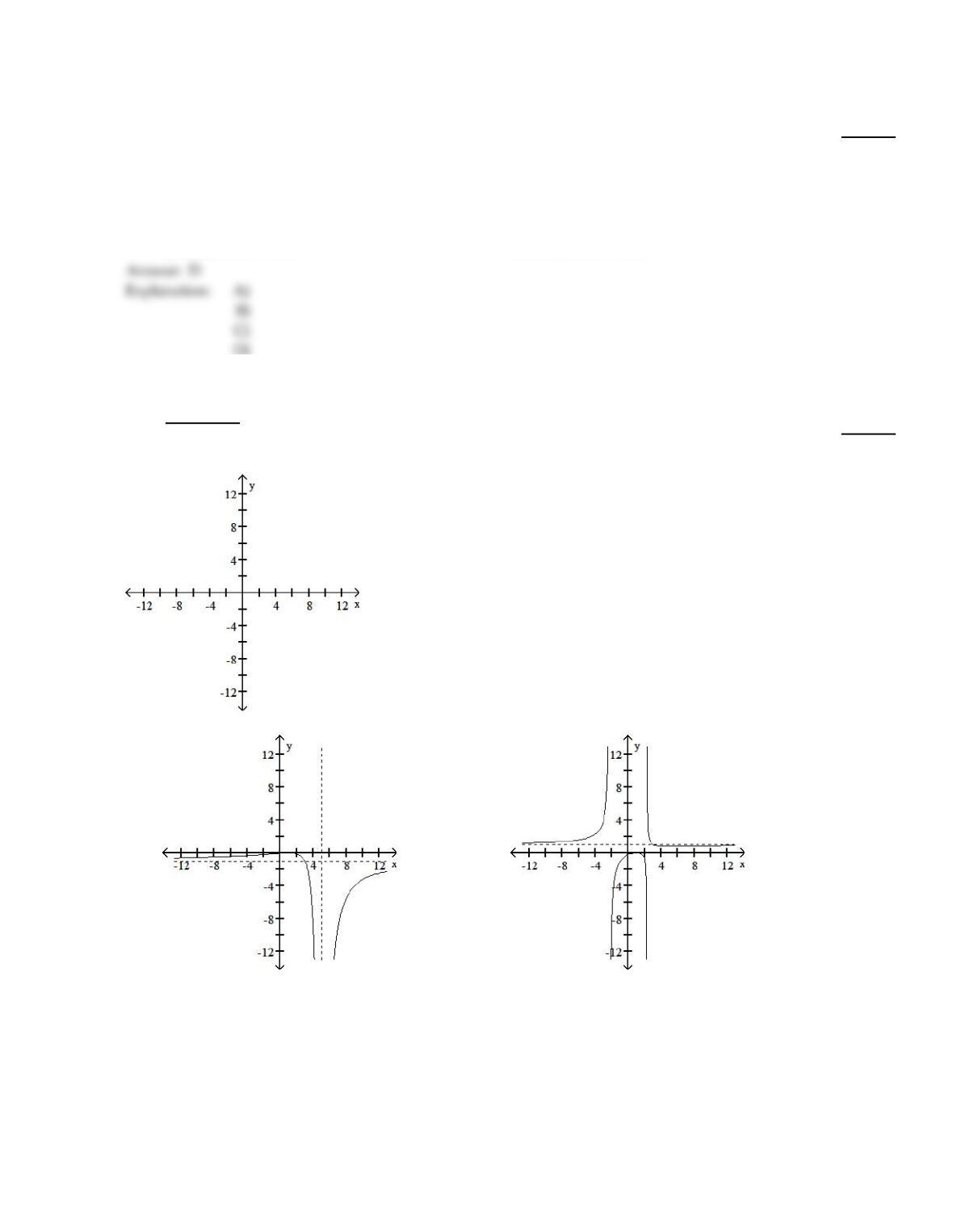
Graph the rational function.
42)
f(x) =x2– 2x + 1
(x – 5)2
42)
A)
B)
21
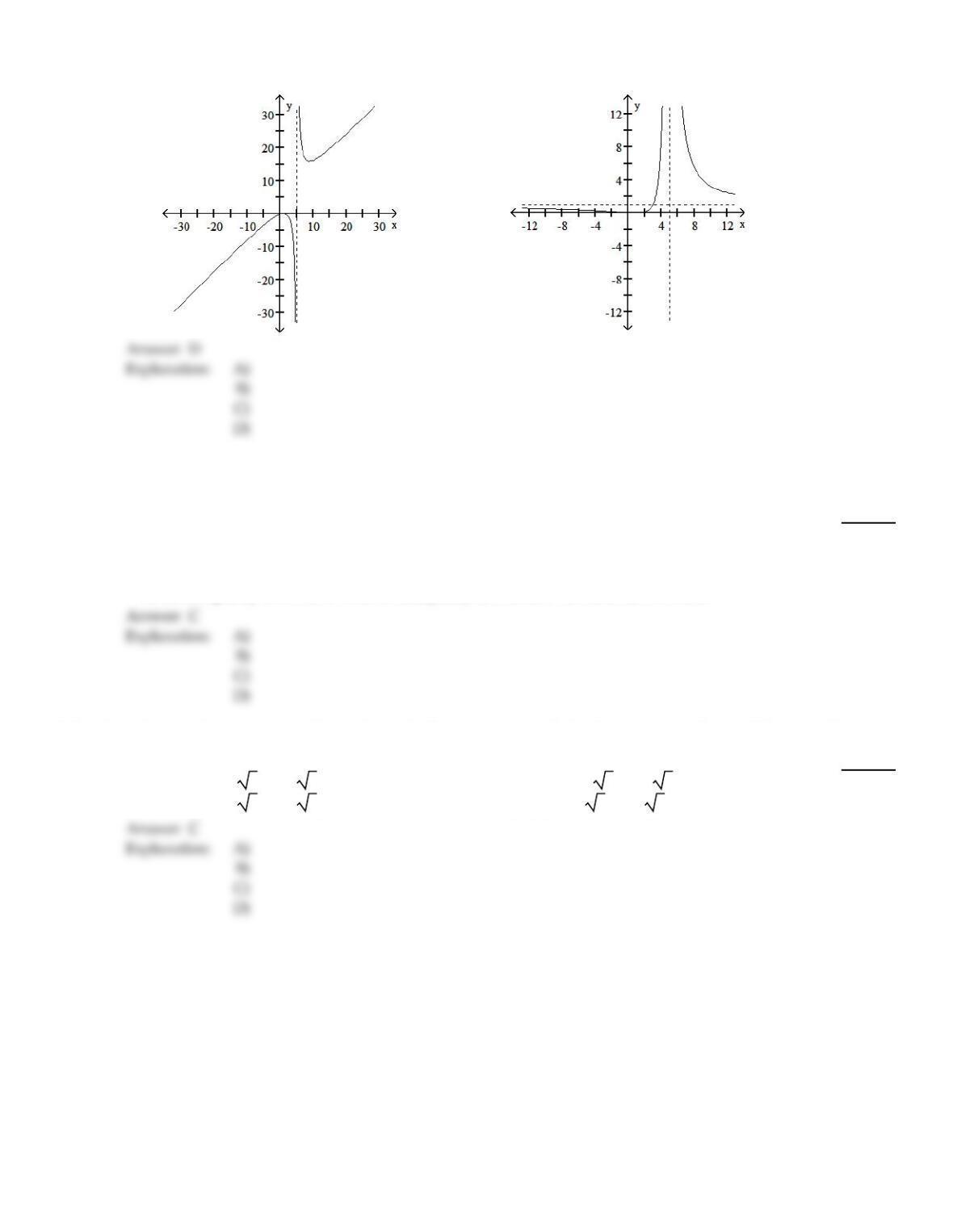
C)
D)
Find the zeros for the polynomial function and give the multiplicity for each zero. State whether the graph crosses the
x–axis or touches the x–axis and turns around, at each zero.
43)
f(x) =3(x + 2)(x + 5)2
43)
A)
2, multiplicity 1, touches x–axis and turns around; 5, multiplicity 2, crosses x–axis
B)
–2, multiplicity 1, touches x–axis and turns around; –5, multiplicity 2, crosses x–axis
C)
–2, multiplicity 1, crosses x–axis; –5, multiplicity 2, touches x–axis and turns around
D)
2, multiplicity 1, crosses x–axis; 5, multiplicity 2, touches x–axis and turns around
Solve the polynomial equation. In order to obtain the first root, use synthetic division to test the possible rational roots.
44)
x4+ 3x3– 15x2– 45x – 28 = 0
44)
A)
{1, –4, –3+2, –3–2}
B)
{–1, –4, –3+3, –3–3}
C)
{–1, 4, –3+2, –3–2}
D)
{–1, 5, –3+3, –3–3}
22
Solve the problem.
45)
The concentration, in parts per million, of a particular drug in a patient’s blood x hours after the
drug is administered is given by the function
f(x) = – x4+ 11x3– 41x2+ 55x
How many hours after the drug is administered will it be eliminated from the bloodstream.
45)
A)
5 hours
B)
16 hours
C)
11 hours
D)
4 hours
D)
Solve.
46)
If the voltage, V, in an electric circuit is held constant, the current, I, is inversely proportional to the
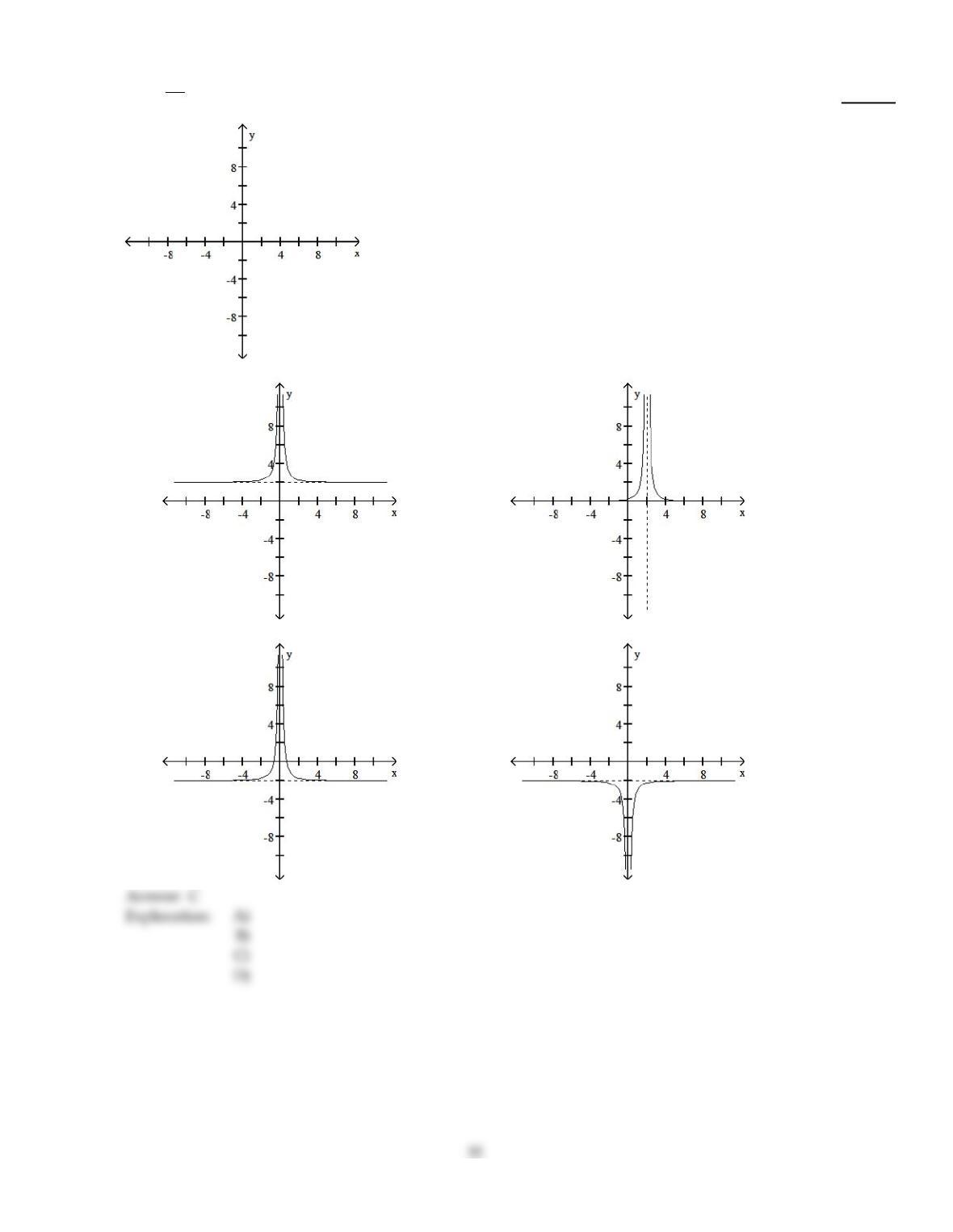
resistance, R. If the current is 420 milliamperes when the resistance is 2 ohms, find the current
when the resistance is 14 ohms.
46)
A)
2940 milliamperes
B)
60 milliamperes
C)
2933 milliamperes
D)
120 milliamperes
D)
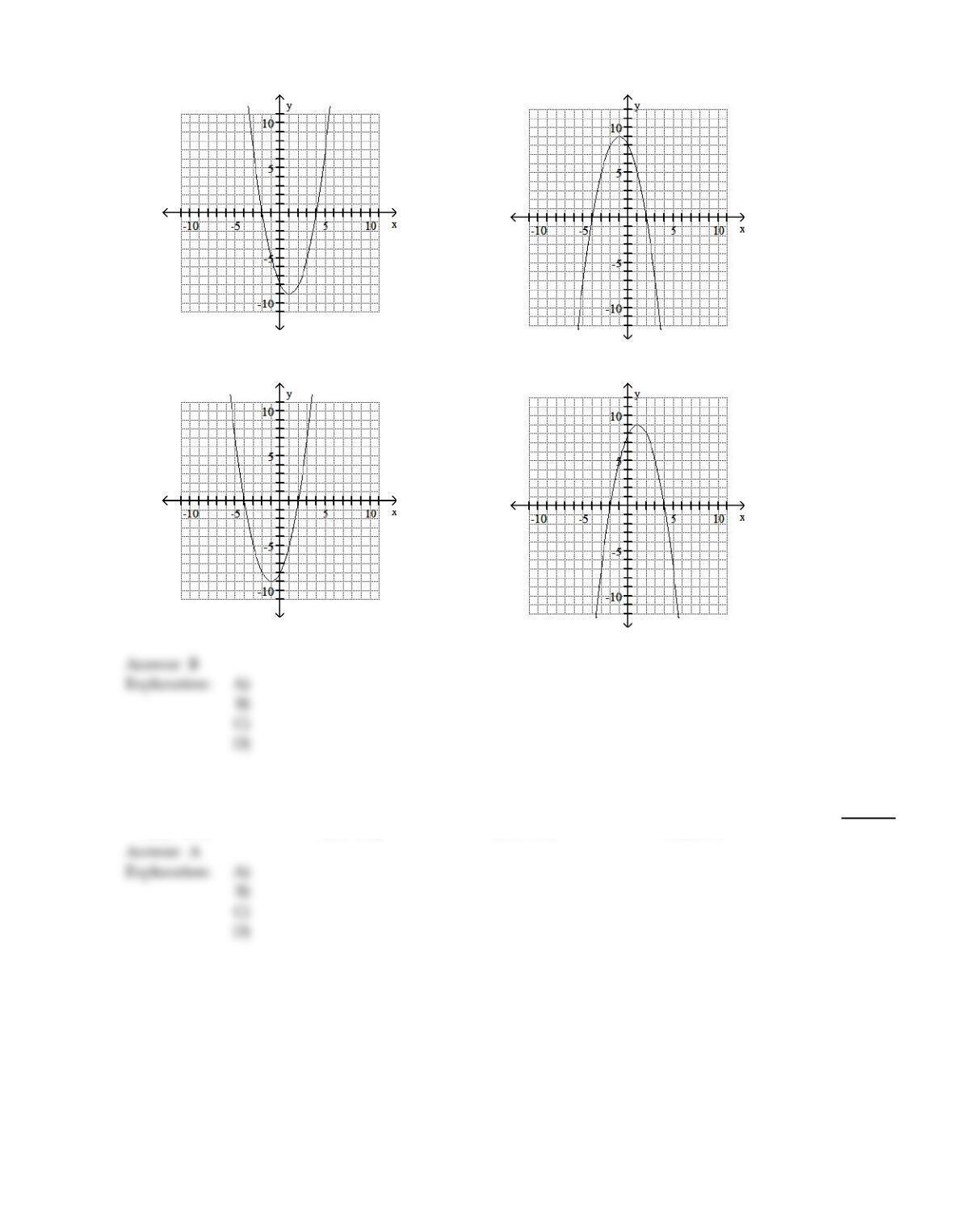
Use the vertex and intercepts to sketch the graph of the quadratic function.
47)
f(x) =8–x2– 2x
47)
23
A)
B)
C)
D)
Find the range of the quadratic function.
48)
y +4=(x + 2)2
48)
A)
[– 4, )
B)
(–, 2]
C)
(–, 4]
D)
[4, )
24
Find the domain and range of the quadratic function whose graph is described.
49)
The vertex is (1, –13) and the graph opens up.
49)
A)
Domain: (–, )
Range: [–13, )
B)
Domain: (–, )
Range: [1, )
C)
Domain: (–, )
Range: (–, –13]
D)
Domain: [1, )
Range: [–13, )
Find an nth degree polynomial function with real coefficients satisfying the given conditions.
50)
n = 4; 2i, 3, and –3 are zeros; leading coefficient is 1
50)
A)
f(x) = x4– 5x2– 36
B)
f(x) = x4+ 4x2–3x – 36
C)
f(x) = x4+ 4x3– 5x2– 36
D)
f(x) = x4+ 4x2– 36
Find the vertical asymptotes, if any, of the graph of the rational function.
51)
g(x) =x + 1
x(x – 1)
51)
A)
x =1
B)
x = 0 and x =1
C)
x = – 1 and x =1
D)
no vertical asymptote
Solve the problem.
52)
A ball is thrown vertically upward with an initial velocity of 192 feet per second. The distance in
feet of the ball from the ground after t seconds is s =192t – 16t2. For what interval of time is the ball
more than 432 above the ground?
52)
A)
between 3 and 9 seconds
B)
between 5.5 and 6.5 seconds
C)
between 2.5 and 9.5 seconds
D)
between 9 and 15 seconds
Use synthetic division and the Remainder Theorem to find the indicated function value.
53)
f(x) =6x4 + 2x3+ 3x2– 4x + 40; f(3)
53)
A)
595
B)
1567
C)
377
D)
813
Use synthetic division to show that the number given to the right of the equation is a solution of the equation, then solve
the polynomial equation.
54)
2x3– 5x2– 21x + 36 = 0; 4
54)
A)
–3
2, 3, 4
B)
–3
2, –3, 4
C)
3
2, 3, 4
D)
3
2, –3, 4
Solve the problem.
55)
A rectangular playground is to be fenced off and divided in two by another fence parallel to one
side of the playground. 600 feet of fencing is used. Find the maximum area of the playground.
55)
A)
15,000 ft2
B)
11,250 ft2
C)
22,500 ft2
D)
16,875 ft2
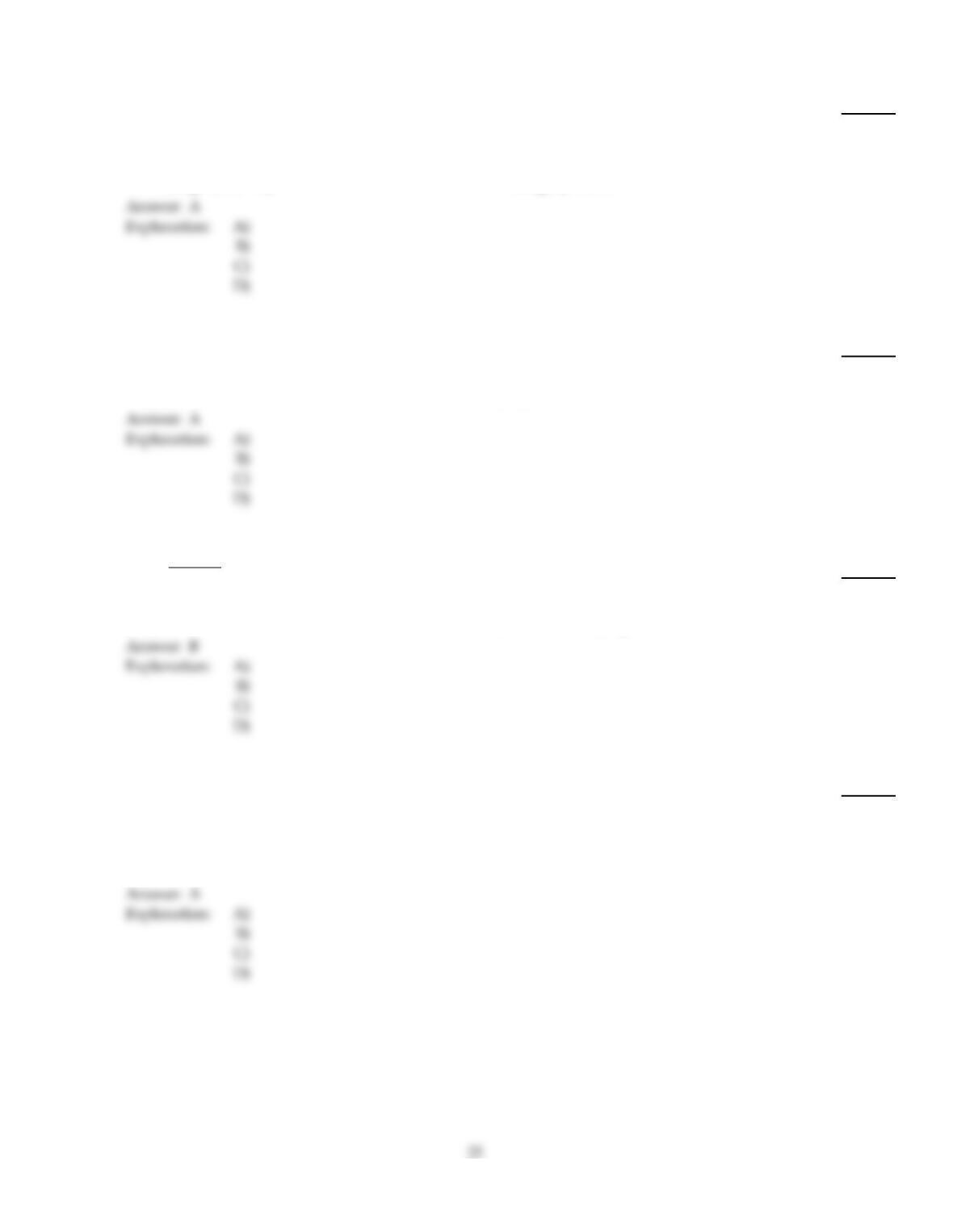
The graph of a quadratic function is given. Determine the function’s equation.
56)
56)
A)
g(x) = – x2+4x +4
B)
h(x) = – x2–2
C)
f(x) = – x2–4x –4
D)
j(x) = – x2+2
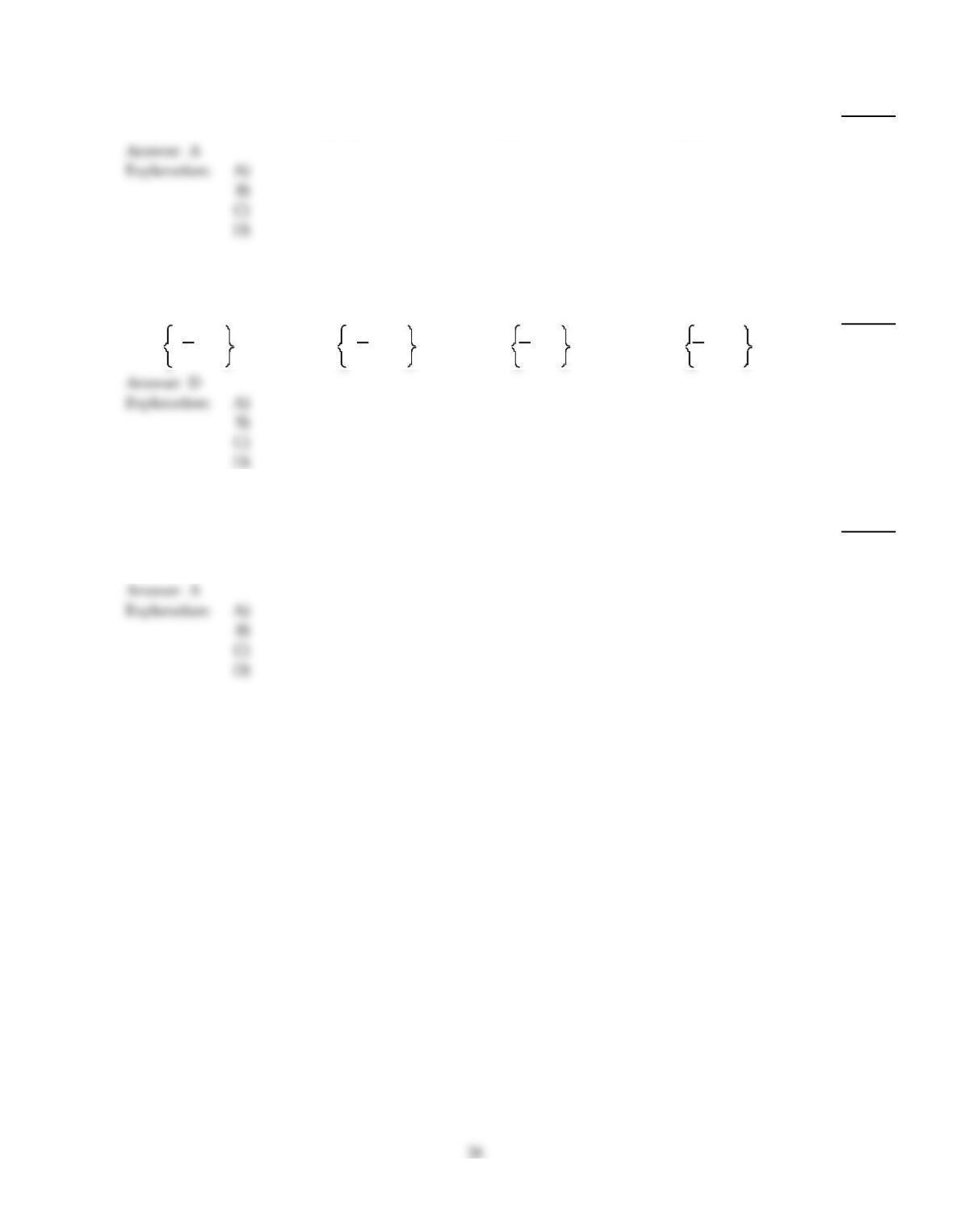
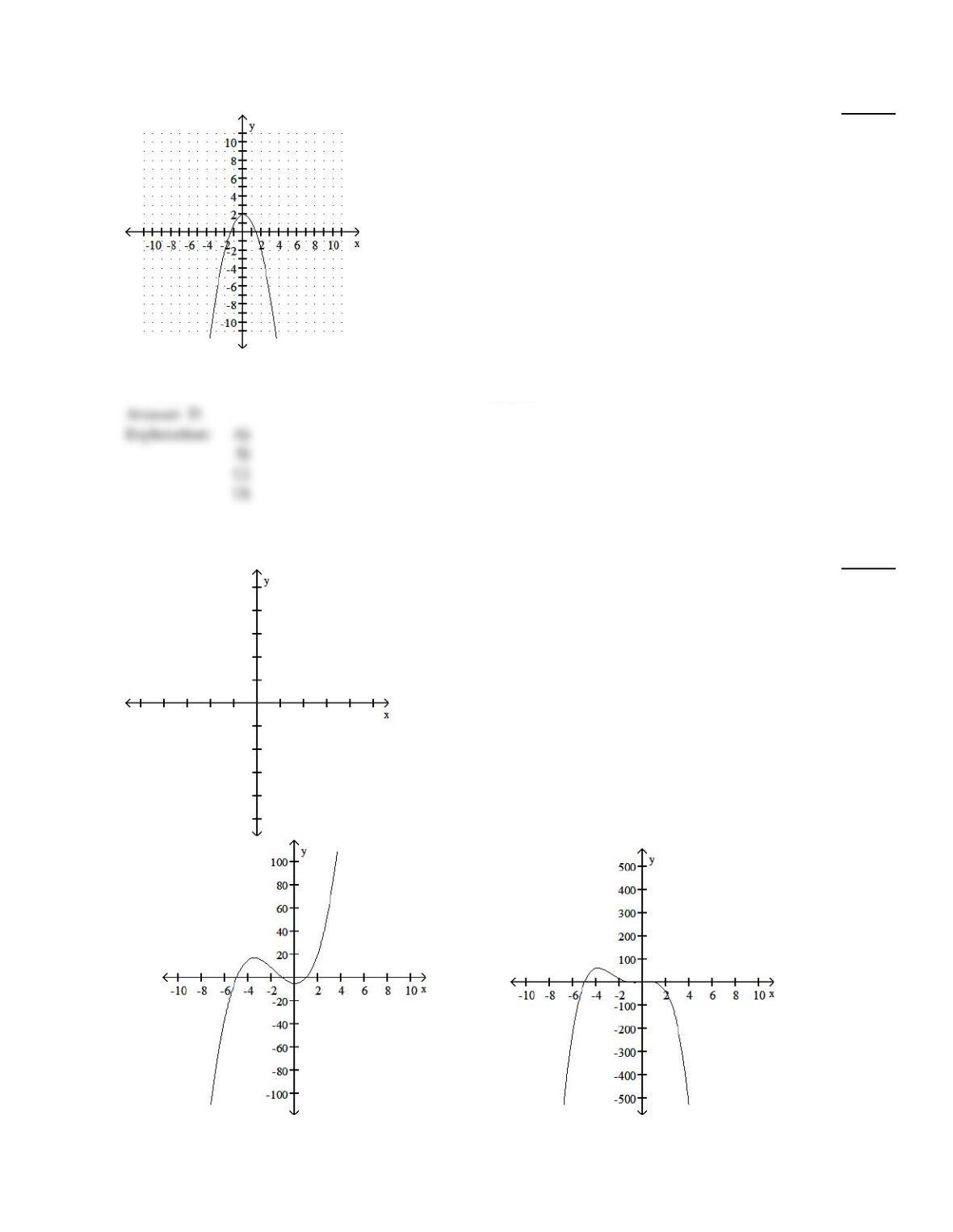
Graph the polynomial function.
57)
f(x) =x3+5x2– x –5
57)
A)
B)
27
C)
D)
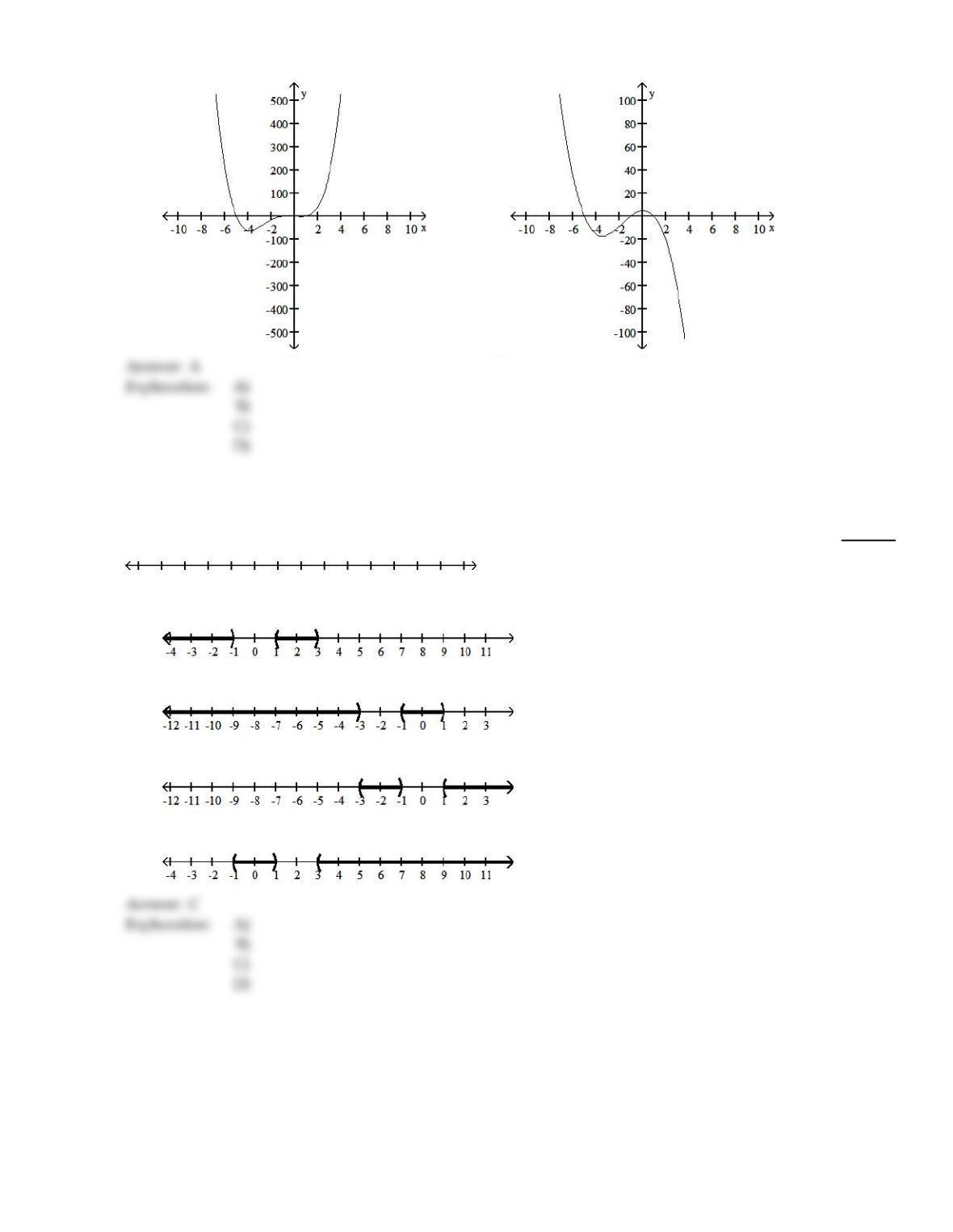
Solve the polynomial inequality and graph the solution set on a number line. Express the solution set in interval
notation.
58)
x3+3x2– x –3> 0
58)
A)
(–, –1) (1, 3)
B)
(–, –3) (–1, 1)
C)
(–3, –1)
(1, )
D)
(–1, 1) (3, )
28
Find the coordinates of the vertex for the parabola defined by the given quadratic function.
59)
f(x) = x2– 5
59)
A)
(1, 0)
B)
(5, 0)
C)
(0, –5)
D)
(0, 5)
Find the x–intercepts (if any) for the graph of the quadratic function.
60)
f(x) =6+5x + x2
60)
A)
(–3, 0) and (–2, 0)
B)
(–3, 0) and (2, 0)
C)
(3, 0) and (–2, 0)
D)
(3, 0) and (2, 0)
A
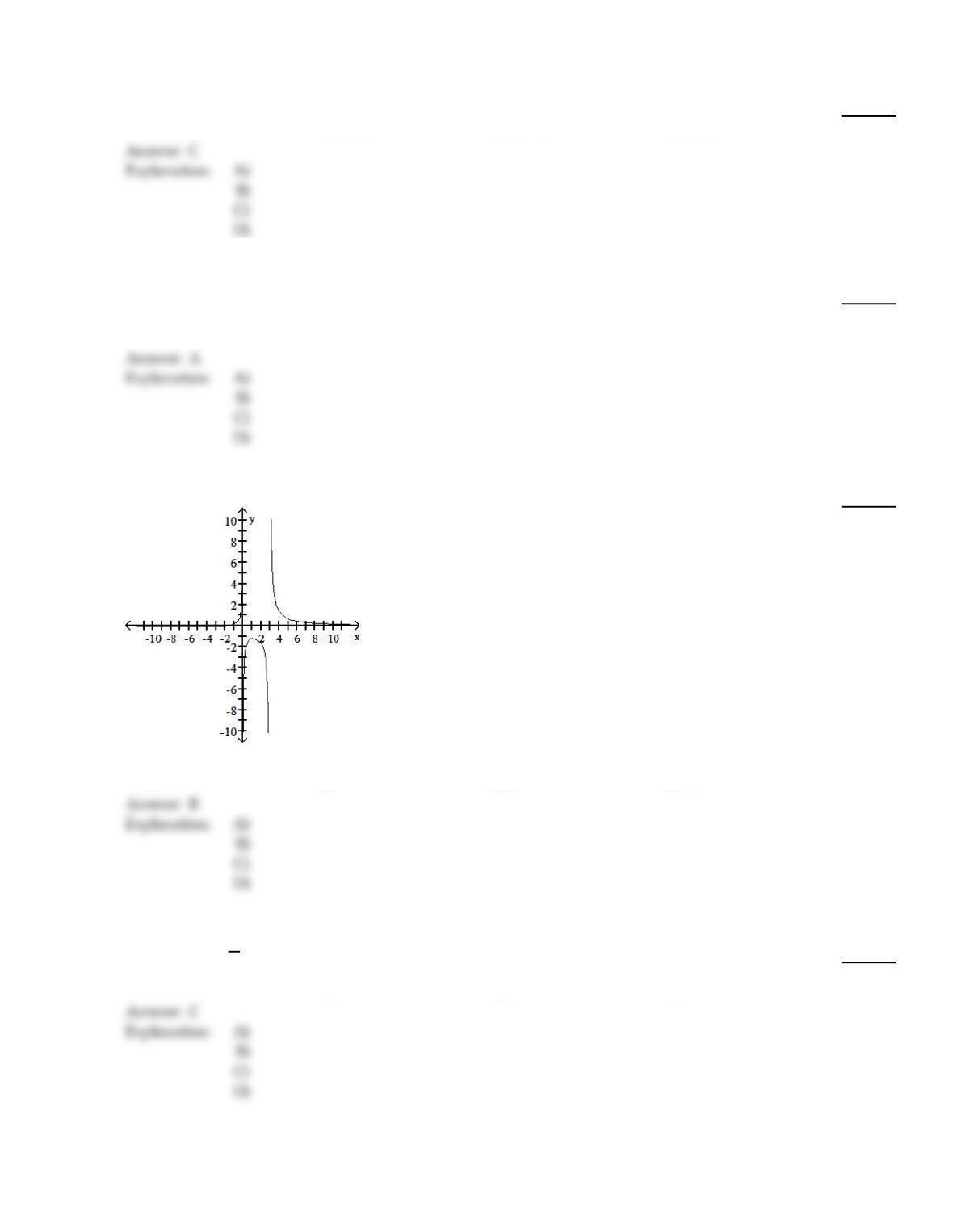
Use the graph of the rational function shown to complete the statement.
61)
As x
3–, f(x)
?
61)
A)
+
B)
–
C)
0
D)
–3
B
Find the degree of the polynomial function.
62)
f(x) =5x –x4+5
4
62)
A)
–1
B)
1
C)
4
D)
5
C
29
C
Solve the problem.
63)
The pressure of a gas varies jointly as the amount of the gas (measured in moles) and the
temperature and inversely as the volume of the gas. If the pressure is 936 kPa (kiloPascals) when
the number of moles is 8, the temperature is 260° Kelvin, and the volume is 960 cc, find the
pressure when the number of moles is 10, the temperature is 270° K, and the volume is 600 cc.
63)
A)
1944
B)
1008
C)
1872
D)
972
64)
Two people are 31 years old and 25 years old, respectively. In x years from now, their ages can be
represented by x +31 and x +25. Use long division to find the ratio of the older person’s age to the
younger person’s age in x years.
64)
A)
1 +56
x +25
B)
1.2400
C)
1 +56
x +31
D)
1 +6
x +25
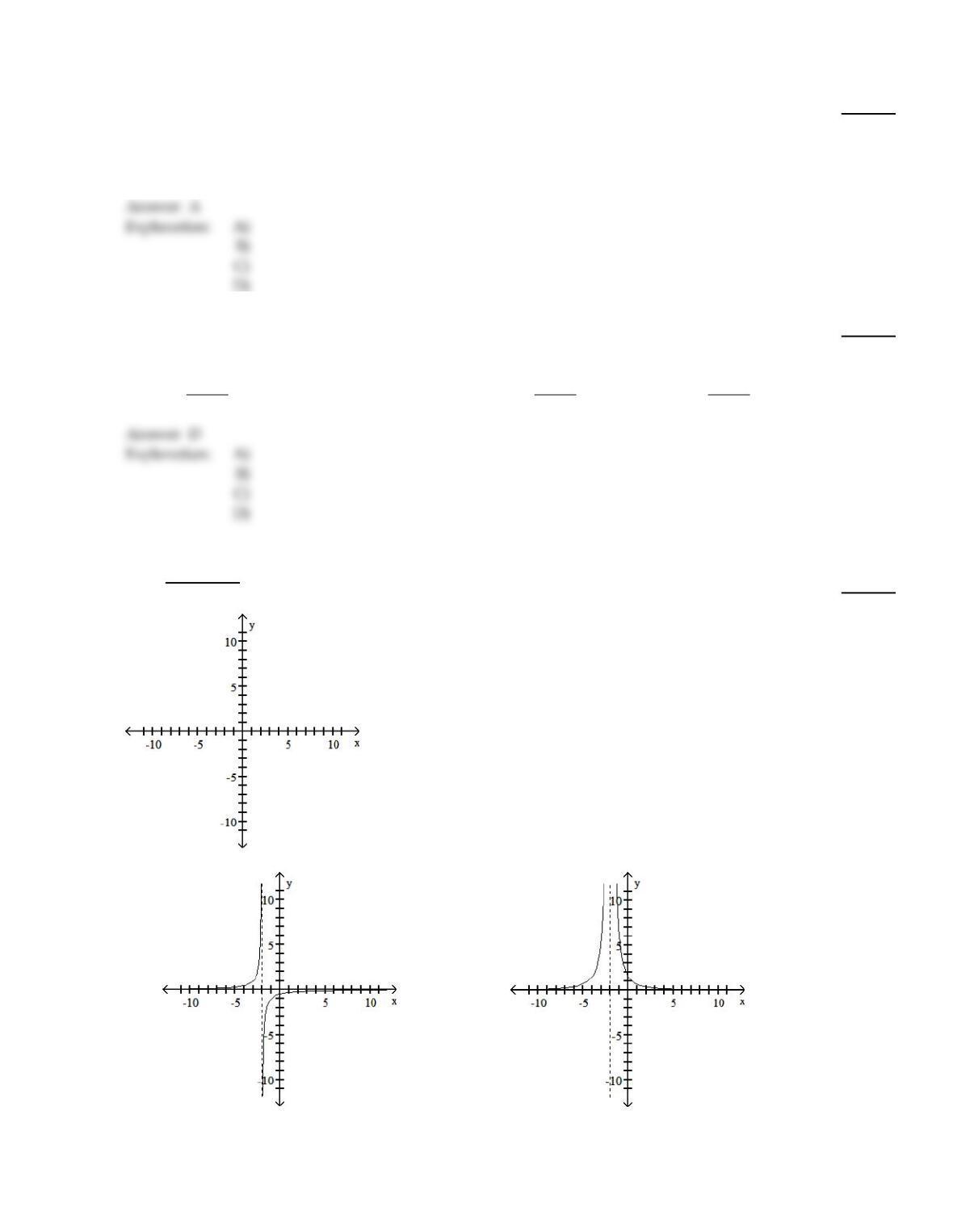
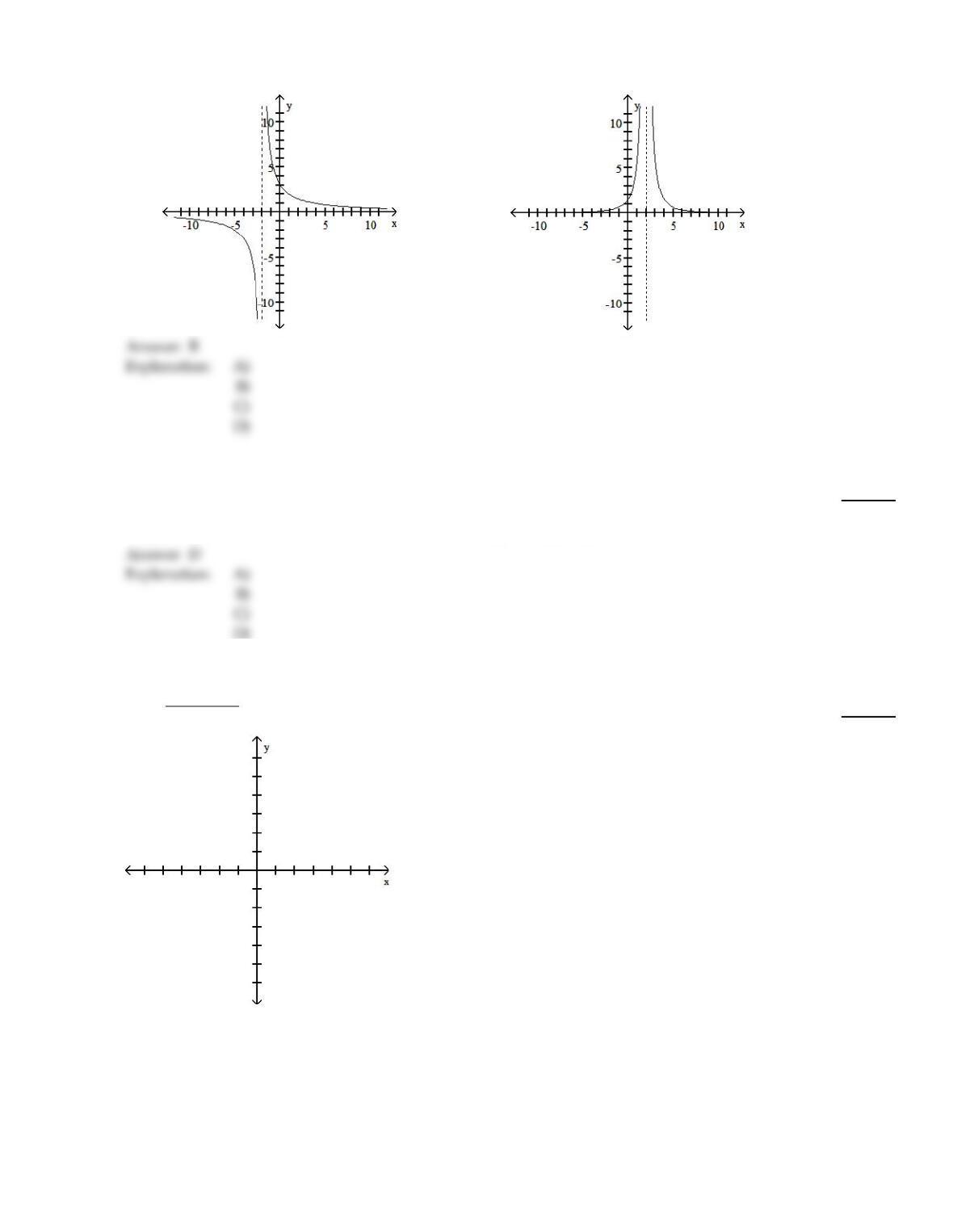
Graph the rational function.
65)
f(x) =6
x2+4x +4
65)
A)
B)
30
C)
D)
Find the zeros of the polynomial function.
66)
f(x) =2(x + 5)(x – 2)3
66)
A)
x = – 5, x =3
B)
x =5, x = – 2, x =3
C)
x =5, x =3
D)
x = – 5, x =2,
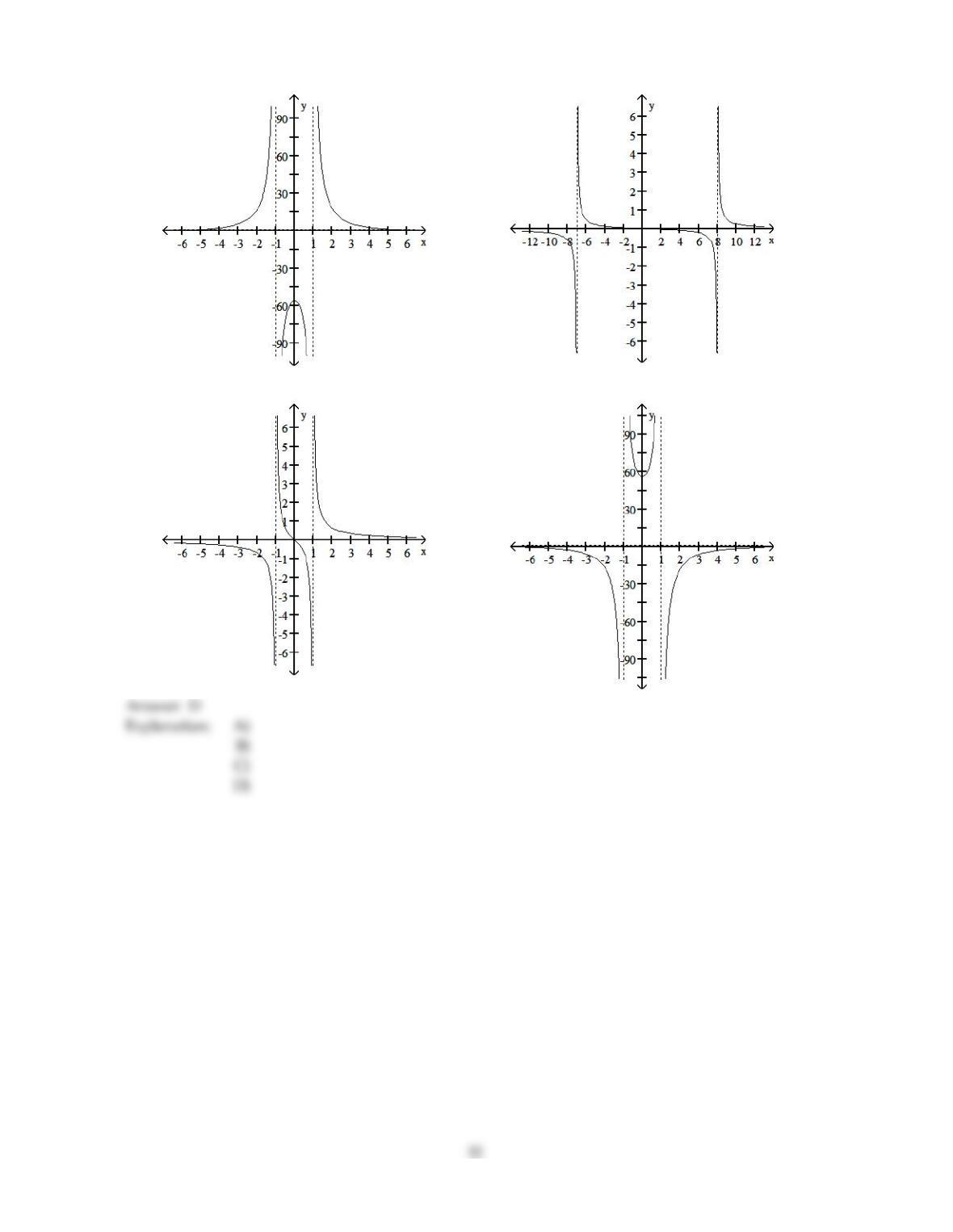
Graph the rational function.
67)
f(x) =x2– x – 56
x2– 1
67)
31
A)
B)
C)
D)
Solve the problem.
68)
A drug is injected into a patient and the concentration of the drug is monitored. The drug’s
concentration, C(t), in milligrams after t hours is modeled by
C(t) =5t
2t2+2.
What is the horizontal asymptote for this function? Describe what this means in practical terms.
68)
A)
y =1.25; After 1.25 hours, the concentration of the drug is at its greatest.
B)
y =2.50; 2.50 is the final amount, in milligrams, of the drug that will be left in the patient’s
bloodstream.
C)
y =2.50; After 2.50 hours, the concentration of the drug is at its greatest.
D)
y = 0; 0 is the final amount, in milligrams, of the drug that will be left in the patient’s
bloodstream.
69)
The average cost per unit, y, of producing x units of a product is modeled by y =1,950,000 +0.35x
x.
Describe the company’s production level so that the average cost of producing each unit does not
exceed $6.85.
69)
A)
Not more than 300,000 units
B)
At least 400,000 units
C)
Not more than 400,000 units
D)
At least 300,000 units
Solve.
70)
While traveling at a constant speed in a car, the centrifugal acceleration passengers feel while the
car is turning is inversely proportional to the radius of the turn. If the passengers feel an
acceleration of 8 feet per second per second when the radius of the turn is 80 feet, find the
acceleration the passengers feel when the radius of the turn is 160 feet.
70)
A)
5 feet per second per second
B)
6 feet per second per second
C)
7 feet per second per second
D)
4 feet per second per second
Find the y–intercept for the graph of the quadratic function.
71)
f(x) =6+5x + x2
71)
A)
(0, 6)
B)
(0, –6)
C)
(0, 3)
D)
(0, 5)
33
Use the Rational Zero Theorem to list all possible rational zeros for the given function.
72)
f(x) =x5–6x2+3x +3
72)
A)
±1
6, ±1
2, ±3
B)
± 1, ±1
3
C)
± 1, ±3
D)
±3, ±1
3
If y varies inversely as x, find the inverse variation equation for the situation.
73)
y =30 when x =1
6
73)
A)
y =180x
B)
y =x
5
C)
y =5
x
D)
y =1
5x
Solve the problem.
74)
Write an equation in standard form of the parabola that has the same shape as the graph of f(x) = – 7
x2, but which has a maximum of 5 at x =3.
74)
A)
f(x) = – 7(x –3)2+ 5
B)
f(x) = – 7(x +3)2+ 5
C)
f(x) = – 7(x –3)2–5
D)
f(x) = 7(x –3)2+ 5
75)
If y varies directly as x, and y =500 when x =150, find y when x =60.
75)
A)
200
B)
18
C)
1250
D)
1
18
Use transformations of f(x) =1
x or f(x) =1
x2 to graph the rational function.
34
76)
f(x) =1
x2– 2
76)
A)
B)
C)
D)
Divide using long division.
77)
(x2– 12x + 35) ÷ (x – 7)
77)
A)
x2– 12
B)
x – 12
C)
x – 5
D)
x2– 5
Find the x–intercepts (if any) for the graph of the quadratic function.
78)
y +1=(x – 1)2
78)
A)
(0, 0) and (–2, 0)
B)
(–2, 0) and (2, 0)
C)
(0, 0)
D)
(0, 0) and (2, 0)
D
Find a rational zero of the polynomial function and use it to find all the zeros of the function.
79)
f(x) =x4+4x3– 11x2– 26x – 12
79)
A)
{1, –3, –3+5, –3–5}
B)
{–1, 4, –3+2, –3–2}
C)
{–1, 3, –3+5, –3–5}
D)
{–1, –3, –3+2, –3–2}
C
Determine whether the given quadratic function has a minimum value or maximum value. Then find the coordinates of
the minimum or maximum point.
80)
f(x) =4x2– 12x
80)
A)
maximum; 3
2, – 9
B)
minimum; –3
2, – 9
C)
maximum; –3
2, – 9
D)
minimum; 3
2, – 9
D
Graph the polynomial function.
36
C
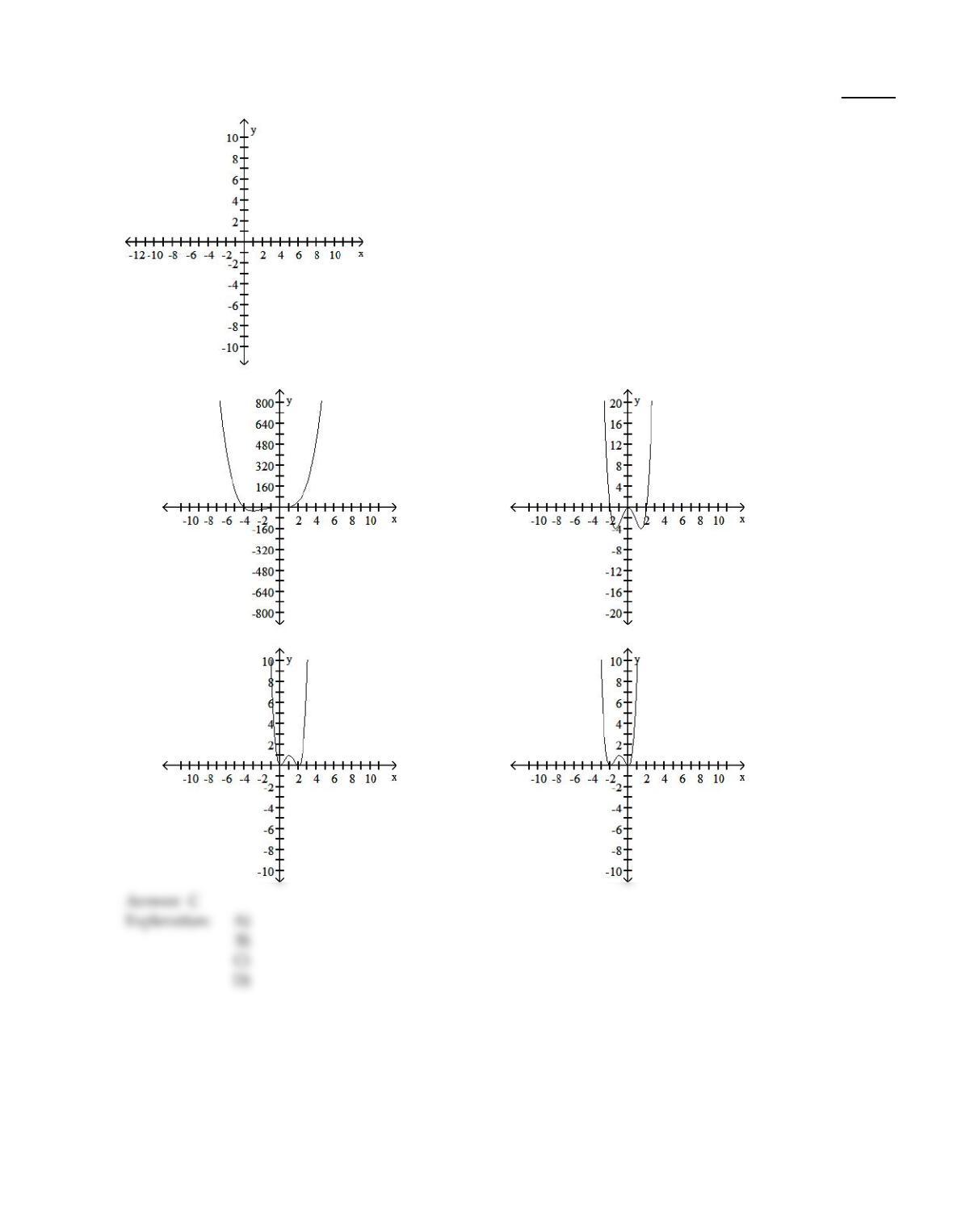
81)
f(x) =x4– 4x3+ 4x2
81)
A)
B)
C)
D)
37
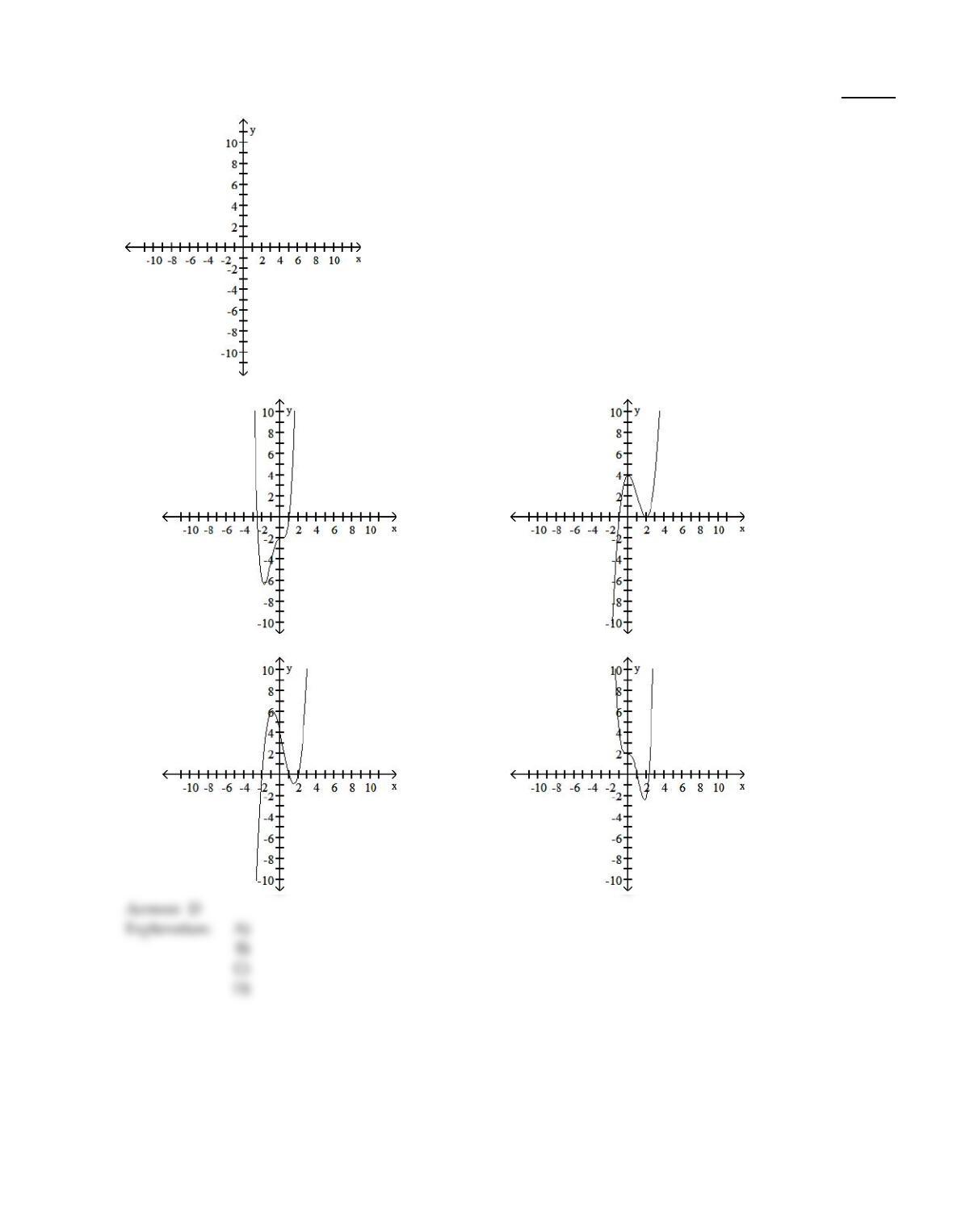
82)
f(x) =x4– 2x3–x2+ 2
82)
A)
B)
C)
D)
38
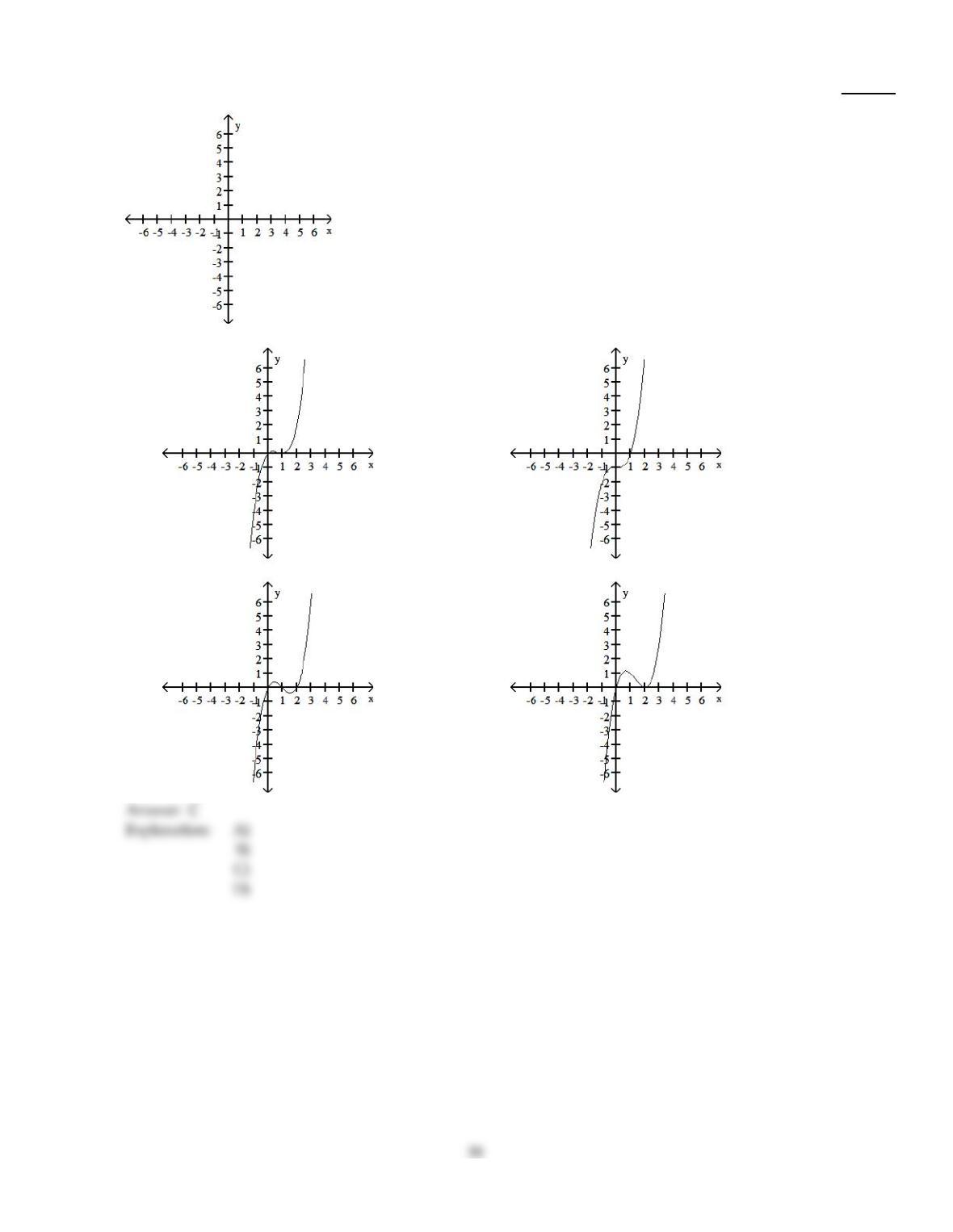
83)
f(x) = x(x – 2)(x – 1)
83)
A)
B)
C)
D)
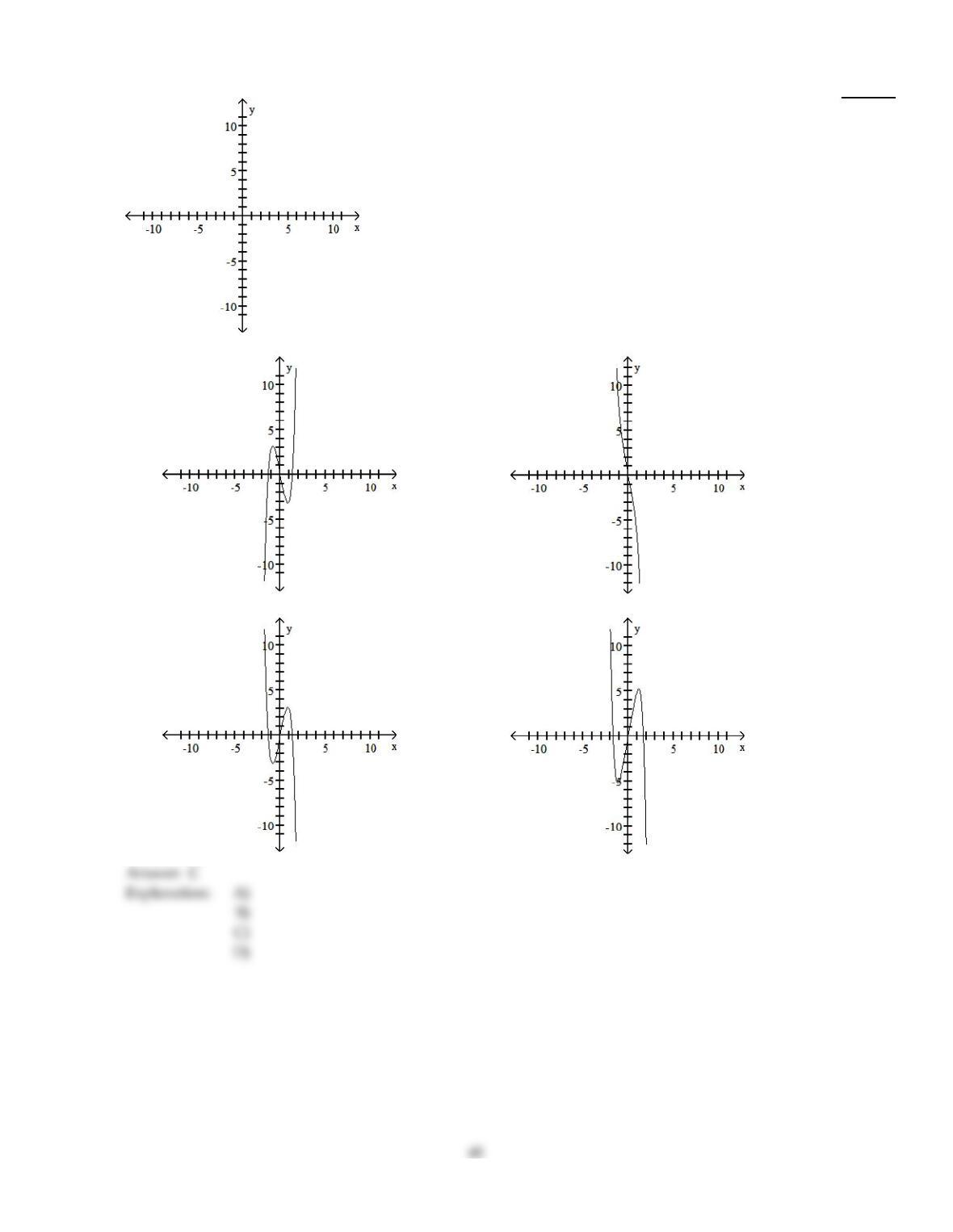
84)
f(x) =5x –x3–x5
84)
A)
B)
C)
D)