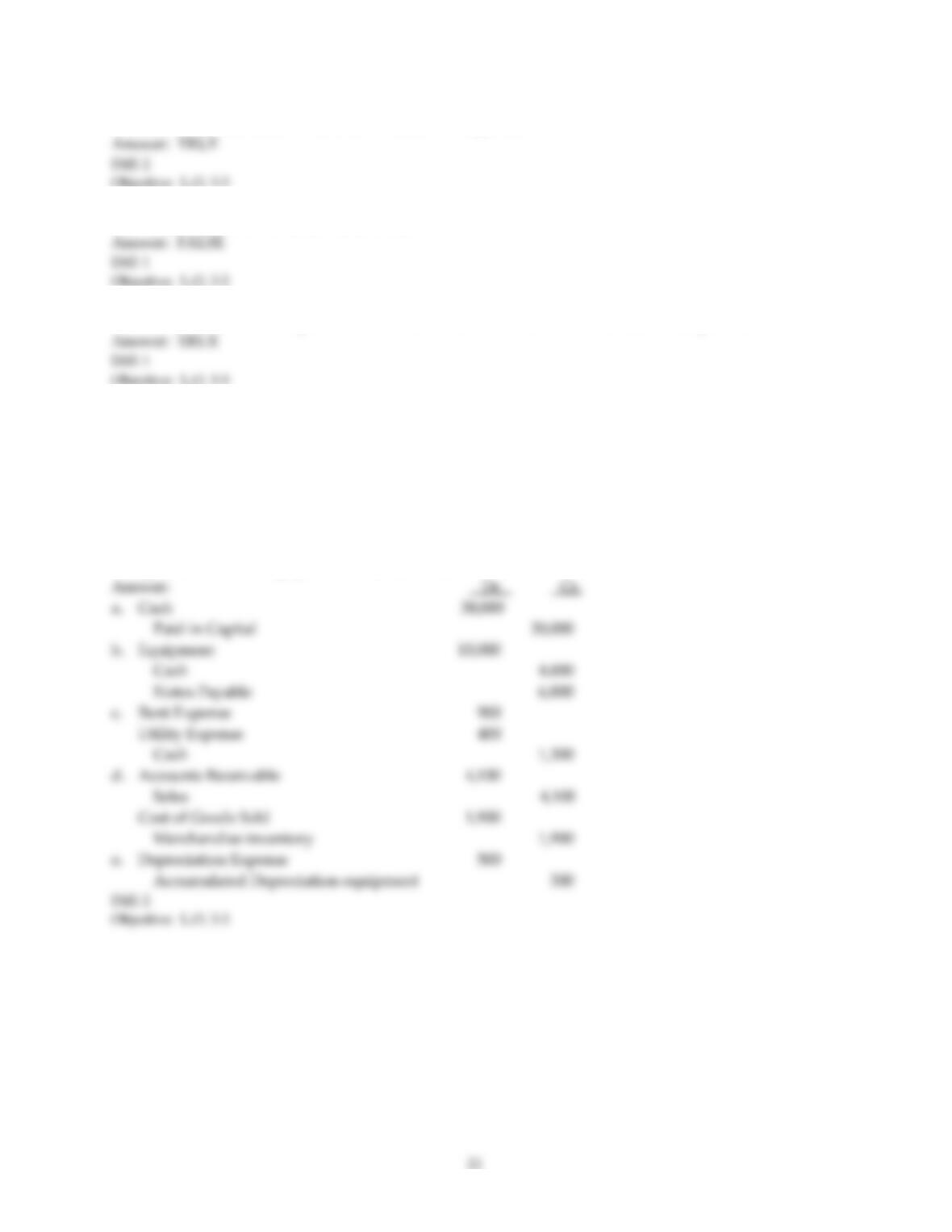
3.3-45) A credit decreases the balance of assets and expenses.
3.3-46) Liabilities are known as contra assets.
3.3-47) The accumulated depreciation is sometimes referred to as the allowance for depreciation.
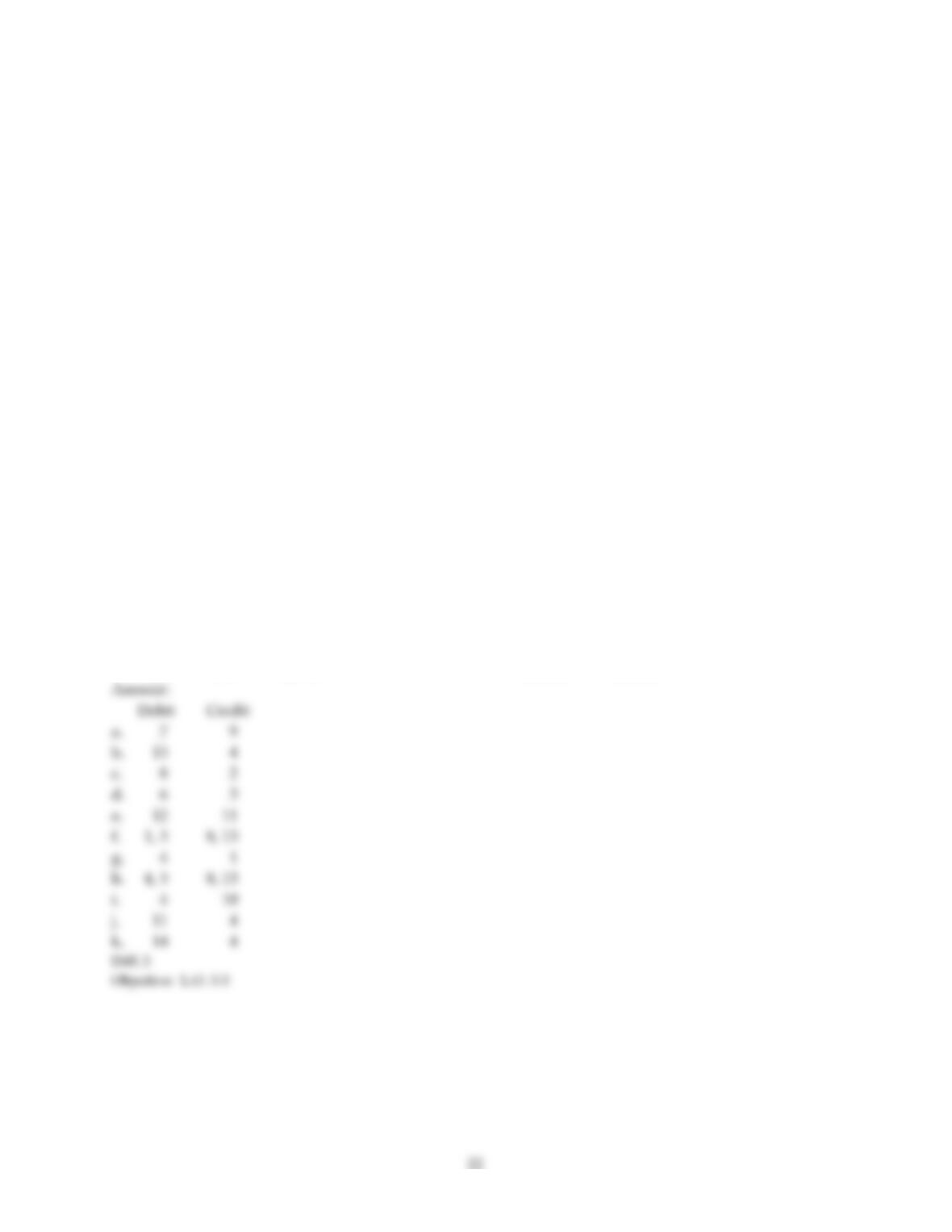
3.3-48) Prepare the necessary journal entries for each of the following transactions for the Ash Window
Company.
a. Ash Window Company sold 1,500 shares of common stock at $20 per share in cash.
b. The company purchased equipment for $10,000, paying $4,000 in cash and the remainder in a note.
c. The company paid the current month’s rent, which amounted to $900, and the current month’s utilities,
which amounted to $400.
d. Merchandise inventory costing $1,900 was sold on account for $4,100.
e. Depreciation on the equipment amounted to $500.
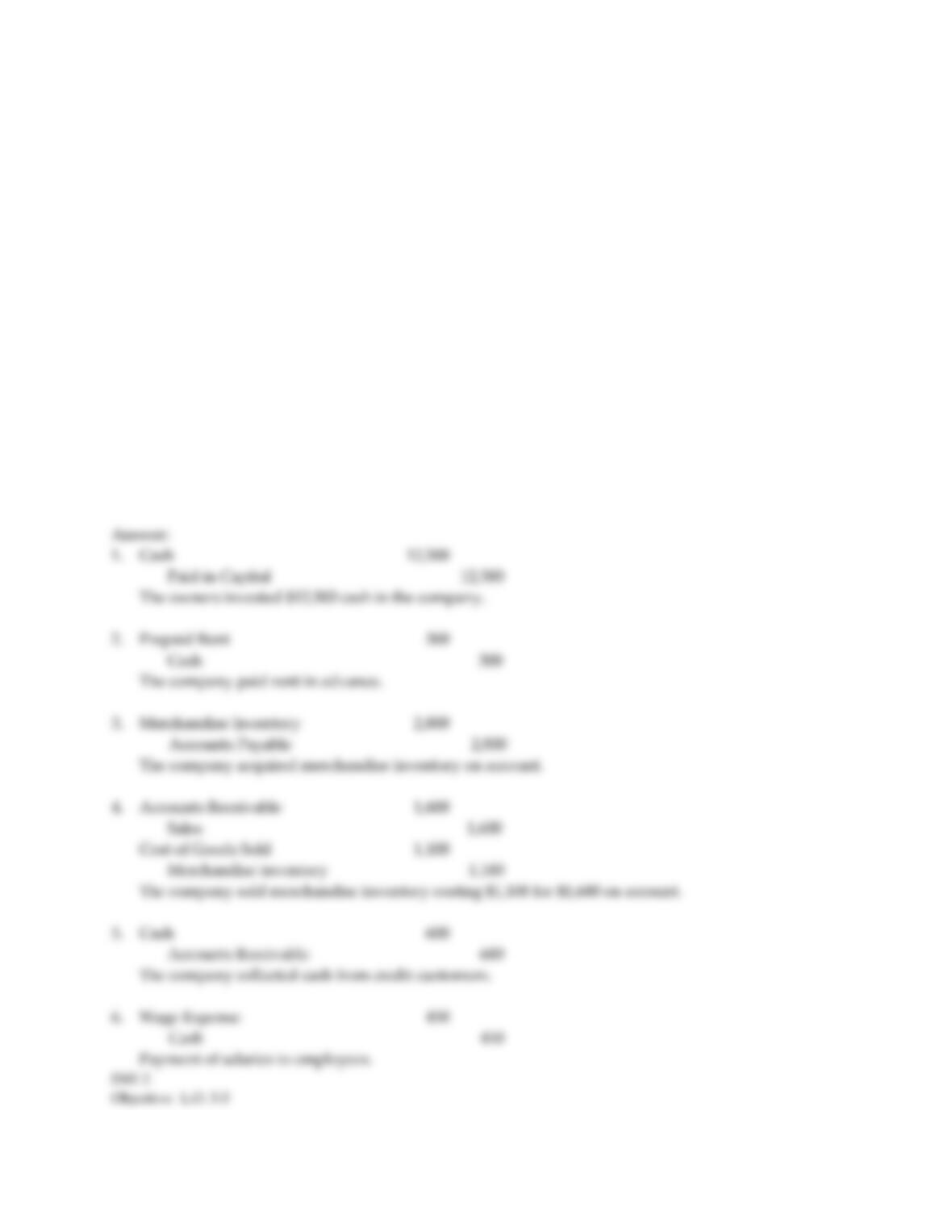
3.3-49) Following are accounts in alphabetical order, which are numbered for identification, followed by a
series of transactions. For each transaction, determine what account(s) should be debited and credited,
and place the number associated with that account in the appropriate debit or credit column.
1. Accounts Receivable 9. Notes Payable
2. Accounts Payable 10. Paid–in Capital
3. Accumulated Depreciation–equipment 11. Prepaid Rent
4. Cash 12. Rent Expense
5. Cost of Goods Sold 13. Sales
6. Depreciation Expense 14. Wage Expense
7. Equipment 15. Utility Expense
8. Merchandise Inventory
Debit Credit
a. Purchased equipment by offering a six month note. ______ ______
b. Received and paid the current utility bill. ______ ______
c. Purchased merchandise inventory on account. ______ ______
d. Recorded depreciation on the equipment. ______ ______
e. Recognized expense of 1 month‘s rent ______
(prepaid rent recorded on the books)
f. Sold merchandise inventory on account,
sale price above cost. ______ ______
g. Collected cash from customers on account. ______ ______
h. Sold merchandise inventory for cash,
sale price above cost. ______ ______
i. Sold shares of common stock for cash. ______ ______
j. Paid 6 months rent in advance. ______ ______
k. Wages were paid to employees. ______ ______
23
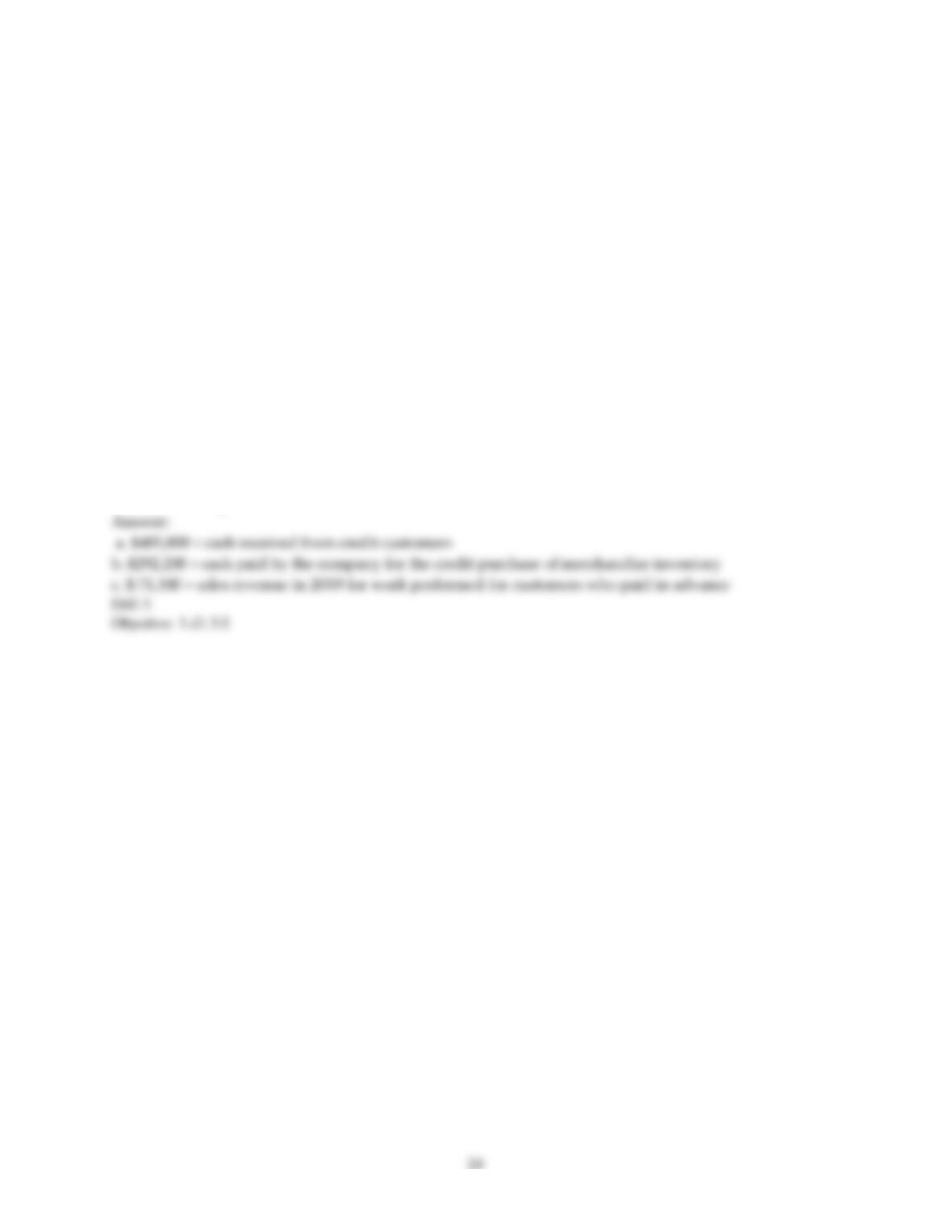
3.3-50) Prepare the journal entries for each of the six transactions depicted in the following T–accounts,
along with a brief explanation as to the nature of the transaction.
Cash Prepaid Rent Sales
——————– ———————- ——————-
(1) 12,500| 300 (2) (2) 300 | | 1,600 (4)
(5) 600| 450 (6) | |
| | |
Accounts Receivable Accounts Payable Cost of Goods Sold
——————— ——————— ——————-
(4) 1,600| 600 (5) | 2,800 (3) (4) 1,100|
| | |
Merchandise
Inventory Paid–in Capital Wage Expense
——————— ——————— ——————-
(3) 2,800| 1,100 (4) |12,500 (1) (6) 450 |
| | |
3.3-51) The West Company had the following balances as of December 31, 20X8:
Accounts Receivable $ 21,600
Accounts Payable $ 14,300
Unearned Revenue $ 6,100
During 20X9 the following activity occurred:
1. During 20X9, $73,100 was paid by customers in advance for work to be performed by the company.
The balance in the unearned revenue account as of December 31, 20X9, was $7,700.
2. Credit sales in 20X9 were $497,100. As of December 31, 20X9, the accounts receivable balance was
$32,900.
3. Accounts payable is solely attributable to the acquisition of merchandise inventory on account. Credit
purchases of merchandise inventory during 20X9 were $291,000. The balance in accounts payable as of
December 31, 20X9, was $13,100.
Required:
a. What was the amount of cash received from credit customers in 20X9?
b. How much cash was paid by the company for the credit purchase of merchandise inventory related to
its accounts payable in 20X9?
c. How much sales revenue was recognized by the company in 20X9, related to the work performed for
customers who paid in advance?
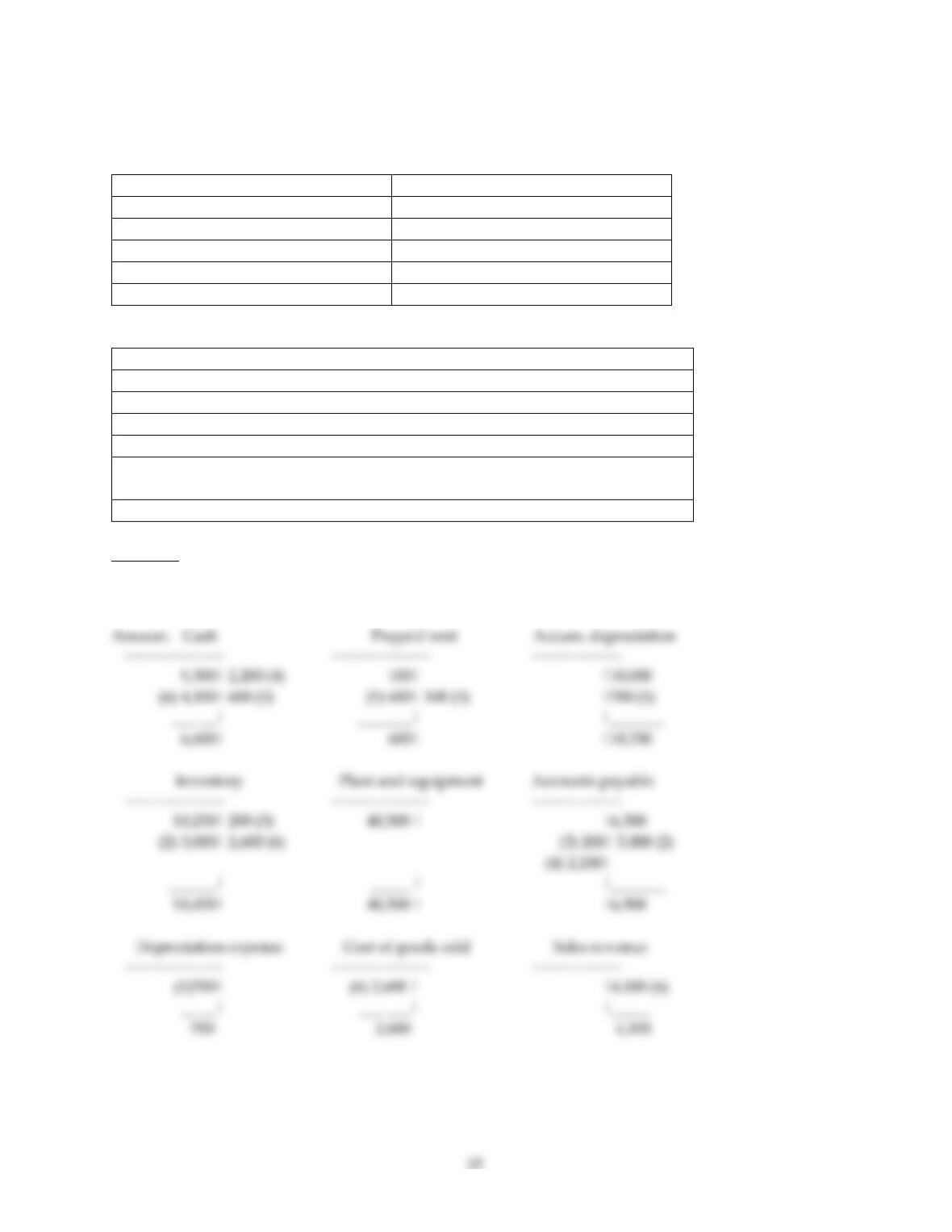
3.3-52) Selected accounts from Williams Company as of March 31, 20X9, follow:
Table 1
Cash
$ 5,300
Inventory
10,250
Prepaid rent
100
Plant and equipment
40,500
Accumulated depreciation
10,000
Accounts payable
6,300
Table 2
In addition, the following transactions occurred in the month of March.
1. Depreciation for the month amounted to $700
2. Purchased inventory on account for $3,000
3. Returned a portion of the inventory deemed defective for $200
4. Paid creditors $2,200
5. Paid 6 months’ rent of $600 in advance, covering April – September, and incurred
current months’ rent from previous year’s similar contract
6. Sold inventory for $4,100 cash that cost Willliams Company $2,600
Required:
1. Open T–accounts for the beginning balances of the selected accounts of Williams Company.
2. Post transactions to T–accounts.
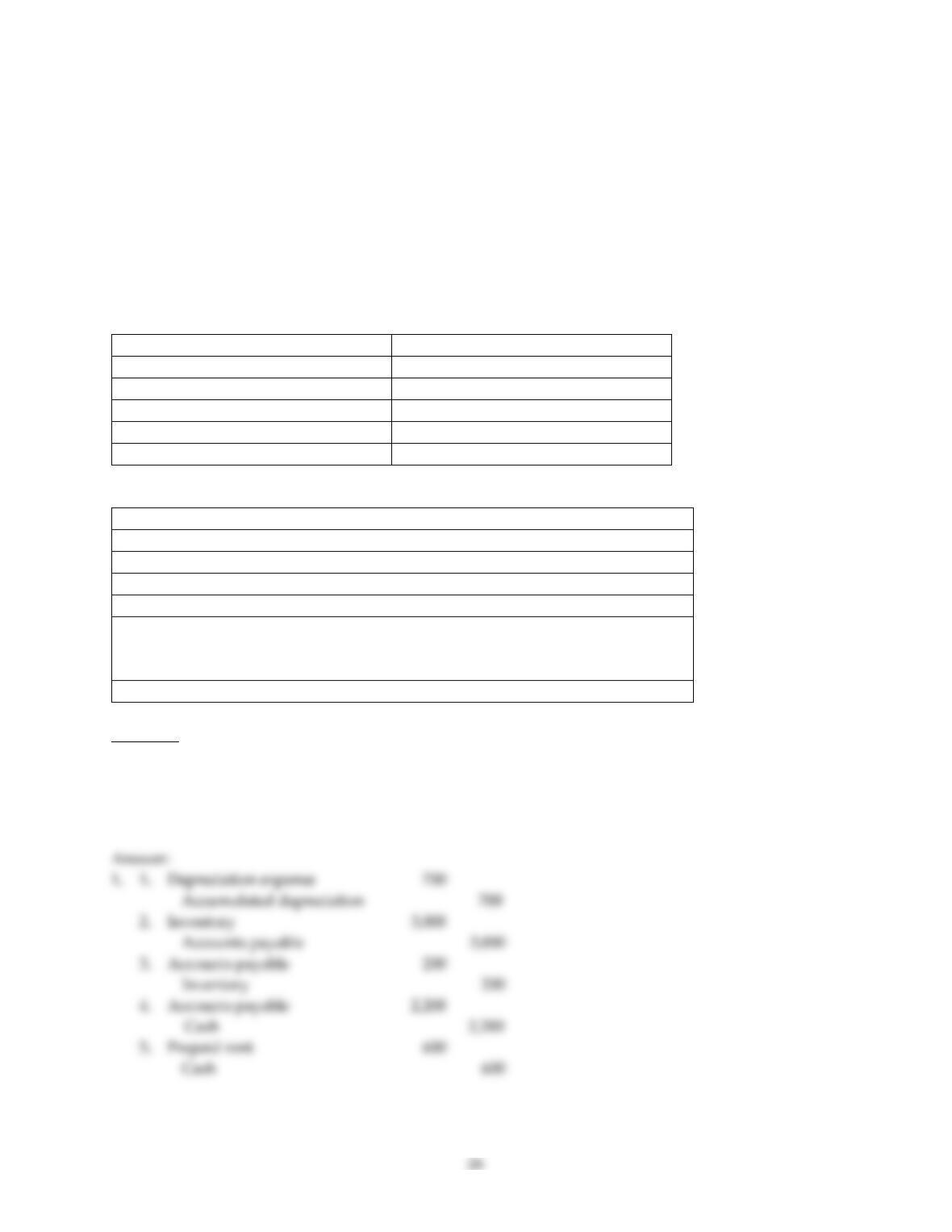
Rent expense
———————
100|
__ __|
100
Diff: 3
Objective: L.O. 3–3
3.3-53) Selected accounts from Williams Company as of March 31, 20X9, follow:
Table 1
Cash
$ 5,300
Inventory
10,250
Prepaid rent
100
Plant and equipment
40,500
Accumulated depreciation
10,000
Accounts payable
6,300
Table 2
In addition, the following transactions occurred in the month of March.
1. Depreciation for the month amounted to $700
2. Purchased inventory on account for $3,000
3. Returned a portion of the inventory deemed defective for $200
4. Paid creditors $2,200
5. Paid 6 months’ rent of $600 in advance, covering April – September. The contract
price did not increase from the previous 6 months’ period and covered October,
20X8 – March, 20X9
6. Sold inventory for $4,100 cash that cost Willliams Company $2,600
Required:
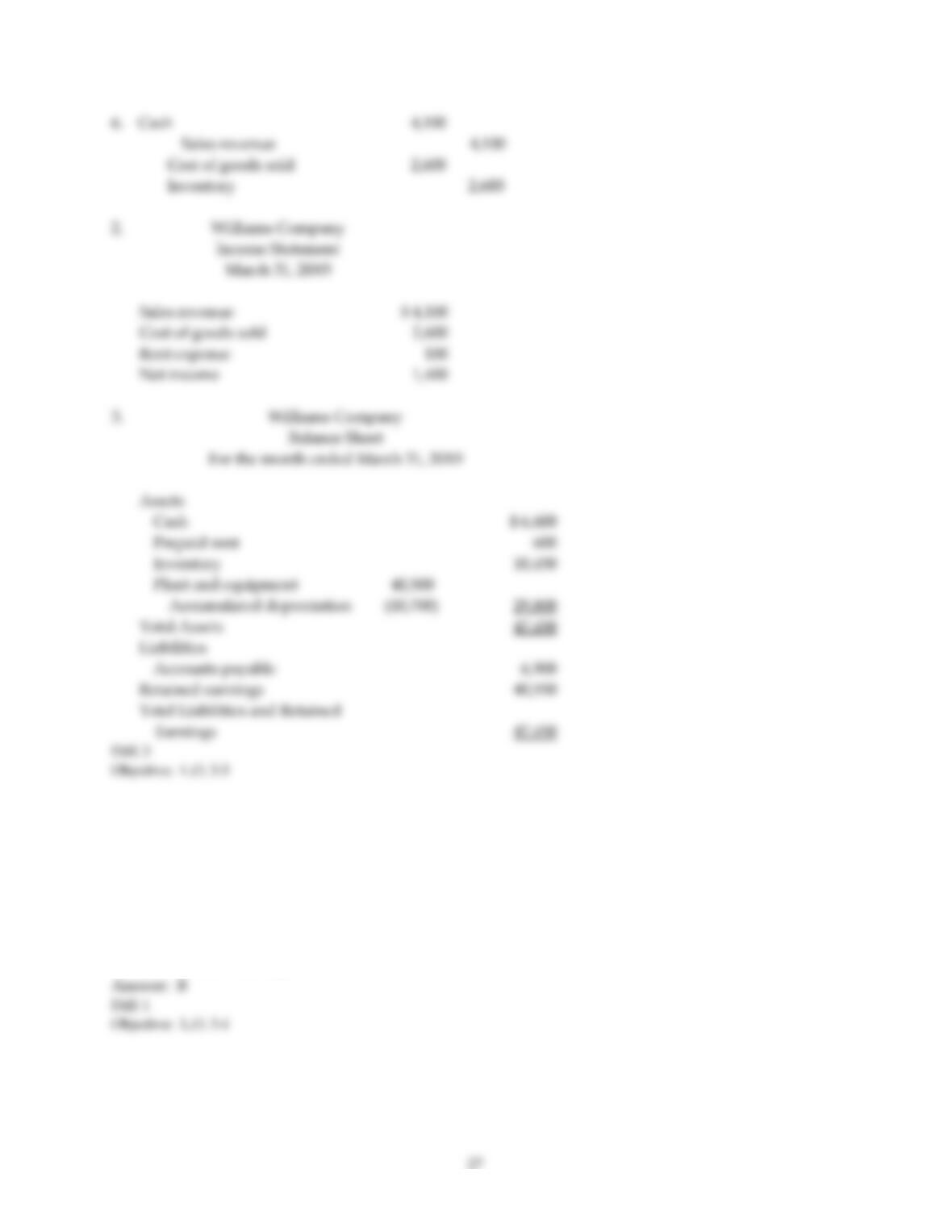
1. Journalize the transactions for Williams Company.
2. Prepare an income statement for the month of March.
3. Prepare a balance sheet for the month of March. HINT: Although not provided, Williams Company
had a beginning balance in the Retained Earnings account.
Learning Objective 3.4 Questions
3.4-1) Which of the following accounts would not be found on the debit side of a trial balance?
A) Equipment
B) Accumulated Depreciation
C) Prepaid Rent
D) Rent Expense
E) Merchandise Inventory
3.4-2) Given the following balances, what would the total debits in the trial balance equal?
1. Equipment $52,000
2. Accounts Payable 1,000
3. Sales 51,000
4. Accumulated Depreciation 3,000
5. Accounts Receivable 4,000
6. Retained Earnings 13,000
7. Salary Expense 4,000
8. Cash 12,000
9. Paid–in Capital 10,000
10. Cost of Goods Sold 25,000
A) $ 52,000
B) $101,000
C) $ 97,000
D) $103,000
E) $107,000
3.4-3) Given the following complete list of balances, what will be the total credits in the trial balance,
assuming no errors exist in the accounts?
1. Retained Earnings $ 28,000
2. Merchandise Inventory 9,000
3. Accumulated Depreciation 5,000
4. Sales 42,000
5. Selling Expenses 11,000
6. Accounts Receivable $ 7,000
7. Cost of Goods Sold 22,000
8. Accounts Payable ?
9. Cash 5,000
10. Equipment 33,000
Note: The accounts payable records were damaged by a flood, and the company is not certain what the
correct balance should be.
A) $72,000
B) $69,000
C) $58,000
D) $87,000
E) Due to the damage of the accounts payable records, it is impossible to determine the amount of the
total credits on the trial balance.
3.4-4) A trial balance is similar to a balance sheet in that it only includes balance sheet accounts.
3.4-5) In a trial balance, the number of accounts that are debited do not have to equal the number of
accounts that are credited, but the total dollar amount of the debits must equal the total dollar amount of
the credits.
3.4-6) The trial balance serves two purposes. It verifies the clerical accuracy of the posting process and
assists in preparing the financial statements.
3.4-7) The trial balance is an internal report that helps accountants to prepare the financial statements.
3.4-8) A trial balance in balance proves the equality of the total debits and total credits of the accounts
listed.
3.4-9) If the debit side of a journal entry is posted but the credit side is not, the trial balance will not
balance.
3.4-10) If an entry involving only two assets is not posted, the trial balance will be out of balance.
3.4-11) Given the following account balances for Duncan Decorating, an antique shop, on December 31,
20X9, prepare a trial balance.
Merchandise Inventory $18,000
Accum. Depreciation–equipment 3,000
Paid–in Capital 32,000
Cost of Goods Sold 38,000
Accounts Payable 9,000
Retained Earnings 18,000
Wages Payable 2,000
Sales 93,000
Cash 26,000
Supplies 2,000
Wage Expense 29,000
Equipment 27,000
Rent Expense 17,000
3.4-12) Given the following account balances for Hanna Publishing, prepare a trial balance for September
30, 20X9.
Paid–in Capital $51,000
Cost of Goods Sold 21,000
Wages Payable 2,000
Accounts Receivable 9,000
Sales 49,000
Equipment 64,000
Cash 6,000
Prepaid Rent 500
Accounts Payable 8,000
Retained Earnings 17,500
Wage Expense 19,000
Merchandise Inventory 11,000
Accum. Depreciation–equipment 5,000
Rent Expense 2,000
Learning Objective 3.5 Questions
3.5-1) The entry to close revenue accounts involves
A) a debit to Income Summary and credits to all the revenue accounts.
B) debits to all the revenue accounts and a credit to Income Summary.
C) debits to all the expense accounts and credits to all the revenue accounts.
D) a debit to Retained Earnings and a credit to Income Summary.
E) a debit to Income Summary and a credit to Retained Earnings.
3.5-2) The entry to close expense accounts involves
A) a credit to Income Summary and debits to all the revenue accounts.
B) debits to all the revenue accounts and a credit to Income Summary.
C) credits to all the expense accounts and a debit to Income Summary.
D) a debit to Retained Earnings and a credit to Income Summary.
E) a debit to Income Summary and a credit to Retained Earnings.
3.5-3) The entry to close net income at the end of the accounting period involves a
A) debit to Retained Earnings and a credit to Income Summary.
B) debit to Income Summary and a credit to Retained Earnings.
C) debit to Accounts Receivable and a credit to Retained Earnings.
D) debit to Retained Earnings and a credit to Accounts Receivable.
E) debit to Income Summary and a credit to Accounts Receivable.
3.5-4) What is the purpose of closing the books?
A) To reset the revenue and expense accounts to zero so that they are ready to record the next period’s
transactions
B) To reset the asset and liability accounts to zero so that they are ready to record the next period’s
transactions
C) To transfer all account activity to retained earnings so that they are ready to record the next period’s
transactions
D) To transfer all account activity to paid–in–capital so that they are ready to record the next period‘s
transactions
E) To transfer and reset any account with activity