
ch3 Key
1. Job costing or job-order costing treats each individual job as the unit of output and assigns, or allocates costs
to each job as resources are used.
2. In order to qualify for job-order costing, each job must consist of a single, unique product consisting of only
one unit produced of relatively high value.
3. Process Costing treats each individual job as the unit of output and assigns, or allocates costs to each job as
resources are used.
4. Process costing treats all units processed during a time period as the output to be costed and does not separate
and record costs for each unit produced.
5. As output becomes more unique and separately identifiable, operation costing becomes more appropriate.
6. In job costing, each unit produced is of relatively low value.
7. Process costing does not separate and record costs for each unit produced.
8. In process costing, the units of output are relatively homogeneous and indistinguishable from one another.
9. Operation costing is appropriate when companies produce large batches of similar products and wish to trace
the direct labor component of each unit.

10. The basic cost flow equation in job order costing is: Beginning balance + resource transfers out – resource
transfers in = ending balance.
11. The Work-in- Process inventory account represents the cost of all active jobs that have not yet been
completed.
12. The Finished Goods account collects the total cost of all jobs completed and sold during the accounting
period.
13. When a company uses job-order costing, information regarding the costs of a specific job will be found in
the company’s general ledger.
14. The primary cost document for a job is called a job–cost record or job-cost sheet.

15. The cost of goods sold account records the cost of finished jobs that have been sold during the period.
16. Transfers out of the Work-in-Process account represent increases to the Cost of Goods Sold account.
17. The accounting journal entry to record the transfer of raw material needed for a production job consists of a
debit to Work-in–Process inventory and a credit to Raw-Material inventory.
18. The accounting journal entry to record factory supervisors‘ salaries consists of a debit to Work-in-Process
inventory and a credit to Wages Payable.
19. A debit to Finished- Goods-Inventory will normally be offset by a credit to cost of goods sold.
20. A credit to the Work-in-Process account will normally be accompanied by a debit to the Finished Goods
account.
21. A credit to the Manufacturing Overhead account represents the assignment of overhead into
Work-in–Process using a predetermined overhead rate.
22. When a job is sold, Finished Goods will be credited for the selling price of the job.
23. The overhead variance is the difference between the actual overhead spending and the applied overhead.
24. Predetermined overhead rates are used because they are more accurate than using actual costs.
25. When the actual amount of overhead exceeds the amount of applied overhead, overhead is overapplied.
26. The predetermined overhead rate is computed by dividing the budgeted manufacturing overhead cost for the
month by the budgeted direct–labor hours for the month.
27. The left side of the Manufacturing Overhead account applies overhead costs using the predetermined rate,
while the right side accumulates actual overhead costs.
28. When the amount of the overhead variance is immaterial, it is normally written off immediately as part of
cost of goods sold.
29. When the amount of the overhead variance is material, it is normally prorated to the Materials and Finished
goods accounts.
30. The difference between actual and applied overhead will eventually be expensed, regardless of whether it is
written off immediately or prorated.
31. Both normal costing and standard costing use actual inputs to assign direct costs to units produced.
32. Standard costing uses a predetermined rate for both direct and indirect costs to assign manufacturing costs to
products.
33. The major difference between normal costing and standard costing is that normal costing only accounts for
manufacturing costs in determining per unit cost while standard costing uses both manufacturing costs and
general and administrative expenses.
34. The job-order costing process is basically the same in both service and manufacturing firms.
35. Traditional systems tend to focus on only the production component of the value chain.
36. A Gantt chart shows the timing, sequencing and overlapping of major project activities.
37. An unethical contractor will be more likely to understate the actual percentage of completion on a job than
to overstate it.
38. Which of the following companies would most likely use a job-order costing system?
39. Which of the following companies would most likely use a process costing system?
40. Which of the following companies would most likely use operation costing?
41. Given the following: Transfers In $30,000; Transfers Out: $36,000; Ending Inventory: $6,000.
What was the beginning balance?
42. Given the following: Beginning Balance, $12,000; Transfers Out, $25,000; Ending Balance, 9,000. What
was the amount of Transfers In?
43. If the amount of Transfers Out exceeds the amount of Transfers In of an account during the period:
Use the following to answer questions 44-46:
Use the following information for Swansea Manufacturing Company for the next three questions:
Hilton – Chapter 03
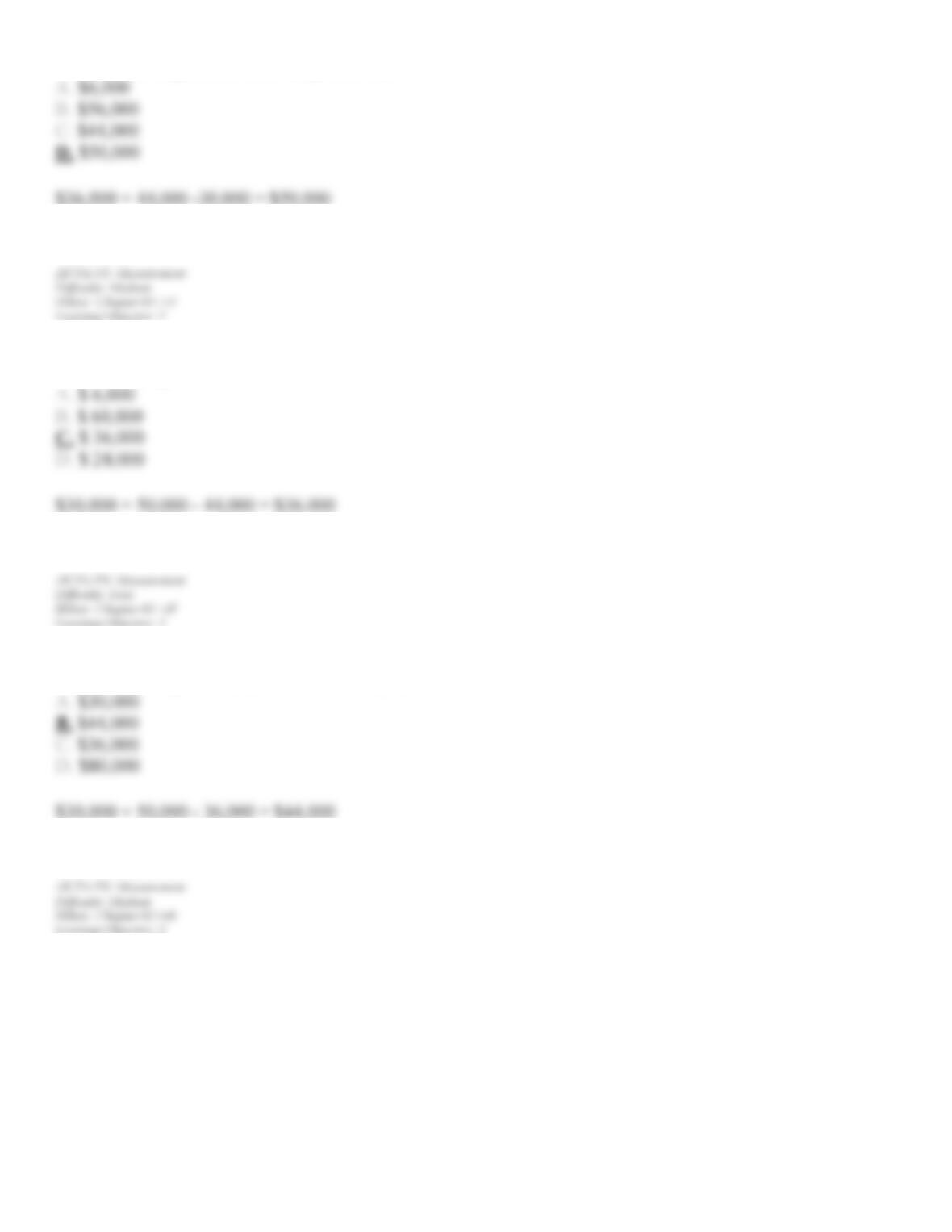
44. The cost of goods sold for the period was:
45. The ending Balance in Work-in-Process was:
46. The cost of goods manufactured for the period was:
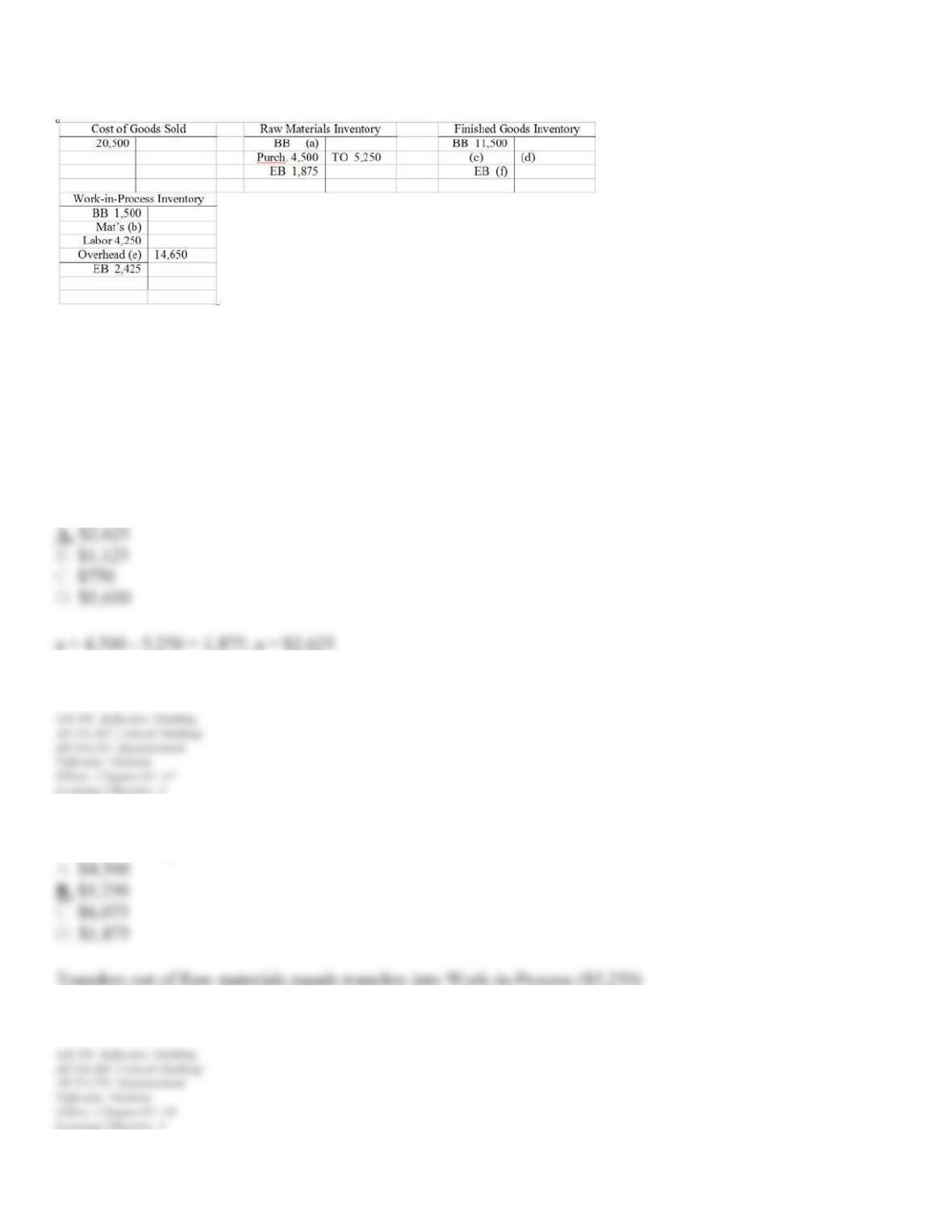
Use the following to answer questions 47-53:
Key: BB = Beginning Balance EB = Ending Balance
Refer To: 03-47
Hilton – Chapter 03
47. The missing amount for letter a is:
48. The missing amount for letter b is:
49. The missing amount for letter c is:
50. The missing amount for letter d is:
51. The missing amount for letter e is:
52. The missing amount for letter f is:
53. The amount that would appear in the Manufacturing Overhead account to represent overhead applied is:
54. In a job-order costing system, the journal entry to record depreciation on factory equipment would be
recorded by a:
55. In a job-order costing system, the entry to requisition $1,000 of factory supplies from Raw– Materials
inventory would be recorded with a:
56. In a job-order costing system, the entry to record the completion of jobs would be recorded with a:
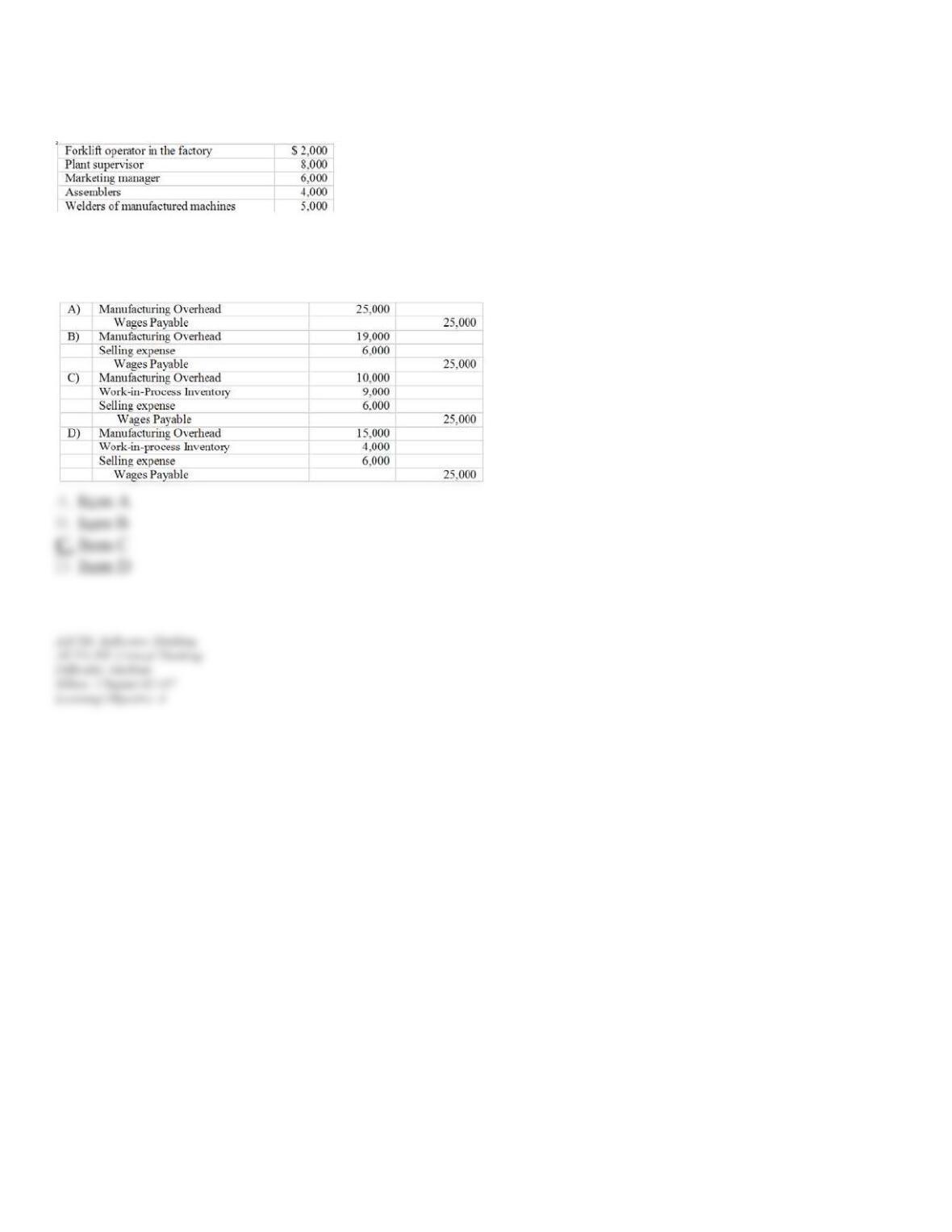
57. Chelsea Tool Corporation, a machine-tool manufacturing company, incurred the following wage costs on
employees during June, 2007:
The entry to record the payroll for the month of June, 2007 should include:
Use the following to answer questions 58-59:
Mansfield Corporation estimates its manufacturing overhead costs to be $160,000 and its direct labor costs to be
$320,000 for 2007. The actual manufacturing labor costs were $80,000 for job 1, $120,000 for job 2 and
$160,000 for job 3 during 2007. Manufacturing overhead is applied to jobs on the basis of direct labor costs
using a predetermined overhead rate. The actual manufacturing overhead cost for the year was $172,000.
Hilton – Chapter 03
58. The amount of overhead assigned to Job 3 during 2007 was:
59. The amount of the manufacturing overhead variance during 2007 was:
60. Framingham Company, which uses labor hours to apply overhead to manufacturing, may have increased
amounts of underapplied manufacturing overhead at month-end if:
61. Readville Company inadvertently assigns a $50,000 advertising expense to Manufacturing Overhead.
Readville Company has more inventory at the end of the year than at the beginning of the year. The result of
this error will be to:
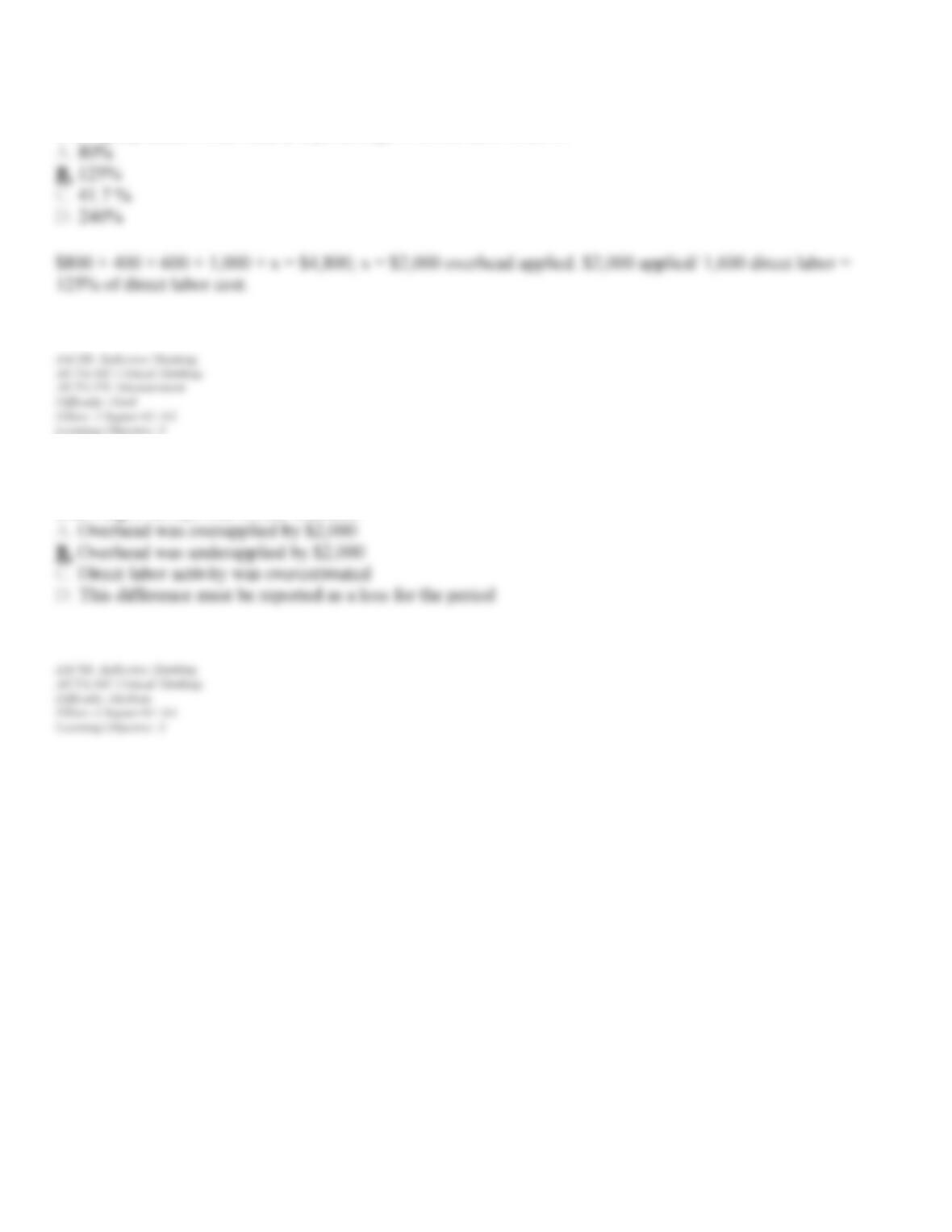
62. The general journal entry to record the issuance of materials represented by the following materials
requisitions for the month includes:
63. The Work– in- Process Inventory account of Charles River Corporation has a balance of $4,800 at the end of
an accounting period. The job cost sheets of two incomplete jobs show charges of $800 and $400 for materials
used and charges of $600 and $1,000 for direct labor used. From this information, it appears that Charles River
is using a predetermined rate, as a percentage of direct labor costs of:
64. Manufacturing Overhead applied was $60,000, while actual overhead incurred was $62,000. Which of the
following is always true of this situation?
Use the following to answer questions 65-66:
Before prorating overhead, the current period overhead component of Cost of Goods Sold for Wilmington
Company was $230,000, while the current period overhead component of the ending inventory was $80,000.
Manufacturing overhead of $310,000 was applied during the period, whereas $296,000 was actually incurred.
Wilmington has no Work–in-Process inventory at the end of the period.
Hilton – Chapter 03