
Chemistry for Changing Times, 14e (Hill/McCreary)
Chapter 3 Atomic Structure
3.1 Multiple Choice Questions
1) Which statement best summarizes the general nature of investigations during the 1800s related to the
acquisition and development of knowledge that provided glimpses into the atomic structure of matter?
A) Qualitative observations, influenced by ideas related to magic and mysticism, provide glimpses of the
structure of matter.
B) Quantitative measurements of studies of compounds with fire, lead to the formulation of fundamental
laws leading to an atomic theory of matter.
C) Electricity played an important role in unraveling the structure of the atom.
D) New experimental and mathematical techniques provided information concerning the organization of
subatomic particles in atoms.
2) Electrolysis is
A) the production of electrical currents from a battery.
B) the chemical reactions caused by electricity.
C) the production of cathode rays in vacuum tubes using electricity.
D) the conversion of elements into new elements by the use of electricity.
3) The application of electricity to chemical systems provided much of the experimental evidence for the
existence of subatomic particles. With respect to the use of electricity in studying matter, which one of
the following scientists would NOT be grouped with the others?
A) Humphry Davy
B) Michael Faraday
C) J.J. Thomson
D) Ernest Rutherford

4) Ions are
A) charged atoms (or groups of atoms).
B) electrons.
C) neutrons.
D) electrodes.
5) A cation is a
A) negatively charged ion.
B) positively charged ion.
C) negative electrode.
D) positive electrode.
6) Electrolytes are important substances in the chemistry of living systems. An electrolyte is a compound
that
A) conducts electricity when melted or put into solution.
B) generates light when electricity is applied.
C) contains electrons.
D) contains electrodes.
7) Cathode rays are beams of
A) anions.
B) electrons.
C) neutrons.
D) protons.

8) By measuring the deflection of cathode rays in electrical and magnetic fields, J.J. Thomson was able to
determine the
A) mass of the electron.
B) speed of the electron.
C) charge on the electron.
D) ratio of mass to charge for the electron.
9) Which experimental observation led scientists to speculate that cathode rays contained particles that
were constituents of all matter?
A) The rays were deflected by electrical fields.
B) The rays were deflected by magnetic fields.
C) The rays were independent of the type of gas in the vacuum tube.
D) All of the above provided evidence of the “fundamental” nature of cathode rays.
10) The existence of positively charged particles in gas discharge tubes was first experimentally verified
by
A) Lavoisier.
B) Dalton.
C) Faraday.
D) Goldstein.
11) Millikan’s “oil drop” apparatus allowed for the determination of which property of the electron?
A) mass
B) charge
C) ratio of mass to charge
D) speed

12) When combined with Thomson’s determination of the mass to charge ratio of the electron, Millikan’s
experimental work allowed for the determination of the
A) charge on the electron.
B) mass of the electron.
C) speed of the electron.
D) all of the above
13) An anion is a
A) negatively charged ion.
B) positively charged ion.
C) negative electrode.
D) positive electrode.
14) William Crookes passed an electric current through a tightly sealed tube. The current generated a
green beam of light (due to fluorescence as the beam struck a zinc sulfide surface) which seemed to pass
from one electrode to the other. This beam was called a cathode ray because
A) it seemed to leave the anode and travel to the cathode.
B) it seemed to leave the cathode and travel to the anode.
C) it seemed to travel from the zinc sulfide screen to the cathode.
D) it seemed to travel from the zinc sulfide screen to the anode.
15) A stream of electrons in a magnetic field would
A) be unchanged.
B) be stopped.
C) be deflected toward the positive electrode.
D) be deflected toward the negative electrode.

16) A cathode is a
A) negatively charged ion.
B) positively charged ion.
C) negative electrode.
D) positive electrode.
17) An anode is a
A) negatively charged ion.
B) positively charged ion.
C) negative electrode.
D) positive electrode.
18) Radioactivity is
A) the spontaneous emission of radiation from unstable elements.
B) the emission of light from certain substances after exposure to sunlight.
C) the spontaneous emission of radio waves from matter.
D) the emission of light from matter when exposed to radio waves.
19) Which person(s) won two Nobel prizes (one in physics; the other in chemistry) for work with
radioactivity?
A) Antoine Henri Becquerel
B) Marie Sklodowska Curie
C) Pierre Curie
D) Marie and Pierre Curie
20) Some chemicals which are exposed to sunlight will continue to glow even when they are placed in a
dark room. This phenomenon is known as
A) alpha emission.
B) beta emission.
C) fluorescence.
D) X-rays.
21) Identify the particle that is symbolized by He2+.
A) alpha, α
B) beta, β
C) gamma, γ
D) delta, δ
22) Identify the particle that is the least penetrating.
A) alpha, α
B) beta, β
C) gamma, γ
D) delta, δ
23) Which of the following types of electromagnetic radiation is emitted from unstable elements?
A) gamma rays
B) microwaves
C) radio waves
D) visible light

24) Which is NOT one of the three types of radiation emitted from radioactive elements?
A) alpha, α
B) beta, β
C) gamma, γ
D) lambda, λ
25) Which type of radioactivity is NOT deflected by a magnetic field?
A) alpha, α
B) beta, β
C) gamma, γ
D) delta, δ
26) Which type of radioactivity has a positive charge?
A) alpha, α
B) beta, β
C) gamma, γ
D) delta, δ
27) Which type of radioactivity has a negative charge?
A) alpha, α
B) beta, β
C) gamma, γ
D) delta, δ

28) Which type of radioactivity is an electron?
A) alpha, α
B) beta, β
C) gamma, γ
D) lambda, λ
29) Which type of radioactivity has essentially no mass?
A) alpha, α
B) beta, β
C) gamma, γ
D) lambda, λ
30) All of the following types of radiation will be deflected either by a magnetic field or electricity
EXCEPT
A) alpha, α.
B) beta, β.
C) gamma, γ.
D) electrons.
31) Which radioactive particle was used by Geiger and Marsden in their experiments with thin metal
foils?
A) alpha, α
B) beta, β
C) gamma, γ
D) lambda, λ

32) The nuclear model of the atom was constructed from which fundamental experiment?
A) alpha particle scattering by thin metal foils
B) cathode ray behavior in electrical fields
C) atomic spectra from gas discharge tubes
D) electrolysis of water
33) Based upon the experiments of his co-workers, Rutherford proposed that
A) atoms are mostly empty space.
B) most of the mass of atoms is located in a dense, small volume nucleus.
C) the nucleus is positively charged.
D) all of the above
34) Relative to the mass of the nucleus of an atom, the mass of the electron is
A) always much smaller.
B) always much larger.
C) about the same.
D) dependent upon the element.
35) The nuclear nature of the atom was postulated by
A) Rutherford.
B) Dalton.
C) Thomson.
D) Millikan.
36) Nuclear physicists have discovered over 100 different particles that compose the nucleus of an atom.
From a chemistry perspective, the nucleus is best described as being composed of
A) protons and neutrons packed tightly into a very small volume.
B) protons and electrons packed tightly into a very small volume.
C) neutrons and electrons packed tightly into a very small volume.
D) protons, neutrons and electrons packed tightly into a very small volume.
37) Rutherford concluded that the nucleus of an atom is positively charged because
A) some negatively charged alpha particles were deflected by the nucleus in the gold foil experiment.
B) some positively charged alpha particles were deflected by the nucleus in the gold foil experiment.
C) some negatively charged beta particles were deflected by the nucleus in the gold foil experiment.
D) some positively charged beta particles were deflected by the nucleus in the gold foil experiment.
38) The difference in mass between protons and neutrons is generally regarded as
A) significant.
B) insignificant.
C) unknown.
D) variable.
39) Essentially all of the mass of an atom is due to the
A) protons.
B) neutrons.
C) nucleons.
D) electrons.
40) The mass of the electrons in atoms is generally regarded as
A) significant.
B) insignificant.
C) comparable to the mass of the nucleus.
D) unknown.
41) The mass of a nucleon is
A) 1 gram.
B) 1 atomic mass unit (u).
C) equivalent to the mass of the electron.
D) 0.
42) Which statement comparing chemical and nuclear properties of isotopes is correct?
A) Isotopes have similar chemical and nuclear properties.
B) Isotopes have different chemical and nuclear properties.
C) Isotopes have different chemical properties, but generally the same nuclear properties.
D) Isotopes generally have the same chemical properties, but often different nuclear properties.
43) The charge on the nucleus of a sodium atom is
A) 1+.
B) 23+.
C) 11+.
D) 0.
44) The element iron (Fe) occurs naturally as four isotopes. Each of these isotopes has
A) 26 protons.
B) 26 electrons.
C) a different number of neutrons.
D) all of the above
45) The sum of protons and neutrons in an atom is called the
A) atomic number.
B) atomic mass.
C) nuclear mass.
D) nucleon number.
46) How many neutrons are in this isotope of tin?
Sn
A) 50
B) 66
C) 116
D) 182
47) How many nucleons are in this isotope of calcium?
Ca
A) 66
B) 46
C) 20
D) 16
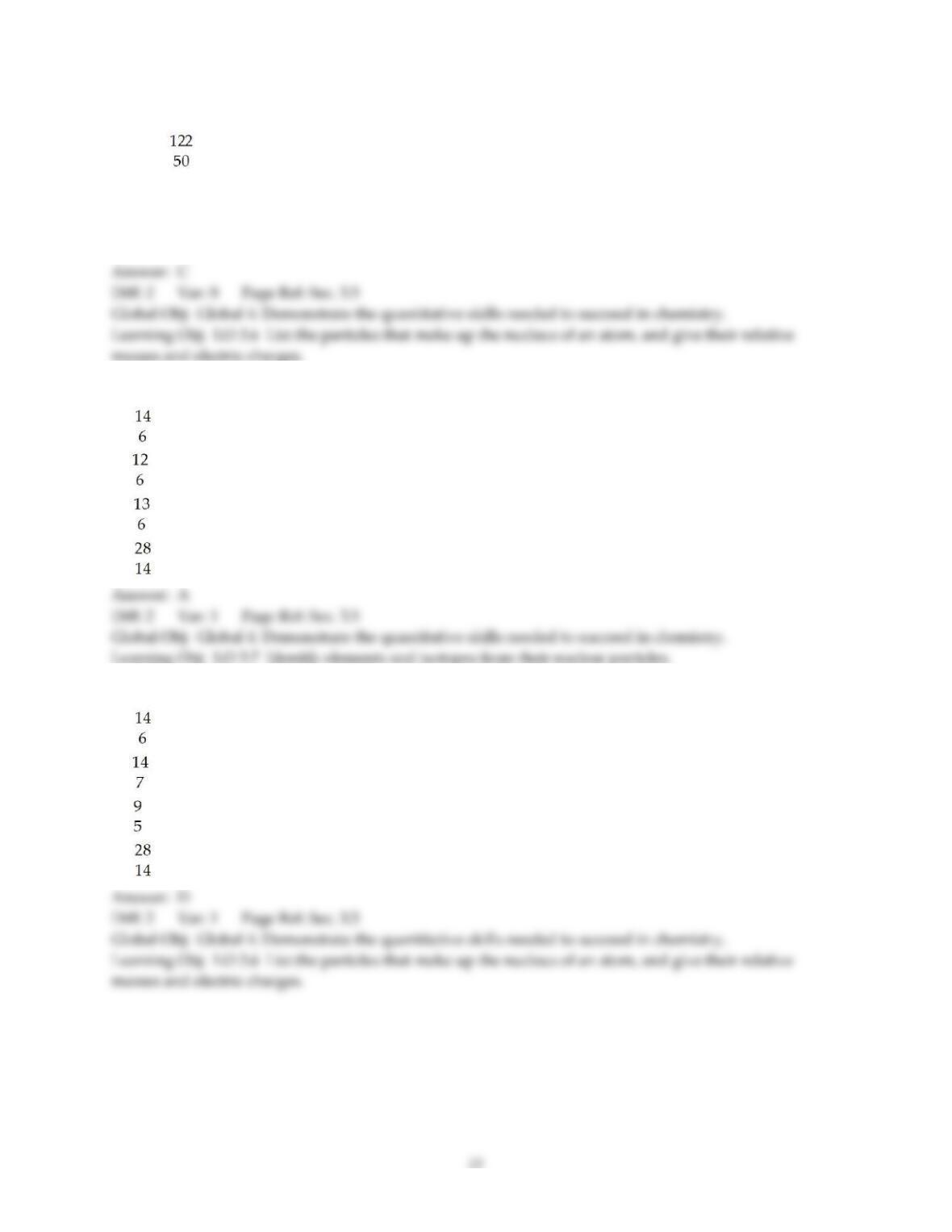
48) How many nucleons are in this isotope of tin?
Sn
A) 50
B) 72
C) 122
D) 194
49) The isotope of carbon commonly referred to as “carbon-14″ is
A) C.
B) C.
C) C.
D) Si.
50) Which contains 14 neutrons?
A) C
B) N
C) B
D) Si
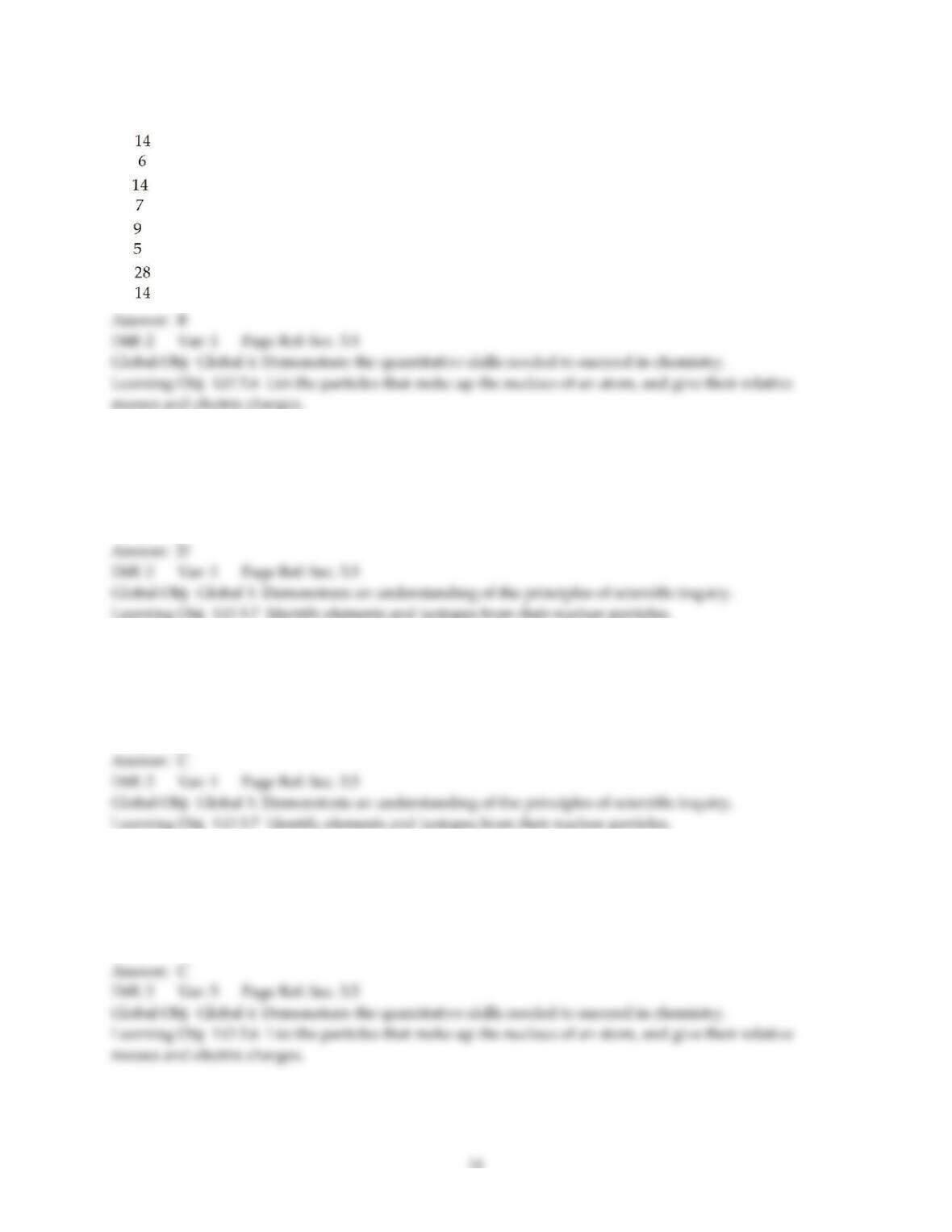
51) Which contains 7 neutrons?
A) C
B) N
C) B
D) Si
52) Tritium is the common name for
A) hydrogen-0.
B) hydrogen-1.
C) hydrogen-2.
D) hydrogen-3.
53) Deuterium is the common name for
A) hydrogen-0.
B) hydrogen-1.
C) hydrogen-2.
D) hydrogen-3.
54) How many neutrons are there in the sulfur-31 isotope?
A) 47
B) 31
C) 15
D) 16
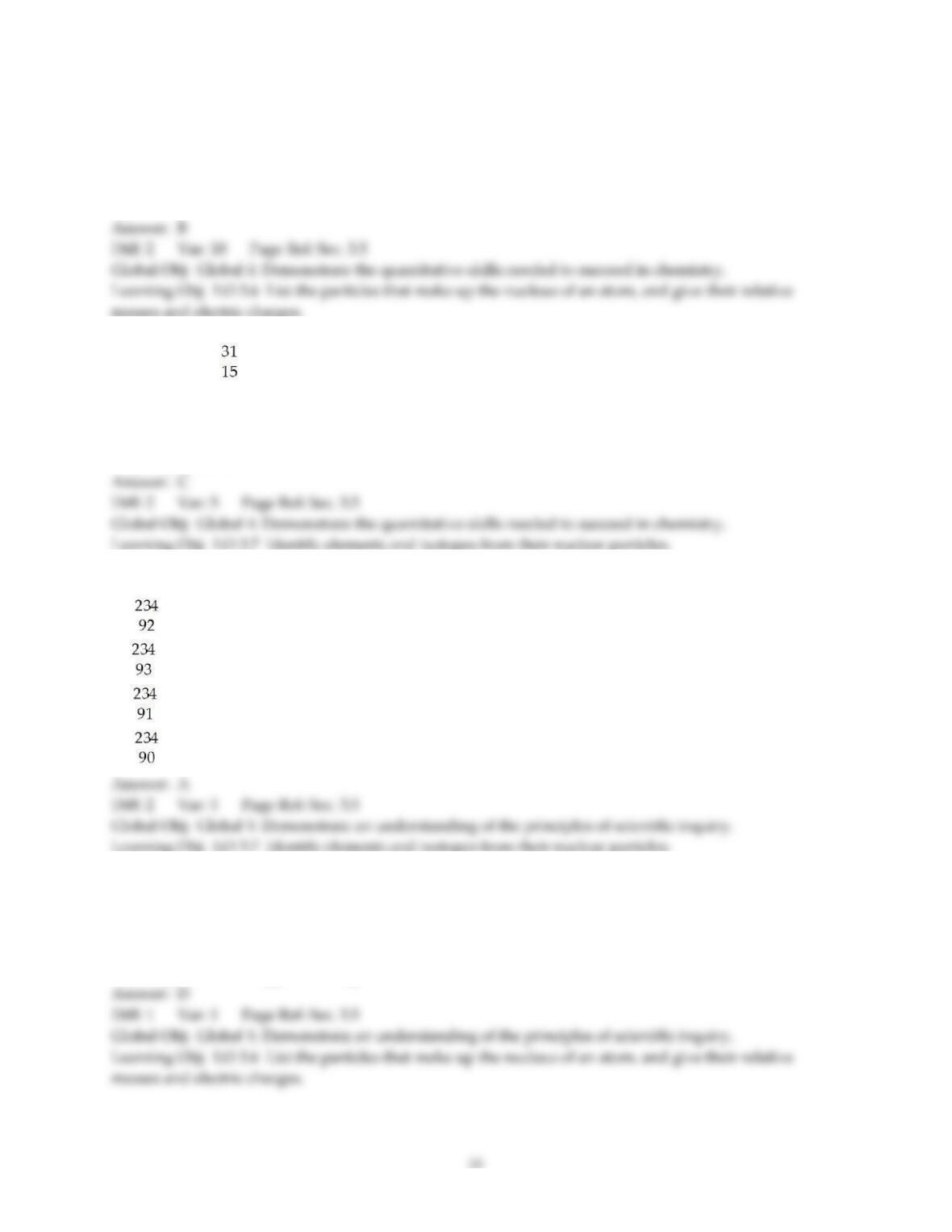
55) How many nucleons are there in the sulfur-35 isotope?
A) 16
B) 35
C) 19
D) 51
56) The isotope P is also called
A) phosphorus-15.
B) phosphorus-16.
C) phosphorus-31.
D) phosphorus-46.
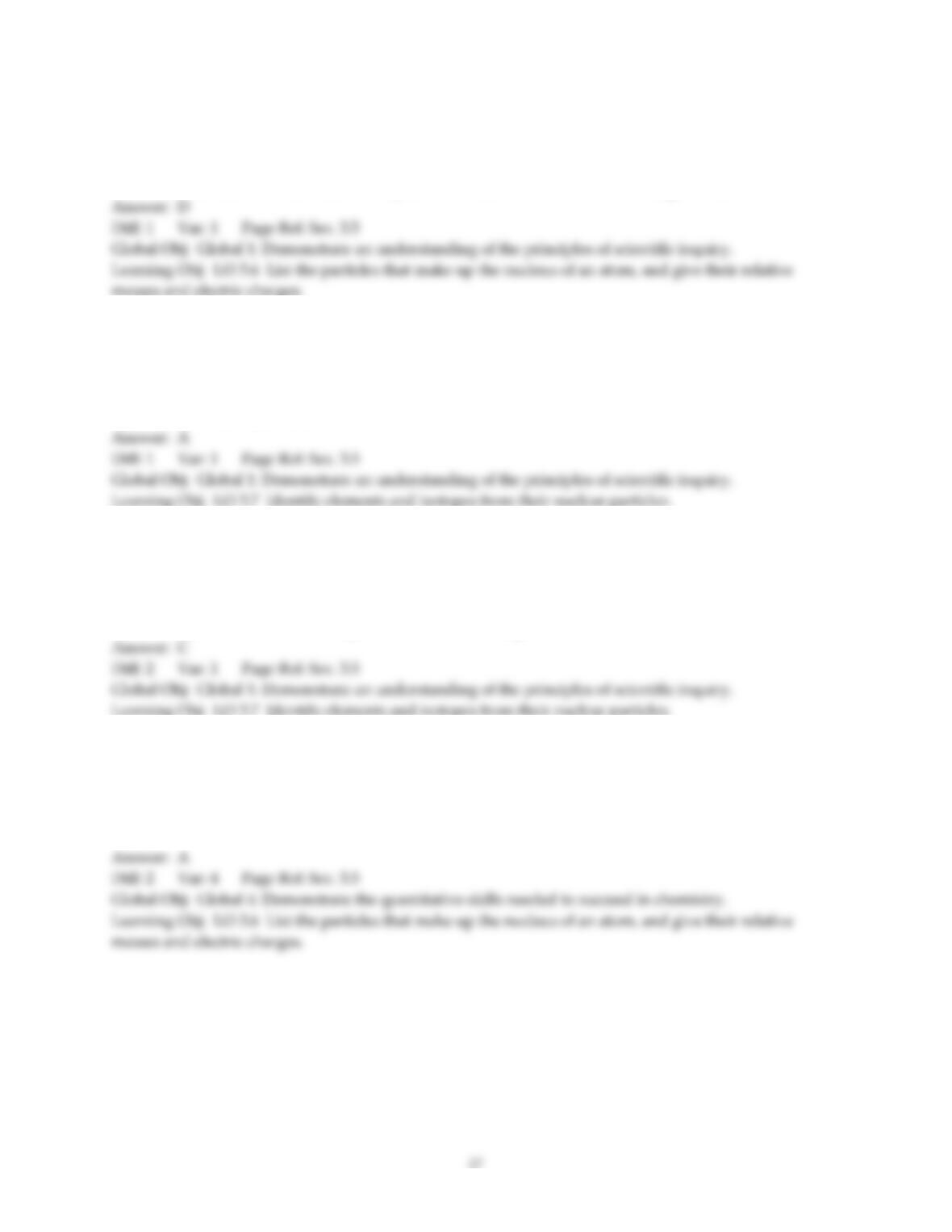
57) Identify the uranium isotope.
A) U
B) Np
C) Pa
D) Th
58) The proton has
A) the same mass and charge as the electron.
B) a smaller mass and same charge as the electron.
C) a smaller mass and opposite charge as the electron.
D) a larger mass and opposite charge as the electron.

16
59) The neutron has
A) the same approximate mass and charge as an electron.
B) the same approximate mass and charge as a proton.
C) the same approximate mass as a proton, but no charge.
D) the same approximate mass as an electron, but no charge.
60) The experiment that confirmed the existence of neutrons was performed
A) before the discovery of the proton.
B) at about the same time as the discovery of the proton.
C) after the discovery of the proton.
D) with the discovery of the first element.
61) The number of protons in an atom is called the
A) atomic mass.
B) atomic number.
C) atomic weight.
D) mass number.
62) Which is a correct description of the organization of subatomic particles in atoms?
A) Protons and electrons are tightly packed into a small nucleus. Neutrons occupy the space outside the
nucleus.
B) Protons and neutrons are tightly packed into a small nucleus. Electrons occupy the space outside the
nucleus.
C) Neutrons and electrons are tightly packed into a small nucleus. Protons occupy the space outside of
the nucleus.
D) Electrons are tightly packed into a small nucleus. Protons and neutrons occupy the space outside of
the nucleus.
63) Which is NOT true about the atomic number?
A) The atomic number of an element is the number of protons in an atom.
B) The atomic number of an element is equal to the positive charge of an atom’s nucleus.
C) The atomic number of an element is equal to the number of electrons in a neutral atom.
D) The atomic number of an element is equal to the number of electrons in a charged atom.
64) Isotopes are atoms of the same element with
A) different numbers of neutrons.
B) different numbers of electrons.
C) different numbers of protons.
D) different atomic numbers.
65) With the discovery of isotopes, which postulate of Dalton’s original atomic theory must be modified?
A) Matter is made up of atoms.
B) Atoms combine with other atoms in whole number ratios to form compounds.
C) All atoms of the same element are the same.
D) In chemical reactions, the arrangement of atoms is changed.
66) The number of protons in a Br atom is
A) 35.
B) 80.
C) 79.
D) 81.
67) How many protons are there in a phosphorus atom?
A) 31
B) 15
C) 17
D) 46
68) How many protons are there in a silver atom?
A) 16
B) 38
C) 47
D) 79
69) How many protons are there in a gold atom?
A) 16
B) 38
C) 47
D) 79
70) The isotope of hydrogen that has two neutrons is called
A) deuterium.
B) hydrogen.
C) dihydrogen.
D) tritium.
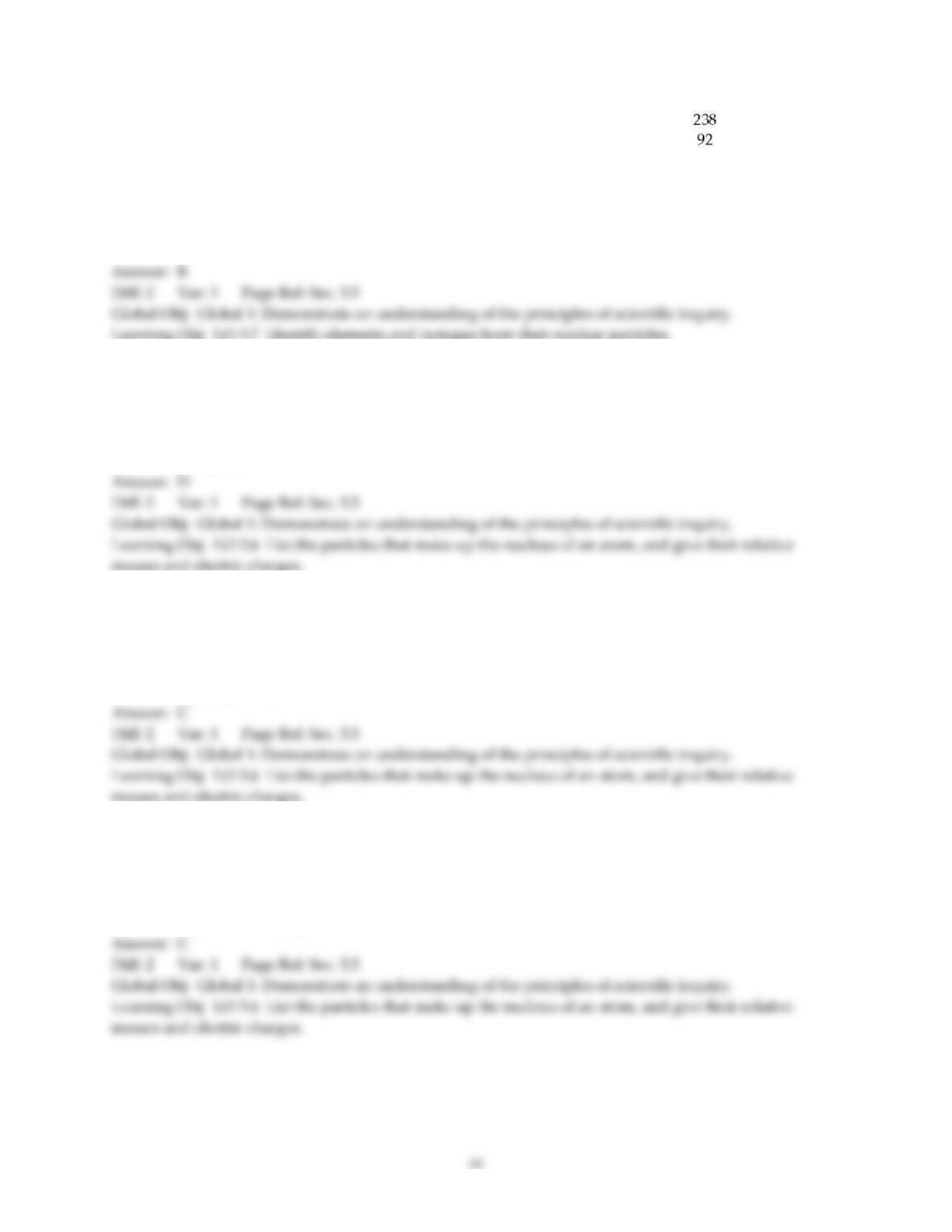
71) If X can represent the chemical symbol of any element in the periodic table, then X represents an
isotope of
A) calcium.
B) uranium.
C) niobium.
D) lead.
72) The identity of an element is determined by the ________ in the atom.
A) charge
B) number of neutrons
C) number of nucleons
D) number of protons
73) A neutral atom has the same number of
A) electrons and neutrons.
B) electrons and nucleons.
C) electrons and protons.
D) neutrons and protons.
74) Which subatomic particles have approximately the same mass?
A) electrons and neutrons
B) electrons and protons
C) neutrons and protons
D) electrons, neutrons and protons
75) The isotope of hydrogen that contains two nucleons is
A) deuterium.
B) dihydrogen.
C) hydrogen.
D) tritium.
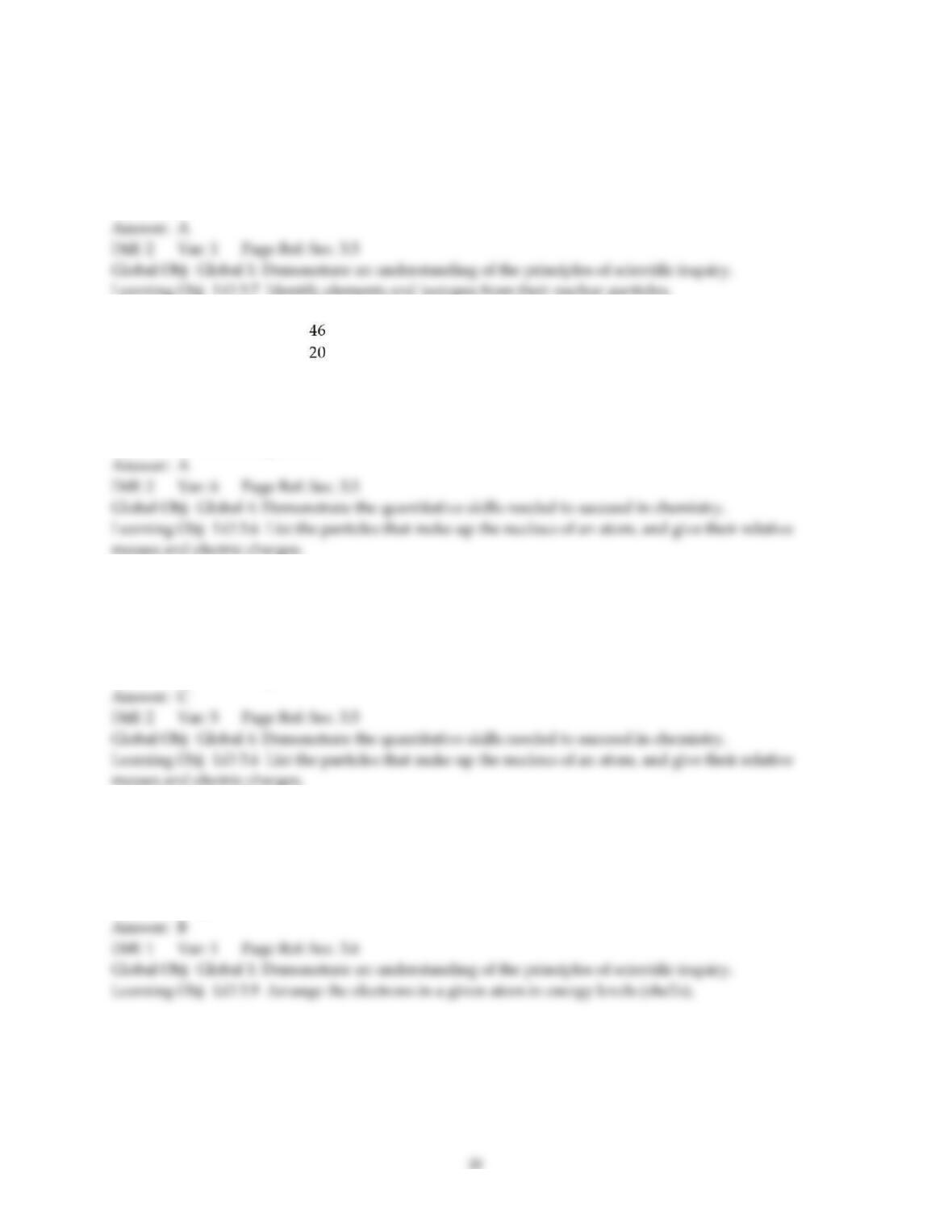
76) An atom represented by X has
A) 20 protons and 26 neutrons.
B) 20 neutrons and 26 protons.
C) 20 protons and 46 neutrons.
D) 20 neutrons and 46 protons.
77) An atom of chlorine-37 has
A) 20 protons and 17 neutrons.
B) 37 neutrons and 17 protons.
C) 17 protons and 20 neutrons.
D) 17 neutrons and 37 protons.
78) The specific pattern of colors emitted by excited atoms is called a
A) rainbow.
B) line spectrum.
C) continuous spectrum.
D) cathode ray.