
Chapter 3: Assessing Students’ Literacy Development
Multiple Choice Items
1. Six-year-old Madison selected a book, Junie B. Jones and the Stupid Smelly Bus, from the
classroom library. Madison was able to read most of the words but she needed her teacher’s help
to fully comprehend the story. Consequently, this book fit Madison’s:
a) independent level
b) instructional level
c) frustration level
d) lexile level
2. To encourage book discussions, all of the sixth grade students in the Charles School District
have been asked to read the novel, The Giver. Because a few of her students struggle in reading
and are unable to read The Giver independently, the principal has wisely advised the teacher to
a) excuse struggling readers from the book discussions
b) require the students to read the book as a homework assignment
c) read the novel aloud and discuss it with the students who struggle
d) motivate the struggling readers to read The Giver independently
3. Students’ scores on high-stakes tests such as the Metropolitan Achievement Test and the Iowa
Test of Basic Skills can often be linked to readability levels of the:
a) Fry Readability Graph
b) Fountas and Pinnell guidelines
c) Lexile Framework
d) Informal Reading Inventory
4. Scoring guides that are used to evaluate student performance in reading and writing according
to specific criteria and levels of achievement are known as:
a) running records
b) rubrics
c) informal reading inventories
d) miscue analyses
5. Bobby’s teacher administered an informal reading inventory and found that he had a fourth
grade instructional reading level and a sixth grade listening level. These scores indicate that this
student should be able to:
a) read fourth grade level materials independently
b) read sixth grade level materials independently
c) define vocabulary words at the sixth grade level
d) comprehend sixth grade level materials when they are read aloud
6. Systematic and meaningful collections of artifacts documenting students’ literacy
development over a period of time are known as:
a) running records
b) rubrics
c) informal reading inventories
d) portfolios
7. Of the following, the tool which is most likely to help students engage in self-assessment is
the:
a) portfolio
b) running record
c) informal reading inventory
d) miscue analysis
8. An informal reading inventory usually contains:
a) only narrative passages
b) only expository passages
c) narrative and expository passages at only one grade level
d) narrative and expository passages at many grade levels
9. Items to be included in a portfolio are usually selected by the:
a) students
b) teacher
c) administrators
d) parents
10. Sixth grade teacher Helen Crump has been asked to evaluate students’ writing samples. To
complete this task, Miss Crump should develop a(n):
a) informal reading inventory
b) rubric
c) running record
d) portfolio
11. Principal Andy Taylor has correctly advised teachers to prepare students for high-stakes
testing by:
a) teaching test-taking strategies through minilessons and literacy activities
b) providing more time for stress-relieving exercises
c) creating practice tests with multiple-choice items
d) creating family newsletters to explain the tests
12. The level where students can read and comprehend what they are reading with the support of
the teacher is the student’s
a) independent level
b) frustration level
c) instructional level
d) tested level
13. George lives on a farm and enjoys reading books about farm animals. Of the following, the
most likely reason why George can read books about farm animals independently is that books
with:
a) predictable text are usually more difficult to read
b) decodable text are usually more difficult to read
c) familiar objects and experiences are usually easier to read
d) varied sentence patterns are usually easier to read
14. A reading test which is composed of graded word lists, graded passages from stories and
informational books, and comprehension questions is known as a (n):
a) DIBELS
b) miscue analysis
c) informal reading inventory
d) portfolio assessment
15. When Mary orally read a paragraph from the text, Little House on the Prairie, she stumbled
over most of the words and required a great deal of assistance from her teacher. Mary was unable
to state the main idea of the selection. This book was at Mary’s:
a) independent level
b) instructional level
c) frustration level
d) lexile level
16. High-stakes testing differs from classroom assessment in many ways. One significant way in
which high-stakes testing and classroom assessment differ is that classroom assessment usually:
a) is based upon national norms
b) includes only oral presentations
c) can be conducted by a paraprofessional
d) provides more information for making daily instructional decisions
17. Sixth grade reading teacher David Scott has been asked to help his students prepare for a
high-stakes assessment. Of the following, the best way that a reading teacher could help his
students prepare for a high-stakes assessment is to:
a) teach students about question-answer relationships
b) use a timer to encourage students to work more quickly
c) conduct daily speed drills
d) stress the importance of good nutrition
18. When used correctly, portfolios focus upon a student’s:
a) weaknesses
b) strengths
c) oral reading
d) skills in the mechanics of writing
19. High-stakes tests are designed to objectively measure students’ ability to meet:
a) their personal goals
b) their parents’ expectations
c) teacher-created rubrics
d) grade-level standards
20. An informal reading inventory can be used to measure:
a) only word recognition
b) only comprehension
c) word recognition and comprehension
d) word recognition, comprehension, and numerical fluency
21. Of the following, the most effective way for teachers to monitor progress and make
instructional decisions is to:
a) distribute a weekly parent newsletter
b) develop a schedule for observing each student
c) assign homework regularly
d) ask students to submit writing samples
22. During a classroom observation, the principal noted that a fifth grade teacher did not
communicate well with her students. To help the students understand their teacher’s expectations
and to make assignments clearer, the principal wisely suggested that the teacher develop and
distribute:
a) miscue analyses
b) anecdotal records
c) checklists
d) daily quizzes
23. To help students understand the genre of standardized tests, effective teachers:
a) seek opportunities for students to examine old test forms
b) conduct read alouds with actual test forms
c) prepare weekly parent newsletters
d) teach to the test
24. Third grade teacher Bea Taylor writes brief notes as she observes students. Which of the
following notes would be most helpful in planning instruction?
a) Clara wrote an essay in neat cursive handwriting.
b) Clara is a good student.
c) Clara earned an A on her report.
d) Clara used context clues to determine the meaning of the words shore and seashell.
25. When a teacher administers an informal reading inventory, the student:
a) only reads passages orally
b) only reads passages silently
c) reads passages orally and silently
d) usually responds to picture cues
1. Fifth grade teacher Michael Baker is using a readability formula to determine the difficulty of
books selected for his classroom library. Should he rely solely on a readability formula to
determine the appropriateness of books in his classroom library? Support your answer.
2. In addition to using high-stakes assessments, teachers in the Madeline School District
routinely gather and share their students’ work in portfolios. List three benefits of including
portfolios in an assessment plan.
3. What steps can teachers take to help their students prepare for standardized tests?
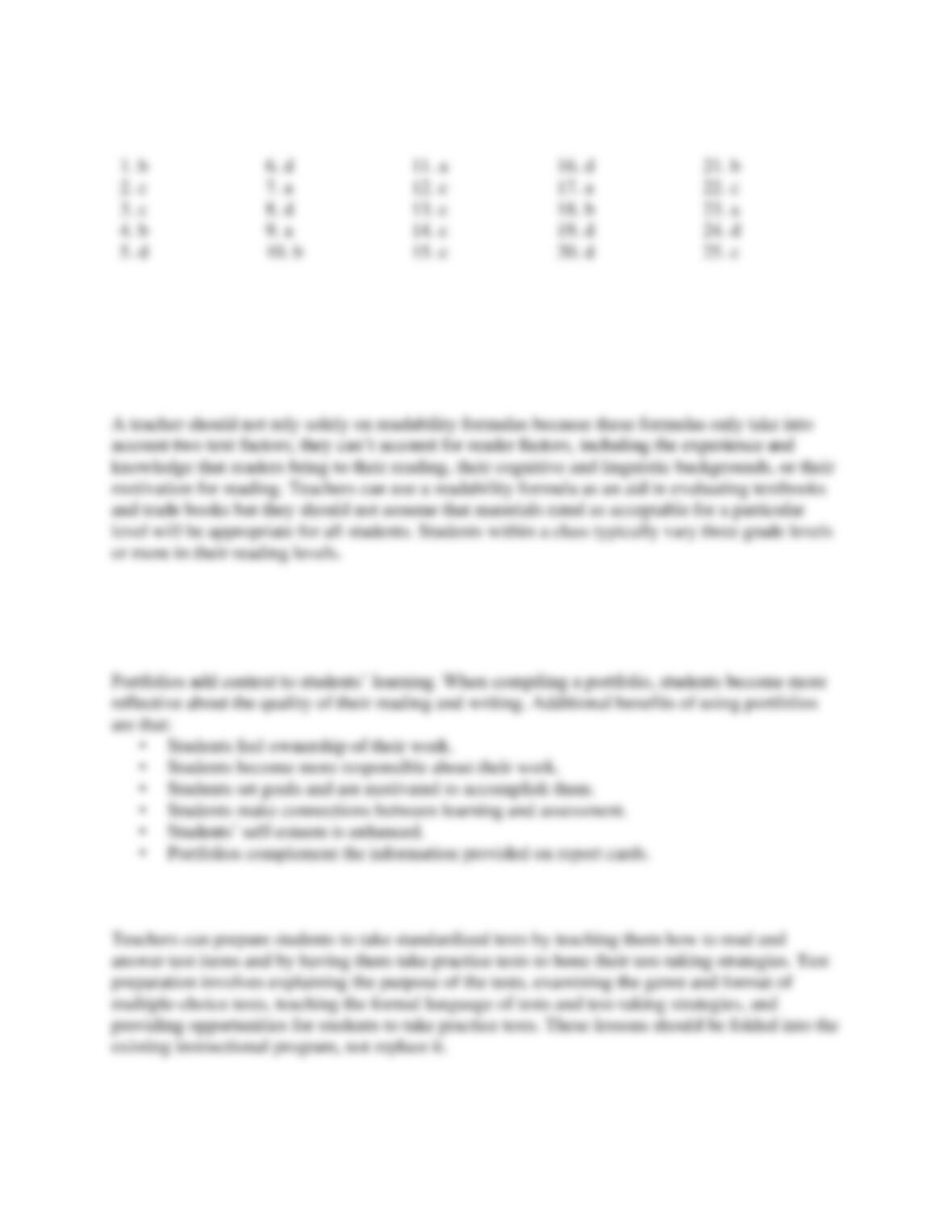
Chapter 3 Answer Key for Multiple Choice Items
1. Fifth grade teacher Michael Baker is using a readability formula to determine the
difficulty of books selected for his classroom library. Should he rely solely on a readability
formula to determine the appropriateness of books in his classroom library? Support your
answer.
2. In addition to using high-stakes assessments, teachers in the Madeline School District
routinely gather and share their students’ work in portfolios. List three benefits of
including portfolios in an assessment plan.
3. What steps can teachers take to help their students prepare for standardized tests?