Chapter 3
The Measurement Framework and Mechanics of Financial Accounting
MULTIPLE CHOICE QUESTIONS
1. When preparing the financial statements, we assume that the life of the entity will
continue beyond the current period. Which assumption are we most likely following?
a. Stable dollar theory.
b. Going concern assumption.
c. Economic entity assumption.
d. Fiscal period assumption.
2. By recognizing the economic effects of inflation on the accounting financial statements,
which accounting assumption is ignored?
a. Economic entity assumption
b. Going concern assumption
c. Stable dollar assumption
d. Fiscal period assumption
3. A company prepares financial statements once every year. What practice does this
assumption illustrate?
a. Going concern assumption
b. Fiscal period assumption
c. The five-year moving theory
d. Stable dollar assumption
4. Which assumption is applied when Laramie recognizes the operations of its wholly
owned subsidiary, Big Sky, separately and distinctly from its own operations?
a. Economic entity assumption
b. Going concern assumption
c. Fiscal period assumption
d. The subsidiary stability assumption
1-2 Test Bank – Chapter 3 – Measurement Framework and Mechanics of Financial Accounting
5. Original cost may be defined as the
a. cash price of the asset when purchased.
b. discounted future cash flows.
c. selling price.
d. price you bought the item for when it was first released for consumer sales.
6. Expensing the cost of a pencil holder that cost $1.25 instead of capitalizing it as a plant
asset and depreciating it over its estimated useful life of 10 years
a. violates the economic entity assumption.
b. violates GAAP since pencil holders are important assets.
c. is justified because of materiality.
d. is appropriate because of the stable dollar assumption.
7. Today’s fair market value would be the same as
a. the cash price of the asset when it was originally purchased.
b. the current price paid for an item in the input market.
c. the value of an item in the output market or sales price.
d. the discounted future cash flows from input and output markets.
8. Net realizable value is
a. the input price of liabilities.
b. a form of market value.
c. a present value concept.
d. the current input cost.
9. Present value, as of today, would be the same as
a. the cash price of the asset when it was purchased.
b. the present price of any given product or service.
c. the selling price.
d. the discounted value of future cash flows.
Test Bank – Chapter 3 – Measurement Framework and Mechanics of Financial Accounting 1-3
10. Recognition of increases in purchasing power of monetary units is inconsistent with the
a. economic entity assumption.
b. going concern assumption.
c. consistency principle.
d. stable dollar assumption.
11. Which one of the following statements best describes the concept of consistency?
a. When uncertainty exists, understating assets, overstating liabilities, accelerating
recognition of losses, and delaying recognition of gains is preferred.
b. Accounting numbers are consistently market value.
c. Different firms use identical accounting measurement methods for similar events.
d. Similar events are measured using identical accounting procedures from period to
period.
12. The valuation basis used to measure long-term liabilities is
a. present value.
b. replacement cost.
c. fair market value.
d. historical cost.
13. The valuation basis used to measure accounts payable is
a. fair value.
b. replacement cost.
c. face value.
d. present value.
14. Most companies prepare annual financial statements
a. with a fiscal ending date of June 30.
b. on the calendar year.
c. at a different date each year.
d. every two weeks.
1-4 Test Bank – Chapter 3 – Measurement Framework and Mechanics of Financial Accounting
15. Which one of the following statements best describes objectivity?
a. When uncertainty exists, understating assets, overstating liabilities, accelerating
recognition of losses, and delaying recognition of gains is preferred.
b. The measurement of an event is verifiable and reliable.
c. Different firms use identical accounting measurement methods for similar events.
d. Objectives are laid out that are conservative or too aggressive by management.
16. Which one of the following is violated when a firm has a policy of accelerating the
recognition of depreciation expense during good years and decreasing depreciation
expense during lean years?
a. Relevance
b. Matching
c. Consistency
d. Conservatism
17. Which one of the following is violated when a firm measures property, plant, and
equipment at its estimated selling price?
a. Objectivity
b. Economic entity assumption
c. Materiality
d. Input markets
18. Ten years after a company purchases a plot of land, it is measured on the balance sheet
at its cost from the year it was purchased instead of its current selling price. This
accounting practice is justified by the
a. financial period assumption.
b. going concern assumption.
c. fiscal period assumption.
d. original cost base.
Test Bank – Chapter 3 – Measurement Framework and Mechanics of Financial Accounting 1-5
19. The valuation basis used to measure short-term investments is
a. fair market value.
b. replacement cost.
c. original cost.
d. present value.
20. Which one of the following statements best describes the concept of conservatism?
a. Profits should be accelerated in all cases.
b. The measurement of an event is verifiable and reliable.
c. The value of goods and services provided is recognized when earned.
d. When uncertainty exists, understating assets, overstating liabilities, accelerating
recognition of losses, and delaying recognition of gains is preferred.
21. The valuation basis used to measure equipment and other plant assets on the balance
sheet is
a. the dollar amount for which the assets can be sold.
b. the cash expected to be received in the future.
c. the original cost adjusted for depreciation.
d. the assets’ net realizable value.
22. Which one of the following is violated when a department store records revenue for gift
certificates sold to customers that are not expected to be redeemed until next year?
a. Matching
b. Revenue recognition criteria
c. Going concern
d. Expense versus revenue concept
23. Which one of the following is violated when a retail store records revenue for a bank
credit card sale prior to receiving the money from the bank?
a. No violation occurred.
b. Objectivity
c. Going concern
d. Revenue recognition criteria
1-6 Test Bank – Chapter 3 – Measurement Framework and Mechanics of Financial Accounting
24. Which one of the following is violated when a company recognizes revenue upon the
receipt of cash from a customer who has paid in advance for services?
a. Expense policy
b. Objectivity
c. Matching
d. Revenue recognition criteria
25. Which of the following are exceptions to financial accounting measurement?
a. Consistency and conservatism
b. Objectivity and materiality
c. Going concern and materiality
d. Conservatism and materiality
26. Which one of the following is most likely violated if firm increases the dollar amount
reported for unsold inventory on the balance sheet to a cost it anticipates it will have to
pay for future inventory items?
a. Consistency
b. Conservatism
c. Going concern
d. Economic entity
27. Which one of the following is violated when a company records cost of goods sold
expense at the time when inventory is purchased?
a. Relevance
b. Historical cost
c. Matching
d. Revenue recognition criteria
28. Which one of the following is violated when a firm reports its long-term debt at the
present value of the cash flows associated with that debt?
a. Matching
b. No violations occurred. This accounting is correct.
c. Revenue recognition
d. Gross value of the debt
Test Bank – Chapter 3 – Measurement Framework and Mechanics of Financial Accounting 1-7
29. Which one of the following is violated when a sole proprietor records its magazine stand
at the present value of the cash flows expected to be earned from the sale of magazine
over the expected life of the stand?
a. Original cost
b. Fair market value
c. Going concern
d. Revenue recognition
30. Why must measures of performance and financial position be available on a timely
basis?
a. For the users of the financial information to make decisions
b. For the SEC to determine whether the company should be shut down or not
c. FASB requires this information to be submitted to them for approval
d. For management to have time to manipulate income
31. The fiscal period assumption states that the operating life of an economic entity
a. is generally for a period of one year.
b. can be any period management decides it to be.
c. must be an entity separately distinct from its owners.
d. can be divided into time periods over which measures can be developed and
applied.
32. The stable dollar assumption assumes that
a. the monetary unit is the functional currency of any country in which a company
operates.
b. inflationary effects should be recognized in the financial statements.
c. economic wealth is not measurable.
d. the monetary unit is stable across time.
1-8 Test Bank – Chapter 3 – Measurement Framework and Mechanics of Financial Accounting
33. The monetary unit that a company uses to measure economic transactions is primarily
determined by the
a. stable dollar concept adjusted for inflationary effects.
b. markets in which a company operates.
c. fiscal period a company has chosen.
d. decision by management to elect to use a given currency.
34. Objective accounting information
a. cannot be used in the financial statements.
b. requires that values of transactions and related assets and liabilities created by them
be arbitrarily determined.
c. ensures that revenue matches expenses for every accounting period.
d. states that financial accounting information must be reliable and verifiable.
35. The matching principle states that
a. expenses should be recognized in the period that the related revenue is recognized.
b. after expenses have been identified in a particular accounting period in which they
were incurred, revenues can be recognized.
c. each company should use the same accounting principles as other companies use.
d. for every dollar of revenue recognized, the company should recognize a
corresponding dollar of expenses.
36. Compared to U.S. GAAP, IFRS tends to:
a. require fewer disclosures.
b. allow management to choose between fewer accounting method alternatives.
c. be the same as U.S. GAAP in all respects.
d. provide a stricter interpretation of objectivity than in the U.S.
37. The most common point of revenue recognition is
a. when the cash is collected from the customer.
b. when the customer elects to issue the check to pay for goods shipped.
c. when the goods are delivered to the customer.
d. as the goods are being produced.
Test Bank – Chapter 3 – Measurement Framework and Mechanics of Financial Accounting 1-9
38. The principle of consistency states that
a. companies should choose a set of accounting methods and use them from one
period to the next.
b. once a company selects an accounting method, it must use that method throughout
the company’s entire existence.
c. a company may change any accounting method, provided the SEC approves the
change.
d. companies should elect to use methods that consistently inflate profits.
39. Everett, Inc.’s reporting period ends on June 30th every year. This is an example of
a. matching.
b. fiscal period.
c. materiality.
d. relevance.
40. Which of the following represents two of the four criteria that must be met before
revenue can be included in the income statement?
a. The amount of revenue must be objectively measurable and the cash must be
collected.
b. The company elects to record the revenue and the cash for payment is relatively
certain.
c. The company must intend to transfer the goods or services to the buyer and the
collection of cash must be reasonably assured.
d. The collection of cash must be reasonably assured and the seller’s price to the buyer
is fixed or determinable.
41. Information is considered material if
a. it would have a bearing on decisions of those who use the financial statements.
b. there is a substantial likelihood that a reasonable investor would not be concerned
about the information.
c. an item is so insignificant that users would likely ignore it.
d. the FASB explicitly rules the transaction or item to be material.
1-10 Test Bank – Chapter 3 – Measurement Framework and Mechanics of Financial Accounting
42. Why would a company recognize the cost of an asset on its balance sheet rather than
treat it as an expense on the date it is acquired?
a. Conservatism requires this recognition.
b. Matching requires costs to be matched against the related revenues of the asset.
c. Strictly to record the amount in the most economically favorable manner possible for
the company.
d. The stable dollar concept will not allow inflation to be added to expenses, but does
allow inflation to be added to assets.
43. When in doubt, financial statements should
a. understate assets, overstate liabilities, delay the recognition of gains, and accelerate
the recognition of losses.
b. understate assets and liabilities and delay the recognition of gains and losses.
c. understate assets, overstate liabilities, and delay the recognition of gains and losses.
d. overstate assets and understate liabilities.
44. Ramos Company ordered 500 toy wagons from Lamar, Inc. on May 1, 2010. Ramos
Company paid for them on May 20 at a cost of $2 each. Ramos sold 50 of them on June
2, 2010, for $5 each to Gilloz Company. Gilloz Company paid Ramos on June 10.
On which date should Ramos Company recognize revenue?
a. May 1
b. May 20
c. June 10
d. June 2
45. Ramos Company ordered 500 toy wagons from Lamar, Inc. on May 1, 2010. Ramos
Company paid for them on May 20 at a cost of $2 each. Ramos sold 50 of them on June
2, 2010, for $5 each to Gilloz Company. Gilloz Company paid Ramos on June 10.
How much revenue should Ramos Company recognize at the preferred point of revenue
recognition?
a. $240
b. $700
c. $560
d. $250
Test Bank – Chapter 3 – Measurement Framework and Mechanics of Financial Accounting 1-11
46. Ramos Company ordered 500 toy wagons from Lamar, Inc. on May 1, 2010. Ramos
Company paid for them on May 20 at a cost of $2 each. Ramos sold 50 of them on June
2, 2010, for $5 each to Gilloz Company. Gilloz Company paid Ramos on June 10.
Which amount represents Ramos Company’s input markets related to this sale?
a. $300
b. $1,000
c. $1,700
d. $250
47. Equipment with an original cost of $38,000 has a fair market value of $34,000, current
replacement cost of $41,000, and a depreciated value of $35,000 on December 31,
2010. At what amount would net equipment be measured on the December 31, 2010
balance sheet?
a. $38,000
b. $35,000
c. $41,000
d. $34,000
48. Short-term investments have an original cost of $29,000 and a market price of $30,000
at December 31, 2010. At what amount would the investments be measured on the
December 31, 2010 balance sheet?
a. $29,000
b. $30,000
c. ($1,000)
d. $1,000
49. Hampton Company has land with an original cost of $66,000 and a fair market value of
$81,000. Hampton has considered selling its business next year and listing the land with
a realtor for $100,000. At what amount would land be measured on the December 31,
2010 balance sheet?
a. $100,000
b. $81,000
c. $15,000
d. $66,000
1-12 Test Bank – Chapter 3 – Measurement Framework and Mechanics of Financial Accounting
50. On October 1, 2010, $18,000 of annual magazine subscriptions were sold by Dog World
Magazines. The subscribed magazines are delivered on the first day of each month
beginning on October 1, 2010. The total cost of the subscribed magazines is $9,600,
equal to $800 per month. What is the amount of revenue to be recognized during 2010?
a. $18,000
b. $3,000
c. $4,500
d. $8,400
Solution:
Revenue for 2010 is the amount earned for the 3 months of subscriptions delivered for a total of
$4,500 ($18,000 x 3/12). Cost of goods sold is $2,400 (3 months x $800 per month).
51. On October 1, 2010, $18,000 of annual magazine subscriptions were sold by Dog World
Magazines. The total cost of the subscribed magazines is $9,600, equal to $800 per
month. The subscribed magazines are delivered on the first day of each month
beginning on October 1, 2010. What is the amount of the cost of the magazines to be
recognized during 2010?
a. $9,600
b. $8,400
c. $1,600
d. $2,400
Solution:
Revenue for 2010 is the amount earned for the 3 months of subscriptions delivered for a total of
$4,500 ($18,000 x 3/12). Cost of goods sold is $2,400 (3 months x $800 per month).
Test Bank – Chapter 3 – Measurement Framework and Mechanics of Financial Accounting 1-13
52. Jackson Construction built a levee for the state of Mississippi over a three-year period.
The contracted price for the levee was $1,200,000. The costs incurred by Jackson and
the payments from the state over the three year period are as follows:
2009
2010
2011
Total
Costs incurred
by Jackson
$300,000
$200,000
$100,000
$600,000
Payments from
Mississippi
$500,000
$300,000
$400,000
$1,200,000
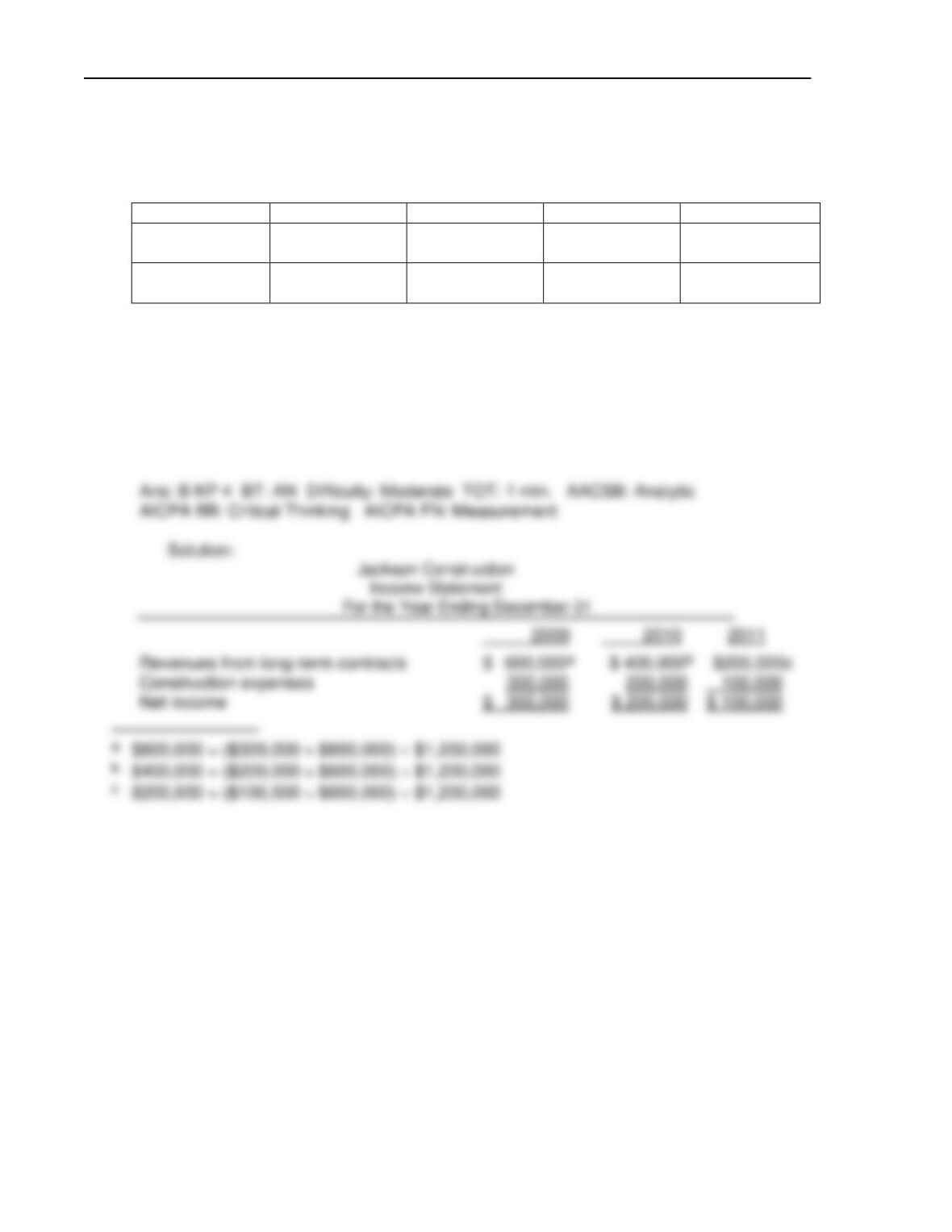
If revenue is recognized when payments are received, which of the following present the
net income amounts reported in 2009, 2010, and 2011, respectively?
a. $500,000; $300,000; $400,000
b. $200,000; $100,000; $300,000
c. $400,000; $400,000; $400,000
d. $300,000; $200,000; $100,000
1-14 Test Bank – Chapter 3 – Measurement Framework and Mechanics of Financial Accounting
53. Jackson Construction built a levee for the state of Mississippi over a three-year period.
The contracted price for the levee was $1,200,000. The costs incurred by Jackson and
the payments from the state over the three year period are as follows:
2009
2010
2011
Total
Costs incurred
by Jackson
$300,000
$200,000
$100,000
$600,000
Payments from
Mississippi
$500,000
$300,000
$400,000
$1,200,000
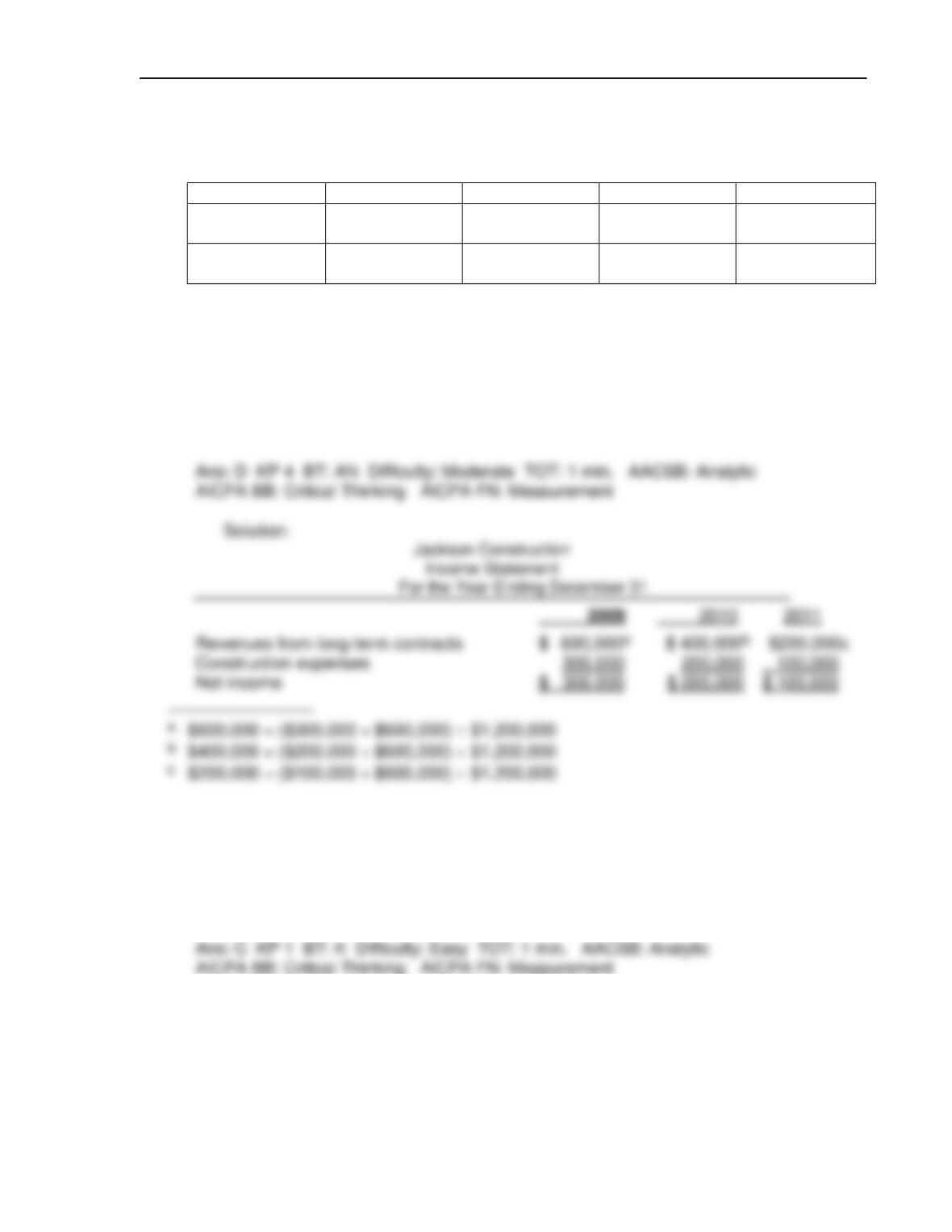
If revenue is recognized in proportion to the costs incurred by Jackson, how much net
income is reported in 2010?
a. $100,000
b. $200,000
c. $300,000
d. $400,000
Test Bank – Chapter 3 – Measurement Framework and Mechanics of Financial Accounting 1-15
54. Jackson Construction built a levee for the state of Mississippi over a three-year period.
The contracted price for the levee was $1,200,000. The costs incurred by Jackson and
the payments from the state over the three year period are as follows:
2009
2010
2011
Total
Costs incurred
by Jackson
$300,000
$200,000
$100,000
$600,000
Payments from
Mississippi
$500,000
$300,000
$400,000
$1,200,000
If revenue is recognized in proportion to the costs incurred by Jackson, how much net
income is reported in 2011?
a. $600,000
b. $400,000
c. $300,000
d. $100,000
55. An event that affects assets, liabilities, or shareholders’ equity is considered to be
a. timely.
b. objectively measured.
c. relevant.
d. capitalized.
1-16 Test Bank – Chapter 3 – Measurement Framework and Mechanics of Financial Accounting
56. An event for which an appropriate monetary measure can be derived is considered to be
a. objectively measured.
b. economically viable.
c. relevant.
d. capitalized.
57. If an event is considered to change assets, liabilities, or shareholders’ equity with an
appropriate monetary measure, then it is
a. considered a financial changing event.
b. listed on the U.S. stock exchange.
c. considered a debt or payable of a company.
d. recorded in the books of a company.
58. If assets are $1,000, liabilities are $500, and contributed capital is $200, then
shareholders’ equity is
a. $500.
b. $1,500.
c. $700.
d. $300.
Solution: $1,000 − $500 = $500
59. Liabilities are $2,000, retained earnings are $1,000, and contributed capital is $3,000.
Assets must be
a. $3,000.
b. $6,000.
c. $5,000.
d. $4,000.
Solution: $2,000 + $1,000 + $3,000 = $6,000
Test Bank – Chapter 3 – Measurement Framework and Mechanics of Financial Accounting 1-17
60. Which one of the following changes describes the receipt of $2,000 from the issuance of
common stock?
a. Assets and shareholders’ equity increase by $2,000.
b. Assets and shareholders’ equity decrease by $2,000.
c. Assets and liabilities increase by $2,000.
d. Assets increase and shareholders’ equity decreases by $2,000.
61. Which one of the following changes describes the receipt of $3,000 from the issuance of
a long-term note payable?
a. Assets and shareholders’ equity increase by $3,000.
b. Assets and shareholders’ equity decrease by $3,000.
c. Assets and liabilities increase by $3,000.
d. Assets and liabilities decrease by $3,000.
62. Which of the following changes describes the purchase of $2,000 of inventory through
payment on credit?
a. Assets and shareholders’ equity increase by $2,000.
b. Assets and shareholders’ equity decrease by $2,000.
c. Assets and liabilities increase by $2,000.
d. Assets and liabilities decrease by $2,000.
63. Providing $4,000 of services to customers on account causes
a. assets and shareholders’ equity to decrease by $4,000.
b. assets and shareholders’ equity to increase by $4,000.
c. assets and liabilities to increase by $4,000.
d. assets and liabilities to decrease by $4,000.
64. Which of the following changes describes the payment of $1,000 for cash
dividends?
a. Assets and shareholders’ equity increase by $1,000.
b. Assets and shareholders’ equity decrease by $1,000.
c. Assets and liabilities increase by $1,000.
d. Assets and liabilities decrease by $1,000.
1-18 Test Bank – Chapter 3 – Measurement Framework and Mechanics of Financial Accounting
65. Which of the following changes describes the purchase of $3,000 of equipment financed
by the issuance of a long-term note payable?
a. Assets and shareholders’ equity increase by $3,000.
b. Assets and shareholders’ equity decrease by $3,000.
c. Assets and liabilities decrease by $3,000.
d. Assets and liabilities increase by $3,000.
66. Acacia Company provided landscaping services and received $2,000 from customers
immediately. Which of the following occurred?
a. Assets and shareholders’ equity increase by $2,000.
b. Assets and shareholders’ equity decrease by $2,000.
c. Assets and liabilities increase by $2,000.
d. Assets and liabilities decrease by $2,000.
67. Lakeshore Corp. purchased $2,000 of supplies on account. The supplies will be used
over the next few months. This event causes
a. assets and shareholders’ equity to increase by $2,000.
b. assets and shareholders’ equity to decrease by $2,000.
c. assets and expenses to decrease by $2,000.
d. assets and liabilities to increase by $2,000.
68. Which one of the following changes describes the payment of $800 for utilities for the
current month?
a. Assets and shareholders’ equity decrease by $800.
b. Assets and shareholders’ equity don’t change.
c. Assets and liabilities increase by $800.
d. Assets and liabilities decrease by $800.
69. Which of the following changes describes the payment of $20,000 for a new
bulldozer?
a. Assets and shareholders’ equity decrease by $20,000.
b. Assets decrease and shareholders’ equity increases by $20,000.
c. No net change in total assets.
d. Assets decrease by $20,000.