College Physics: A Strategic Approach, 3e (Knight)
Chapter 3 Vectors and Motion in Two Dimensions
3.1 Conceptual Questions
1) If a vector pointing upward has a positive magnitude, a vector pointing downward has a
negative magnitude.
A) True
B) False
2) Two displacement vectors have magnitudes of 5.0 m and 7.0 m, respectively. If these two
vectors are added together, the magnitude of the sum
A) is equal to 2.0 m.
B) could be as small as 2.0 m or as large as 12 m.
C) is equal to 12 m.
D) is equal to 8.6 m.
3) Two vectors, of magnitudes 20 mm and 50 mm, are added together. Which one of the
following is a possible value for the magnitude of the resultant?
A) 10 mm
B) 20 mm
C) 40 mm
D) 80 mm
4) The magnitude of the resultant of two vectors cannot be less than the magnitude of either of
those two vectors.
A) True
B) False
5) A student adds two displacement vectors that have the magnitudes of 12.0 m and 5.0 m. What
is the range of possible answers for the magnitude of the resultant vector?
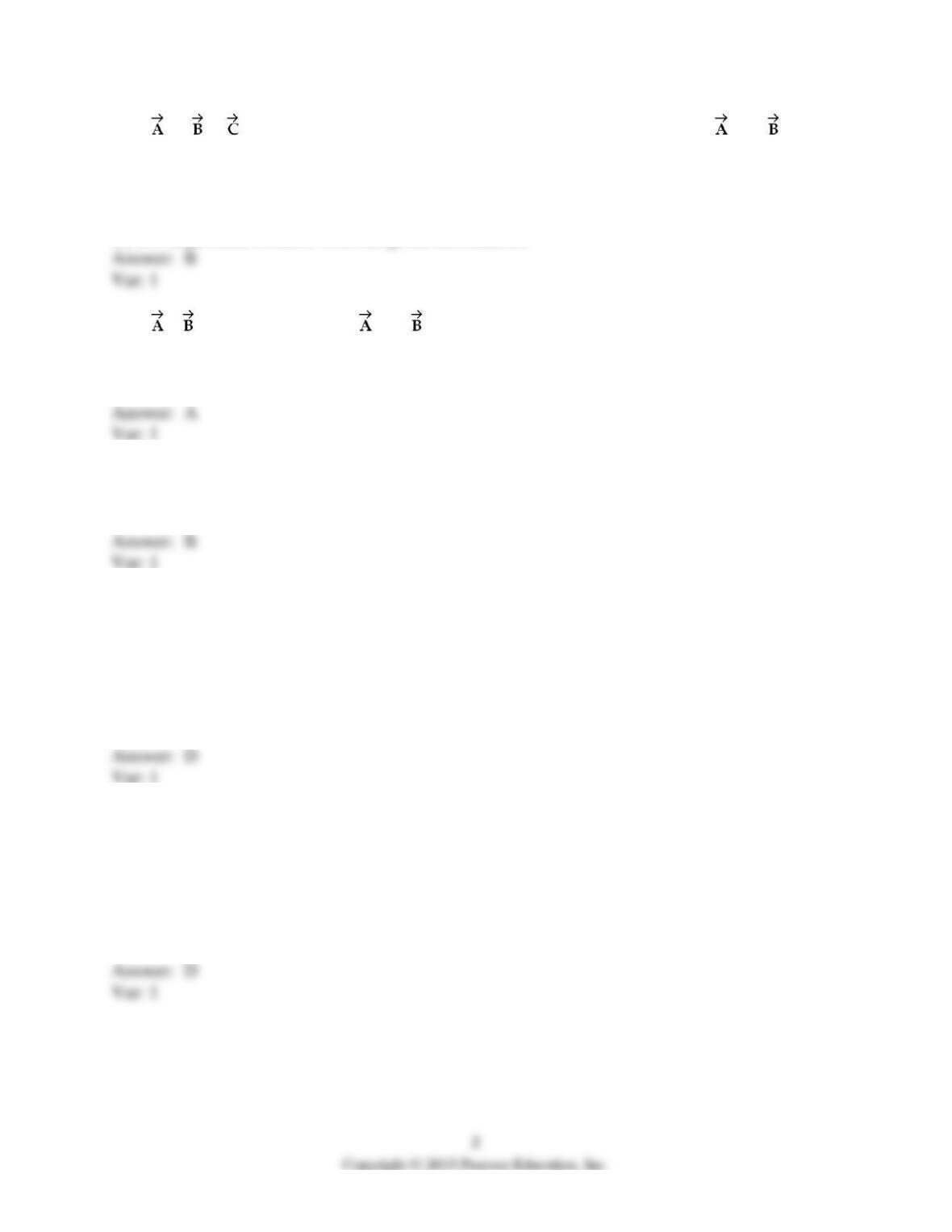
6) If + = and their magnitudes are given by A + B = C, then the vectors and are
oriented
A) perpendicular relative to one other.
B) parallel to each other (in the same direction).
C) antiparallel to each other (in opposite directions).
D) It is impossible to know from the given information.
7) If – = 0, then the vectors and have equal magnitudes and are directed in the same
direction.
A) True
B) False
8) If three vectors add to zero, they must all have equal magnitudes.
A) True
B) False
9) The sum of two vectors of fixed magnitudes has the greatest magnitude when the angle
between these two vectors is
A) 90°
B) 180°
C) 60°
D) 0°
E) 270°
10) The sum of two vectors of fixed magnitudes has its minimum magnitude when the angle
between these vectors is
A) 0°
B) 90°
C) 270°
D) 180°
E) 360°
11) Vectors and obey the equation + = 0. These vectors satisfy which one of the
following statements?
A) Vectors and are at right angles to each other.
B) Vectors and point in the same direction.
C) Vectors and have the same magnitudes.
D) The magnitude of is the negative of the magnitude of .
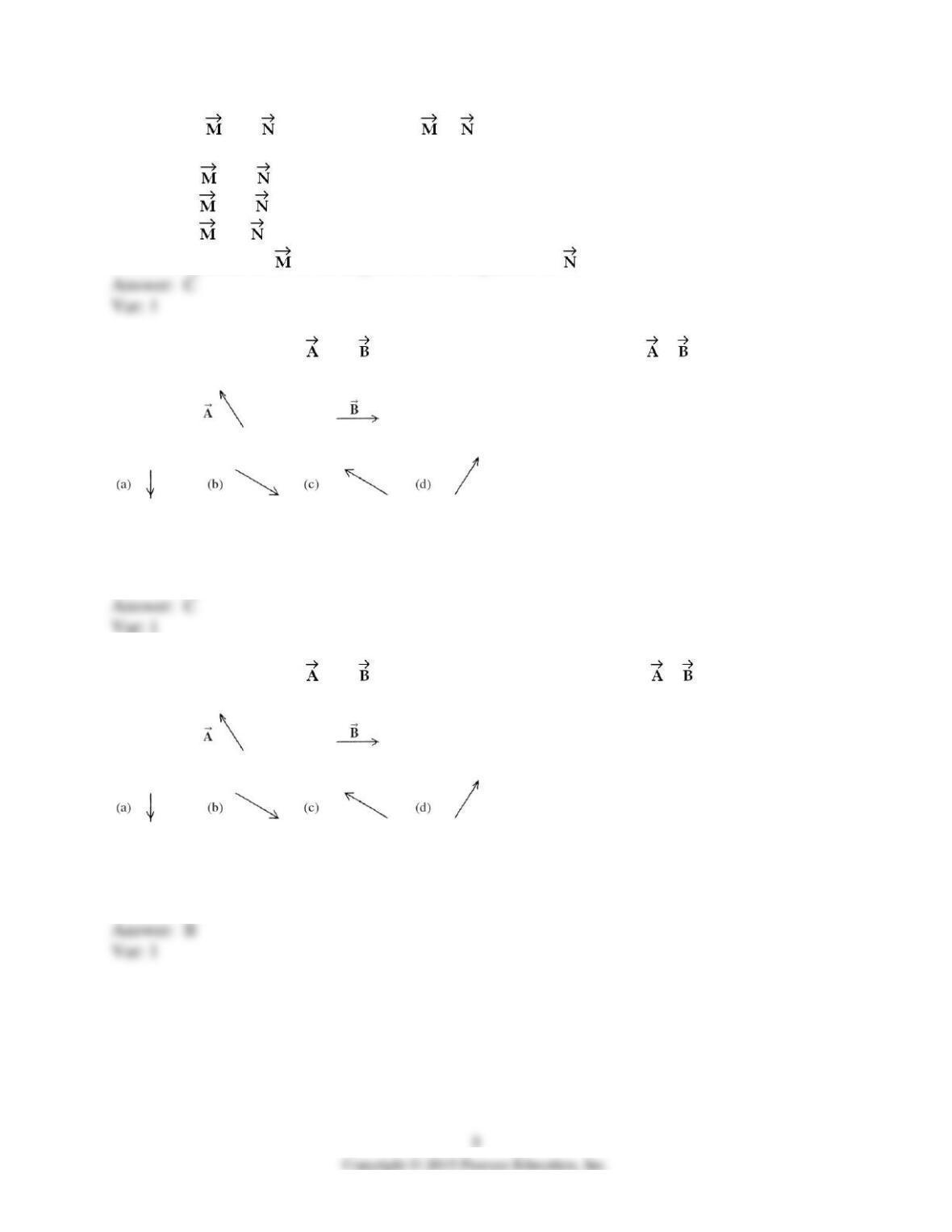
12) Consider two vectors and shown in the figure. The difference – is best illustrated
by
A) choice (a)
B) choice (b)
C) choice (c)
D) choice (d)
13) Consider two vectors and shown in the figure. The difference – is best illustrated
by
A) choice (a)
B) choice (b)
C) choice (c)
D) choice (d)
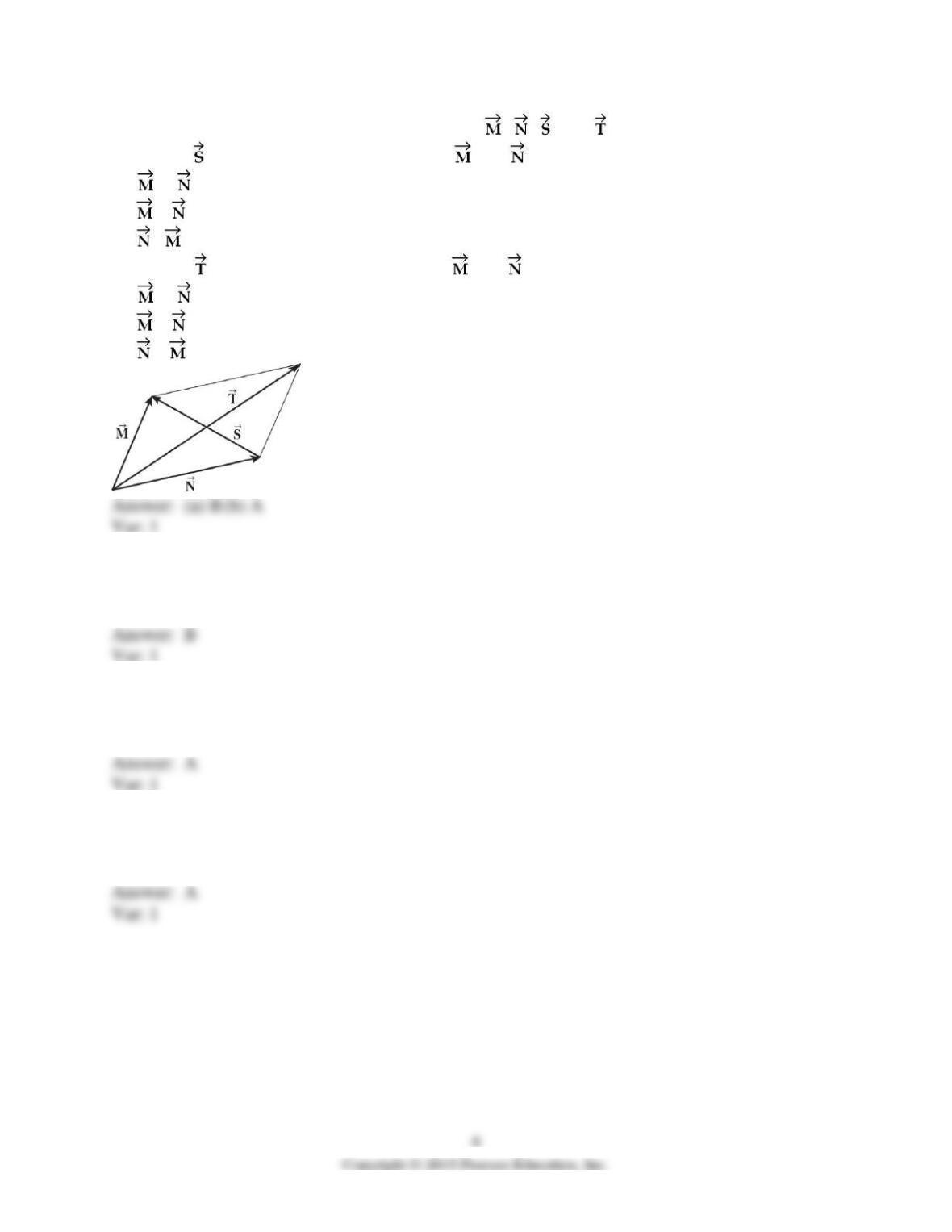
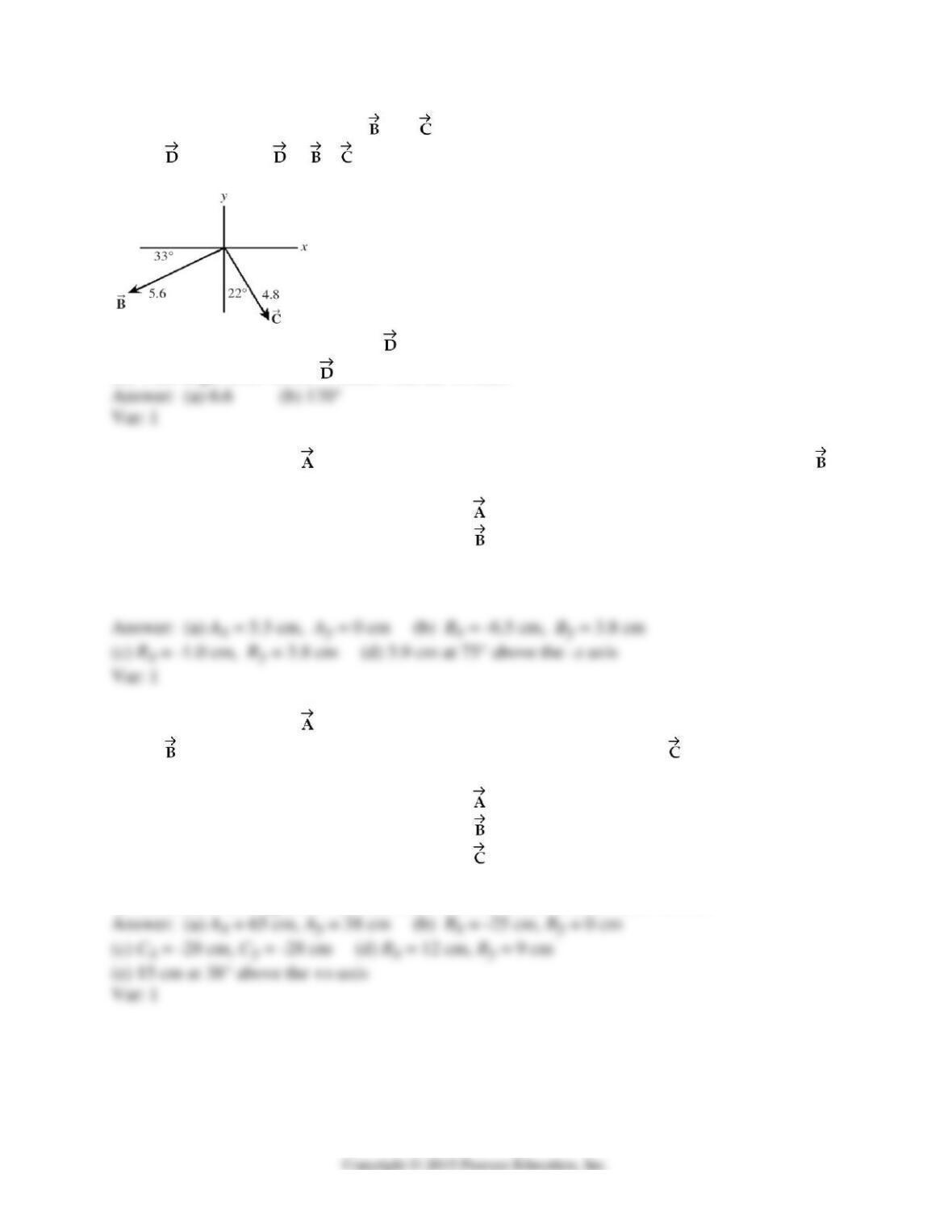
14) Refer to the figure, which shows four vectors , , , and .
(a) Vector as expressed in terms of vectors and is given by
A) + .
B) – .
C) – .
(b) Vector as expressed in terms of vectors and is given by
A) + .
B) – .
C) – .
15) If a vector’s components are all negative, then the magnitude of the vector is negative.
A) True
B) False
16) The magnitude of a vector can never be less than the magnitude of any of its components.
A) True
B) False
17) The magnitude of a vector an only zero if all of its components are zero.
A) True
B) False
18) If a vector has components Ax < 0, and Ay > 0, then the angle that this vector makes with
the positive x-axis must be in the range
A) 0° to 90°
B) 90° to 180°
C) 180° to 270°
D) 270° to 360°
E) It cannot be determined without additional information.
19) If a vector has components Ax < 0, and Ay < 0, then the angle that this vector makes with
the positive x-axis must be in the range
A) 0° to 90°
B) 90° to 180°
C) 180° to 270°
D) 270° to 360°
E) cannot be determined without additional information
20) If a vector has components Ax > 0, and Ay < 0, then the angle that this vector makes with
the positive x-axis must be in the range
A) 0° to 90°
B) 90° to 180°
C) 180° to 270°
D) 270° to 360°
E) cannot be determined without additional information
21) The eastward component of vector is equal to the westward component of vector and
their northward components are equal. Which one of the following statements must be correct
for these two vectors?
A) Vector is parallel to vector .
B) Vector is antiparallel (in the opposite direction) to vector .
C) Vector must be perpendicular to vector .
D) The magnitude of vector must be equal to the magnitude of vector .
E) The angle between vector and vector must be 90°.
22) Vector is along the +x-axis and vector is along the +y-axis. Which one of the following
statements is correct with respect to these vectors?
A) The x component of vector is equal to the x component of vector .
B) The y component of vector is equal to the y component of vector .
C) The x component of vector is equal to the y component of vector .
D) The y component of vector is equal to the x component of vector .
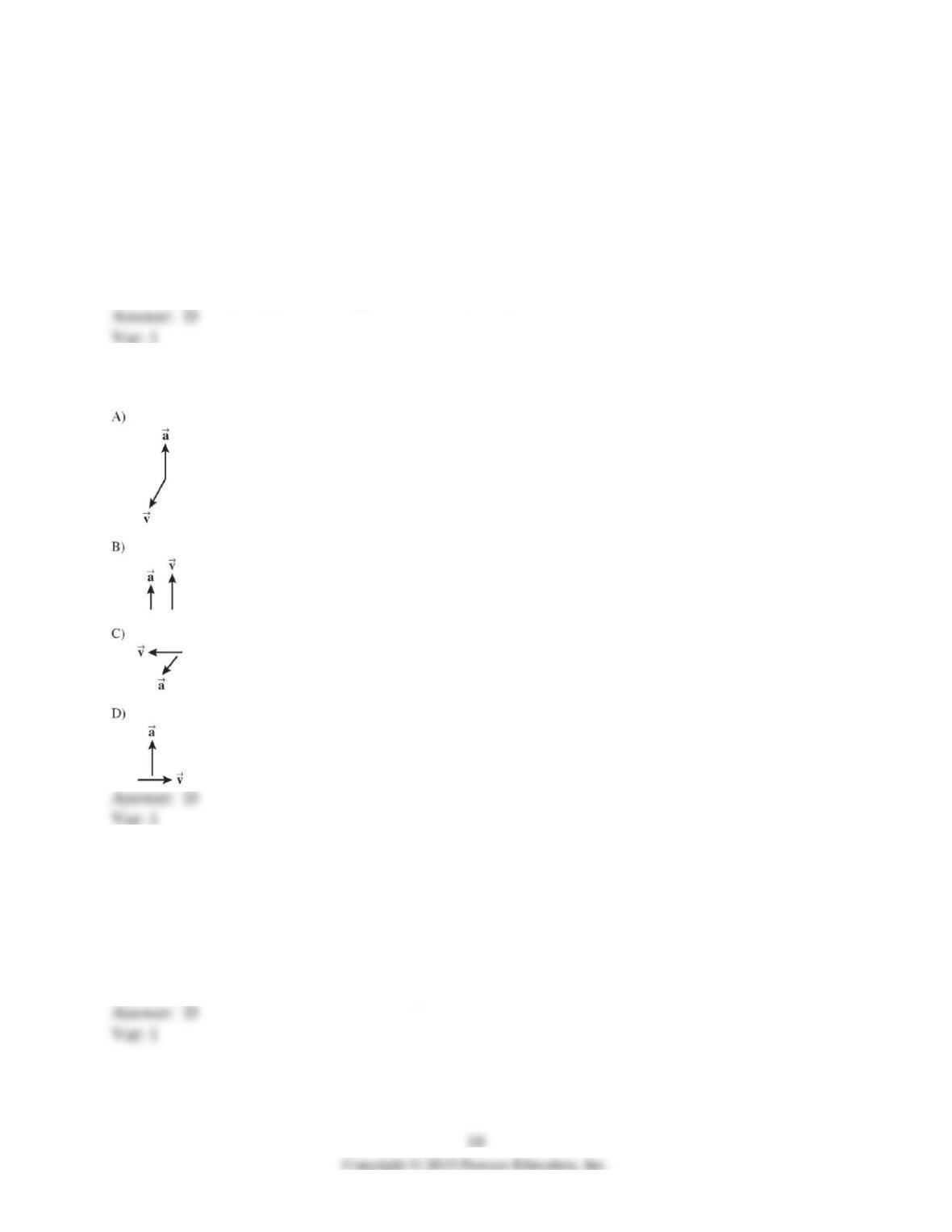
23) Shown below are the velocity and acceleration vectors for an object in several different types
of motion. In which case is the object slowing down and turning to its right?
24) A boulder rolls off of a very high cliff and experiences no significant air resistance. While it
is falling, its trajectory is never truly vertical.
A) True
B) False
25) For general projectile motion with no air resistance, the horizontal component of a
projectile’s velocity
A) remains zero.
B) remains a non-zero constant.
C) continuously increases.
D) continuously decreases.
E) first decreases and then increases.
26) For general projectile motion with no air resistance, the horizontal component of a
projectile’s acceleration
A) is always zero.
B) remains a non-zero constant.
C) continuously increases.
D) continuously decreases.
E) first decreases and then increases.
27) For general projectile motion with no air resistance, the vertical component of a projectile’s
acceleration
A) is always zero.
B) remains a non-zero constant.
C) continuously increases.
D) continuously decreases.
E) first decreases and then increases.
28) Which of the following statements are true about an object in two-dimensional projectile
motion with no air resistance? (There could be more than one correct choice.)
A) The speed of the object is constant but its velocity is not constant.
B) The acceleration of the object is +g when the object is rising and –g when it is falling.
C) The acceleration of the object is zero at its highest point.
D) The speed of the object is zero at its highest point.
E) The horizontal acceleration is always zero and the vertical acceleration is always a non-zero
constant downward.
29) A ball is thrown horizontally from the top of a tower at the same instant that a stone is
dropped vertically. Which object is traveling faster when it hits the level ground below if neither
of them experiences any air resistance?
A) It is impossible to tell because we do not know their masses.
B) the stone
C) the ball
D) Both are traveling at the same speed.
30) In an air-free chamber, a pebble is thrown horizontally, and at the same instant a second
pebble is dropped from the same height. Compare the times of fall of the two pebbles.
A) The thrown pebble hits first.
B) The dropped pebble hits first.
C) They hit at the same time.
D) We cannot tell without knowing which pebble is heavier.
31) A pilot drops a package from a plane flying horizontally at a constant speed. Neglecting air
resistance, when the package hits the ground the horizontal location of the plane will
A) be behind the package.
B) be directly over the package.
C) be in front of the package.
D) depend on the speed of the plane when the package was released.
32) James and John dive from an overhang into the lake below. James simply drops straight
down from the edge. John takes a running start and jumps with an initial horizontal velocity of
25 m/s. If there is no air resistance, when they reach the lake below
A) the splashdown speed of James is larger than that of John.
B) the splashdown speed of John is larger than that of James.
C) they will both have the same splashdown speed.
D) the splashdown speed of James must be 9.8 m/s larger than that of John.
E) the splashdown speed of John must be 25 m/s larger than that of James.
33) James and John dive from an overhang into the lake below. James simply drops straight
down from the edge. John takes a running start and jumps with an initial horizontal velocity of
25 m/s. Compare the time it takes each to reach the lake below if there is no air resistance.
A) James reaches the surface of the lake first.
B) John reaches the surface of the lake first.
C) James and John will reach the surface of the lake at the same time.
D) Cannot be determined without knowing the mass of both James and John.
E) Cannot be determined without knowing the weight of both James and John.
34) A player kicks a soccer ball in a high arc toward the opponent’s goal. At the highest point in
its trajectory
A) both the velocity and the acceleration of the soccer ball are zero.
B) neither the ball’s velocity nor its acceleration are zero.
C) the ball’s acceleration is zero but its velocity is not zero.
D) the ball’s acceleration points upward.
E) the ball’s velocity points downward.
35) Mary and Debra stand on a snow-covered roof. They both throw snowballs with the same
initial speed, but in different directions. Mary throws her snowball downward, at 30° below the
horizontal; Debra throws her snowball upward, at 30° above the horizontal. Which of the
following statements are true about just as the snowballs reach the ground below? (There could
be more than one correct choice.)
A) Debra’s snowball will have a higher speed than Mary’s snowball.
B) Mary’s snowball will have a higher speed than Debra’s snowball.
C) Both snowballs will hit the ground with the same speed.
D) Both snowballs hit the ground at the same time.
E) Mary’s snowball reaches the ground before Debra’s snowball.
36) Mary and Debra stand on a snow-covered roof. They both throw snowballs with the same
initial speed, but in different directions. Mary throws her snowball downward, at 30° below the
horizontal; Debra throws her snowball upward, at 30° above the horizontal. Which of the
following statements are true about just before the snowballs reach the ground below? (There
could be more than one correct choice.)
A) Debra’s snowball will stay in the air longer than Mary’s snowball.
B) Mary’s snowball will stay in the air longer than Debra‘s snowball.
C) Both snowballs will take the same amount of time to hit the ground.
D) Debra’s snowball has exactly the same acceleration as Mary’s snowball.
E) Mary’s snowball has a greater downward acceleration than Debra’s snowball.
37) A rock is thrown from the upper edge of a tall cliff at some angle above the horizontal. It
reaches its highest point and starts falling down. Which of the following statements about the
rock’s motion are true just before it hits the ground? (There could be more than one correct
choice.)
A) Its horizontal velocity component is zero.
B) Its velocity is vertical.
C) Its vertical velocity component is the same as it was just as it was launched.
D) Its horizontal velocity component is the same as it was just as it was launched.
E) Its speed is the same as it was just as it was launched.
38) Shown below are the velocity and acceleration vectors for an object in several different types
of motion. In which case is the object’s velocity changing while its speed is not changing?
39) If a satellite moves with constant speed in a perfectly circular orbit around the earth, what is
the direction of the acceleration of the satellite?
A) in the forward direction
B) in the backward direction
C) outward away from the earth
D) inward toward the earth
E) The acceleration is zero because the speed is constant.
40) An object moves in a circular path at a constant speed. Compare the direction of the object’s
velocity and acceleration vectors.
A) Both vectors point in the same direction.
B) The vectors point in opposite directions.
C) The vectors are perpendicular to each other.
D) The acceleration is zero but the velocity is constant.
41) The Moon is accelerated toward the earth, so it is gradually getting closer to the earth.
A) True
B) False
C) The moon is not accelerated toward the earth.
42) You are trying to cross a river that flows toward the south with a strong current. You start
out in your motorboat on the east bank desiring to reach the west bank directly west from your
starting point. You should head your motorboat
A) directly toward the west.
B) directly toward the north.
C) in a general southwesterly direction.
D) in a general northwesterly direction.
1) A velocity vector has components 36 m/s westward and 22 m/s northward. What are the
magnitude and direction of this vector?
2) The x component of vector is 8.7 units, and its y component is -6.5 units. The magnitude of
is closest to
A) 9.9 units
B) 7.9 units
C) 8.9 units
D) 11 units
E) 12 units
3) When rolled down a mountainside at 7.0 m/s, the horizontal component of its velocity vector
was 1.8 m/s. What was the angle of the mountain surface above the horizontal?
A) 75°
B) 57 °
C) 33°
D) 15°
4) When Jeff ran up a hill at 7.0 m/s, the horizontal component of his velocity vector was 5.1
m/s. What was the vertical component of Jeff’s velocity?
A) 4.8 m/s
B) 4.3 m/s
C) 3.8 m/s
D) 3.4 m/s
5) The x component of vector is 5.3 units, and its y component is -2.3 units. The angle that
vector makes with the +x-axis is closest to
A) 340°
B) 160°
C) 250°
D) 110°
E) 23°
6) A vector in the xy–plane has an x component of -7.50 units. What must be the y component of
this vector so that its magnitude is 10.0 units. (Note: There are two possible answers.)
7) A displacement vector is 34.0 m in length and is directed 60.0° east of north. Selecting from
the choices in the table below, what are the components of this vector?
Northward Eastward
choice component component
1 29.4 m 17.0 m
2 18.2 m 28.1 m
3 22.4 m 11.5 m
4 17.0 m 29.4 m
5 25.2 m 18.2 m
A) choice 1
B) choice 2
C) choice 3
D) choice 4
E) choice 5
8) A player throws a football 50.0 m at 61.0° north of west. What is the westward component of
the displacement of the football?
A) 64.7m
B) 55.0 m
C) 0.00 m
D) 74.0 m
E) 24.2 m
9) A vector has components Ax = 12.0 m and Ay = 5.00 m.
(a) What is the angle that vector makes with the +x-axis?
(b) What is the magnitude of vector ?
10) The x and y components of a vector in a horizontal plane are 4.00 m and 3.00 m,
respectively.
(a) What is the magnitude of this vector?
(b) What angle does this vector make with the positive +y-axis.
11) A boy jumps with a velocity of magnitude 20.0 m/s at an angle of 25.0° above the horizontal.
What is the horizontal component of the boy’s velocity?
A) 18.1 m/s
B) 15.6 m/s
C) 8.45 m/s
D) 12.6 m/s
E) 9.33 m/s
12) The magnitude of is 5.5 m, and this vector lies in the second quadrant and makes an angle
of 34 ° with the +y-axis. The components of are closest to:
A) = -3.1 m, = 4.6 m.
B) = 3.1 m, = -4.6 m.
C) = 4.6 m, = -3.1 m.
D) = -4.6 m, = 3.1 m.
E) = -4.6 m, = -3.1 m.
13) The components of vectors and are given as follows:
= -9.2 = -4.5
= -6.1 = 4.3
The angle (less than 180°) between vectors and is closest to
A) 77°.
B) 103°.
C) 10°.
D) 170°.
E) 84°.
14) A car travels 20 km west and then 20 km south. What is the magnitude of its displacement
vector?
A) 0 km
B) 20 km
C) 28 km
D) 40 km
15) You walk to the north, then turn 60° to your right and walk another How far are
you from where you originally started?
A) 68 m
B) 39 m
C) 75 m
D) 35 m
16) You walk 53 m to the north, then you turn 60° to your right and walk another
Determine the direction of your displacement vector. Express your answer as an angle relative to
east.
A) 63° N of E
B) 50° N of E
C) 57° N of E
D) 69° N of E
17) The components of vectors and are given as follows:
Ax = 7.6 Bx = -5.1
Ay = -9.2 By = -6.8
What is the magnitude of the vector difference – ?
A) 13
B) 3.5
C) 16
D) 170
E) 3.4
18) If vector has components Ax = -3.0 lb and Ay = -4.0 lb, and vector has components Bx =
3.0 lb and By = -8.0 lb, what is the magnitude of vector = – ?
A) 13 lb
B) 16 lb
C) 140 lb
D) 7.2 lb
19) Vector has magnitude 2 units and is directed to the north. Vector has magnitude
and is directed to the south. Calculate the magnitude and direction of
A) 7 units, north
B) 7 units, south
C) 3 units, north
D) 3 units, south
20) Two perpendicular vectors, and , are added together giving vector . If the magnitudes
of both vectors and are doubled without changing their directions, the magnitude of vector
will
A) increase by a factor of 8.
B) increase by a factor of 4.
C) increase by a factor of 2.
D) increase by a factor of .
E) not change.
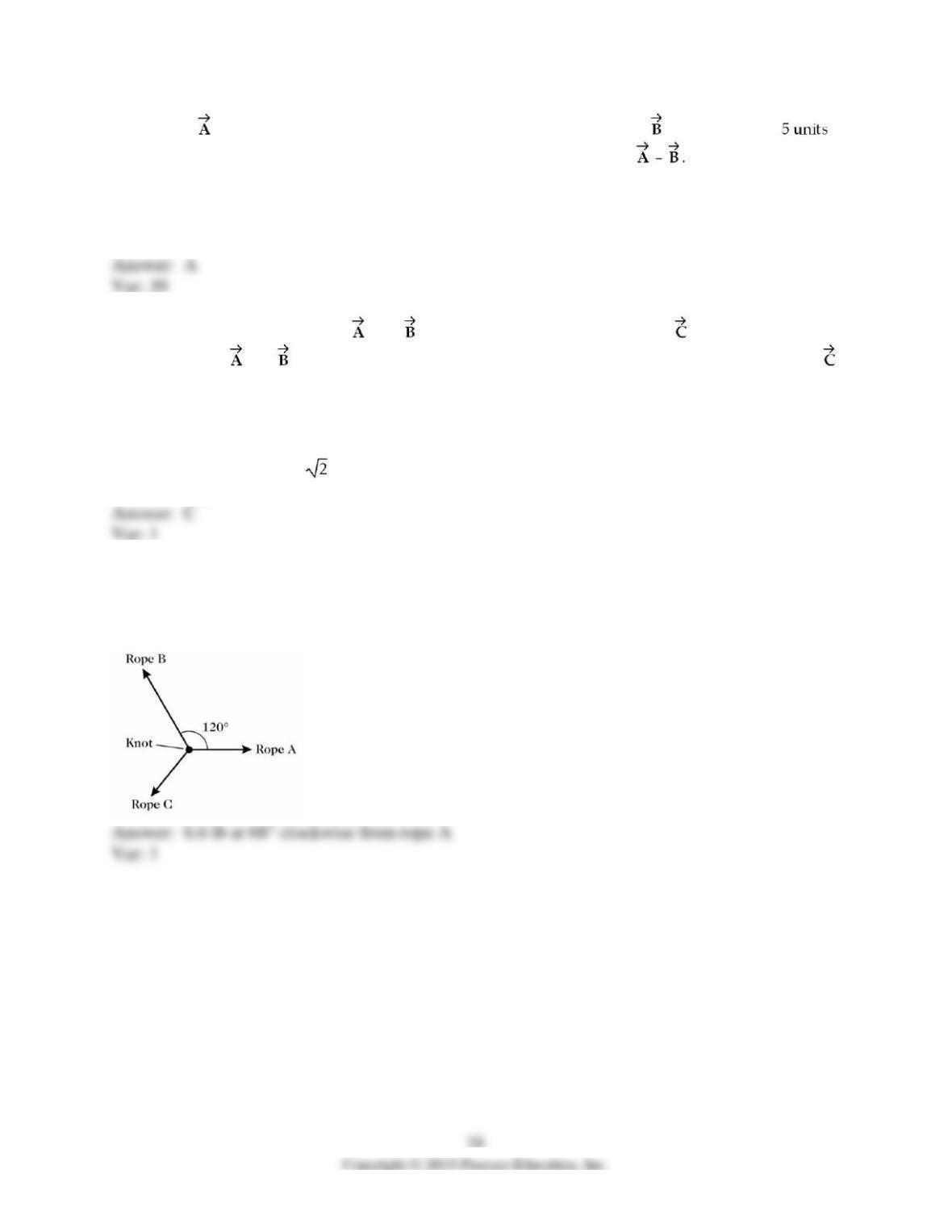
21) Three ropes are tied in a knot as shown in the figure. One student pulls on rope A with 1.0
pound of force, and another student pulls on rope B with 7.0 pounds of force. How hard and in
what direction must you pull on rope C to balance the first two pulls? Give the direction by
specifying the angle (clockwise or counterclockwise) of the pull with the direction of rope A.
17
22) The figure shows two vectors and , along with their magnitudes and directions. The
vector is given by = – .
(a) What is the magnitude of vector ?
(b) What angle does vector make with the +x-axis?
23) Displacement vector is 5.5 cm long and points along the +x-axis. Displacement vector
is 7.5 cm long and points at +30° to the –x-axis.
(a) Determine the x and y components of vector .
(b) Determine the x and y components of vector .
(c) Determine the x and y components of the resultant of these two vectors.
(d) Determine the magnitude and direction of the resultant of these two vectors.
24) Displacement vector is 75 cm long and points at 30° above the +x-axis. Displacement
vector is 25 cm long and points along the –x-axis. Displacement vector is 40 cm long and
points at 45° below the –x-axis.
(a) Determine the x and y components of vector .
(b) Determine the x and y components of vector .
(c) Determine the x and y components of vector .
(d) Determine the x and y components of the resultant of these three vectors.
(e) Determine the magnitude and direction of the resultant of these three vectors.
25) Vector = 4.00 m points eastward and vector = 3.00 m points southward. The resultant
vector + is given by
A) 5.00 m at an angle of 36.9° south of east.
B) 5.00 m at an angle of 53.1° south of east.
C) 5.00 m at an angle of 71.6° south of east.
D) 5.00 m at an angle of 18.4° south of east.
E) 5.00 m at an angle of 26.6° south of east.
26) Vector has a magnitude of 6.0 m and points 30° north of east. Vector has a magnitude
of 4.0 m and points 30° east of north. The resultant vector + is given by
A) 0.70 m at an angle of 42° north of east.
B) 14 m at an angle of 42° north of east.
C) 1.1 m at an angle of 42° north of east.
D) 9.7 m at an angle of 42° north of east.
E) 2.0 m at an angle of 42° north of east.
27) Vector has a magnitude of 6.0 m and points 30° north of east. Vector has a magnitude
of 4.0 m and points 30° west of north. The resultant vector + is given by
A) 9.8 m at an angle of 64° east of north.
B) 9.8 m at an angle of 26° north of east.
C) 7.2 m at an angle of 26° east of north.
D) 3.3 m at an angle of 26° north of east.
E) 3.3 m at an angle of 64° east of north.
28) Vector has a magnitude of 6.0 m and points 30° north of east. Vector has a magnitude
of 4.0 m and points 30° west of south. The resultant vector + is given by
A) 2.7 m at an angle of 8.3° south of east.
B) 2.7 m at an angle of 8.3° east of south.
C) 3.2 m at an angle of 8.3° east of south.
D) 3.2 m at an angle of 8.3° south of east.
E) 2.3 m at an angle of 8.3° south of east.
29) Vector has a magnitude of 6.0 m and points 30° south of east. Vector has a magnitude
of 4.0 m and points 30° west of south. The resultant vector + is given by
A) 7.2 m at an angle of 64° south of east.
B) 3.3 m at an angle of 64° south of east.
C) 9.8 m at an angle of 26° south of east.
D) 9.8 m at an angle of 64° south of east.
E) 3.3 m at an angle of 26° south of east.
30) Vector has a magnitude of 4.0 m and points 30° south of east. Vector has a magnitude
of 2.0 m and points 30° north of west. The resultant vector + is given by
A) 10.0 m at an angle 30° south of east.
B) 10.0 m at an angle 60° east of south.
C) 2.0 m at an angle 60° south of east.
D) 2.0 m at an angle 30° south of east.
E) 1.0 m at an angle 30° east of south.
31) Vector has a magnitude of 7.0 m and points 30° east of north. Vector has a magnitude
of 5.0 m and points 30° west of south. The resultant vector + is given by
A) 10.0 m at an angle 60° north of east.
B) 10.0 m at an angle 30° east of north.
C) 2.0 m at an angle 30° north of east.
D) 2.0 m at an angle 60° north of east.
E) 1.0 m at an angle 60° east of north
32) Vector has a magnitude of 6.0 m and points 30° east of south. Vector has a magnitude
of 4.0 m and points 30° west of north. The resultant vector + is given by
A) 2.0 m at an angle of 30° north of west.
B) 2.0 m at an angle of 30° east of south.
C) 10.0 m at an angle of 60° north of west.
D) 10.0 m at an angle of 60° east of south.
E) 1.0 m at an angle of 60° north of west.
33) Vector has a magnitude of 8.0 m and points east, vector has a magnitude of 6.0 m and
points north, and vector has a magnitude of 5.0 m and points west. The resultant vector +
+ is given by
A) 2.0 m at an angle 63° north of east.
B) 2.0 m at an angle 63° east of north.
C) 6.7 m at an angle 63° east of north.
D) 6.7 m at an angle 63° north of east.
E) 3.8 m at an angle 67° north of east
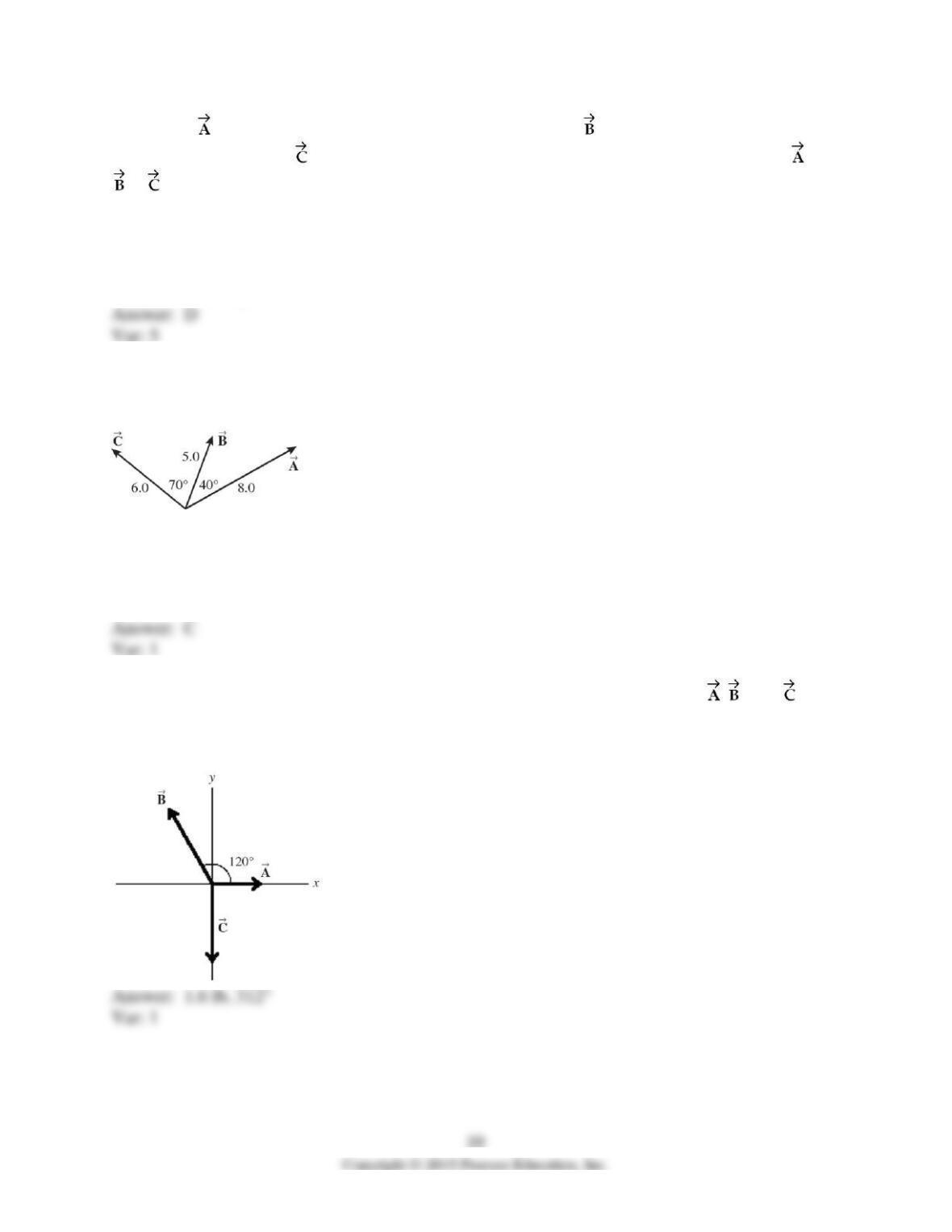
34) The figure shows three vectors and their magnitudes and relative directions. The magnitude
of the resultant of the three vectors is closest to
A) 19
B) 16
C) 13
D) 10
E) 7.0
35) Find the magnitude and direction of the resultant of the three force vectors, , , and ,
shown in the figure. These vectors have the following magnitudes: A = 5.0 lb, B = 7.9 lb, and C
= 8.0 lb. Express the direction of the resultant by specifying the angle it makes with the +x-axis,
with counterclockwise angles taken to be positive.