CHAPTER 3
Classical and Neoclassical Thought
Chapter 3 Multiple Choice
Choose the best answer for each of the following.
1. Which of the following statements would probably not be made by a Classical School
criminologist?
a. I believe that punishment is necessary to deter offenders from recidivating
b. I believe that people have certain basic rights and if the government infringes upon
these rights, it should be dissolved
c. I believe that people’s behavior is determined by pain and pleasure
d. I believe that forces beyond a person’s control can affect his or her involvement in
criminal behavior
2. According to the key principles of Classical Criminology, the purpose of punishment is to
a. treat an offender the way he or she deserves.
b. treat an offender the same way he or she treated the victim.
c. deter an offender from future criminal involvement.
d. rehabilitate an offender.
3. An individual who dresses in an unusual way is most likely to be violating a ________ of his
or her social group.
a. more
b. folkway
c. law
d. contract
4. Which of the following is an example of a mala in se offense?
a. Gambling
b. Premarital sexual behavior
c. Drug use
d. Theft
5. Which of the following was not an early demonic era explanation of personal deviance?
a. Free will
b. Demonic possession
c. Spiritual influences
d. Temptation by fallen angels
6. The Code of Hammurabi emphasized which of the following goals of punishment?
a. Deterrence
b. Retribution
c. Rehabilitation
d. Incapacitation
7. Early Roman Law derived from the
a. Justinian Code.
b. Code of Hammurabi.
c. Code of Babylonia.
d. Twelve Tables.
8. _______ refers to a traditional body of unwritten legal precedents created through everyday
practice and supported by court decisions
a. Natural law
b. Common law
c. Natural rights
d. Social contract
9. The concept of the social contract was developed by
a. Thomas Hobbes.
b. John Locke.
c. Thomas Paine.
d. Jean-Jacques Rousseau.
10. The belief that the natural human condition at birth is that of a blank slate is attributed to
a. Thomas Hobbes.
b. John Locke.
c. Thomas Paine.
d. Jean Jacques Rousseau.
11. The present-day debate over abortion is an example of a current use of
a. natural law
b. common law.
c. natural rights.
d. hedonistic calculus.
12. The Classical School of criminology attributes crime to
a. spiritual shortcomings.
b. the exercise of free will.
c. hard determinism.
d. positivist outlooks.
13. According to Cesare Beccaria, the purpose of punishment should be
a. retribution.
b. rehabilitation.
c. incapacitation.
d. deterrence.
14. Which type of crime would Cesare Beccaria be most likely to recommend be punished
through the use of corporal punishment?
a. Treason
b. Inciting revolution
c. Burglary
d. Assault
15. Jeremy Bentham’s __________ approach emphasizes the determination of behavior based on
the amount of pleasure or pain the behavior can be expected to produce.
a. hedonistic calculus
b. common law
c. hard determinism
d. positivist
16. The Panopticon was designed by
a. William Sumner.
b. Cesare Beccaria.
c. John Locke.
d. Jeremy Bentham.
17. Which of the following explanations of criminal behavior would not be acceptable to a
positivist studying crime?
a. Criminal behavior is due to socialization
b. Criminal behavior is due to individual choice

c. Criminal behavior is due to economic conditions
d. Criminal behavior is due to peer group influences
18. Positivism is based on an acceptance of
a. free will.
b. soft determinism.
c. hard determinism.
d. individual choice.
19. David Fogel’s justice model is based on the idea that
a. crime is a result of social conditions such as poverty.
b. offenders deserve punishment because of the choices they make.
c. rehabilitation is the main purpose of punishment.
d. crime can be prevented by changing the conditions that produce criminality
20. Situational choice theory is an example of
a. hard determinism.
b. free will.
c. soft determinism.
d. traditional classical criminology.
21. Which of the following crime prevention techniques would best meet the objective of
reducing the rewards of crime?
a. Closing residential streets to reduce offender access to homes
b. Starting a neighborhood watch program to increase informal surveillance

c. Engraving identification codes on personal property to facilitate the identification of
stolen property
d. Limiting access to alcohol and drugs
22. Situational crime prevention is primarily concerned with
a. why people commit crime.
b. why crime occurs in specific settings.
c. why some individuals are more likely to be victimized.
d. the disposition of criminals
23. Rational choice theories have been criticized for
a. an overemphasis on individual choice.
b. an underemphasis on individual choice.
c. an overemphasis on the role of social factors in crime causation.
d. a focus on biological bases of criminal behavior.
24. According to neoclassical criminology, the role of punishment is
a. deterrence only.
b. retribution only.
c. both deterrence and retribution
d. neither deterrence nor retribution.
25. ________ focuses on preventing a particular offender from engaging in repeat criminality?
a. General deterrence
b. Recidivism
c. Retribution
d. Specific deterrence
26. Advocates of capital punishment question
a. whether ethnic differences exist in the rate of imposition of the death penalty.
b. whether the death penalty is fairly imposed.
c. whether there is a racial disparity in the ethnicity of murder victims in the U.S.
d. whether the death penalty is too expensive.
27. ___________ mandates a fixed amount of time to be served for each offense category.
a. Truth in sentencing
b. Selective incapacitation
c. Determinate sentencing
d. Dangerousness
28. A law that mandated a harsher sentence for a career criminal than a first time offender, even
though both have committed the same crime, would be an example of
a. truth in sentencing.
b. determinate sentencing.
c. collective incapacitation.
d. selective incapacitation.
29. Classical theories have been criticized for being less a theory of crime causation than a
philosophy of
a. behavior.
b. social values.
c. justice.
d. mores.
30. Classical and neoclassical theories have been criticized for lacking an explanation of
a. dangerousness.
b. recidivism.
c. deviance.
d. criminal motivation
Chapter 3 True-False
Choose whether each statement is true or false.
1. Classical criminology holds that humans are fundamentally rational.
a. True
b. False
2. According to the Classical School of Criminology, the two key determining factors of human
behavior are right and wrong.
a. True
b. False
3. Mala prohibita offenses are those acts that are said to be wrong only because they are
prohibited.
a. True
b. False
4. The concept of natural law influenced the U.S. Constitution.
a. True
b. False
5. The Enlightenment emphasized religion and superstition.
a. True
b. False
6. Punishment imposed for the purpose of retribution would be an example of Cesare Beccaria’s
views on crime and punishment.
a. True
b. False
7. According to Bentham, punishment needs to be cruel and extreme in order to be an effective
deterrent.
a. True
b. False
8. Bentham’s approach to punishment has been described as utilitarianism because of its
emphasis on the worth an action holds for the individual undertaking it.
a. True
b. False
9. Positivist criminology was based on soft determinism.
a. True
b. False
10. Broad social programs are an example of situational crime control.
a. True
b. False
11. Jack Katz argues that crime may be sensually compelling to an offender.
a. True
b. False
12. Rational choice theory recognizes that not everyone is capable of making rational decisions.
a. True
b. False
13. Situational crime prevention works by removing criminal opportunity.
a. True
b. False
14. Modern neoclassical theorists argue that if a person chooses to commit a crime, that person
deserves to be punished.
a. True
b. False
15. High recidivism rates suggest that current methods of punishment are not effective in
deterring crime.
a. True
b. False
16. The death penalty appears to be an effective general deterrent.
a. True
b. False
17. The death penalty is imposed disproportionately on racial minorities
a. True
b. False
18. Advocates of determinate sentencing believe that the fixed amount of punishment necessary
for deterrence can be calculated and specified.
a. True
b. False
19. Wolfgang’s study of chronic recidivists supports the crime control strategy of collective
incapacitation.
a. True
b. False
20. The recent decrease in crime, in the wake of “get tough on crime” policies inspired by
neoclassical principles clearly supports the effectiveness of the neoclassical approach.
a. True
b. False
1. According to Classical School principles, law violators are deterred by ________
2. _________exists to provide individuals with benefits they would not receive in isolation.
3. _________ law forms the basis for much of modern statutory law.
4. The concept of due process of law developed from a provision of the _______.
5. Thomas Paine’s writings on ________ influenced the writers of the U.S. Constitution.
6. The Enlightenment emphasized ________ as the basic determinant of behavior
7. Beccaria’s influence over the framers of the U.S. Constitution was so great that some claim
the ______ might not have existed except for his emphasis on individual rights in the face of
state power.
8. Bentham developed the concept of ______________, the belief that people evaluate the
pleasure and pain that may be produced by a behavior.
9. The statement that offenders deserve punishment because of the choices they make is typical
of the _________ model.
10. In addition to motivation, situational choice theory considers _______ as a key element of
crime.
11. Rational choice theory has been criticized for resulting in the ________ of crime from one
area to another.
12. __________ deterrence involves punishing an offender in the hopes that others will refrain
from crime out of a desire to avoid a similar experience
13. The _______ is expressed as the percentage of convicted offenders who have been released
from prison and who are later rearrested for a new crime
14. Passing laws mandating longer periods of incarceration to reduce the likelihood that an
offender will be capable of committing future offenses is based on the strategy of ________.
15. _________ is the likelihood that a given individual will later harm other individuals or
society.
Chapter 3 Matching
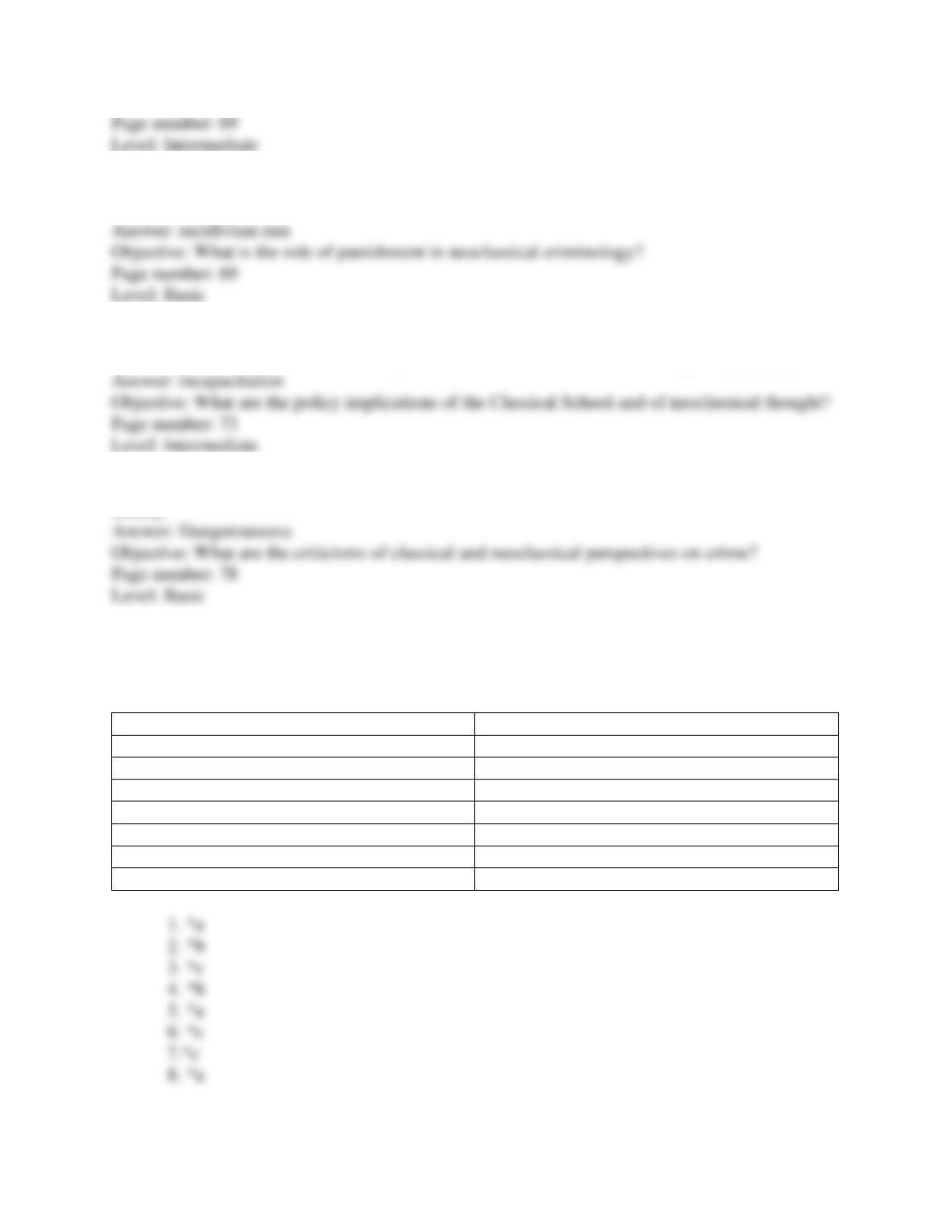
1. Match each major thinker to the field or era to which they contributed.
1. Thomas Paine
a. Age of Enlightenment
2. Cesare Beccaria
b. Classical School of Criminology
3. Robert Martinson
c. Neoclassical school
4. Jeremy Bentham
5. Thomas Hobbes
6. Lawrence Cohen
7. Ronald V. Clarke
8. John Locke

2. Match each theorist to his major theory or work
1. Thomas Hobbes
a. Nothing works doctrine
2. Robert Martinson
b. Situational choice perspective
3. David Fogel
c. Social contract
4. Derek Cornish
d. Thinking About Crime
5. Jack Katz
e. Justice model
6. James Q. Wilson
f. Seductions of Crime
3. Match the concept to its definition
1. Folkways
a. Acts that are wrong in areas where they are
prohibited
2. Mores
b. Proscriptions covering potentially serious
violations of a group’s values
3. Laws
c. Time honored customs
4. Mala in se
d. Acts that are fundamentally wrong
5. Mala prohibita
e. Rules that have been codified into formal
structures
4. Match the Enlightenment philosopher to his key ideas

1. Thomas Hobbes
a. The concept of a separation of powers
between divisions of government
2. John Locke
b. Natural laws are immutable and can be
readily ascertained through reason
3. Jean-Jacques Rousseau
c. People are forced into a social contract with
each other due to fear of death
4. Charles-Louis de Secondat Montisquieu
d. Only democratic institutions can guarantee
natural rights
5. Thomas Paine
e. At birth, humans are a blank slate
5. Match the situational crime control objective to a technique
1. Increase the effort
a. Reduce emotional arousal
2. Increase the risk
b. Identify property
3. Reduce the rewards
c. Strengthen surveillance
4. Reduce provocations
d. Control drugs/alcohol
5. Remove the excuses
e. Close streets
6. Match the policy to its definition.
1. Truth in sentencing
a. A close correspondence between the
sentence imposed upon an offender and the
actual time served
2. Determinate sentencing
b. A strategy of imprisoning specific
individuals to control crime
3. Selective incapacitation
c. The use of imprisonment or other means to
reduce the likelihood that an offender will be
capable of committing future offenses
4. Incapacitation
d. A punishment strategy that mandates a
specified fixed amount of time to be served
for each offense category
5. Collective incapacitation
e. Imprisoning entire groups of individuals
judged to be dangerous as a way of removing
them from society
1. *a
Chapter 3 Essay
Answer the following questions.
1. List the key principles of classical and neoclassical criminology.
2. What were some of the early forms of law? How did these develop during the Age of
Enlightenment?
3. What is the utilitarianism view of punishment conceptualized by Jeremy Bentham?
4. What is neoclassic criminology? What is the role of positivism in neoclassic criminology?
5. What are the main justice policies that have been influenced by classical and neoclassical
thought?
Chapter 3 Critical Thinking
Answer the following questions.
1. Explain Beccaria’s philosophy of punishment and provide modern-day examples.
2. How did neoclassical criminology develop out of the Classical School? What were some of
the major contributions of neoclassical criminology to the field of criminology?