Exam
Name___________________________________
MULTIPLE CHOICE. Choose the one alternative that best completes the statement or answers the question.
Provide an appropriate response.
1)
Suppose q and p are linearly related such that p= 30 when q = 5, and p= 50 when q = 7. Find p
when q= 15.
1)
A)
120
B)
130
C)
140
D)
100
E)
110
2)
A manufacturer sells his product at $23 per unit, selling all he produces. His fixed cost is $18,000
and his variable cost per unit is $18.50. The level of production at which the manufacturer breaks
even is
2)
A)
3000 units.
B)
3500 units.
C)
4000 units.
D)
4500 units.
E)
5000 units.
3)
Which of the following statements are true?
I. Slope is not defined for a vertical line.
II. A line that falls from left to right has a negative slope.
III. A line with slope 1
3 is more nearly horizontal than a line with slope 2
3.
3)
A)
I only
B)
II only
C)
I and II only
D)
I and III only
E)
all of the above
4)
A line has slope 3
2 and passes through the point (4, 2). The point on the line that has its second
coordinate equal to –5 is
4)
A)
–2
3, –5 .
B)
–1
3, –5 .
C)
–15
2, –5 .
D)
–3
2, –5 .
E)
–7
2, –5 .
5)
The slope of the line 4x+ 5y+ 3 = 0 is
5)
A)
4
5.
B)
–4
5.
C)
–4
3.
D)
–4.
E)
4.
6)
The solution of the system
2
3x–1
2y=5
6
2
5x–3
10 y=1
2
is
6)
A)
x= – 1
6, y=7
10
B)
x= 5, y= – 1
C)
x=4
3, y=3
5
D)
the coordinates of any point on the line y =4
3x–5
3
E)
no solution
7)
If you solve the following system, what is the value of y? 3x+ 2y=26
2x+ 3y=29
7)
A)
3
B)
4
C)
5
D)
6
E)
7
8)
Suppose f(0) = 4 and f(3) = 8. Find f(12) if f is a linear function.
8)
A)
20
B)
–3
C)
13
D)
6
E)
24
9)
Solve the following system for x, y, and z. (Answers are given in that order)
x+y+z= 2
x –y+z= – 2
x–y–z= 0
9)
A)
2, 2, –2
B)
2, –2, –2
C)
1, 2, –1
D)
4, 2, –4
E)
–1, 2, 1
10)
An x–value of a solution of the system x – y – 1 =0
y=x+ 5 is
10)
A)
4.
B)
–4.
C)
–1.
D)
11.
E)
1.
11)
The slope of the line passing through the points (–4, 5) and (3, –2) is
11)
A)
–3.
B)
–7.
C)
–1.
D)
1.
E)
3.
12)
The demand function for a manufacturer’s product is p=f(q) = 800 – 2q, where p is the price (in
dollars) per unit when q units are demanded (per week). Find the level of production that
maximizes the manufacturer’s total revenue.
12)
A)
175
B)
150
C)
100
D)
125
E)
200
13)
An equation of the line with slope 8 and y–intercept 5 is
13)
A)
5x– 3y+ 8 = 0.
B)
y= 8x+ 5.
C)
y= 5x+ 8.
D)
16x– 2y+ 5 = 0.
E)
8x+ 2y+ 5 = 0.
14)
Find the x–coordinate of the vertex of a graph of the quadratic function y=f(x) = 4x2– 2x+ 3.
14)
A)
1
4
B)
1
2
C)
–1
4
D)
–1
2
E)
none of the above
4
15)
The supply and demand equations for a product are p=1
10 q+ 20 and p= 200 –1
2q, respectively,
where q represents the number of units and p represents the price per unit in dollars. The
equilibrium price is
15)
A)
$10.
B)
$20.
C)
$30.
D)
$40.
E)
$50.
16)
Suppose f is a linear function with slope –3 and f(2) = 5. Find f(x).
16)
A)
f(x) = – 3x+ 7
B)
f(x) = – 3x+ 5
C)
f(x) = – 3x + 13
D)
f(x) = – 3x+ 11
E)
f(x) = – 3x+ 2
17)
An automobile factory produces two models. The first model requires 1 hour to paint and 1
2 hour
to polish. The second requires 1 hour for each process. During each hour that the assembly line is
operating, there are 100 hours available for painting and 80 hours for polishing. How many of the
first model can be produced each hour if all the hours available are to be used?
17)
A)
70
B)
60
C)
50
D)
40
E)
30
18)
Find the minimum value of g(x) = 3x2– 3x+ 4.
18)
A)
–5
2
B)
4
C)
0
D)
1
2
E)
13
4
5
19)
The slope of the line x= 2 is
19)
A)
3.
B)
–2.
C)
0.
D)
2.
E)
not defined.
20)
The number of solutions of the system x2+y2= 7
x2–y2= 1 is
20)
A)
zero.
B)
one.
C)
two.
D)
three.
E)
four.
Answer:
21)
Suppose that consumers will demand 100 units of a product when the price is $10 per unit, and 120
units when the price is $8 per unit. Assuming that price p and quantity q are linearly related, find
the price at which 90 units are demanded.
21)
A)
$13
B)
$9
C)
$11
D)
$7
E)
$12
Answer:
22)
The slope and y–intercept of the line 6x– 5y+ 4 = 0 are
22)
A)
6
5 and 4, respectively.
B)
5
6 and 5
4, respectively.
C)
6
5 and 4
5, respectively.
D)
–5
6 and 2
3, respectively.
E)
–5 and 4, respectively.
Answer:
6
Answer:
23)
Find the vertex of the graph of the quadratic function y=f(x) = 4 + 12x– 3x2 .
23)
A)
(–2, –32)
B)
(2, 16)
C)
(4, 20)
D)
(2, 4)
E)
(–2, 4)
24)
A general linear equation of the line that has slope –2 and that passes through the point (1, 3) is
24)
A)
2x+y– 5 = 0
B)
2x+y– 7 = 0
C)
3x+y+ 5 = 0
D)
2x+y+ 1 = 0.
E)
2x–y+ 1 = 0.
25)
If you solve the following system 2x– 3y=1
x + 5y=7, what is the value of y?
25)
A)
2
B)
–1
C)
–2
D)
5
E)
1
26)
The y–intercept of the line determined by the points (–1, –4) and (–2, 5) is
26)
A)
–13.
B)
–7.
C)
13.
D)
7.
E)
–15.
27)
Suppose f is a linear function with slope 2 and f(1) = 3. Find f(2).
27)
A)
1
B)
2
C)
3
D)
4
E)
5
28)
Suppose f(1) = – 5and f(–2) = 4. Find f(x) if f is a linear function.
28)
A)
f(x) = – x
3+14
3
B)
f(x) =x
3+2
3
C)
f(x) = – 3x+ 5
D)
f(x) =x
3–16
3
E)
f(x) = – 3x– 2
29)
One solution of the system x –y2= 0
3x+ 2y– 5 = 0 is x= 1 and y= 1. Another solution is
29)
A)
x=9
25 , y= – 3
5
B)
x= 0, y= 0
C)
x=25
9, y= – 5
3
D)
x= 1, y= – 1
E)
x=49
2, y= – 7
2
30)
The slope of the line 4x– 8y+ 3 = 0 is
30)
A)
–1
2.
B)
4.
C)
2.
D)
1
2.
E)
–2.
8
31)
An equation of the straight line passing through (1, –5) and (–2, 4) is
31)
A)
3x+y– 5 = 0.
B)
3x+y+ 2 = 0.
C)
x– 3y+ 2 = 0.
D)
x – 3y– 16 = 0.
E)
x+ 3y– 14 = 0.
32)
Suppose that a manufacturer will place on the market 80 units of a product when the price is $10
per unit, and 100 units when the price is $12 per unit. Find the supply equation for the product
assuming that price p and quantity q are linearly related.
32)
A)
p=1
10 q+ 2
B)
p= 10q+ 12
C)
p= 10q– 988
D)
p= – 1
10 q+ 12
E)
p=1
10 q+ 10
33)
Find the maximum value of f(x) = 7 – 2x–x2.
33)
A)
7
B)
8
C)
9
D)
10
E)
11
34)
A line passes through the points (1, 1) and (9, 8). The point on it that has a y–coordinate of –6 is
34)
A)
(6, –6).
B)
(–7, –6).
C)
(4, –6).
D)
(5, –6).
E)
(–5, –6).
35)
The y–intercept of the line 3x+ 5y+ 4 = 0 is
35)
A)
4
5.
B)
4.
C)
–4
3.
D)
–4.
E)
–4
5.
SHORT ANSWER. Write the word or phrase that best completes each statement or answers the question.
36)
State whether f(x) = 12x2– 24x+ 10 has maximum or minimum value and find that value.
36)
Answer:
Explanation:
37)
In testing an experimental diet for sheep, it was determined that the (average) live weight
w (in kilograms) of a sheep was statistically a linear function of the number of days d after
the diet was started, where 0 d 150. The weight of a sheep starting the diet was 15 kg
and 40 days later it was 43 kg. Determine w as a linear function of d and find the average
weight of a sheep when d=100.
37)
Answer:
Explanation:
38)
Find the slope of the linear function f(t) =3 – 4t
5.
38)
Answer:
Explanation:
39)
Find the vertex and axis of symmetry of the parabola y= – x2+ 6x+ 3. Also find if it opens
upward or downward.
39)
Answer:
(3, 12); x= 3; downward
Explanation:
40)
For the line y= 7x– 3, find (a) the slope and (b) the y–intercept.
40)
Answer:
Explanation:
41)
Find the Break Even Point for a product whose Total Revenue, yTR, (in $) and Total Cost,
yTC, (in $) are as follows:
yTR = (10q– 25)q
yTC = 2000 + 75q
41)
Answer:
Explanation:
Answer:
Explanation:
42)
A business woman has $300,000 of profits from her office supply company invested in two
investments. One has a yearly return of 6% and the other has a yearly return of 7%. If the
total yearly income from the investments is $19,300, how much is invested at each rate?
42)
43)
A botanist collected data from an experiment on the amount of oxygen released by a plant
given different amounts of an experimental fertilizer. He graphs the data with grams of
fertilizer given in a day on the x–axis and milliliters of oxygen produced in a day on the
y–axis. His data points are: (1, 0.02), (3, 0.02), (5, 0.02),
(7, 0.02). Find an equation for the line which fits this data and interpret its meaning.
43)
44)
In a test of a diet for pigs, the average live weight w (in kilograms) of a pig was a linear
function of the number d of days after the start of the diet, where 0 d
50. The weight of a
pig at the beginning of a diet was 25 kg and thereafter the pig gained 5 kg every nine days.
(a) Express w as a function of d. (b) Find the weight of a pig 36 days after the beginning of
the diet.
44)
45)
Find the x–intercept made by the line that passes through the points (1, –1) and (–1, 0).
45)
46)
A baby weighs 9 pounds at birth and 30 pounds at age 3. Use a graphing calculator to
graph the resulting equation and determine how much the child will weight at age 12.
46)
47)
A chemist has two solutions that contain different concentrations of hydrochloric acid. One
is a 20% concentration and the other is a 12% concentration. How many cubic centimeters
of each should he mix to obtain 100 cc with a concentration of 15.2%?
47)
48)
Consider the restricted quadratic function f (x) =x2 + 4x + 6 on x–2. Determine the
restricted function f–1(x) graphically. Graph both f(x) and f–1(x) on the same xy–plane.
48)
49)
Find the slope–intercept form of the line that passes through (0,4) and (1,1).
49)
Answer:
Explanation:
50)
Find the slope of the line 4x– 8y+ 5 = 0.
50)
Answer:
Explanation:
51)
Solve the following system algebraically:
x–z=14
y+z=21
x –y+z= – 10
51)
Answer:
Explanation:
52)
Find the slope of the line 3x+ 9y– 7 = 0.
52)
Answer:
–1
3
Explanation:
53)
A manufacturer produces two products, A and B. For each unit of A sold the profit is $8.
For each unit of B sold the profit is $11. From past experience it has been found that 25
percent more of A can be sold than of B. Next year the manufacturer desires a total profit
of $42,000. How many units of each product must be sold?
53)
Answer:
Explanation:
54)
An investor has $12,000 to purchase stock in two companies. If the first stock sells for $45
per share, and the second stock sells for $62 per share, find an equation that shows the
possible ways to purchase the stock.
54)
Answer:
Answer:
Explanation:
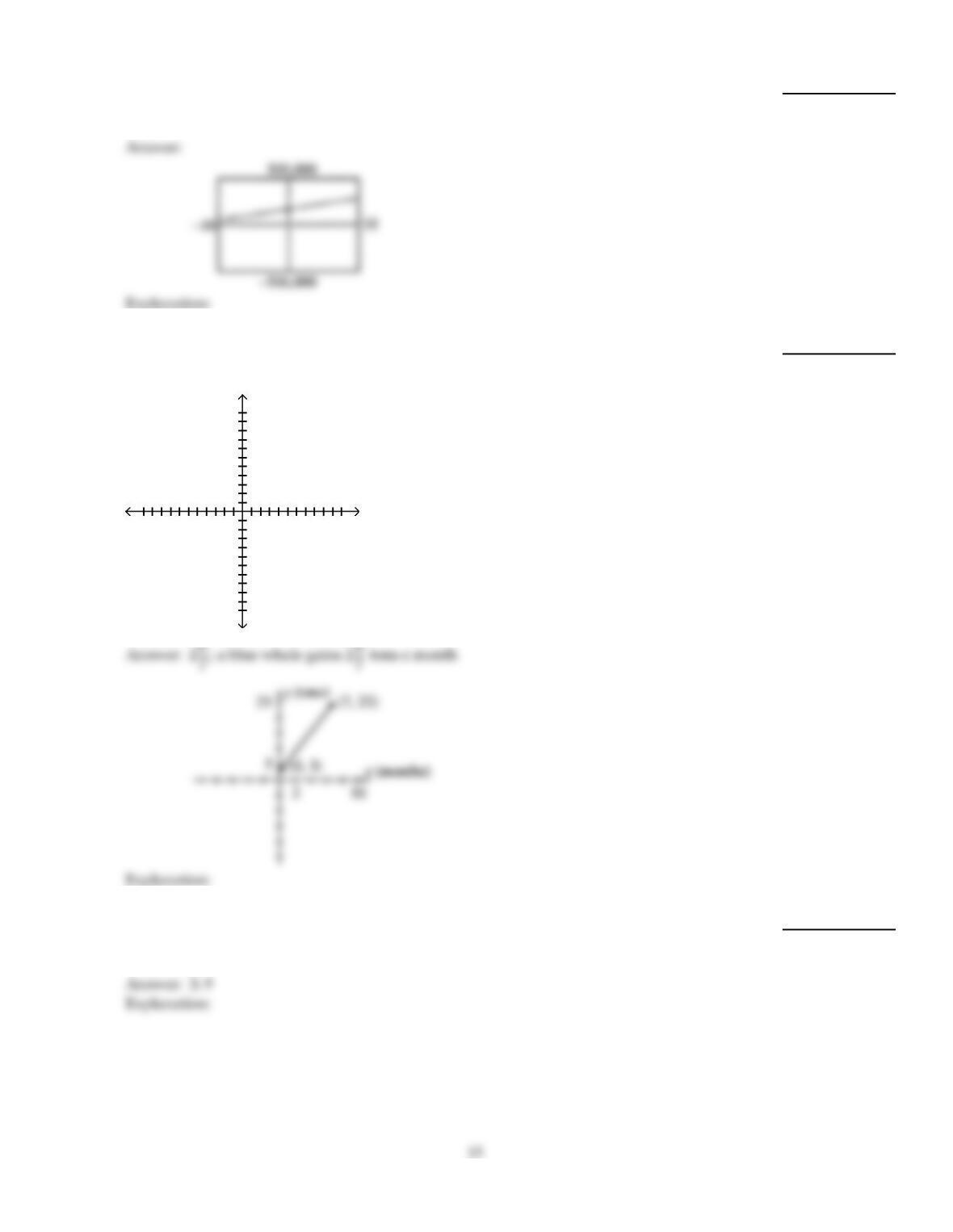
55)
A function describing the value of a house purchased for $180,000 after x years of
appreciation is estimated to be f(x) = 12,000x+ 180,000. Graph the function on your
graphing calculator.
55)
56)
The average weight of newborn blue whales is 3 tons. By the time they are 7 months old
the average weight of these whales is 23 tons. Draw a line showing the relationship
between weight (in tons) and age (in months) of blue whales. Find and interpret the slope.
56)
57)
The demand function for a manufacturer’s product is p=f(q) = 6 –q where p is price per
unit when q units are demanded by consumers. Find the level of production that will
maximize the manufacturer’s total revenue and determine this revenue.
57)
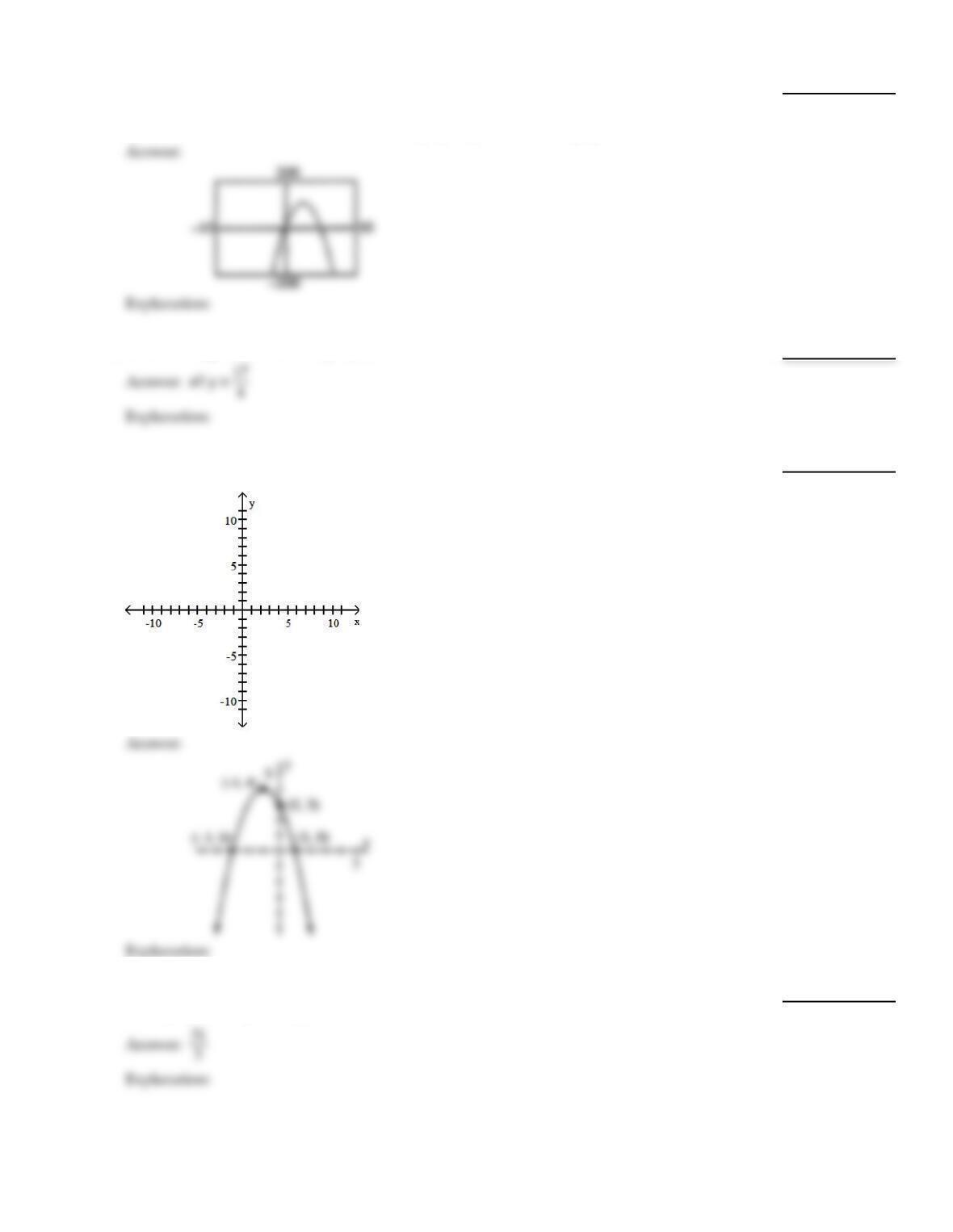
58)
A toy rocket is launched straight up from the roof of a garage with an initial velocity of 80
feet per second. The height h of the rocket in feet t seconds after it was thrown is described
by the function h(t) = – 16t2+ 80t+ 16. Use a graphing calculator to graph the function.
58)
59)
Find the range of the function y=f(x) = – x2+ 3x+ 2.
59)
60)
Graph the function y=f(x) = 3 – 2x–x2 and indicate the coordinates of the vertex and
intercepts.
60)
61)
Suppose the variables q and p are linearly related such that p= 3 when q= 20, and p= 5
when q= 15. Find p when q= 12.
61)
14
62)
Show that the points A(0, 0), B(0, 3), C(8, 5), and D(12, 3) are the vertices of a trapezoid. (A
trapezoid is a four–sided figure with exactly two sides parallel.)
62)
63)
Graph the function y=f(x) =x2– 6x+ 5 and indicate the coordinates of the vertex and
intercepts.
63)
64)
Two types of chickens, A and B, are raised in a chicken coop. Each day they receive 1.4
kilograms of corn and 2.8 kilograms of millet. Each chicken of type A requires 100 grams
of corn and 200 grams of millet. Each chicken of type B requires 60 grams of corn and 120
grams of millet. How many of each type of chicken will the corn and millet support so that
all of the food is consumed each day?
64)
65)
Solve the following system of equations algebraically. (If the system does not have a
solution, then say so or if it has more than one unique solution, then please describe the
solutions.)
x+y+z= 2
x+ 2y+ 3z = 4
x+ 3y+ 5z= 6
65)
66)
Solve the following system algebraically:
2x+y+z = 0
4x+ 3y+ 2z= 2
2x –y– 3z= 0
66)
67)
For the linear function f(x) = – 5x+ 5, find: (a) the slope and (b) the vertical axis intercept.
(c) Sketch the graph of f.
67)
68)
A young family with two children has $40,000 saved for college costs, with part invested at
12% and part invested at 8%. If the total yearly income from the investments is $3400, how
much is invested at each rate?
68)
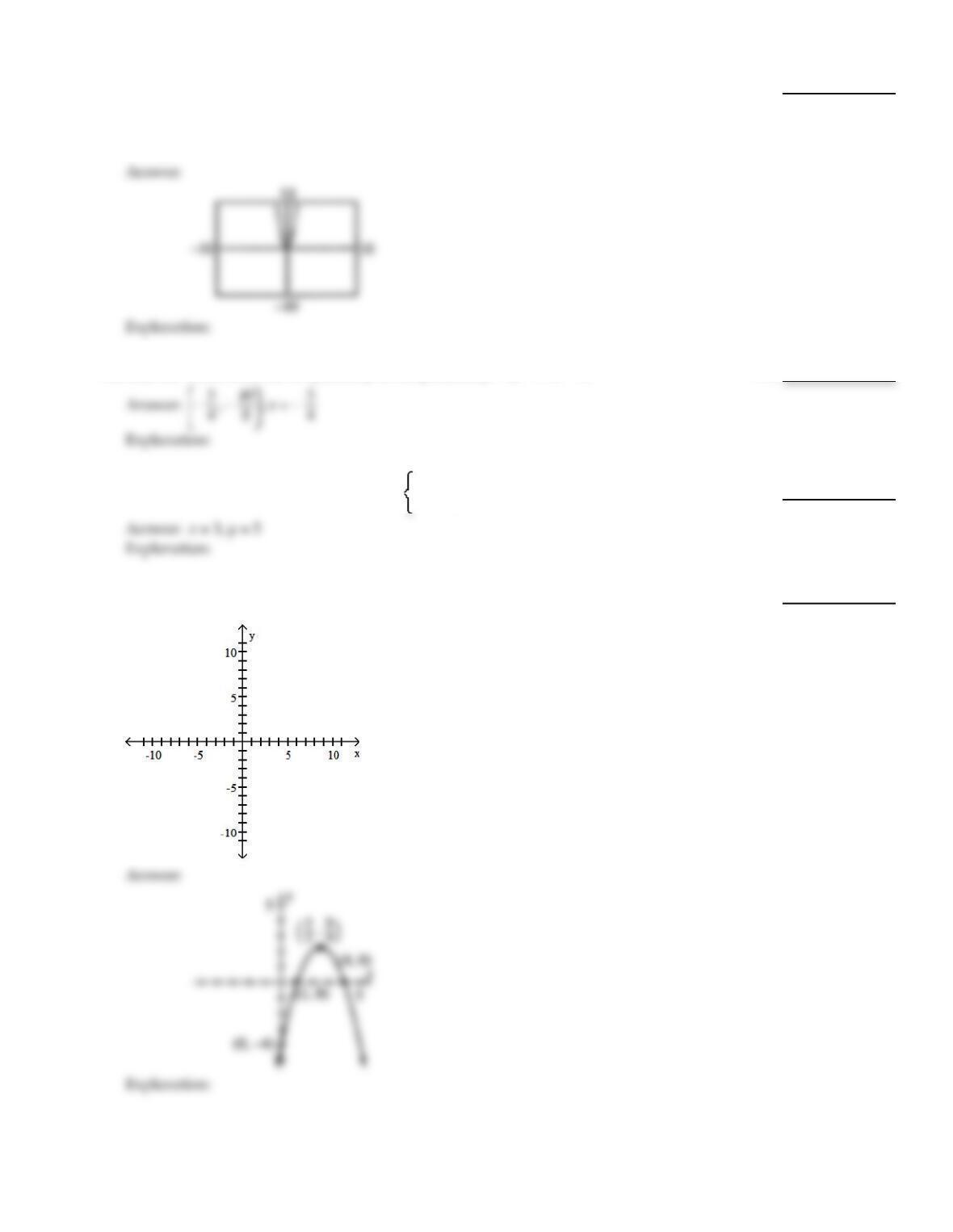
69)
A prediction made by early psychology relating the magnitude of a stimulus x to the
magnitude of a response y is expressed by the equation y=kx2, where k is a constant of the
experiment. In an experiment on odor intensity, k= 5. Use a graphing calculator to graph
the equation.
69)
70)
Find the vertex and axis of symmetry of the parabola y= 2x2+ 3x– 5.
70)
71)
Solve the following system algebraically: 2x–y= 1
–x+ 2y= 7
71)
72)
Graph the function y=f(x) =–x2+ 5 – 4 and indicate the coordinates of the vertex and
intercepts.
72)
17
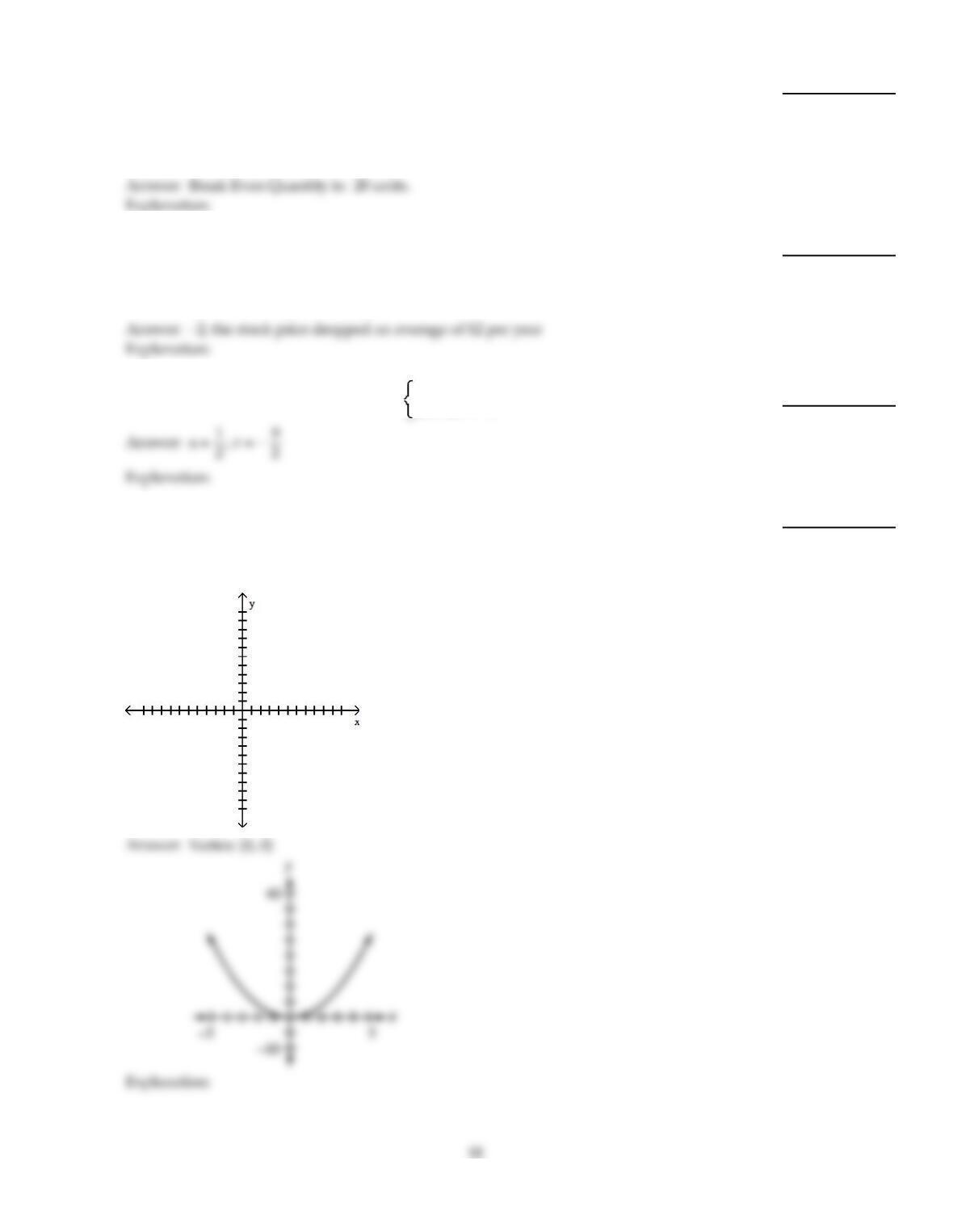
73)
Find the Break Even Quantity for a product whose Total Revenue, yTR, (in $) and Total
Cost, yTC, (in $) are as follows:
yTR = (10q– 25)q
yTC = 2000 + 75q
73)
74)
In 1986 the stock in a biotechnology company traded for $30 per share. In 1996 the
company started having trouble, and the stock price dropped to $10 per share. Use a
graphing calculator to show the relationship between price per share and the year in which
it traded. Find and interpret the slope.
74)
75)
Solve the following system algebraically: 5u+v= – 2
20u+2v= 1
75)
76)
A prediction made by early psychology relating the magnitude of a stimulus x to the
magnitude of a response y is expressed by the equation y=kx2, where k is a constant of the
experiment. In an experiment on brightness of light, k= 1. Find the function’s vertex and
graph the equation.
76)
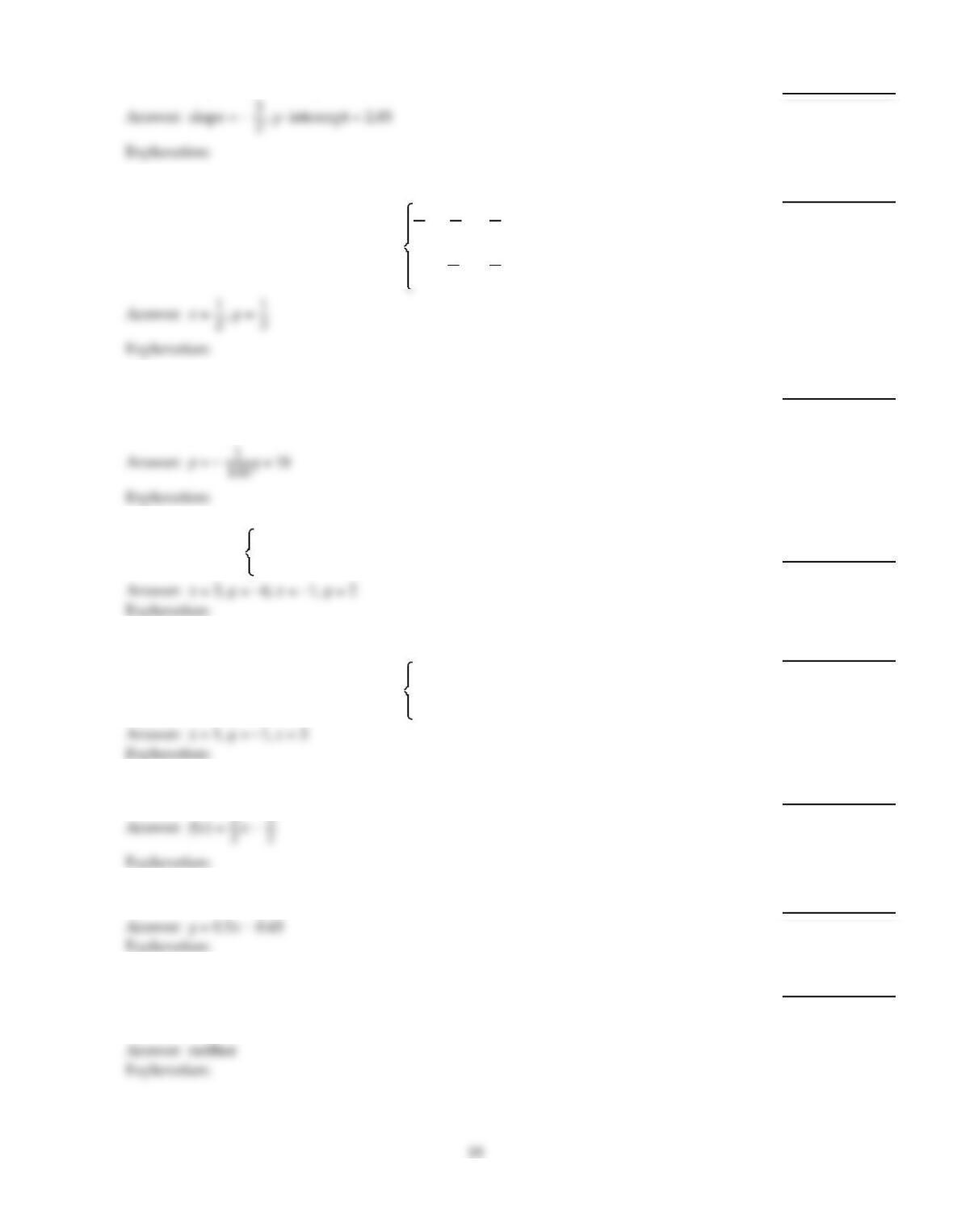
77)
Find the slope and y–intercept of a line 2y+ 3(x– 1.9) = 0.
77)
78)
Solve the following system algebraically:
1
2x–1
4y=1
6
x +1
2y=2
3
78)
79)
Suppose that consumers will demand 800 units of a product when the price is $10 per unit,
and 1000 units when the price is $8 per unit. Find the demand equation for the product
assuming that price p and quantity q are linearly related.
79)
80)
Solve the system: x2+ y – 3 = 0
2x + y = 0
80)
81)
Solve the following system algebraically:
2x–y+ 3z=12
x+y–z= – 3
x + 2y– 3z= – 10
81)
82)
Determine a linear function f(x), given f(2) = 0.5; f(1) = – 1.
82)
83)
Find the equation of a line having slope 0.5 and x–intercept = 1.3.
83)
84)
Determine whether the following lines are parallel, perpendicular or neither.
3x– 4y= 3
12x+ 6y= 12
84)
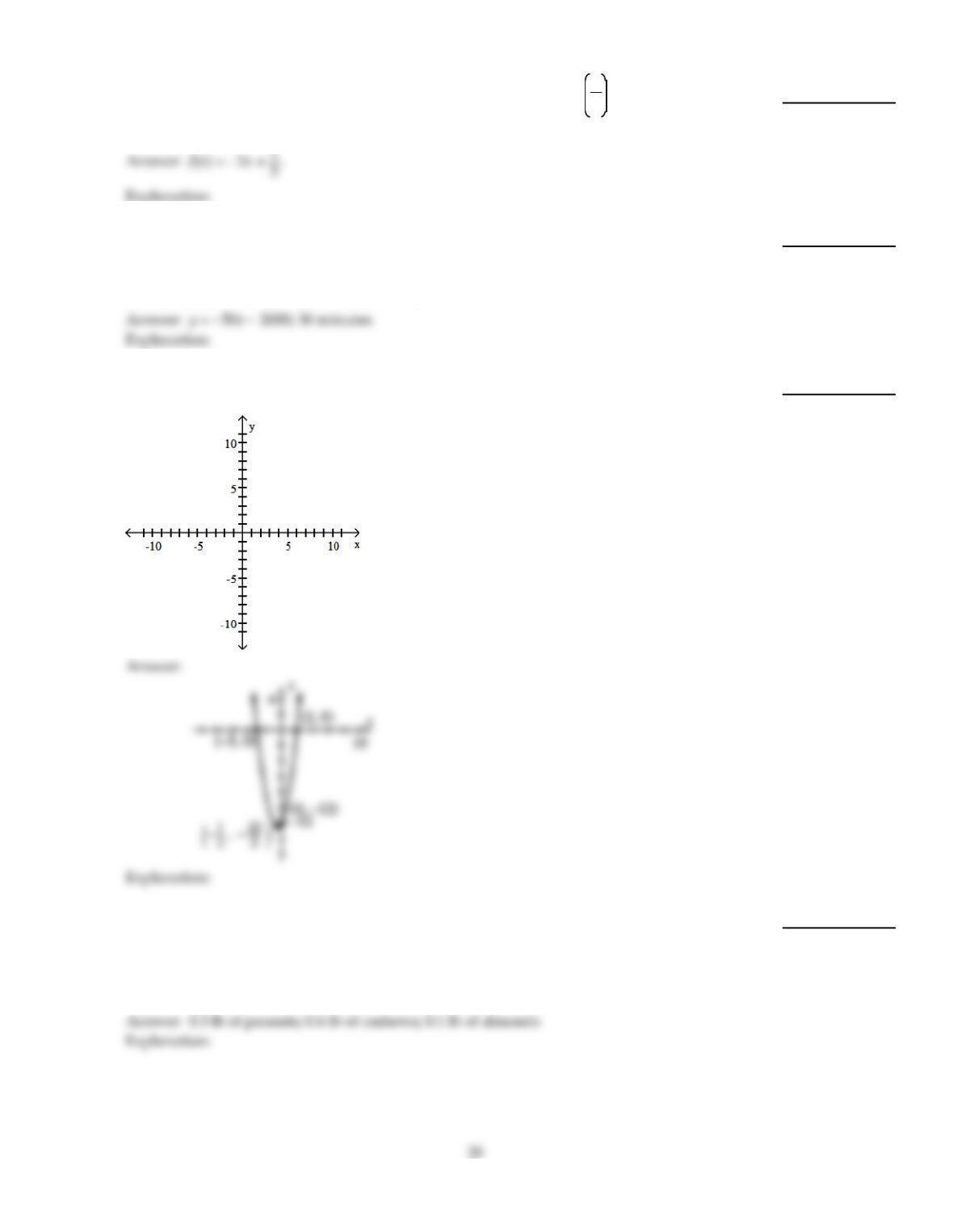
85)
Suppose that f(x) is a linear function with slope = – 3 and y–intercept 1
5, then find the
function f(x).
85)
86)
A deep sea diver has spent a week in a submerged research facility at 2000 feet below sea
level. He is now ready to move to a deeper facility at 3500 feet below sea level. He
descends at the rate of 50 feet per minute. Write an equation that shows this relationship,
and determine when the diver will reach 3500 feet below sea level.
86)
87)
Graph the function y=f(x) = 2x2+ 2x– 12 and indicate the coordinates of the vertex and
intercepts.
87)
88)
A nut shop packages mixtures of different nuts for sale. From peanuts, cashews and
almonds, the owner wants to prepare a mixture which will sell for $4.45 for a 1 pound bag.
The cost per pound of these nuts is $1.50, $6.00, and $4.00, respectively. The amount of
peanuts is to be three times the amount of almonds. How much of each type of nut will be
in the final blend?
88)