Chapter 03 – Job-Order Costing
3-1
Chapter 03 Job-Order Costing Answer Key
True / False Questions
1. The use of predetermined overhead rates in a job-order cost system makes it possible to
estimate the total cost of a given job as soon as production is completed.
2. A job cost sheet is used to accumulate costs charged to a job.
3. The following journal entry would be made to apply overhead cost to jobs in a job-order
costing system:
Chapter 03 – Job-Order Costing
3-2
4. Under a job-order cost system the Work in Process account is debited with the cost of
materials purchased.
5. The process of assigning overhead cost to jobs is known as overhead application.
6. The cost of a completed job in a job-order costing system typically consists of the actual
direct materials cost of the job, the actual direct labor cost of the job, and the actual
manufacturing overhead cost of the job.
Chapter 03 – Job-Order Costing
3-3
7. A debit balance in the Manufacturing Overhead account at the end of the year means that
manufacturing overhead is overapplied.
8. Period costs are expensed as incurred, rather than going into the Work in Process account.
9. Advertising costs should be charged to the Manufacturing Overhead account.
10. When a job has been completed, the goods are transferred from the production department
to the finished goods warehouse and the journal entry would include a credit to Work in
Process.
Chapter 03 – Job-Order Costing
3-4
11. Underapplied or overapplied manufacturing overhead represents the difference between
actual overhead costs and applied overhead costs.
12. Top management salaries should not go into the Manufacturing Overhead account.
13. If manufacturing overhead applied exceeds the actual manufacturing overhead costs of the
period, then manufacturing overhead is overapplied.
Multiple Choice Questions
Chapter 03 – Job-Order Costing
3-5
14. In computing its predetermined overhead rate, Marple Company inadvertently left its
indirect labor costs out of the computation. This oversight will cause:
15. Which of the following is the correct formula to compute the predetermined overhead
rate?
Chapter 03 – Job-Order Costing
3-6
16. Which of the following would probably be the least appropriate allocation base for
allocating overhead in a highly automated manufacturer of specialty valves?
17. What document is used to determine the actual amount of direct labor to record on a job
cost sheet?
Chapter 03 – Job-Order Costing
3-7
18. A proper journal entry to close overapplied manufacturing overhead to Cost of Goods
Sold would be:
19. In a job-order costing system, direct labor cost is ordinarily debited to:
Chapter 03 – Job-Order Costing
3-8
20. In a job-order costing system, the use of direct materials that have been previously
purchased is recorded as a debit to:
21. The journal entry to record the incurrence of indirect labor costs is:
Chapter 03 – Job-Order Costing
3-9
22. Which of the following accounts is debited when direct labor is recorded?
23. The balance in the Work in Process account equals:
24. In a job-order costing system, indirect materials that have been previously purchased and
that are used in production are recorded as a debit to:
Chapter 03 – Job-Order Costing
3-10
25. Martinez Aerospace Company uses a job-order costing system. The direct materials for
Job #045391 were purchased in July and put into production in August. The job was not
completed by the end of August. At the end of August, in what account would the direct
material cost assigned to Job #045391 be located?
26. Which terms will make the following statement true? When manufacturing overhead is
overapplied, the Manufacturing Overhead account has a __________ balance and applied
manufacturing overhead is greater than __________ manufacturing overhead.
Chapter 03 – Job-Order Costing
3-11
27. Which of the following is correct with respect to closing out overapplied manufacturing
overhead to Cost of Goods Sold versus closing it out to Cost of Goods Sold and Finished
Goods and Work in Process inventories?
28. Overapplied manufacturing overhead occurs when:
Chapter 03 – Job-Order Costing
3-12
29. Daguio Corporation uses direct labor-hours in its predetermined overhead rate. At the
beginning of the year, the total estimated manufacturing overhead was $224,580. At the end
of the year, actual direct labor-hours for the year were 18,200 hours, manufacturing overhead
for the year was underapplied by $12,100, and the actual manufacturing overhead was
$219,580. The predetermined overhead rate for the year must have been closest to:
Chapter 03 – Job-Order Costing
3-13
30. Wert Corporation uses a predetermined overhead rate based on direct labor cost to apply
manufacturing overhead to jobs. Last year, the company’s estimated manufacturing overhead
was $1,200,000 and its estimated level of activity was 50,000 direct labor-hours. The
company’s direct labor wage rate is $12 per hour. Actual manufacturing overhead amounted
to $1,240,000, with actual direct labor cost of $650,000. For the year, manufacturing overhead
was:
Chapter 03 – Job-Order Costing
3-14
31. Crinks Corporation uses direct labor-hours in its predetermined overhead rate. At the
beginning of the year, the estimated direct labor-hours were 11,200 hours and the total
estimated manufacturing overhead was $259,840. At the end of the year, actual direct labor-
hours for the year were 10,800 hours and the actual manufacturing overhead for the year was
$254,840. Overhead at the end of the year was:
Chapter 03 – Job-Order Costing
3-15
32. At the beginning of the year, manufacturing overhead for the year was estimated to be
$267,500. At the end of the year, actual direct labor-hours for the year were 22,100 hours, the
actual manufacturing overhead for the year was $262,500, and manufacturing overhead for
the year was overapplied by $13,750. If the predetermined overhead rate is based on direct
labor-hours, then the estimated direct labor-hours at the beginning of the year used in the
predetermined overhead rate must have been:
Chapter 03 – Job-Order Costing
3-16
33. Brace Corporation uses direct labor-hours in its predetermined overhead rate. At the
beginning of the year, the estimated direct labor-hours were 21,600 hours. At the end of the
year, actual direct labor-hours for the year were 20,400 hours, the actual manufacturing
overhead for the year was $506,920, and manufacturing overhead for the year was
underapplied by $23,440. The estimated manufacturing overhead at the beginning of the year
used in the predetermined overhead rate must have been:
Chapter 03 – Job-Order Costing
3-17
34. Yista Corporation uses a predetermined overhead rate based on direct labor-hours to apply
manufacturing overhead to jobs. The company estimated manufacturing overhead at $510,000
for the year and direct labor-hours at 100,000 hours. Actual manufacturing overhead costs
incurred during the year totaled $540,000. Actual direct labor-hours were 105,000. What was
the overapplied or underapplied overhead for the year?
Chapter 03 – Job-Order Costing
3-18
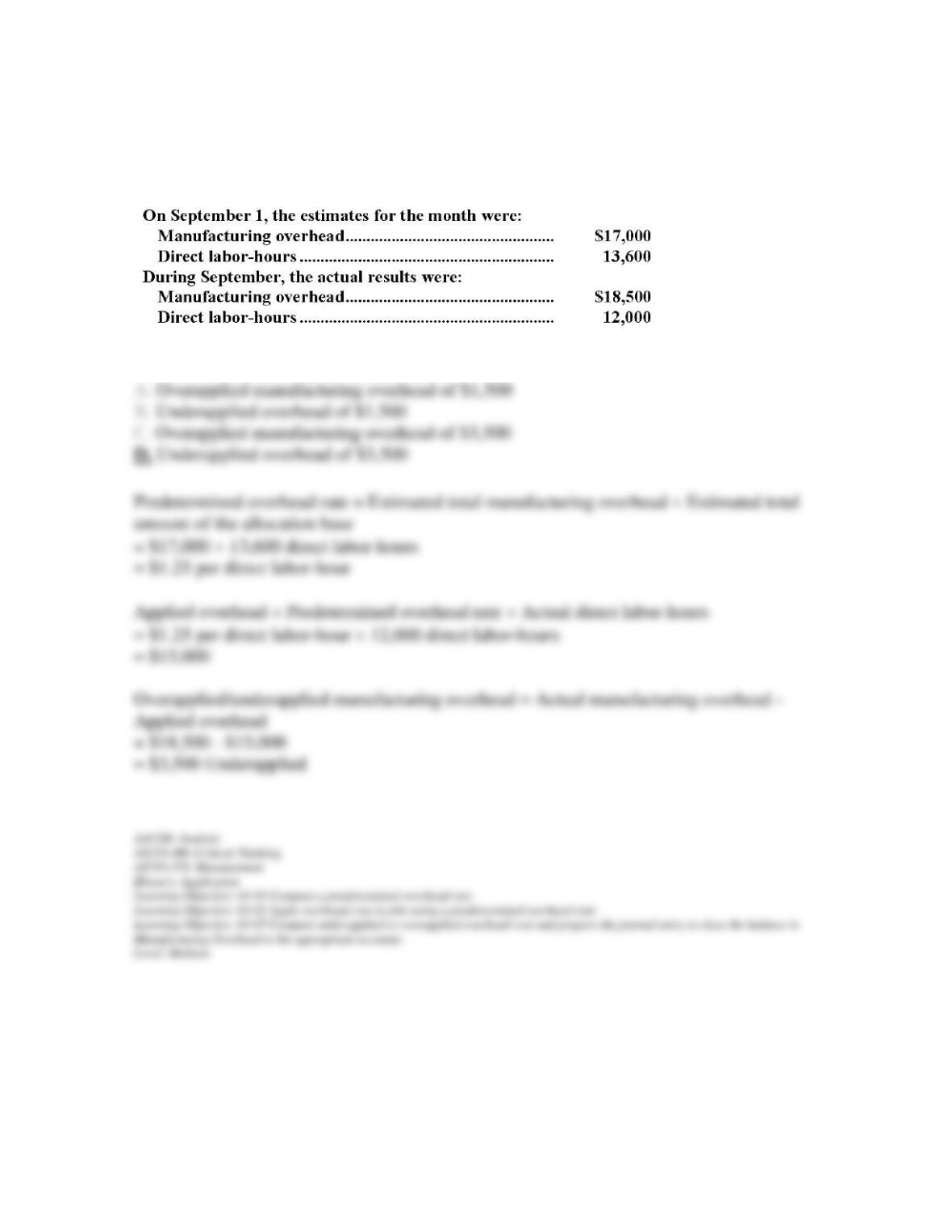
35. Malcolm Company uses a predetermined overhead rate based on direct labor-hours to
apply manufacturing overhead to jobs.
The cost records for September will show:
Chapter 03 – Job-Order Costing
3-19
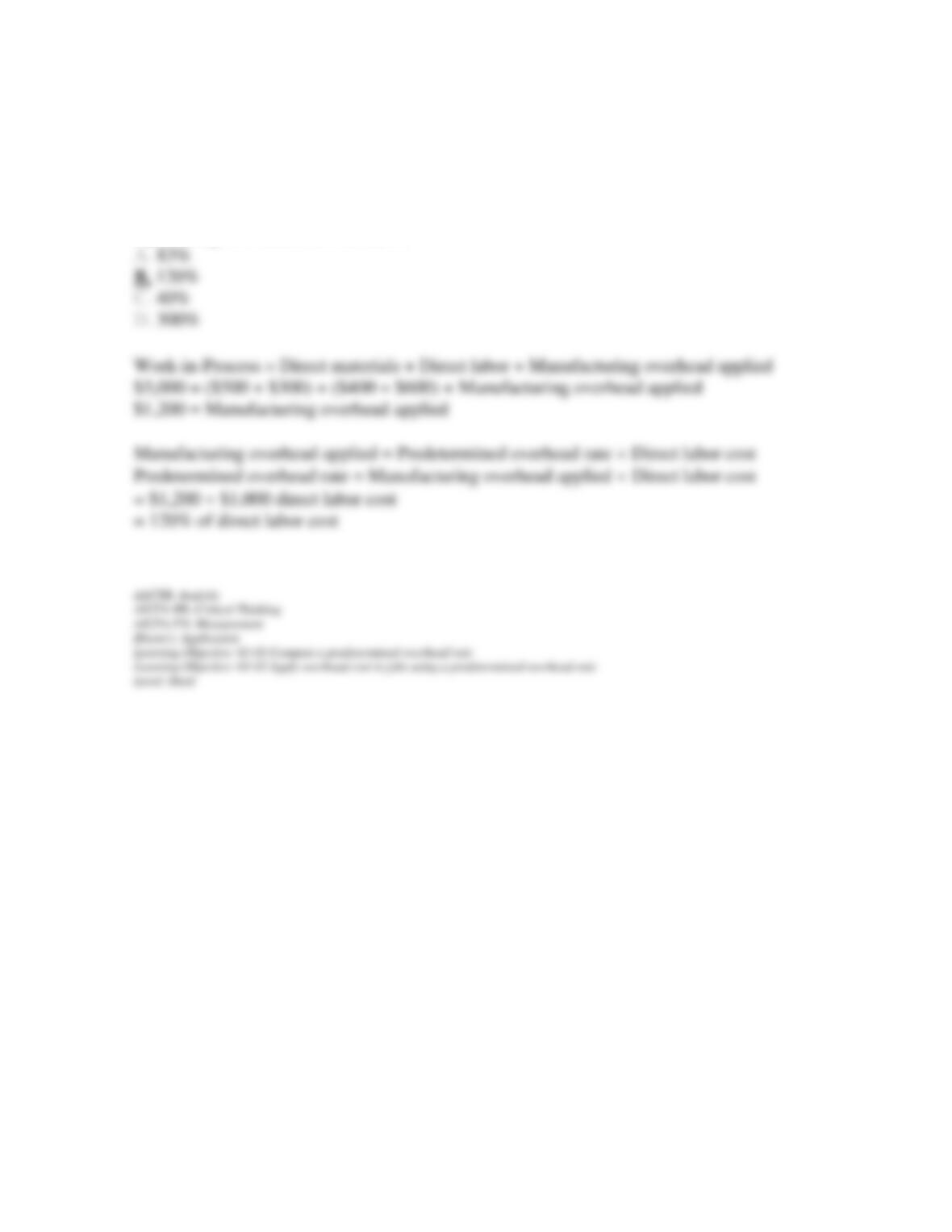
36. The Work in Process inventory account of a manufacturing firm shows a balance of
$3,000 at the end of an accounting period. The job cost sheets of two uncompleted jobs show
charges of $500 and $300 for direct materials, and charges of $400 and $600 for direct labor.
From this information, it appears that the company is using a predetermined overhead rate, as
a percentage of direct labor costs, of:
Chapter 03 – Job-Order Costing
3-20
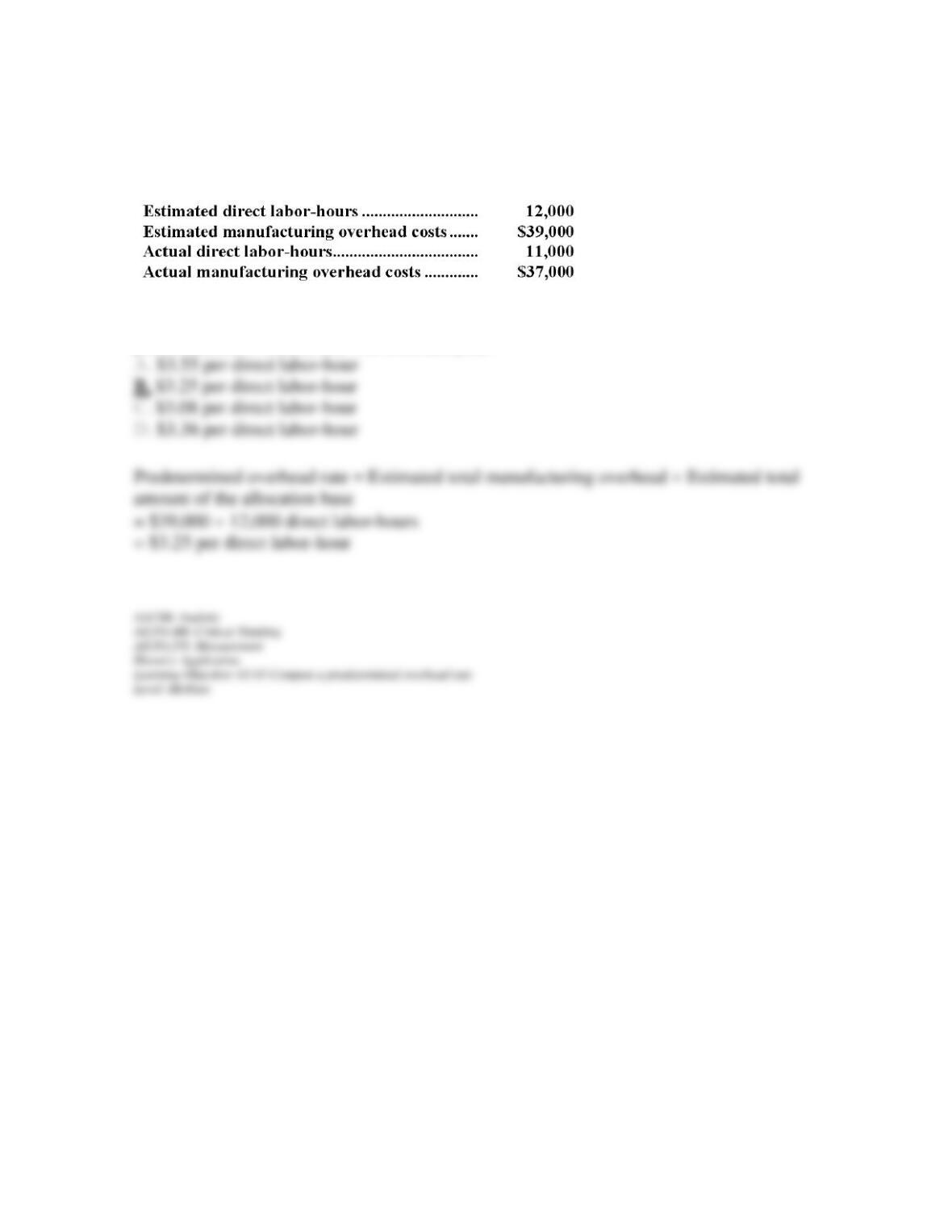
37. Washtenaw Corporation uses a job-order costing system. The following data are for last
year:
Washtenaw applies overhead using a predetermined rate based on direct labor-hours. What
predetermined overhead rate was used last year?