1
General Chemistry: Atoms First, 2e (McMurry and Fay)
Chapter 3 Atoms and Ionic Bonds
3.1 Multiple Choice Questions
1) Which of the species below has 28 protons and 26 electrons?
A) Fe2+
B) Ni2+
C) Fe
D) Ni
2) How many electrons are in the ion, Zn2+?
A) 28
B) 30
C) 32
D) 65
3) How many electrons are in the ion, P3-?
A) 12
B) 18
C) 28
D) 34
4) In which of the following sets do all species have the same number of electrons?
A) Br–, Kr, Sr2+
B) C, N3-, O2-
C) Mg2+, Sr2+, Ba2+
D) O, O2-, O2+
5) In which of the following sets do all species have the same number of protons?
A) Br–, Kr, Sr2+
B) C, N3-, O2-
C) Mg2+, Sr2+, Ba2+
D) O, O2-, O2+
6) What is the identity of element Q if the ion Q2+ contains 10 electrons?
A) C
B) O
C) Ne
D) Mg
7) How many electrons are in the ion, CO32-?
A) 16
B) 28
C) 30
D) 32
8) The definitive distinction between ionic bonding and covalent bonding is that
A) ionic bonding involves a sharing of electrons and covalent bonding involves a transfer of
electrons.
B) ionic bonding involves a transfer of electrons and covalent bonding involves a sharing of
electrons.
C) ionic bonding requires two nonmetals and covalent bonding requires a metal and a nonmetal.
D) covalent bonding requires two nonmetals and ionic bonding requires a metal and a nonmetal.
9) Which of the following statements concerning ionic compounds is true?
A) Essentially all ionic compounds are solids at room temperature and pressure.
B) Ionic compounds do not contain any covalent bonds.
C) Ionic compounds contain the same number of positive ions as negative ions.
D) The chemical formula for an ionic compound must show a nonzero net charge.
10) In which set do all elements tend to form cations in binary ionic compounds?
A) Li, B, O
B) Mg, Cr, Pb
C) N, As, Bi
D) O, F, Cl
11) In which set do all elements tend to form anions in binary ionic compounds?
A) C, S, Pb
B) K, Fe, Br
C) Li, Na, K
D) N, O, I
12) The solid compound, Na2CO3, contains
A) Na+, C4+, and O2- ions.
B) Na+ ions and CO32-ions.
C) Na2+ and CO32- ions.
D) Na2CO3 molecules.
13) The gas Freon-11, CCl3F, contains
A) C4+, Cl–, and F– ions.
B) C4+, Cl3–, and F– ions.
C) C4+ and Cl3F4- ions.
D) CCl3F molecules.
14) What type of bonding is found in the compound PCl5?
A) covalent bonding
B) hydrogen bonding
C) ionic bonding
D) metallic bonding
15) Which one of the following compounds contains ionic bonds?
A) CaO
B) HF
C) NI3
D) SiO2
16) Which of the following is the correct chemical formula for a molecule of bromine?
A) Br
B) Br–
C) Br+
D) Br2
5
17) Which of the compounds, Li3P, PH3, C2H6, IBr3, are ionic compounds?
A) only C2H6
B) only Li3P
C) Li3P and PH3
D) PH3, C2H6, and IBr3
18) Which of the compounds, C3H8, MgCl2, Zn(NO3)2, OCl2, are expected to exist as
molecules?
A) only C3H8
B) C3H8 and OCl2
C) C3H8, Zn(NO3)2, and OCl2
D) MgCl2 and Zn(NO3)2
19) What is the ground-state electron configuration of the ion Hg2+?
A) [Xe]4f145d10
B) [Xe]4f145d86s2
C) [Xe]4f145d106s2
D) [Xe]4f145d106s26p2
20) How many electrons are in the outermost shell of the In3+ ion in its ground state?
A) 2
B) 3
C) 6
D) 18
21) Which of the following three sets consist of atoms or ions with the same electron
configuration in the ground state?
(I) O2-, Ne, and Mg2+
(II) Ni, Cu+, and Zn2+
(III) Hg, Tl+, and Pb2+
A) all three sets
B) all but (I)
C) all but (II)
D) only (I)
22) Which two ions have the same electron configuration in the ground state?
A) Rb+ and Cs+
B) Ba2+ and I–
C) Se2+ and I–
D) Fe2+ and Fe3+
23) What is the ground-state electron configuration of Se2-?
A) [Ar]3d104s24p2
B) [Ar]3d104s24p4
C) [Ar]3d124s24p4
D) [Ar]3d104s24p6
24) Which ion does not have a noble gas configuration in its ground state?
A) Sc3+
B) Al3+
C) Ga3+
D) As3-
25) Which ion has the same electron configuration as Kr?
A) Rb+
B) Br–
C) Se2–
D) All of the above
26) Most of the compounds of the 2+ ions of the first row of the transition metals from Mn to Zn
are colored due to absorption of visible light promoting an electron from one 3d orbital to
another. Which of these ions should tend to form colorless compounds?
A) Mn2+
B) Co2+
C) Cu2+
D) Zn2+
27) Which ion has the smallest ionic radius?
A) Li+
B) Na+
C) K+
D) Rb+
28) Which ion has the smallest ionic radius?
A) F–
B) Cl–
C) Br–
D) I–
8
29) Indicate which is larger in each of the following two sets.
(I) Cr3+ or Cr (II) Se2- or Se
A) Cr3+ is larger than Cr and Se2- is larger than Se.
B) Cr3+ is larger than Cr and Se is larger than Se2-.
C) Cr is larger than Cr3+ and Se2- is larger than Se.
D) Cr is larger than Cr3+ and Se is larger than Se2-.
30) Arrange the ions N3-, O2-, Mg2+, Na+, and F– in order of increasing ionic radius, starting
with the smallest first.
A) Mg2+, Na+, F–, O2-, N3-
B) N3-, Mg2+, O2-, Na+, F–
C) N3-, O2-, Mg2+, F–, Na+
D) N3-, O2-, F–, Na+, Mg2+
31) Which of the following most likely represent the atomic radius of a Cr atom, the ionic radius
of a Cr2+ ion, and the ionic radius of a Cr3+ ion?
A) 128 pm for Cr, 167 pm for Cr2+, and 193 pm for Cr3+
B) 128 pm for Cr, 147 pm for Cr2+, and 193 pm for Cr3+
C) 128 pm for Cr, 109 pm for Cr2+, and 63 pm for Cr3+
D) 128 pm for Cr, 89 pm for Cr2+, and 63 pm for Cr3+
32) Consider Li+, F–, and O2-. Which ratio should be the largest?
A) (radius Li+)/(radius F–)
B) (radius Li+)/(radius O2-)
C) (radius F–)/(radius Li+)
D) (radius O2-)/(radius Li+)
33) Of the following, which element has the highest first ionization energy?
A) beryllium
B) boron
C) hydrogen
D) lithium
34) Of the following, which element has the highest first ionization energy?
A) aluminum
B) magnesium
C) silicon
D) sodium
35) Of the following, which element has the highest first ionization energy?
A) Al
B) Cl
C) Na
D) P
36) Of the following, which element has the highest first ionization energy?
A) Ca
B) K
C) Li
D) Mg
10
37) Of the following, which element has the highest first ionization energy?
A) Ca
B) Cl
C) Na
D) Se
38) Of the following, which element has the highest first ionization energy?
A) Cl
B) F
C) O
D) S
39) List the elements Na, Ca, Rb, Cl, He in order of decreasing first ionization energy.
A) He > Cl > Ca > Na > Rb
B) He > Na > Ca > Cl > Rb
C) He > Na > Cl > Ca > Rb
D) Rb > Ca > Cl > Na > He
40) List the elements Cs, Ca, Ne, Na, Ar in order of decreasing first ionization energy.
A) Ar > Ca > Cs > Na > Ne
B) Ne > Ar > Ca > Na > Cs
C) Ne > Ar > Na > Cs > Ca
D) Ne > Na > Cs > Ca > Ar
41) Which ionization process requires the most energy?
A) P(g) → P+(g) + e–
B) P+(g) → P2+(g) + e–
C) P2+(g) → P3+(g) + e–
D) P3+(g) → P4+(g) + e–
42) Which ionization process requires the most energy?
A) S(g) → S+(g) + e–
B) S+(g) → S2+(g) + e–
C) Cl(g) → Cl+(g) + e–
D) Cl+(g) → Cl2+(g) + e–
43) Which of the following species will have the highest ionization energy?
A) Na+
B) Ne
C) F–
D) O2-
44) Which of the following atoms with the specified electronic configurations would have the
lowest first ionization energy?
A) [He]2s22p3
B) [Ne]3s23p4
C) [Xe]6s1
D) [Xe]6s24f145d106p1
45) Which of the following represents the change in electronic configuration that is associated
with the first ionization energy of magnesium?
A) [Ne]3s13p1 → [Ne]3s1 + e–
B) [Ne]3s2 → [Ne]3s13p1
C) [Ne]3s2 → [Ne]3s1 + e–
D) [Ne]3s2 + e– → [Ne]3s23p1
46) Consider the following electron configurations for neutral atoms:
I = 1s22s22p63s2
II = 1s22s22p63s23p4
III= 1s22s22p63s23p6
Which atom would be expected to have the largest third ionization energy?
A) atom I
B) atom II
C) atom III
D) All of these atoms would be expected to have the same third ionization energy.
47) Which period 3 element has successive first through seventh ionization energies (kJ/mol) :
Ei1 = 578; Ei2 = 1,817; Ei3 = 2,745; Ei4 = 11,575; Ei5 = 14,830; Ei6 = 18,376; and Ei7 =
23,293?
A) Mg
B) Al
C) S
D) Cl
48) Which liberates the most energy?
A) F(g) + e– → F–(g)
B) N(g) + e– → N–(g)
C) O(g) + e– → O–(g)
D) C(g) + e– → C–(g)
49) Which liberates the most energy?
A) Br(g) + e⁻ → Br⁻(g)
B) Cl(g) + e⁻ → Cl⁻(g)
C) F(g) + e⁻ → F⁻(g)
D) I(g) → I⁻(g)
13
50) Which electron affinity process would liberate the most energy?
A) [He] 2s2 + e– → [He] 2s2 2p1
B) [He] 2s2 2p2 + e– → [He] 2s2 2p3
C) [He] 2s2 2p3 + e– → [He] 2s2 2p4
D) [He] 2s2 2p6 + e– → [He] 2s2 2p6 3s1
51) Which element has the most favorable (most negative) electron affinity?
A) B
B) C
C) Li
D) N
52) Which element has the most favorable (most negative) electron affinity?
A) Na
B) Mg
C) O
D) Ne
53) Which element has the least favorable (least negative) electron affinity?
A) B
B) C
C) N
D) O
54) Which of these elements has the most favorable (most negative) electron affinity?
A) Ca
B) N
C) Ne
D) S
55) What is the general trend in ionization energy and electron affinity values?
A) Both decrease as one traverses a period from left to right and both decrease as one descends a
group.
B) Both decrease as one traverses a period from left to right and both increase as one descends a
group.
C) Both increase as one traverses a period from left to right and both decrease as one descends a
group.
D) Both increase as one traverses a period from left to right and both increase as one descends a
group.
56) Which of the following elements has the least tendency to form an ion?
A) Ca
B) K
C) Kr
D) Se
57) How many valence shell electrons does an atom of aluminum have?
A) 1
B) 2
C) 3
D) 13
58) An element that has the valence electron configuration 3s23p3 belongs to which period and
group?
A) period 3; group 3A
B) period 3; group 5A
C) period 4; group 3A
D) period 4; group 5A
15
59) To reach a noble gas electron configuration how many electrons would sulfur have to adopt?
A) 1
B) 2
C) 6
D) 8
60) Which species does not have an octet of electrons for its outer core?
A) C4-
B) P3-
C) O2-
D) Mg+
61) An element M reacts with chlorine to form MCl2, with oxygen to form MO, and with
nitrogen to form M3N2. The most likely candidate for the element is
A) Li
B) Mg
C) Al
D) Si
62) How many electrons does magnesium lose and nitrogen need to form Mg3N2?
A) magnesium loses 2 and nitrogen gains 2
B) magnesium loses 2 and nitrogen gains 3
C) magnesium loses 3 and nitrogen gains 2
D) magnesium loses 3 and nitrogen gains 3
63) The octet rule is most likely to fail occasionally for which of the following elements?
A) C
B) N
C) Na
D) S
64) In the reaction of sodium metal with chlorine gas which of the following processes releases
energy?
A) Cl2(g) → 2 Cl(g)
B) Cl(g) + e– → Cl–(g)
C) Na(s) → Na(g)
D) Na(g) → Na+(g) + e–
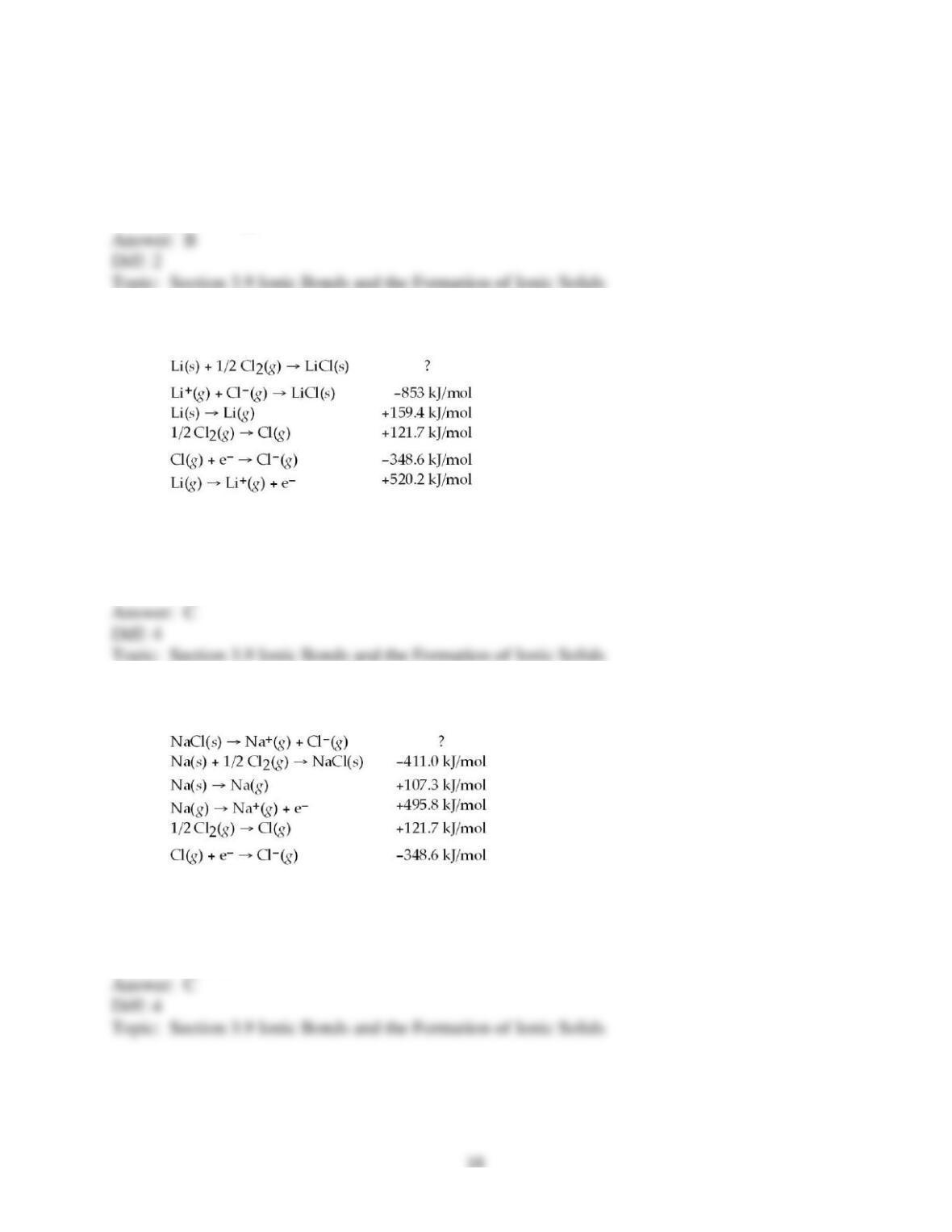
65) Calculate the energy change for the formation of LiCl(s) from its elements in their standard
states and the following tabulated information:
A) +1305.7 kJ/mol
B) +296.9 kJ/mol
C) -400.3 kJ/mol
D) -627.2 kJ/mol
66) Calculate the lattice energy for NaCl(s) using a Born-Haber cycle and the following
information:
A) +34.8 kJ/mol
B) +690.3 kJ/mol
C) +787.2 kJ/mol
D) +1512 kJ/mol
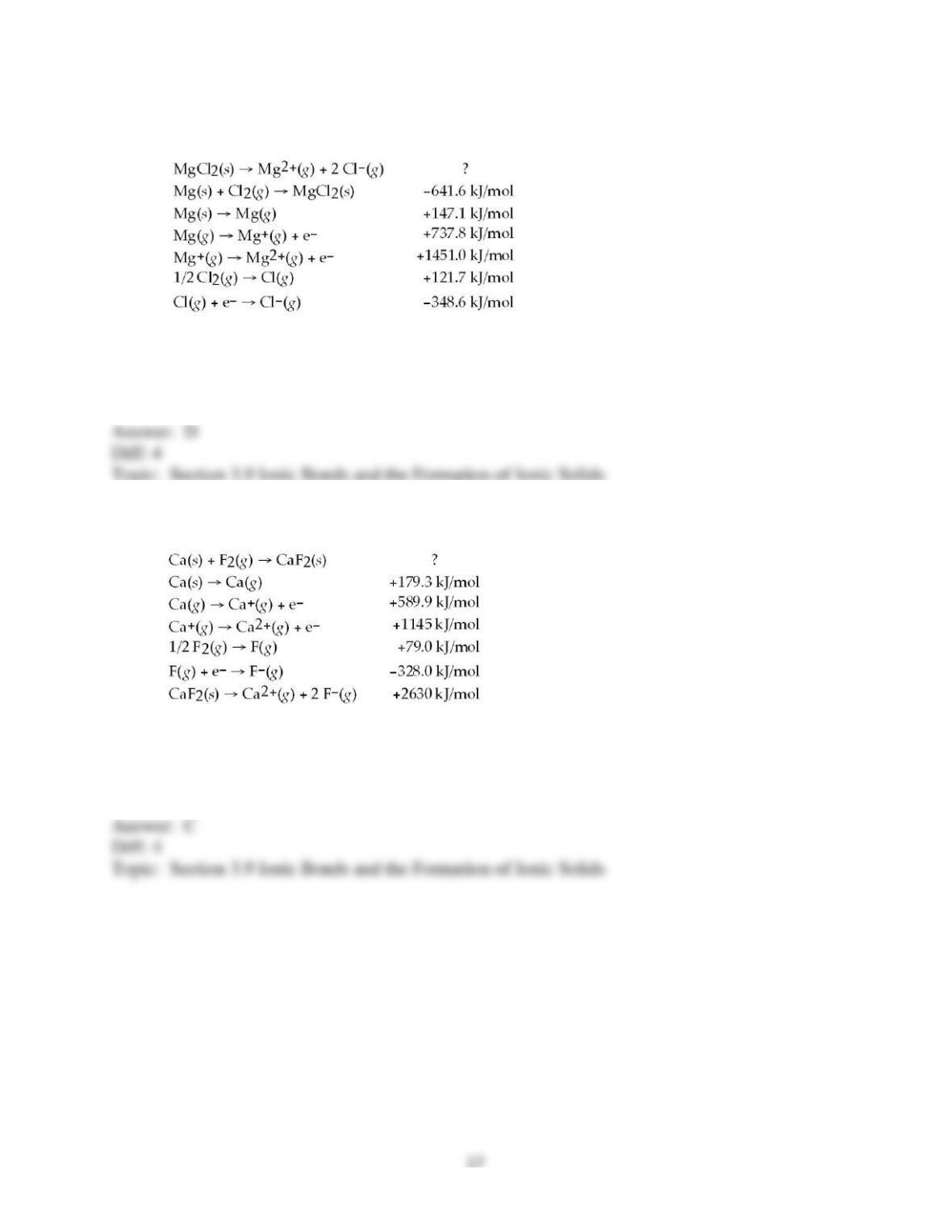
67) Calculate the lattice energy for MgCl2(s) using a Born-Haber cycle and the following
information:
A) +641.6 kJ/mol
B) +1240.5 kJ/mol
C) +1882.1 kJ/mol
D) +2523.7 kJ/mol
68) Calculate the energy change for the formation of CaF2(s) from its elements in their standard
states and the following information:
A) +4046 kJ/mol
B) -965 kJ/mol
C) -1214 kJ/mol
D) -3286 kJ/mol
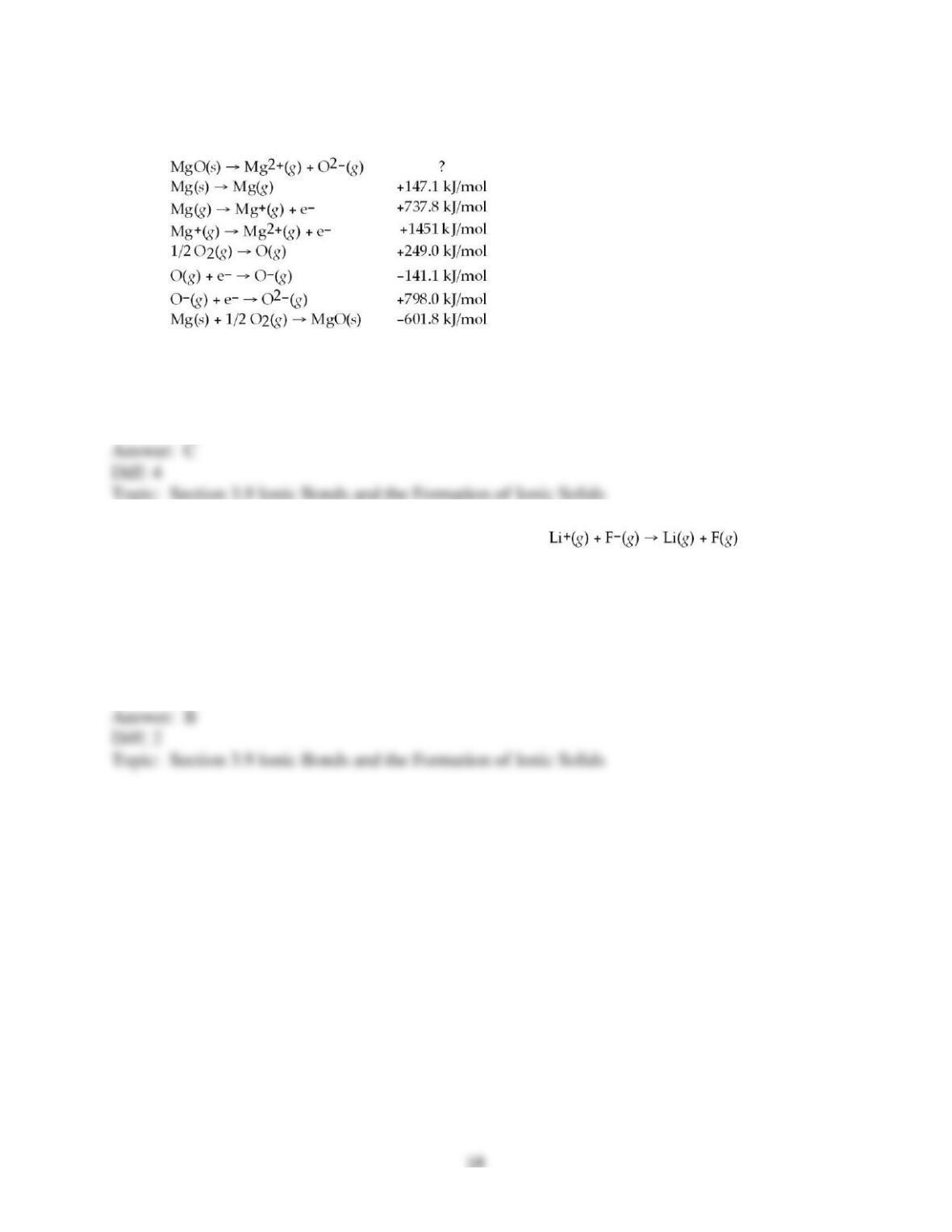
69) Calculate the lattice energy for MgO(s) using a Born-Haber cycle and the following
information:
A) +1842 kJ/mol
B) +2444 kJ/mol
C) +3844 kJ/mol
D) +4108 kJ/mol
70) Calculate the energy change in kJ/mol for the reaction using the
following information:
Li(g) → Li+(g) + e– +520 kJ/mol
F(g) + e– → F–(g) -328 kJ/mol
A) -848 kJ/mol
B) -192 kJ/mol
C) +192 kJ/mol
D) +848 kJ/mol
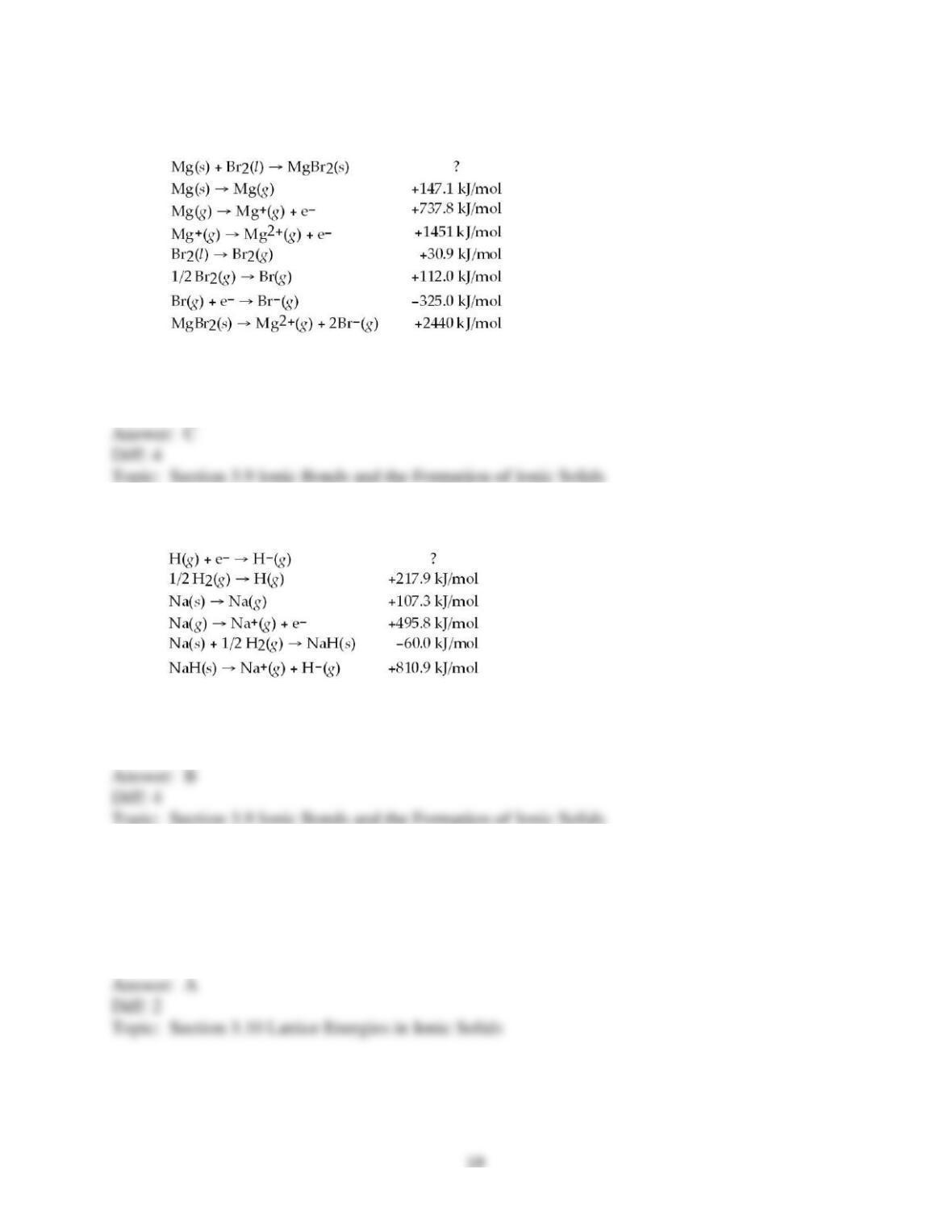
71) Calculate the energy change for the formation of MgBr2(s) from its elements in their
standard states:
A) -150.8 kJ/mol
B) -286.0 kJ/mol
C) -499.2 kJ/mol
D) -5682 kJ/mol
72) Calculate the electron affinity for the formation of the hydride ion from the following
information:
A) -50.1 kJ/mol
B) -70.1 kJ/mol
C) -816 kJ/mol
D) -1632 kJ/mol
73) Which chemical process is associated with the lattice energy for sodium chloride?
A) NaCl(s) → Na+(g) + Cl–(g)
B) NaCl(g) → Na+(g) + Cl–(g)
C) Na(s) + 1/2 Cl2(g) → NaCl(s)
D) NaCl(s) + H2O(l) → Na+(aq) + Cl–(aq)
74) Which of the following ionic compounds would be expected to have the highest lattice
energy?
A) NaF
B) NaCl
C) NaBr
D) NaI
75) Which of the following ionic compounds would be expected to have the highest lattice
energy?
A) LiCl
B) NaCl
C) KCl
D) RbCl
76) Which ionic compound would be expected to have the highest lattice energy?
A) Na2O
B) MgO
C) Al2O3
D) CO2
77) Which ionic compound would be expected to have the highest lattice energy?
A) NaCl
B) MgO
C) AlF3
D) Al2O3