Microeconomics, 4e (Hubbard/O’Brien)
Chapter 3 Where Prices Come From: The Interaction of Demand and Supply
3.1 The Demand Side of the Market
1) The market for tablet computers has grown rapidly over the past few years, due in part to the
overwhelming success of the Apple iPad. Following the successful launch of the iPad in 2010,
companies such as Toshiba, Samsung, Dell, and Amazon have all introduced products to
compete with the iPad. The tablet computers introduced to compete with the iPad would be
considered
A) complements to the iPad.
B) substitutes for the iPad.
C) inferior goods compared to the iPad.
D) normal goods compared to the iPad.
2) If the Apple iPad and the Samsung Galaxy Tab are considered substitutes, then, other things
equal, an increase in the price of the iPad will
A) decrease the demand for the iPad.
B) increase the demand for the Galaxy Tab.
C) increase the quantity demanded for the Galaxy Tab.
D) increase the quantity demanded for the iPad.
3) What is the difference between an “increase in demand” and an “increase in quantity
demanded”?
A) There is no difference between the two terms; they both refer to a shift of the demand curve.
B) An “increase in demand” is represented by a rightward shift of the demand curve while an
“increase in quantity demanded” is represented by a movement along a given demand curve.
C) There is no difference between the two terms; they both refer to a movement downward along
a given demand curve.
D) An “increase in demand” is represented by a movement along a given demand curve, while an
“increase in quantity demanded” is represented by a rightward shift of the demand curve.
4) The demand by all the consumers of a given good or service is the ________ for the good or
service.
A) market demand
B) quantity demanded
C) law of demand
D) scheduled demand
5) If, in response to an increase in the price of chocolate, the quantity demanded of chocolate
decreases economists would describe this as
A) a decrease in demand.
B) a decrease in quantity demanded.
C) a change in consumer income.
D) a decrease in consumers’ taste for chocolate.
6) By drawing a demand curve with ________ on the vertical axis and ________ on the
horizontal axis, economists assume that the most important determinant of the demand for a
good is the ________ of the good.
A) quantity; price; quantity
B) price; quantity; quantity
C) price; quantity; price
D) quantity; price; price
7) The law of demand implies, holding everything else constant, that
A) as the price of bagels increases, the quantity of bagels demanded will decrease.
B) as the price of bagels increases, the demand for bagels will decrease.
C) as the price of bagels increases, the quantity of bagels demanded will increase.
D) as the price of bagels increases, the demand for bagels will increase.
8) If a demand curve shifts to the right, then
A) demand has increased.
B) quantity demanded has increased.
C) demand has decreased.
D) quantity demanded has decreased.
9) Holding everything else constant, an increase in the price of MP3 players will result in
A) a decrease in the quantity of MP3 players supplied.
B) a decrease in the demand for MP3 players.
C) an increase in the supply of MP3 players.
D) a decrease in the quantity of MP3 players demanded.
10) A change in all of the following variables will change the market demand for a product
except
A) the price of the product.
B) population and demographics.
C) income.
D) tastes.
Table 3-1
Loose Leaf
Tea
Price per lb.
(dollars)
Sunil’s
Quantity
Demande
d (lbs)
Mia’s
Quantity
Demande
d (lbs)
Rest of
Market
Quantity
Demanded
(lbs)
Market
Quantity
Demande
d (lbs)
$8
4
0
30
6
7
2
40
5
9
3
51
4
12
5
64
3
15
8
90
11) Refer to Table 3-1. The table above shows the demand schedules for loose-leaf tea of two
individuals (Sunil and Mia) and the rest of the market. At a price of $5, the quantity demanded in
the market would be
A) 51 lbs.
B) 63 lbs.
C) 76 lbs
D) 146 lbs.
12) Refer to Table 3-1. The table above shows the demand schedules for loose-leaf tea of two
individuals (Sunil and Mia) and the rest of the market. If the price of loose-leaf tea rises from $3
to $4, the market quantity demanded would
A) decrease by 32 lbs.
B) increase by 64 lbs.
C) increase by 32 lbs.
D) decrease by 64 lbs.
13) The income effect of a price change refers to the impact of a change in
A) income on the price of a good.
B) demand when income changes.
C) the quantity demanded when income changes.
D) the price of a good on a consumer’s purchasing power.
14) Which of the following will shift the demand curve for a good?
A) a change in the technology used to produce the good
B) an increase in the price of the good
C) a decrease in the price of a complementary good
D) a decrease in the price of the good
15) A movement along the demand curve for toothpaste would be caused by
A) a change in the price of toothbrushes.
B) a change in consumer income.
C) a change in the price of toothpaste.
D) a change in population.
16) When the price of a good falls, consumers buy a larger quantity because of the ________
effect and the ________ effect.
A) substitution; income
B) normal; inferior
C) substitute; complement;
D) supply; demand
17) If the price of grapefruit rises, the substitution effect due to the price change will cause
A) a decrease in the demand for grapefruit.
B) a decrease in the demand for oranges, a substitute for grapefruit.
C) a decrease in the quantity demanded of grapefruit.
D) a decrease in the quantity supplied of grapefruit.
18) The ________ effect refers to the change in quantity demanded for a good that results from
the effect of a change in the good’s price on consumer’s purchasing power.
A) ceteris paribus
B) population
C) substitution
D) income
19) If an increase in income leads to in an increase in the demand for peanut butter, then peanut
butter is
A) a neutral good.
B) a normal good.
C) a necessity.
D) a complement.
20) If an increase in income leads to a decrease in the demand for popcorn, then popcorn is
A) an inferior good.
B) a neutral good.
C) a necessity.
D) a normal good.
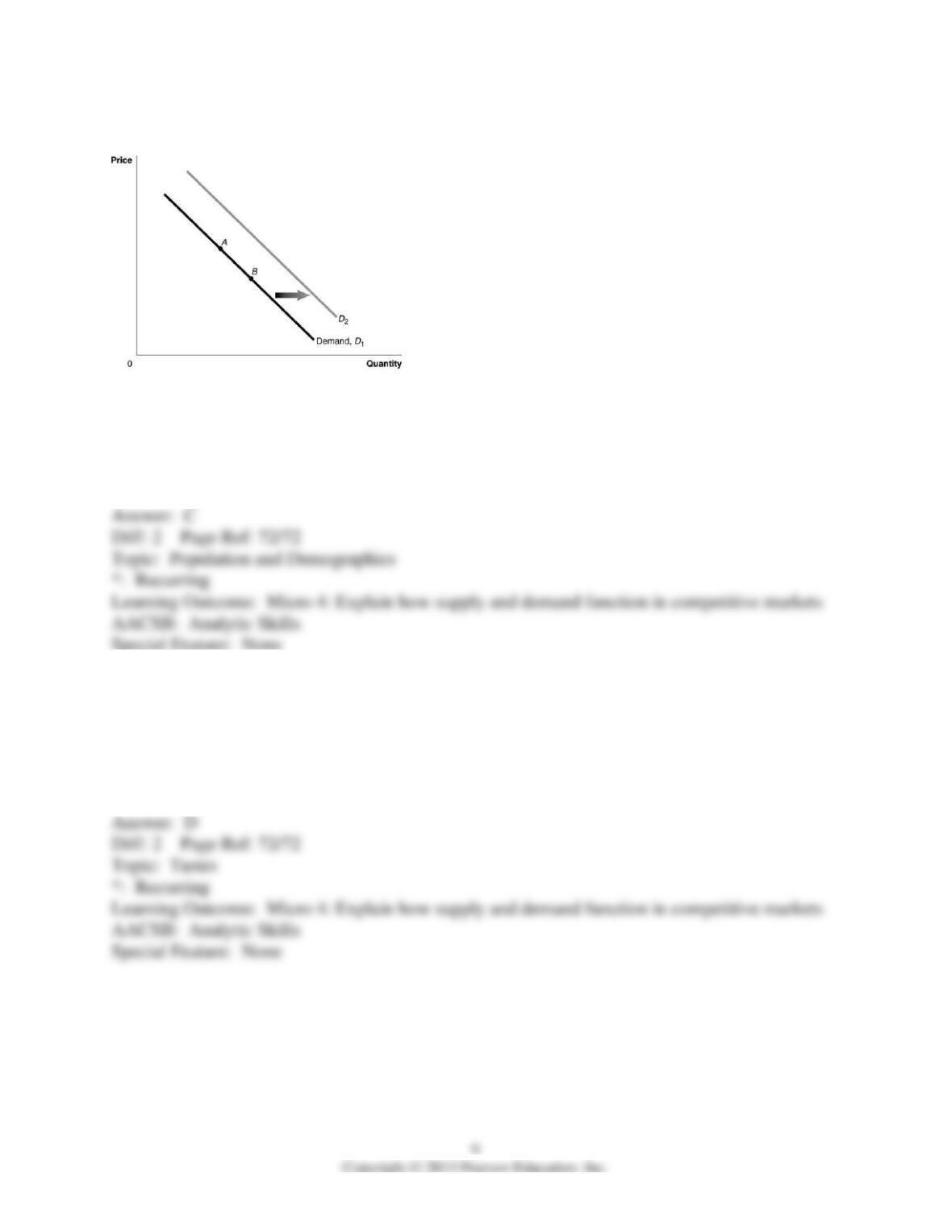
Figure 3-1
21) Refer to Figure 3-1. An increase in population would be represented by a movement from
A) A to B.
B) B to A.
C) D1 to D2.
D) D2 to D1.
22) Refer to Figure 3-1. A decrease in taste or preference would be represented by a movement
from
A) A to B.
B) B to A.
C) D1 to D2.
D) D2 to D1.
23) Refer to Figure 3-1. If the product represented is an inferior good, an increase in income
would be represented by a movement from
A) A to B.
B) B to A.
C) D1 to D2.
D) D2 to D1.
24) Refer to Figure 3-1. A decrease in the price of the product would be represented by a
movement from
A) A to B.
B) B to A.
C) D1 to D2.
D) D2 to D1.
25) The Internet has created a new category in the book selling market, namely, the “barely
used” book. How does the availability of barely used books affect the market for new books?
A) The demand curve for new books shifts to the right.
B) The demand curve for new books shifts to the left.
C) The supply curve for new books shifts to the right.
D) The supply curve for new books shifts to the left.
26) Elvira decreased her consumption of bananas when the price of peanut butter increased. For
Elvira, peanut butter and bananas are
A) substitutes in consumption.
B) both inferior goods.
C) complements in consumption.
D) both luxury goods.
27) If the price of automobiles was to increase, then
A) the demand for gasoline would decrease.
B) the demand for gasoline would increase.
C) the supply of gasoline would increase.
D) the quantity demanded of gasoline would decrease.
28) Suppose that when the price of raspberries increases, Lonnie increases his purchases of
papayas. To Lonnie,
A) raspberries and papayas are complements.
B) raspberries and papayas are inferior goods.
C) raspberries and papayas are normal goods.
D) raspberries and papayas are substitutes.
29) Suppose that when the price of hamburgers decreases, the Ruiz family increases their
purchases of ketchup. To the Ruiz family,
A) hamburgers and ketchup are complements.
B) hamburgers and ketchup and substitutes.
C) hamburgers and ketchup are normal goods.
D) hamburgers are normal goods and hot dogs are inferior goods.
30) Studies have shown links between calcium consumption and a reduction in osteoporosis.
How does this affect the market for calcium?
A) The calcium supply curve shifts to the right because of a change in tastes in favor of calcium.
B) The calcium demand curve shifts to the right because of a change in tastes in favor of
calcium.
C) The calcium demand curve shifts to the left because this new information will increase the
price of calcium.
D) The calcium supply curve shifts to the left because this new information will increase the
price of calcium.
31) Technological advances have resulted in lower prices for digital cameras. What is the impact
of this on the market for traditional (non-digital) cameras?
A) The demand curve for traditional cameras shifts to the right.
B) The supply curve for traditional cameras shifts to the right.
C) The demand curve for traditional cameras shifts to the left.
D) The supply curve for traditional cameras shifts to the left.
32) How does the increasing use of MP3 players affect the market for compact discs?
A) The demand curve for compact discs shifts to the right.
B) The supply curve for compact discs shifts to the left.
C) The supply curve for compact discs shifts to the right.
D) The demand curve for compact discs shifts to the left.
33) Technological advancements have led to lower prices and an increase in the sale of digital
cameras. How does this affect the digital photo printing paper market?
A) The demand curve for digital photo printing paper shifts to the right.
B) The demand curve for digital photo printing paper shifts to the left.
C) The supply curve for digital photo printing paper shifts to the right.
D) The supply curve for digital photo printing paper shifts to the left.
34) Buyers rush to purchase stocks in California vineyards following a forecast of a 30 percent
decline in this year’s grape harvest. What happens in the California wine market as a result of
this announcement?
A) The demand curve for California wine shifts to the left in anticipation of higher prices in the
future.
B) The demand curve for California wine shifts to the right in anticipation of higher prices in the
future.
C) The supply curve for California wine shifts to the right in anticipation of higher prices in the
future.
D) The supply curve for California wine shifts to the left in anticipation of lower quantities in the
future.
35) Tom Searchinger, a senior attorney at the Environmental Defense Fund, observed that
generous farm subsidies have encouraged farmers to produce more corn and more wheat. How
does this affect the market for fertilizer?
A) The supply of fertilizer increases.
B) The supply of fertilizer decreases
C) The demand for fertilizer increases.
D) The demand for fertilizer decreases.
36) In June, buyers of titanium expect that the price of titanium will fall in July. What happens in
the titanium market in June, holding everything else constant?
A) The demand curve shifts to the right.
B) The quantity demanded increases.
C) The quantity demanded decreases
D) The demand curve shifts to the left.
37) In January, buyers of gold expect that the price of gold will rise in February. What happens
in the gold market in January, holding all else constant?
A) The supply curve shifts to the right.
B) The demand curve shifts to the left.
C) The demand curve shifts to the right.
D) The quantity demanded increases.
38) During the recession of 2007-2009, despite falling income levels, the fast-food chain Subway
experienced increased sales. The increase in demand for Subway sandwiches despite the decline
in income indicates that Subway sandwiches are considered
A) normal goods.
B) inferior goods.
C) complementary goods.
D) substitute goods.
39) During the recession of 2007-2009
A) casual dining restaurants like Olive Garden and Red Lobster experienced increased demand
and fast-food restaurants like McDonald’s and Subway experienced decreased demand.
B) casual dining restaurants like Olive Garden and Red Lobster experienced decreased demand
and fast-food restaurants like McDonald’s and Subway experienced increased demand.
C) both casual dining restaurants like Olive Garden and Red Lobster and fast-food restaurants
like McDonald’s and Subway experienced increased demand.
D) both casual dining restaurants like Olive Garden and Red Lobster and fast-food restaurants
like McDonald’s and Subway experienced decreased demand.
40) Which of the following is expected to occur as the baby-boom generation ages?
A) The demand for baby clothes should increase.
B) The demand for prescription drugs should decrease.
C) The demand for medical services should increase.
D) The demand for larger houses should increase.
41) In the United States during the recession of 2007-2009,
A) the total number of jobs declined, but jobs in health care increased.
B) jobs in health care declined at a faster rate than overall jobs in the economy.
C) demand for medical services declined, which resulted in a decline in available jobs in the
medical field.
D) despite the large decrease in demand for medical services, the number of jobs in health care
remained virtually unchanged.
42) When deciding on which new products to develop, a firm must devote people, time, and
money to designing a new product. Because any firm has only limited resources, it
A) should wait until its competitors develop a similar product before deciding on devoting
resources to its own product development.
B) is not able to develop more than one new product at a time.
C) must be certain that the product it chooses to develop will be successful or it will not be able
to stay in business.
D) faces a trade-off, because resources used to develop one product will not be available to
develop another product.
43) The income effect of a price change refers to the change in the quantity demanded of a good
that results from a change in purchasing power as a result of the price change.
44) Chips and salsa are complements. If the price of salsa decreases, the demand for chips will
increase.
45) A normal good is a good for which the demanded increases as income decreases, holding
everything else constant.
46) The income effect explains why there is an inverse relationship between the price of a
product and the quantity of the product demanded.
47) If consumers believe the price of iPads will decrease in the future, this will cause the demand
for iPads to decrease now.
48) What is the ceteris paribus condition?
49) What are the two effects that explain the Law of Demand? Briefly explain each effect.
50) Explain the difference between a normal good and an inferior good.
51) For each of the following pairs of products state which are complements, which are
substitutes, and which are unrelated.
a. Digital camera and memory stick
b. 7Up and Mountain Dew
c. Swimsuits and flip-flops
d. Tylenol and cat food
e. Photocopier and paper
3.2 The Supply Side of the Market
1) A supply schedule
A) is a table that shows the relationship between the price of a product and the quantity of the
product supplied.
B) is a curve that shows the relationship between the price of a product and the quantity of the
product supplied.
C) is the relationship between the supply of a good and the cost of producing the good.
D) is a table that shows the relationship between the price of a product and the quantity of the
product that producers and consumers are willing to exchange.
2) If in the market for peaches, the supply curve has shifted to the left,
A) the supply of peaches has increased.
B) the supply of peaches has decreased.
C) the quantity of peaches supplied has increased.
D) the quantity of peaches supplied has decreased.
3) If, in the market for oranges, the supply has increased then
A) the supply curve for oranges has shifted to the right.
B) the supply curve for oranges has shifted to the left.
C) there has been a movement upwards along the supply curve for oranges.
D) there has been a movement downwards along the supply curve for oranges.
4) Last year, the Pottery Palace supplied 8,000 ceramic pots at $40 each. This year, the company
supplied the same quantity of ceramic pots at $55 each. Based on this evidence, The Pottery
Palace has experienced
A) a decrease in supply.
B) an increase in supply.
C) an increase in the quantity supplied.
D) a decrease in the quantity supplied.