
Chapter 3 The Database Management System Concept
3-1
Last Update: November 7, 2011 — 9PM
Chapter 3: The Database Management System Concept
Multiple Choice
1. In an automobile manufacturing company, an object about which we might want to
maintain data could be any of the following, except _____.
a. an employee
b. a finished car
c. a length
d. a supplier
e. a sales meeting
2. A single piece of data is _____ the business environment.
a. a fact about
b. a record describing an object in
c. the same thing as an object in
d. a file describing an object in
e. an event in
3. An entity is _____ in the business environment.
a. a fact about an object
b. a record in a file
c. an object or event
d. an attribute
e. a file
4. An entity set is _____.
a. a file
b. a collection of records of the same type
c. all of the attributes in a record

Chapter 3 The Database Management System Concept
3-2
d. a collection of characteristics of an entity
e. a collection of entities of the same type
5. An attribute is _____.
a. a collection of objects of the same type
b. a characteristic of an entity
c. a record of a file
d. a collection of records of the same type
e. an event
6. Which of the following is a description of a particular entity?
a. field
b. key
c. record type
d. record occurrence
e. file
7. Which of the following is a collection of descriptions of the entities in an entity set?
a. field
b. key
c. record type
d. record occurrence
e. file
8. Which of the following is the unique identifier of an entity?
a. field
b. key
c. record type
d. record occurrence
e. file
Chapter 3 The Database Management System Concept
3-3
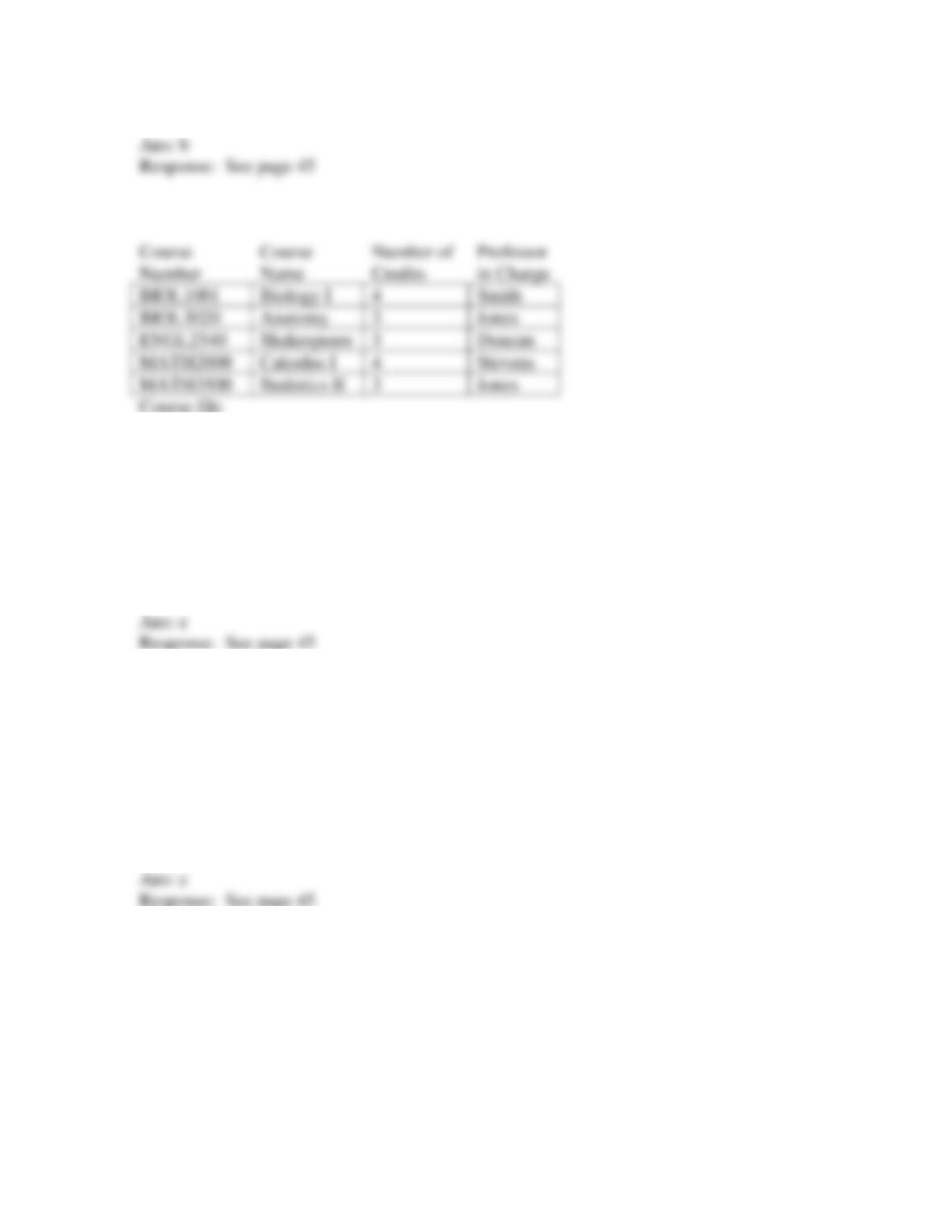
9. How many entities are described in the Course file?
a. 1
b. 2
c. 3
d. 4
e. 5
10. In the Course file, the string “ENGL2540 Shakespeare 3 Duncan” can best be
described as a _____.
a. field
b. record type
c. record occurrence
d. entity
e. entity set
11. In the Course file, the string “Anatomy” can best be described as a _____.
a. field type
b. field occurrence
c. record type
d. record occurrence
e. entity

Chapter 3 The Database Management System Concept
3-4
12. Each of the following is one of the fundamental operations that can be performed on
stored data, except _____.
a. converge
b. retrieve
c. insert
d. delete
e. update
13. Which of the following does not change the contents of a file?
a. retrieve
b. insert
c. delete
d. update
e. all of the above
14. Retrieving the records of a file in order based on a set of field values is referred to as
_____.
a. immediate sequential retrieval
b. logical sequential retrieval
c. physical sequential retrieval
d. direct retrieval
e. indirect retrieval
15. Retrieving the records of a file in order based on the order in which they are stored on
a disk is referred to as _____.
a. immediate sequential retrieval
b. logical sequential retrieval
c. physical sequential retrieval
d. direct retrieval
e. indirect retrieval

Chapter 3 The Database Management System Concept
3-5
16. Retrieving a single record of a file based on a field value is an example of _____.
a. immediate sequential retrieval
b. logical sequential retrieval
c. physical sequential retrieval
d. direct retrieval
e. indirect retrieval
17. Retrieving a subset of the records of a file based on a field value is an example of
_____.
a. immediate sequential retrieval
b. logical sequential retrieval
c. physical sequential retrieval
d. direct retrieval
e. indirect retrieval
18. Prior to the development of the database concept, redundant data ____.
a. could be found within individual files
b. could be found across multiple files
c. could be found across multiple files but not within individual files
d. a & b
e. did not exist
19. Prior to the development of the database concept ____.
a. data was regularly shared among applications
b. data redundancy was not a problem
c. changes in the way that data was stored did not affect programs that used the data
d. data security was not an issue
e. data was not regularly shared among applications

Chapter 3 The Database Management System Concept
3-6
20. All of the following are basic principles of the database concept, except _____.
a. maintaining redundant data that does not cause data integrity problems
b. the ability to store data in a non-redundant fashion
c. the ability to store data representing entities involved in multiple relationships
d. striving to achieve a high degree of data independence
e. data integration
21. Which of the following is a basic principle of the database concept?
a. The ability to achieve data integration with redundant data.
b. The ability to achieve data integration without introducing redundant data.
c. The establishment of an environment that permits a high degree of data
dependence.
d. The establishment of an environment that permits data redundancy in return for
data security controls.
e. The establishment of an environment that permits data redundancy in return for
backup and recovery controls.
22. All of the following are corporate resources, except _____.
a. money
b. inventory
c. data
d. plant and equipment
e. competitors
23. Data integration _____.
a. refers to the compatibility between data and the hardware on which it is stored
b. is the ability to tie together pieces of related data in an information system
c. is the ease with which data can be accessed by an application program that
requires it
d. refers to the linkage between data and its related information

Chapter 3 The Database Management System Concept
3-7
e. is undesirable in any information system
24. Which of the following is true?
a. Data integration is desirable but data redundancy is not.
b. Data redundancy is desirable but data integration is not.
c. Both data integration and data redundancy are desirable.
d. Neither data integration nor data redundancy is desirable.
e. None of the above.
25. Data redundancy _____.
a. can occur across multiple files but not within a single file
b. can occur within a single file but not across multiple files
c. is a positive feature in the simple linear file environment but is a negative feature
in the database environment
d. is a negative feature in the simple linear file environment but is a positive feature
in the database environment
e. None of the above.
26. All of the following are problems caused by redundant data, except _____.
a. wasted disk space
b. additional processing time for data updates
c. wasted network transmission time
d. potential data integrity problems
e. the possibility of having what should be the same data value in two different files
having different values.
27. All of the following are true about data redundancy across multiple files, except
_____.
a. it speeds updates when the redundant data must be updated
b. it is a managerial problem when the company does not encourage data sharing

Chapter 3 The Database Management System Concept
c. it is a technical problem when the company’s software systems do not support
data sharing
d. it wastes disk space
e. it can potentially cause data integrity problems
28. Which of the following is true about data redundancy within one file?
a. The appearance of a particular data value multiple times in one field always
indicates data redundancy.
b. Data redundancy cannot occur within a single file.
c. The problems caused by data redundancy within one file are substantially
different from the problems caused by data redundancy across multiple files.
d. Data redundancy within one file occurs when different kinds of data (data about
different entities) are merged in one file.
e. Data redundancy within one file only occurs when a single kind of data (data
about a single entity) is present in the file.
29. When different kinds of data (data about different entities) are merged in one file, a
deletion anomaly _____.
a. cannot occur
b. causes a loss of data that may not be stored anywhere else
c. is helpful in reducing the amount of redundant data present
d. causes additional redundant data to appear
e. occurs as the result of an insertion anomaly
30. When different kinds of data (data about different entities) are merged in one file,
which of the following anomalies can occur?
a. deletion but not insertion or update
b. insertion but not deletion or update
c. insertion and deletion but not update
d. insertion and update but not deletion
e. deletion, insertion, and update

3-9
31. By definition, a database management system _____.
a. permits data to be stored non-redundantly but does not provide for data
integration
b. provides for data integration but does not permit the data to be stored non-
redundantly
c. permits data to be stored non-redundantly and provides for data integration
d. does not permit data to be stored non-redundantly and also does not provide for
data integration
e. provides for data integration only when the data is stored redundantly
32. A database management system is designed to handle _____ relationships without
introducing data redundancy or causing other problems.
a. unary, binary, and ternary
b. binary but not unary or ternary
c. unary but not binary or ternary
d. unary and binary but not ternary
e. binary and ternary but not unary
33. Regarding the three data control issues of security, backup and recovery, and
concurrency, a database management system _____.
a. should expect each application programmer to handle them
b. should expect the operating system to handle them
c. should expect each systems analyst to handle them
d. should be responsible for handling all of them
e. should not be responsible for handling any of them
34. Problems caused by two or more users trying to update the same data simultaneously
fall primarily under the heading of _____.
a. computer security
b. backup and recovery
c. concurrency control
d. integration control

Chapter 3 The Database Management System Concept
3-10
e. access control
35. Rebuilding a database after it is destroyed by a natural disaster is an aspect of _____.
a. computer security
b. backup and recovery
c. concurrency control
d. integration control
e. access control
36. Protecting against hackers is primarily a matter of _____.
a. computer security
b. backup and recovery
c. concurrency control
d. integration control
e. access control
37. When data structures can be modified without affecting the programs that use the
data, we say that the environment is highly _____.
a. secure
b. recoverable
c. data structured
d. data independent
e. data dependent
38. All of the following are major DBMS approaches, except _____.
a. network
b. index
c. object-oriented
d. relational
e. hierarchical

Chapter 3 The Database Management System Concept
39. The navigational approaches to database management are _____.
a. relational and object-oriented
b. hierarchical and object-oriented
c. hierarchical and network
d. relational and network
e. network and object-oriented
40. The DBMS approach in primary use today is _____.
a. hierarchical
b. network
c. relational
d. object-oriented
e. none of the above
True/False
1. A single piece of data is a fact about something of interest to us in our business
environment.
2. An entity is the set of facts in a record.
3. An attribute is an entity.