Introduction to Financial Accounting, 10e (Horngren)
Chapter 3 Recording Transactions
Learning Objective 3.1 Questions
3.1-1) Which of the following transactions would not affect owners’ equity?
A) Recording cost of goods sold
B) Recording a cash sale
C) Recording a sale on account
D) Recording rent expense
E) Purchasing supplies for cash
3.1-2) Which of the following statements is true regarding attributes of the general ledger and the general
journal?
A) Both the general ledger and the general journal focus on general accounting concepts and not specific
events or occurrences.
B) The general journal displays the balance in a particular account.
C) The general ledger and the general journal are separate and distinct accounting records that are not
related or cross–referenced to each other.
D) The general ledger is account driven and the general journal is transaction driven.
E) General ledger accounts are only used in ERP systems.
3.1-3) Which of the following accounts are expected to have a debit balance?
1. Merchandise Inventory
2. Rent Expense
3. Paid–in Capital
4. Accumulated Depreciation
5. Sales
6. Prepaid Rent
7. Accounts Payable
A) Merchandise Inventory, Rent Expense, Prepaid Rent
B) Merchandise Inventory, Paid–in Capital, Sales, Prepaid Rent
C) Paid–in Capital, Accumulated Depreciation, Sales, Accounts Payable
D) Rent Expense, Accumulated Depreciation, Accounts Payable
E) Merchandise Inventory, Paid–in Capital, Accumulated Depreciation, Accounts Payable
3.1-4) Which of the following accounts is classified differently from the others in the list?
A) Notes Payable
B) Accounts Receivable
C) Merchandise Inventory
D) Prepaid Rent
E) Cash
3.1-5) Mathew Berry decides to start his own business. He plans to invest $50,000 in cash in the company.
As an accountant, you would tell Mr. Berry to
A) debit Retained Earnings and credit Cash for $50,000.
B) debit Cash and credit Retained Earnings for $50,000.
C) debit Paid–in Capital and credit Retained Earnings for $50,000.
D) debit Paid–in Capital and debit Retained Earnings for $50,000.
E) debit Cash and credit Paid–in Capital for $50,000.
3.1-6) Which of the following accounts is increased with a debit?
A) Accounts Payable
B) Notes Payable
C) Merchandise Inventory
D) Capital
E) Sales Revenue
3.1-7) Which of the following accounts are expected to have a credit balance?
1. Cash
2. Salary Expense
3. Retained Earnings
4. Accumulated Depreciation
5. Sales
6. Prepaid Rent
7. Accounts Payable
A) Cash, Retained Earnings, Sales
B) Salary Expense, Accounts Payable, Accumulated Depreciation
C) Cash, Retained Earnings, Accumulated Depreciation, Prepaid Rent, Accounts Payable
D) Cash, Salary Expense, Prepaid Rent
E) Retained Earnings, Accumulated Depreciation, Sales, Accounts Payable
3.1-8) Which of the following would not be found in a general journal?
A) The balance in an account
B) Separate columns for debits and credits
C) The date of the transaction
D) Identification numbers for the entries made
E) A posting reference
3.1-9) A ledger contains only balance sheet accounts kept up–to–date in a systematic way.
3.1-10) T–accounts focus on account balances while journal entries focus on transactions.
3.1-11) The right side of a T–account always increases an account balance and the left side of a T–account
always decreases an account balance.
3.1-12) T–accounts facilitate the preparation of financial statements at any instant if the account balances
are kept up–to–date.
3.1-13) T–accounts can only be used for income statement accounts.
3.1-14) A T–account is an analysis of an account.
4
3.1-15) For each of the following accounts, indicate whether the account normally possesses a debit (DR)
or a credit (CR) balance.
1. Wage expense
2. Prepaid rent
3. Cost of goods sold
4. Cash
5. Sales
6. Paid–in–capital
7. Depreciation expense
8. Accounts payable
9. Merchandise inventory
10. Rent expense
11. Equipment
12. Accounts receivable
13. Accumulated depreciation
14. Notes payable
15. Utilities expense
Answer: Account
Normal Balance
To Decrease
Prepaid rent
Notes payable
Retained earnings
Sales revenue
Cash
Store equipment
Paid in capital
Wage expense
Accounts receivable
Cost of goods sold
Accounts payable
Inventory
Utilities expense
Depreciation expense
Accumulated depreciation
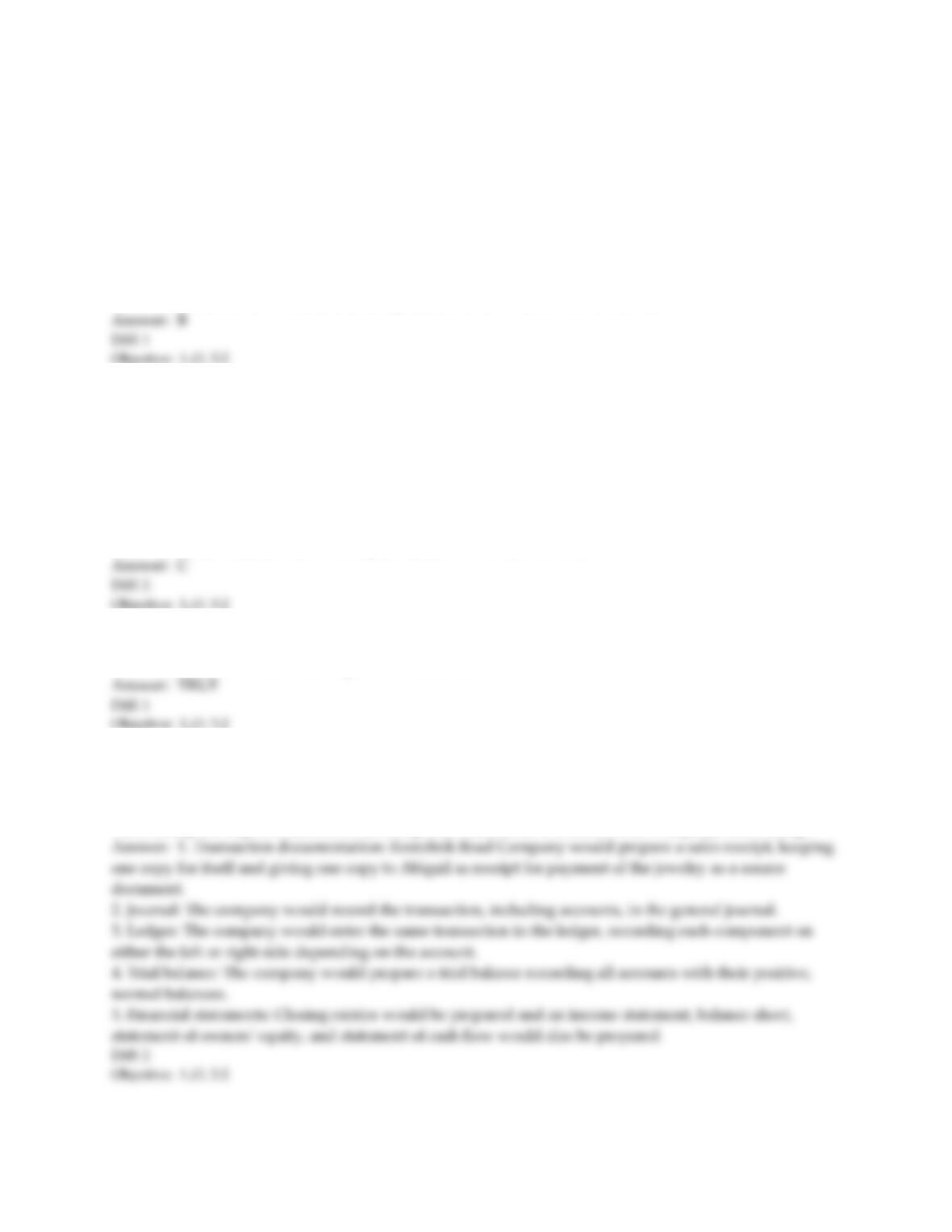
3.1-16) Listed below are several accounts from White Motors Company for the year ended December 31,
20X9. Next to each account indicate its normal balance and whether you would need to debit or credit the
account to decrease it. Use DR for debit and CR for credit.
Account
Normal Balance
To Decrease
Prepaid rent
Notes payable
Retained earnings
Sales revenue
Cash
Store equipment
Paid in capital
Wage expense
Accounts receivable
Cost of goods sold
Accounts payable
Inventory
Utilities expense
Depreciation expense
Accumulated depreciation
6
Learning Objective 3.2 Questions
3.2-1) The recording process has a sequence of five steps. What is the specific order of the recording
process?
A) Journal, trial balance, financial statements, ledger, transaction documentation
B) Transaction documentation, journal, ledger, trial balance, financial statements
C) Transaction documentation, ledger, journal, trial balance, financial statements
D) Ledger, journal, transaction documentation, trial balance, financial statements
E) Trial balance, financial statements, ledger, journal, transaction documentation
3.2-2) A chart of accounts is used in organizations to
A) encrypt the general journal so that no other organization can read any other organization’s journal.
B) process transactions to the ledger.
C) ensure consistency in recording transactions quicker, since a chart of accounts is essentially shorthand
of accounts.
D) alphabetize accounts so that when accountants prepare financial statements the accounts can be
quickly transferred.
E) verify correct amounts before being transferred to the trial balance.
3.2-3) A book of original entry is a chronological record of an entity’s transactions and how the
transactions affect the balances in pertinent accounts.
3.2-4) Abigail Kennedy purchased jewelry from Kostelnik Bead Company on August 14, 20X9, for an
upcoming party for $120. Abigail paid Kostelnik Bead Company in cash and Kostelnik Bead Company
purchased the beads for $75. What steps must Kostelnik Bead Company follow to record the purchase?
After listing the step, describe in detail the specific transaction Kostelnik Bead Company is recording.
Learning Objective 3.3 Questions
3.3-1) A posting reference number
A) helps outside investors locate entries for verification of specific amounts.
B) cross–references general journal transactions to the ledger.
C) equals the transaction amount and is used to organize and track transactions.
D) is used in the closing process to zero out the Income Summary account.
E) carries a debit as a normal balance.
3.3-2) Posting is the process of transferring information from the
A) journal to the ledger.
B) ledger to the journal.
C) journal to the balance sheet.
D) income statement to the balance sheet.
E) ledger to the income statement and balance sheet.
3.3-3) The entry to collect cash on account involves a
A) debit to Cash and a credit to Accounts Payable.
B) debit to Accounts Receivable and a credit to Cash.
C) debit to Cash and a credit to Accounts Receivable.
D) debit to Accounts Receivable and a credit to Accounts Payable.
E) debit to Cash and a credit to Sales Revenue.
3.3-4) The entry to record the cost of merchandise inventory sold involves a
A) debit to Merchandise Inventory and a credit to Sales Revenue.
B) debit to Cost of Goods Sold and a credit to Merchandise Inventory.
C) debit to Merchandise Inventory and a credit to Cost of Goods Sold.
D) debit to Cost of Goods Sold and a credit to Sales Revenue.
E) debit to Merchandise Inventory and a credit to Accounts Receivable.
3.3-5) Caldwell Industries purchased $2,000 of merchandise inventory, paying cash for 10% of the
purchase, with the remainder on account. The entry would include a
A) debit to Cash for $200, debit to Accounts Payable for $1,800, and credit to Merchandise Inventory for
$2,000.
B) debit to Cash for $800, debit to Notes Payable for $1,800, and credit to Merchandise Inventory for
$2,000.
C) debit to Merchandise Inventory for $2,000, credit to Cash for $200, and credit to Notes Payable for
$1,800.
D) debit to Merchandise Inventory for $2,000, credit to Cash for $200, and credit to Accounts Payable for
$1,800.
E) debit to Merchandise Inventory for $200, and credit to Cash for $200.
3.3-6) Coleman, Inc., has acquired equipment costing $10,000. The company paid $5,000 and gave a 10–
month note for the balance. As the accountant, you would tell the bookkeeper to
A) debit Equipment for $10,000, credit Cash for $5,000, and credit Notes Receivable for $5,000.
B) debit Cash for $5,000, debit Notes Receivable for $5,000, and credit Equipment for $10,000.
C) debit Equipment for $10,000, credit Cash for $5,000, and credit Notes Payable for $5,000.
D) debit Cash for $5,000, debit Notes Payable for $5,000, and credit Equipment for $10,000.
E) debit Equipment for $10,000, debit Cash for $5,000, credit Notes Payable for $5,000, and credit Paid–in
Capital for $5,000.
3.3-7) Gaspar Catering acquired merchandise inventory for $400 cash. A week later it discovered a defect
in the merchandise inventory and returned it to the supplier for a cash refund. Which of the following is
the journal entry that would be required for the return of the merchandise?
A) Dr. Cr.
Cash 400
Merchandise Inventory 400
B) Dr. Cr.
Merchandise Inventory 400
Cash 400
C) Dr. Cr.
Accounts Payable 400
Merchandise Inventory 400
D) Dr. Cr.
Merchandise Inventory 400
Accounts Payable 400
E) Dr. Cr.
Cash 400
Accounts Payable 400
3.3-8) The Shanghai Company borrowed $4,800 at the beginning of the year. All interest has been paid
and properly recorded for the year. On December 31, the company repaid the loan. Which of the
following is the journal entry to be made at the time of the loan repayment?
A) Dr. Cr.
Notes Payable Expense 4,800
Cash 4,800
B) Dr. Cr.
Notes Payable 4,800
Cash 4,800
C) Dr. Cr.
Cash 4,800
Notes Payable Expense 4,800
D) Dr. Cr.
Cash 4,800
Notes Payable 4,800
E) Dr. Cr.
Cash 4,800
Notes Receivable 4,800
3.3-9) The Depp Company repaid a bank loan of $1,000. As the accountant, you would tell the bookkeeper
to
A) debit Cash and credit Notes Receivable for $1,000.
B) debit Notes Receivable and credit Cash for $1,000.
C) debit Cash and credit Accounts Payable for $1,000.
D) debit Cash and credit Notes Payable for $1,000.
E) debit Notes Payable and credit Cash for $1,000.
3.3-10) Browse Books, Inc., received and paid its utility bill of $250. As the accountant, you would tell the
bookkeeper to
A) debit Utility Expense and credit Cash for $250.
B) debit Cash and credit Utility Payable for $250.
C) debit Cash and credit Utility Expense for $250.
D) debit Cash and credit Retained Earnings for $250.
E) debit Utility Receivable and credit Cash for $250.
3.3-11) Higgins Landscaping sold merchandise inventory costing $2,500 for $5,000 in cash. As the
accountant, you would tell the bookkeeper to
A) debit Cash for $5,000, credit Sales for $2,500, and credit Merchandise Inventory for $2,500.
B) debit Cash for $5,000, debit Cost of Goods Sold for $2,500, credit Sales for $5,000, and credit
Merchandise Inventory for $2,500.
C) debit Cash for $5,000, debit Merchandise Inventory for $2,500, credit Sales for $5,000, and credit Cost
of Goods Sold for $2,500.
D) debit Sales for $5,000, debit Merchandise Inventory for $2,500, credit Cash for $5,000, and credit Cost
of Goods Sold for $2,500.
E) debit Sales for $5,000, debit Cost of Goods Sold for $2,500, credit Cash for $5,000, and credit
Merchandise Inventory for $2,500.
3.3-12) Marshall Karate, Inc., paid $500 to the local newspaper for advertising that will begin in 10 days
and continue for the following 3 weeks. How would Sunflower Company record this transaction?
A) Debit Cash and credit Advertising Expense for $500
B) Debit Prepaid Advertising and credit Advertising Expense for $500
C) Debit Advertising Expense and credit Prepaid Advertising for $500
D) Debit Cash and credit Prepaid Advertising for $500
E) Debit Prepaid Advertising and credit Cash for $500
3.3-13) The journal entry to acquire equipment costing $30,000 with a $12,000 down payment and a note
issued for the difference would include a
A) debit to Cash for $18,000 and a credit to Equipment for $30,000.
B) debit to Equipment for $30,000 and a credit to Notes Payable for $12,000.
C) debit to Equipment for $30,000, credit to Notes Payable for $18,000, and a credit to Cash for $12,000.
D) debit to Equipment for $30,000, credit to Notes Payable for $12,000, and a credit to Cash for $18,000.
E) debit to Equipment for $30,000 and a credit to Cash for $30,000.

3.3-14) Mathias Enterprises acquired merchandise inventory for $12,000, paying one–fourth in cash and
the remainder on open account. Which of the following is the journal entry necessary to record this
transaction?
A) Dr. Cr.
Cash 3,000
Merchandise Inventory 3,000
B) Dr. Cr.
Cash 3,000
Accounts Receivable 9,000
Merchandise Inventory 12,000
C) Dr. Cr.
Cash 3,000
Accounts Payable 9,000
Merchandise Inventory 12,000
D) Dr. Cr.
Merchandise Inventory 12,000
Cash 3,000
Accounts Payable 9,000
E) Dr. Cr.
Merchandise Inventory 12,000
Cash 3,000
Accounts Receivable 9,000

3.3-15) McAfee Digital assembles and sells personal computers. The company sold a computer costing
$3,000 to a customer for $4,000. The customer paid cash. Which of the following is the journal entry that
McAfee would make to record the sale of the computer?
A) Dr. Cr.
Cash 4,000
Sales 1,000
Merchandise Inventory 3,000
B) Dr. Cr.
Merchandise Inventory 3,000
Sales 1,000
Cash 4,000
C) Dr. Cr.
Cash 4,000
Net Income 1,000
Merchandise Inventory 3,000
D) Dr. Cr.
Cash 4,000
Cost of Goods Sold 3,000
Sales 4,000
Merchandise Inventory 3,000
E) Dr. Cr.
Sales 4,000
Merchandise Inventory 3,000
Cash 4,000
Cost of Goods Sold 3,000
3.3-16) On April 1, 20X9, Martin Company paid $1,800 for rent on the building it occupies. This rent
payment is for the 3–month period of April 1 to June 30, 20X9. Which of the following is the journal entry
to be made on October 1, 20X9?
A) Dr. Cr.
Rent Expense 1,800
Prepaid Rent 1,800
B) Dr. Cr.
Cash 1,800
Rent Expense 1,800
C) Dr. Cr.
Prepaid Rent 1,800
Cash 1,800
D) Dr. Cr.
Cash 1,800
Prepaid Rent 1,800
E) Dr. Cr.
Prepaid Rent 1,800
Rent Expense 1,800
3.3-17) On October 1, 20X9, The Weber Company paid $3,600 for 6 months’ rent in advance. The
appropriate journal entry was made at the time using Prepaid Rent. No other journal entry has been
made. As of December 31, 20X9, The Weber Company should
A) debit Rent Expense and credit Prepaid Rent for $1,200.
B) debit Rent Expense and credit Prepaid Rent for $1,800.
C) debit Prepaid Rent and credit Rent Expense for $1,800.
D) debit Prepaid Rent and credit Rent Expense for $1,200.
E) No journal entry is necessary as of December 31, 20X9.
3.3-18) The Parsons Company paid $300 for an advertisement that will appear in today’s newspaper.
Which of the following is the journal entry to record this transaction?
A) Dr. Cr.
Cash 300
Prepaid Advertising 300
B) Dr. Cr.
Advertising Receivable 300
Cash 300
C) Dr. Cr.
Advertising Expense 300
Prepaid Advertising 300
D) Dr. Cr.
Cash 300
Advertising Expense 300
E) Dr. Cr.
Advertising Expense 300
Cash 300
3.3-19) Palady Manufacturing borrowed $10,000 from the Thompson Bank on October 1, 20X9. The note
carries an annual interest rate of 12%, which will be paid once a year on August 31. The company has not
recognized any interest expense during 20X9. What is the journal entry necessary to recognize interest
expense as of December 31, 20X9?
A) Dr. Cr.
Interest Expense 300
Interest Payable 300
B) Dr. Cr.
Interest Expense 300
Notes Payable 300
C) Dr. Cr.
Interest Payable 300
Interest Expense 300
D) Dr. Cr.
Interest Expense 1,200
Interest Payable 1,200
E) Dr. Cr.
Interest Expense 1,200
Notes Payable 1,200
3.3-20) The Perrine Company obtained a $20,000 note payable on August 1, 20X9, that is due in 5 years.
Interest, at an annual rate of 12%, will be paid once a year on July 31. The accountant made the
appropriate journal entry on August 1, 20X9. No other journal entry has been made. What journal entry is
necessary as of December 31, 20X9?
A) Debit Interest Expense and credit Notes Payable for $1,000
B) Debit Interest Expense and credit Notes Payable for $2,400
C) Debit Interest Expense and credit Interest Payable for $1,000
D) Debit Interest Expense and credit Interest Payable for $2,400
E) Debit Interest Expense and credit Interest Receivable for $2,400
3.3-21) Moneypenny, Inc., acquired $10,000 of equipment by paying $3,500 in cash, with the remaining
balance on a note due in 6 months. Which set of T–accounts best describes this transaction?
A) Cash Notes Receivable Equipment
————— —-———— —————
|3,500 |13,500 10,000|
| | |
B) Cash Notes Receivable Equipment
————— —-———— —————
3,500| 13,500| |10,000
| | |
C) Cash Equipment Accounts Payable
————— —-———– —————-
3,500| |10,000 13,500|
| | |
D) Cash Equipment Notes Payable
————— —-———– —————-
3,500| |10,000 13,500|
| | |
E) Cash Equipment Notes Payable
————— —-———– —————
|3,500 10,000| |6,500
| | |
3.3-22) Given the following transactions, what is the balance in the cash account?
1. The owner started the company by investing $8,900 cash.
2. The company paid $3,000 for 6 months’ rent in advance.
3. The company acquired $2,400 in merchandise inventory with two–thirds of the purchase on account.
4. The company sold merchandise inventory costing $1,500 for $3,100 on account.
A) $3,600 debit balance
B) $5,100 debit balance
C) $5,100 credit balance
D) $8,100 debit balance
E) $8,100 credit balance
3.3-23) From the following information, determine the ending balance in Retained Earnings.
1. Beginning Retained Earnings $ 6,200
2. Cash 1,900
3. Accounts Payable 1,100
4. Sales 27,000
5. Merchandise Inventory 9,200
6. Cost of Goods Sold 14,400
7. Salary Expense 9,900
A) $ 6,200
B) $ 8,900
C) $12,700
D) $18,900
E) $20,000
3.3-24) Speyer Company purchased merchandise costing $900, one–fourth of which was acquired on open
account. Which set of T–accounts best describes this transaction?
A) Accounts Merchandise
Cash Payable Inventory
————- ——–—– ————-
| 675 | 225 900 |
| | |
B) Accounts Merchandise
Cash Payable Inventory
———–— ————- ————-
| 675 900 | | 225
| | |
C) Accounts Merchandise
Cash Receivable Inventory
————- ——–—– ————-
675 | 225 | | 900
| | |
D) Accounts Merchandise
Cash Payable Inventory
————- ——–—– ————-
675 | | 900 225 |
| | |
E) Notes Merchandise
Cash Payable Inventory
————- ——–—– ————-
675 | | 900 225 |
| | |
3.3-25) To record the prepaid insurance that has expired during the period, the entry would include a
debit to
A) Prepaid Insurance.
B) Insurance Expense.
C) Retained Earnings.
D) Accrued Insurance.
E) Unearned Insurance.
3.3-26) Okoye Company paid 9 months rent in advance amounting to $10,800. At the end of the first
month, the proper entry would include a
A) debit to Prepaid Rent for $10,800.
B) credit to Rent Expense for $10,800.
C) debit to Rent Expense for $9,600.
D) debit to Rent Expense for $1,200.
E) debit to Prepaid Rent for $1,200.
3.3-27) A company began operations and purchased $5,000 of supplies. By year–end, $3,200 were still on
hand. The year–end entry would include a
A) debit to Supplies Expense for $3,200.
B) debit to Supplies for $5,000.
C) credit to Supplies Expense for $3,200.
D) credit to Supplies Expense for $1,800.
E) debit to Supplies Expense for $1,800.
3.3-28) Accumulated depreciation is classified as a(n)
A) asset account.
B) liability account.
C) contra asset account.
D) contra liability account.
E) equity account.
3.3-29) Anderson Flooring, Inc., determines that depreciation amounts to $400 for the period. As the
accountant, you tell the bookkeeper to
A) debit Depreciation Expense and credit Accumulated Depreciation for $400.
B) debit Accumulated Depreciation and credit Equipment for $400.
C) debit Depreciation Expense and credit Equipment for $400.
D) debit Equipment and credit Accumulated Depreciation for $400.
E) debit Accumulated Depreciation and credit Depreciation Expense for $400.
3.3-30) Anspach Company had to calculate book value on its die cutting machine. The company paid
$45,000 for the equipment on January 1, 20X9, but its current appraised value is $52,000. To date,
accumulated depreciation on the machine is $28,000. In addition, Anspach Company estimated the
equipment to have a useful life of 10 years although the accountant preparing book value has heard that
the equipment’s useful life has changed and has been adjusted in previous years. What is Anspach
Company’s book value on the die cutting machine?
A) $24,000
B) $28,000
C) $52,000
D) $17,000
E) $45,000
3.3-31) Which of the following is a distinguishing feature of a contra account?
A) If a contra account has a credit balance, then its companion account will usually have a debit balance.
B) If a contra account has a credit balance, then its companion account will usually have a credit balance.
C) A contra account usually has a dollar balance larger than its companion account.
D) Contra accounts are found only in the liability section of the balance sheet.
E) Contra accounts do not follow generally accepted accounting principles, while their companion
accounts do follow generally accepted accounting principles.
3.3-32) Journalizing is the analysis of the effects of a transaction on the accounts, usually accompanied by
an explanation.
3.3-33) Debits are always journalized after credits.
3.3-34) Negative numbers are never used in the journal or the ledger; the effect on the account is
conveyed by the side on which the number appears.
3.3-35) Posting is the process of transferring amounts from the ledger to the financial statements.
3.3-36) Posting is the transferring of amounts from the journal to the appropriate accounts in the ledger.
3.3-37) The purchase of office supplies on account would include a debit to accounts payable and a credit
to office supplies.
3.3-38) The purchase of office equipment on account would increase assets and decrease stockholders’
equity.
3.3-39) A compound entry is when two or more journal entries are made.
3.3-40) The purchase of a building with a down payment of cash and the signing of a note payable for the
remainder would include a debit to both the Building account and the Notes Payable account, and a
credit to the Cash account.
3.3-41) Since revenues and expenses are associated with stockholders’ equity, revenues and expenses
must have balances on the same side of a T–account.
3.3-42) The normal balance for any account is the side of the account where increases are recorded.
3.3-43) Assets, expenses, and revenues have normal balances on the debit side of a T–account.
3.3-44) A debit increases the balance of assets and liabilities.