Exam
Name___________________________________
SHORT ANSWER. Write the word or phrase that best completes each statement or answers the question.
Provide an appropriate response.
1)
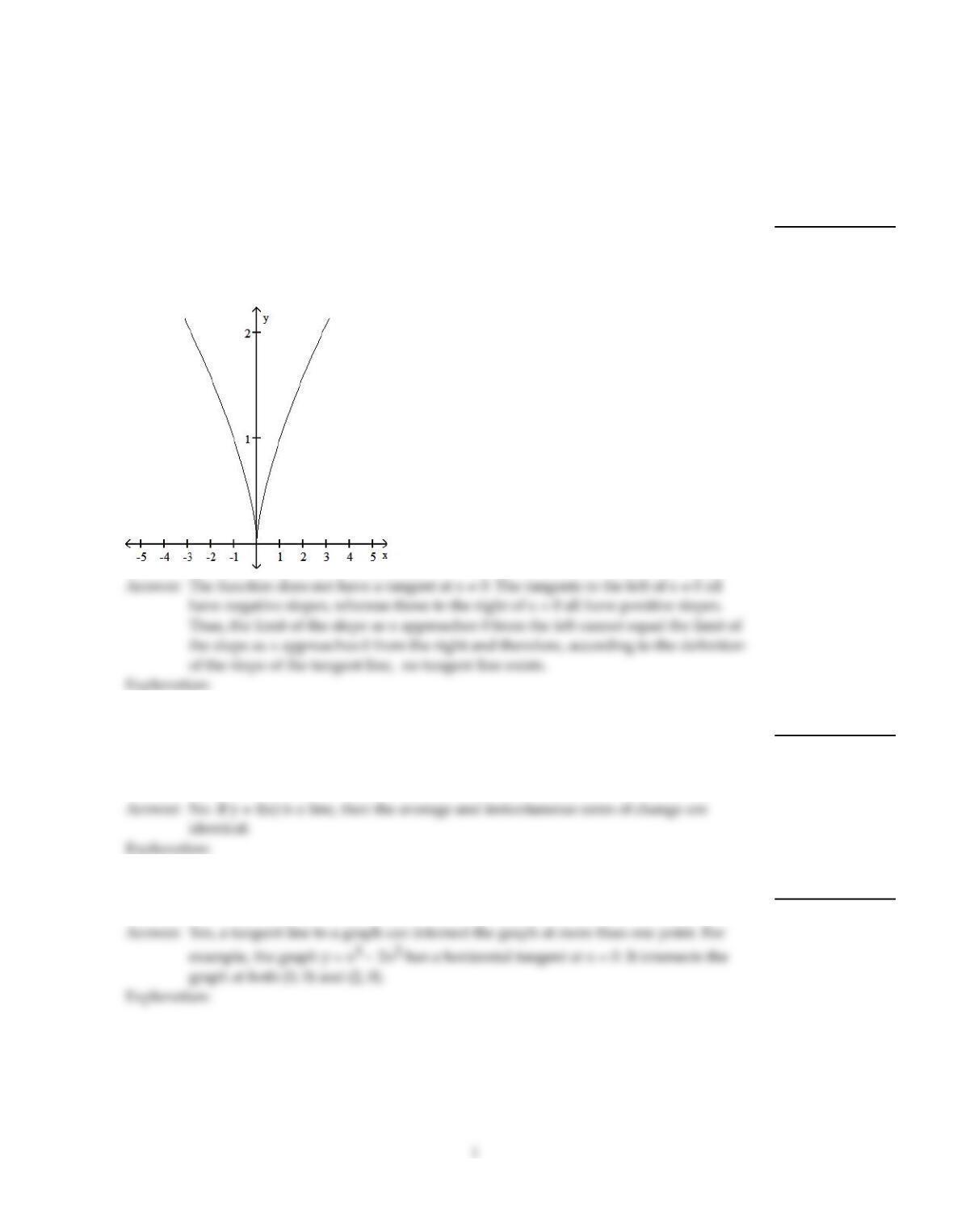
The graph of the function y = f(x) =x2/3 is shown below. The “V”–shaped graph comes to a
sharp point at x = 0. Without doing any calculations, decide whether the function has a
tangent at x = 0. Give reasons for your answer. [Hint: consider the signs of the tangent
lines on either side of x = 0 and what implication this has in terms of the limit definition of
the slope of a tangent line.].
1)
2)
A colleague asserts that a calculation of the average rate of change of y with respect to x
from x = a to x = b will always be only an approximation to the instantaneous rate of
change at x = x. Do you agree with this assertion? Explain your answer using graphs or
examples.
2)
3)
Can a tangent line to a graph intersect the graph at more than one point? If not, why not. If
so, give an example.
3)
4)
Does the curve y =x3+ 4x – 10 have a tangent whose slope is –2? If so, find an equation for
the line and the point of tangency. If not, why not?
4)
5)
If functions f(x) and g(x) are continuous for 0
x 6, could f(x)
g(x) possibly be discontinuous
at a point of [0, 6]? Provide an example.
5)
6)
Explain how the intermediate value theorem can be used to show that there is a zero for
x3– 0.6x2– 7.8x +9 between 5 and –3.
6)
7)
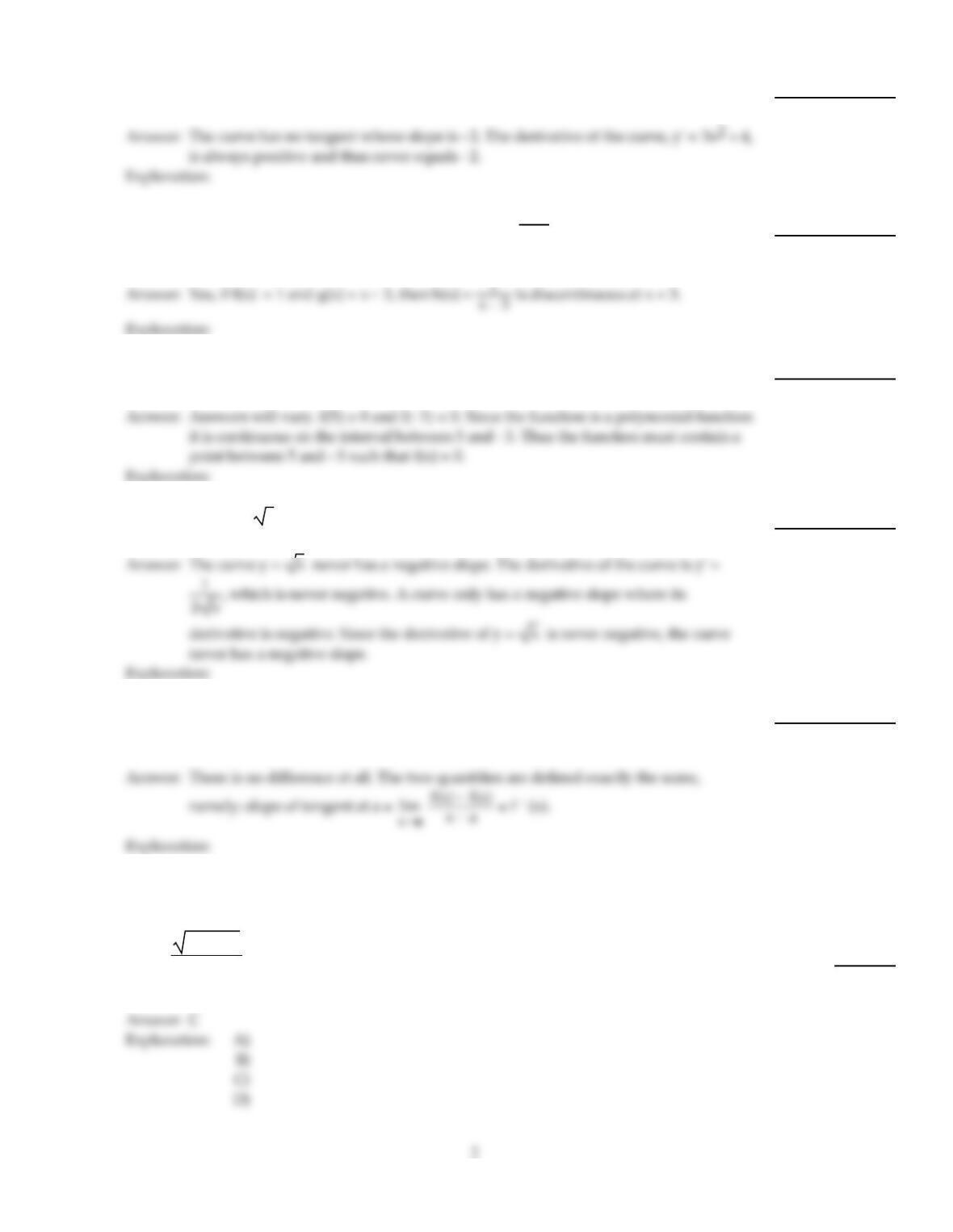
Does the curve y =x ever have a negative slope? If so, where? Give reasons for your
answer.
7)
8)
Is there any difference between the problems “find the derivative of f(x) at x = a” and “find
the slope of the line tangent to f(x) at x = a”? Explain.
8)
MULTIPLE CHOICE. Choose the one alternative that best completes the statement or answers the question.
Use a graphing utility to find the limit, if it exists.
9)
lim
x
49x2+1
3x
9)
A)
0
B)
Does not exist
C)
–2.333
D)
2.333
Find the instantaneous rate of change for the function at the given value.
10)
g(t) = 3t2+ 6 at t = 4
10)
A)
8
B)
24
C)
–24
D)
12
Find all values x = a where the function is discontinuous.
11)
f(x) = ln x –8
x +3
11)
A)
a = – 3
B)
a = – 8, 3
C)
a =8, –3
D)
Nowhere
Find the instantaneous rate of change for the function at the given value.
12)
g(x) = x2+ 11x – 15 at x = 1
12)
A)
13
B)
26
C)
11
D)
–9
Use the properties of limits to help decide whether each limit exits. If a limit exists, find its value.
13)
Let f(x) =
3x + 1 if x < 1
1if x = 1
–7x + 9 if x > 1
. Find lim
x
1f(x).
13)
A)
0
B)
4
C)
Does not exist
D)
2
Use the properties of limits to help decide whether the limit exists. If the limit exists, find its value.
14)
lim
x
5x3+ 2x
–2x4+3x3+9
14)
A)
1
B)
0
C)
–5
2
D)
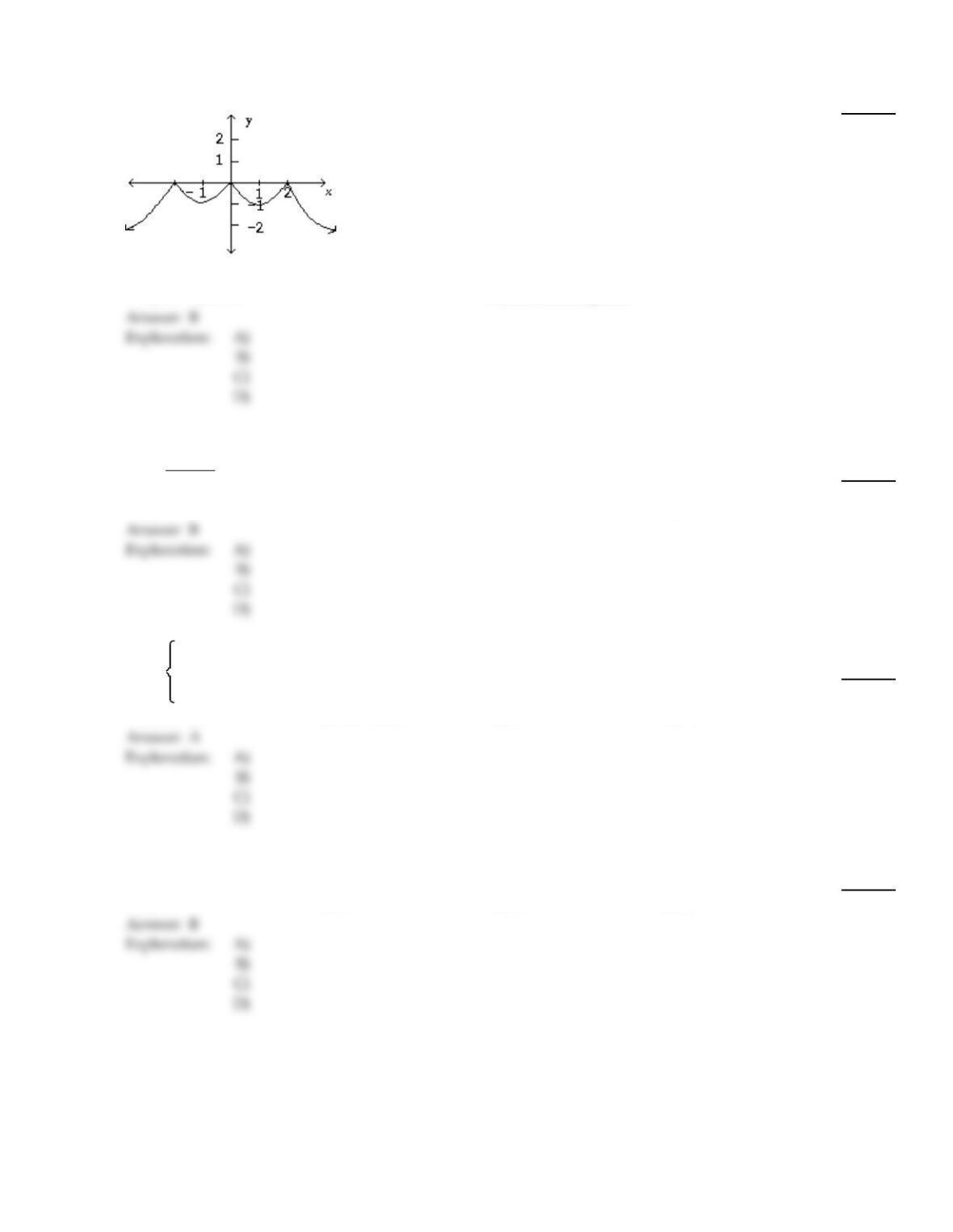
Find the x–values where the function does not have a derivative.
15)
15)
A)
x = 0
B)
x = – 2, x = 0, x = 2
C)
x = – 2, x = 2
D)
Exists at all points
Find all values x = a where the function is discontinuous.
16)
f(x) =x2–36
x +6
16)
A)
a =6
B)
a = – 6
C)
a =5
D)
a = – 36
17)
f(x) =
9if x <4
x2–7if 4
x 10
9if x >10
17)
A)
a =10
B)
Nowhere
C)
a =4
D)
a =7
Find the instantaneous rate of change for the function at the given value.
18)
F(x) = 2x2+ x – 3 at x = 4
18)
A)
19
B)
17
C)
15
D)
5
4
Complete the table and use the result to find the indicated limit.
19)
If f(x) =x – 4
x– 2 , find lim
x
4 f(x).
x 3.9 3.99 3.999 4.001 4.01 4.1
f(x)
19)
A)
x 3.9 3.99 3.999 4.001 4.01 4.1
f(x) 1.19245 1.19925 1.19993 1.20007 1.20075 1.20745 ; limit = 1.20
B)
x 3.9 3.99 3.999 4.001 4.01 4.1
f(x) 5.07736 5.09775 5.09978 5.10022 5.10225 5.12236 ; limit = 5.10
C)
x 3.9 3.99 3.999 4.001 4.01 4.1
f(x) 1.19245 1.19925 1.19993 1.20007 1.20075 1.20745 ; limit =
D)
x 3.9 3.99 3.999 4.001 4.01 4.1
f(x) 3.97484 3.99750 3.99975 4.00025 4.00250 4.02485 ; limit = 4.0
Use a graphing calculator to find f’(x) when x has the given value.
20)
f(x) =4ex; x = – 3
20)
A)
4.0498
B)
0.1991
C)
–32.6194
D)
–12
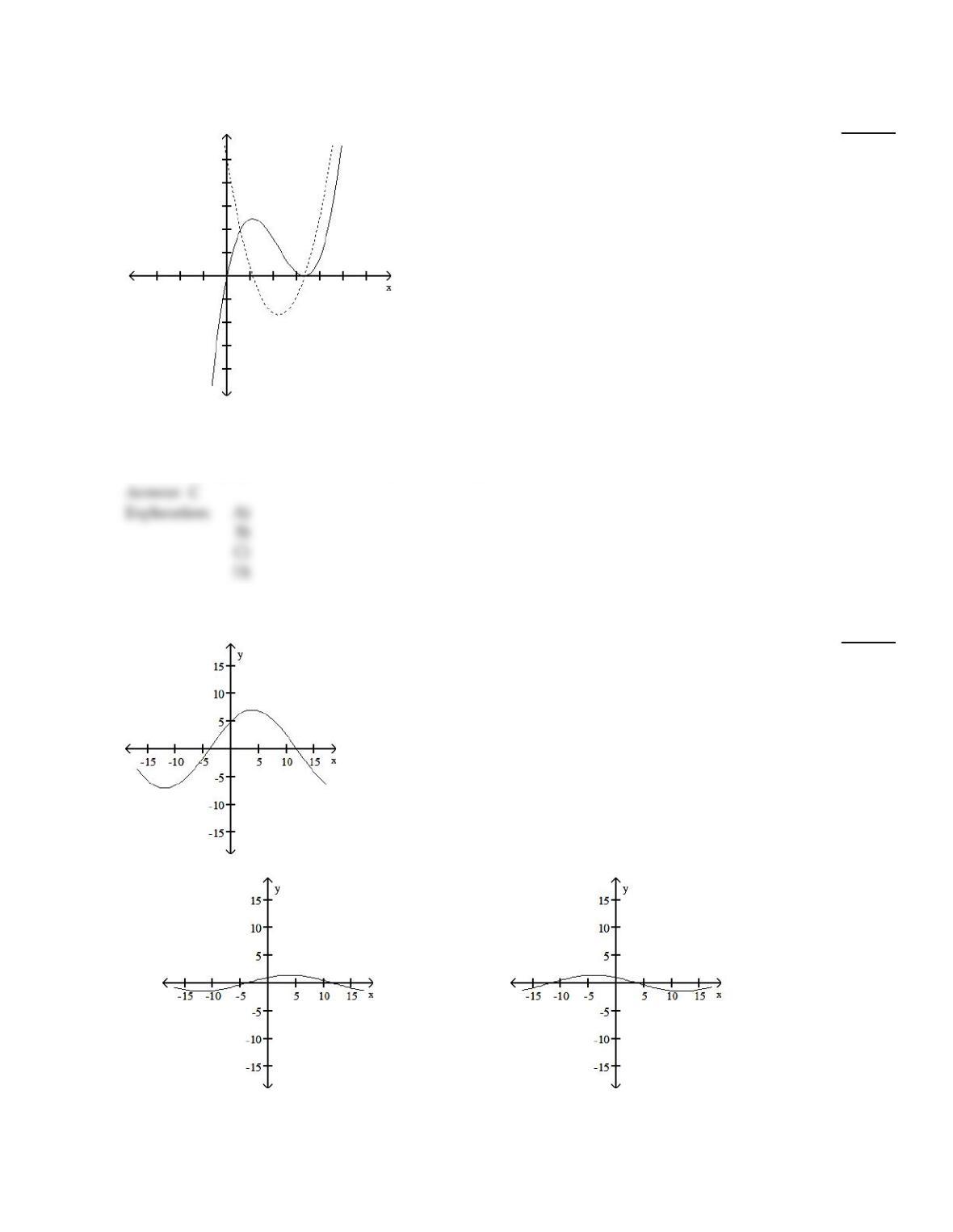
The graphs of a function f(x) and its derivative f'(x) are shown below. Decide which is the graph of f(x) and which is the
graph of f'(x).
21)
21)
A)
f(x) is the dashed line; f'(x) is the solid line.
B)
Either graph could be the derivative of the other.
C)
f(x) is the solid line; f'(x) is the dashed line.
D)
Neither graph could be the derivative of the other.
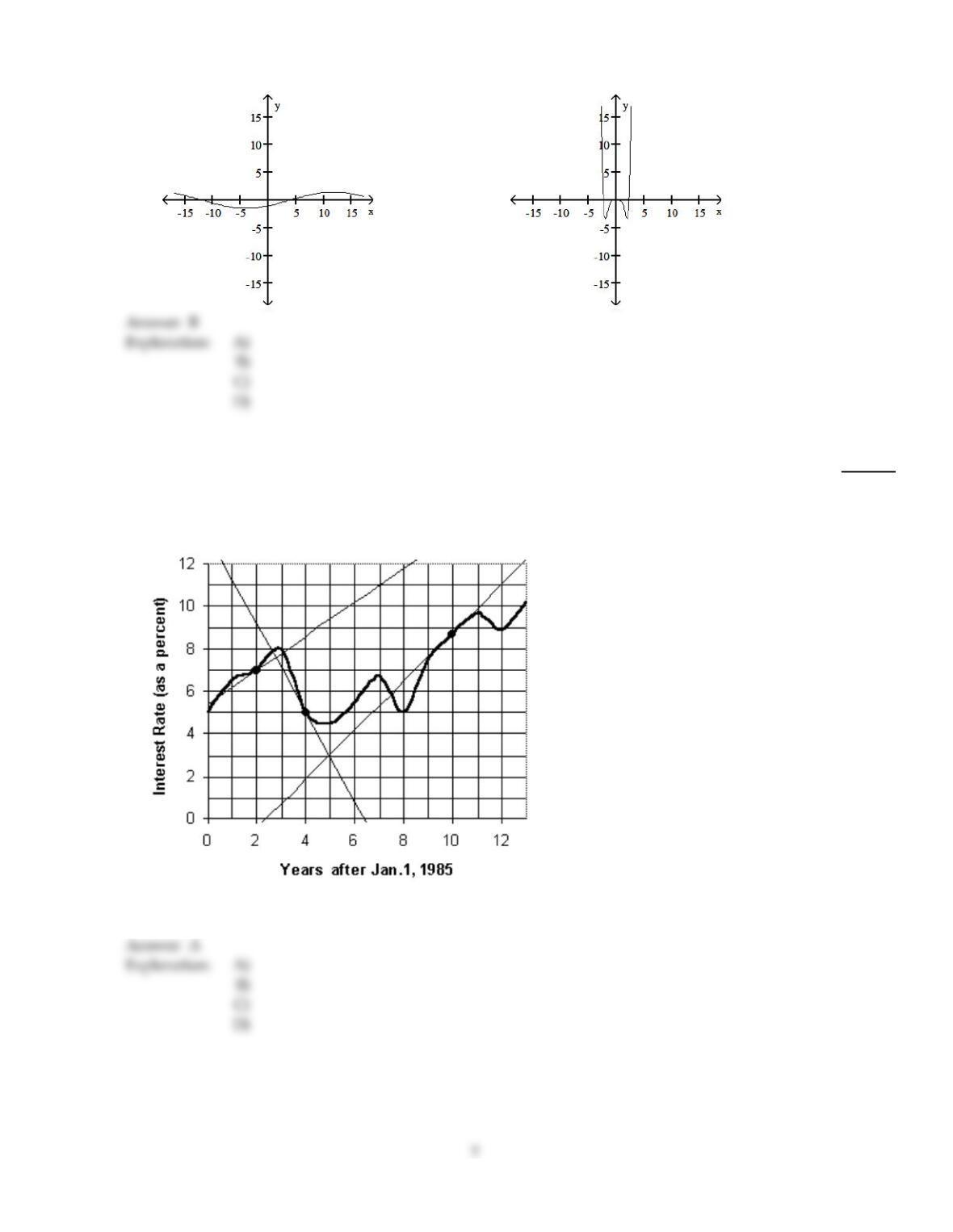
Sketch the derivative of the graph.
22)
22)
A)
B)
6
C)
D)
Solve the problem.
23)
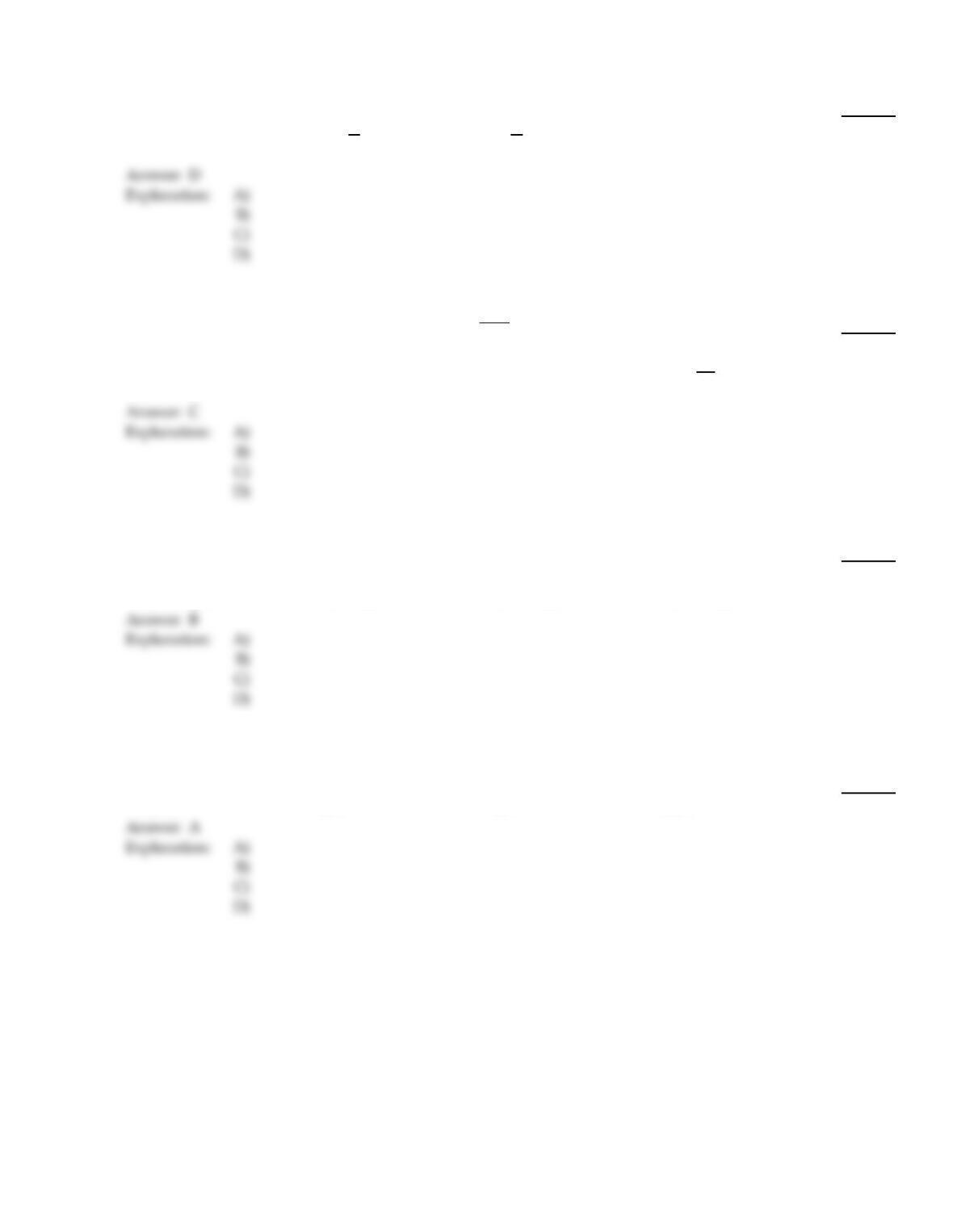
Refer to the figure, where f(t) is the interest rate (as a percent) on a 6–month certificate of deposit t
years after January 1, 1985. The straight lines are tangent to the graph of y = f(t) at t = 2, t = 4, and
t = 10. How fast was the interest rate changing on January 1, 1995?
23)
A)
1%/year
B)
–2%/year
C)
0%/year
D)
2%/year
Find the average rate of change for the function over the given interval.
24)
y = x3+ x2– 8x – 7 between x = 0 and x = 2
24)
A)
–28
B)
–1
6
C)
1
2
D)
–2
Give an appropriate answer.
25)
Let lim
x –5f(x) =10 and lim
x –5g(x) = – 1. Find lim
x –5
f(x)
g(x) .
25)
A)
11
B)
–5
C)
– 10
D)
–1
10
Solve the problem.
26)
The number of gallons of water in a swimming pool t minutes after the pool has started to drain is
Q(t) = 50(20 – x)2. How fast is the water running out at the end of 12 minutes?
26)
A)
400 gal/min
B)
800 gal/min
C)
1600 gal/min
D)
3200 gal/min
Suppose the position of an object moving in a straight line is given by the specified function. Find the instantaneous
velocity at time t.
27)
s(t) =t2+4t +3, t = 1
27)
A)
6
B)
8
C)
9
D)
5
8
Solve the problem.
28)
A ball is thrown vertically upward from the ground at a velocity of 65 feet per second. Its distance
from the ground after t seconds is given by s(t) = – 16t2+65t. How fast is the ball moving 2 seconds
after being thrown?
28)
A)
1 ft per sec
B)
–5 ft per sec
C)
33 ft per sec
D)
66 ft per sec
Give an appropriate response.
29)
Find the limit of f(x) as x approaches 2 from the left.
f(x) =
1if x <2
x +2if 2 x 4
6if x >4
29)
A)
6
B)
1
C)
4
D)
The limit does not exist.
B
Give an appropriate answer.
30)
Let lim
x
9f(x) =3 and lim
x
9g(x) = – 1. Find lim
x
9
[f(x)]2
6+ g(x) .
30)
A)
9
5
B)
9
25
C)
3
5
D)
9
A
Use a graphing calculator to find f’(x) when x has the given value.
31)
f(x) =6 ln|x|; x =5
31)
A)
7.2
B)
0
C)
0.8333
D)
1.2
D
A
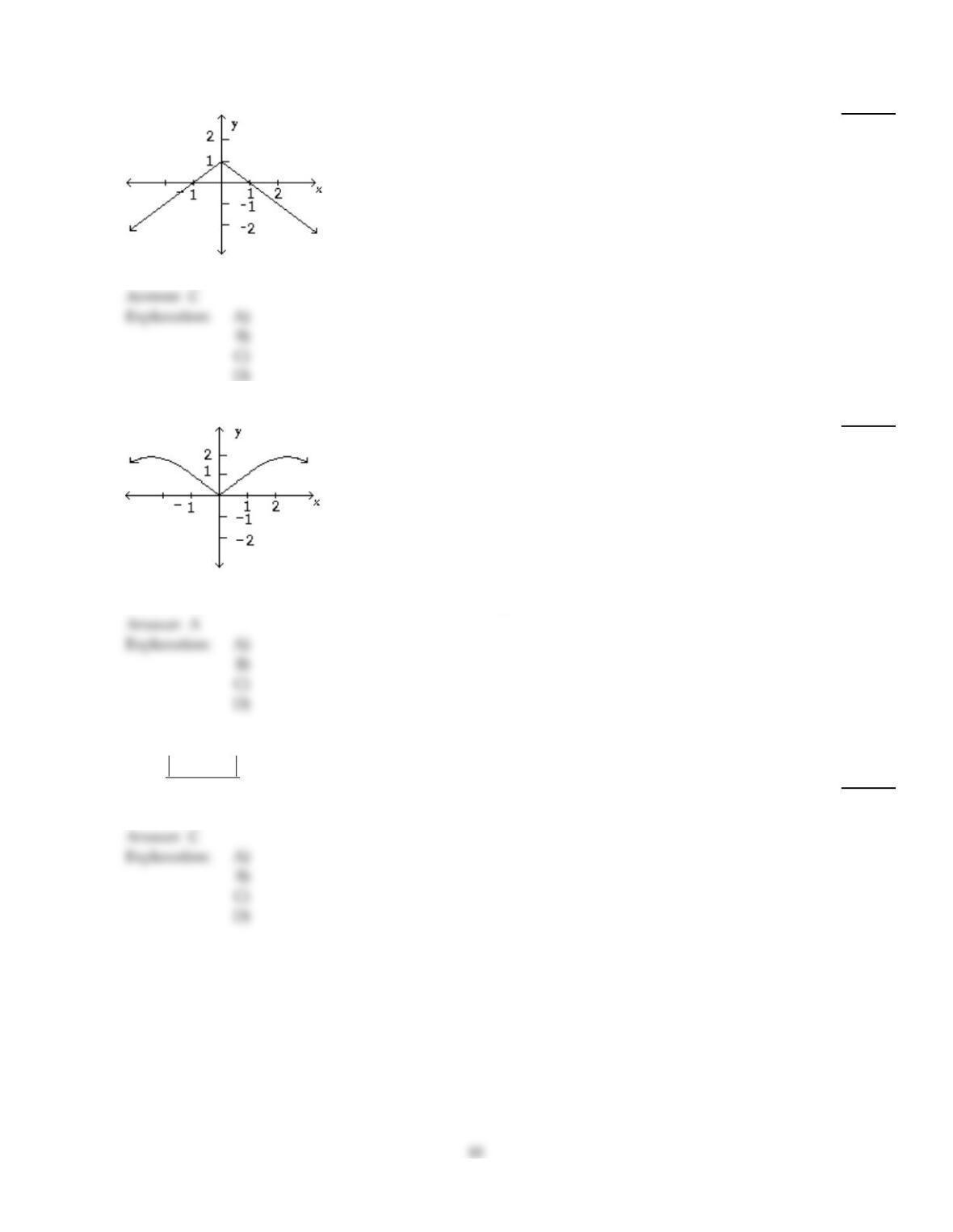
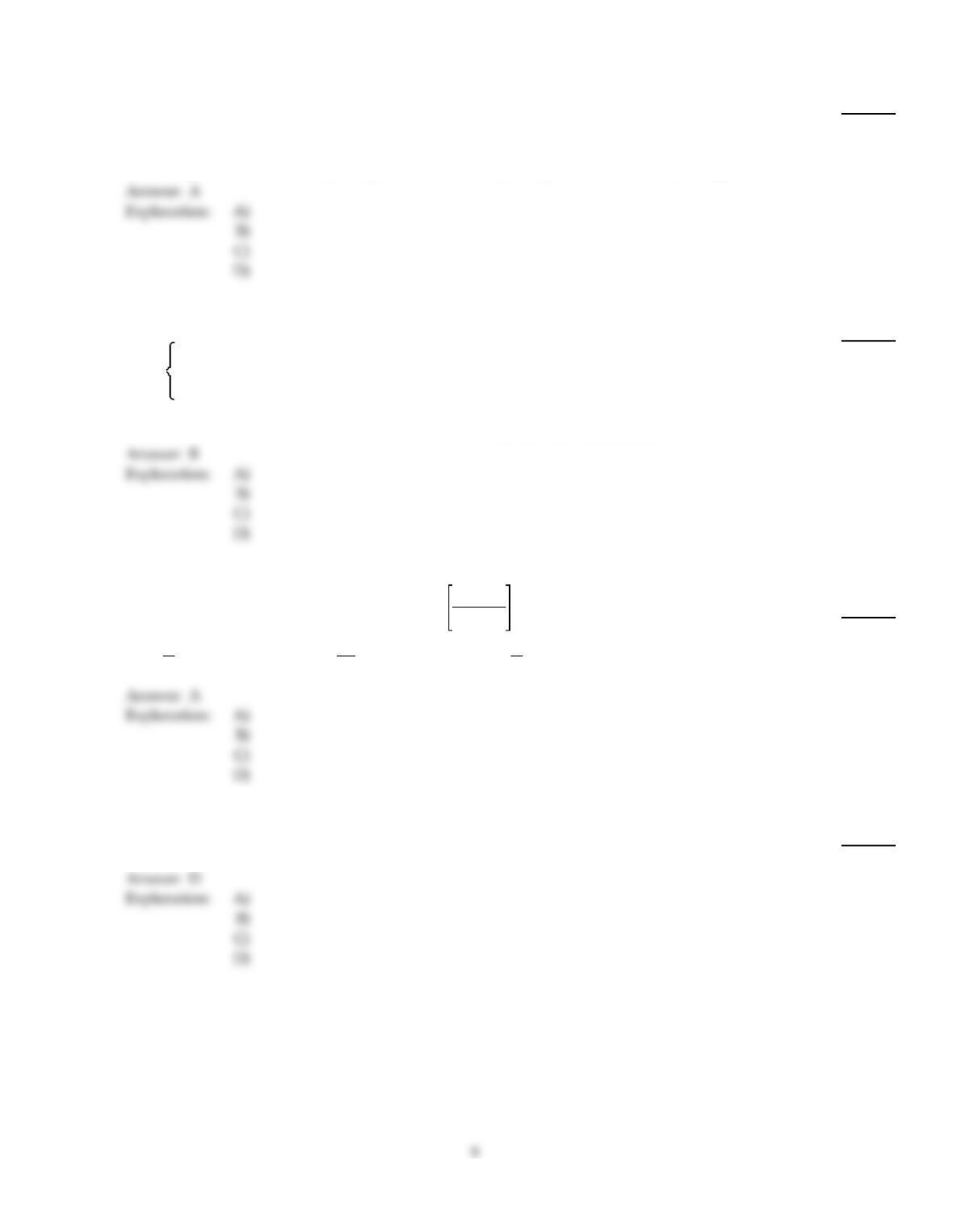
Find the x–values where the function does not have a derivative.
32)
32)
A)
x = – 1
B)
x = 1
C)
x = 0
D)
x = 2
33)
33)
A)
x = 0
B)
x = 2
C)
x = – 2, x = 2
D)
x = – 2, x = 0, x = 2
Find all values x = a where the function is discontinuous.
34)
f(x) =x2–100
x –4
34)
A)
a = – 10, 10, 4
B)
Nowhere
C)
a =4
D)
a =10, 4
Find the equation of the secant line through the points where x has the given values.
35)
f(x) =6 x; x =25, x =4
35)
A)
y = – 6
7x+60
7
B)
y =6
2 x
C)
y =6
7x –60
7
D)
y =6
7x +60
7
Find the equation of the tangent line to the curve when x has the given value.
36)
f(x) =x2–3 ; x =2
36)
A)
y =4x –7
B)
y =4x –11
C)
y =4x –14
D)
y =2x –7
Suppose the position of an object moving in a straight line is given by the specified function. Find the instantaneous
velocity at time t.
37)
s(t) =5t2–7t –3, t =4
37)
A)
30
B)
49
C)
13
D)
33
Solve the problem.
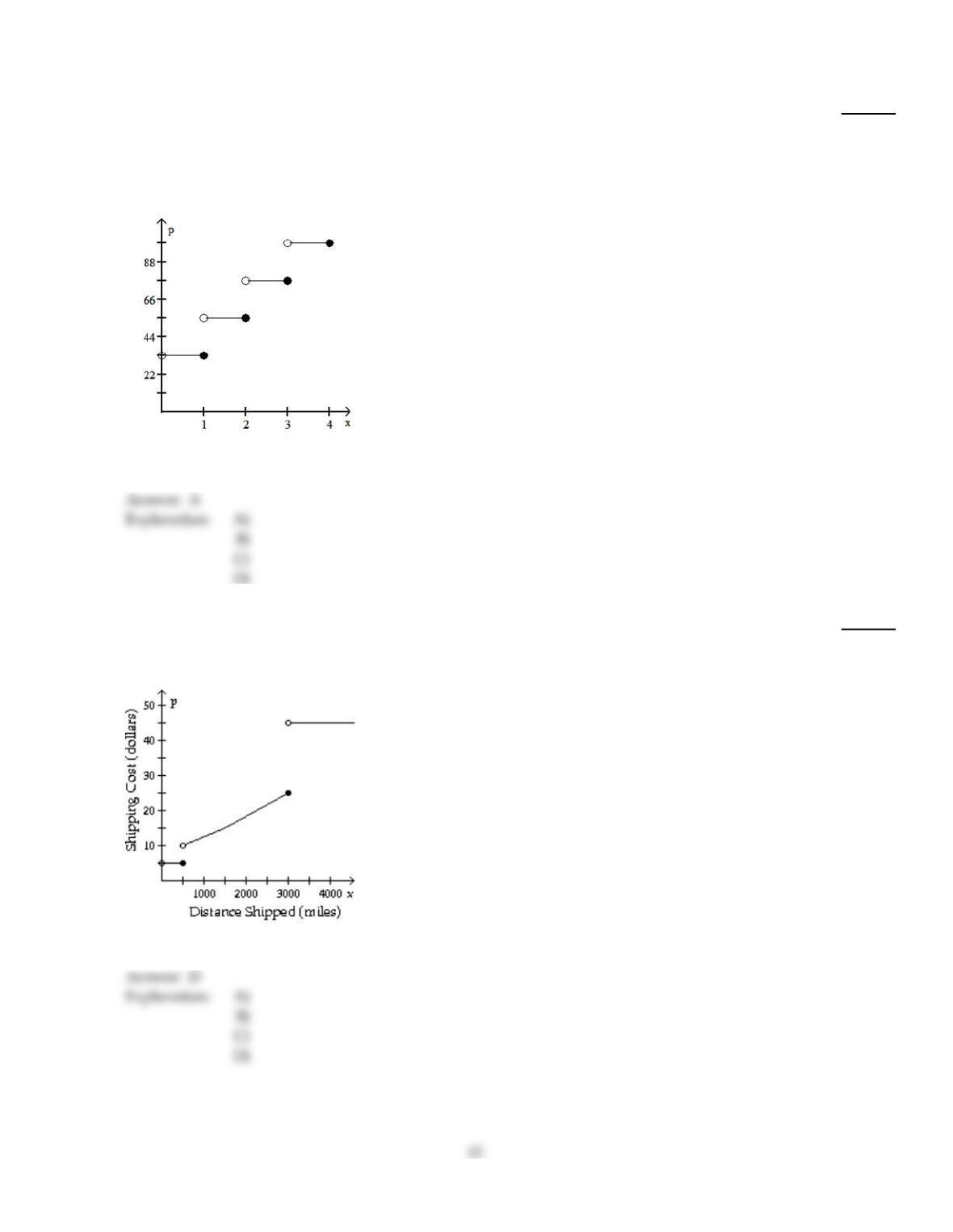
38)
Given is a graph of a portion of the postage function, which depicts the cost (in cents) of mailing a
letter, p, versus the weight (in ounces) of the letter, x. Find each limit, if it exists:
lim
x
3–
p(x), lim
x
3+
p(x), lim
x
3p(x)
38)
A)
77; 99; does not exist
B)
77; 99; 77
C)
77; 77; 77
D)
99; 77; does not exist
39)
Suppose that the cost, p, of shipping a 3–pound parcel depends on the distance shipped, x,
according to the function p(x) depicted in the graph. Is p continuous at x = 50? at x = 500? at
x = 1500? at x = 3000?
39)
A)
Yes; yes; yes; no
B)
Yes; no; no; no
C)
No; no; yes; no
D)
Yes; no; yes; no
Find the average rate of change for the function over the given interval.
40)
y =2x – 1 between x = 1 and x = 5
40)
A)
–1
6
B)
1
2
C)
–28
D)
–2
Use the properties of limits to help decide whether the limit exists. If the limit exists, find its value.
41)
lim
x
0
1
x +6–1
6
x
41)
A)
Does not exist
B)
0
C)
1
36
D)
–1
36
Find the equation of the secant line through the points where x has the given values.
42)
f(x) =8
x; x =6, x =10
42)
A)
y = – 2
15 x
B)
y = – 8
x2
C)
y = – 2
15 x +32
15
D)
y =2
15 x –32
15
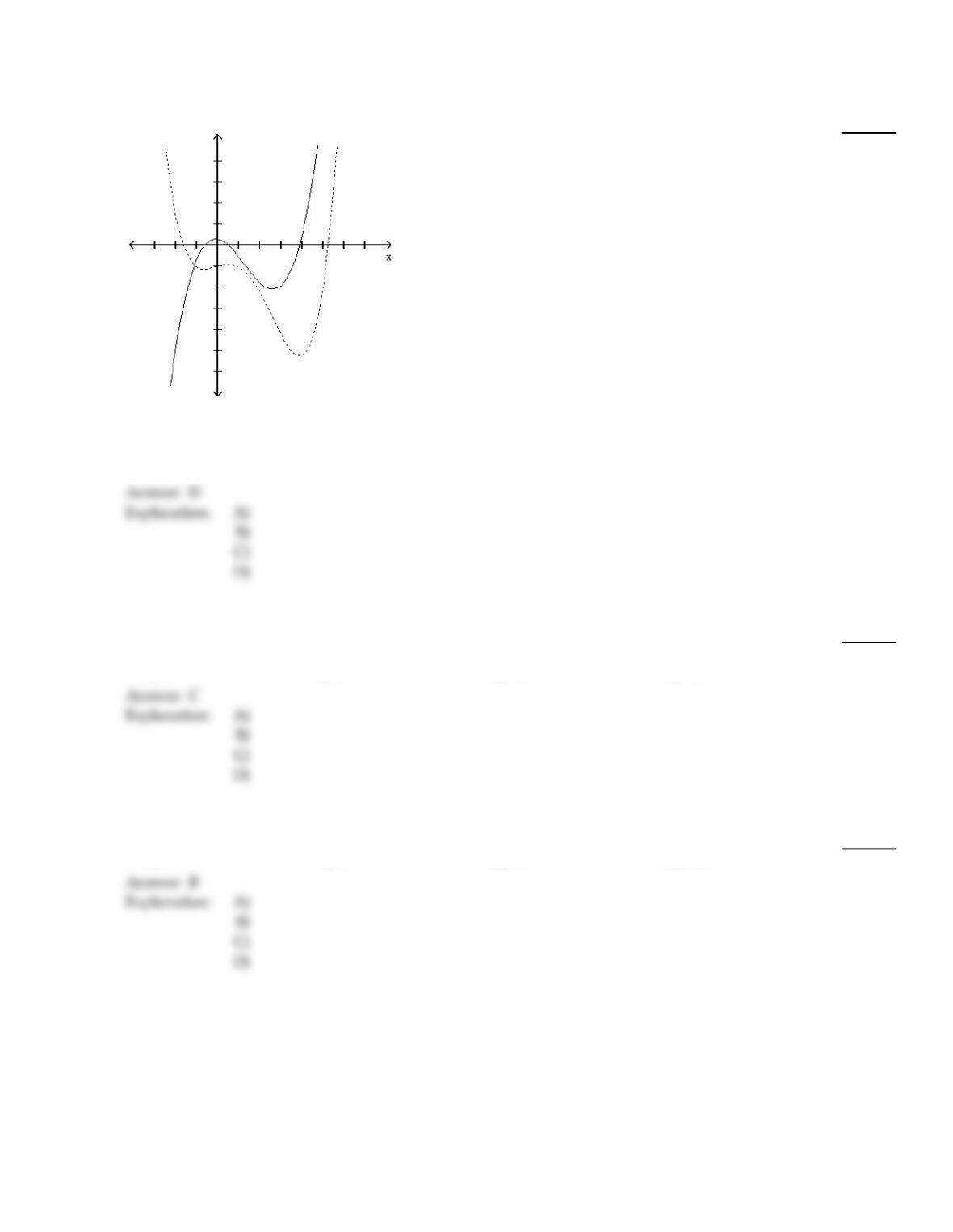
The graphs of a function f(x) and its derivative f'(x) are shown below. Decide which is the graph of f(x) and which is the
graph of f'(x).
43)
43)
A)
Neither graph could be the derivative of the other.
B)
f(x) is the solid line; f'(x) is the dashed line.
C)
Either graph could be the derivative of the other.
D)
f(x) is the dashed line; f'(x) is the solid line.
Give an appropriate answer.
44)
Let lim
x
4f(x) =3 and lim
x
4g(x) = – 2. Find lim
x
4[f(x) · g(x)].
44)
A)
1
B)
4
C)
–6
D)
–2
Find the instantaneous rate of change for the function at the given value.
45)
s(t) = 3t2+ 5t – 7 at t = – 2
45)
A)
1
B)
–7
C)
–1
D)
–17
14
Solve the problem.
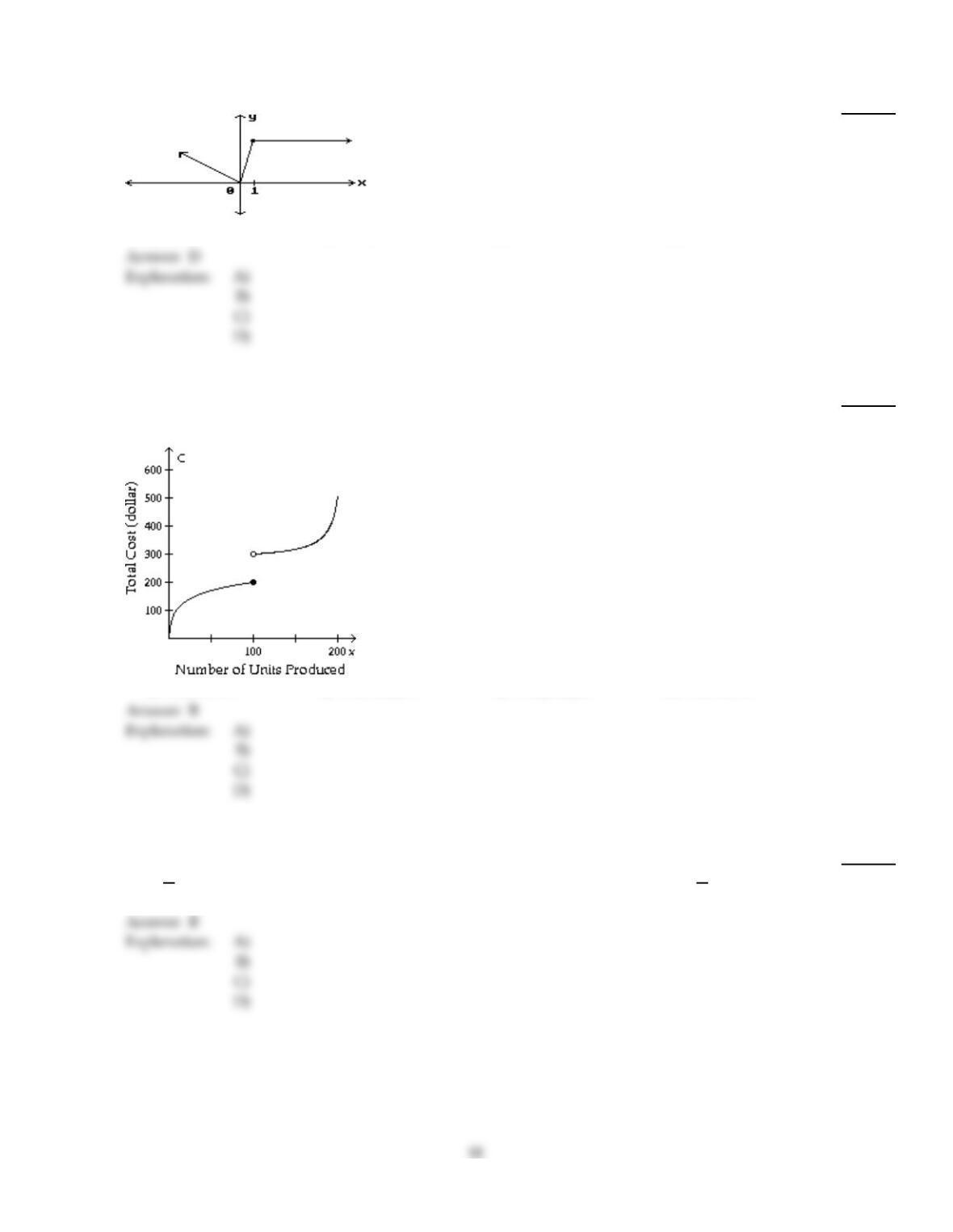
46)
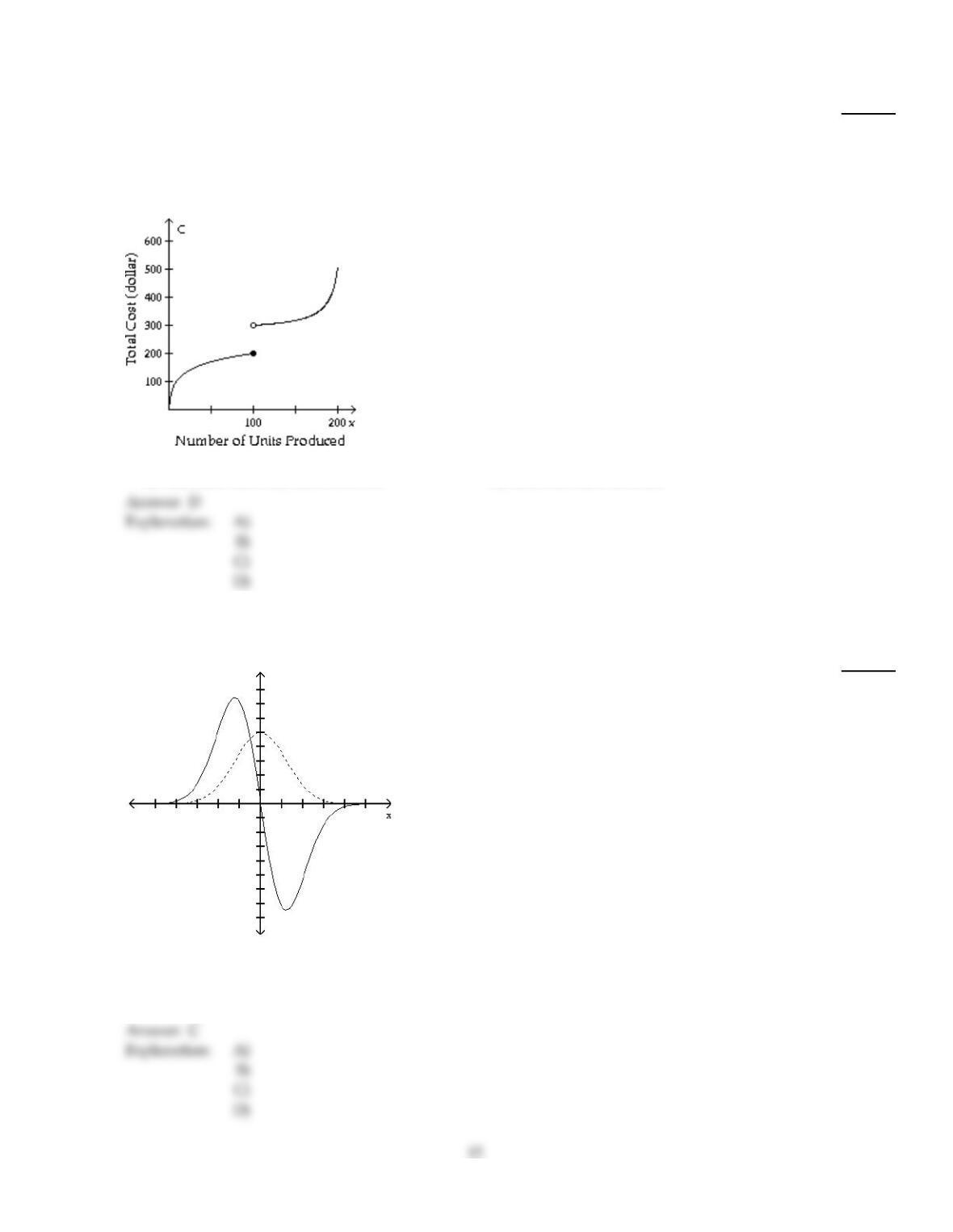
Suppose the the cost, C, of producing x units of a product can be illustrated by the given graph.
Find each limit, if it exists:
lim
x
100–
p(x), lim
x
100+
p(x), lim
x
100 p(x)
46)
A)
200; 300; 200
B)
200; 200; 200
C)
200; does not exist; does not exist
D)
200; 300; does not exist
The graphs of a function f(x) and its derivative f'(x) are shown below. Decide which is the graph of f(x) and which is the
graph of f'(x).
47)
47)
A)
Neither graph could be the derivative of the other.
B)
Either graph could be the derivative of the other.
C)
f(x) is the dashed line; f'(x) is the solid line.
D)
f(x) is the solid line; f'(x) is the dashed line.
Solve the problem.
48)
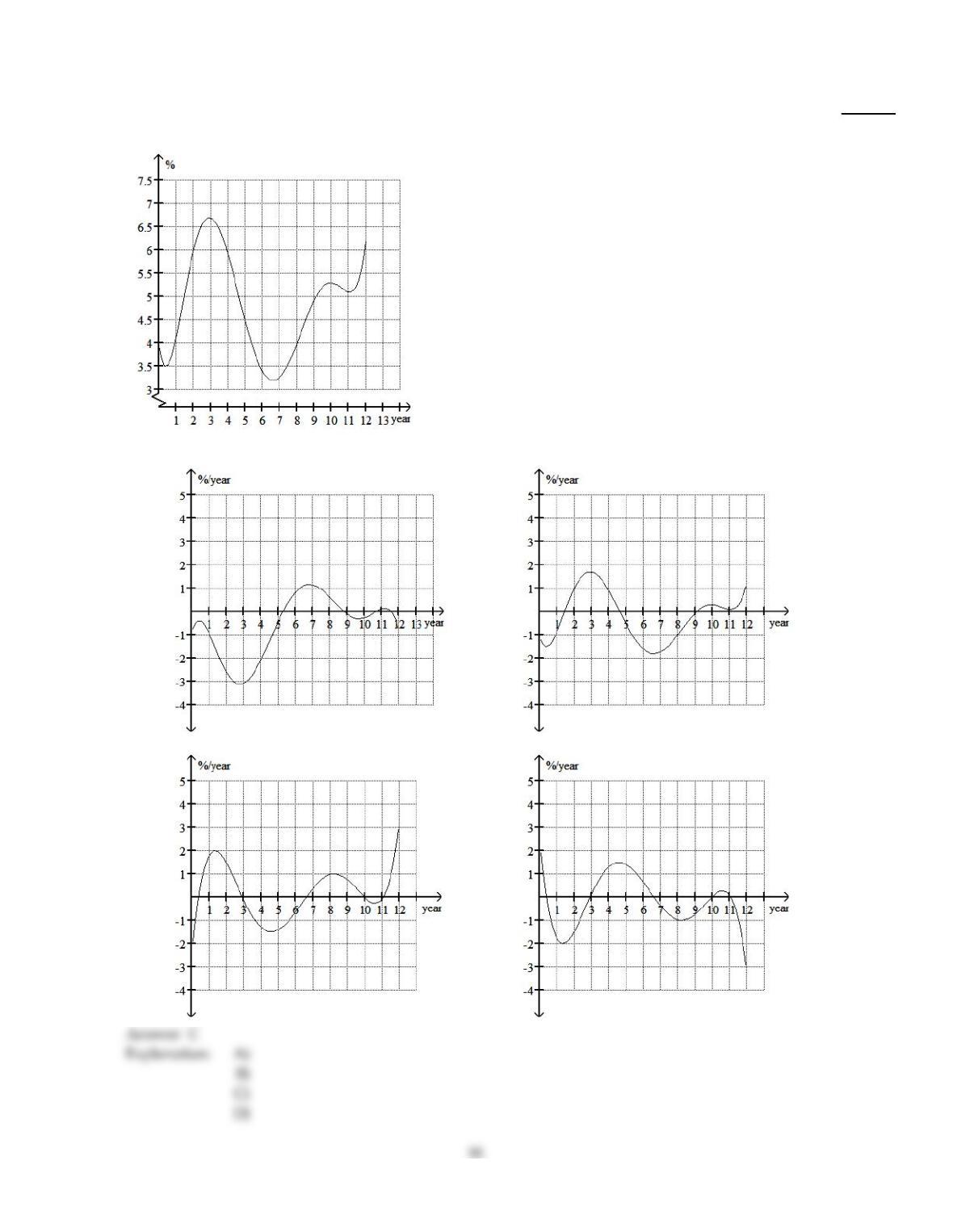
The graph shows the yearly average interest rates for 30–year mortgages for years since 1998 (Year
0 corresponds to 1998). Sketch a graph of the rate of change of interest rates with respect to time.
48)
A)
B)
C)
D)
Use the properties of limits to help decide whether the limit exists. If the limit exists, find its value.
49)
lim
x
7
x2+3x –70
x2–49
49)
A)
17
14
B)
–3
14
C)
0
D)
Does not exist
Use a graphing calculator to find f’(x) when x has the given value.
50)
f(x) =xx/2; x =3
50)
A)
–0.2019
B)
0.2938
C)
5.4524
D)
1.6932
Find the instantaneous rate of change for the function at the given value.
51)
s(t) =t2+ 5t at t = 4
51)
A)
21
B)
9
C)
13
D)
3
Find the equation of the tangent line to the curve when x has the given value.
52)
f(x) =64
x ; x =2
52)
A)
y = – 32x +96
B)
y = – 16x +32
C)
y = – 16x
D)
y = – 16x +64
Find all points where the function is discontinuous.
53)
53)
A)
x = 0
B)
x = 0, x = 1
C)
x = 1
D)
None
Solve the problem.
54)
Suppose that the cost, C, of producing x units of a product can be illustrated by the given graph. Is
C(x) continuous at x = 50? x = 100? x = 150?
54)
A)
Yes; no; no
B)
Yes; no; yes
C)
Yes; yes; yes
D)
No; no; no
Find the average rate of change for the function over the given interval.
55)
y = – 3x2– x between x = 5 and x = 6
55)
A)
1
2
B)
–34
C)
–2
D)
–1
6
Find the equation of the tangent line to the curve when x has the given value.
56)
f(x) =x2– x ; x = – 4
56)
A)
y = – 9x –16
B)
y = – 9x –12
C)
y = – 9x +12
D)
y = – 9x +16
Give an appropriate answer.
57)
Let lim
x
6f(x) =2. Find lim
x
6(–4)f(x).
57)
A)
4096
B)
16
C)
–4
D)
2
Use the properties of limits to help decide whether the limit exists. If the limit exists, find its value.
58)
lim
x
9
x2–81
x –9
58)
A)
Does not exist
B)
1
C)
18
D)
9
Solve the problem.
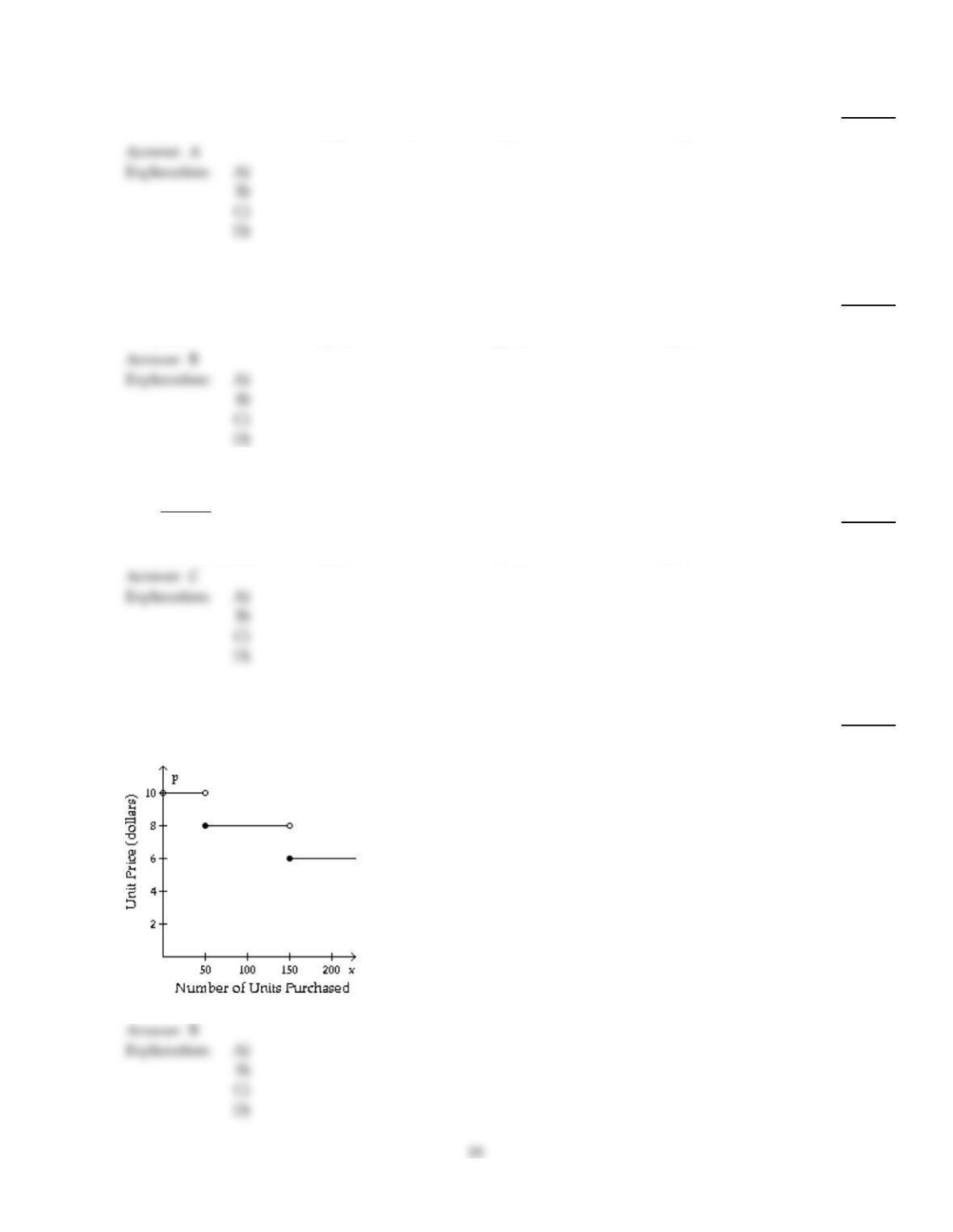
59)
Suppose that the unit price, p, for x units of a product can be illustrated by the given graph. Is p(x)
continuous at x = 50? x = 100? x = 150?
59)
A)
Yes; no; yes
B)
No; yes; no
C)
No; yes; yes
D)
No; no; no
60)
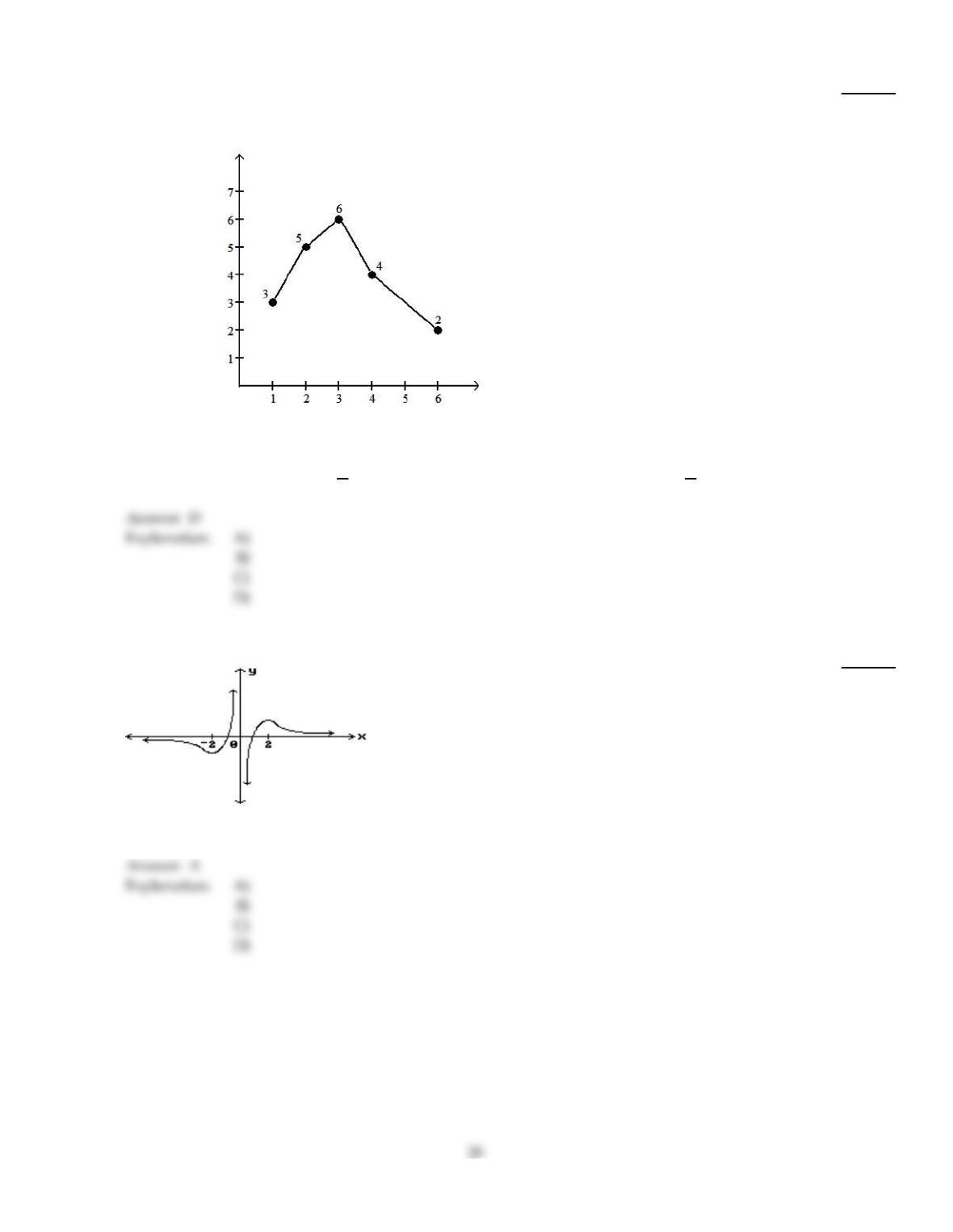
The graph shows the population in millions of bacteria t minutes after a bactericide is introduced
into a culture. Find the average rate of change of population with respect to time for the time from 1
to 4 minutes.
Population
(in millions)
Time (in minutes)
60)
A)
3
B)
1
4
C)
4
D)
1
3
Find all points where the function is discontinuous.
61)
61)
A)
x = 0
B)
None
C)
x = – 2, x = 0, x = 2
D)
x = – 2, x = 2