Survey of Economics, 6e (O’Sullivan/Sheffrin/Perez)
Chapter 3 Demand, Supply, and Market Equilibrium
3.1 The Demand Curve
1) If a competitive market operates perfectly, it relies on
A) the number of people buying goods.
B) the laws of supply and demand.
C) how many products can be produced for sale.
D) how much people are willing to pay for the products.
2) A change in the quantity demanded of a product is the result of a change in
A) the price of the product.
B) the price of related goods.
C) consumer income.
D) the cost of producing the product.
3) A demand curve is defined as the relationship between
A) the price of a good and the quantity of that good that consumers are willing to buy.
B) the price of a good and the quantity of that good that producers are willing to sell.
C) the income of consumers and the quantity of a good that consumers are willing to buy.
D) the income of consumers and the quantity of a good that producers are willing to sell.
4) The quantity demanded of a product increases as
A) consumer income rises.
B) the prices of other products fall.
C) the price of the product rises.
D) the price of the product falls.
5) The Law of Demand can be explained as
A) a lot of people wanting the same thing.
B) the higher the price, the smaller the quantity demanded, ceteris paribus.
C) people are willing to make limited sacrifices to acquire products.
D) legal reasons people make purchases in the marketplace.
6) In considering the relationships between price and quantity demanded, ceteris paribus directs
the economist to assume that
A) price increases affect quantity.
B) quantity increases affect prices.
C) either price nor quantity affect demand.
D) all other variables remain unchanged.
7) When there is a change in the quantity demanded it means that
A) the hours the customer can buy products each day have increased.
B) the number of products in inventory have increased.
C) the quantity a consumer is willing to buy changes when the price changes.
D) the selling price of the products has not changed.
8) The market demand curve
A) shows the relationship between the price of a good and the quantity that all consumers
together are willing to buy.
B) is drawn assuming that variables such as income and tastes are variable.
C) is drawn assuming that the number of consumers is variable.
D) is drawn assuming that the selling price is fixed.
9) Suppose that there are only three consumers of a product. At a price of $6 per unit, the first
consumer would buy 12 units of the product, the second consumer would buy 8 units, and the
third consumer would buy 3 units of the product. If you drew a market demand curve for this
product, the quantity demanded at a price of $6 would be
A) 23 units.
B) 20 units.
C) 12 units.
D) 11 units.
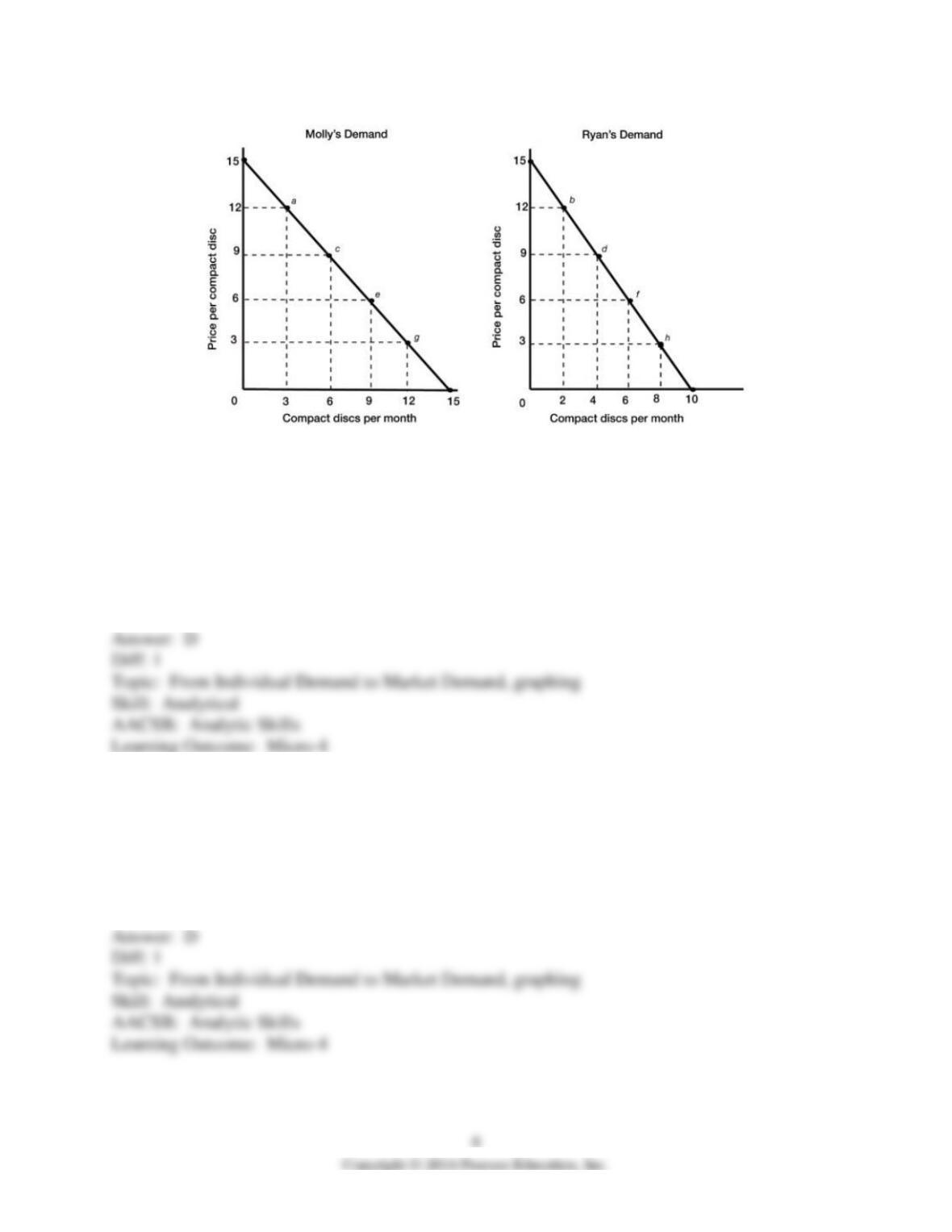
Figure 3.1
10) Refer to Figure 3.1, which shows Molly’s and Ryan’s individual demand curves for compact
discs per month. Assuming Molly and Ryan are the only consumers in the market, what is the
market quantity demanded at a price of $3?
A) 6
B) 9
C) 15
D) 20
11) Refer to Figure 3.1, which shows Molly’s and Ryan’s individual demand curves for compact
discs per month. Assuming Molly and Ryan are the only consumers in the market, what is the
market quantity demanded at a price of $9?
A) 2
B) 4
C) 6
D) 10
12) Refer to Figure 3.1, which shows Molly’s and Ryan’s individual demand curves for compact
discs per month. Assuming Molly and Ryan are the only consumers in the market, if the market
quantity demanded is 15, the price must be
A) $0.
B) $6.
C) $9.
D) $15.
13) Refer to Figure 3.1, which shows Molly’s and Ryan’s individual demand curves for compact
discs per month. Assuming Molly and Ryan are the only consumers in the market, if the market
quantity demanded is 5, the price must be
A) $3.
B) $6.
C) $9.
D) $12.
Recall the Application about the decrease in taxes on cigarettes in several Canadian
provinces in 1994 to answer the following question(s).
14) Recall the application. After the government deceased cigarette taxes in several Canadian
provinces, demand for cigarettes ________ in these provinces, shifting the demand curve to the
________.
A) increased; right
B) increased; left
C) decreased; right
D) decreased; left
15) Recall the Application. The change in demand for cigarettes resulting from the decrease in
taxes would normally create, ceteris paribus,
A) an increase in their supply.
B) a decrease in their supply.
C) an increase in their quantity supplied.
D) a decrease in their quantity supplied.
16) Recall the application. After the government deceased cigarette taxes in several Canadian
provinces in 1994, the price of cigarettes in these provinces decreased by roughly ________%.
A) 8
B) 17
C) 50
D) 88
17) Recall the application. After the government deceased cigarette taxes in several Canadian
provinces in 1994, the decrease in the price of cigarettes in these provinces
A) more than doubled the smoking rate.
B) created no noticeable change in the smoking rate.
C) increased the smoking rate by roughly 17%.
D) was accompanied by a slight decrease in the rate of smoking.
18) As the price of a product falls, the demand for the product increases, ceteris paribus.
19) On the “demand side” of a market, consumers indicate what they are willing to buy, in what
quantity and at what price.
20) The law of demand states that there is a negative relationship between price and quantity
demanded, ceteris paribus.
21) The market demand curve shows the relationship between the price and the quantity
demanded by all consumers, everything else being equal.
3.2 The Supply Curve
1) A supply curve is defined as the relationship between
A) the price of a good and the quantity that consumers are willing to buy.
B) the price of a good and the quantity that producers are willing to sell.
C) the income of consumers and the quantity of a product that consumers are willing to buy.
D) the income of consumers and the quantity of a product that producers are willing to sell.
2) A change in quantity supplied of a product is the result of a change in
A) consumer income.
B) the state of production technology.
C) the cost of producing the product.
D) the price of the product.
3) The Law of Supply states that
A) producers should only produce what they can sell.
B) producers should only sell the items when the price is right.
C) there is a positive relationship between price and quantity supplied, ceteris paribus.
D) producers are legally required to make necessary items available in the marketplace.
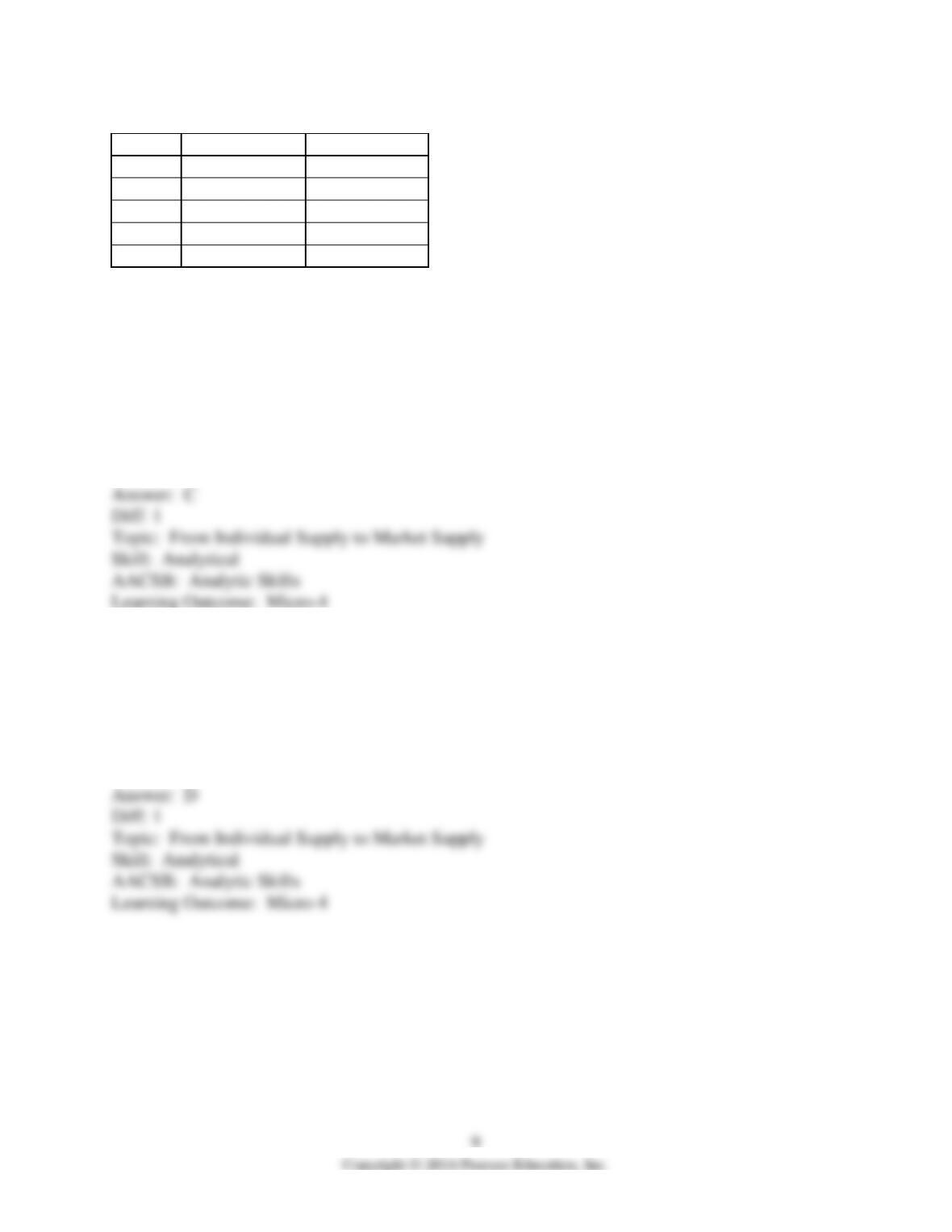
Quantity of Frozen Latte-On-A-Stick Supplied
Price
Flo’s Supply
Rita’s Supply
1
0
0
2
0
3
3
4
6
4
9
9
5
15
12
Table 3.1
4) Refer to Table 3.1, which shows Flo’s and Rita’s individual supply schedules for frozen latte-
on-a-stick. Assuming Flo and Rita are the only suppliers in the market, what is the market
quantity supplied at a price of $2?
A) 0
B) 2
C) 3
D) 5
5) Refer to Table 3.1, which shows Flo’s and Rita’s individual supply schedules for frozen latte-
on-a-stick. Assuming Flo and Rita are the only suppliers in the market, what is the market
quantity supplied at a price of $5?
A) 3
B) 12
C) 15
D) 27
6) Refer to Table 3.1, which shows Flo’s and Rita’s individual supply schedules for frozen latte-
on-a-stick. Assuming Flo and Rita are the only suppliers in the market, what is the market
quantity supplied at a price of $1?
A) 0
B) 1
C) 3
D) 5
7) Refer to Table 3.1, which shows Flo’s and Rita’s individual supply schedules for frozen latte-
on-a-stick. Assuming Flo and Rita are the only suppliers in the market, if the market quantity
supplied is 18, the price must be
A) $2.
B) $3.
C) $4.
D) $5.
8) Refer to Table 3.1, which shows Flo’s and Rita’s individual supply schedules for frozen latte-
on-a-stick. Assuming Flo and Rita are the only suppliers in the market, if the market quantity
supplied is 3, the price must be
A) $0.
B) $2.
C) $4.
D) $5.
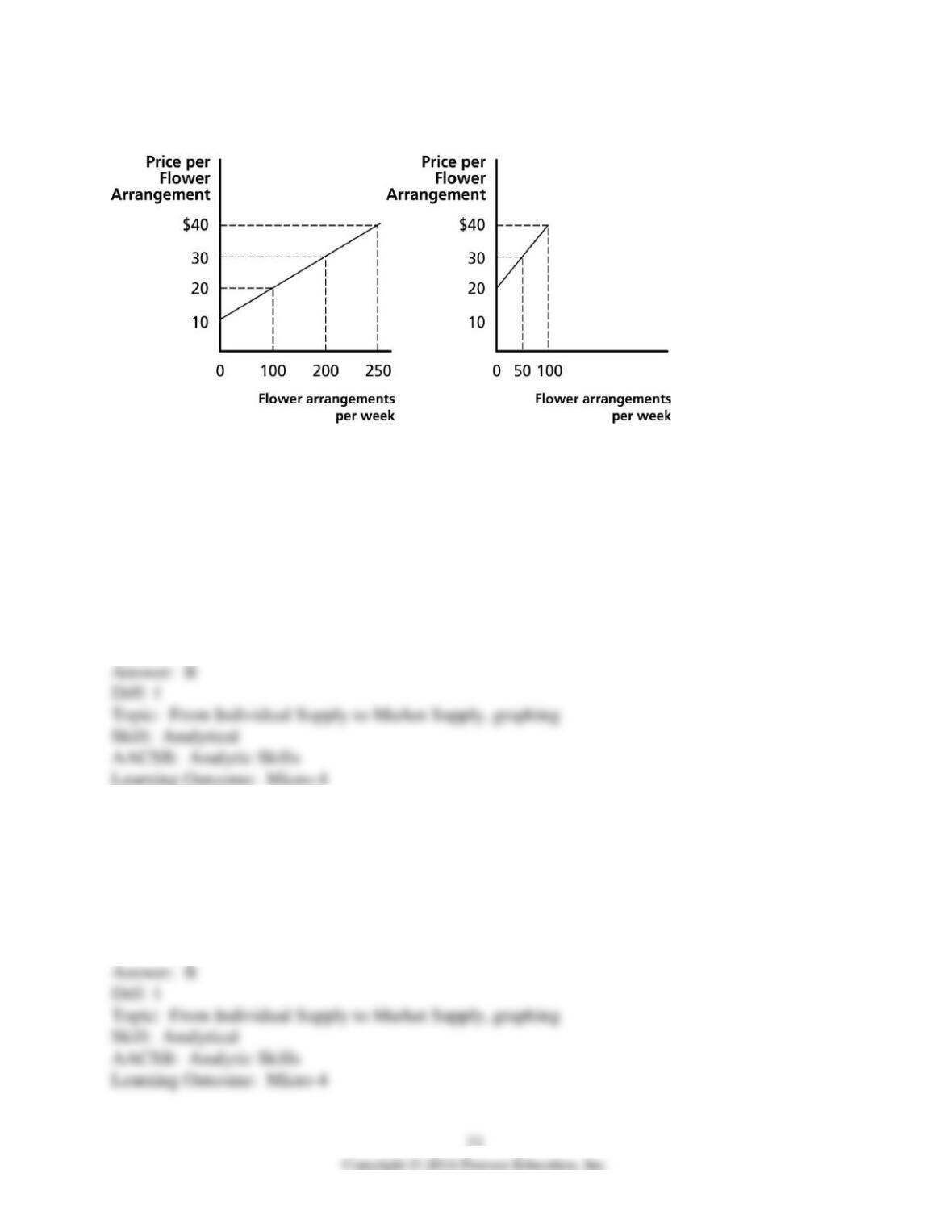
Figure 3.6
David’s Supply Schedule Celeste’s Supply Schedule
9) Refer to Figure 3.6, which shows David’s and Celeste’s individual supply curves for flower
arrangements per week. Assuming David and Celeste are the only producers in the market, what
is the market quantity supplied at a price of $30?
A) 200
B) 250
C) 300
D) 350
10) Refer to Figure 3.6, which shows David’s and Celeste’s individual supply curves for flower
arrangements per week. Assuming David and Celeste are the only producers in the market, what
is the market quantity supplied at a price of $20?
A) 0
B) 100
C) 150
D) 200
11) Refer to Figure 3.6, which shows David’s and Celeste’s individual supply curves for flower
arrangements per week. Assuming David and Celeste are the only producers in the market, if the
market quantity supplied is 350, the price must be
A) $10.
B) $20.
C) $30.
D) $40.
12) Refer to Figure 3.6, which shows David’s and Celeste’s individual supply curves for flower
arrangements per week. Assuming David and Celeste are the only producers in the market, if the
market quantity supplied is 50, the price must be
A) $0.
B) $10.
C) between $10 and $20.
D) $30.
Recall the Application about the decrease in the price of wool in the 1990s to answer the
following question(s). In the 1990s, the world price of wool decreased by about 30% and
prices have remained relatively low since then. In 2012, an organization in New Zealand
proposed that sheep shearing be added to the Commonwealth Games and the Olympics as
a spectator sport in an effort to increase the awareness and the demand for wool.
13) Recall the Application. As the world price of wool decreased, the quantity of wool supplied
by individual ranchers would ________, and the quantity supplied in the whole market would
________.
A) increase; increase
B) increase; decrease
C) decrease; decrease
D) decrease; increase
14) Recall the Application. The decrease in the price of wool would be reflected by a movement
________ on the market supply curve for wool.
A) down and to the right
B) down and to the left
C) up and to the right
D) up and to the left
15) Recall the Application. If the organization in New Zealand was successful in getting the
Olympics to include sheep shearing as a spectator sport, and this helped to raise the world price
of wool, the quantity of wool supplied would ________ because the market supply curve for
wool is ________ sloped.
A) increase; positively
B) increase; negatively
C) decrease; positively
D) decrease; negatively
16) As the price of a product rises, the quantity supplied decreases.
17) On the “supply side” of a market, producers indicate to consumers what they are willing to
sell, in what quantity and at what price.
18) The law of supply states that there is a positive relationship between price and quantity
supplied, ceteris paribus.
3.3 Market Equilibrium: Bringing Demand and Supply Together
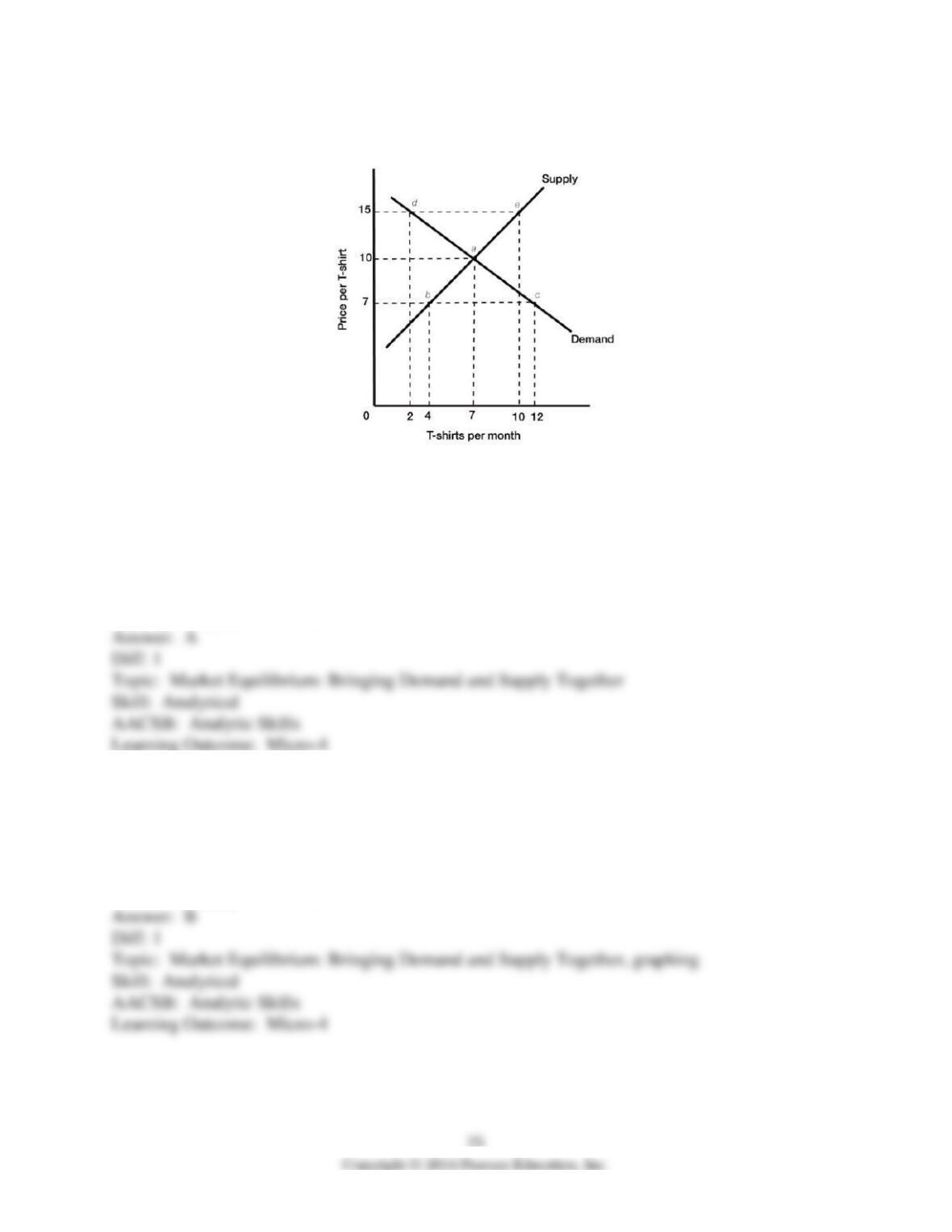
Figure 3.2
1) Figure 3.2 illustrates the supply and demand for t-shirts. If the actual price of t-shirts is $7,
there is an
A) excess demand of 8 t-shirts.
B) excess supply of 8 t-shirts.
C) excess demand of 10 t-shirts.
D) excess supply of 10 t-shirts.
2) Figure 3.2 illustrates the supply and demand for t-shirts. If the actual price of t-shirts is $15,
there is an
A) excess demand of 8 t-shirts.
B) excess supply of 8 t-shirts.
C) excess demand of 10 t-shirts.
D) excess supply of 10 t-shirts.
3) Figure 3.2 illustrates the supply and demand for t-shirts. If the actual price of t-shirts is $7, we
would expect that
A) demand will decrease until quantity demanded equals quantity supplied.
B) supply will increase until quantity demanded equals quantity supplied.
C) price will increase until quantity demanded equals quantity supplied.
D) there will be no change in the price since the market is in equilibrium.
4) Figure 3.2 illustrates the supply and demand for t-shirts. If the actual price of t-shirts is $15,
we would expect that
A) demand will decrease until quantity demanded equals quantity supplied.
B) supply will increase until quantity demanded equals quantity supplied.
C) price will decrease until quantity demanded equals quantity supplied.
D) there will be no change in the price since the market is in equilibrium.
5) Figure 3.2 illustrates the supply and demand for t-shirts. If the actual price of t-shirts is $10,
we would expect that
A) demand will decrease until quantity demanded equals quantity supplied.
B) supply will increase until quantity demanded equals quantity supplied.
C) price will increase until quantity demanded equals quantity supplied.
D) there will be no change in the price since the market is in equilibrium.
6) What happens if the price of a product is below the equilibrium price?
A) The buyers will stop purchasing a “cheap” product.
B) The producer will lower the price to sell more product.
C) There will be an excess demand for the product.
D) There will be a surplus of the product.
7) In the event of excess supply in the coffee market
A) the price of coffee will increase.
B) the price of coffee will decrease.
C) the supply of coffee will decrease (supply will shift to the left) to meet the demand.
D) the demand for coffee will increase (demand will shift to the right) to meet the supply.
8) When consumers are willing to buy more than producers are willing to sell
A) there is excess supply of the product in the market.
B) there is excess demand for the product in the market.
C) the market is in equilibrium.
D) the demand curve will shift until the quantity supplied equals the quantity demanded.
9) Suppose that the quantity of cars demanded exceeds the quantity of cars supplied. We would
expect that
A) the price of cars will increase.
B) the price of cars will decrease.
C) the supply will increase (supply will shift to the right) to meet the demand.
D) the demand will decrease (demand will shift to the left) to meet the supply.
10) Suppose that a market for a product is in equilibrium at a price of $5 per unit. At any price
above $5 per unit
A) there will be an excess demand for the product.
B) there will be an excess supply of the product.
C) the quantity supplied of the product will be less than the quantity demanded of that product.
D) there will be a shortage of that product.
11) The government sometimes creates an excess demand for a product by setting a maximum
price at which the product may be sold to consumers. This is sometimes called a
A) price ceiling.
B) price floor.
C) tax.
D) subsidy.
12) Suppose that the quantity of cars supplied exceeds the quantity of cars demanded. We would
expect that
A) the price of cars will increase.
B) the price of cars will decrease.
C) the supply will increase (supply will shift to the right) to meet the demand.
D) the demand will decrease (demand will shift to the left) to meet the supply.
13) Suppose that a market for a product is in equilibrium at a price of $3 per unit. At any price
below $3 per unit
A) there will be an excess demand for the product.
B) there will be an excess supply of the product.
C) the quantity demanded of the product will be less than the quantity supplied of that product.
D) there will be a surplus of that product.
14) A government sometimes creates an excess supply of a product by setting a minimum price
at which the product may be sold to consumers. This is sometimes called a
A) price ceiling.
B) price floor.
C) tax.
D) subsidy.
Recall the Application about the policies used by the European Union to support the
agricultural sectors of is member countries to answer the following question(s).
15) Recall the application. The policies used by the European Union to support the agricultural
sectors of its member countries created excess supply. This would occur if these policies set a
________ price which was ________ the market equilibrium price.
A) maximum; above
B) maximum; below
C) minimum; above
D) minimum; below
16) Recall the application. The policies used by the European Union to support the agricultural
sectors of its member countries created excess supply. Excess supply can be generated if a
government establishes a
A) price ceiling below the market equilibrium price.
B) price ceiling above the market equilibrium price.
C) price floor below the market equilibrium price.
D) price floor above the market equilibrium price.
17) Recall the application. In recent years the European Union has reformed its agriculture
policies by reducing or eliminating minimum prices. Ceteris paribus, these policy reforms would
________ excess supply by ________ prices.
A) reduce; raising
B) reduce; lowering
C) increase; raising
D) increase; lowering