CHAPTER 3—ANALYSIS OF FINANCIAL STATEMENTS
TRUE/FALSE
1. Ratio analysis involves analyzing financial statements in order to appraise a firm’s financial position
and strength.
2. The current ratio and inventory turnover ratios both help us measure the firm’s liquidity. The current
ratio measures the relationship of a firm’s current assets to its current liabilities, while the inventory
turnover ratio gives us an indication of how long it takes the firm to convert its inventory into cash.
3. Although a full liquidity analysis requires the use of a cash budget, the current and quick ratios provide
fast and easy-to-use measures of a firm’s liquidity position.
4. High current and quick ratios always indicate that a firm is managing its liquidity position well.
5. The inventory turnover ratio and days sales outstanding (DSO) are two ratios that are used to assess
how effectively a firm is managing its assets.
6. A decline in a firm’s inventory turnover ratio suggests that it is managing its inventory more efficiently
and also that its liquidity position is improving, i.e., it is becoming more liquid.
7. Debt management ratios show the extent to which a firm’s managers are attempting to magnify returns
on owners’ capital through the use of financial leverage.
8. The times-interest-earned ratio is one, but not the only, indication of a firm’s ability to meet its
long-term and short-term debt obligations.
9. Profitability ratios show the combined effects of liquidity, asset management, and debt management on
operating results.
10. Market value ratios provide management with an indication of how investors view the firm’s past
performance and especially its future prospects.
11. Determining whether a firm’s financial position is improving or deteriorating requires analyzing more
than the ratios for a given year. Trend analysis is one method of measuring changes in a firm’s
performance over time.
12. The “apparent,” but not the “true,” financial position of a company whose sales are seasonal can differ
dramatically, depending on the time of year when the financial statements are constructed.
13. Significant variations in accounting methods among firms make meaningful ratio comparisons
between firms more difficult than if all firms used similar accounting methods.
14. The basic earning power ratio (BEP) reflects the earning power of a firm’s assets after giving
consideration to financial leverage and tax effects.
15. The inventory turnover and current ratio are related. The combination of a high current ratio and a low
inventory turnover ratio, relative to industry norms, suggests that the firm has an above-average
inventory level and/or that part of the inventory is obsolete or damaged.
16. It is appropriate to use the fixed assets turnover ratio to appraise firms’ effectiveness in managing their
fixed assets if and only if all the firms being compared have the same proportion of fixed assets to total
assets.
17. Since the ROA measures the firm’s effective utilization of assets (without considering how these assets
are financed), two firms with the same EBIT must have the same ROA.
18. Suppose firms follow similar financing policies, face similar risks, have equal access to capital, and
operate in competitive product and capital markets. Under these conditions, then firms that have high
profit margins will tend to have high asset turnover ratios, and firms with low profit margins will tend
to have low turnover ratios.
19. Even though Firm A’s current ratio exceeds that of Firm B, Firm B’s quick ratio might exceed that of
A. However, if A’s quick ratio exceeds B’s, then we can be certain that A’s current ratio is also larger
than that of B.
20. Firms A and B have the same current ratio, 0.75, the same amount of sales and cost of goods sold, and
the same amount of current liabilities. However, Firm A has a higher inventory turnover ratio than B.
Therefore, we can conclude that A’s quick ratio must be smaller than B’s.
21. Suppose a firm wants to maintain a specific TIE ratio. It knows the amount of its debt, the interest rate
on that debt, the applicable tax rate, and its operating costs. With this information, the firm can
calculate the amount of sales required to achieve its target TIE ratio.
22. Suppose Firms A and B have the same amount of assets, pay the same interest rate on their debt, have
the same basic earning power (BEP), and have the same tax rate. However, Firm A has a higher debt
ratio. If BEP is greater than the interest rate on debt, Firm A will have a higher ROE as a result of its
higher debt ratio.
23. If a firm finances with only debt and common equity, and if its equity multiplier is 3.0, then its debt
ratio must be 0.667.
24. One problem with ratio analysis is that relationships can be manipulated. For example, if our current
ratio is greater than 1.5, then borrowing on a short-term basis and using the funds to build up our cash
account would cause the current ratio to increase.
25. One problem with ratio analysis is that relationships can be manipulated. For example, we know that if
our current ratio is less than 1.0, then using some of our cash to pay off some of our current liabilities
would cause the current ratio to increase and thus make the firm look stronger.
MULTIPLE CHOICE
26. Considered alone, which of the following would increase a company’s current ratio?
a.
An increase in accounts payable.
b.
An increase in net fixed assets.
c.
An increase in accrued liabilities.
d.
An increase in notes payable.
e.
An increase in accounts receivable.
27. Which of the following would, generally, indicate an improvement in a company’s financial position,
holding other things constant?
a.
The total assets turnover decreases.
b.
The TIE declines.
c.
The DSO increases.
d.
The EBITDA coverage ratio increases.
e.
The current and quick ratios both decline.
28. A firm wants to strengthen its financial position. Which of the following actions would increase its
current ratio?
a.
Use cash to increase inventory holdings.

b.
Reduce the company’s days’ sales outstanding to the industry average and use the resulting
cash savings to purchase plant and equipment.
c.
Use cash to repurchase some of the company’s own stock.
d.
Borrow using short-term debt and use the proceeds to repay debt that has a maturity of
more than one year.
e.
Issue new stock and then use some of the proceeds to purchase additional inventory and
hold the remainder as cash.
29. Which of the following statements is CORRECT?
a.
If a firm increases its sales and cost of goods sold while holding its inventories constant,
then, other things held constant, its inventory turnover ratio will decrease.
b.
A reduction in inventories held would have no effect on the current ratio.
c.
An increase in inventories would have no effect on the current ratio.
d.
If a firm increases its sales and cost of goods sold while holding its inventories constant,
then, other things held constant, its inventory turnover ratio will increase.
e.
A reduction in the inventory turnover ratio will generally lead to an increase in the ROE.
30. Companies A and C each reported the same earnings per share (EPS), but Company A’s stock trades at
a higher price. Which of the following statements is CORRECT?
a.
Company A trades at a higher P/E ratio.
b.
Company A probably has fewer growth opportunities.
c.
Company A is probably judged by investors to be riskier.
d.
Company A must have a higher market-to-book ratio.
e.
Company A must pay a lower dividend.
31. Which of the following statements is CORRECT?
a.
If a firm has the highest price/earnings ratio of any firm in its industry, then, other things
held constant, this suggests that the board of directors should fire the president.
b.
If a firm has the highest market/book ratio of any firm in its industry, then, other things
held constant, this suggests that the board of directors should fire the president.
c.
Other things held constant, the higher a firm’s expected future growth rate, the lower its
P/E ratio is likely to be.
d.
The higher the market/book ratio, then, other things held constant, the higher one would
expect to find the Market Value Added (MVA).
e.
If a firm has a history of high Economic Value Added (EVA) numbers each year, and if
investors expect this situation to continue, then its market/book ratio and MVA are both
likely to be below average.
32. Which of the following statements is CORRECT?
a.
“Window dressing” is any action that improves a firm’s fundamental, long-run position
and thus increases its intrinsic value.
b.
Borrowing by using short-term notes payable and then using the proceeds to retire
long-term debt is an example of “window dressing.” Offering discounts to customers who
pay with cash rather than buy on credit and then using the funds that come in quicker to
purchase additional inventories is another example of “window dressing.”
c.
Borrowing on a long-term basis and using the proceeds to retire short-term debt would
improve the current ratio and thus could be considered to be an example of “window
dressing.”
d.
Offering discounts to customers who pay with cash rather than buy on credit and then
using the funds that come in quicker to purchase additional inventories is an example of
“window dressing.”
e.
Using some of the firm’s cash to reduce long-term debt is an example of “window
dressing.”
33. The Cavendish Company recently issued new common stock and used the proceeds to pay off some of
its short-term notes payable. This action had no effect on the company’s total assets or operating
income. Which of the following effects would occur as a result of this action?
a.
The company’s debt ratio increased.
b.
The company’s current ratio increased.
c.
The company’s times interest earned ratio decreased.
d.
The company’s basic earning power ratio increased.
e.
The company’s equity multiplier increased.
34. A firm’s new president wants to strengthen the company’s financial position. Which of the following
actions would make it financially stronger?
a.
Increase inventories while holding sales and cost of goods sold constant.
b.
Increase accounts receivable while holding sales constant.
c.
Increase EBIT while holding sales constant.
d.
Increase accounts payable while holding sales constant.
e.
Increase notes payable while holding sales constant.
35. If the CEO of a large, diversified, firm were filling out a fitness report on a division manager (i.e.,
“grading” the manager), which of the following situations would be likely to cause the manager to
receive a better grade? In all cases, assume that other things are held constant.
a.
The division’s DSO (days’ sales outstanding) is 40, whereas the average for its competitors
is 30.
b.
The division’s basic earning power ratio is above the average of other firms in its industry.
c.
The division’s total assets turnover ratio is below the average for other firms in its
industry.
d.
The division’s debt ratio is above the average for other firms in the industry.
e.
The division’s inventory turnover is 6, whereas the average for its competitors is 8.
36. Which of the following would indicate an improvement in a company’s financial position, holding
other things constant?
a.
The current and quick ratios both increase.
b.
The inventory and total assets turnover ratios both decline.
c.
The debt ratio increases.
d.
The profit margin declines.
e.
The EBITDA coverage ratio declines.
37. If a bank loan officer were considering a company’s request for a loan, which of the following
statements would you consider to be CORRECT?
a.
Other things held constant, the lower the current ratio, the lower the interest rate the bank
would charge the firm.
b.
The lower the company’s EBITDA coverage ratio, other things held constant, the lower
the interest rate the bank would charge the firm.
c.
Other things held constant, the higher the debt ratio, the lower the interest rate the bank
would charge the firm.
d.
Other things held constant, the lower the debt ratio, the lower the interest rate the bank
would charge the firm.
e.
The lower the company’s TIE ratio, other things held constant, the lower the interest rate
the bank would charge the firm.
38. Which of the following statements is CORRECT?
a.
All else equal, increasing the debt ratio will increase the ROA.
b.
The use of debt financing will tend to lower the basic earning power ratio, other things
held constant.
c.
A firm that employs financial leverage will have a higher equity multiplier than an
otherwise identical firm that has no debt in its capital structure.
d.
If two firms have identical sales, interest rates paid, operating costs, and assets, but differ
in the way they are financed, the firm with less debt will generally have the higher
expected ROE.
e.
Holding bonds is better than holding stock for investors because income from bonds is
taxed on a more favorable basis than income from stock.
39. A firm wants to strengthen its financial position. Which of the following actions would increase its
quick ratio?
a.
Issue new common stock and use the proceeds to acquire additional fixed assets.
b.
Offer price reductions along with generous credit terms that would (1) enable the firm to
sell some of its excess inventory and (2) lead to an increase in accounts receivable.
c.
Issue new common stock and use the proceeds to increase inventories.
d.
Speed up the collection of receivables and use the cash generated to increase inventories.
e.
Use some of its cash to purchase additional inventories.
40. Amram Company’s current ratio is 1.9. Considered alone, which of the following actions would reduce
the company’s current ratio?
a.
Use cash to reduce accounts payable.
b.
Borrow using short-term notes payable and use the proceeds to reduce accruals.
c.
Borrow using short-term notes payable and use the proceeds to reduce long-term debt.
d.
Use cash to reduce accruals.
e.
Use cash to reduce short-term notes payable.
41. Which of the following statements is CORRECT?
a.
If a firm increases its sales while holding its accounts receivable constant, then, other
things held constant, its days’ sales outstanding will decline.
b.
If a security analyst saw that a firm’s days’ sales outstanding (DSO) was higher than the
industry average and was also increasing and trending still higher, this would be
interpreted as a sign of strength.
c.
If a firm increases its sales while holding its accounts receivable constant, then, other
things held constant, its days’ sales outstanding (DSO) will increase.
d.
There is no relationship between the days’ sales outstanding (DSO) and the average
collection period (ACP). These ratios measure entirely different things.
e.
A reduction in accounts receivable would have no effect on the current ratio, but it would
lead to an increase in the quick ratio.
42. Which of the following statements is CORRECT?
a.
If two firms differ only in their use of debt⎯i.e., they have identical assets, sales,
operating costs, and tax rates⎯but one firm has a higher debt ratio, the firm that uses more
debt will have a higher profit margin on sales.
b.
If one firm has a higher debt ratio than another, we can be certain that the firm with the
higher debt ratio will have the lower TIE ratio, as that ratio depends entirely on the amount
of debt a firm uses.
c.
A firm’s use of debt will have no effect on its profit margin on sales.
d.
If two firms differ only in their use of debt⎯i.e., they have identical assets, sales,
operating costs, interest rates on their debt, and tax rates⎯but one firm has a higher debt
ratio, the firm that uses more debt will have a lower profit margin on sales.
e.
The debt ratio as it is generally calculated makes an adjustment for the use of assets leased
under operating leases, so the debt ratios of firms that lease different percentages of their
assets are still comparable.
43. Which of the following statements is CORRECT?
a.
If Firms X and Y have the same net income, number of shares outstanding, and price per
share, then their market-to-book ratios must also be the same.
b.
If Firms X and Y have the same P/E ratios, then their market-to-book ratios must also be
the same.
c.
If Firms X and Y have the same net income, number of shares outstanding, and price per
share, then their P/E ratios must also be the same.
d.
If Firms X and Y have the same earnings per share and market-to-book ratio, they must
have the same price earnings ratio.
e.
If Firm X’s P/E ratio exceeds that of Firm Y, then Y is likely to be less risky and also to be
expected to grow at a faster rate.
44. Which of the following statements is CORRECT?
a.
Suppose a firm’s total assets turnover ratio falls from 1.0 to 0.9, but at the same time its
profit margin rises from 9% to 10%, and its debt increases from 40% of total assets to
60%. Under these conditions, the ROE will decrease.
b.
Suppose a firm’s total assets turnover ratio falls from 1.0 to 0.9, but at the same time its
profit margin rises from 9% to 10% and its debt increases from 40% of total assets to 60%.
Under these conditions, the ROE will increase.
c.
Suppose a firm’s total assets turnover ratio falls from 1.0 to 0.9, but at the same time its
profit margin rises from 9% to 10% and its debt increases from 40% of total assets to 60%.
Without additional information, we cannot tell what will happen to the ROE.
d.
The modified DuPont equation provides information about how operations affect the
ROE, but the equation does not include the effects of debt on the ROE.
e.
Other things held constant, an increase in the debt ratio will result in an increase in the
profit margin on sales.
45. You observe that a firm’s ROE is above the industry average, but its profit margin and debt ratio are
both below the industry average. Which of the following statements is CORRECT?
a.
Its total assets turnover must equal the industry average.
b.
Its total assets turnover must be above the industry average.
c.
Its return on assets must equal the industry average.
d.
Its TIE ratio must be below the industry average.
e.
Its total assets turnover must be below the industry average.
46. Companies Heidee and Leaudy are virtually identical in that they are both profitable, and they have the
same total assets (TA), Sales (S), return on assets (ROA), and profit margin (PM). However, Company
Heidee has the higher debt ratio. Which of the following statements is CORRECT?
a.
Company Heidee has a lower operating income (EBIT) than Company LD.
b.
Company Heidee has a lower total assets turnover than Company Leaudy.
c.
Company Heidee has a lower equity multiplier than Company Leaudy.
d.
Company Heidee has a higher fixed assets turnover than Company Leaudy.
e.
Company Heidee has a higher ROE than Company Leaudy.
47. Cordelion Communications is considering issuing new common stock and using the proceeds to
reduce its outstanding debt. The stock issue would have no effect on total assets, the interest rate
Cordelion pays, EBIT, or the tax rate. Which of the following is likely to occur if the company goes
ahead with the stock issue?
a.
The times interest earned ratio will decrease.
b.
The ROA will decline.
c.
Taxable income will decrease.
d.
The tax bill will increase.
e.
Net income will decrease.
48. Which of the following statements is CORRECT?
a.
An increase in a firm’s debt ratio, with no changes in its sales or operating costs, could be
expected to lower the profit margin.
b.
The ratio of long-term debt to total capital is more likely to experience seasonal
fluctuations than is either the DSO or the inventory turnover ratio.
c.
If two firms have the same ROA, the firm with the most debt can be expected to have the
lower ROE.
d.
An increase in the DSO, other things held constant, could be expected to increase the total
assets turnover ratio.
e.
An increase in the DSO, other things held constant, could be expected to increase the
ROE.
49. Heidee Corp. and Leaudy Corp. have identical assets, sales, interest rates paid on their debt, tax rates,
and EBIT. However, Heidee uses more debt than Leaudy. Which of the following statements is
CORRECT?
a.
Heidee would have the higher net income as shown on the income statement.
b.
Without more information, we cannot tell if Heidee or Leaudy would have a higher or
lower net income.
c.
Heidee would have the lower equity multiplier for use in the DuPont equation.
d.
Heidee would have to pay more in income taxes.
e.
Heidee would have the lower net income as shown on the income statement.
50. Other things held constant, which of the following alternatives would increase a company’s cash flow
for the current year?
a.
Increase the number of years over which fixed assets are depreciated for tax purposes.
b.
Pay down the accounts payables.
c.
Reduce the days’ sales outstanding (DSO) without affecting sales or operating costs.
d.
Pay workers more frequently to decrease the accrued wages balance.
e.
Reduce the inventory turnover ratio without affecting sales or operating costs.
51. Companies Heidee and Leaudy have the same sales, tax rate, interest rate on their debt, total assets,
and basic earning power. Both companies have positive net incomes. Company Heidee has a higher
debt ratio and, therefore, a higher interest expense. Which of the following statements is CORRECT?
a.
Company Heidee has more net income.
b.
Company Heidee pays less in taxes.
c.
Company Heidee has a lower equity multiplier.
d.
Company Heidee has a higher ROA.
e.
Company Heidee has a higher times interest earned (TIE) ratio.
52. Companies Heidee and Leaudy have the same tax rate, sales, total assets, and basic earning power.
Both companies have positive net incomes. Company Heidee has a higher debt ratio and, therefore, a
higher interest expense. Which of the following statements is CORRECT?
a.
Company Heidee has a lower times interest earned (TIE) ratio.
b.
Company Heidee has a lower equity multiplier.
c.
Company Heidee has more net income.
d.
Company Heidee pays more in taxes.
e.
Company Heidee has a lower ROE.
53. Lincoln Industries’ current ratio is 0.5. Considered alone, which of the following actions would
increase the company’s current ratio?
a.
Use cash to reduce long-term bonds outstanding.
b.
Borrow using short-term notes payable and use the cash to increase inventories.
c.
Use cash to reduce accruals.
d.
Use cash to reduce accounts payable.
e.
Use cash to reduce short-term notes payable.
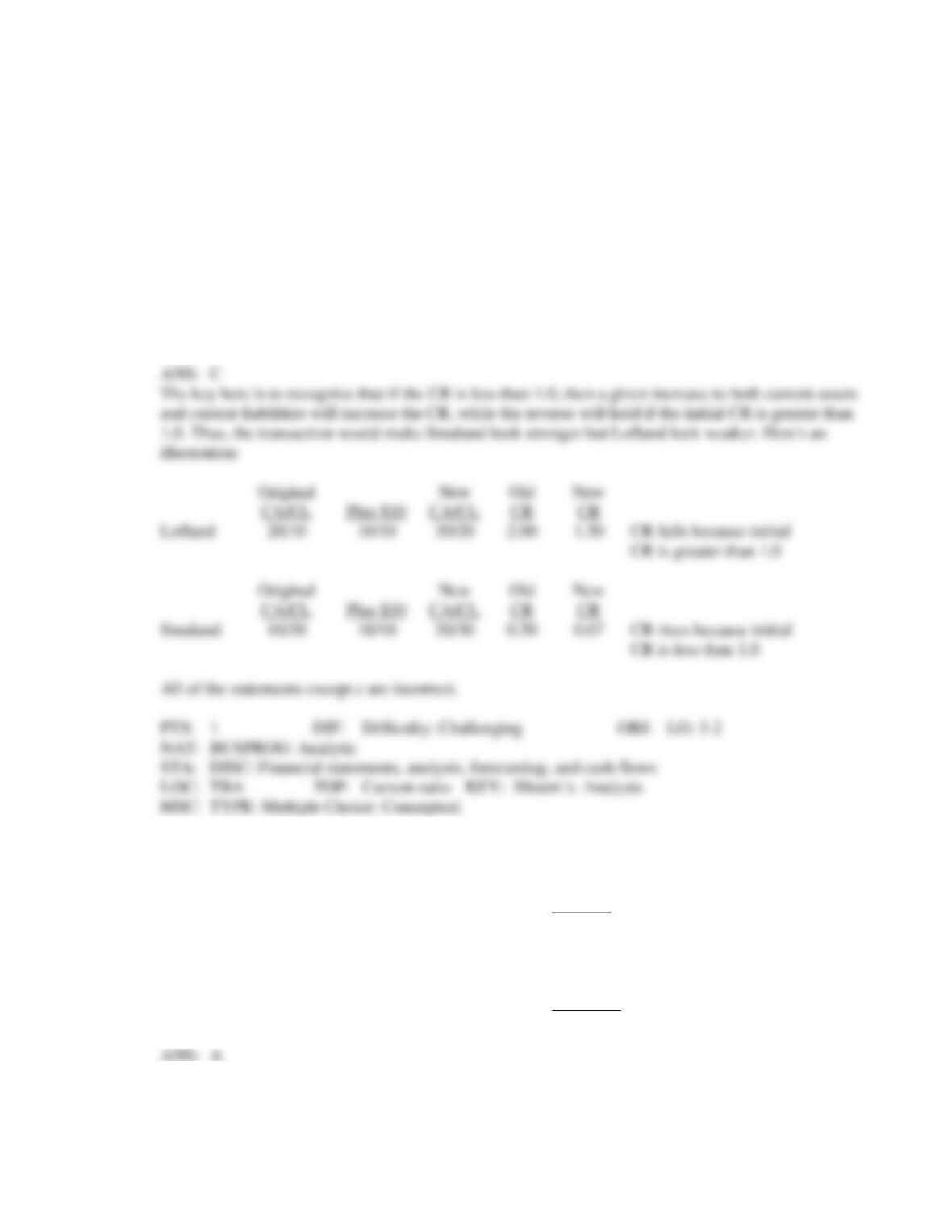
54. Lofland’s has $20 million in current assets and $10 million in current liabilities, while Smaland’s
current assets are $10 million versus $20 million of current liabilities. Both firms would like to
“window dress” their end-of-year financial statements, and to do so each plans to borrow $10 million
on a short-term basis and to then hold the borrowed funds in their cash accounts. Which of the
statements below best describes the results of these transactions?
a.
The transaction would improve both firms’ financial strength as measured by their current
ratios.
b.
The transactions would raise Lofland’s financial strength as measured by its current ratio
but lower Smaland’s current ratio.
c.
The transactions would lower Lofland’s financial strength as measured by its current ratio
but raise Smaland’s current ratio.
d.
The transaction would have no effect on the firm’ financial strength as measured by their
current ratios.
e.
The transaction would lower both firm’ financial strength as measured by their current
ratios.
55. Companies Heidee and Leaudy have the same total assets, sales, operating costs, and tax rates, and
they pay the same interest rate on their debt. However, company Heidee has a higher debt ratio. Which
of the following statements is CORRECT?
a.
If the interest rate the companies pay on their debt is less than their basic earning power
(BEP), then Company Heidee will have the higher ROE.
b.
Given this information, Leaudy must have the higher ROE.
c.
Company Leaudy has a higher basic earning power ratio (BEP).
d.
Company Heidee has a higher basic earning power ratio (BEP).
e.
If the interest rate the companies pay on their debt is more than their basic earning power
(BEP), then Company Heidee will have the higher ROE.
56. Arshadi Corp.’s sales last year were $52,000, and its total assets were $22,000. What was its total
assets turnover ratio (TATO)?
a.
2.03
b.
2.13
c.
2.25
d.
2.36
e.
2.48
57. Hutchinson Corporation has zero debt⎯it is financed only with common equity. Its total assets are
$410,000. The new CFO wants to employ enough debt to bring the debt/assets ratio to 40%, using the
proceeds from the borrowing to buy back common stock at its book value. How much must the firm
borrow to achieve the target debt ratio?
a.
$155,800
b.
$164,000
c.
$172,200
d.
$180,810
e.
$189,851
58. Orono Corp.’s sales last year were $435,000, its operating costs were $362,500, and its interest charges
were $12,500. What was the firm’s times interest earned (TIE) ratio?
a.
4.72
b.
4.97
c.
5.23
d.
5.51
e.
5.80
59. Rappaport Corp.’s sales last year were $320,000, and its net income after taxes was $23,000. What was
its profit margin on sales?
a.
6.49%
b.
6.83%
c.
7.19%
d.
7.55%
e.
7.92%
60. Branch Corp.’s total assets at the end of last year were $315,000 and its net income after taxes was
$22,750. What was its return on total assets?
a.
7.22%
b.
7.58%
c.
7.96%
d.
8.36%
e.
8.78%