3-1: Annuity
Suppose the opportunity cost of capital is 10 percent and you have just won a $1 million
lottery that entitles you to $100,000 at the end of each of the next ten years.
Required:
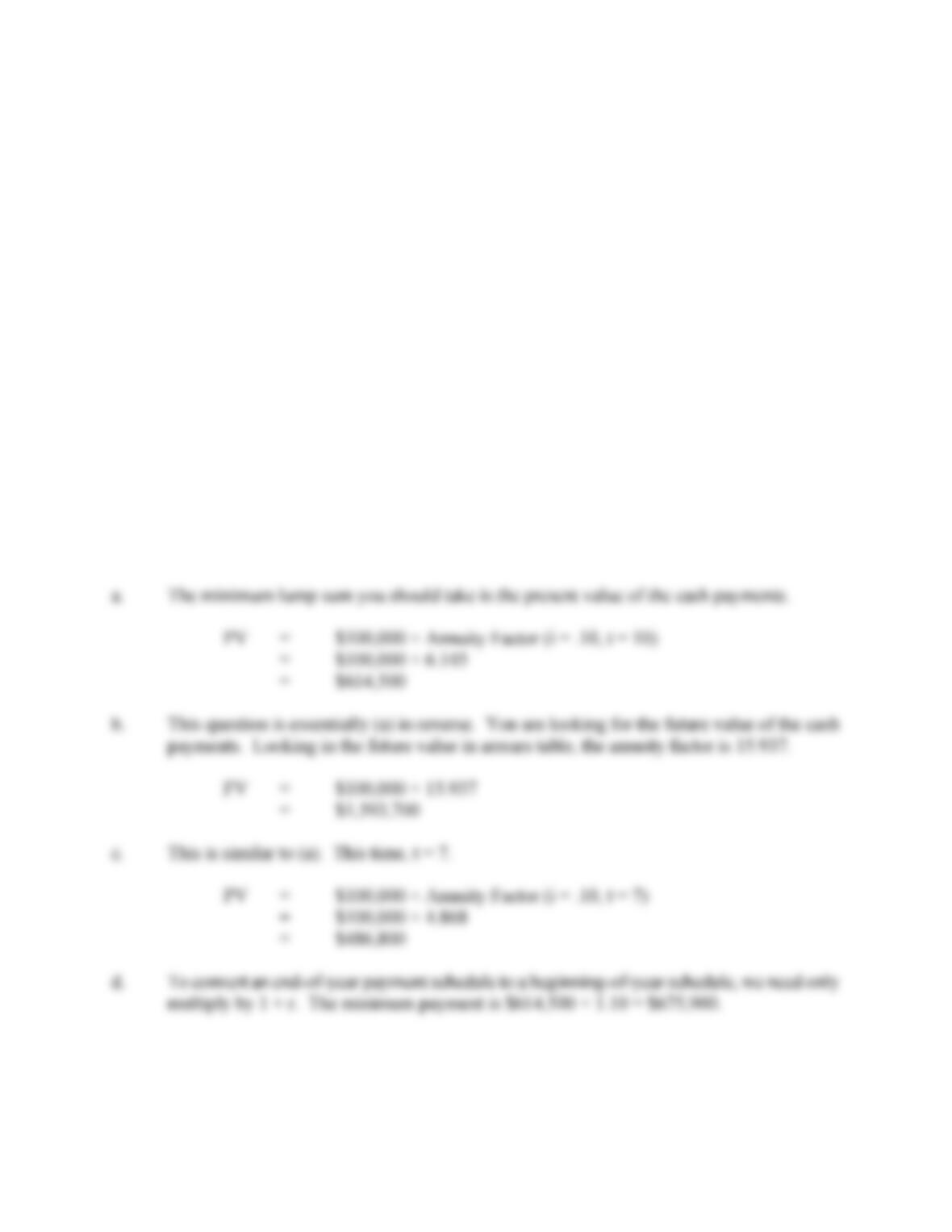
a. What is the minimum lump sum cash payment you would be willing to take now in lieu of
the ten-year annuity?
b. What is the minimum lump sum you would be willing to accept at the end of the ten years
in lieu of the annuity?
c. Suppose three years have passed and you have just received the third payment and you
have seven left when the lottery promoters approach you with an offer to “settle-up for
cash.” What is the minimum you would accept (the end of year three)?
d. How would your answer to part (a) change if the first payment came immediately (at t = 0)
and the remaining payments were at the beginning instead of at the end of each year?
3-1: Solution to Annuity (15 minutes)
3-2: Identifying the Opportunity Cost of Capital
Don Phelps recently started a dry cleaning business. He would like to expand the business
and have a coin-operated laundry also. The expansion of the building and the washing and drying
machines will cost $100,000. The bank will lend the business $100,000 at 12 percent interest rate.
Don could get a 10 percent interest rate loan if he uses his personal house as collateral. The lower
interest rate reflects the increased security of the loan to the bank, because the bank could take
Don’s home if he doesn’t pay back the loan. Don currently can put money in the bank and receive
6 percent interest.
Required:
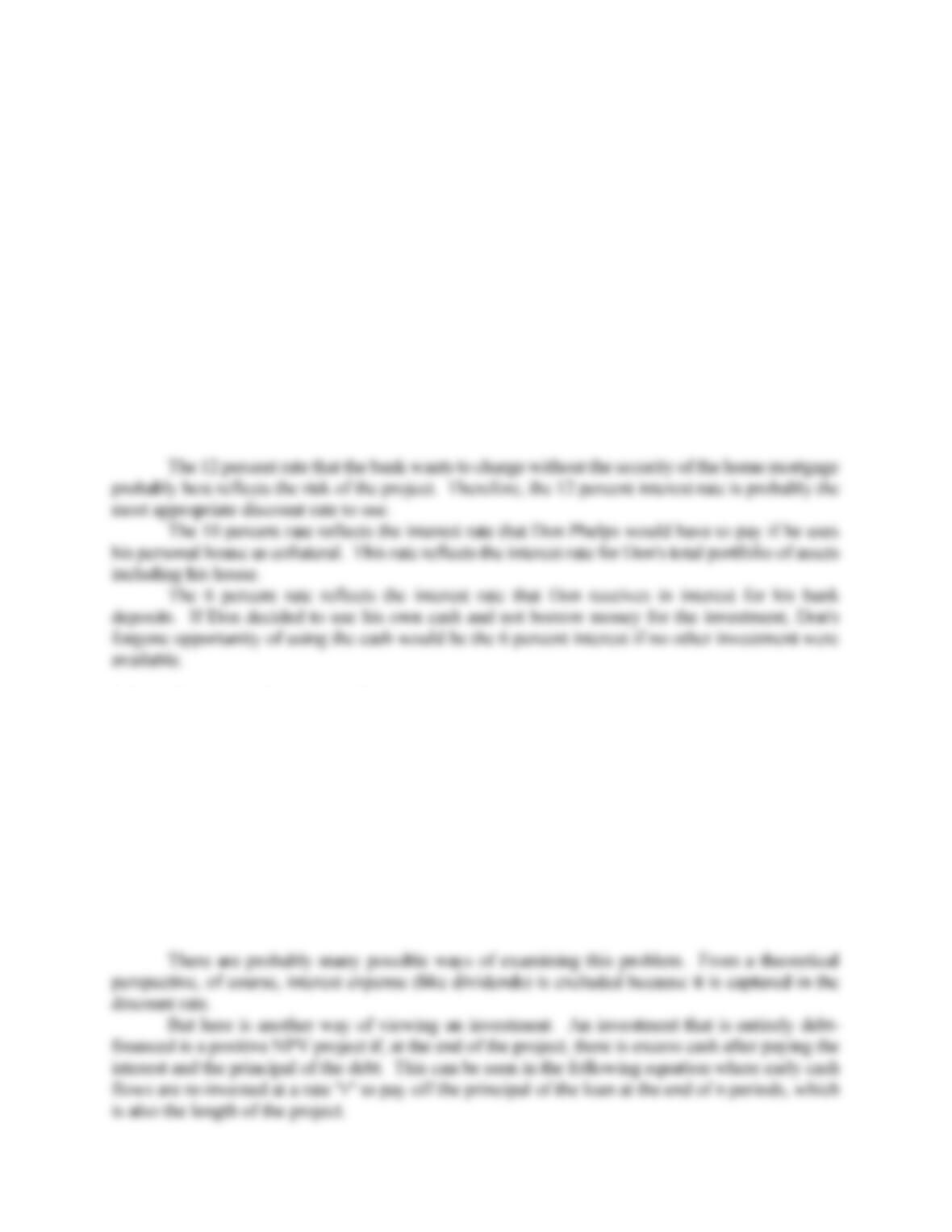
Provide arguments for using 12 percent, 10 percent, and 6 percent as the opportunity cost
of capital for evaluating the investment.
3-2: Solution to Identifying the Opportunity Cost of Capital (15 minutes)
3-3: Financing Charges and Net Present Value
The president of the company is not convinced that the interest expense should be excluded
from the calculation of the net present value. He points out that, “Interest is a cash flow. You are
supposed to discount cash flows. We borrowed money to completely finance this project. Why
not discount interest expenditures?” The president is so convinced that he asks you, the controller,
to calculate the net present value including the interest expense.
How can you adjust the net present value analysis to compensate for the inclusion of the
interest expense?
3-3: Solution to Financing Charges and Net Present Value (15 minutes)
(CF1)(1+r)n-1 + (CF2)(1+r)n-2 + …. + (CFn) > or < Investment (= Principal)
where CFi = Cash flows in period i including interest payments.
If the left hand side of the equation is greater than the right hand side of the equation, the
investment has a positive NPV and is acceptable. This analysis assumes complete debt financing
to capture all of the opportunity cost of using cash.
3-4: Asset Replacement
The Baltic Company is considering the purchase of a new machine tool to replace an
obsolete one. The machine being used for the operation has a tax book value of $80,000, with an
annual depreciation expense of $8,000. It has a salvage value (resale value) of $40,000, is in good
working order, and will last, physically, for at least 10 more years. The proposed machine will
perform the operation so much more efficiently that Baltic engineers estimate that labor, material,
and other direct costs of the operation will be reduced $60,000 a year if it is installed. The proposed
machine costs $240,000 delivered and installed, and its economic life is estimated at 10 years, with
zero salvage value. The company expects to earn 14 percent on its investment after taxes (14
percent is the firm’s cost of capital). The tax rate is 40 percent, and the firm uses straight-line
depreciation. Any gain or loss on the machine is subject to tax at 40 percent.
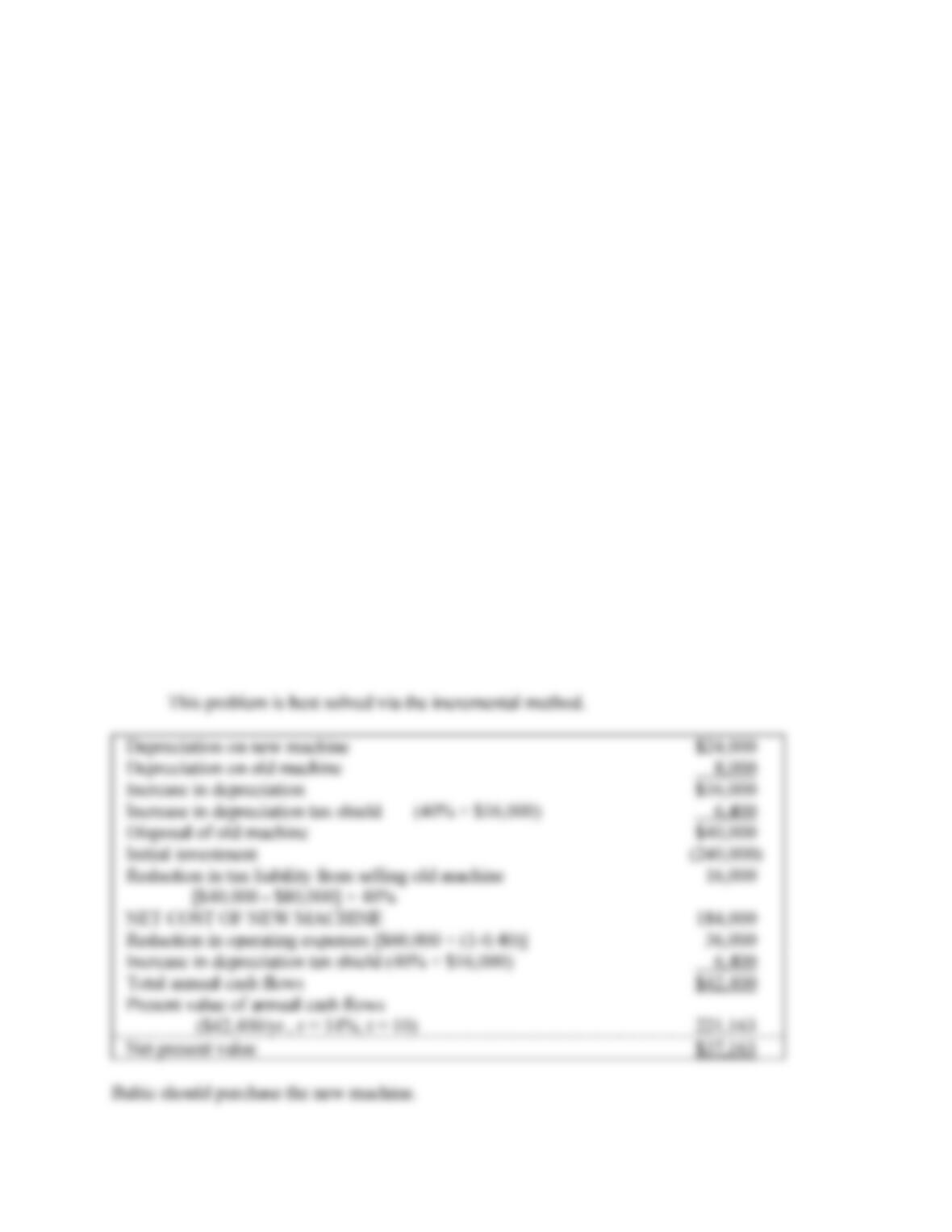
Should Baltic buy the new machine?
3–4: Solution to Asset Replacement (15 minutes)