Exam
Name___________________________________
SHORT ANSWER. Write the word or phrase that best completes each statement or answers the question.
Provide an appropriate response.
1)
Find the amount due on a loan of $8,500 at 7.5% simple interest at the end of 4 years.
1)
Use an amortization table to solve the problem. Round to the nearest cent.
2)
A home was purchased 14 years ago for $70,000. The home was financed by paying a 20%
down payment and signing a 25 year mortgage at 8.5% compounded monthly on the
unpaid balance. The market value is now $100,000. The owner wishes to sell the house.
How much equity (to the nearest dollar) does the owner have in the house after making
168 monthly payments?
2)
3)
You have agreed to pay off a $8,000 loan in 30 monthly payments of $298.79 per month.
The interest rate of the loan is 0.75% per month on the unpaid balance. What is the unpaid
balance after 12 monthly payments have been made?
3)
Provide an appropriate response.
4)
How much should you invest now at 6% compounded semiannually to have $8,500 to buy
a car in 2.5 years?
4)
5)
An investor purchased 500 shares of a stock at $19 per share. The commission she paid to
buy the stock was $65 plus 0.3% of the principal amount. Six months later she sold the
stock for $20.50 per share. If she paid the same rate of commission to sell the stock, what
annual rate of interest (annual yield) did she earn on her initial investment (including
purchase price plus commission)? Express your answer as a percentage, correct to one
decimal place.
5)
Solve the problem.
6)
A couple decides on the following savings plan for their child’s college education. When
the child is 6 months old, and every 6 months thereafter, they will deposit $310 into a
savings account paying 9.5% interest compounded semi–annually. After the child’s tenth
birthday, having made 20 such payments, they will stop making deposits and let the
accumulated money earn interest, at the same rate, for 8 more years, until the child is 18
years old and ready for college. How much money (to the nearest dollar) will be in the
account when the child is ready for college?
6)
Solve the problem. Round to the nearest cent as needed.
7)
A child receives a $10,000 gift toward a college education from her grandparents on her
first birthday. How much money will it be worth in 17 years if it is invested at 8.25%
compounded quarterly? Round your answer to the nearest cent.
7)
Use an amortization table to solve the problem. Round to the nearest cent.
8)
A $90,000 home was financed by making a 20% down payment and signing a 30–year
mortgage at 6.25% annual interest compounded monthly for the unpaid balance. The first
payment is $443.32. How much of the first month’s payment will apply towards reducing
the principal?
8)
9)
A $7,000 debt is to be amortized in 15 equal monthly payments of $504.87 at 1.00% interest
per month on the unpaid balance. What is the unpaid balance after the second payment?
9)
Provide an appropriate response.
10)
What amount will be in an account after 1.5 years if $4,000 is invested at 5% compounded
semiannually?
10)
Solve the problem.
11)
An ordinary annuity has a value of $1,333.85 at the end of 4 years when $150 is deposited
every 6 months into an account earning 6% compounded semiannually. How much
interest has been earned?
11)
12)
You can afford monthly deposits of $200 into an account that pays 8% compounded
monthly. How many months will it be until you have $15,000 to buy a car? (Round up to
the next higher month if not an integer.)
12)
Provide an appropriate response.
13)
An investment company pays 7% compounded quarterly. What is the effective rate?
(Compute the answer to two decimal places).
13)
Use an amortization table to solve the problem. Round to the nearest cent.
14)
You have purchased a new house and have a mortgage for $90,000 at 6% compounded
monthly. The loan is amortized over 20 years in equal monthly payments of $644.79. Find
the total amount paid in interest when the mortgage is paid off.
14)
Solve the problem. Round to the nearest cent as needed.
15)
You have decided to buy a new stereo system for $2,500 and agreed to pay in 30 equal
quarterly payments at 1.25% interest per quarter on the unpaid balance. How much are
your payments?
15)
Solve the problem.
16)
You deposit $130 each month into a savings account that pays 5.5% compounded monthly.
How much interest will you have earned after 8 years?
16)
Provide an appropriate response.
17)
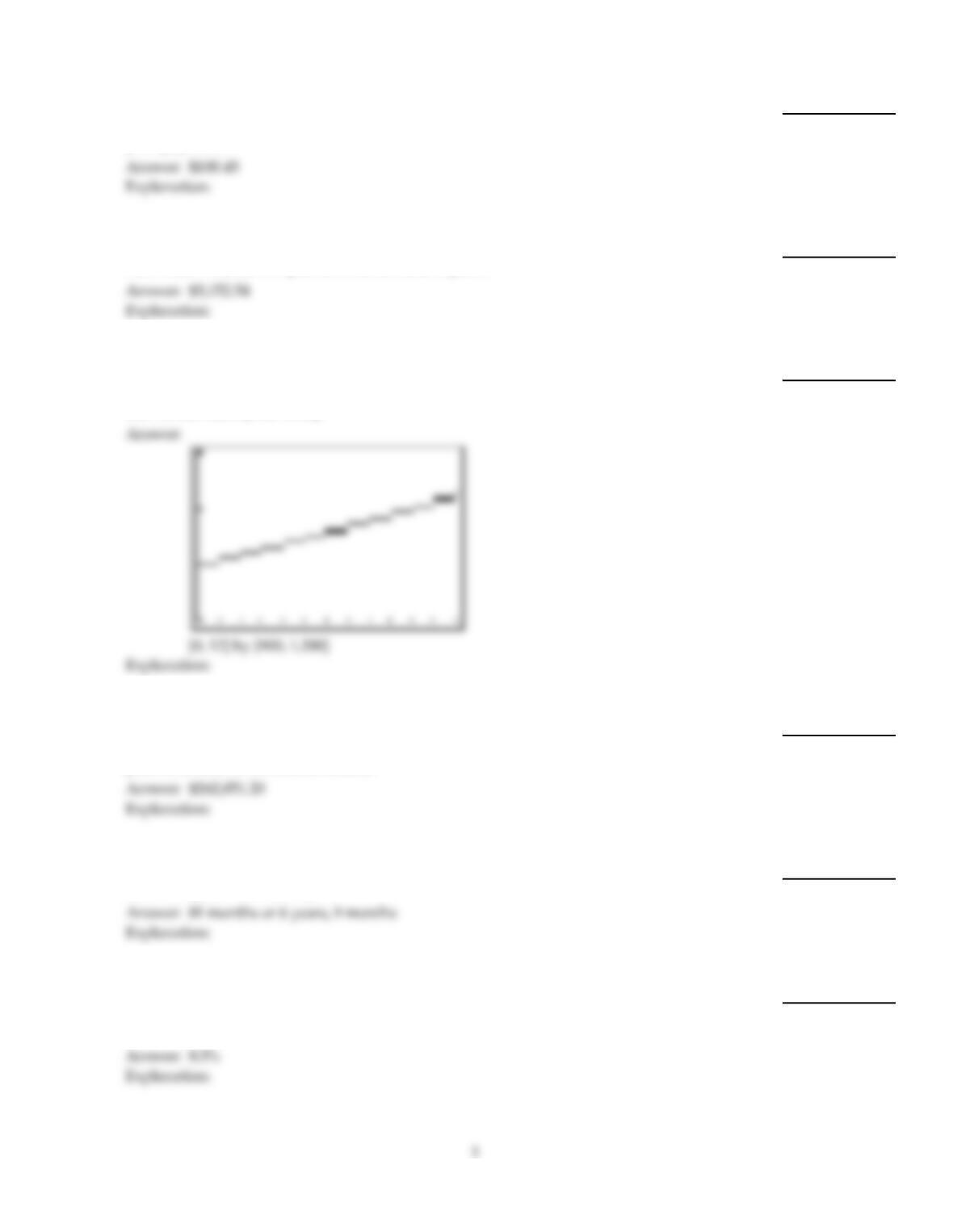
A bank account starts with $1,000 in it. Interest is paid at 6% annual interest, compounded
monthly. Graph the exact function for the amount in the account over the first 12 months.
Use vertical scale [900, 1,200].
17)
Use an amortization table to solve the problem. Round to the nearest cent.
18)
A bank makes a home mortgage loan of $180,000 at 7.25% amortized in equal monthly
payments over 30 years. What is the total amount paid in interest when the mortgage is
paid off (round to the nearest dollar)?
18)
Solve the problem. Round to the nearest cent as needed.
19)
How many months will it take until an account will have $3,500 if $2,500 is invested now
at 5% compounded monthly?
19)
Provide an appropriate response.
20)
If an investor buys a 39–week T–bill with a maturity value of $25,000 for $23,543 what
annual interest rate (annual yield) will the investor earn? (Express your answer as a
percentage, correct to one decimal place.)
20)
Solve the problem.
21)
What is the future value of an ordinary annuity at the end of 3 years if $200 is deposited
each quarter into an account earning 6% compounded quarterly?
21)
Provide an appropriate response.
22)
An investor purchased 150 shares of a stock at $15.80 per share. The investor holds the
stock for 39 weeks and then sells the stock for $19.25 per share. Use the commission
schedule for this company given below to find the annual rate of interest earned by this
investor. Express your answer as a percentage, correct to one decimal place.
Principle Commission
Under $2500 $25 + 1.6% of principle
$2500 – $7500 $38 + 1.1% of principle
Over $7500 $105 + 0.5% of principle
22)
23)
If you pay $5,500 for a simple interest note that will be worth $6,000 in 21 months, what
annual simple interest rate will you earn? (Compute the answer to one decimal place.)
23)
MULTIPLE CHOICE. Choose the one alternative that best completes the statement or answers the question.
Use I = Prt for simple interest to find the indicated quantity.
24)
P = $22,660; r = 13%; 2.4 years. Find I.
24)
A)
$15,590.08
B)
$7069.92
C)
$29,729.92
D)
$2945.80
What is the annual percentage yield (APY) for money invested at the given annual rate? Round results to the nearest
hundredth of a percent.
25)
3.5% compounded continuously.
25)
A)
3.50%
B)
3.56%
C)
3.53%
D)
3.55%
Solve the problem. Round to the nearest cent as needed.
26)
Brandon’s savings account has a balance of $4069. After 4 years what will the amount of interest be
at 5% compounded quarterly?
26)
A)
$101.73
B)
$899.73
C)
$894.73
D)
$885.73
Find the compound amount for the deposit. Round to the nearest cent.
27)
$15,000 at 10% compounded semiannually for 10 years
27)
A)
$30.000.00
B)
$38,906.14
C)
$24,433.42
D)
$39,799.47
Use the formula A = P(1 +
rt) to find the indicated quantity.
28)
P = $7996; r = 6%; t = 10 months. Find A.
28)
A)
$399.80
B)
$6663.33
C)
$8475.76
D)
$8395.80
Solve the problem. Round dollar amounts to the nearest cent. Use 360 days.
29)
What is the purchase price of a 26–week T–bill with a maturity value of $1000 that earns an annual
interest rate of 5.25%?
29)
A)
$1025.58
B)
$25.58
C)
$974.42
D)
$1000
Solve the problem. Round to the nearest cent as needed.
30)
Cheraw Auto Repair believes that it will need new equipment in 10 years. The equipment will cost
$26,000. What lump sum should be invested today at 8% compounded semiannually, to yield
$26,000?
30)
A)
$17,637.61
B)
$21,097.18
C)
$11,866.06
D)
$17,462.98
Convert the given interest rate to decimal form if it is given as a percentage, and to a percentage if it is given in decimal
form.
31)
11.6% to decimal
31)
A)
0.116
B)
0.00116
C)
11.6
D)
116
Solve the problem.
32)
If $300,000 is to be saved over 25 years, how much should be deposited monthly if the investment
earns 8% interest compounded monthly?
32)
A)
$260.87
B)
$315.45
C)
$216.62
D)
$180.48
Use the formula A = P(1 +
rt) to find the indicated quantity.
33)
Allan borrowed $6300 from his father to buy a car. He repaid him after 9 months with interest of
7% per year. Find the total amount he repaid.
33)
A)
$6594.00
B)
$6630.75
C)
$6741.00
D)
$330.75
Solve the problem. Round to the nearest cent as needed.
34)
The monthly payments on a $73,000 loan at 13% annual interest are $807.38. How much of the first
monthly payment will go toward the principal?
34)
A)
$16.55
B)
$790.83
C)
$702.42
D)
$104.96
Solve the problem.
35)
At the end of every 3 months, Judy deposits $100 into an account that pays 6% compounded
quarterly. After 4 years, she puts the accumulated amount into a certificate of deposit paying 7.5%
compounded semiannually for 1 year. When this certificate matures, how much will Judy have
accumulated?
35)
A)
$1930.25
B)
$1823.20
C)
$2072.31
D)
$1920.96
Find the compound interest earned. Round to the nearest cent.
36)
$14,000 at 5% compounded annually for 3 years
36)
A)
$2206.75
B)
$2100.00
C)
$1435.00
D)
$701.50
Solve the problem. Round to the nearest cent as needed.
37)
The rabbit population in a forest area grows at the rate of 8% monthly. If there are 260 rabbits in
September, find how many rabbits (rounded to the nearest whole number) should be expected by
next September. Use y =260(2.7)0.08t
37)
A)
662
B)
674
C)
675
D)
688
Find i (the rate per period) and n (the number of periods) for the annuity.
38)
Semiannual deposits of $400 are made for 10 years into an annuity that pays 7% compounded
semiannually.
38)
A)
i = 0.035; n = 20
B)
i = 0.0175; n = 40
C)
i = 0.07; n = 10
D)
i = 0.35; n = 10
Solve the problem. Assume that the minimum payment on a credit card is the greater of $20 or 2% of the unpaid balance.
39)
Find the minimum payment on an unpaid balance of $890.94.
39)
A)
$20.00
B)
$22.82
C)
$17.82
D)
$178.19
Find the compound amount for the deposit. Round to the nearest cent.
40)
$1100 at 3% compounded quarterly for 2 years
40)
A)
$1166.00
B)
$1166.99
C)
$1116.56
D)
$1167.76
Use an amortization table to solve the problem. Round to the nearest cent.
41)
The monthly payments on a $73,000 loan at 13% annual interest are $807.38. How much of the first
monthly payment will go toward the principal?
41)
A)
$16.55
B)
$104.96
C)
$790.83
D)
$702.42
Find the payment necessary to amortize the loan.
42)
$11,500; 12% compounded monthly; 48 monthly payments
42)
A)
$298.02
B)
$1386.01
C)
$303.05
D)
$302.84
Find the monthly house payment necessary to amortize the following loan.
43)
In order to purchase a home, a family borrows $267,000 at 10.8% for 15 yr. What is their monthly
payment? Round the answer to the nearest cent.
43)
A)
$3001.27
B)
$19,108.39
C)
$2403.00
D)
$3394.52
Find the amount that will be accumulated in the account under the given conditions.
44)
The principal $15,400 is accumulated with simple interest of 16% for 5 years.
44)
A)
$15,892.80
B)
$12,320
C)
$27,720
D)
$20,212.50
Use I = Prt for simple interest to find the indicated quantity.
45)
P = $13,500; t = 4 months; I = $517.50. Find r.
45)
A)
11.7%
B)
7.7%
C)
11.5%
D)
3.8%
Solve the problem. Round to the nearest cent.
46)
Cara needs $9,000 in 8 years. What amount can she deposit at the end of each quarter at 8% interest
compounded quarterly so she will have her $9,000?
46)
A)
$203.50
B)
$846.13
C)
$212.37
D)
$195.18
Find i (the rate per period) and n (the number of periods) for the loan at the given annual rate.
47)
Annual payments of $378.80 are made for 8 years to repay a loan at 6.4% compounded annually.
47)
A)
i = 0.008; n = 8
B)
i = 0.064; n = 8
C)
i = 0.064; n = 16
D)
i = 0.00533; n = 12
Solve for the missing value. Round to four decimal places.
48)
n =33; i =0.05; PMT = $1; PV = ?
48)
A)
$23.9975
B)
$15.8027
C)
$16.0025
D)
$16.1929
Use the average daily balance method to compute the amount of interest that will be charged at the end of the billing
cycle. Use a 365–day year.
49)
Month: February (28 days)
Previous month’s balance: $1220
Interest rate: 20%
Date Transaction
February 3 made payment of $310
February 12 purchase of $325
February 21 purchase of $41
February 22 purchase of $68
49)
A)
$17.77
B)
$16.43
C)
$7.46
D)
$14.39
Convert the given interest rate to decimal form if it is given as a percentage, and to a percentage if it is given in decimal
form.
50)
0.05 to percent
50)
A)
0.05%
B)
50%
C)
0.0005%
D)
5%
Use I = Prt for simple interest to find the indicated quantity.
51)
P = $3000; t = 90 days; I = $105. Find r. (Use 360 days in a year.)
51)
A)
9.7%
B)
14.0%
C)
3.5%
D)
14.2%
Find the rate of interest required to achieve the conditions set forth.
52)
A = $32,000
P = $8,000
t = 20 years
compounded quarterly
52)
A)
5.5310%
B)
3.4959%
C)
3.5489%
D)
6.9919%
Solve the problem. Round to the nearest cent as needed.
53)
An actuary for a pension fund need to have $14.6 million grow to $22 million in 6 years. What
interest rate compounded annually does he need for this investment to growth as specified. Round
your answer to the nearest hundredth of a percent.
53)
A)
7%
B)
7.7%
C)
0.07%
D)
7.07%
Find the compound interest earned. Round to the nearest cent.
54)
$700 at 8% compounded semiannually for 4 years
54)
A)
$118.90
B)
$595.65
C)
$252.34
D)
$258.00
Solve the problem. Round to the nearest cent.
55)
Joe wants to start an SEP–IRA that will have $460,000 in it when he retires in 15 years. How much
should he invest semiannually in his IRA to do this if the interest is 15% compounded
semiannually?
55)
A)
$17,612.13
B)
$4790.74
C)
$44.35.77
D)
$4448.77
Solve the problem.
56)
How long will it take for $1400 to grow to $39,800 at an interest rate of 10.2% if the interest is
compounded continuously? Round the number of years to the nearest hundredth.
56)
A)
3.28 yr
B)
0.33 yr
C)
3281.76 yr
D)
32.82 yr
Find the rate of interest required to achieve the conditions set forth.
57)
If Jay bought a lot for $8,000 and sold it 15 years later for $24,000, what was her percentage rate of
return on this investment if it was compounded annually?
57)
A)
7.5990%
B)
3.7995%
C)
8.7104%
D)
9.6825%
Make the indicated conversion. Assume a 360–day year as needed.
58)
150 days to a simplified fraction of year
58)
A)
5
36
B)
15
365
C)
5
12
D)
15
12
Find i (the rate per period) and n (the number of periods) for the annuity.
59)
Monthly deposits of $1600 are made for 6 years into an annuity that pays 9% compounded
monthly.
59)
A)
i = 0.09; n = 72
B)
i = 0.75; n = 6
C)
i = 0.0075; n = 72
D)
i = 0.75; n = 12
Convert the given interest rate to decimal form if it is given as a percentage, and to a percentage if it is given in decimal
form.
60)
0.05% to decimal
60)
A)
0.0005
B)
0.05
C)
0.5
D)
5.0
Solve the problem. Round to the nearest cent as needed.
61)
The bacteria in a 9–liter container double every 4 minutes. After 54 minutes the container is full.
How long did it take to fill a quarter of the container?
61)
A)
46 min
B)
40.5 min
C)
13.5 min
D)
27 min
Solve the problem. Round dollar amounts to the nearest cent. Use 360 days.
62)
Polson Associates bought a new computer system. To pay for the system, they borrowed $41,950
from the bank at 8 3
4% interest for 130 days. Find the simple interest.
62)
A)
$1307.35
B)
$3670.63
C)
$1325.50
D)
$1315.31
Solve the problem. Round to the nearest cent as needed.
63)
Samantha’s savings account has a balance of $4643. After 25 years, what will the amount of interest
be at 6% compounded annually?
63)
A)
$15,275.16
B)
$2785.80
C)
$15,284.16
D)
$15,289.16