
Biology: A Guide to the Natural World, 5e (Krogh)
Chapter 29 Defending the Body: The Immune System
1) Any substance that can cause an immune response is a/an:
A) nonspecific defense.
B) microbe.
C) interferon.
D) antigen.
E) antibody.
2) The skin serves as which type of defense against pathogens?
A) adaptive immunity
B) protective immunity
C) barrier to infection
D) innate response
E) complement
3) Helpful bacteria that produce lactic acid would be a defense found in which part of the body?
A) female reproductive tract
B) stomach
C) skin
D) urinary tract
E) respiratory tract
4) Which part of the immune system does not target specific microbial invaders?
A) antibodies
B) specific defense
C) antigens
D) innate response

5) Which of the following would be best categorized as a phagocyte?
A) mast cell
B) lymphocyte
C) eosinophil
D) dendritic cell
6) Which of the following cells release histamine?
A) mast cells
B) lymphocytes
C) eosinophils
D) dendritic cells
7) Which cells in the immune system produce memory cells?
A) mast cells
B) lymphocytes
C) eosinophils
D) dendritic cells
8) The response that targets specific (and only specific) pathogens is the:
A) phagocytosis response.
B) barrier to infection.
C) inflammatory response.
D) innate response.
E) adaptive immune response.

9) In which type of response are Toll-Like Receptors (TLR’s) important to pathogens?
A) protective immunity
B) adaptive immunity
C) barrier to infection
D) innate response
E) complement response
10) Signaling proteins that alert the immune system an infection is present and that sometimes
directly fight pathogens are the:
A) complement proteins.
B) antibodies.
C) cytokines.
D) histamines.
E) antihistamines.
11) Histamine causes which of the following?
A) TLR production
B) increased permeability and dilation of blood vessels
C) antibody production
D) complement protein production
E) the anti-inflammatory response
12) Which part of the innate response cuts holes in the cell membranes of pathogens?
A) complement proteins
B) histamines
C) antibodies
D) cytokines
E) fibrin

13) Which part of the innate response can sometimes kill bacteria outright but mainly speeds up
metabolism, improving the immune response?
A) histamine
B) macrophage attack
C) protective immunity
D) fever
E) fibrin
14) Which of the following best describes the place adaptive immunity occupies in the animal
kingdom?
A) All animals except sponges have adaptive immunity.
B) Only vertebrates, echinoderms, and mollusks have adaptive immunity.
C) Only vertebrates have adaptive immunity.
D) Only mammals have adaptive immunity.
E) Only humans have adaptive immunity.
15) Lymphocytes and other white blood cells are produced in the:
A) thymus gland.
B) lymph nodes.
C) bone marrow.
D) heart.
16) Lymphocytes that become part of cell-mediated immunity arm of the adaptive immune
response develop in the:
A) bone marrow.
B) thymus.
C) intestine.
D) lymph nodes.
E) spleen.

17) Lymphocytes that become part of antibody-mediated immunity arm of the adaptive immune
response develop in the:
A) bone marrow.
B) thymus.
C) intestine.
D) lymph nodes.
E) spleen.
18) The lymphocyte group that includes both CD4 receptor “helper” and CD8 receptor “killer”
cells would be the:
A) macrophages.
B) mast cells.
C) dendritic cells.
D) T-cells.
E) B-cells.
19) The lymphocyte group that includes antibody-producing cells would be the:
A) macrophages.
B) mast cells.
C) dendritic cells.
D) T-cells.
E) B-cells.
20) Lymphatic tissue closely associated with the bloodstream as well as lymphatic circulation is
found in the:
A) tonsils.
B) spleen.
C) thymus.
D) bone marrow.
E) intestine.

21) Which statement about the B cells’ abilities to produce antibodies is most accurate?
A) B cells wait to encounter an antigen and then copy it.
B) There are no B cells until an antigen is encountered.
C) There may be 100 million different B-cells, each producing a different antibody.
D) Most B cells are capable of producing any kind of antibody.
E) B cells don’t produce antibodies until they develop in the thymus.
22) Infected body cells can self-identify for destruction by the immune system by:
A) placing fragments of the infectious agent on their surfaces.
B) reshaping their membranes into a pattern that B cells recognize.
C) secreting hormones that stimulate macrophages.
D) releasing histamine.
E) becoming dendritic cells.
23) CD4 and CD8 T cells are likely to become active when they:
A) interact with B-cells.
B) travel through the spleen.
C) travel through lymph nodes.
D) are attracted by the inflammatory response.
E) dock with a dendritic cell with a matching antigen.
24) Why does producing a large “clone” of activated T cells also provide long-term immunity?
A) More cells are produced than necessary.
B) Some of the T cells can become B cells.
C) Some of the T cells become memory cells.
D) Leftover antibodies last a long time.
E) The cloned cells are stronger than the original cells.

7
25) What is the explanation for why B cells come in so many different types that can produce so
many different antibodies?
A) The genome of B cells is much larger than other body cells.
B) B cells can recombine their genes with T cells.
C) B cells can recombine their genes with the pathogen.
D) B cells have gene fragments that can shuffle or recombine.
E) B cells can regulate shape to match the antigen.
26) Cells in the body that have been infected by a virus or bacteria are specifically killed by:
A) cytotoxic B cells.
B) mast cells.
C) dendritic cells.
D) regulatory T cells.
E) cytotoxic T cells.
27) Cells that help initiate the adaptive immune response by placing microbial antigens on their
surfaces are generally referred to as:
A) helper T cells.
B) antigen-presenting cells.
C) B cells.
D) mast cells.
E) regulatory T cells.
28) Place the following in proper sequence regarding activation of the cell-mediated response:
(1) dendritic cell migrates to lymph node, (2) T cells divide rapidly, (3) dendritic cell ingests
pathogen, (4) CD4 and CD8 cells dock with dendritic cell, (5) dendritic cell presents antigen on
its surface.
A) 1, 2, 3, 4, 5
B) 5, 3, 1, 2, 4
C) 3, 1, 5, 2, 4
D) 4, 3, 1, 5, 2
E) 3, 5, 1, 4, 2
29) Which of the following best describes the role of regulatory T cells?
A) Regulatory T cells are a kind of helper T cell that stimulates B cells.
B) Regulatory T cells are a kind of helper T cell that stimulates cytotoxic T cells.

C) Regulatory T cells help limit the immune system response.
D) Regulatory T cells stabilize and support memory cells.
E) Regulatory T cells stimulate natural killer cells to attack tumors.
30) A plasma cell is a cell that has differentiated from a:
A) B cell.
B) mast cell.
C) T cell.
D) dendritic cell.
31) Which of the following is not true of antibodies?
A) There are many different kinds of antibodies.
B) Antibodies are secreted by plasma cells.
C) Vaccines can stimulate production of antibodies.
D) T cells produce antibodies.
E) Antibodies bind to antigens.
32) Once you have had a primary exposure to a specific antigen and encounter this antigen again,
you will mount a rapid immune response due to:
A) memory cells.
B) antigen-presenting cells.
C) antibodies.
D) cytotoxic T cells.

33) Clumping of antibodies and antigens is referred to as:
A) coagulation.
B) agglutination.
C) antigen presentation.
D) neutralization.
34) Attaching an antibody to an antigen so that the antigen cannot attach to anything else is
referred to as:
A) coagulation.
B) agglutination.
C) antigen presentation.
D) neutralization.
35) The virus HIV, which causes AIDS, infects:
A) mast cells.
B) B cells.
C) T cells.
D) phagocytes.
36) AIDS has become a more manageable illness in developed countries in recent years due to:
A) vaccines.
B) changes in the viral genome.
C) medications that keep HIV from copying itself.
D) general resistance in the human population.
E) declining disease rates in most areas of the world.

37) What does it mean when we say a vaccine is based on an “attenuated” virus?
A) The vaccine is a live virus that has been heat-killed.
B) The vaccine is a live virus that has been chemically damaged.
C) The vaccine is a similar species to the virus that isn’t harmful (e.g., cowpox for smallpox).
D) The vaccine isn’t the virus at all, just similar-shaped chemicals.
E) The vaccine is based on a virus that has been rendered harmless by lab-induced mutation.
38) Which of the following is an autoimmune disease?
A) AIDS
B) type 1 diabetes
C) allergies
D) anaphylactic shock
39) Which of the following is an autoimmune disease that affects women in far greater numbers
than men?
A) type 1 diabetes
B) AIDS
C) allergies
D) lupus
40) Which of the following would best be defined in part as an immune system overreaction?
A) autoimmune disease
B) chronic disease
C) allergies
D) cell-mediated response
E) cytotoxic T cell action

41) What do many of the different kinds of allergies have in common?
A) They cause histamine release.
B) They result in high blood pressure.
C) They contribute to autoimmune disorders.
D) All allergens are living things.
42) Why may a transplanted organ be rejected by the immune system?
A) The organ contains different blood antigens.
B) The immune system produces a severe allergic response.
C) The organ contains different T cells.
D) The organ contains different B cells.
E) The organ has non-self surface recognition molecules.
43) Immune therapy research with potential to work in alleviating both organ rejection and
autoimmune disease involves:
A) antibodies.
B) regulatory T cells.
C) vaccines.
D) cytotoxic T cell action.
44) An antigen is any foreign substance that elicits an immune response.
45) Macrophages and dendritic cells can both be antigen presenting cells.
46) Complement proteins are antibodies produced by skin cells.

47) Dendritic cells are the histamine-producing cells of the immune system.
48) Stomach acid is one of our natural defenses against bacteria in food.
49) Cytokines are molecules that cut holes in bacterial membranes.
50) There are different Toll-Like Receptors for bacteria and viruses.
51) Phagocytes can ingest pathogens, cells, and cell parts in the body.
52) The natural killer (NK) cell specializes in attacking bacteria.
53) T cells are a type of lymphocyte.
54) T cells develop in the thalamus.
55) Helper T cells are also called CD4 cells due to the receptors found on their surfaces.
56) Lymph “glands” (nodes) swelling is a sign that an infection is present.

57) Antibodies are produced by plasma cells and regulatory T cells.
58) B cells are the main cells of the cell-mediated pathway.
59) B cell receptors are specific to only one antigen.
60) Antibodies may help phagocytes grab and ingest bacteria.
61) Smallpox vaccines used today are heat-killed cowpox viruses.
62) AIDS is an autoimmune disease.
63) Therapy involving Toll-Like Receptors may be useful in treating some autoimmune
disorders and cancers.
Match the following.
A) limit the immune response
B) facilitates adaptive response
C) B cell that makes antibodies
D) antigen-presenting cell
E) directly kills cells
64) Helper T cell
Topic: Section 29.3
Skill: Knowledge/Comprehension
65) Plasma cell
Topic: Section 29.3
Skill: Knowledge/Comprehension
66) Regulatory T cell
Topic: Section 29.3
Skill: Knowledge/Comprehension
67) Cytotoxic T cell
Topic: Section 29.3
Skill: Knowledge/Comprehension
68) Dendritic cell
Topic: Section 29.3
Skill: Knowledge/Comprehension
69) Inflammation is a type of ________ immune response.
70) What is a phagocyte?
71) The inflammatory response is caused by the chemical ________.
72) Antibodies are a part of our ________ immune response.
73) Cowpox inoculation worked as a somewhat effective vaccine against smallpox because its
viral particles were similar enough in ________ to smallpox viral particles.
Refer to the scenario below, and then answer the following question(s).
You are walking in the park and see a few people crowded around a young lady who is lying on
the grass. You notice a few wasps circling around some food on a nearby picnic table, and you
ask what happened. One fellow says, “She was stung a minute ago and passed out right after
saying something like, ‘a penguin.'” You look and find an EpiPen® in the bag clutched in her
hand. Recalling your first aid training, you inject her in her thigh with the EpiPen®. She quickly
revives and lives happily ever after.
74) What happened to the young lady?
75) Between the hint in the name and what you learned in this section, speculate as to what an
EpiPen® contains.
76) Explain the ways in which the two arms of the adaptive immune response are very effective
yet different in their responses to pathogens. Be sure to compare and contrast their respective
strengths and weaknesses.
77) Compare and contrast the benefits of histamine and histamine-producing cells with their
potential risks to the health of the human body.
78) Even though they are different species, cowpox exposure can render immunity to smallpox.
Compare the connections between this fact and the causes of autoimmune disorders.
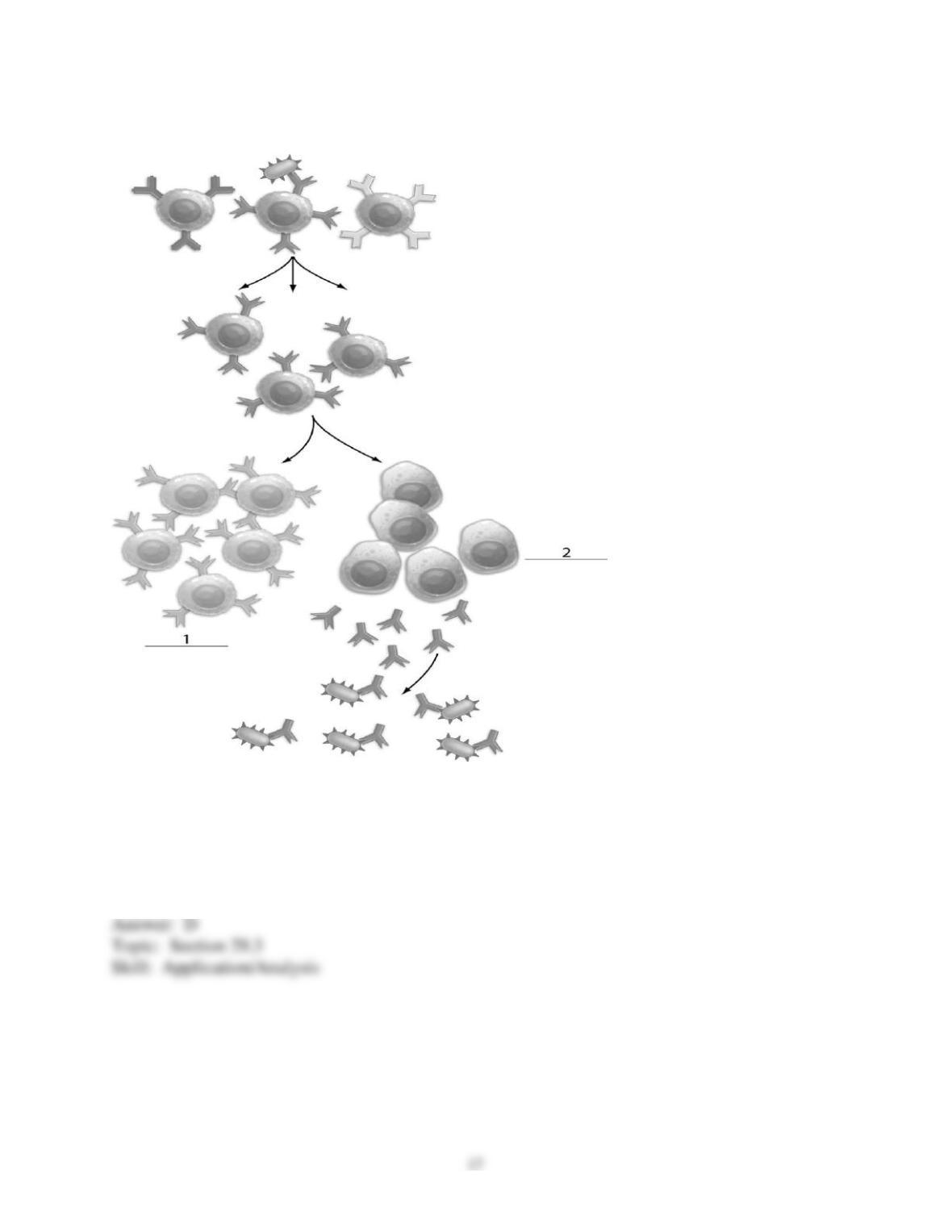
Refer to the figure below, and then answer the following question(s).
79) The figure above shows antibody-mediated immunity. The cells indicated by a “1” are:
A) bacterial cells.
B) cytotoxic T cells.
C) helper T cells.
D) memory cells.
E) plasma cells.

80) The figure above shows antibody-mediated immunity. The cells indicated by a “2” are:
A) bacterial cells.
B) cytotoxic T cells.
C) helper T cells.
D) memory cells.
E) plasma cells.