
280)
The main difference between a monopsonist and a competitive buyer of labor is that
280)
A)
the competitive firm can hire as many workers as it wants at the going wage while the
monopsonist can hire more workers at lower wages.
B)
the monopsonist can hire as many workers as it wants at the going wage while the
competitive firm must raise wages to hire additional workers.
C)
the competitor can hire as many workers as it wants at the going wage while the monopsonist
must raise wages to hire additional workers.
D)
the monopsonist can force wages down and still hire as many workers as it wants while the
competitive firm must increase the wage rate to hire additional workers.
Quantity of Labor Required Hourly
Supplied to Management Wage Rate
0
1$17
2$19
3$21
281)
Refer to the above table. What is the marginal factor cost when the firm employs the third unit of
labor?
281)
A)
$57
B)
$25
C)
$21
D)
$62

Quantity of Required
Labor Supplied Wage Rate
1$6.00
2 9.00
3 12.00
415.00
5 18.00
6 21.00
7 24.00
8 27.00
930.00
10 33.00
282)
From the information in the above table, calculate the marginal factor cost of the third worker.
282)
A)
$12.00
B)
$18.00
C)
$24.00
D)
$36.00
Quantity of
Wage Rate Labor Supplied
$10 1
$15 2
$20 3
$25 4
283)
Use the above table. The MFC of the 3rd worker is
283)
A)
$5.
B)
$30.
C)
$6.7.
D)
$20.
284)
Which of the following best describes the effects of unions in the United States today?
284)
A)
The average union worker works fewer hours but earns a higher annual income than the
average nonunion worker.
B)
The average union worker works more hours and earns a higher annual income than the
average nonunion worker.
C)
The average union worker works more hours but earns a lower annual income than the
average nonunion worker.
D)
The average union worker works fewer hours and earns a lower annual income than the
average nonunion worker.
285)
A situation in which union membership is required before a person can be hired is a
285)
A)
closed shop.
B)
agency shop.
C)
union shop.
D)
restricted shop.
286)
A legal arrangement whereby a firm can hire only union labor is called
286)
A)
a union shop.
B)
a closed shop.
C)
an open shop.
D)
a sweat shop.
B
287)
Strikebreakers
287)
A)
make a strike permanent.
B)
make a union negotiation invalid.
C)
can reduce the bargaining power of a union.
D)
can strengthen the bargaining power of a union.
C
288)
The practice of forcing employers to use more labor than they would otherwise use is called
288)
A)
railroading.
B)
featherbedding.
C)
bootstrapping.
D)
dumping.
B
289)
When there is only one buyer of labor in a community, we talk of a
289)
A)
labor cooperative.
B)
monopolistic market.
C)
monopsony.
D)
monopoly.
C
A
290)
A firm that is a monopsonist in the labor market and a monopolist in the product market will hire
labor to the point at which
290)
A)
where supply of labor = demand for labor.
B)
MFC = MRPm.
C)
a perfectly inelastic labor supply = perfectly inelastic labor demand.
D)
a perfectly elastic labor supply = MRP.
Quantity of Required
Labor Supplied Wage Rate
1$6.00
2 9.00
3 12.00
415.00
5 18.00
6 21.00
7 24.00
8 27.00
930.00
10 33.00
291)
According to the above table, if the marginal revenue product is $48, how many workers will the
profit maximizing monopsonist hire?
291)
A)
5
B)
6
C)
7
D)
8
292)
A jurisdictional dispute means that
292)
A)
two unions disagree on which should represent workers in a particular industry.
B)
a higher court reversed the decision of a lower court in a case brought by a union.
C)
a union leadership and membership cannot agree on an issue.
D)
members of a union disagree on the outcome of union elections.
293)
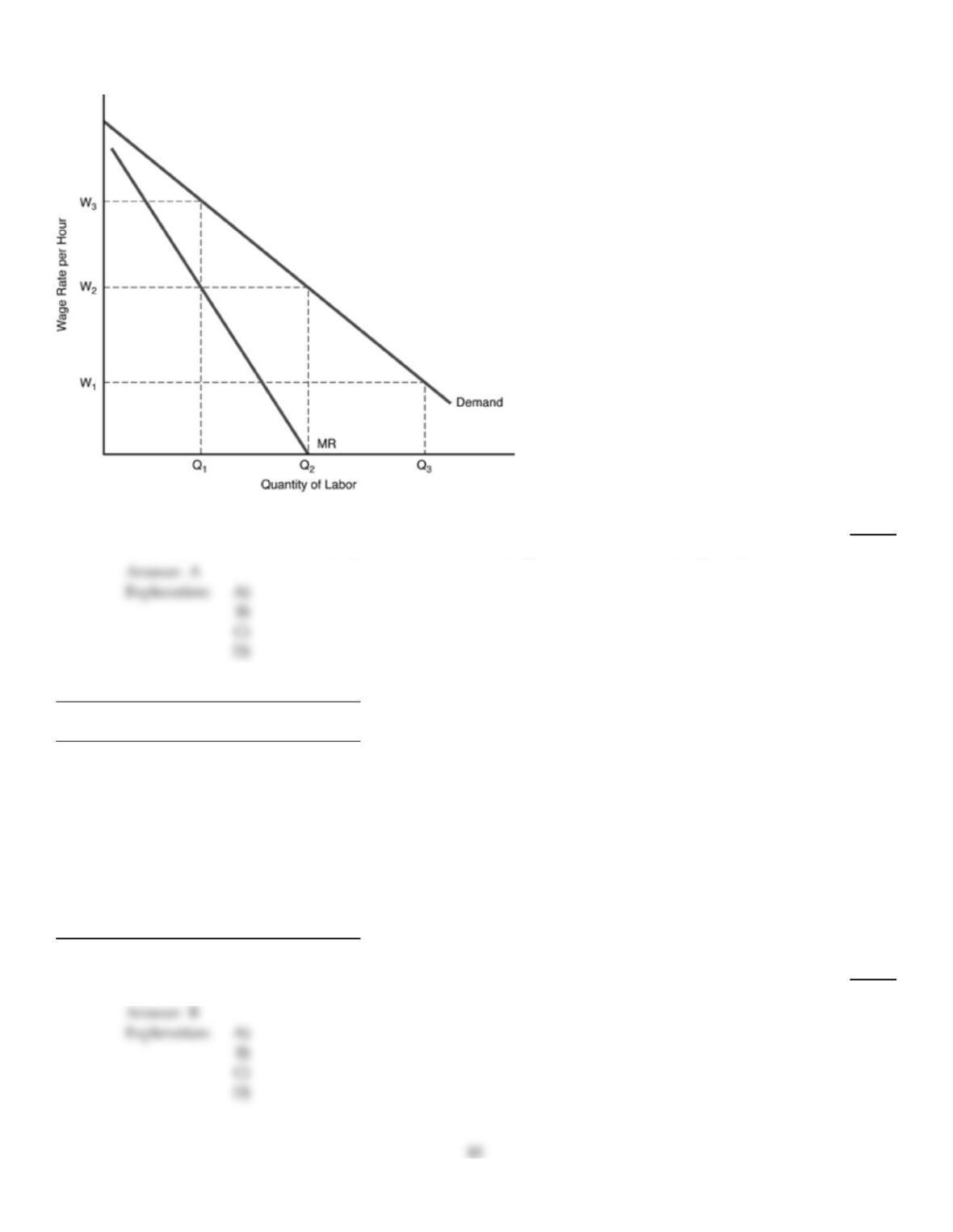
In the above figure, which wage rate yields the highest union employment?
293)
A)
W1
B)
W2
C)
W3
D)
W2–W1
Quantity of Required
Labor Supplied Wage Rate
1$6.00
2 9.00
3 12.00
415.00
5 18.00
6 21.00
7 24.00
8 27.00
930.00
10 33.00
294)
According to the above table, the marginal factor cost of the eighth worker is
294)
A)
$168.00.
B)
$48.00.
C)
$216.00.
D)
$27.00.
B
A
295)
Suppose union workers are earning more than similarly qualified nonunion workers. From this, we
can conclude that
295)
A)
unemployment of nonunion workers must have increased.
B)
unemployment of union workers must have increased.
C)
productivity of union workers must be greater than the productivity of nonunion workers.
D)
Any of the above are possible and we cannot tell which without having more information.
296)
A monopsonist is currently employing 50 workers at $10 an hour. It wants to hire an additional
worker, but will have to pay the worker $10.10. The marginal factor cost is
296)
A)
$10.00.
B)
$10.10.
C)
$15.10.
D)
ten cents.
Quantity of Labor Required Hourly
Supplied to Management Wage Rate
0
1$17
2$19
3$21
297)
Refer to the above table. What is the marginal factor cost when the firm employs the second unit of
labor?
297)
A)
$21
B)
$38
C)
$19
D)
$36
298)
Which of the following laws made “closed shops” unlawful?
298)
A)
Taft–Hartley Act
B)
National Industrial Recovery Act
C)
Railway Workers Act
D)
National Labor Relations Act
299)
A union is striking a steel company, and then, to put more pressure on the steel company, also
promotes a boycott against an auto company that buys steel from the steel company. This latter
action is
299)
A)
a sympathy strike, and is illegal under the Taft–Hartley Act.
B)
a sympathy strike, and is legal under the Wagner Act.
C)
a secondary boycott, and is legal under the Landrum–Griffin Act.
D)
a secondary boycott, and is illegal under the Taft–Hartley Act.
300)
Since the 1970s, union membership in the U.S. has been
300)
A)
remaining constant.
B)
erratic.
C)
rising.
D)
declining.
D
301)
Collective bargaining in the United States typically involves negotiations between
301)
A)
union and nonunion employees regarding work rules.
B)
an individual and her boss over the appropriate salary level.
C)
the government and management over the minimum wage law.
D)
the management of a company and the leaders of the union over the wages and fringe
benefits to be offered.
D
ESSAY. Write your answer in the space provided or on a separate sheet of paper.
302)
What was the overall trend of U.S. union membership beginning the 1960s? What was the main reason behind
that trend?
303)
“Unions in the United States have helped raise the incomes of union workers as compared to nonunion
workers.” Do you agree or disagree? Why?
D
304)
Discuss the benefits of unions.
305)
Using a graph, compare the labor–market equilibrium under perfect competition and monopsony. Explain.
306)
Why might a union find that attaining the goal of employing all its members and the goal of maximizing total
union wage receipts to be incompatible objectives?
307)
A union can be viewed as a monopoly seller of a service. What are the three wage and employment strategies
the union might use?
308)
What can a union do in order to raise the wages of its members ?
309)
Have unions been successful at raising wages for their members? What about raising wages for all workers?
310)
A union could raise wages without causing unemployment of union members if it can increase demand for
union labor. How might this goal be achieved?
311)
Distinguish between craft unions and industrial unions.
312)
What is the purpose of a strike? What are the costs to workers and to management?
313)
How can restricting entry into a union help boost members’ wages without the union specifically setting wages?
314)
Suppose a union negotiates for its members a wage that is above the market–clearing wage. What problems
does the union have to solve now? Explain.
315)
Distinguish between a closed shop and a union shop. Are either or both shops legal? Explain.
316)
What is a monopsony and how does a monopsonistic firm determine the wage rate to pay its employees?
317)
Discuss the significant laws passed since the Great Depression that affect labor–management relations.
318)
Can unions increase productivity? Explain.
93
94
95
96