146)
A primary objective of labor unions is to
146)
A)
seek better pay and improved work conditions.
B)
secure equal pay for its members.
C)
have equal power with their employer.
D)
all of the above.
E)
none of the above.
147)
The type of labor agreement that requires workers to be union members prior to being considered
for employment is a
147)
A)
union shop agreement.
B)
right–to–work agreement.
C)
closed–shop agreement.
D)
open–shop agreement.
C
Quantity of
Wage Rate Labor Supplied
$10 1
$15 2
$20 3
$25 4
148)
Use the above table. If the marginal revenue product is $20, how many workers will the profit
maximizing monopsonist hire?
148)
A)
1
B)
2
C)
3
D)
4
B
A
Quantity Hourly Total Marginal
of Labor Wage Rate Wage Bill Factor Cost
0– – –
1$10
212
3 14
416
518
620
149)
In the above table, if the marginal revenue product is $18, how many workers will the profit
maximizing monopsonist hire?
149)
A)
2
B)
3
C)
4
D)
5
150)
Temporary or permanent workers hired to replace striking union workers are known as
150)
A)
backbreakers.
B)
strikebreakers.
C)
rationers.
D)
strikeaiders.
Explanation:
151)
A union of all workers from a particular industry is a(n)
151)
A)
industrial union.
B)
expansive union.
C)
craft union.
D)
conglomerate union.
Explanation:
152)
A business enterprise in which employees must belong to the union before they can be hired is
152)
A)
an industrial union.
B)
a closed shop.
C)
a jurisdictional dispute.
D)
a union shop.
Explanation:
Explanation:
153)
A craft labor union is made up of
153)
A)
an organization that controls the labor market in a particular industry.
B)
all the workers in a firm such as General Motors.
C)
firms that employ similar labor skills.
D)
groups of workers in an individual trade.
154)
A firm that is a monopolist in the output market and a monopsonist in the input market
154)
A)
will hire less labor and pay a lower wage compared to the perfectly competitive case.
B)
will hire less labor but pay the same wage compared to the perfectly competitive case.
C)
will restrict the level of output but not that of employment compared to the perfectly
competitive case.
D)
will hire the same amount of labor as if perfect competition prevailed in both markets, but
pay a lower wage.
155)
Which statement best describes the behavior of the monopsonist in the labor market?
155)
A)
It restricts its output to keep the product price high.
B)
It must pay different amounts to each unit of labor hired.
C)
It hires less labor but pays the perfectly competitive wage rate.
D)
It hires less labor and pays a lower wage rate than in the perfectly competitive case.
156)
Prior to World War I, the U.S. government‘s attitude towards labor unions was one of
156)
A)
hostility.
B)
support, except when it came to unions of public employees.
C)
indifference.
D)
support.
157)
Under monopsony, marginal factor cost
157)
A)
equals the wage rate.
B)
is less than the wage rate, although it increases as more workers are hired.
C)
is downward sloping.
D)
is greater than the going wage rate.
158)
In a monopsonistic market
158)
A)
both employment and wages are higher than in a comparable competitive market.
B)
both employment and wages are lower than in a comparable competitive market.
C)
employment is lower but wages are higher than in a comparable competitive market.
D)
employment is higher but wages are lower than in a comparable competitive market.
B
159)
A business enterprise in which employees must belong to the union before they can be hired is
called a(n)
159)
A)
closed shop.
B)
craft union.
C)
industrial union.
D)
union shop.
A
160)
The attempt to force employers to use more labor than they otherwise would, or to force employers
to use labor inefficiently, is known as
160)
A)
a monopsony.
B)
featherbedding.
C)
a sympathy strike.
D)
a secondary boycott.
B
D
161)
A state with “right–to–work” laws would most likely have
161)
A)
higher employment levels than neighboring states without such laws.
B)
more worker safety requirements than neighboring states without such laws.
C)
more workers’ benefits than neighboring states without such laws.
D)
more union workers than neighboring states without such laws.
162)
A practice which might force employers to use more labor than they would otherwise is referred to
as
162)
A)
yellow–dogging.
B)
mothballing.
C)
featherbedding.
D)
wall propping.
C
Quantity Hourly Total Marginal
of Labor Wage Rate Wage Bill Factor Cost
0– – –
1$10
212
3 14
416
518
620
163)
In the above table, if the marginal revenue product is $22, how many workers will the profit
maximizing monopsonist hire and what wage will they pay each worker?
163)
A)
4; $16
B)
5; $18
C)
3; $14
D)
4; $22
A
164)
Which of the following is LEAST likely to be a reason for the decline in U.S. union membership?
164)
A)
increases in the work force of the public sector
B)
declines in manufacturing employment
C)
increasingly more immigrant workers to fill unskilled job positions
D)
deregulation of transportation industries
A
A
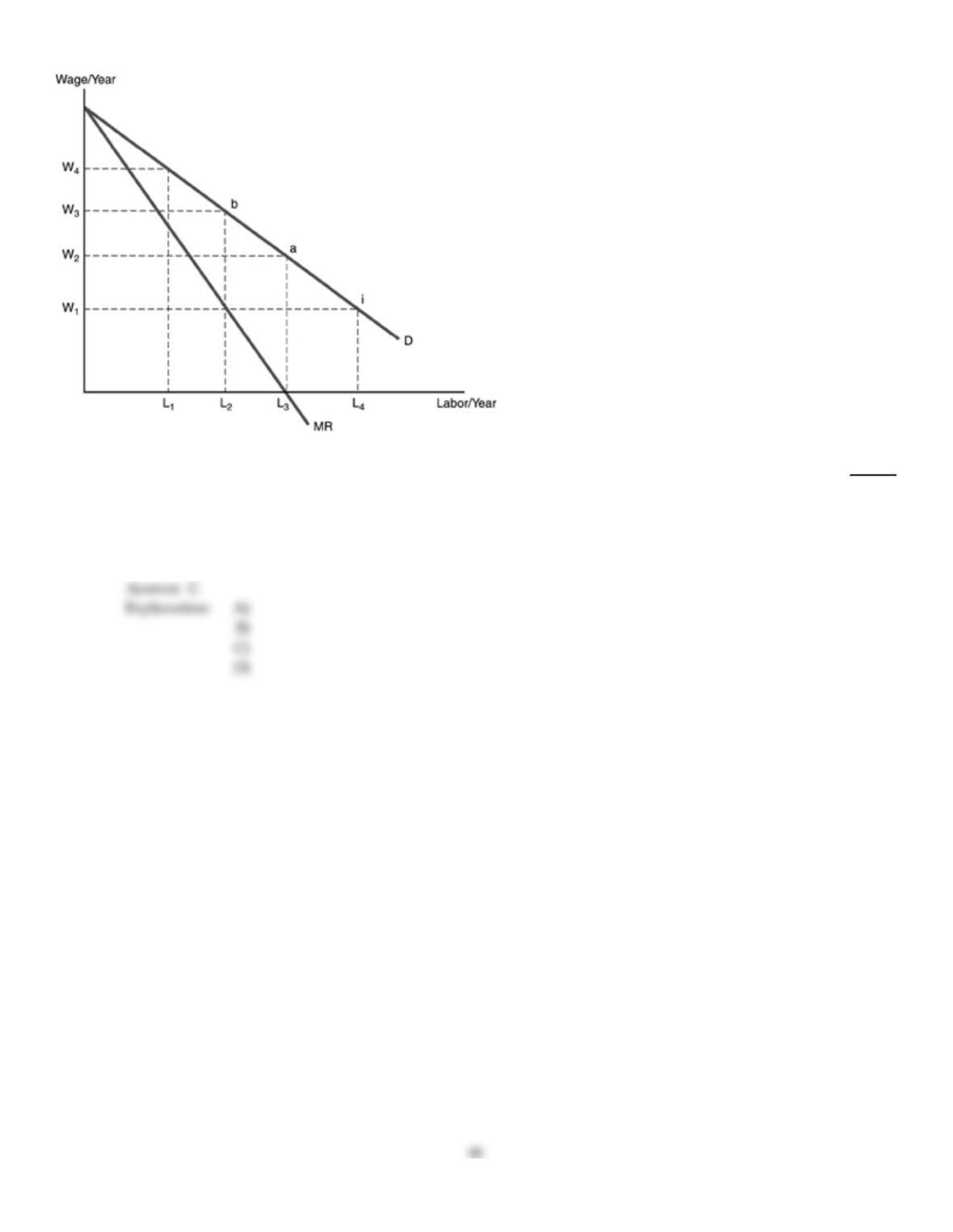
165)
Refer the above figure. An increase in labor productivity is likely to stimulate and shift the labor
demand curve to
165)
A)
to the left and hence increase union wages per year.
B)
the right and hence lower union wages per year.
C)
the right and hence increase union wages per year.
D)
None of the above is likely to happen.
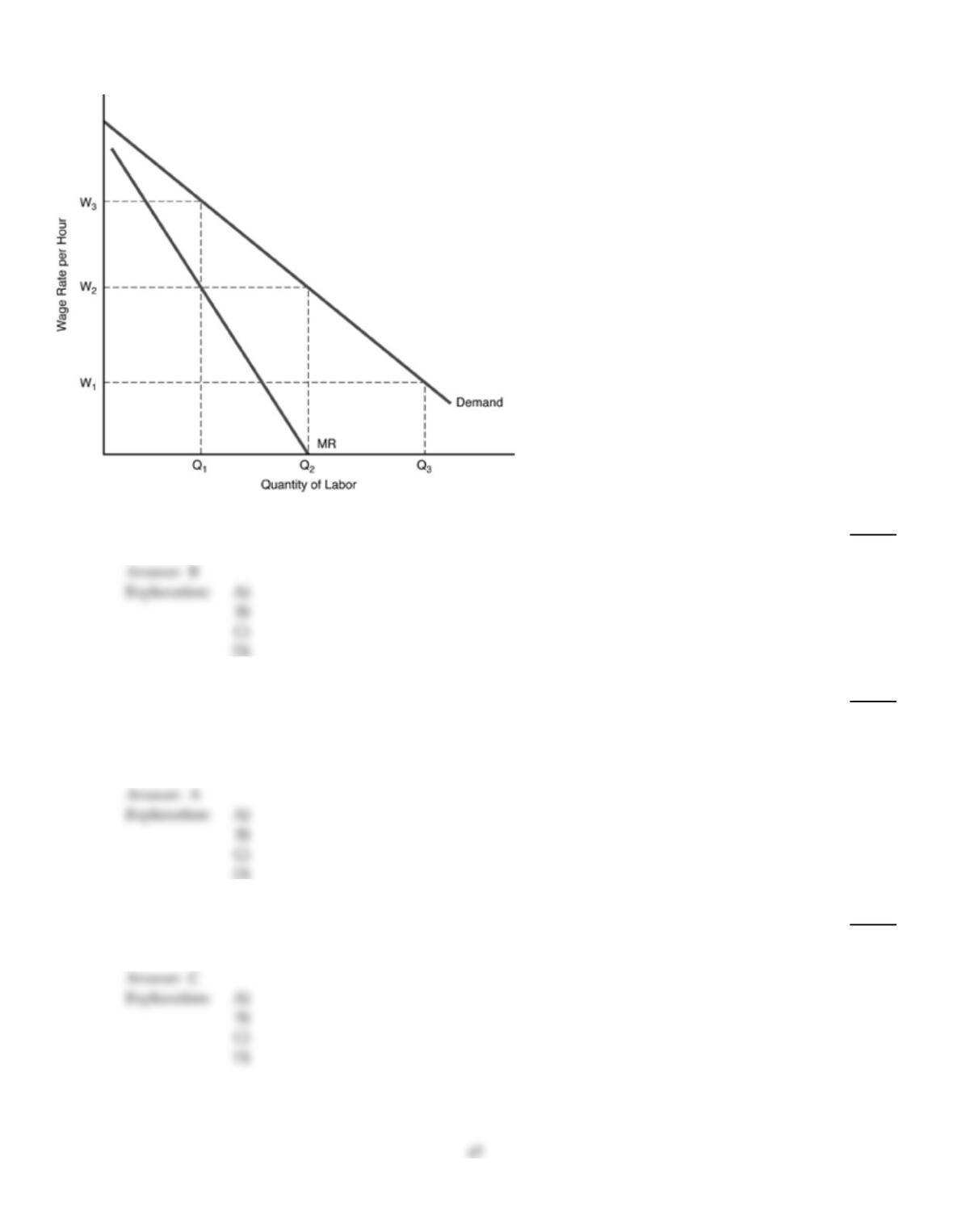
166)
In the above figure, which wage rate will maximize union members’ income?
166)
A)
W1
B)
W2
C)
W3
D)
W3–W1
167)
An industrial union is
167)
A)
a union composed of workers who are employed in a particular industry.
B)
a union composed of public employees.
C)
a union composed of workers who engage in a particular trade or skill.
D)
a union composed of workers who are in a specific geographic area.
168)
Deregulation has contributed to
168)
A)
an increase in union power.
B)
an increase in union membership.
C)
declines in union membership.
D)
higher wages in unions.
169)
The Taft–Hartley Act
169)
A)
permits states to pass right–to–work laws.
B)
permits states to outlaw unions.
C)
encourages unions to engage in sympathy strikes.
D)
encourages unions to engage in secondary boycotts.
170)
The United Auto Workers is an example of
170)
A)
a socialist union.
B)
a craft union.
C)
an industrial union.
D)
a public–sector union.
171)
Bilateral monopoly exists when
171)
A)
a single buyer confronts a single seller.
B)
two labor unions are trying to represent the same group of workers.
C)
a firm is both a monopoly in its output market and a monopsonist in its input market.
D)
there are two monopolistic buyers trying to buy resources.
Quantity Hourly Total Marginal
of Labor Wage Rate Wage Bill Factor Cost
0– – –
1$10
212
3 14
416
518
620
172)
In the above table, what is the marginal factor cost of the 4th worker?
172)
A)
$64
B)
$16
C)
$30
D)
$22
173)
The first labor unions in the United States were
173)
A)
industrial unions.
B)
craft unions.
C)
public–sector unions.
D)
guilds.
174)
Suppose a union successfully negotiates a wage rate for its members that is above the competitive
wage rate, then
174)
A)
there will be downward pressure on the wage rate until equilibrium is established.
B)
there is a shortage of jobs.
C)
right–to–work laws become effective.
D)
there is excess demand for labor.
175)
At any quantity, the marginal factor cost is always
175)
A)
parallel to the marginal revenue product.
B)
above the labor demand curve.
C)
below the labor supply curve.
D)
above the labor supply curve.
176)
A right–to–work law makes it illegal for
176)
A)
union membership to be denied on the basis of race, gender, or national origin.
B)
union membership to be a requirement for continued employment in any establishment.
C)
employers to refuse to hire union workers.
D)
a union to exist in a state.
177)
Marginal factor cost is
177)
A)
the change in the price of an input when an additional unit of the input is hired.
B)
the change in total costs due to a one–unit increase in the variable input.
C)
the change in total costs due to a one–unit change in the quantity of the good produced.
D)
the marginal cost of changing the rate of production in the long run.
178)
The United Auto Workers is striking against Ford. The Teamsters refuse to deliver steel to Ford.
This is an example of
178)
A)
a secondary boycott and is illegal under the Taft–Hartley Act.
B)
a closed shop and is illegal under the Wagner Act.
C)
a jurisdictional dispute and is illegal under the Taft–Hartley Act.
D)
a sympathy strike and is illegal under the Taft–Hartley Act.
179)
The American Federation of State, County, Government and Municipal Employees is an example of
a(n)
179)
A)
guild.
B)
craft union.
C)
public–sector union.
D)
industrial union.
180)
When a group of workers forms a union, they introduce an element of
180)
A)
pure competition into the labor market.
B)
monopoly into the product market.
C)
monopsony into the product market.
D)
monopoly into the labor market.
181)
In a bilateral monopoly, the wage rate that is determined in the market
181)
A)
is the same as in a perfectly competitive market.
B)
is indeterminate.
C)
is equal to MRP.
D)
is equal to MFC.
182)
Unions tend to want import restrictions because
182)
A)
imports are usually of inferior quality.
B)
they can increase the wages for union workers by increasing the productivity of union
workers when the workers aren’t worried about foreign competition.
C)
the restrictions decrease the demand for non–union made goods, increasing the demand for
union made goods.
D)
the restrictions also reduce the number of immigrants that can enter the country and decrease
the supply of nonunion labor.
183)
The ultimate threat of a union is
183)
A)
the strike.
B)
the President‘s power granted by the Taft–Hartley Act.
C)
the unity of spirit of the union membership.
D)
the lockout.
Explanation:
184)
A right–to–work state is one in which
184)
A)
the closed shop is permitted.
B)
the union shop is prohibited.
C)
there is guaranteed employment for all citizens.
D)
unions are illegal.
Explanation:
185)
The welders’ union at Ajax is on strike. The maintenance union has decided to walk out in support
of the welders’ union. This is known as
185)
A)
a union shop.
B)
a closed shop.
C)
a sympathy strike.
D)
a secondary boycott.
Explanation:
Explanation:
186)
A work stoppage by a union in solidarity with another union’s cause is known as a
186)
A)
secondary boycott.
B)
primary boycott.
C)
sympathy strike.
D)
jurisdictional dispute.
187)
Which of the following is FALSE regarding unions?
187)
A)
For a period after World War I the government temporarily stopped protecting labor’s right to
organize.
B)
The AFL and the CIO merged in 1955.
C)
The American Federation of Labor (AFL), composed of craft unions, was formed in 1886
under the leadership of Samuel Gompers.
D)
During the Great Depression, legislation was passed that made collective bargaining illegal.
D
188)
Featherbedding means that
188)
A)
employers are forced to hire more workers than they want to.
B)
company management receives a cut from the collected union wages.
C)
employers are force to hire apprentices.
D)
a union can join a sympathy strike.
A
189)
Which of these nations has the highest rate of union membership (as a share of total employment)?
189)
A)
Japan
B)
India
C)
the United States
D)
Sweden
D
C
190)
Union membership, in terms of percentage of the U.S. civilian labor force
190)
A)
has increased steadily since the passage of the Wagner Act.
B)
peaked about 1960 and has since declined.
C)
has increased dramatically since 1970.
D)
was over 50 percent in 1987.
191)
The MFC can be calculated by the
191)
A)
total wages/total labor.
B)
change in labor/change in total wages.
C)
change in total wages/change in labor.
D)
total wages/change in labor.
C
192)
If the labor supply curve faced by a firm is rising, the marginal factor cost curve of labor must be
192)
A)
rising and above the supply curve.
B)
horizontal.
C)
equal to the supply curve.
D)
rising and below the supply curve.
A
193)
All of the following are benefits of labor unions EXCEPT
193)
A)
unions reduce wage inequity.
B)
unions increase the stability of the workforce.
C)
unions maximize employment for all workers.
D)
unions give workers a political voice.
C
194)
The primary purpose of a strike by labor unions is to
194)
A)
secure a larger market share for the firm.
B)
force the firm out of business.
C)
ensure they get paid for striking.
D)
extract from the firm better and improved conditions of work or contract terms.
D
B
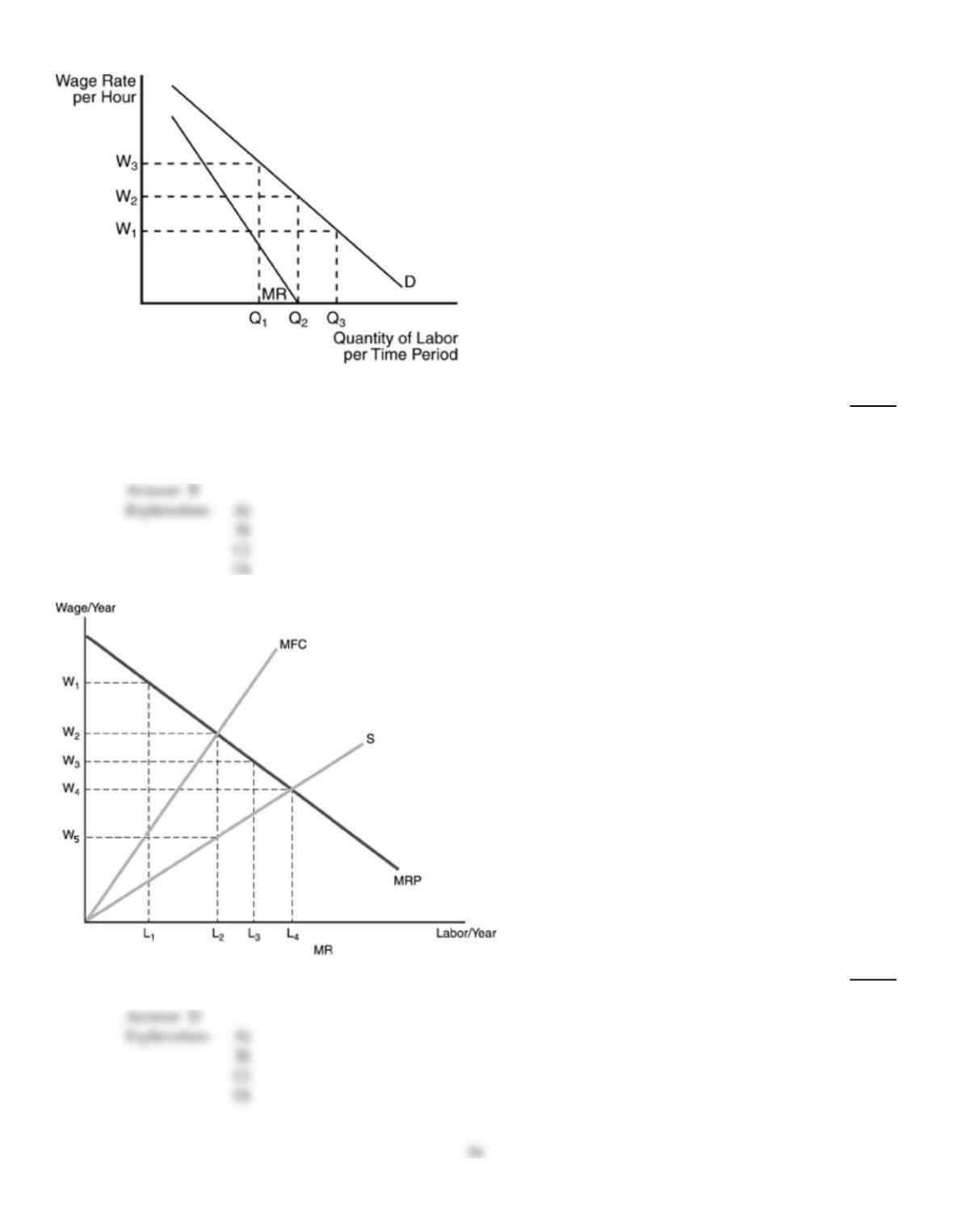
195)
In the above figure, if the union has Q2 members and wants to ensure that all members have jobs, it
will set wage equal to
195)
A)
W1.
B)
W2.
C)
W3.
D)
none of the above.
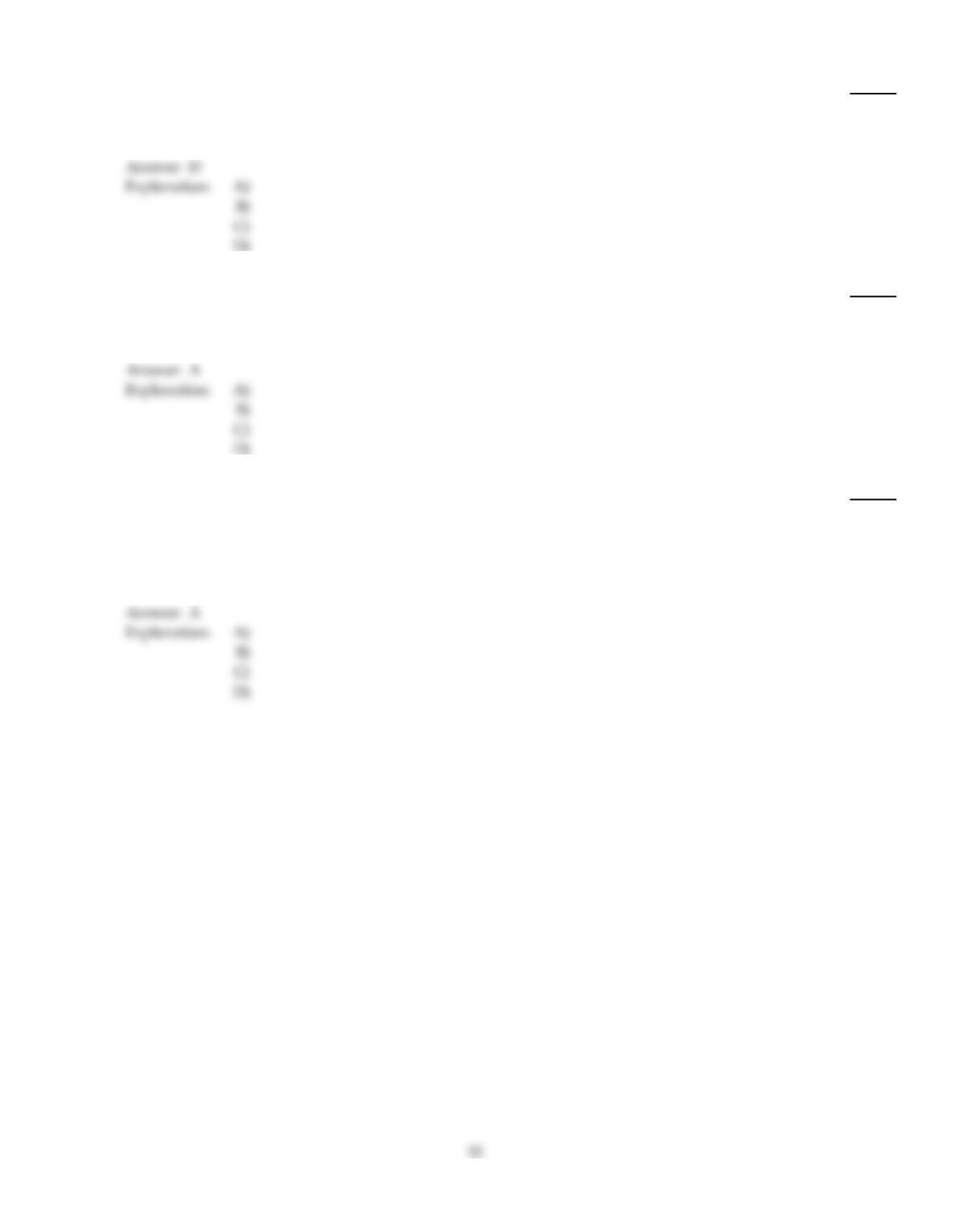
196)
Refer to the above figure. Under monopsony, the wage rate will be
196)
A)
W1.
B)
W2.
C)
W3.
D)
W5.
D
B
197)
A business enterprise that allows the hiring of nonunion members conditional on their joining the
union is
197)
A)
an industrial union.
B)
a closed shop.
C)
a jurisdictional dispute.
D)
a union shop.
198)
If a union sets the wage rate to maximize the total wage receipts of its members, the marginal
revenue would be
198)
A)
zero.
B)
positive, but greater than 1.
C)
positive, but less than 1.
D)
negative.
Explanation:
199)
If a union negotiates and obtains a wage rate above the competitive wage rate,
199)
A)
it must find a way to ration jobs among the excessive number of workers who wish to work in
the union sector.
B)
it must find a way to make workers more productive.
C)
unemployment will increase in the nonunion sector relative to the union sector.
D)
employment in the union sector will increase relative to employment in the nonunion sector.
Explanation:
Explanation:
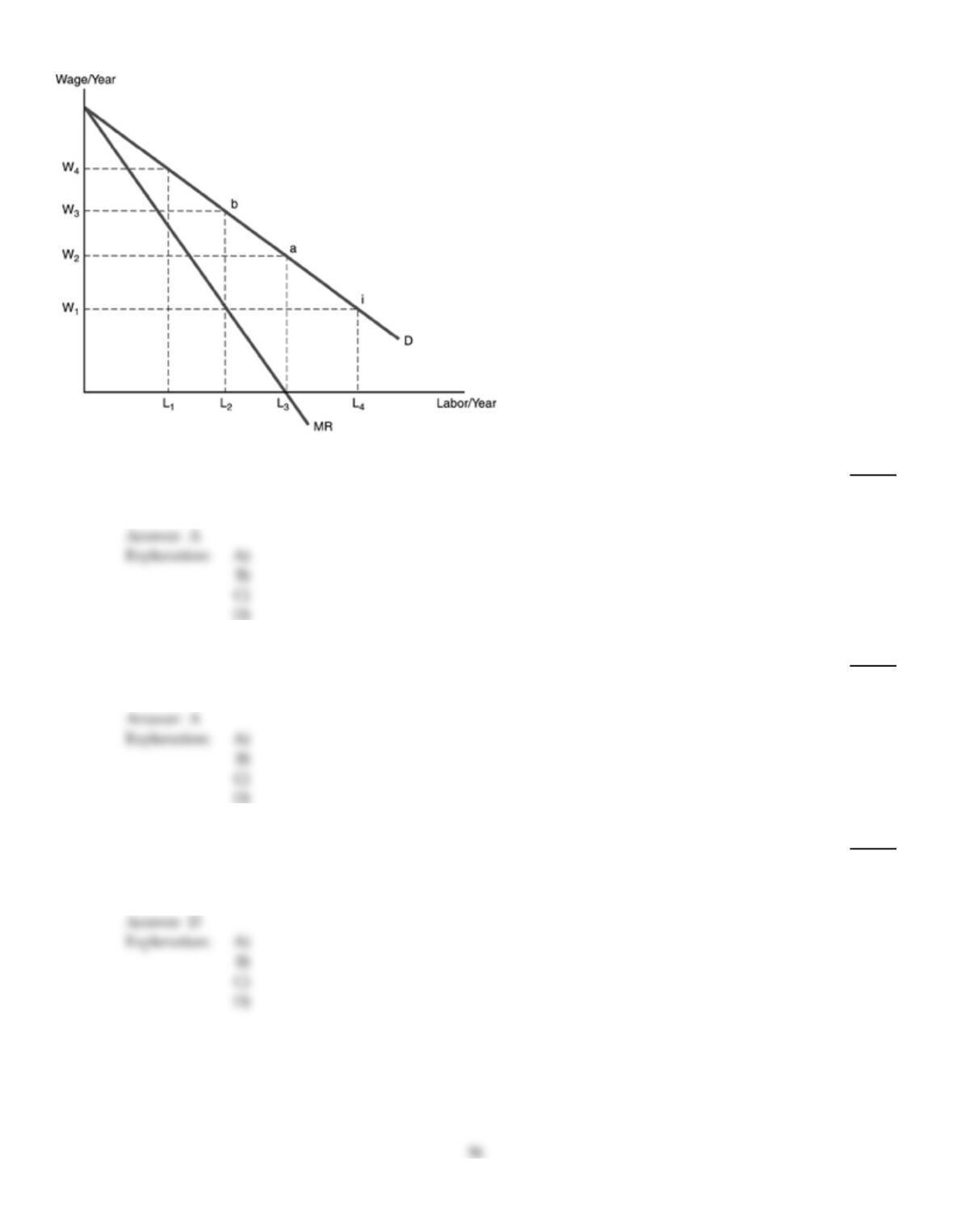
200)
Refer to the above figure. Suppose there are L4 workers in the union, and the union wants all of its
workers to have a job. It will set the wage rate at
200)
A)
W1.
B)
W2.
C)
W3.
D)
W4.
201)
What time period in U.S. history do we generally recognize as the peak of labor union
membership?
201)
A)
1940s–1970s
B)
1900s–1920s
C)
1970s–2000s
D)
1920s–1940s
202)
A union requirement that a fireman has to be hired to work in a diesel locomotive would be an
example of
202)
A)
work stabilization.
B)
work requirements.
C)
work expansion.
D)
featherbedding.
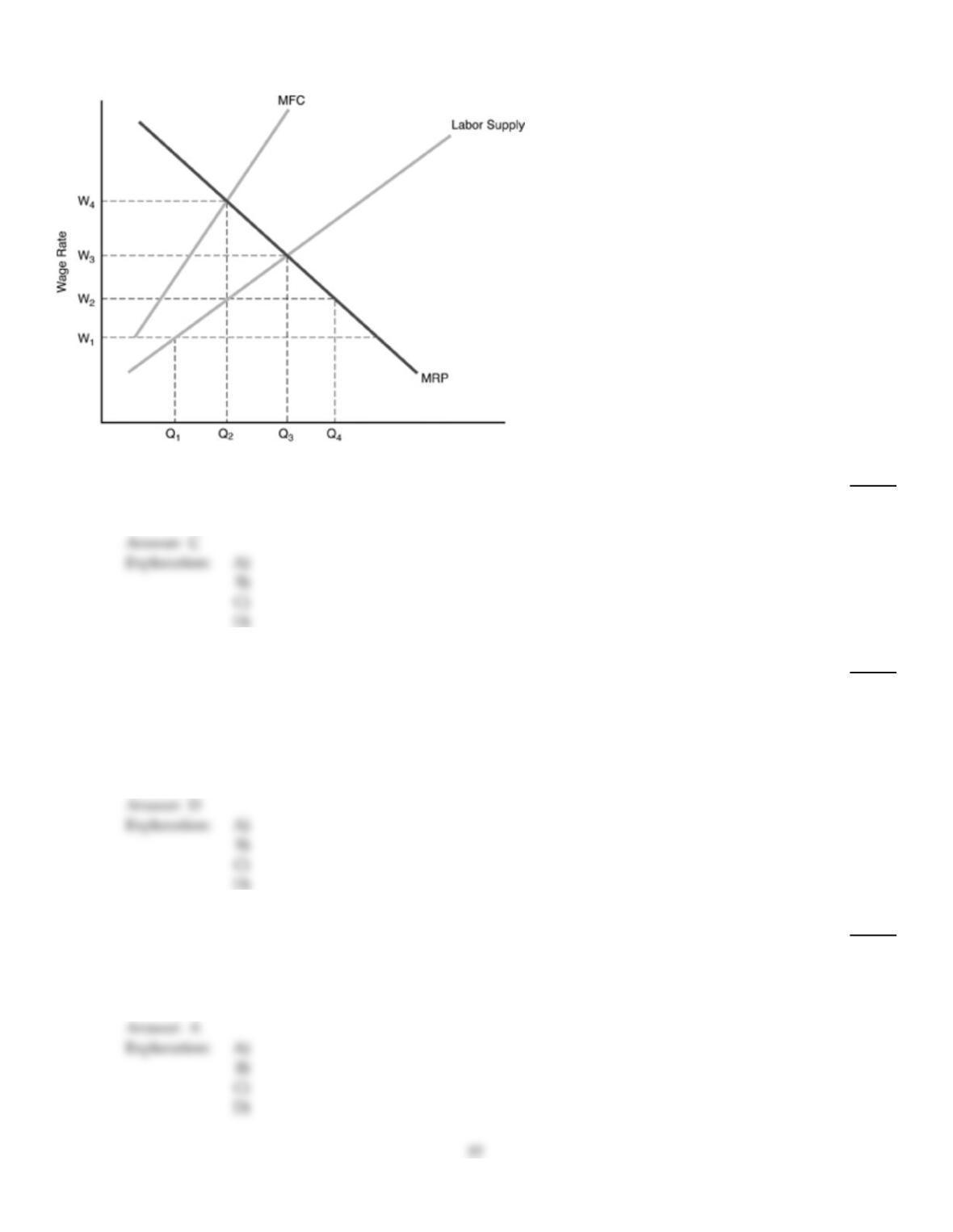
203)
In the above figure, what is the quantity of workers that would be hired in a perfectly competitive
market?
203)
A)
Q1
B)
Q2
C)
Q3
D)
Q4
204)
Which of the following is FALSE regarding bilateral monopoly?
204)
A)
An example of bilateral monopoly is a state education employer facing a single teachers’
union in the labor market.
B)
Bilateral monopoly is defined as a market structure in which a single buyer faces a single
seller.
C)
Bilateral monopoly is a market structure consisting of a monopolist and a monopsonist.
D)
The price outcome is easily determined.
205)
Evidence in support of the hypothesis that unions increase the productivity of union workers is
205)
A)
that unionized firms face lower turnover rates than nonunion firms do.
B)
there is an excess supply of labor at the union wage rate.
C)
that most contracts are settled without a strike.
D)
the fact that union wages are greater than nonunion wages.
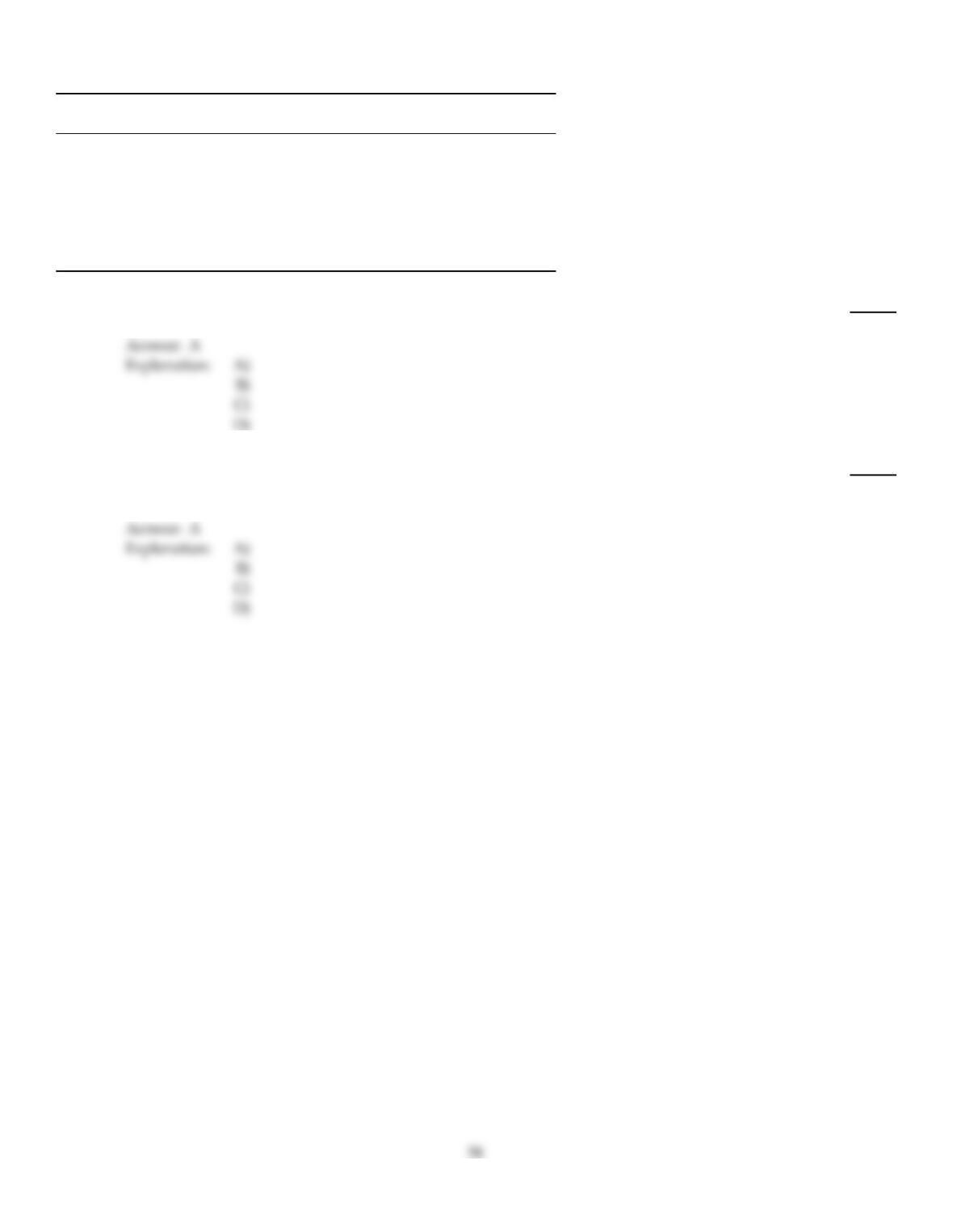
Quantity Hourly Total Marginal
of Labor Wage Rate Wage Bill Factor Cost
0– – –
1$10
212
3 14
416
518
620
206)
In the above table, what is the marginal factor cost of the 5th worker?
206)
A)
$26
B)
$18
C)
$22
D)
$90
207)
The Congress of Industrial Organization (CIO) was founded by
207)
A)
John L. Lewis.
B)
Samuel Gompers.
C)
George Meany.
D)
Jimmy Hoffa.
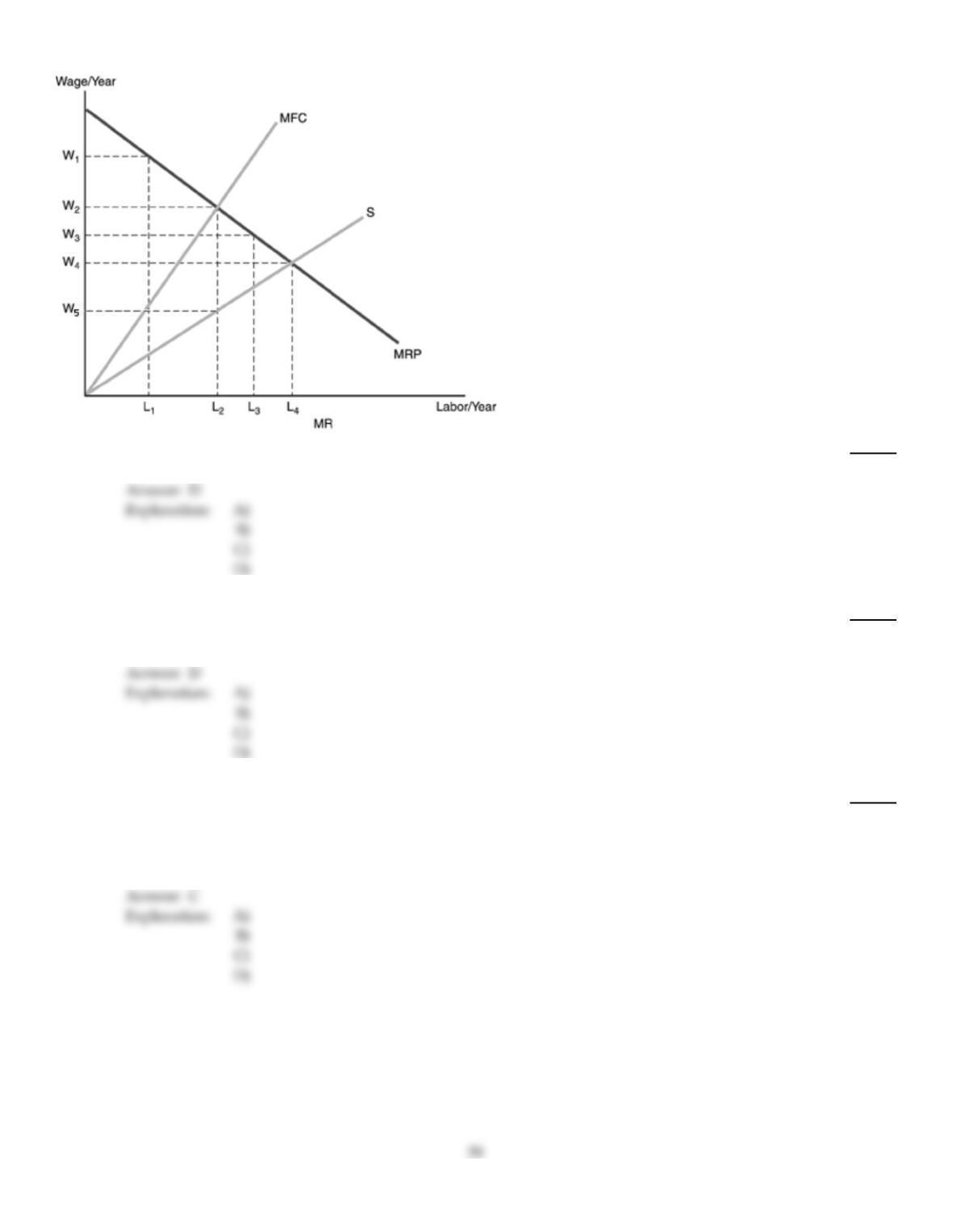
208)
Refer to the above figure. The wage rate under perfect competition is
208)
A)
W2.
B)
W3.
C)
W4.
D)
W5.
209)
If you want to become an actor, and you must join the Screen Actors Guild after your first job, the
Screen Actors Guild is a(n)
209)
A)
closed shop.
B)
open shop.
C)
agency shop.
D)
union shop.
D
210)
Research indicates that on average, state government unions have
210)
A)
have not significantly raised wages above similar workers in the nonunion sector.
B)
raised wages 25 to 30 percent above nonunionized private–sector and government workers.
C)
raised wages to 20 percent above nonunionized government workers.
D)
raised wages about 100 percent above similar workers in the nonunion private sector.
C
D
211)
A secondary boycott is
211)
A)
illegal according to the Wagner Act.
B)
a legal way to support striking workers.
C)
legal according to the Sherman Act.
D)
illegal according to the Taft–Hartley Act.
212)
At the profit–maximizing level of employment, the monopsonist
212)
A)
pays a wage less than MRP.
B)
pays a wage equal to MRP.
C)
pays a wage greater than MRP.
D)
pays a wage equal to MFC.
213)
If we were to compare the hourly earnings of union and nonunion workers in recent years, we
would find that
213)
A)
state government unionized employees have earned less in hourly wages than nonunion
government employee.
B)
unions have not succeeded in raising the hourly incomes of their members above nonunion
members.
C)
unions have succeeded in raising the hourly incomes of their members above nonunion
members.
D)
union members have increased their hourly incomes, but are still below the hourly incomes of
nonunion members.
214)
Under monopsony, the marginal factor cost of a worker is equal to
214)
A)
the additional worker’s wage rate only.
B)
the increase in the wages of all other existing workers.
C)
the difference between the worker’s wage rate and the lower wage rate received by workers
who have already been hired.
D)
the additional worker’s wage rate plus the increase in the wages of all other existing workers.