71)
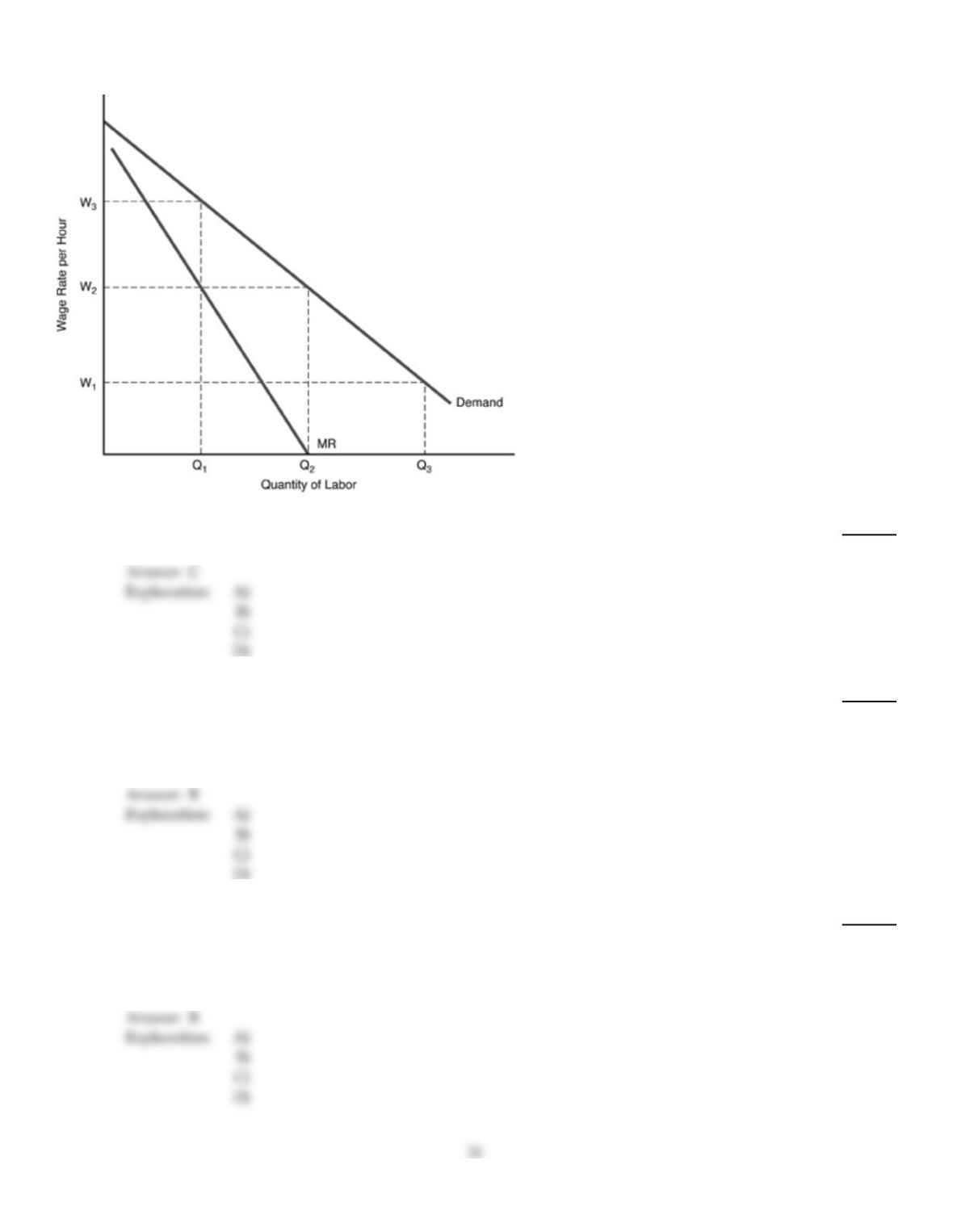
In the above figure, which wage rate will yield the highest wage rates for particular workers?
71)
A)
W1
B)
W2
C)
W3
D)
W3–W2
72)
Which of the following is NOT considered to be a benefit of unionism?
72)
A)
greater workplace safety
B)
increased featherbedding
C)
higher workforce stability
D)
provision of arbitration and grievance procedures
73)
When workers are paid a wage that is less than their contribution to a monopsonist’s revenues
73)
A)
they seek part time employment.
B)
this is sometimes referred to monopsonistic exploitation.
C)
they file a grievance with their union representative.
D)
this is sometimes referred to as an incentive.
74)
The Service Employees International Union is an example of a(n)
74)
A)
craft union.
B)
industrial union.
C)
guild.
D)
public–sector union.
75)
State right–to–work laws
75)
A)
force companies to submit to Equal Employment Opportunities Commission arbitration in
disputes.
B)
encourage companies to hire minorities.
C)
make compulsory union membership illegal.
D)
prohibit discrimination in hiring.
76)
Monopsonistic exploitation is
76)
A)
measured by the height of the supply curve of labor.
B)
measured by the area above the supply curve but below the wage paid.
C)
the cost to society from unions.
D)
the difference between the marginal revenue product of a worker and the wage received by
the worker.
77)
Methods that are sometimes used by unions to increase wages of union workers include
I. advertising to increase the demand for union–made goods.
II. campaigning against imports.
77)
A)
I only
B)
II only
C)
both I and II
D)
neither I nor II
78)
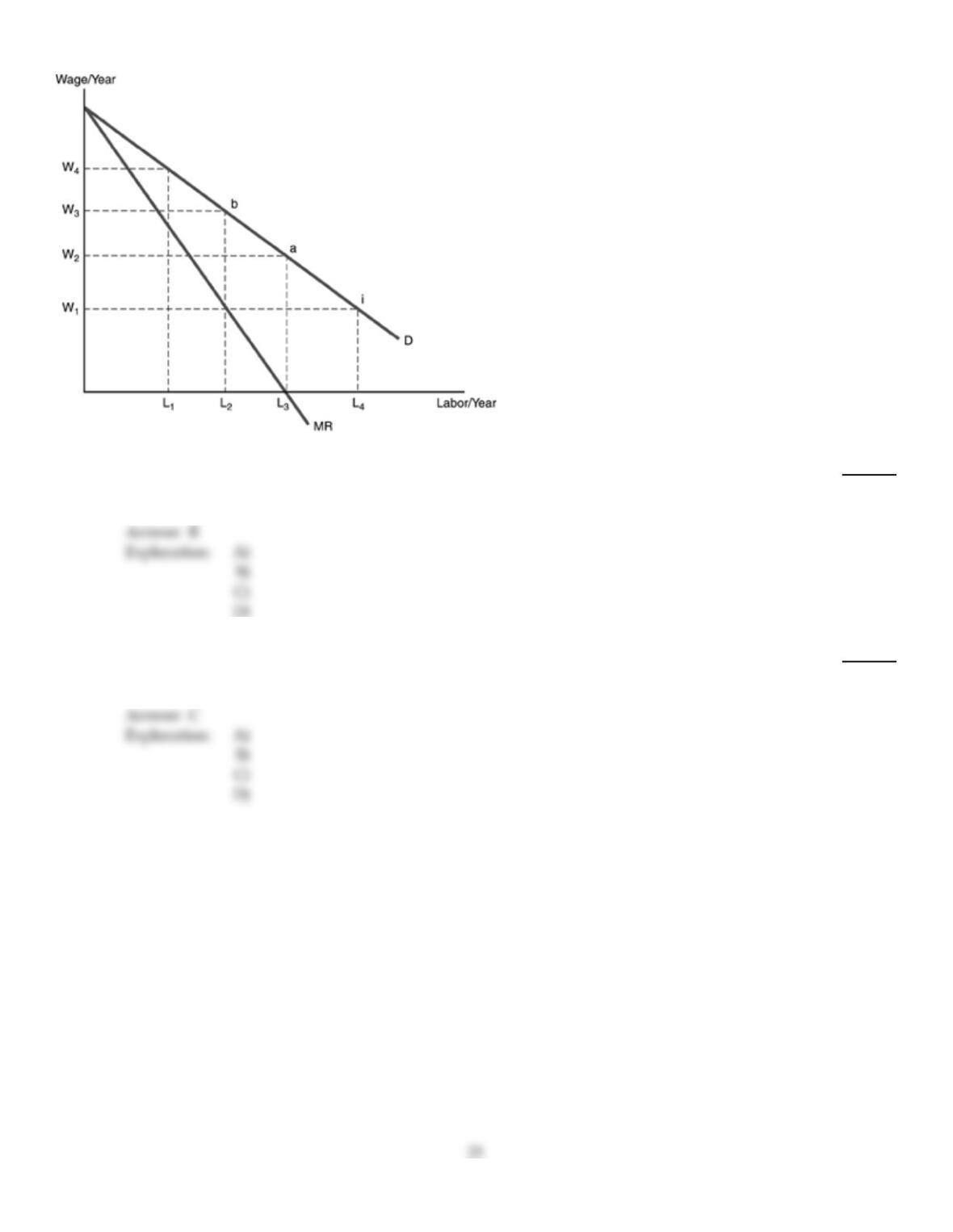
Refer to the above figure. If the union wants to maximize the total income of its members who
work, it will set wages at
78)
A)
W1.
B)
W2.
C)
W3.
D)
W4.
79)
A profit–maximizing monopsonist will hire workers up to the point at which
79)
A)
W = MRP = MFC.
B)
W = MRP.
C)
MRP = MFC.
D)
W = MFC.
80)
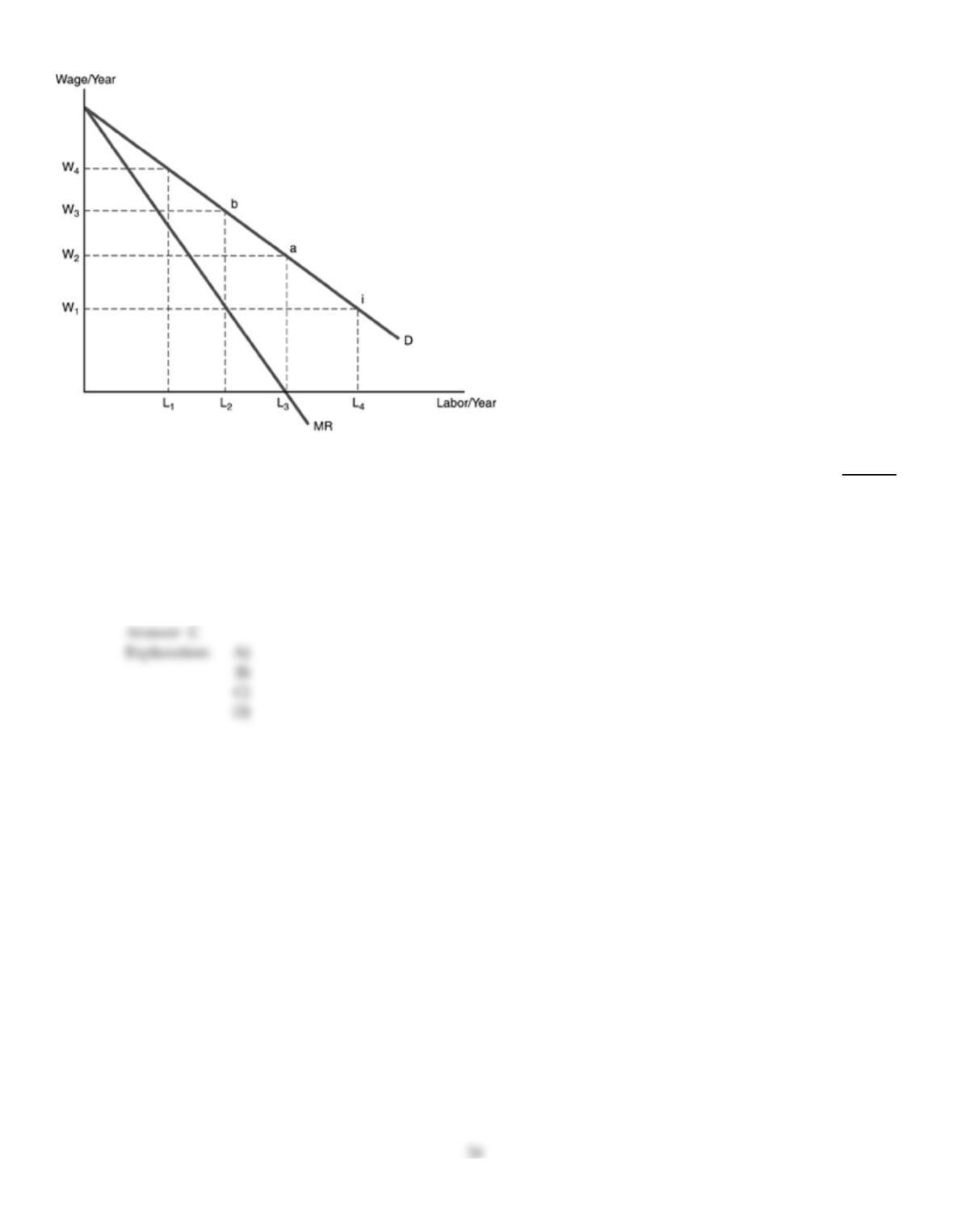
Refer to the above figure. Suppose there are L4 workers in the union. If the union wants to set a
wage rate of W3, it must
80)
A)
accept that L3– L2 workers will have to get a lower wage equal to W2 and L4– L3 workers
will have to get a wage of W1.
B)
determine the most efficient way to get the firms to accept the wage and hire all L4 workers.
C)
accept that L4– L2 members will not be able to find work in the industry.
D)
determine which of its members will earn W3 and which will earn W1.

Quantity of Required
Labor Supplied Wage Rate
1$6.00
2 9.00
3 12.00
415.00
5 18.00
6 21.00
7 24.00
8 27.00
930.00
10 33.00
81)
According to the above table, the marginal factor cost of the fifth worker is
81)
A)
$45.00.
B)
$60.00.
C)
$30.00.
D)
$90.00.
82)
If a single supplier of labor, such as a union, were supplying labor to a single monopsonistic
employer, this is referred to as a(n)
82)
A)
total monopsony.
B)
trilateral monopoly.
C)
collective monopoly.
D)
bilateral monopoly.
83)
Which of the following is FALSE regarding a monopsonist?
83)
A)
The monopsonist faces an upward sloping labor supply curve.
B)
The monopsonist faces the entire market labor supply curve.
C)
The monopsonist faces an upward sloping labor demand curve.
D)
The monopsonist is the only buyer in a market.
84)
Suppose a union successfully negotiates a wage rate for its members that is above the competitive
wage rate, then
84)
A)
employment in the union sector will increase.
B)
the union must find a way to make union workers more productive.
C)
the union must find a way to ration jobs among the excessive number of workers who wish to
work at the negotiated wage.
D)
the union must also negotiate a fringe–benefit package that the membership will like.
85)
Collective bargaining
85)
A)
has nothing to do with fringe benefits.
B)
is illegal in many states.
C)
is bargaining between unions and management.
D)
is practiced in non–union related disputes.
86)
Strikes occur in about ________ percent of the labor–management negotiations.
86)
A)
25
B)
2
C)
40
D)
16
87)
In 2005, which union organization was formed out of the AFL–CIO membership?
87)
A)
National Brotherhood of Teamsters
B)
Service Employees International Union
C)
Change to Win
D)
American Federation of Workers
88)
Which piece of legislation allowed states to pass right–to–work laws?
88)
A)
National Industrial Recovery Act
B)
Landrum–Griffin Act
C)
Wagner Act
D)
Taft–Hartley Act
89)
Bargaining between the management of a company and the management of a union is
89)
A)
collective bargaining.
B)
a craft union.
C)
a bilateral monopoly.
D)
a closed shop.
90)
The founder of the American Federation of Labor was
90)
A)
Samuel Gompers.
B)
Walter Reuther.
C)
John L. Lewis.
D)
Ralph Nader.
91)
A monopsonist wants to purchase more labor. Which of the following statements is TRUE?
91)
A)
The wage rate that the monopsonist has to pay future workers will be the same rate it pays
current workers.
B)
The wage rate that the monopsonist has to pay future workers is higher than what it will
continue to pay current workers.
C)
The wage rate that the monopsonist has to pay future workers is lower than it pays current
workers since there is no other place to work.
D)
The monopsonist will have to raise the wage rate for current and additional employees.
92)
The Taft–Hartley Act made all of the following illegal EXCEPT
92)
A)
closed shops.
B)
the Congress of Industrial Organizations.
C)
make–to–work laws.
D)
jurisdictional disputes.
93)
A disagreement involving two or more unions over which should have control over a particular
firm or industry is
93)
A)
a closed shop.
B)
a union shop.
C)
an industrial union.
D)
a jurisdictional dispute.
94)
Currently about what percentage of the civilian labor force is unionized in the United States?
94)
A)
30 percent
B)
6 percent
C)
12 percent
D)
70 percent
95)
When workers boycott a company because it does business with a firm whose employees are on
strike, that is a
95)
A)
strike.
B)
primary boycott.
C)
secondary boycott.
D)
sympathy strike.
C
96)
A monopsony has an upward sloping supply curve because
96)
A)
when more units of labor are hired, all laborers must receive the higher wage.
B)
when more units of labor are hired, only the new workers receive the higher wage.
C)
each additional unit of labor costs less.
D)
diminishing marginal product to scale does not exist in a monopsony.
A
97)
If the goal of the union is to maximize member income, then
97)
A)
a wage rate will be set in the inelastic portion of the demand curve.
B)
a wage rate will be set at the point at which marginal revenue equal zero.
C)
a wage rate will be set at the point at which the elasticity of demand equals 1 and marginal
revenue is positive.
D)
the supply of labor must be inelastic.
B
C
98)
Sometimes unions can raise wages above what productivity increases would permit. When this
happens, we can be sure that
98)
A)
some union workers end up losing their jobs.
B)
there is a redistribution of income from union workers to nonunion workers.
C)
the employment of union workers is increasing.
D)
featherbedding will occur.
99)
The Congress of Industrial Organizations (CIO) was formed in 1938 by
99)
A)
Ralph Nader.
B)
Walter Reuther.
C)
John L. Lewis.
D)
Samuel Gompers.
100)
Bilateral monopoly exists when
100)
A)
there are two competing labor unions in a labor market.
B)
a firm is both a monopolist in its output market and a monopsonist in the input market.
C)
there is a monopoly and a monopsony in a market.
D)
there is either a monopoly or a monopsony in the market.
101)
Which of the following is NOT one of the reasons for declining union membership in the United
States?
101)
A)
Some industries have been deregulated.
B)
Labor force participation by women has increased.
C)
The AFL–CIO merger and creation of the Change to Win Federation reduced competition
among unions.
D)
The economy has shifted away from manufacturing.
102)
Laws that make it illegal to require union membership as a condition of continuing employment in
a firm are
102)
A)
jurisdictional laws.
B)
right–to–work laws.
C)
closed–shop laws.
D)
union shop laws.
103)
Other things equal, granting unemployment benefits or welfare benefits to striking workers
103)
A)
reduces the likelihood of a strike since union workers make wages significantly above
unemployment benefits or welfare payments.
B)
reduces the costs of a strike to workers and will increase their willingness to strike.
C)
reduces the likelihood of a strike since management will be more cooperative.
D)
increases the willingness of management to permit a strike.
B
104)
If a minimum wage is established, a monopsonist faces
104)
A)
an upward sloping supply of labor at all quantities of labor.
B)
a horizontal supply of labor at the minimum wage and the downward sloping portion of the
labor demand curve below minimum wage.
C)
a horizontal supply of labor at the minimum wage and the upward sloping portion of the
labor supply curve above minimum wage.
D)
a downward sloping supply of labor at all quantities of labor.
C
105)
Which of the following is NOT a wage or employment strategy that a union would follow?
105)
A)
Set a wage rate that will maximize the income of only some of its members.
B)
Set a maximum wage rate such that a shortage of workers will result.
C)
Set a wage rate that will maximize the income of its members.
D)
Set a wage rate such that all workers that want to find a job can find a job.
B
B
106)
If we were to compare the annual earnings of union and nonunion workers in recent years, we
would find that
106)
A)
unions have not succeeded in raising the annual incomes of their members.
B)
the data is incomplete to tell whether unions have been successful in raising the annual
income of their members.
C)
union members have annual incomes substantially below nonunion members.
D)
unions have succeeded in raising the annual incomes of their members.
107)
The first type of labor unions that emerged in the United States were
107)
A)
professional unions.
B)
industrial unions.
C)
craft unions.
D)
transportation unions.
C
108)
The monopsonist will employ labor to the point at which the
108)
A)
marginal cost of output equals the marginal revenue.
B)
marginal factor cost equals the marginal revenue product of labor.
C)
marginal revenue product equals the wage rate.
D)
demand equals the supply of labor.
B
109)
Which of the following type of shops is unlawful under the provisions of the Taft–Hartley Act?
109)
A)
modified union shops
B)
closed shops
C)
union shops
D)
open shops
B
110)
A benefit of unions is that they
110)
A)
increase the stability of the workforce.
B)
restrict the labor market.
C)
increase wage inequality.
D)
increase firm profits.
A
A
111)
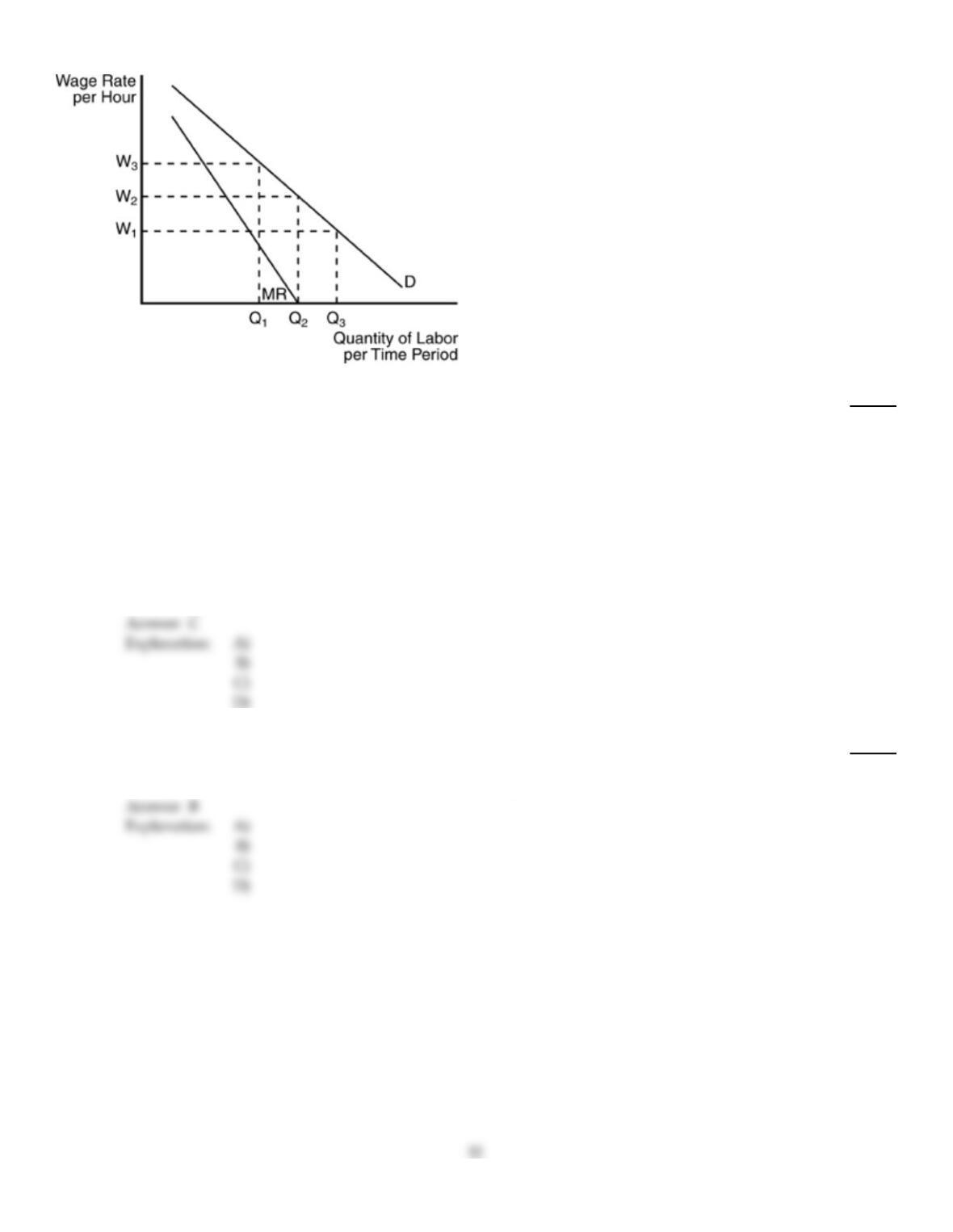
Consider the above figure, which displays the situation faced by a union employed by a firm with
the labor demand curve D. This union has total membership of Q3 workers, but its single wage
setting goal is to maximize wages for the Q1 members with the most seniority. If the union
managers accomplish this goal, what occurs?
111)
A)
The senior members of the union will receive a wage equal to W3, but Q3 union members
will be unemployed.
B)
All of the union members will be employed at the wage rate W3.
C)
The select group of senior union members will have work and receive a wage of W3, but Q3
–Q1 union members will not be employed by the firm.
D)
All of the union members will be employed at the wage rate W1.
112)
The United Steelworkers is an example of a(n)
112)
A)
craft union.
B)
industrial union.
C)
guild.
D)
public–sector union.
Quantity of Labor Required Hourly
Supplied to Management Wage Rate
0
1$17
2$19
3$21
113)
Refer to the above table. If the marginal revenue product is $21, how many workers will the profit
maximizing monopsonist hire and what wage will they pay each worker?
113)
A)
3; $21
B)
2; $19
C)
2; $21
D)
1; $17
114)
The largest labor union in the United States is the
114)
A)
United Food and Commercial Workers International Union.
B)
National Education Association.
C)
Service Employees International Union.
D)
International Brotherhood of Teamsters.
B
115)
When you see a commercial on TV asking you to “look for the union label,” the union is trying to
115)
A)
increase the demand for union goods.
B)
increase worker productivity.
C)
increase the demand for nonunion goods.
D)
decrease the demand for nonunion goods.
A
116)
Economists argue that the union wage advantage
116)
A)
in the private sector is a 4% increase in wages for union workers over nonunion workers.
B)
reached its height in 2000 in the private sector.
C)
has been close to zero since World War II in the private sector.
D)
has been estimated to be 100% in the private sector.
A
B
117)
The purpose of a strike is
117)
A)
to force management to accept the union’s proposed contract terms.
B)
to obtain higher wages for union members only.
C)
to solve jurisdictional disputes.
D)
to obtain a closed shop.
118)
The Taft–Hartley Act outlawed all of the following practices EXCEPT
118)
A)
union shops.
B)
secondary boycotts.
C)
sympathy strikes.
D)
closed shops.
A
119)
A union can achieve higher wages without accepting lower levels of employment of members by
119)
A)
promoting right–to–work laws.
B)
increasing conflicts with management.
C)
increasing the demand for substitute products made by non–union labor.
D)
beginning a campaign against buying foreign imports.
D
120)
Legislation that makes it illegal to require union membership as a condition of continuing
employment is the
120)
A)
Congress of Industrial Organizations.
B)
Wagner Act.
C)
National Labor Relations Act.
D)
collection of right–to–work laws.
D
121)
A bilateral monopoly exists when there is a
121)
A)
single seller and many buyers in the market.
B)
single buyer and many sellers in the market.
C)
large number of buyers and sellers in the market.
D)
single buyer and a single seller in the market.
D
A
122)
If a union wishes to maximize the number of union members employed, it will
122)
A)
accept the competitive wage.
B)
set a wage where the elasticity of demand for labor equals one.
C)
set a wage below the competitive wage.
D)
set a wage above the competitive wage.
123)
A monopsonistic employer will pay a wage rate
123)
A)
greater than the labor’s MRP.
B)
equal to MFC.
C)
less than the labor’s MRP.
D)
equal to the labor’s MRP.
C
124)
The president of the United States can obtain a court injunction that will stop a strike for an 80–day
“cooling–off”period if the strike is expected to imperil national safety or health. This power is
granted in the
124)
A)
Wagner Act.
B)
National Industrial Recovery Act.
C)
Taft–Hartley Act.
D)
Landrum–Griffin Act.
C
125)
When unions raise wages beyond what productivity increases would permit,
125)
A)
more union workers are employed.
B)
there is a redistribution of income from low– to high–seniority workers.
C)
nonunion workers wages in the economy also increase.
D)
there are higher wages for all union members.
B
A
126)
Collective bargaining refers to
126)
A)
negotiations between management of a company and a labor union.
B)
the process of electing union leaders.
C)
farming methods in Marxist states.
D)
negotiations between workers and health officials.
127)
Featherbedding refers to
127)
A)
the amount of the union premium.
B)
training programs initiated by the unions to make the less–skilled workers more productive.
C)
the practice that forces employers to use more labor than they would otherwise.
D)
attempts by management to reduce workers‘ interest in a union.
C
128)
The AFL and CIO merged because it was thought that
128)
A)
managers would be more sympathetic to unions.
B)
union pension funds would shrink as a result.
C)
strikes could be averted.
D)
organized labor would grow faster as a result.
D
129)
When unions exist in markets
129)
A)
there no longer is a perfectly competitive labor supply.
B)
employers have market power in labor markets.
C)
individual workers no longer make labor–leisure trade–off decisions.
D)
firms must have market power in their output markets.
A
A
130)
Featherbedding refers to
130)
A)
the practice of inducing a firm to use more than the cost–minimizing level of labor.
B)
increased international competition and its negative impact on trade unions.
C)
the practice of laying off union activists.
D)
union leaders arguing for higher wages when they know that they will not become
unemployed given their seniority.
131)
The labor market in professional baseball is an example of
131)
A)
a bilateral monopoly.
B)
a perfectly competitive labor market.
C)
a monopsonistic labor market.
D)
a monopolistic labor market.
A
132)
A labor union that consists of workers from a particular industry is a(n)
132)
A)
closed shop.
B)
bilateral monopoly.
C)
industrial union.
D)
union shop.
C
133)
Featherbedding is the term for
133)
A)
any practice that forces employers to use more labor than they would otherwise.
B)
attempts by management to eliminate a union.
C)
the practice of trying to recruit union members among public employees.
D)
training programs initiated by unions to make their less–skilled members more productive.
A
A
134)
When it comes to productivity, some economists argue that
134)
A)
through the use of featherbedding unions have been responsible for productivity increases.
B)
the union‘s insistence on profitability laborsaving devices has led to an increase in
productivity.
C)
unions have caused a decrease in productivity by excessive staffing and makework
requirements.
D)
the passage of the Taft–Hartley Act has led to a significant decrease in productivity.
135)
Since the National Basketball Association is the only significant employer of professional basketball
players, it might be referred to as a(n)
135)
A)
oligopolist.
B)
monopsony.
C)
monopoly.
D)
oligopsony.
Explanation:
136)
Unions can ration the excess supply of labor generated by the establishment of a wage that is above
the competitive wage by
136)
A)
having more intensive membership drives to ensure a larger proportion of workers are
covered by the union contract.
B)
encouraging older workers to take early retirement.
C)
lengthening the time period for apprenticeship programs.
D)
lowering union dues.
Explanation:
137)
The ultimate bargaining tool for unions is
137)
A)
“labor’s Magna Carta.”
B)
the sympathy strike.
C)
the strike.
D)
the Taft–Hartley Act.
Explanation:
Explanation:
138)
Paying a wage to an employee that is lower than the employee’s marginal revenue product is
sometimes referred to as
138)
A)
total exploitation.
B)
illegal in most states.
C)
monopolistic exploitation.
D)
monopsonistic exploitation.
139)
A union can achieve higher wages without accepting lower levels of employment of members by
139)
A)
increasing the amounts of imports.
B)
striking.
C)
increasing the productivity of its members.
D)
increasing the difficulty of its apprenticeship program.
C
140)
Any practice that forces employers to use more labor than they would otherwise use is
140)
A)
closed shop.
B)
featherbedding.
C)
monopolistic exploitation.
D)
a craft union.
B
141)
A plumbers’ union is an example of
141)
A)
auxiliary union.
B)
a craft union.
C)
an industrial union.
D)
skilled workers union.
B
142)
All of the following can raise wages of union members EXCEPT
142)
A)
increasing the demand for union–made goods.
B)
limiting union membership over time.
C)
increasing the productivity of union workers.
D)
increasing the demand for non–union made goods.
D
D
143)
A closed shop is a
143)
A)
strike by a union in sympathy with another union’s strike or cause.
B)
dispute involving two or more unions over which should have control of a particular
jurisdiction.
C)
legal environment in which businesses may hire nonunion members conditional on their
joining the union by some specified date after employment begins.
D)
business enterprise in which employees must belong to the union before they can be hired
and must remain in the union after they are hired.
144)
For a monopsonist the marginal cost of increasing its workforce will always be greater than the
wage rate because
144)
A)
a normal rate of return must be paid to the owner.
B)
the industry will be a closed shop.
C)
there is not good factor substitution in a monopsony.
D)
the wage rate offered the newest employee must be paid to all workers.
Quantity of
Wage Rate Labor Supplied
$10 1
$15 2
$20 3
$25 4
145)
Use the above table. If the marginal revenue product is $10, how many workers will the profit
maximizing monopsonist hire?
145)
A)
1
B)
2
C)
3
D)
4