
28) The longest wavelength of a photon that can be emitted by a hydrogen atom, for which the
initial state is n = 3, is closest to which one of the following values? (c = 3.00 × 10⁸ m/s, h =
6.626 × 10⁻³⁴ J ∙ s, 1 eV = 1.60 × 10⁻¹⁹ J)
A) 550 nm
B) 575 nm
C) 600 nm
D) 625 nm
E) 658 nm
29) What is the shortest wavelength of a photon that can be emitted by a hydrogen atom, for
which the initial state is n = 3? (c = 3.00 × 10⁸ m/s, h = 6.626 × 10⁻³⁴ J ∙ s, 1 eV = 1.60 × 10⁻¹⁹
J)
A) 822 nm
B) 850 nm
C) 103 nm
D) 91.4 nm
E) 950 nm
30) What is the energy required to remove the electron from a hydrogen atom in the n = 11 state?
A) 0.112 eV
B) 1.24 eV
C) 13.5 eV
D) 12.4 eV
E) 0.141 eV
31) If light excites atomic hydrogen from its lowest energy level to the n = 12 level, what is the
energy of the photons of this light?
A) 13.5 eV
B) 32.2 eV
C) 13.6 eV
D) 0.0944 eV
E) 1.13 eV

32) Light shines through atomic hydrogen gas that was initially in its ground state. You observe
that after awhile much of the hydrogen gas has been excited to its n = 5 state. What wavelength
of light entering the gas caused this excitation? (c = 3.00 × 10⁸ m/s, h = 6.626 × 10⁻³⁴ J ∙ s, 1 eV
= 1.60 × 10⁻¹⁹ J)
A) 110 nm
B) 91.4 nm
C) 95.2 nm
D) 2280 nm
33) Radio astronomers often study the radiation emitted by a hydrogen atom from a transition
between the two hyperfine levels associated with the ground state. This radiation has a
wavelength of 21 cm. What is the energy difference between the hyperfine levels? (1 eV = 1.60
× 10-19 J)
A) 5.9 × 10⁻⁶ eV
B) 5.9 × 10⁻²⁵ J
C) 1.7 × 10⁻²⁴ J
D) 4.7 × 10⁻²⁵ J
34) In a transition from one vibrational state to another, a molecule emits a photon of wavelength
5.56 µm. What is the energy difference between these two states? (c = 3.00 × 10⁸ m/s, h = 6.626
× 10-34 J ∙ s, 1 eV = 1.60 × 10⁻¹⁹ J)
A) 0.223 eV
B) 2.23 MeV
C) 13.6 eV
D) 13.6 MeV
E) 0.223 MeV
35) What is the wavelength of the photon emitted when an electron in a hydrogen atom which is
in the initial state n = 8 jumps to the final state n = 2? (c = 3.00 × 10⁸ m/s, h = 6.626 × 10⁻³⁴ J ∙
s, 1 eV = 1.60 × 10⁻¹⁹ J)
A) 205 nm
B) 104 nm
C) 389 nm
D) 486 nm
E) 610 nm

36) What is the wavelength of the photon emitted when an electron in a hydrogen atom which is
in the initial state n = 4 jumps to the final state n = 2? (c = 3.00 × 10⁸ m/s, h = 6.626 × 10⁻³⁴ J ∙
s, 1 eV = 1.60 × 10⁻¹⁹ J)
A) 243 nm
B) 486 nm
C) 556 nm
D) 312 nm
E) 609 nm
37) The wavelength of the emitted photon if an electron in the hydrogen atom makes a transition
from the n = 2 state to the ground state is closest to which of the following values? (c = 3.0 × 10⁸
m/s, h = 6.626 × 10⁻³⁴ J ∙ s, 1 eV = 1.60 × 10⁻¹⁹ J)
A) 122 nm
B) 203 nm
C) 243 nm
D) 389 nm
E) 411 nm
38) What is the wavelength of the emitted photon if an electron in the hydrogen atom makes a
transition from the n = 7 state to the n = 2 state? (c = 3.00 × 10⁸ m/s, h = 6.626 × 10⁻³⁴ J ∙ s, 1
eV = 1.60 × 10⁻¹⁹ J)
A) 199 nm
B) 365 nm
C) 4480 nm
D) 398 nm
E) 796 nm
39) What frequency must a photon have to raise an electron in a hydrogen atom from the n = 2 to
the n = 4 state? (h = 6.626 × 10⁻³⁴ J ∙ s, 1 eV = 1.60 × 10⁻¹⁹ J)
A) 3.06 × 10¹⁴ Hz
B) 6.16 × 10¹⁴ Hz
C) 4.11 × 10¹⁴ Hz
D) 5.20 × 10¹⁴ Hz
E) 9.24 × 10¹⁴ Hz

40) In making a transition from state n = 1 to state n = 2, the hydrogen atom must
A) absorb a photon of energy 10.2 eV.
B) emit a photon of energy 10.2 eV.
C) absorb a photon of energy 13.58 eV.
D) emit a photon of energy 13.58 eV.
41) In the n = 1 state, the energy of the hydrogen atom is -13.6 eV. What is its energy in the n =
2 state?
A) -6.79 eV
B) -4.53 eV
C) -3.40 eV
D) -1.51 eV
42) Consider the Bohr model for the hydrogen atom in its second excited state.
(a) Determine the binding energy (eV) of the electron.
(b) What is the radius of the electron orbit, given that r1 = 0.0529 nm?
(c) How far is it from the next higher excited orbit?
43) A hydrogen atom with a barely bound electron may have an average radius as large as a
bacterium, which is a radius of What is the nearest principal quantum number of the atom
in this state? The radius for ground state hydrogen is 0.0529 nm.
A) 514
B) 51
C) 16
D) 264,650
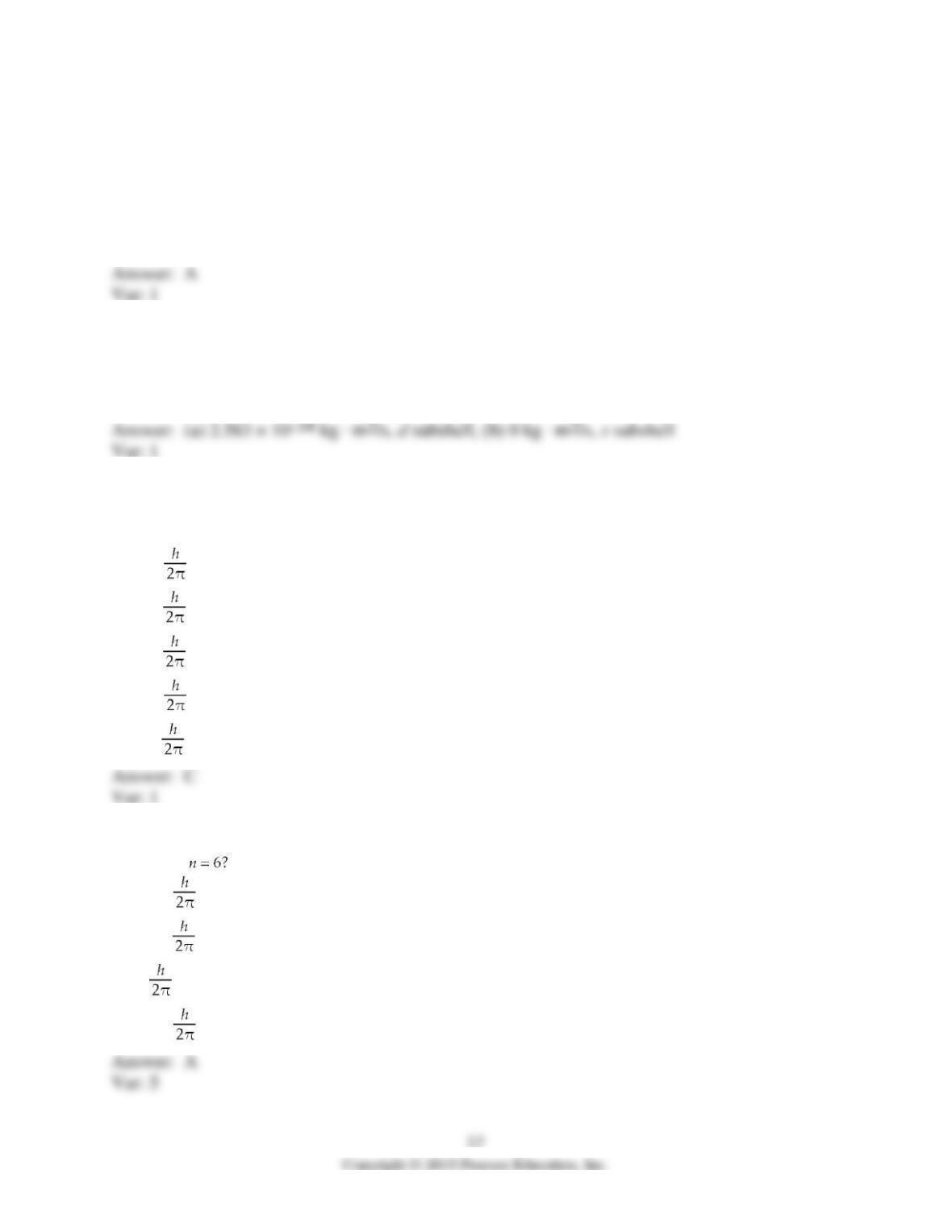
44) Calculate the orbital Bohr radius of the excited state in a hydrogen atom.
A) 0.212 nm
B) 0.106 nm
C) 0.170 nm
D) 0.244 nm
45) Given that the speed of an electron in the ground state of hydrogen is 2190 km/s, what is the
speed of an electron in the n = 4 orbit of hydrogen?
A) 547 km/s
B) 31,000 km/s
C) 139 km/s
D) 178 km/s
E) 2180 km/s
46) For an electron in the M (n = 3) shell, find (a) the largest possible orbital angular momentum
it can have, and (b) the smallest possible orbital angular momentum it can have. Express your
answers in SI units, and for each case indicate the subshell (s, p, d, …) of the electron. (h = 6.626
× 10-34 J ∙ s)
47) An atom has completely filled inner shells and a single valence electron in an excited p state.
The filled inner shells have an orbital momentum equal to zero. What is the magnitude of the
orbital angular momentum of the atom?
A) 1.0
B) 1.2
C) 1.4
D) 1.7
E) 2.0
48) What is the greatest magnitude of the orbital angular momentum L that you can find in a
state with
A) 5.48
B) 5.92
C) 6
D) 6.48

49) Consider the n = 10 shell.
(a) What is the largest value of the angular momentum quantum number, ℓ, in this shell?
(b) How many electrons can be placed in this shell?
50) An atom with atomic number 6 is in its ground state. How many electrons are in its
outermost shell?
51) Write out the electron configuration for the ground state of the phosphorus atom, which has
15 electrons.
52) The only valid electron state and shell designation among the following is
A) 1p, K (n = 1) shell.
B) 2s, K (n = 1) shell.
C) 1s, L (n = 2) shell.
D) 2p, L (n = 2) shell.
E) 3f, M (n = 3) shell.
53) The only invalid electron state and shell designation among the following is
A) 1s, K (n = 1) shell.
B) 2s, L (n = 2) shell.
C) 2d, L (n = 2) shell.
D) 3s, M (n = 3) shell.
E) 3d, M (n = 3) shell.
54) What is the electron configuration for Li, which has 3 electrons?
A) 1s3
B) 1s1 2s2
C) 1s2 2s1
D) 1s2 1p1
E) 1s1 2s1 3s1

55) What is the correct ground state electron configuration of boron, which has 5 electrons?
A) 1s2 2s2 2p
B) 1s2 2s2 2p3
C) 1s2 1p2 2s
D) 1s2 2p2 3s
E) 1s2 2p3
56) Which one of the following is the correct electronic configuration for carbon, which has 6
electrons?
A) 1s2 2s2 2p2
B) 1s1 2p1
C) 1s1 2s2 2p1
D) 1s1 2s1 2p1
E) 1s2 2s2 2p4
57) Which one of the following is the correct electronic configuration for the sodium atom,
which has 11 electrons?
A) 1s1 2s2 3p6 2s2
B) 1s2 2s1 3p6 2s2
C) 1s1 2s2 2p6 2s2
D) 1s2 2s2 2p6 3s2
E) 1s2 2s2 2p6 3s1
58) A hydrogen atom is in the 6h state. How many electrons are allowed in this state?
A) 22
B) 18
C) 14
D) 10
E) 6

59) A hydrogen atom is in the 6h state. Which one of the following numbers could be an orbital
angular momentum quantum number ℓ for that state?
A) 5
B) 6
C) 7
D) 8
E) 9
60) A hydrogen atom is in the 6h state. Which one of the following is not a magnetic quantum
number for that state?
A) 0
B) 1
C) 2
D) 4
E) 6
61) In a hydrogen atom, a given electron has n = 7. How many possible values can ℓ have?
A) 6
B) 7
C) 15
D) 98
62) In a hydrogen atom, a given electron has ℓ = 7. How many possible values can m1 have?
A) 6
B) 7
C) 15
D) 98
63) In a hydrogen atom, an electron with n = 7 can exist in how many different quantum states?
A) 6
B) 7
C) 15
D) 98

64) How many values of the magnetic quantum number, mℓ, are possible if the orbital angular
momentum quantum number is ℓ = 2?
A) 1
B) 2
C) 3
D) 4
E) 5
65) How many values of the magnetic quantum number, mℓ, correspond to a value of ℓ = 4?
A) 3
B) 5
C) 8
D) 9
E) 7
66) For the ground state of the hydrogen atom, which of the following numbers represents the
correct value of the orbital angular momentum quantum number?
A) -1
B) 1
C) 0
D) 2
E) -2
67) For the ground state of the hydrogen atom, which of the following numbers represents the
correct value of the magnetic quantum number?
A) -1
B) 0
C) 1
D) 2
E) -2

68) How many values can the magnetic quantum number have in a hydrogen atom for which the
orbital angular momentum quantum number is equal to 8?
A) 9
B) 15
C) 5
D) 8
E) 17
69) How many unique quantum states correspond to the lowest possible energy level of an
electron in the hydrogen atom?
A) 3
B) 0
C) 1
D) 4
E) 2
70) How many electrons can be found with principal quantum number in a suitably heavy
atom?
A) 18
B) 6
C) 20
D) 9
71) How many 2d electron states can an atom have?
A) 0
B) 4
C) 6
D) 8
E) 10
72) How many 3d electron states can an atom have?
A) 0
B) 4
C) 6
D) 8
E) 10

73) What is the maximum number of electrons that can occupy the g subshell?
A) 10
B) 14
C) 18
D) 22
74) How many possible sets of electron states (or quantum numbers) are there in the 5f subshell?
A) 2
B) 8
C) 10
D) 14
75) How many electrons will fit into a 4f subshell?
A) 3
B) 4
C) 7
D) 14
76) The values of n and ℓ for a 4f subshell are
A) n = 4, ℓ = 4.
B) n = 4, ℓ = 3.
C) n = 3, ℓ = 3.
D) n = 4, ℓ = 2.
E) n = 3, ℓ = -3.
77) Neon has 10 electrons. What is the value of Z of the next higher element that has chemical
properties very similar to those of neon?
A) 11
B) 17
C) 18
D) 19
E) 36