58)
The union wage differential
58)
A)
varies substantially across employment sectors.
B)
increases during expansions.
C)
is greater for private sector employees than for government sector workers.
D)
has remained fairly constant over the past 30 years.
59)
The Taft–Hartley Act made all of the following illegal EXCEPT
59)
A)
jurisdictional disputes.
B)
closed shops.
C)
the Congress of Industrial Organizations.
D)
make–to–work laws.
C
60)
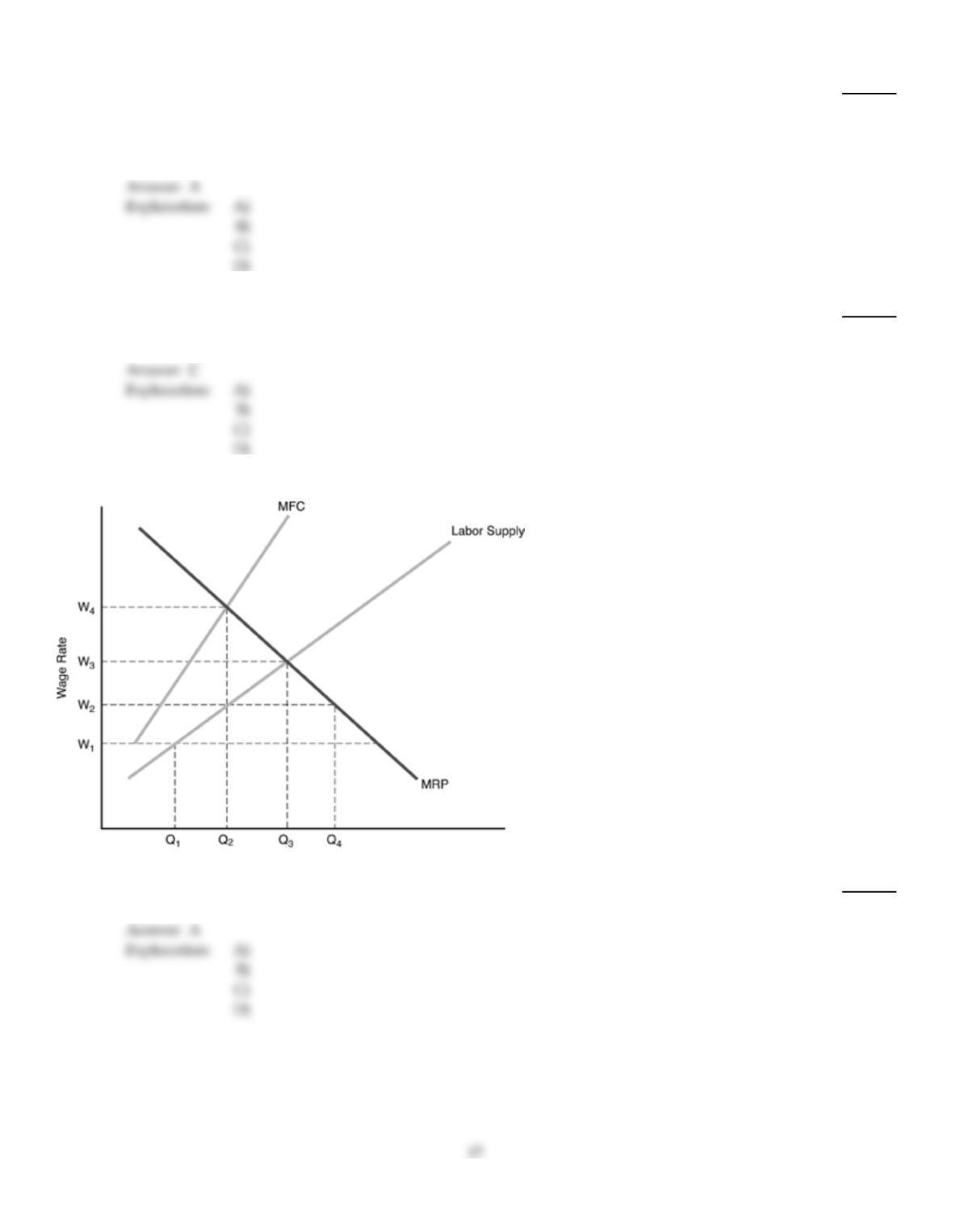
In the above figure, what is the wage rate the monopsonist will pay?
60)
A)
W2
B)
W4
C)
W3
D)
W1
A
A
61)
A profit–maximizing monopsonist will hire workers up to the point at which
61)
A)
W = MRP.
B)
W = MFC.
C)
MRP = MFC.
D)
W = MRP = MFC.
62)
Legislation that makes it illegal to require union membership as a condition of continuing
employment is the
62)
A)
Wagner Act.
B)
National Labor Relations Act.
C)
collection of right–to–work laws.
D)
Congress of Industrial Organizations.
63)
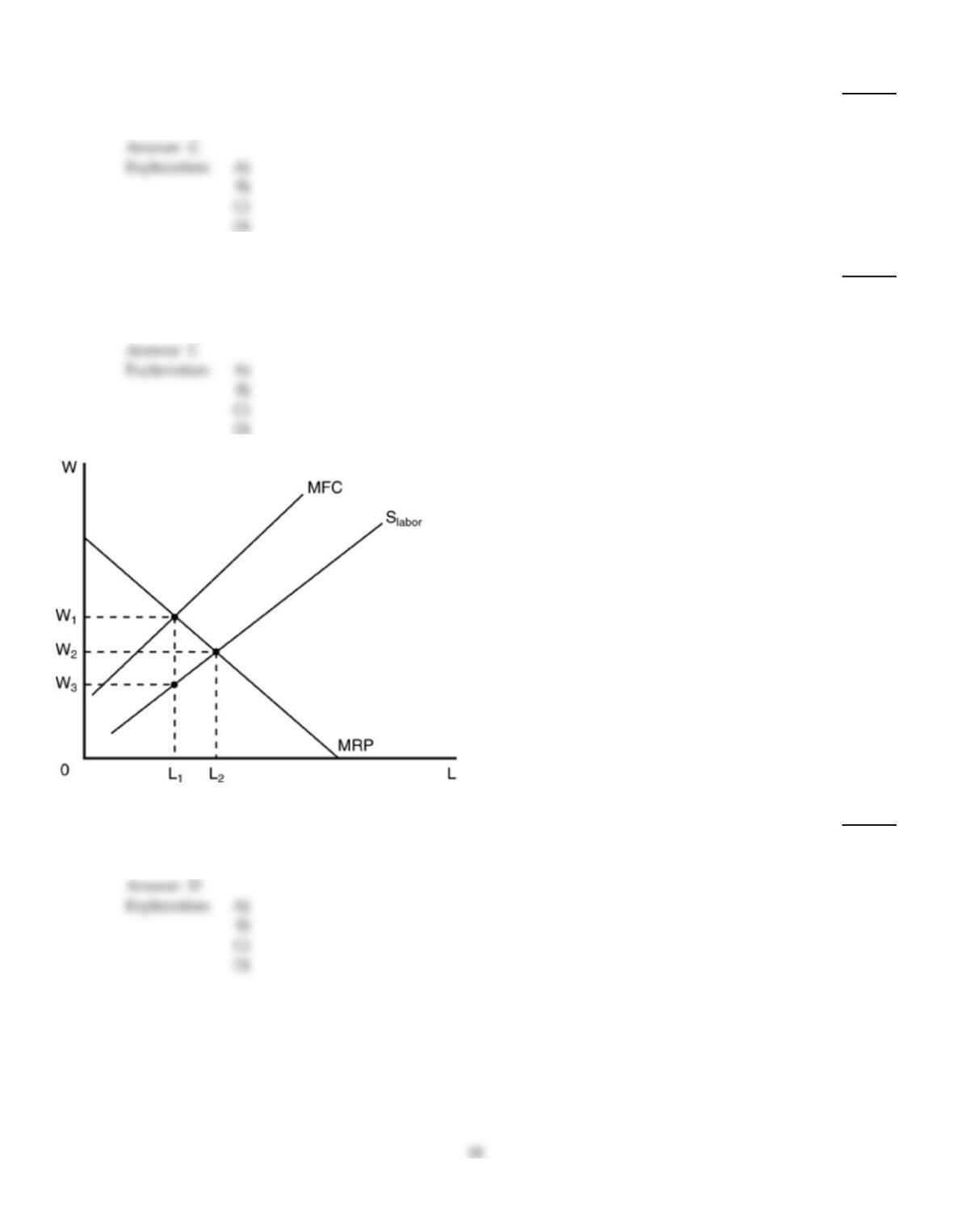
In the above figure, the monopsonist will employ
63)
A)
L1 at a wage of W1.
B)
L2 at a wage of W2.
C)
L2 at a wage of W3.
D)
L1 at a wage of W3.
64)
The leadership of unions must recognize that they face
64)
A)
a fundamental trade–off between higher wages for members and fewer jobs for members.
B)
an economic system that is hostile to the interests of workers.
C)
a no–win situation whenever they think a strike is necessary.
D)
a fundamental trade–off between higher wages for members and higher taxes for members.
65)
The AFL and CIO merged because it was thought that
65)
A)
union pension funds would shrink as a result.
B)
organized labor would grow faster as a result.
C)
managers would be more sympathetic to unions.
D)
strikes could be averted.
B
66)
The impact of a strike is limited to the ability of the union to
66)
A)
control the pension fund.
B)
lower its wage demands of non–union members.
C)
prevent replacement workers from continuing their work.
D)
none of the above.
C
67)
The CIO was formed as a(n)
67)
A)
union shop.
B)
closed shop.
C)
association of industrial unions.
D)
bilateral monopoly.
C
A
Quantity Hourly Total Marginal
of Labor Wage Rate Wage Bill Factor Cost
0– – –
1$10
212
3 14
416
518
620
68)
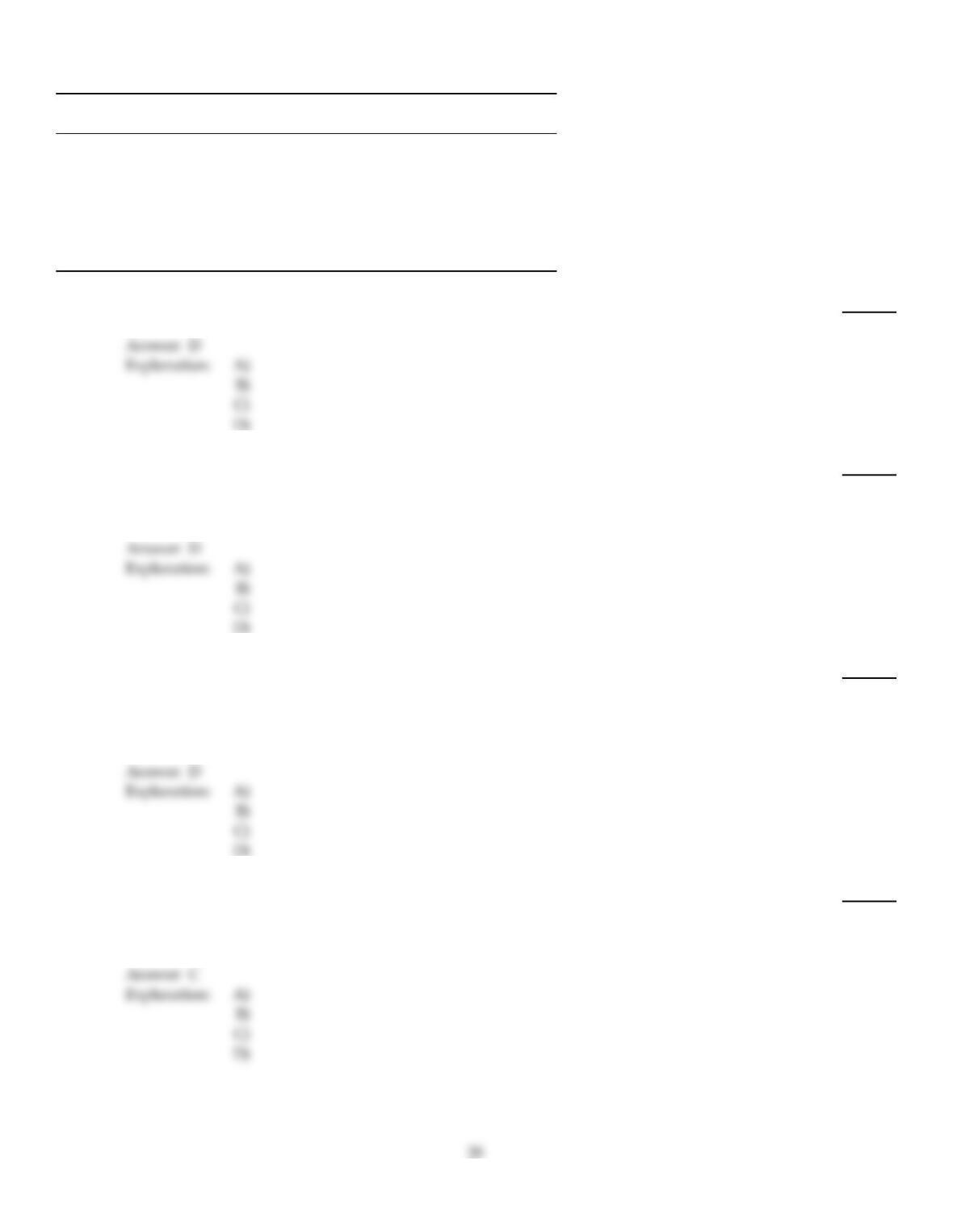
In the above table, what is the marginal factor cost of the 6th worker?
68)
A)
$120
B)
$18
C)
$20
D)
$30
69)
A boycott of products sold by companies that are dealing with a company whose workers are on
strike is a
69)
A)
jurisdictional dispute.
B)
right–to–boycott law.
C)
sympathy strike.
D)
secondary boycott.
70)
Monopsonistic exploitation refers to
70)
A)
the payment to the resource equal to MFC.
B)
the payment to a resource above MRP.
C)
the payment to a resource equal to MRP.
D)
the payment to a resource less than MRP.
71)
Paying a wage to an employee that is lower than the employee’s marginal revenue product is
sometimes referred to as
71)
A)
monopolistic exploitation.
B)
illegal in most states.
C)
monopsonistic exploitation.
D)
total exploitation.
72)
If a union succeeds in increasing the wage rate by restricting labor supply, then
72)
A)
all of its members will be better off.
B)
all of its members will be worse off.
C)
some members may lose their jobs.
D)
more of its members will be employed.
73)
Featherbedding means that
73)
A)
company management receives a cut from the collected union wages.
B)
employers are forced to hire more workers than they want to.
C)
a union can join a sympathy strike.
D)
employers are force to hire apprentices.
Quantity Hourly Total Marginal
of Labor Wage Rate Wage Bill Factor Cost
0– – –
1$10
212
3 14
416
518
620
74)
In the above table, what is the marginal factor cost of the 4th worker?
74)
A)
$16
B)
$22
C)
$30
D)
$64
75)
A practice which might force employers to use more labor than they would otherwise is referred to
as
75)
A)
wall propping.
B)
featherbedding.
C)
yellow–dogging.
D)
mothballing.
76)
The United Auto Workers is an example of
76)
A)
an industrial union.
B)
a socialist union.
C)
a public–sector union.
D)
a craft union.
77)
A monopsonist wants to purchase more labor. Which of the following statements is true?
77)
A)
The wage rate that the monopsonist has to pay future workers will be the same rate it pays
current workers.
B)
The wage rate that the monopsonist has to pay future workers is lower than it pays current
workers since there is no other place to work.
C)
The wage rate that the monopsonist has to pay future workers is higher than what it will
continue to pay current workers.
D)
The monopsonist will have to raise the wage rate for current and additional employees.
78)
In a bilateral monopoly, the wage rate that is determined in the market
78)
A)
is the same as in a perfectly competitive market.
B)
is equal to MFC.
C)
is equal to MRP.
D)
is indeterminate.
79)
The American Federation of State, County, Government and Municipal Employees is an example of a(n)
79)
A)
craft union.
B)
guild.
C)
industrial union.
D)
public–sector union.
80)
When a group of workers forms a union, they introduce an element of
80)
A)
monopoly into the labor market.
B)
monopoly into the product market.
C)
monopsony into the product market.
D)
pure competition into the labor market.
81)
Samuel Gompers served as the first leader of the
81)
A)
Knights of Labor.
B)
United Steel Workers.
C)
Congress of Industrial Organizations.
D)
American Federation of Labor.
82)
The primary purpose of a strike by labor unions is to
82)
A)
extract from the firm better and improved conditions of work or contract terms.
B)
force the firm out of business.
C)
ensure they get paid for striking.
D)
secure a larger market share for the firm.
Quantity of
Wage Rate Labor Supplied
$10 1
$15 2
$20 3
$25 4
83)
Use the above table. If the marginal revenue product is $30, how many workers will the profit
maximizing monopsonist hire and what wage will they pay each worker?
83)
A)
3; $20
B)
4; $25
C)
2; $15
D)
1; $10
84)
To reduce labor surplus above the equilibrium union wage level, a union may do all of the
following EXCEPT
84)
A)
limit the number of new members accepted.
B)
lengthen apprenticeship period.
C)
encourage nonunion members to join the union.
D)
assign jobs based on seniority.
85)
Currently about what percentage of the civilian labor force is unionized in the United States?
85)
A)
6 percent
B)
12 percent
C)
70 percent
D)
30 percent
86)
Which statement best describes the behavior of the monopsonist in the labor market?
86)
A)
It restricts its output to keep the product price high.
B)
It hires less labor and pays a lower wage rate than in the perfectly competitive case.
C)
It must pay different amounts to each unit of labor hired.
D)
It hires less labor but pays the perfectly competitive wage rate.
Quantity of Required
Labor Supplied Wage Rate
1$6.00
2 9.00
3 12.00
415.00
5 18.00
6 21.00
7 24.00
8 27.00
930.00
10 33.00
87)
According to the above table, if the marginal revenue product is $48, how many workers will the
profit maximizing monopsonist hire?
87)
A)
8
B)
6
C)
5
D)
7
88)
Labor unions composed of workers who engage in a particular trade or skill, such as carpentry, are
called
88)
A)
collective unions.
B)
industrial unions.
C)
craft unions.
D)
closed unions.
89)
When there is only one buyer of labor in a community, we talk of a
89)
A)
monopolistic market.
B)
monopoly.
C)
labor cooperative.
D)
monopsony.
90)
The founder of the American Federation of Labor was
90)
A)
Samuel Gompers.
B)
Walter Reuther.
C)
Ralph Nader.
D)
John L. Lewis.
A
91)
A right–to–work law makes it illegal for
91)
A)
union membership to be a requirement for continued employment in any establishment.
B)
a union to exist in a state.
C)
union membership to be denied on the basis of race, gender, or national origin.
D)
employers to refuse to hire union workers.
A
92)
Labor unions that consist of workers from a particular industry, such as automobile manufacturing,
are called
92)
A)
industrial unions.
B)
closed unions.
C)
collective unions.
D)
craft unions.
A
93)
Which of the following is NOT considered to be a benefit of unionism?
93)
A)
higher workforce stability
B)
provision of arbitration and grievance procedures
C)
greater workplace safety
D)
increased featherbedding
D
D
94)
Which of the following is legal under the Taft–Hartley Act?
94)
A)
Closed shops
B)
Sympathy strikes
C)
Collective bargaining
D)
Secondary boycotts
95)
When there is only one buyer in a market, there is a
95)
A)
buyer’s monopoly.
B)
monopsony.
C)
buyer’s cooperative.
D)
monopoly.
B
96)
A craft labor union is made up of
96)
A)
firms that employ similar labor skills.
B)
all the workers in a firm such as General Motors.
C)
an organization that controls the labor market in a particular industry.
D)
groups of workers in an individual trade.
D
97)
A closed shop is one in which
97)
A)
belonging to a union is a condition of employment.
B)
the union is a co–manager of the day–to–day operations of the firm.
C)
some members belong to the union while others do not.
D)
a union is prohibited.
A
98)
Sometimes unions can raise wages above what productivity increases would permit. When this
happens, we can be sure that
98)
A)
the employment of union workers is increasing.
B)
there is a redistribution of income from union workers to nonunion workers.
C)
some union workers end up losing their jobs.
D)
featherbedding will occur.
C
C
99)
Deregulation has contributed to
99)
A)
declines in union membership.
B)
an increase in union membership.
C)
higher wages in unions.
D)
an increase in union power.
100)
For a monopsonist, marginal factor cost exceeds the wage rate since
100)
A)
the supply of labor is perfectly elastic.
B)
the labor demand is downward sloping.
C)
more workers have to be paid the prevailing wage rate.
D)
when new workers are hired the wage rate must be increased for all workers and not just for
the additional workers.
D
SHORT ANSWER. Write the word or phrase that best completes each statement or answers the question.
101)
“Unions in the United States have helped raise the incomes of union workers as compared
to nonunion workers.” Do you agree or disagree? Why?
101)
102)
What can a union do in order to raise the wages of its members ?
102)
103)
What is a monopsony and how does a monopsonistic firm determine the wage rate to pay
its employees?
103)
A
104)
Why might a union find that attaining the goal of employing all its members and the goal
of maximizing total union wage receipts to be incompatible objectives?
104)
105)
Discuss the significant laws passed since the Great Depression that affect
labor–management relations.
105)
106)
Suppose a union negotiates for its members a wage that is above the market–clearing
wage. What problems does the union have to solve now? Explain.
106)
107)
What was the overall trend of U.S. union membership beginning the 1960s? What was the
main reason behind that trend?
107)
108)
Distinguish between craft unions and industrial unions.
108)
109)
Distinguish between a closed shop and a union shop. Are either or both shops legal?
Explain.
109)
110)
What is the purpose of a strike? What are the costs to workers and to management?
110)
111)
Can unions increase productivity? Explain.
111)
112)
Discuss the benefits of unions.
112)
Answer Key
Testname: C29
Answer Key
Testname: C29
Answer Key
Testname: C29
32