Exam
Name___________________________________
MULTIPLE CHOICE. Choose the one alternative that best completes the statement or answers the question.
1)
Which statement concerning powers granted the President of the United States by the Taft–Hartley
Act is TRUE?
1)
A)
The President can obtain an injunction that will stop a strike, if the strike involves
government workers only.
B)
The President can obtain an injunction that will stop a strike indefinitely.
C)
The President can obtain an injunction that will stop a strike for an eighty–day “cooling off”
period if the strike is expected to imperil national safety or health.
D)
The President can require management to negotiate with a union and if the firm’s
management refuses, the President can appoint an arbitrator to resolve the conflict.
2)
The most powerful tool unions have at their disposal when bargaining with management is
2)
A)
the ability to strike.
B)
the power of pure competition.
C)
the Taft–Hartley Act.
D)
the secondary boycott.
3)
A union that pursued a policy of restricting entry over time into the union would
3)
A)
also have to negotiate to be sure that all the members were able to find jobs.
B)
generate rising real wages for its membership over time as long as demand for union workers
increased over time.
C)
see real wages hold constant over time at whatever premium they could get initially.
D)
fail to obtain benefits for their workers in excess of what the workers would get under open
markets.
4)
If a union establishes by collective bargaining a wage rate that is above a competitive market
equilibrium wage rate, then
4)
A)
an excess quantity of labor will be supplied.
B)
a shortage of labor will result.
C)
management will want to substitute labor for machinery.
D)
there will be an increase in total employment.
5)
One method unions use to ration available jobs among excess workers is
5)
A)
refuse to unionize.
B)
lengthy apprenticeships.
C)
collective bargaining.
D)
to hire only white collar workers.
6)
Collective bargaining contracts between management and the union negotiators
6)
A)
cover wages only.
B)
also apply to the workers who are not members of the union.
C)
cover wages and fringe benefits only.
D)
usually are settled only after a strike.
7)
The employees of Ajax cookies are on strike. Jane has decided not to shop at any store that is still
selling Ajax cookies. This is known as
7)
A)
a sympathy strike.
B)
a secondary boycott.
C)
a closed shop.
D)
a union shop.
8)
Which of the following correctly describes the trend in U.S. union membership?
8)
A)
Union membership peaked in the 1960s and has been decreasing steadily since.
B)
Union membership has been decreasing steadily since the 1930s.
C)
Union membership declined until the 1980s, but has been increasing steadily since.
D)
Union membership decreased from 1930 – 1960, but has been increasing steadily since.
9)
The MFC curve
9)
A)
is the labor supply curve.
B)
lies below the labor supply curve, when the labor supply curve is upward sloping.
C)
lies above the labor supply curve, when the labor supply curve is upward sloping.
D)
is parallel to the labor supply curve, when the labor supply curve is downward sloping.
C
10)
If a union negotiated a wage above the market equilibrium wage, we would find
10)
A)
higher efficiency of labor at the negotiated wage.
B)
a shortage of laborers at the negotiated wage.
C)
lower worker productivity at the negotiated wage.
D)
a surplus of laborers at the negotiated wage.
D
11)
The Taft–Hartley Act of 1947 outlawed
11)
A)
right–to–work states.
B)
strikes.
C)
make–work rules and forcing unwilling workers to join a union.
D)
none of the above.
C
A
12)
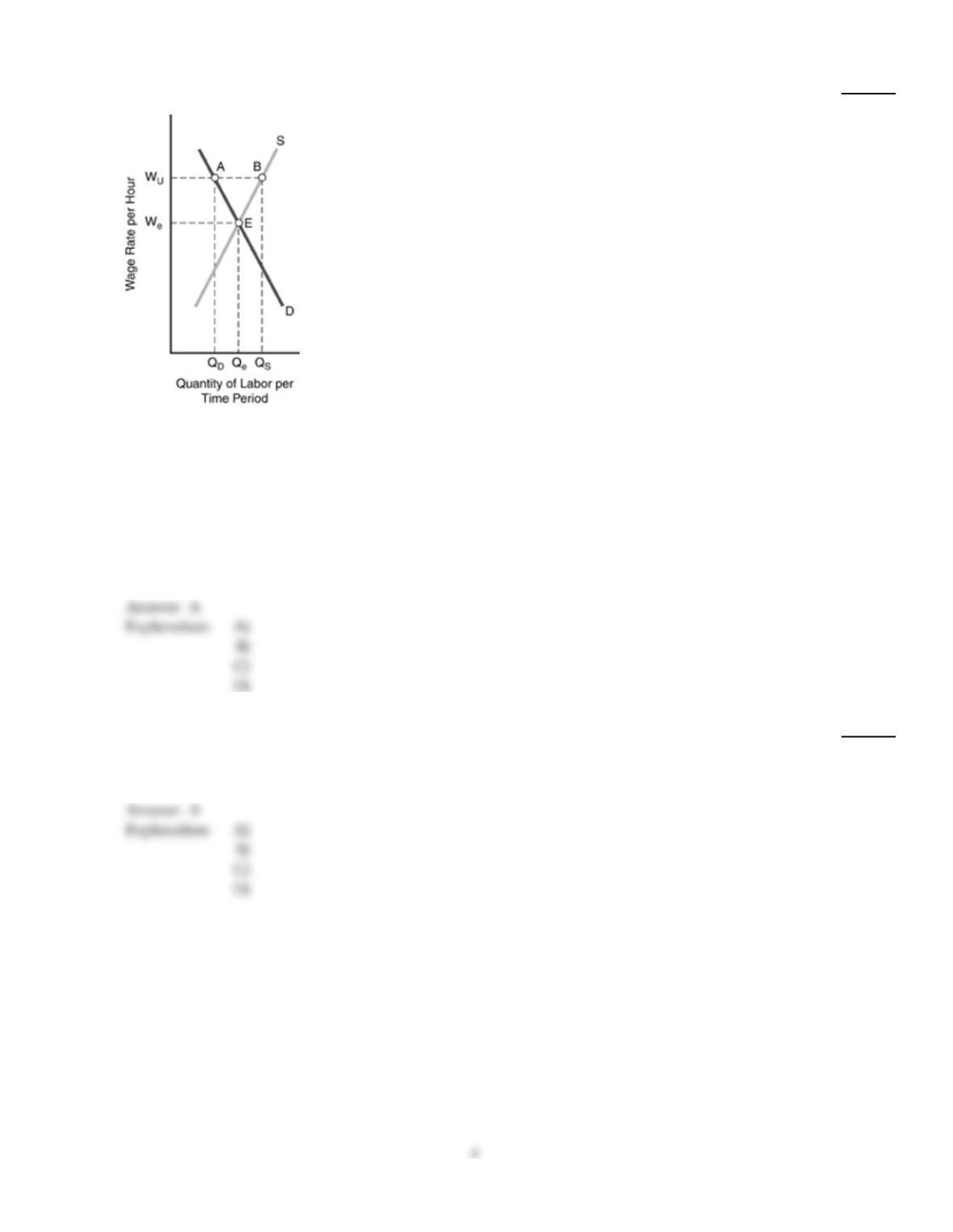
The figure illustrates all of the following EXCEPT
12)
A)
if the union establishes by collective bargaining a wage rate that exceeds equilibrium, an
excess quantity of labor will be demanded.
B)
at higher wages, more workers will seek to enter the industry, thereby adding to the surplus
of workers where QS is greater than QD.
C)
there is a trade–off union leadership faces: Higher wages inevitably mean a reduction in total
employmenta smaller number of positions.
D)
if the union establishes by collective bargaining a wage rate that exceeds equilibrium at point
Wu an excess quantity of labor will be supplied.
13)
Recently, two construction industry unions also left the AFL–CIO and joined with ironworkers and
bricklayers unions to form
13)
A)
the National Construction Alliance.
B)
the National Brotherhood of Teamsters.
C)
Change to Win.
D)
the American Federation of Workers.
14)
If a union is successful in negotiating a wage rate which is above the market clearing wage, then
which of the following would not occur?
14)
A)
To handle the surplus of labor the union will form a closed shop.
B)
The union may shift the supply of labor curve by developing methods to ration jobs.
C)
The higher wages attract more workers leading to a shortage of jobs.
D)
Management may replace part of the workforce with machinery.
15)
Since the 1960s, the share of the labor force that is unionized in the United States has
15)
A)
increased.
B)
declined except in the private sector.
C)
increased except for the government sector.
D)
declined.
16)
A closed shop is a business enterprise in which
16)
A)
employees must belong to the union before they can be employed.
B)
employees cannot belong to a union when they are employed, and cannot join a union and
keep working there.
C)
employees must join the union to maintain employment.
D)
employees cannot belong to the union when they are hired, but may join the union later and
keep their jobs.
17)
Which is NOT one of the potential benefits of labor unions?
17)
A)
Unions may have contributed to safer working conditions.
B)
Unions appear to reduce wage inequality.
C)
Unionism raises social efficiency.
D)
Unions may reduce a company’s profits.
18)
If a union succeeds in forcing employers in a perfectly competitive product market to increase
wages above the equilibrium level, then the level of unemployment
18)
A)
will decrease.
B)
will remain constant.
C)
will increase.
D)
may increase or decrease.
19)
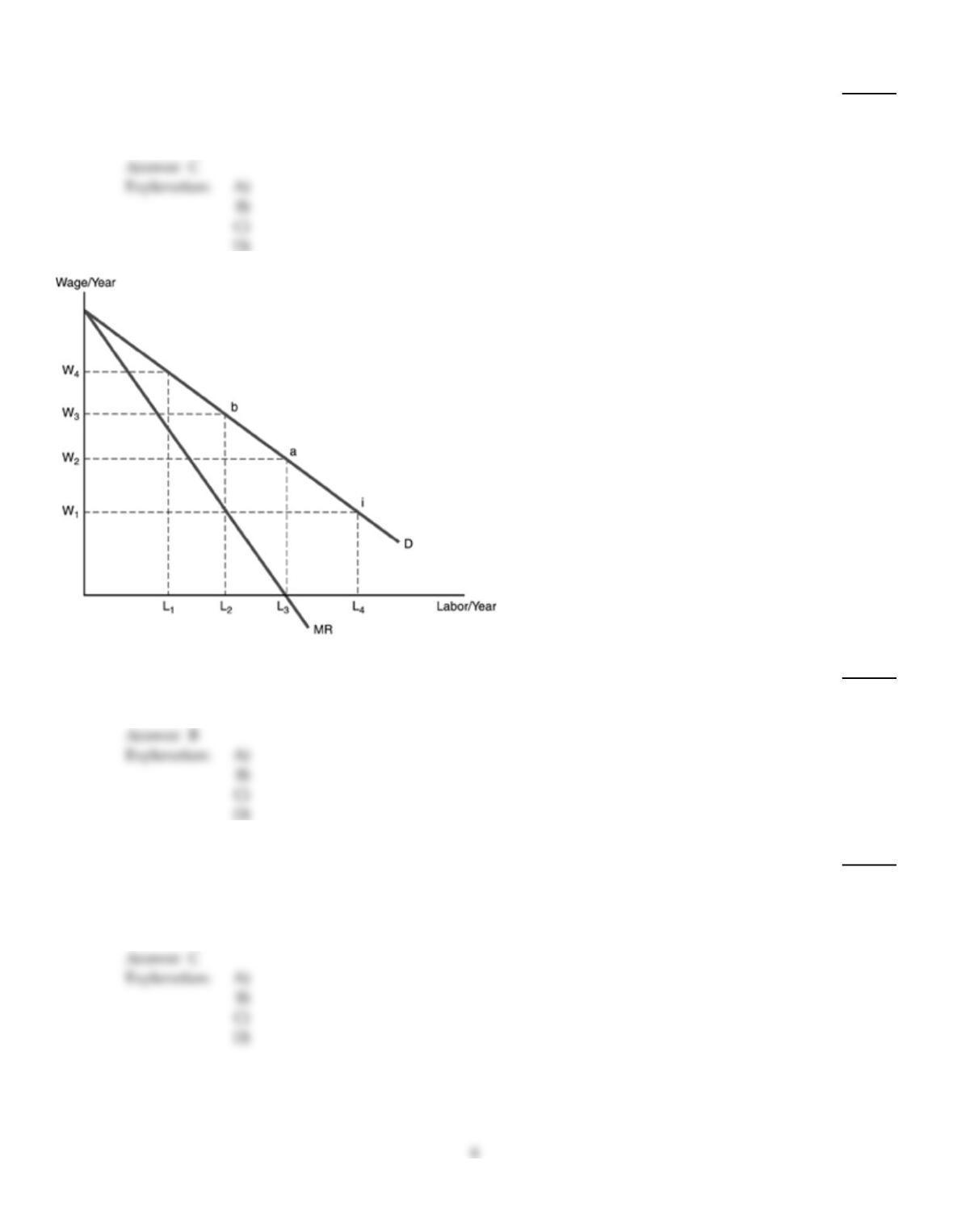
Refer the above figure. Suppose the union sets the wage rate that will maximize the total income
for the members who work. The total wages will be
19)
A)
W3bL2O.
B)
W2aL3O.
C)
W1iL4O.
D)
W3bhW1.
20)
A monopsonistic employer faces a
20)
A)
perfectly inelastic labor supply curve.
B)
MFC curve that is less than the wage rate at each quantity of labor.
C)
MFC curve that is greater than the wage rate at each quantity of labor.
D)
perfectly elastic labor supply curve.
21)
A right–to–work law is
21)
A)
a state law making the union shop illegal.
B)
a federal law making the union shop illegal.
C)
a state law making the open shop illegal.
D)
a federal law making the closed shop illegal.
22)
Exploitation due to a single buyer in the input market is known as
22)
A)
monopsonistic exploitation.
B)
monopoly exploitation.
C)
the result of closed shops.
D)
Marxian exploitation.
A
23)
A labor union composed of workers in the same occupation is called
23)
A)
an industrial union.
B)
a company union.
C)
a closed shop.
D)
a craft union.
D
24)
In order to hire additional laborers, a monopsony must
24)
A)
do nothing.
B)
lower the supply of labor.
C)
raise the wage rate.
D)
advertise for the labor.
C
25)
The percentage of U.S. workers in the private sector who belong to unions is currently
25)
A)
greater than 50 percent.
B)
approximately 20 percent.
C)
approximately 8 percent.
D)
approximately 12 percent.
C
A
26)
Which of the following is a correct statement about unions in the United States?
26)
A)
Half of all U.S. workers are union members.
B)
Since the 1960s, there has been a gradual increase in the proportion of U.S. workers who are
members of unions.
C)
The trend away from manufacturing and the deregulation of certain industries has promoted
unionization of the U.S. workforce.
D)
Half of the top ten U.S. unions now have members who work in service and government
occupations.
27)
Which of the following would increase the demand for union labor?
27)
A)
decreasing the demand for non–union–manufactured goods
B)
increasing the demand for union made goods
C)
increasing worker productivity
D)
all of the above
28)
Critics of unions tend to focus on the fact that unions
28)
A)
tend to generate higher wages.
B)
reduce profits.
C)
engage in restrictive labor practices.
D)
are politically active.
29)
Negotiations between the management of a company and the management of a union for the
purpose of setting a mutually agreeable contract on wages, fringe benefits and working conditions
for all employees in a union is know as
29)
A)
a union shop.
B)
an industrial union.
C)
a closed shop.
D)
collective bargaining.
30)
A tariff on imported goods produced by an unlimited industry could benefit the members of the
domestic union since the tariff would most likely
30)
A)
increase the demand for domestic, union–made goods.
B)
lower the domestic production of the good and increase wages.
C)
decrease the cost of the imported goods.
D)
lower the price of the output that workers purchase.
31)
Suppose a union successfully negotiates a wage rate for its members that is above the competitive
wage rate, then
31)
A)
the labor market will be in equilibrium.
B)
the quantity of labor demanded will be less than the quantity supplied.
C)
it is impossible to tell whether or not the labor market will be in equilibrium without more
information.
D)
the quantity of labor demanded will be greater than the quantity supplied.
32)
Which of the following is the BEST example of a monopsonist?
32)
A)
Hershey’s Chocolate Factory in Hershey, PA
B)
Vinaka Coffee Shop in Carlsbad, CA
C)
a household hiring a gardener
D)
a turnip farmer hiring seasonal help
33)
A union can induce a rise in equilibrium wages in a unionized industry by
33)
A)
successfully increasing the demand for union labor.
B)
reducing the marginal revenue product of firms employing union labor.
C)
successfully decreasing the demand for union labor.
D)
not striking.
Quantity Hourly Total Marginal
of Labor Wage Rate Wage Bill Factor Cost
0– – –
1$10
212
3 14
416
518
620
34)
In the above table, what is the marginal factor cost of the 2nd worker?
34)
A)
$24
B)
$12
C)
$14
D)
$64
35)
What is it called when the price paid for a variable input is less than its marginal revenue product?
35)
A)
featherbedding
B)
monopolistic exploitation
C)
monopsonistic exploitation
D)
bilateral monopoly
C
36)
A union contract requiring elevator operators in a building with automatic elevators is an example
of
36)
A)
a closed shop.
B)
featherbedding.
C)
a right–to–work requirement.
D)
a lockout.
B
37)
Workers in the United States were granted the legal right to engage in collective bargaining by the
37)
A)
National Labor Relations Act.
B)
Landrum–Griffin Act.
C)
Taft–Hartley Act.
D)
Knights of Labor Act.
A
C

38)
A company town in the lumber or mining industry is an example of a
38)
A)
buyer’s monopoly.
B)
bilateral monopoly.
C)
monopsony.
D)
monopoly.
Quantity of
Wage Rate Labor Supplied
$10 1
$15 2
$20 3
$25 4
39)
Use the above table. The MFC of the 4th worker is
39)
A)
$40.
B)
$5.
C)
$25.
D)
$6.25.
A
40)
The impact of a strike is limited to the ability of the union to
40)
A)
prevent replacement workers from continuing their work.
B)
control the pension fund.
C)
lower its wage demands of non–union members.
D)
none of the above.
A
41)
Which of the following types of unions did the CIO promote?
41)
A)
military unions
B)
public sector unions
C)
industrial unions
D)
craft unions
C
C
42)
The main difference between a monopsonist and a competitive buyer of labor is that
42)
A)
the competitor is a small firm while the monopsonist is a large firm.
B)
the competitor can hire as many workers as it wants at the going wage while a monopsonist
must raise wages to hire additional workers.
C)
the competitor can hire as many workers as it wants at the going wage while a monopsonist
can force wages down when hiring additional workers.
D)
the competitor is also a competitor in product markets while the monopsonist is also a
monopoly in product markets.
43)
Under monopsony, marginal factor cost is
43)
A)
greater than the wage rate.
B)
downward sloping.
C)
below the wage rate but increases as more workers are hired.
D)
equal to the wage rate.
A
44)
Which of the following is NOT correct regarding the status of U.S. labor unions?
44)
A)
Greater domestic and global competition has had a part in bringing about a decline in unions.
B)
Global trade has increased the number of union members in the United States.
C)
Today fewer than one in eight workers is a union member.
D)
A key reason for the decline in union membership is the relative decline in manufacturing
jobs as a share of total employment.
B
45)
Which statement is most TRUE about the impact of unions on wage levels in the United States?
45)
A)
Unions have had no impact on the wage levels of their workers.
B)
Unions have contributed to increased income inequality in the United States by raising
corporate profits.
C)
Unions have tended to increase the hourly wage rates of their members relative to nonunion
workers by an average of about $3.20.
D)
The union/nonunion wage differential tends to decrease during a recession.
C
B
46)
Which type of collective bargaining agreement requires workers to be union members prior to
being considered for employment?
46)
A)
closed shop
B)
union shop
C)
open shop
D)
right–to–work
47)
Which of the following is TRUE about unions?
47)
A)
Unions in some settings have been effective in promoting general social legislation.
B)
Unions in some settings are associated with increased productivity.
C)
Both A and B are correct.
D)
Neither A nor B is correct.
48)
An example of featherbedding is
48)
A)
a requirement that all construction workers working on government–funded construction
projects must be paid union wages.
B)
a requirement on railroads to keep a fireman on board after the introduction of diesel engines.
C)
employer–paid dental insurance negotiated by the union.
D)
the union practice that requires younger workers to be laid off first in a recession.
49)
An example of featherbedding is
49)
A)
the requirement that all construction workers who work on a government–financed project
receive the union wage rate regardless if they are in the union or not.
B)
union requirements that forbid the use of certain laborsaving equipment.
C)
lobbying Congress to get higher tariffs.
D)
advertising that encourages consumers to buy union–made goods.
50)
Suppose that under its collective bargaining agreement, the XYZ Co. can only hire union members
in good standing at the time of hiring. XYZ Co. is
50)
A)
a union shop.
B)
a company union.
C)
an open shop.
D)
a closed shop.
Quantity of
Wage Rate Labor Supplied
$10 1
$15 2
$20 3
$25 4
51)
Use the above table. The data shows that the firm
51)
A)
is a monopsonist.
B)
is selling its output in a perfectly competitive market.
C)
is hiring in a perfectly competitive labor market.
D)
is selling its output in an imperfectly competitive market.
52)
For the past several decades, union membership in the United States has been declining. What has
been happening in the rest of the world?
52)
A)
Union membership has been increasing in almost every other country.
B)
We do not know because other nations do not keep these statistics.
C)
In almost every other nation, union membership has held constant.
D)
In most cases, union membership in other nations has also been falling.
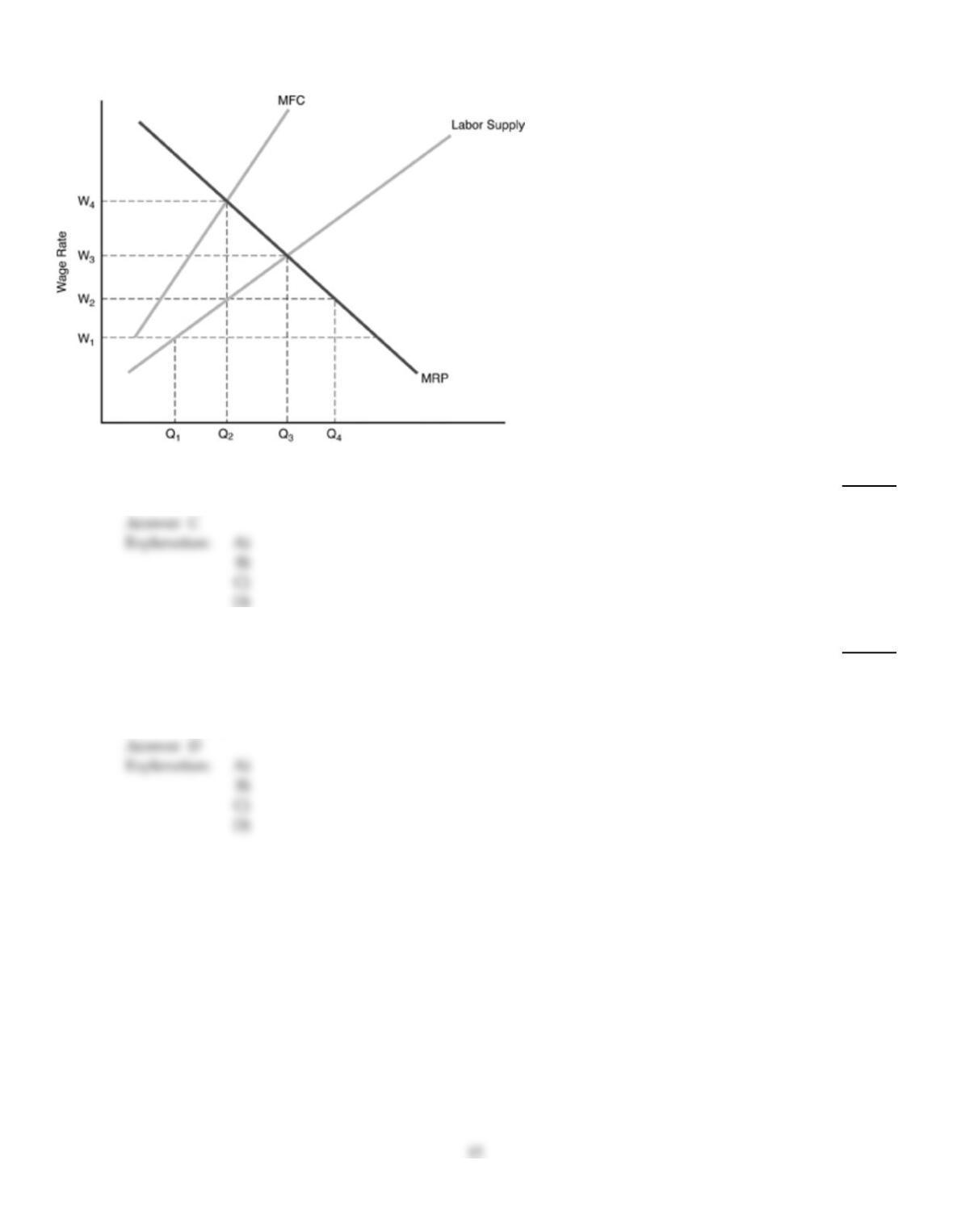
53)
In the above figure, what is the wage rate for the perfectly competitive market?
53)
A)
W1
B)
W2
C)
W3
D)
W4
54)
A closed shop is one in which
54)
A)
a union is prohibited.
B)
the union is a co–manager of the day–to–day operations of the firm.
C)
some members belong to the union while others do not.
D)
belonging to a union is a condition of employment.
Quantity of Required
Labor Supplied Wage Rate
1$6.00
2 9.00
3 12.00
415.00
5 18.00
6 21.00
7 24.00
8 27.00
930.00
10 33.00
55)
According to the above table, if the marginal revenue product is $24, how many workers will the
profit maximizing monopsonist hire?
55)
A)
4
B)
5
C)
6
D)
7
56)
Labor unions are organizations that
56)
A)
try to secure more opportunities for more workers in the economy.
B)
try to secure economic improvements for their members.
C)
try to make labor markets more competitive.
D)
try to secure economic improvements for all workers.
57)
Which of the following is NOT a union wage and employment strategy?
57)
A)
maximizing wage rates for some workers
B)
minimizing the adjusted gross income of non–members
C)
ensuring employment for all members of a union
D)
maximizing aggregate income of workers
58)
The supply curve of labor to a monopsonist is
58)
A)
upward sloping.
B)
downward sloping because of the law of diminishing marginal returns.
C)
horizontal.
D)
downward sloping, but not because of the law of diminishing marginal returns.
59)
A labor union is likely to seek all of the following EXCEPT
59)
A)
increased competitiveness in the labor market.
B)
increased job security for its members.
C)
economic improvements for their members.
D)
safer working conditions.
A
60)
If a union succeeds in increasing the wage rate by restricting labor supply, then
60)
A)
all of its members will be worse off.
B)
all of its members will be better off.
C)
some members may lose their jobs.
D)
more of its members will be employed.
C
61)
For a monopsonist, marginal factor cost exceeds the wage rate since
61)
A)
more workers have to be paid the prevailing wage rate.
B)
when new workers are hired the wage rate must be increased for all workers and not just for
the additional workers.
C)
the labor demand is downward sloping.
D)
the supply of labor is perfectly elastic.
B
A
62)
A jurisdictional dispute is a
62)
A)
strike by a union in sympathy with another union’s strike or cause.
B)
legal environment in which businesses may hire nonunion members conditional on their
joining the union by some specified date after employment begins.
C)
dispute involving two or more unions over which should have control of a particular
jurisdiction.
D)
business enterprise in which employees must belong to the union before they can be hired
and must remain in the union after they are hired.
63)
Craft unions exert market control by
63)
A)
limiting the demand for labor.
B)
setting minimum wages.
C)
limiting the supply of labor.
D)
setting maximum wages.
64)
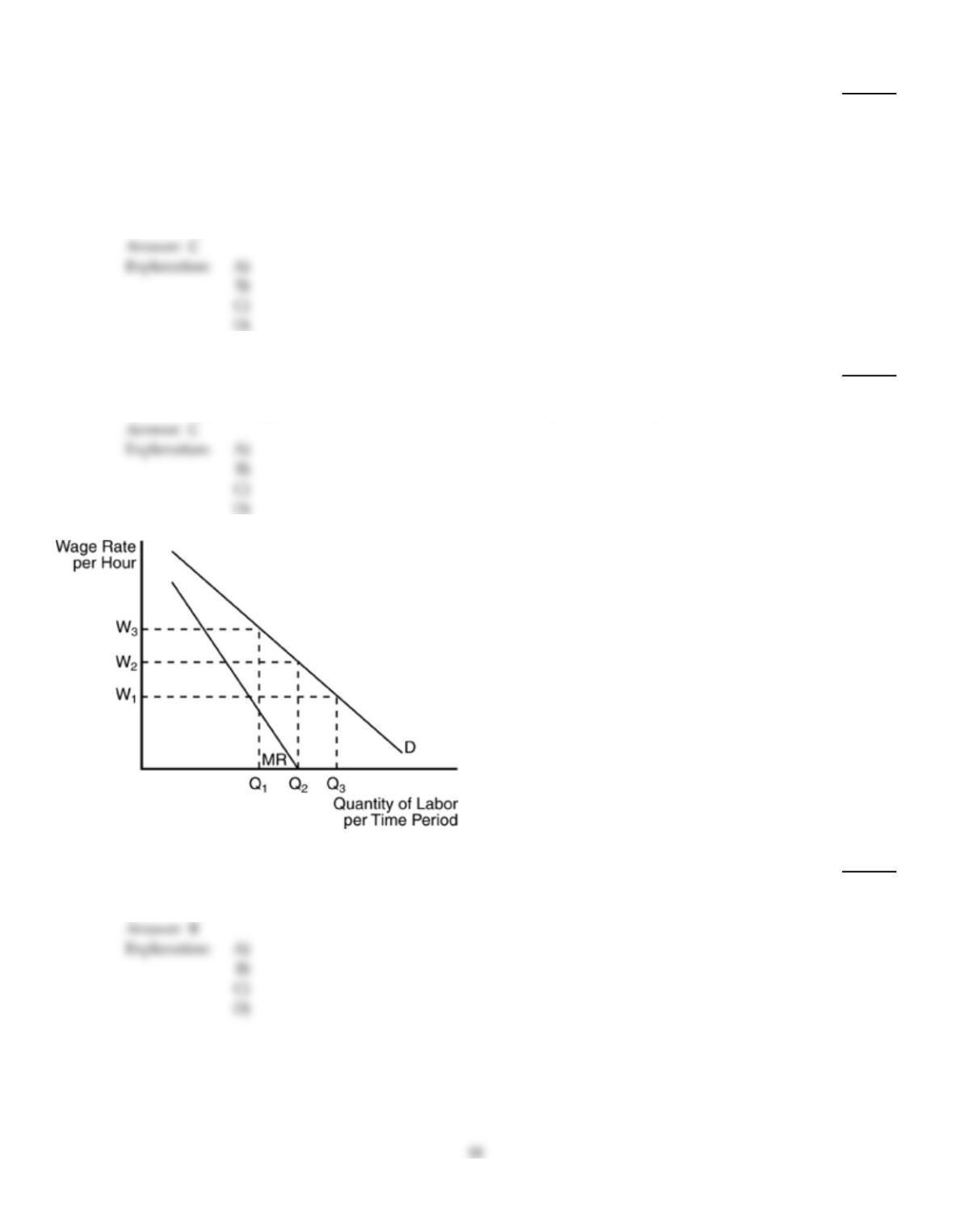
Look at the above figure. A union wishes to maximize wage income for employed union members,
so it should aim for a wage rate ________ and a number of employed members equal to ________.
64)
A)
W1, Q3
B)
W2, Q2
C)
W3, Q1
D)
W4, Q3
65)
Unions face a trade–off between higher wages and
65)
A)
more available positions.
B)
fewer available positions.
C)
equipment.
D)
none of the above.
Quantity Hourly Total Marginal
of Labor Wage Rate Wage Bill Factor Cost
0– – –
1$10
212
3 14
416
518
620
66)
In the above table, if the marginal revenue product is $26, how many workers will the profit
maximizing monopsonist hire and what wage will they pay each worker?
66)
A)
6; $30
B)
4; $16
C)
5; $18
D)
5; $16
C
67)
A strikebreaker is
67)
A)
someone who engages in featherbedding.
B)
a temporary worker hired by a company to replace a union member who is striking.
C)
when the President imposes a cooling–off period.
D)
a secondary boycott.
B
68)
Monopsonistic exploitation refers to
68)
A)
the payment to the resource equal to MFC.
B)
the payment to a resource less than MRP.
C)
the payment to a resource above MRP.
D)
the payment to a resource equal to MRP.
B
B
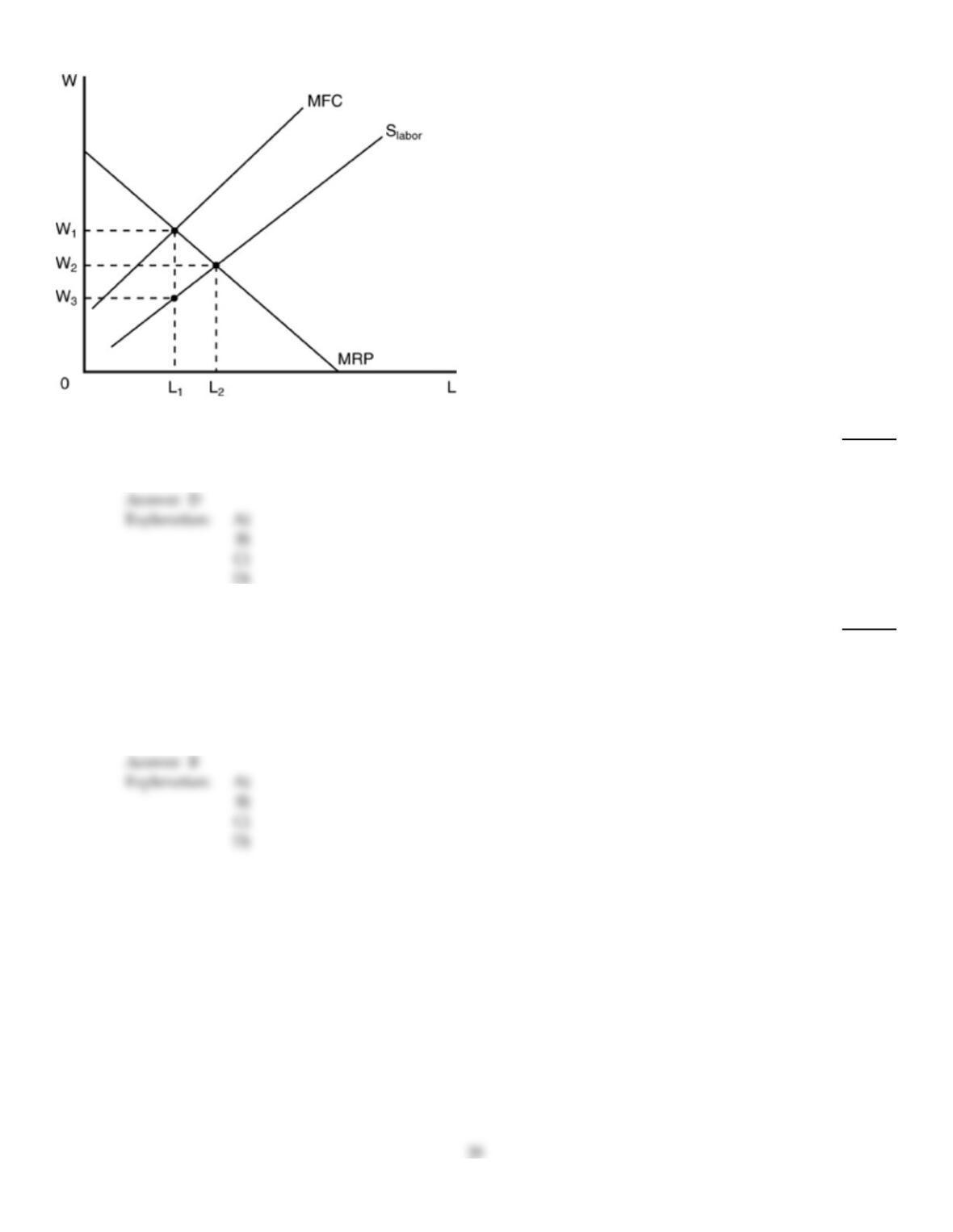
69)
In the above figure, the monopsonist will employ
69)
A)
L2 at a wage of W3.
B)
L2 at a wage of W2.
C)
L1 at a wage of W1.
D)
L1 at a wage of W3.
70)
Supposed you are hired to be a checker at a local grocery store. After ninety days of probation you
become a member of the union. As a result you feel more secure about your job and work harder to
be part of the team. This is a benefit of union membership that
70)
A)
increases union dues.
B)
increases worker productivity of union members.
C)
increases demand for union–made goods.
D)
decreases the demand for nonunion–made goods.