Exam
Name___________________________________
MULTIPLE CHOICE. Choose the one alternative that best completes the statement or answers the question.
1)
In a monopsonistic market,
1)
A)
employment is higher but wages are lower than in a comparable competitive market.
B)
both employment and wages are lower than in a comparable competitive market.
C)
both employment and wages are higher than in a comparable competitive market.
D)
employment is lower but wages are higher than in a comparable competitive market.
2)
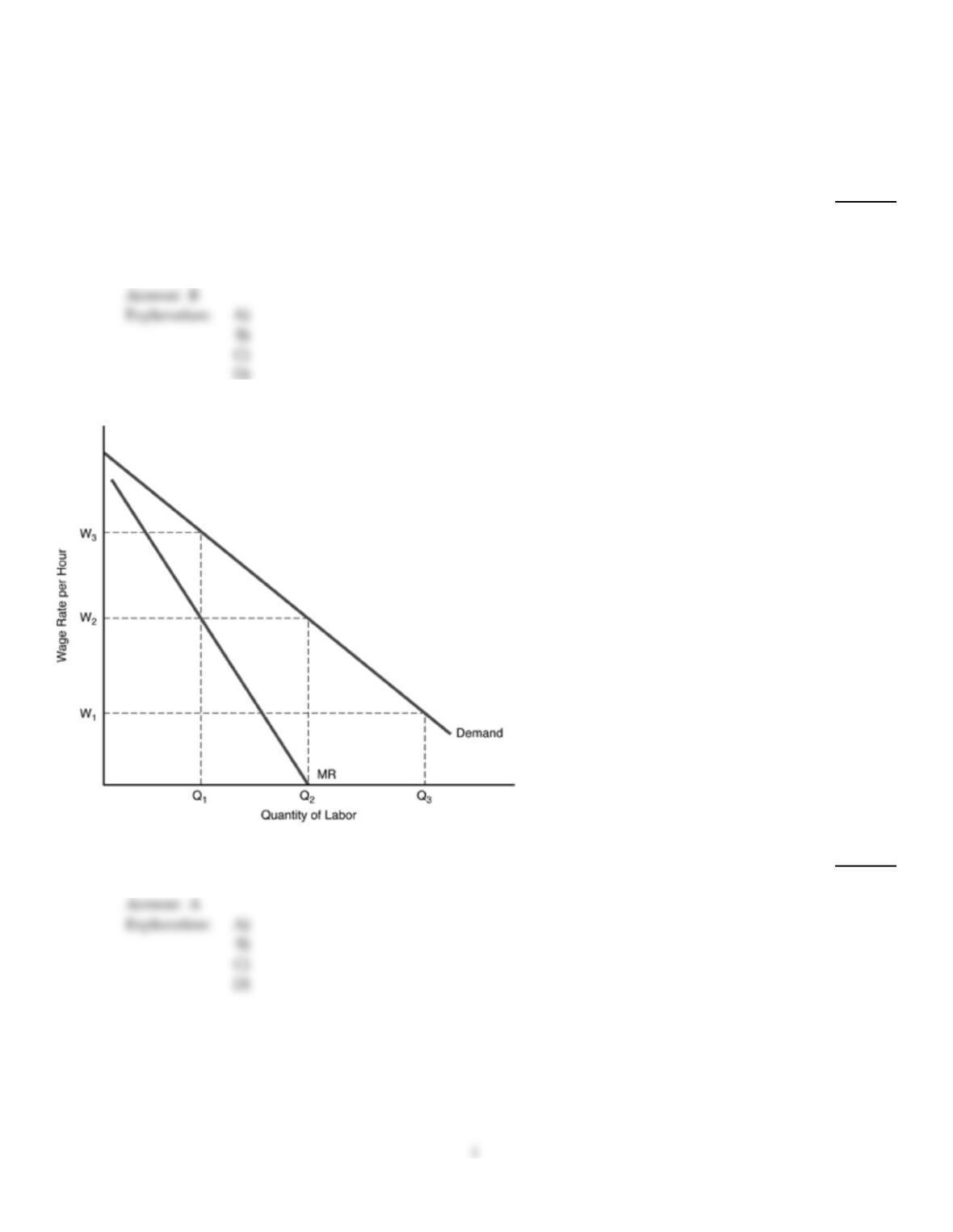
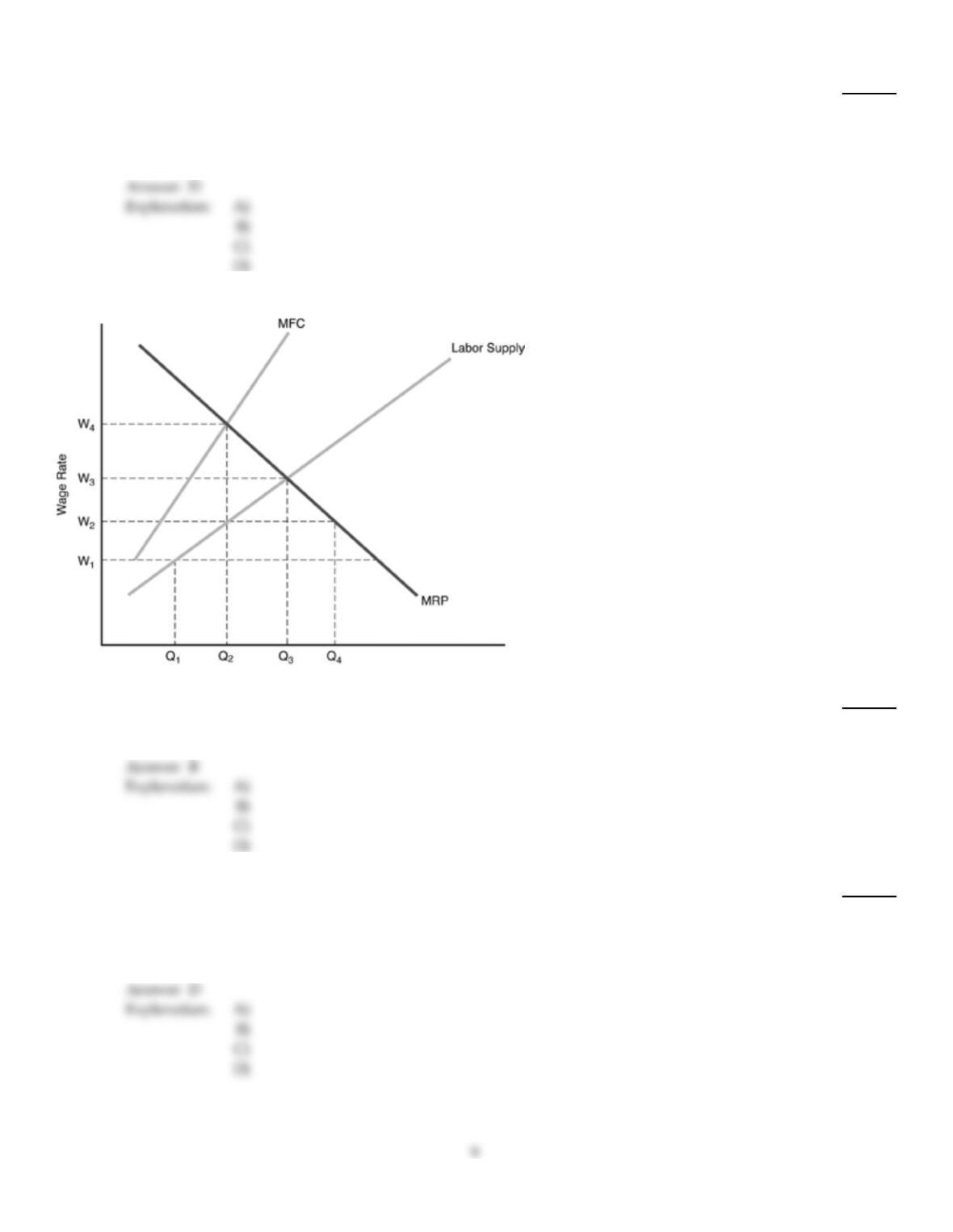
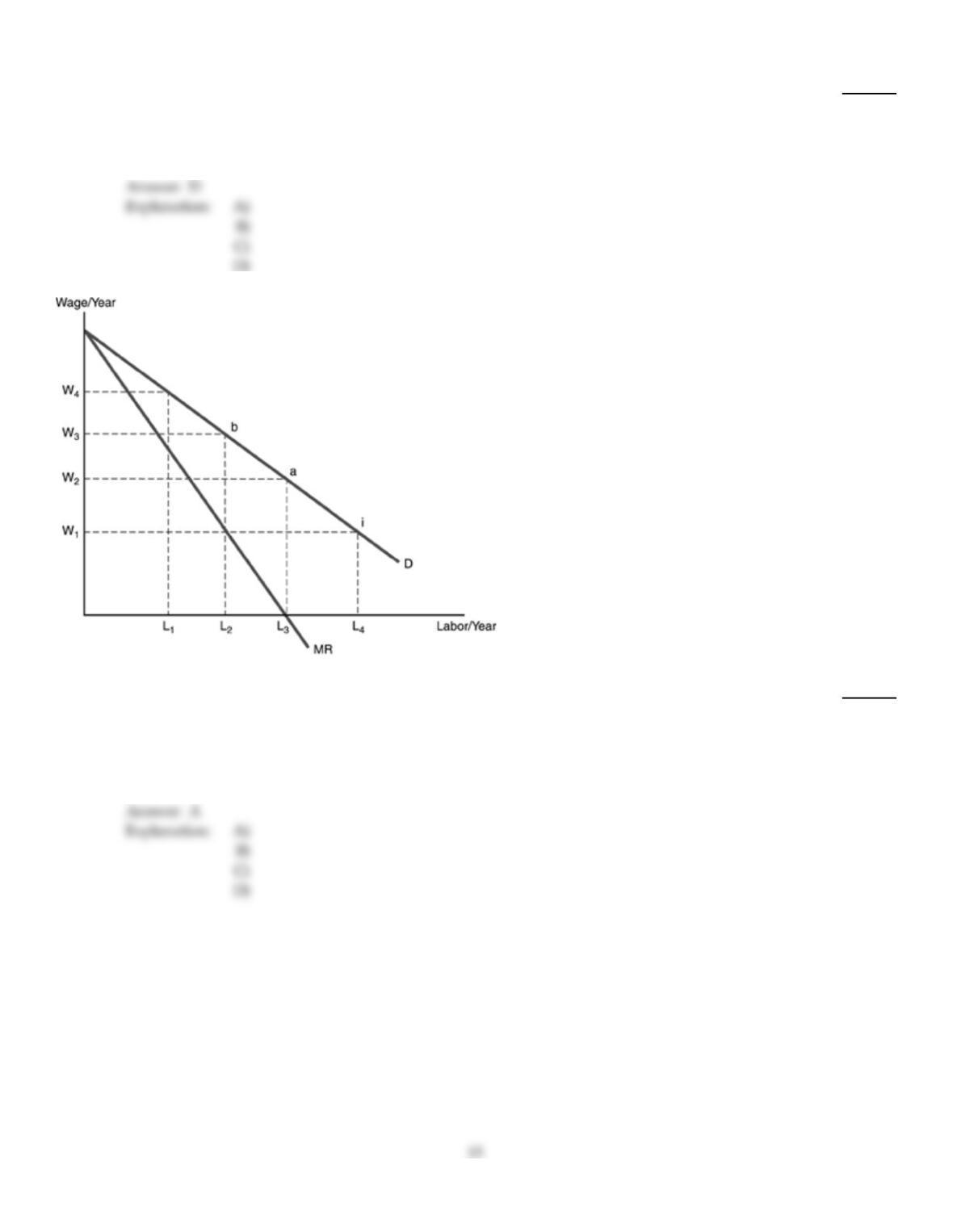
In the above figure, which wage rate will maximize union members’ income?
2)
A)
W2
B)
W3–W1
C)
W3
D)
W1

3)
A benefit of unions is that they
3)
A)
restrict the labor market.
B)
increase wage inequality.
C)
increase the stability of the workforce.
D)
increase firm profits.
Quantity of Required
Labor Supplied Wage Rate
1$6.00
2 9.00
3 12.00
415.00
5 18.00
6 21.00
7 24.00
8 27.00
930.00
10 33.00
4)
According to the above table, the marginal factor cost of the fifth worker is
4)
A)
$90.00.
B)
$30.00.
C)
$60.00.
D)
$45.00.
B
5)
The American Federation of Labor was formed in 1886 as a dissident group from the
5)
A)
Knights of Labor.
B)
Knights of Columbus.
C)
Masonic Lodge.
D)
Knights of Pythias.
A
6)
A union can achieve higher wages without accepting lower levels of employment of members by
6)
A)
increasing the amounts of imports.
B)
increasing the productivity of its members.
C)
increasing the difficulty of its apprenticeship program.
D)
striking.
B
C

7)
A union that pursued a policy of restricting entry over time into the union would
7)
A)
generate rising real wages for its membership over time as long as demand for union workers
increased over time.
B)
fail to obtain benefits for their workers in excess of what the workers would get under open
markets.
C)
see real wages hold constant over time at whatever premium they could get initially.
D)
also have to negotiate to be sure that all the members were able to find jobs.
8)
A right–to–work law makes it illegal
8)
A)
to inquire whether a prospective employee is a member of a union or not.
B)
for union membership to be a requirement for continued employment in any firm.
C)
to prevent union members from working in any firm.
D)
to fire a worker who has joined a union or who tries to organize a union at any firm.
Explanation:
9)
The welders’ union at Ajax is on strike. The maintenance union has decided to walk out in support
of the welders’ union. This is known as
9)
A)
a union shop.
B)
a sympathy strike.
C)
a closed shop.
D)
a secondary boycott.
Explanation:
Quantity of
Wage Rate Labor Supplied
$10 1
$15 2
$20 3
$25 4
10)
Use the above table. The MFC of the 3rd worker is
10)
A)
$30.
B)
$6.7.
C)
$20.
D)
$5.
Explanation:
Explanation:
11)
When there is only one buyer in the market,
11)
A)
the supply curve for the good will be perfectly elastic.
B)
a monopsony exists.
C)
then the market will be perfectly competitive.
D)
a closed shop exists.
12)
The U.S. labor movement started with
12)
A)
depression unions.
B)
industrial unions.
C)
aerospace workers unions.
D)
craft unions.
13)
A labor union that consists of workers from a particular industry is a(n)
13)
A)
closed shop.
B)
industrial union.
C)
bilateral monopoly.
D)
union shop.
14)
The largest labor union in the United States is the
14)
A)
International Brotherhood of Teamsters.
B)
National Education Association.
C)
Service Employees International Union.
D)
United Food and Commercial Workers International Union.
15)
Which type of collective bargaining agreement requires workers to be union members prior to
being considered for employment?
15)
A)
union shop
B)
open shop
C)
closed shop
D)
right–to–work

16)
The MFC curve
16)
A)
lies above the labor supply curve, when the labor supply curve is upward sloping.
B)
is the labor supply curve.
C)
lies below the labor supply curve, when the labor supply curve is upward sloping.
D)
is parallel to the labor supply curve, when the labor supply curve is downward sloping.
17)
Featherbedding refers to
17)
A)
the practice of laying off union activists.
B)
the practice of inducing a firm to use more than the cost–minimizing level of labor.
C)
increased international competition and its negative impact on trade unions.
D)
union leaders arguing for higher wages when they know that they will not become
unemployed given their seniority.
B
18)
A company town in the lumber or mining industry is an example of a
18)
A)
buyer’s monopoly.
B)
monopoly.
C)
monopsony.
D)
bilateral monopoly.
C
A
19)
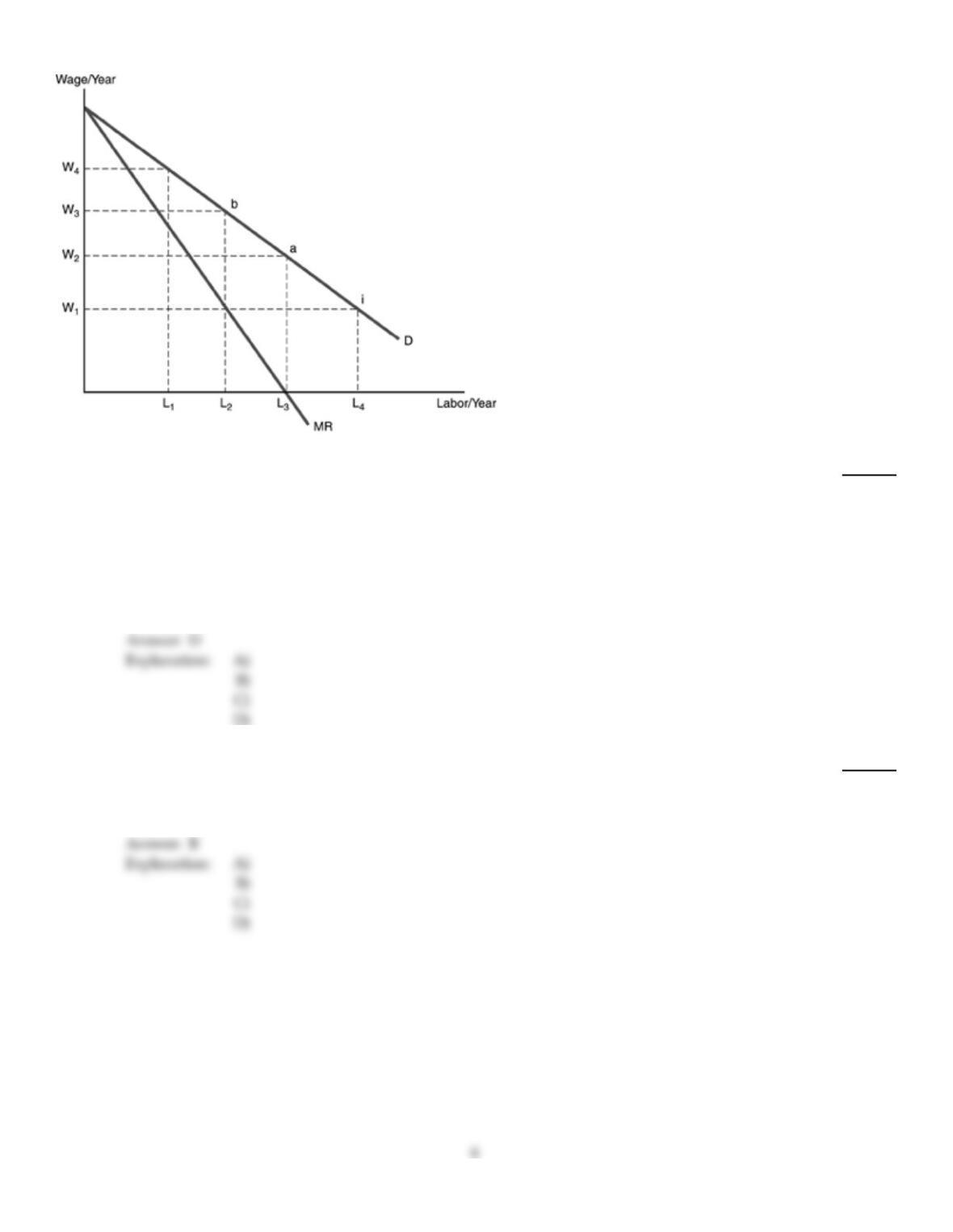
Refer to the above figure. Suppose there are L4 workers in the union. If the union wants to set a
wage rate of W3, it must
19)
A)
determine the most efficient way to get the firms to accept the wage and hire all L4 workers.
B)
determine which of its members will earn W3 and which will earn W1.
C)
accept that L3–L2 workers will have to get a lower wage equal to W2 and L4–L3 workers
will have to get a wage of W1.
D)
accept that L4–L2 members will not be able to find work in the industry.
20)
A business enterprise in which employees must belong to the union before they can be hired is
called a(n)
20)
A)
union shop.
B)
closed shop.
C)
craft union.
D)
industrial union.
21)
Which statement is most TRUE about the impact of unions on wage levels in the Untied States?
21)
A)
The union/nonunion wage differential tends to decrease during a recession.
B)
Unions have had no impact on the wage levels of their workers.
C)
Unions have contributed to increased income inequality in the United States by raising
corporate profits.
D)
Unions have tended to increase the hourly wage rates of their members relative to nonunion
workers by an average of about $2.25.
22)
If a union negotiates and obtains a wage rate above the competitive wage rate,
22)
A)
it must find a way to make workers more productive.
B)
it must find a way to ration jobs among the excessive number of workers who wish to work in
the union sector.
C)
employment in the union sector will increase relative to employment in the nonunion sector.
D)
unemployment will increase in the nonunion sector relative to the union sector.
23)
A primary objective of labor unions is to
23)
A)
seek better pay and improved work conditions.
B)
secure equal pay for its members.
C)
have equal power with their employer.
D)
all of the above
E)
none of the above
24)
An example of featherbedding is
24)
A)
union requirements that forbid the use of certain laborsaving equipment.
B)
the requirement that all construction workers who work on a government–financed project
receive the union wage rate regardless if they are in the union or not.
C)
advertising that encourages consumers to buy union–made goods.
D)
lobbying Congress to get higher tariffs.
25)
A union requirement that a fireman has to be hired to work in a diesel locomotive would be an
example of
25)
A)
work expansion.
B)
featherbedding.
C)
work stabilization.
D)
work requirements.
26)
The ultimate bargaining tool for unions is
26)
A)
the Taft–Hartley Act.
B)
“labor’s Magna Carta.”
C)
the strike.
D)
the sympathy strike.
C
27)
Which of the following is one of the reasons for declining union membership in the United States?
27)
A)
Labor force participation by women has decreased.
B)
The repeal of the Taft–Hartley Act.
C)
Much of the unskilled, nonunionized work in the United States is done by immigrant workers
who are undocumented.
D)
The AFL–CIO merger and creation of the Change to Win Federation reduced competition
among unions.
C
28)
A state with “right–to–work” laws would most likely have
28)
A)
more union workers than neighboring states without such laws.
B)
more worker safety requirements than neighboring states without such laws.
C)
higher employment levels than neighboring states without such laws.
D)
more workers’ benefits than neighboring states without such laws.
C
29)
If you want to become an actor, and you must join the Screen Actors Guild after your first job, the
Screen Actors Guild is a(n)
29)
A)
open shop.
B)
agency shop.
C)
union shop.
D)
closed shop.
C
B
30)
Featherbedding refers to
30)
A)
the amount of the union premium.
B)
training programs initiated by the unions to make the less–skilled workers more productive.
C)
attempts by management to reduce workers‘ interest in a union.
D)
the practice that forces employers to use more labor than they would otherwise.
31)
In the above figure, what is the quantity of workers that would be hired in a perfectly competitive
market?
31)
A)
Q2
B)
Q3
C)
Q4
D)
Q1
32)
A monopsonist in the labor market has
32)
A)
a perfectly elastic labor supply.
B)
a decreasing average variable cost.
C)
a downward sloping marginal revenue product curve.
D)
an upward sloping labor supply curve.
33)
Negotiations between the management of a company and the management of a union for the
purpose of setting a mutually agreeable contract on wages, fringe benefits and working conditions
for all employees in a union is know as
33)
A)
collective bargaining.
B)
an industrial union.
C)
a union shop.
D)
a closed shop.
34)
The United Auto Workers is striking against Ford. The Teamsters refuse to deliver steel to Ford.
This is an example of
34)
A)
a sympathy strike and is illegal under the Taft–Hartley Act.
B)
a jurisdictional dispute and is illegal under the Taft–Hartley Act.
C)
a closed shop and is illegal under the Wagner Act.
D)
a secondary boycott and is illegal under the Taft–Hartley Act.
Explanation:
35)
When workers are paid a wage that is less than their contribution to a monopsonist’s revenues,
35)
A)
they seek part time employment.
B)
they file a grievance with their union representative.
C)
this is sometimes referred to monopsonistic exploitation.
D)
this is sometimes referred to as an incentive.
Explanation:
36)
A secondary boycott is
36)
A)
illegal according to the Wagner Act.
B)
a legal way to support striking workers.
C)
legal according to the Sherman Act.
D)
illegal according to the Taft–Hartley Act.
Explanation:
37)
A monopsonistic employer will pay a wage rate
37)
A)
less than the labor’s MRP.
B)
greater than the labor’s MRP.
C)
equal to MFC.
D)
equal to the labor’s MRP.
Explanation:
Explanation:
38)
The CIO was founded by
38)
A)
George Meany.
B)
Jimmy Hoffa.
C)
John L. Lewis.
D)
Samuel Gompers.
39)
Strikebreakers
39)
A)
can strengthen the bargaining power of a union.
B)
can reduce the bargaining power of a union.
C)
make a strike permanent.
D)
make a union negotiation invalid.
B
40)
The National Labor Relations Act (Wagner Act)
40)
A)
guaranteed workers the right to organize.
B)
set the length of the workweek at 40 hours.
C)
set the minimum wage at $5.15 an hour.
D)
prohibited the creation of company unions.
A
41)
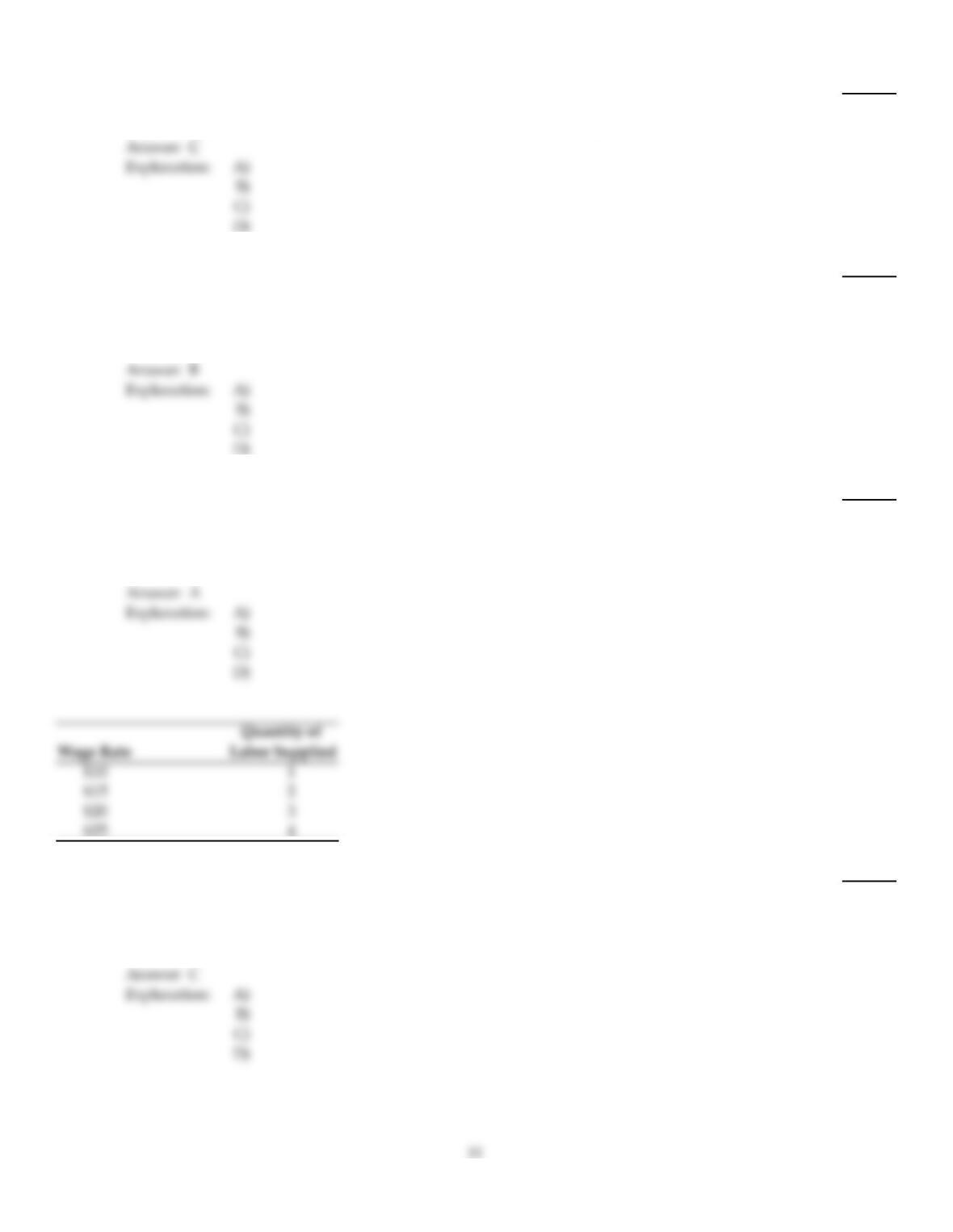
Use the above table. The data shows that the firm
41)
A)
is selling its output in a perfectly competitive market.
B)
is selling its output in an imperfectly competitive market.
C)
is a monopsonist.
D)
is hiring in a perfectly competitive labor market.
C
C
42)
A plumbers’ union is an example of
42)
A)
an industrial union.
B)
skilled workers union.
C)
a craft union.
D)
auxiliary union.
43)
A union is striking a steel company, and then, to put more pressure on the steel company, also
promotes a boycott against an auto company that buys steel from the steel company. This latter
action is
43)
A)
a sympathy strike, and is illegal under the Taft–Hartley Act.
B)
a sympathy strike, and is legal under the Wagner Act.
C)
a secondary boycott, and is legal under the Landrum–Griffin Act.
D)
a secondary boycott, and is illegal under the Taft–Hartley Act.
44)
Since the National Basketball Association is the only significant employer of professional basketball
players, it might be referred to as a(n)
44)
A)
oligopsony.
B)
monopsony.
C)
monopoly.
D)
oligopolist.
45)
An example of featherbedding is
45)
A)
employer–paid dental insurance negotiated by the union.
B)
a requirement that all construction workers working on government–funded construction
projects must be paid union wages.
C)
the union practice that requires younger workers to be laid off first in a recession.
D)
a requirement on railroads to keep a fireman on board after the introduction of diesel engines.
46)
A right–to–work state is one in which
46)
A)
the closed shop is permitted.
B)
there is guaranteed employment for all citizens.
C)
unions are illegal.
D)
the union shop is prohibited.
47)
Refer the above figure. An increase in labor productivity is likely to stimulate and shift the labor
demand curve to
47)
A)
the right and hence increase union wages per year.
B)
the right and hence lower union wages per year.
C)
to the left and hence increase union wages per year.
D)
None of the above is likely to happen.
48)
Suppose a union successfully negotiates a wage rate for its members that is above the competitive
wage rate, then
48)
A)
the quantity of labor demanded will be less than the quantity supplied.
B)
it is impossible to tell whether or not the labor market will be in equilibrium without more
information.
C)
the quantity of labor demanded will be greater than the quantity supplied.
D)
the labor market will be in equilibrium.
49)
For the past several decades, union membership in the United States has been declining. What has
been happening in the rest of the world?
49)
A)
We do not know because other nations do not keep these statistics.
B)
In almost every other nation, union membership has held constant.
C)
In most cases, union membership in other nations has also been falling.
D)
Union membership has been increasing in almost every other country.
C
50)
The percentage of U.S. workers in the private sector who belong to unions is currently
50)
A)
greater than 50 percent.
B)
approximately 12 percent.
C)
approximately 8 percent.
D)
approximately 20 percent.
C
51)
Temporary or permanent workers hired to replace striking union workers are known as
51)
A)
rationers.
B)
strikeaiders.
C)
backbreakers.
D)
strikebreakers.
D
A
52)
Since the 1960s, the share of the labor force that is unionized in the United States has
52)
A)
increased.
B)
declined.
C)
declined except in the private sector.
D)
increased except for the government sector.
53)
Under monopsony, marginal factor cost is
53)
A)
below the wage rate but increases as more workers are hired.
B)
greater than the wage rate.
C)
downward sloping.
D)
equal to the wage rate.
54)
A monopsonist is currently employing 50 workers at $10 an hour. It wants to hire an additional
worker, but will have to pay the worker $10.10. The marginal factor cost is
54)
A)
$10.00.
B)
$15.10.
C)
$10.10.
D)
ten cents.
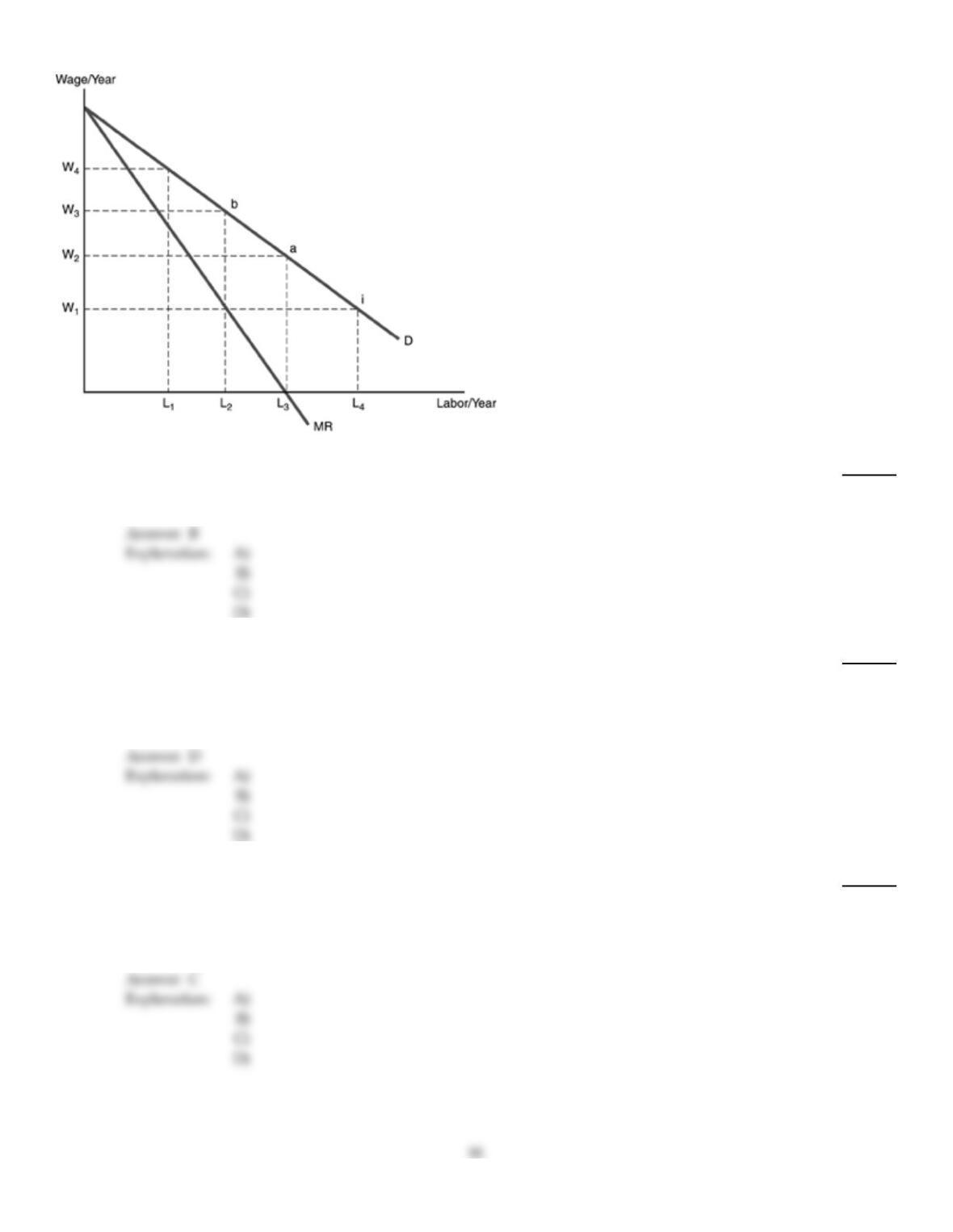
55)
Refer to the above figure. If the union wants to maximize the total income of its members who
work, it will set wages at
55)
A)
W1.
B)
W2.
C)
W3.
D)
W4.
56)
The Taft–Hartley Act
56)
A)
permits states to outlaw unions.
B)
encourages unions to engage in secondary boycotts.
C)
encourages unions to engage in sympathy strikes.
D)
permits states to pass right–to–work laws.
57)
In some settings,
57)
A)
unions have been effective in promoting general social legislation.
B)
unionism is associated with increased productivity.
C)
Both A and B are correct.
D)
Neither A nor B is correct.