1
Biology: A Guide to the Natural World, 5e (Krogh)
Chapter 28 Communication and Control 2: The Endocrine System
1) Hormones differ from other chemical messengers such as neurotransmitters in that hormones:
A) are all in the lipid chemical family.
B) travel through the bloodstream.
C) cross a synapse.
D) always suppress rather than stimulate a response.
E) are released through ducts.
2) A consequence of the way hormones, as compared to neurotransmitters, get to their target
cells is that hormones:
A) must be larger molecules.
B) must be proteins.
C) can be lipids.
D) would be slower to act.
E) cannot maintain homeostasis.
3) A bunch of hormone molecules travel by one cell and have no effect but quickly stimulate the
next cell. What did the second cell have that the first did not?
A) greater need for the hormone
B) a homeostatic response
C) receptors for the hormone
D) dendrites
E) larger size
4) Hormones made from chains of amino acids are:
A) peptide hormones.
B) steroid hormones.
C) protein hormones.
D) glycolipid hormones.
E) glycoprotein hormones.
5) Hormones made from variations on the cholesterol molecule are:
A) peptide hormones.
B) steroid hormones.
C) protein hormones.
D) glycolipid hormones.
E) glycoprotein hormones.
6) Peptide hormones generally work by:
A) attaching to membrane receptors and triggering chemical reactions.
B) passing into the cell and attaching to receptors inside.
C) triggering an action potential in the cell.
D) triggering an influx of potassium ions.
E) stimulating endocytosis of hormones and receptors.
7) Steroid hormones generally work by:
A) attaching to membrane receptors and triggering chemical reactions.
B) passing into the cell and attaching to receptors inside.
C) triggering an action potential in the cell.
D) triggering an influx of potassium ions.
E) stimulating endocytosis of hormones and receptors.
8) Which of the following is a steroid hormone?
A) glucagon
B) T4 from the thyroid
C) adrenaline
D) melatonin
E) estrogen
9) Which of the following is a peptide hormone?
A) melatonin
B) progesterone
C) adrenaline
D) glucagon
E) estrogen
10) Release of most hormones is controlled by:
A) the cerebrum.
B) positive feedback.
C) negative feedback.
D) internal enzyme levels.
E) DNA.
11) In order to maintain homeostasis, parathyroid hormone would stimulate what response to low
blood calcium levels?
A) stimulate the hunger drive
B) stimulate the thirst drive
C) reduce urine production at the kidneys
D) prompt bones to store calcium
E) prompt bones to release stored calcium
12) The structure that is at the center of control for endocrine activity, particularly as it relates to
homeostasis, is the:
A) posterior pituitary gland.
B) brain stem.
C) thyroid gland.
D) hypothalamus.
E) cerebral cortex.
13) Hormones that are released by the posterior pituitary were made in the:
A) hypothalamus.
B) anterior pituitary.
C) brain stem.
D) adrenal glands.
E) thalamus.
14) “Releasing hormones” and “inhibiting hormones” produced by the hypothalamus target the:
A) posterior pituitary.
B) anterior pituitary.
C) adrenal glands.
D) ovaries and testes.
E) digestive organs.
15) Release of thyroid-stimulating hormone (TSH) from the pituitary is inhibited when:
A) the metabolic rate of cells decreases.
B) T3 and T4 levels are low.
C) T3 and T4 levels are high.
D) blood sugar levels are low.
E) blood sugar levels are high.
16) Through nervous stimulation, the hypothalamus controls the release of which hormone?
A) adrenaline
B) growth hormone
C) thyroid-stimulating hormone
D) glucagon
E) follicle-stimulating hormone
17) Insulin and glucagon are produced by a:
A) small proportion of the cells in the pituitary.
B) large proportion of the cells in the adrenal glands.
C) small proportion of the cells in the pancreas.
D) large proportion of the cells in the pancreas.
18) When blood sugar levels are running low, the body would produce more:
A) insulin than glucagon.
B) glucagon than insulin.
C) glycogen than insulin.
D) insulin than cortisol.
E) insulin than adrenaline.
19) Which organ that is a target of insulin plays the most significant role in regulating sugar
levels in circulation?
A) adrenal glands
B) kidneys
C) stomach
D) pituitary
E) liver
20) Which hormone causes glucose to be produced from the breakdown of protein and fat?
A) insulin
B) glucagon
C) cortisol
D) growth hormone
E) oxytocin
6
21) Which hormone controls water retention by the kidneys and is also known as antidiuretic
hormone?
A) T4
B) parathyroid hormone
C) luteinizing hormone
D) vasopressin
E) oxytocin
22) Some hormones may take up to several hours to work.
23) The adrenal glands are located close to the heart.
24) Most peptide hormones enter the target cell through large channels.
25) Small amounts of testosterone are made in the ovaries and adrenal glands of females.
26) The endocrine system helps maintain homeostasis through positive feedback.
27) The hypothalamus makes the hormones that are released from the posterior pituitary.
28) Hypothalamic neurons directly control the anterior pituitary with neural stimuli at a synapse.
29) Most of the hormones of the anterior pituitary control other endocrine glands.
30) Follicle-stimulating hormone stimulates thyroid gland follicles to produce T4.
31) Alpha cells of the pancreas make insulin.
32) Insulin stimulates liver cells to store glucose in the form of glycogen.
33) Cortisol is part of the body’s stress response.

Match the following. Answers may be used more than once.
A) steroid hormone
B) amino-acid-based hormone
C) peptide hormone
34) Estrogen
Topic: Section 28.2
Skill: Knowledge/Comprehension
35) Growth hormone
Topic: Section 28.2
Skill: Knowledge/Comprehension
36) Adrenaline
Topic: Section 28.2
Skill: Knowledge/Comprehension
37) Receptors inside cell
Topic: Section 28.2
Skill: Knowledge/Comprehension

Match the following.
A) posterior pituitary
B) thyroid
C) adrenal cortex
D) pancreas
E) anterior pituitary
38) Calcitonin
Topic: Section 28.5
Skill: Knowledge/Comprehension
39) Glucocorticoids
Topic:
Skill: Knowledge/Comprehension
Section 28.5
40) Prolactin
Topic: Section 28.5
Skill: Knowledge/Comprehension
41) Insulin
Topic: Section 28.5
Skill: Knowledge/Comprehension
42) Oxytocin
Topic: Section 28.5
Skill: Knowledge/Comprehension
Match the following.
A) increases heart rate and blood pressure
B) stimulates contraction of the uterus
C) increases blood calcium levels
D) stimulates estrogen production and egg development in females
E) increases metabolic rate
43) Oxytocin
Topic: Section 28.5
Skill: Knowledge/Comprehension
44) Follicle-stimulating hormone
Topic: Section 28.5
Skill: Knowledge/Comprehension
45) Parathyroid hormone
Topic: Section 28.5
Skill: Knowledge/Comprehension
46) Epinephrine
Topic: Section 28.5
Skill: Knowledge/Comprehension
47) T3 and T4
Topic: Section 28.5
Skill: Knowledge/Comprehension
48) Where are the parathyroid glands located?
49) Human growth hormone is composed of 191 amino acids. This would place it in which class
of hormone?
50) A friend tells you that his Aunt Jane is being treated for a brain disorder that is causing her to
produce too much of the glucocorticoid hormones. Your friend looked up the hormone and
(correctly) found it to be produced by the adrenal glands. He says he doesn’t understand why a
brain disorder should have anything to do with the adrenal glands. What do you tell your friend
to help him understand the connection between the two?
51) A diabetic friend of yours passes out shortly after taking her insulin injection. She regains
consciousness and asks you to give her one of the glucose tablets she carries in her purse.
Another friend steps in and says, “Wait! You shouldn’t give sugar to a diabetic!” Recalling what
you learned about the endocrine system, you give your diabetic friend the glucose tablet she
asked for. Why did you trust the request of your diabetic friend for the glucose tablet and not the
other friend who thought he was being helpful (but wasn’t)?
52) What gland and hormone control the release of cortisol from the adrenal cortex?
53) The hormone that stimulates mammary gland development and milk production is ________.
54) Which endocrine gland is associated with proper development of certain white blood cells?
55) Which hormones stimulate the kidneys to retain sodium and excrete potassium?
56) What would be the logical consequences of hormones traveling via the circulatory system as
compared to the action-potential-based stimuli of the nervous system? Are these consequences
necessarily a disadvantage?
57) Long ago, the pituitary gland was nicknamed the “master gland” of the endocrine system.
Based on what you have learned from this section, provide an argument for why this nickname is
undeserved or at least less deserved.
58) As you may have heard before, stress can kill you! Explain the connection between the
deleterious effects of stress and the endocrine system.
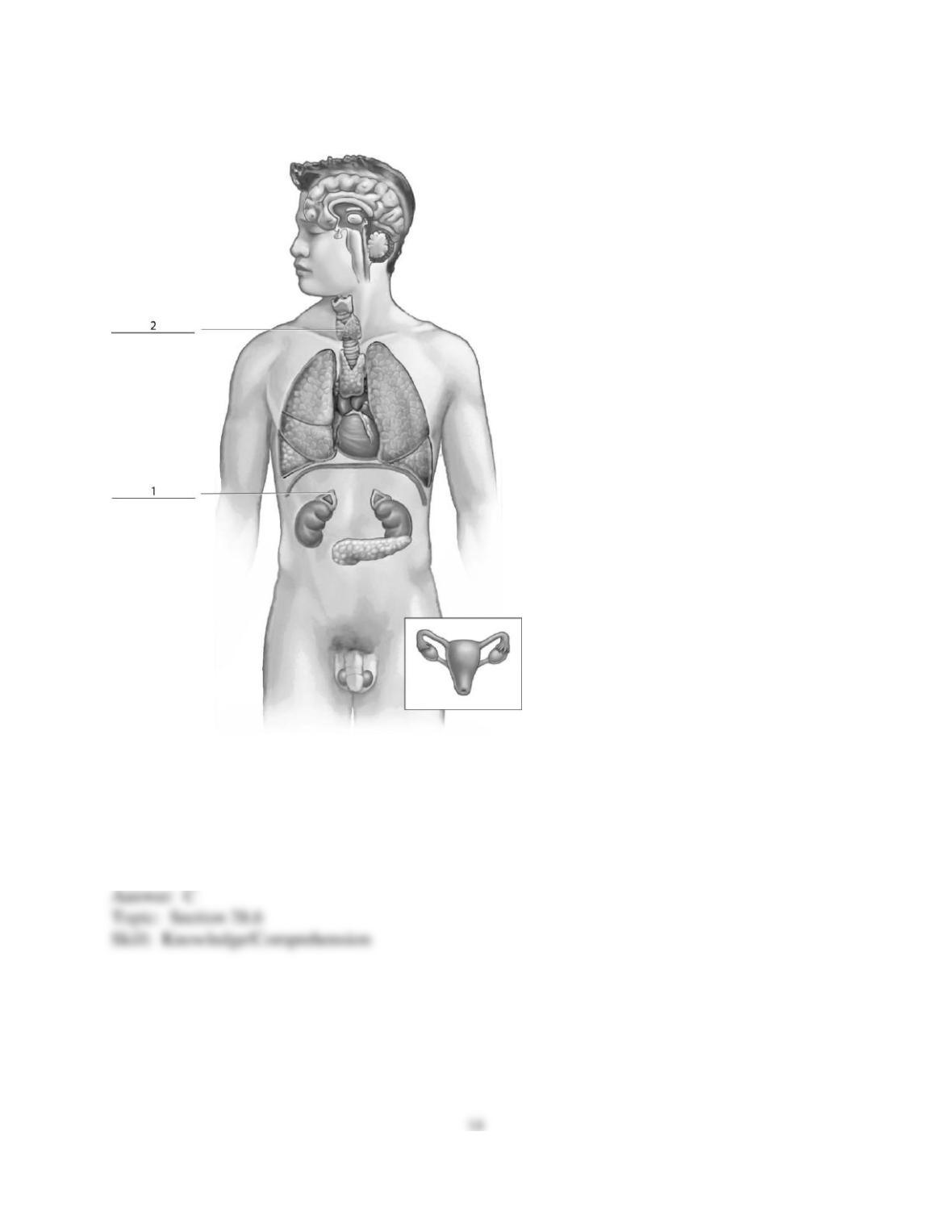
Refer to the figure below, and then answer the following question(s).
59) The endocrine gland indicated by a “1” corresponds to the:
A) pineal.
B) thyroid.
C) adrenal cortex.
D) thymus.
E) pancreas.
60) The endocrine gland indicated by a “2” corresponds to the:
A) pineal.
B) thyroid.
C) adrenal cortex.
D) thymus.
E) pancreas.