
296)
A short–run increase in the price of a firm’s output will typically
296)
A)
not impact the hiring of labor.
B)
lead to a movement along the firm’s demand for labor curve.
C)
lead to more employment in the competitive firm.
D)
make the demand for labor more inelastic.
Number of Total Number of Total
Workers Output Workers Output
0 0 6 945
1 200 7 1000
2 420 8 1025
3620 9 1035
4 770 10 1040
5 870
297)
Refer to the above table. Suppose the marginal revenue product of the 7th worker is $1100. This
implies that
297)
A)
the price of the good is $1.
B)
the price of the good is $8.
C)
the price of the good is $20.
D)
we cannot tell what the price of the good is without more information.
298)
The marginal physical product of labor is
298)
A)
the change in output resulting from the addition of one more worker, adjusting the level of
the capital stock accordingly.
B)
the output of the firm divided by the number of workers.
C)
the change in total revenues resulting from the addition of one more worker, while increasing
one other factor of production.
D)
the change in output resulting from the addition of one more worker, holding other factors of
production constant.
299)
The demand for DVDs increases. As a result
299)
A)
the wage rate in the DVD industry increases and the quantity supplied of workers increases.
B)
the demand for labor increases and the supply of labor also increases, leaving wages
unchanged.
C)
the wage rate in the DVD industry increases and the quantity demanded of workers increases.
D)
the demand for labor increases, but since the supply curve of labor is perfectly elastic, the
wage rate does not change.
300)
The additional production resulting from hiring one more worker is
300)
A)
additional production.
B)
marginal cost.
C)
marginal production.
D)
marginal physical product.
301)
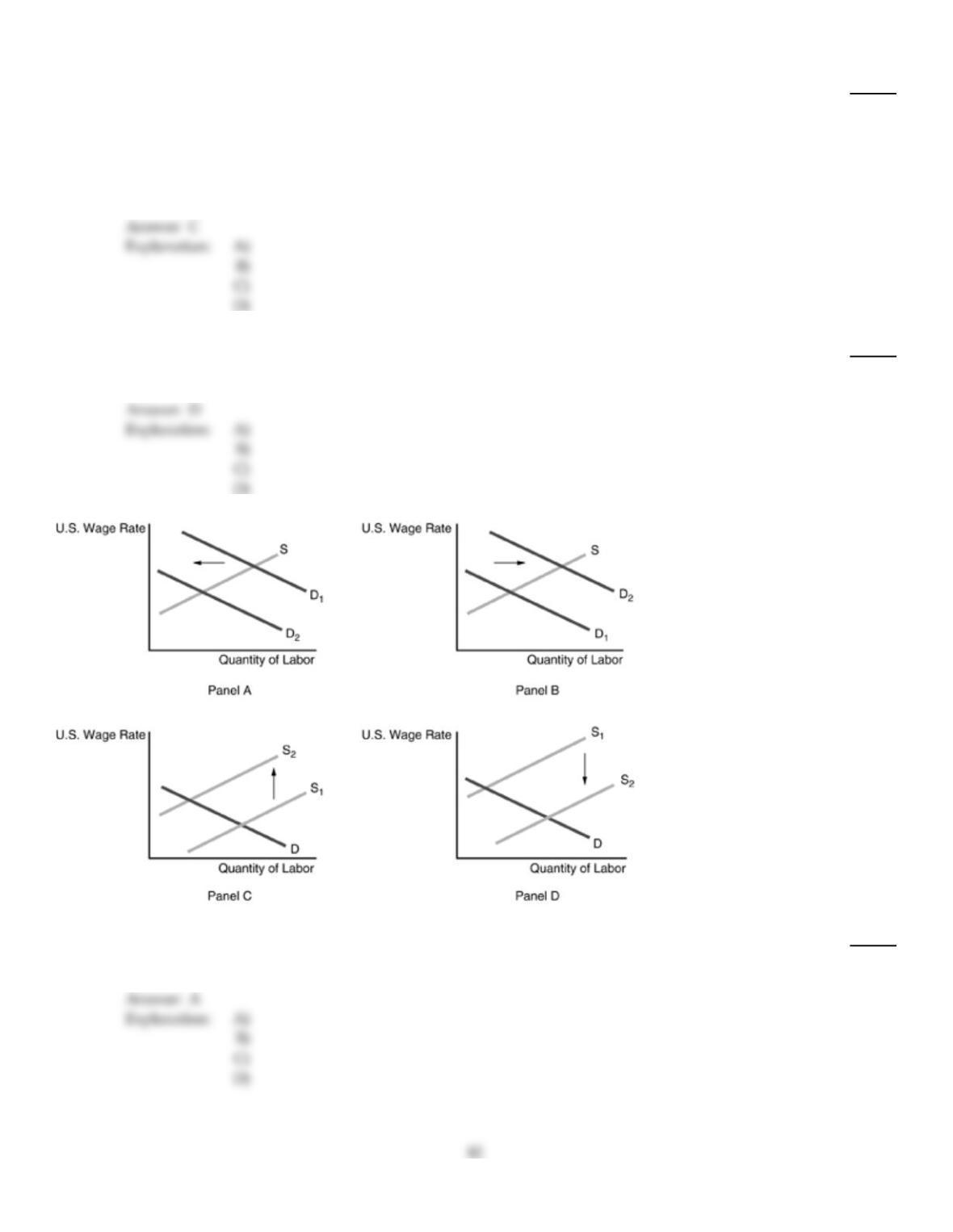
Refer to the above figure. Which panel represents what happens in the U.S. job market in the
short–run when U.S. firms substitute labor outside of the U.S. for labor inside the U.S.?
301)
A)
Panel A
B)
Panel B
C)
Panel C
D)
Panel D

302)
Other things equal, a monopolist will hire
302)
A)
fewer workers than a perfectly competitive industry.
B)
the same number of workers as a perfectly competitive industry would.
C)
more workers than a perfectly competitive firm.
D)
more workers than a perfectly competitive industry.
303)
To minimize total costs for a particular rate of output, a firm will equate
303)
A)
the marginal revenue product and variable marginal revenue for each factor.
B)
the marginal physical product per dollar spent on each factor.
C)
the average cost of each factor.
D)
the marginal revenue of each factor.
304)
Ajax has just discovered that the marginal revenue product generated by the last worker hired was
$75 while the marginal factor cost was $95. What should Ajax do?
304)
A)
Leave the level of production unchanged.
B)
Increase the amount produced.
C)
Reduce the amount produced.
D)
Collect more information before making a decision.

Marginal Marginal
Labor Input Physical Product Revenue
(workers per week) (output per week) MR
25 150 9.00
26 140 8.50
27 130 8.00
28 120 7.50
29 110 7.00
305)
Refer to the above table. How do we know that this is not a competitive firm?
305)
A)
The marginal revenue changes as output changes.
B)
Marginal physical product cannot be computed for competitive firms.
C)
The marginal physical product decreases as the amount of labor hired increases.
D)
The marginal revenue product decreases as the amount of labor increases.
306)
When MFC < MRP, a firm in a competitive market will
306)
A)
stop hiring.
B)
layoff workers.
C)
hire more workers.
D)
earn fewer profits.
C
307)
A firm is a price taker in the labor market if
307)
A)
there is a scarcity of labor in the market.
B)
the skills of available workers do not match the requirements for the job.
C)
the hiring of more workers will drive the existing wage rate up.
D)
the hiring of more workers will leave the existing wage rate unchanged.
D
A

Quantity of Marginal Physical Price of Marginal
Workers Total Product Product Final Product Revenue Product
1 7 $10
218 9
330 8
440 7
548 6
652 5
308)
In the above table, what is the marginal revenue product of the 1st worker?
308)
A)
$8
B)
$92
C)
$40
D)
$70
Labor Input Total Physical Product
(workers/day) (output/day)
10 500
11 600
12 690
13 760
14 800
309)
Refer to the above table. What does the marginal physical product equal when the amount of labor
goes from 11 to 12 units?
309)
A)
600
B)
90
C)
690
D)
100
310)
Coal and iron ore are complements in the manufacture of steel. An increase in the price of coal
would lead to
310)
A)
an increase in the demand for iron ore as producers substitute more iron ore for coal in the
production process.
B)
no change in the demand for iron ore since the steel makers must use both iron ore and coal if
they are to make steel.
C)
an increase in the supply of iron ore as iron ore producers see an opportunity to expand their
markets.
D)
a decrease in the demand for iron ore as steel manufacturers reduce production of steel.

311)
We would expect that a rise in labor supply will have a proportionately larger effect on the market
wage rate when
311)
A)
the demand for labor is unitary elastic.
B)
the demand for labor is elastic.
C)
the demand for labor is inelastic.
D)
the supply for labor is elastic.
312)
The monopolist’s input demand curve is equal to its
312)
A)
marginal revenue product curve.
B)
marginal cost curve.
C)
variable cost curve.
D)
average cost curve.
A
313)
When a firm is hiring an input such that the marginal revenue product of the input is equal to the
marginal factor cost of the input, the firm
313)
A)
should be expanding output.
B)
is producing too much output.
C)
is hiring too little of the input.
D)
is maximizing economic profit.
D
314)
Marginal revenue product is
314)
A)
marginal physical product multiplied by marginal revenue.
B)
the total revenue from the sale of the product sales.
C)
marginal physical product multiplied by average variable cost of the product.
D)
the price of the product.
A
315)
If the marginal productivity of labor decreases, then
315)
A)
the demand curve for labor will shift upward and to the right.
B)
the quantity of labor demanded at every possible wage rate will be higher.
C)
the quantity of labor demanded will not be affected.
D)
the quantity of labor demanded at every possible wage rate will be less.
D
C

316)
The demand for labor is
316)
A)
derived from the demand for the final product of the firm.
B)
derived from the satisfaction workers get for being employed.
C)
derived from the satisfaction that hiring labor provides the owner of the firm.
D)
derived from a utility–maximizing process similar to that used to derive the demand curve
for all workers in a given industry.
317)
A perfectly competitive firm is hiring variable resources M and N. It will minimize total costs
317)
A)
MRPm
MFCm= MRPn
MFCn.
B)
Pm/MPPm= Pn/MPPn.
C)
MPPm/Pm= MPPn/Pn.
D)
MRPm/MFCm= MRPn/MFCn.
318)
The price elasticity of demand for labor will be greater, the
318)
A)
smaller is the price elasticity of demand for the final product.
B)
smaller is the proportion of wage costs in the total cost of production.
C)
shorter is the time period under examination.
D)
easier it is to employ substitute inputs in production.
319)
If the price elasticity of demand is less than 1, then consumer demand is
319)
A)
unitary elastic.
B)
inelastic.
C)
unrelated to the elasticity of demand.
D)
elastic.
320)
Suppose at the current level of labor used, MRP = $100 and MFC = $150. To maximize profits, the
firm should
320)
A)
reduce the level of labor.
B)
expand production.
C)
hire more labor.
D)
maintain the current level of labor.

321)
Suppose that in a computer factory, if there is 1 worker, 80 computers are produced per week. If
there are 2 workers, 150 computers are produced per week. If there are 3 workers, 210 computers
are produced per week. Given this information, there
321)
A)
is diminishing marginal product.
B)
is increasing marginal product.
C)
are not enough workers.
D)
are too many workers.
322)
What are the short–run economic effects when U.S. firms substitute labor outside of the U.S. for
labor inside the U.S.?
322)
A)
The wage rate in the U.S. will increase, and the wage rate in the foreign country will decrease.
B)
The wage rate in the U.S. will remain the same, and the wage rate in the foreign country will
decrease.
C)
The wage rate in the U.S. will decrease, and the wage rate in the foreign country will
decrease.
D)
The wage rate in the U.S. will decrease, and the wage rate in the foreign country will increase.
Number of Total Number of Total
Workers Output Workers Output
0 0 6 945
1 200 7 1000
2 420 8 1025
3620 9 1035
4 770 10 1040
5 870
323)
Refer to the above table. Suppose the price of the good sold is $4 and the marginal factor cost of
labor is $600, how many units of labor will the firm hire?
323)
A)
3
B)
5
C)
4
D)
6

324)
When U.S. computer companies hire workers in India to staff their customer service call centers,
they are engaging in
324)
A)
predatory pricing.
B)
labor engagement.
C)
unfair trade practices.
D)
outsourcing.
325)
The demand curve for labor slopes down because
325)
A)
firms must lower prices to sell the additional units of its product that the extra workers
produce.
B)
of the law of diminishing marginal product.
C)
of profit maximizing behavior.
D)
firms value less efficient workers less than they value more efficient workers.
326)
If the marginal revenue product of the last worker hired exceeds the marginal factor cost of the
worker, the firm would be better served if it
326)
A)
hires additional workers.
B)
lays off the last worker hired.
C)
maintains its current level of workers already hired.
D)
None of the above is a good option for a profit–seeking firm.
327)
All of the following affect the demand elasticity for labor EXCEPT
327)
A)
final product price elasticity.
B)
labor costs as a portion of total cost.
C)
ease of substitution of labor for other inputs.
D)
final product income elasticity.

Number of Total Number of Total
Workers Output Workers Output
0 0 6540
1100 7600
2220 8650
3320 9 690
4 400 10 700
5475
328)
According to the above table, if the price of the good produced is $5 and the wage rate is $400, then
the marginal revenue product of the 7th worker is
328)
A)
$60.
B)
$12.
C)
$400.
D)
$300.
329)
Suppose that in a computer factory, if there is 1 worker, 80 computers are produced per week. If
there are 2 workers, 150 computers are produced per week. If there are 3 workers, 210 computers
are produced per week. Given this information and the fact that the firm receives $200 per
computer, the marginal revenue product of the third worker is
329)
A)
$10,000.
B)
$12,000.
C)
$14,000.
D)
$4,200.
Quantity of Marginal Physical Price of Marginal
Workers Total Product Product Final Product Revenue Product
1 7 $10
218 9
330 8
440 7
548 6
652 5
330)
In the above table, if the marginal factor cost is $96, how many workers would be hired?
330)
A)
4
B)
5
C)
2
D)
3

331)
Some companies are having their technical support calls answered by people located in India. This
is an example of
331)
A)
insourcing.
B)
outsourcing.
C)
a change in the demand for the final product that labor produces.
D)
a factor that shifts the supply of labor curve in the U.S.
Number of Total Number of Total
Workers Output Workers Output
0 0 6 945
1 200 7 1000
2 420 8 1025
3620 9 1035
4 770 10 1040
5 870
332)
Refer to the above table. Suppose the price of the good sold is $3 and the marginal factor cost of
labor is $300, how many units of labor will the firm hire?
332)
A)
4
B)
6
C)
5
D)
3
333)
If a firm faces perfectly competitive product and factor markets and the marginal product of labor
and capital are 4 and 9, respectively, while the wage rate is $2 and the rental rate on capital is $4,
the firm should
333)
A)
increase all inputs proportionately.
B)
use relatively less labor.
C)
use relatively more labor.
D)
decrease all inputs proportionately.
334)
In the perfectly competitive market, the labor supply curve faced by the individual firm is
________, while that of the market is ________.
334)
A)
perfectly inelastic; perfectly elastic
B)
perfectly elastic; upward sloping
C)
perfectly elastic; perfectly inelastic
D)
perfectly inelastic; upward sloping

335)
If a firm wants to maximize profits, it should hire workers up to the point at which
335)
A)
total factor cost = total revenue.
B)
marginal factor cost = marginal revenue product.
C)
total social benefit = total social costs.
D)
marginal utility = marginal cost.
336)
The supply of labor to the individual firm in a perfectly competitive market is
336)
A)
perfectly inelastic at the current equilibrium employment level.
B)
downward sloping.
C)
perfectly elastic at the current market clearing wage rate.
D)
equal to the marginal revenue of output.
C
Quantity Total Marginal Marginal
of Workers Product Physical Product Revenue Product
0 0 – –
1 7
218
330
440
548
337)
In the above table, what is the marginal physical product of worker 5?
337)
A)
11
B)
10
C)
8
D)
7
C
338)
The additional output from one more worker is known as
338)
A)
marginal wage.
B)
marginal physical product.
C)
marginal revenue product.
D)
marginal factor cost.
B
B

339)
Which will NOT affect the elasticity of demand for labor?
339)
A)
the elasticity of supply for labor
B)
the elasticity of demand for the good
C)
the substitutability of capital for labor
D)
the labor intensity of the production process
340)
Outsourcing is
340)
A)
another way for residents of different nations to conduct trade with one another.
B)
not beneficial to any country.
C)
only beneficial to a few select countries.
D)
not beneficial to the consumers who purchase outsourced goods.
A
341)
Which of the following represents the general rule of hiring for a firm?
341)
A)
Average revenue product equals the wage rate.
B)
Marginal cost equals marginal revenue.
C)
Marginal revenue product equals marginal factor cost.
D)
Total physical product equals marginal factor cost.
C
342)
Which of the following statements is TRUE about the market and individual firm’s supply curve for
labor?
342)
A)
The market supply curve is more inelastic than the firm’s supply curve.
B)
The market supply curve is more elastic than the firm’s supply curve.
C)
The market supply curve is perfectly elastic and the individual firm’s supply curve is
perfectly inelastic.
D)
The market supply curve is perfectly inelastic and the individual firm’s supply curve is
perfectly elastic.
A
A

343)
Profit maximization occurs where
343)
A)
each factor is used up to the point where its marginal physical product is equal to its marginal
factor cost.
B)
average variable cost equals average total cost.
C)
average variable cost equals marginal cost.
D)
each factor is used up to the point where its marginal revenue product is equal to its marginal
factor cost.
344)
Which of the following will not cause the supply of labor curve to shift in the economics professor
industry?
344)
A)
a decrease in the number of courses a professor must teach
B)
University professors are going to be required to spend more time in their offices.
C)
a decrease in the wage rate for Ph.D. economists in the banking industry
D)
Universities have discovered a way to make professors more productive.
D
Explanation:
345)
In the employment of any resource, a firm should
345)
A)
hire each input unit that adds more to revenue than it adds to costs.
B)
equate marginal revenue product with the cost of the additional resource.
C)
hire each input unit provided its marginal physical product is greater than zero.
D)
A and B are both correct.
D
Explanation:
346)
When MFC > MRP, a firm in a competitive market will
346)
A)
earn additional profits.
B)
layoff workers.
C)
hire more workers.
D)
stop hiring.
B
Explanation:
D
Explanation:

347)
What has been the impact of the widespread adoption of automated teller machines (ATMs) on the
demand for bank tellers?
347)
A)
The demand for bank tellers has become more elastic.
B)
There has been no change because the ATMs and the employees provide completely different
services.
C)
The demand for tellers has increased.
D)
The demand for bank tellers has become more inelastic.
348)
As a firm hires more workers, holding the amounts of capital and other inputs constant,
348)
A)
output increases at a decreasing rate.
B)
output increases for a while and then decreases.
C)
output increases, but we can’t be certain whether output increases at an increasing or a
decreasing rate.
D)
output increases at a constant rate.
349)
Aluminum cannot be produced without bauxite. Hence, the price elasticity of demand for bauxite
by aluminum manufacturers will be
349)
A)
unitary elastic.
B)
inelastic.
C)
elastic.
D)
perfectly elastic.
350)
An increase in the supply of labor to an industry could be caused by
350)
A)
increased productivity of labor.
B)
an increase in job flexibility in the industry.
C)
an increase of wages in another industry.
D)
higher wages.

351)
A rule of thumb in the employment of resources is to set
351)
A)
marginal physical product equal to marginal resource cost.
B)
marginal revenue product (MRP) equal to marginal factor cost (MFC).
C)
marginal revenue (MR) equal to marginal cost (MC).
D)
none of the above.
352)
The labor supply curve faced by an individual firm in a perfectly competitive market is
352)
A)
downward sloping.
B)
vertical.
C)
upward sloping.
D)
horizontal.
D
Labor Input Total Physical Product
(workers/day) (output/day)
10 500
11 600
12 690
13 760
14 800
353)
Refer to the above table. What does the marginal physical product equal when the amount of labor
goes from 10 to 11 units?
353)
A)
54.5
B)
100
C)
600
D)
500
B
354)
In a perfectly competitive labor market, the industry demand curve is ________ and the industry
supply curve is ________.
354)
A)
upward sloping; downward sloping
B)
perfectly elastic; upward sloping
C)
vertical; perfectly elastic
D)
downward sloping; upward sloping
D
B