
223)
Which of the following would NOT be a reason for a shift in the labor demand curve?
223)
A)
a change in demand for the final product
B)
a change in the price of a related input
C)
a change in labor productivity
D)
a change in the market wage rate
224)
An increase in demand for DVD machines occurs. Which of the following statements is TRUE for
individual firms that produce DVD machines?
224)
A)
The price of DVD machines will increase leading to a decrease in demand by customers
leading to a decrease in the demand for labor by the firm.
B)
A change in demand at the industry level does not influence an individual firm’s demand
curve for labor.
C)
The price of DVD machines will decrease leading to an increase in the demand for labor by
the firm.
D)
The price of DVD machines will increase leading to an increase in the demand for labor by
the firm.
225)
Suppose that U.S. firms outsource plane manufacturing jobs to China, it is expected that
225)
A)
the wage rate for workers manufacturing planes will increase in the U.S. but decrease in
China.
B)
the wage rate for workers manufacturing planes will decrease in the U.S. but increase in
China.
C)
the wage rate for workers manufacturing planes will decrease in both the U.S. and China.
D)
the wage rate for workers manufacturing planes will increase in both the U.S. and China.

Labor Input Total Physical Output
(workers per week) (computers per week)
10 100
11 190
12 270
13 340
14 400
226)
The above table depicts output from a firm that manufactures computers. The computers sell for
$1,000 each. What is the marginal revenue product (MRP) for the fourteenth worker per week?
226)
A)
90 units
B)
$60,000
C)
80 units
D)
$70,000
227)
If the price of a product being sold in a perfectly competitive market increases,
227)
A)
the MFC curve shifts to the left.
B)
the MFC curve shifts to the right.
C)
the MRP curve shifts to the right.
D)
the MPP curve shifts to the right.
C
228)
Marginal revenue product is
228)
A)
marginal physical product times marginal factor cost.
B)
marginal physical product times the wage rate.
C)
average physical product times marginal revenue.
D)
marginal physical product times marginal revenue.
D
229)
Suppose a new technology allows firms to substitute mechanical tomato pickers for farm laborers.
As a result, the demand curve for farm laborers will
229)
A)
shift to the right.
B)
become less elastic.
C)
not be affected.
D)
become more elastic.
D
B

230)
When Canadian firms outsource accounting services to the United States, in markets for the labor
of accountants,
230)
A)
equilibrium employment and the market clearing wage rate will both decrease in Canada and
the United States.
B)
equilibrium employment and the market clearing wage rate will both increase in Canada and
in the United States.
C)
equilibrium employment and the market clearing wage rate will both increase in Canada, but
equilibrium employment and the market clearing wage rate will both decrease in the United
States.
D)
equilibrium employment and the market clearing wage rate will both decrease in Canada, but
equilibrium employment and the market clearing wage rate will both increase in the United
States.
231)
Suppose there are 100 firms in a market and all are identical. Firm A will hire 20 workers when the
wage rate is $10, 25 workers when the wage rate is $9, and 30 workers when the wage rate is $8.
The equilibrium wage rate for a number of years has been $9. If the wage rate falls to $8, we know
that
231)
A)
the quantity demanded for the market will increase to less than 3,000 workers.
B)
the quantity demanded for the market will increase to 3,000 workers.
C)
the quantity demanded for the market will increase to more than 3,000 workers.
D)
the quantity demanded for the market will increase, but we can’t tell which of the above
answers is correct.
B
232)
In a perfectly competitive industry, an individual firm faces
232)
A)
a perfectly vertical labor supply curve.
B)
a perfectly inelastic labor supply curve.
C)
a perfectly elastic labor supply curve.
D)
none of the above.
C
233)
All of the following make the demand for labor more elastic EXCEPT
233)
A)
the smaller the proportion of total costs accounted for by labor.
B)
the easier it is to substitute another input for labor.
C)
the longer the time period under consideration.
D)
greater elasticity of demand for the final product.
A
D

Marginal Marginal
Labor Input Physical Product Revenue
(workers per week) (output per week) MR
25 150 9.00
26 140 8.50
27 130 8.00
28 120 7.50
29 110 7.00
234)
Refer to the above table. How many workers will this firm hire if the weekly wage rate is $900?
234)
A)
29
B)
27
C)
28
D)
26
235)
An increase in the marginal factor cost of labor will
235)
A)
cause the value of the marginal product of labor to increase.
B)
lead to an increase in the value of an additional worker.
C)
induce a firm to hire fewer workers.
D)
lead to an increase in the quantity demanded of labor.
C
236)
If the wage rate doesn’t change but a profit–maximizing competitive firm hires fewer workers, we
know that
236)
A)
the price of the product increased.
B)
demand for the product fell or there has been a reduction in labor productivity.
C)
technical change occurred that increased labor productivity, reducing the firm’s demand for
labor.
D)
marginal factor cost increased.
B
237)
The change in total output due to the change in one variable input, while holding all other inputs
constant, is the
237)
A)
marginal revenue product.
B)
market demand curve for labor.
C)
derived demand for labor.
D)
marginal physical product.
D
C

Number of Total Number of Total
Workers Output Workers Output
0 0 6 945
1 200 7 1000
2 420 8 1025
3620 9 1035
4 770 10 1040
5 870
238)
Refer to the above table. If the price of the good produced is $5, the marginal revenue product of
the 7th worker is
238)
A)
$5000.
B)
$125.
C)
$275.
D)
$55.
239)
A firm’s employment of labor outside the country in which the firm is located
239)
A)
is outsourcing.
B)
shifts the supply of labor in the other country.
C)
shifts the supply of labor in the original country.
D)
is the marginal revenue product.
240)
A monopolist hires fewer workers than a perfectly competitive industry, other things being equal,
because
240)
A)
the monopolist producer has to deal with unions and face higher wages than do competitive
industries.
B)
the monopolist substitutes more capital for labor when compared to a competitive industry.
C)
the monopolist produces less output than a competitive industry.
D)
a monopolist has to pay higher wages in order to attract additional workers.

Number of Total Number of Total
Workers Output Workers Output
0 0 6540
1100 7600
2220 8650
3320 9 690
4 400 10 700
5475
241)
Refer to the above table. If the price of the good produced is $10 and the wage rate is $500, then the
marginal revenue product of the 5th worker is
241)
A)
$50.
B)
$10.
C)
$750.
D)
$4,750.
242)
The marginal physical product of labor is the
242)
A)
wage that must be paid to labor.
B)
change in output generated by a unit change in labor.
C)
total output divided by the number of labor employed.
D)
value of sales divided by additional labor used.
243)
The demand curve for labor will shift whenever
243)
A)
the supply of labor changes.
B)
the marginal factor cost changes.
C)
demand for the final product changes.
D)
the wage rate changes.

Labor Input Total Physical Output
(workers per week) (computers per week)
10 100
11 190
12 270
13 340
14 400
244)
The above table depicts the output of a firm that manufactures computers. The computers sell for
$1,000 each. What is the marginal physical product (MPP) of the eleventh worker per week?
244)
A)
$6,000
B)
80 units
C)
$7,000
D)
90 units
245)
When hiring additional workers, a firm operating in a perfectly competitive labor market will
245)
A)
have to offer higher wages to hire additional workers, but the old workers do not get the
higher wage.
B)
be able to hire additional workers without offering higher wages.
C)
have to offer higher wages to hire additional workers, and the old workers will also receive
the new, higher wage.
D)
be able to hire additional workers at lower wages because the new workers have been
unemployed.
246)
If a firm sells its product in a monopolistic market, even though the firm operates in a perfectly
competitive labor market, the firm will employ workers up to the point where
246)
A)
the MRP = the marginal physical product of labor.
B)
the MRP = the wage rate.
C)
the MRP = the output price.
D)
TR = TC.

247)
The downward sloping marginal revenue product of labor is
247)
A)
another term for the marginal revenue product of labor.
B)
the firm’s short–run demand for labor.
C)
the firm’s supply of labor.
D)
the firm’s marginal cost of labor.
248)
Goods X and Y are substitutes. If the price of good Y falls, the marginal revenue product of good X
248)
A)
will not change.
B)
will become more inelastic.
C)
will shift out.
D)
will shift in.
249)
A single firm in a competitive labor market has a labor supply curve that is
249)
A)
downward sloping.
B)
upward sloping.
C)
perfectly inelastic.
D)
perfectly elastic.
250)
Ajax has just discovered that the marginal revenue product generated by the last worker hired was
$125 while the marginal factor cost was $85. What should Ajax do?
250)
A)
Leave the level of production unchanged.
B)
Increase the amount produced.
C)
Reduce the amount produced.
D)
Collect more information before making a decision.

Labor Input Total Physical Product
(workers/day) (output/day)
10 500
11 600
12 690
13 760
14 800
251)
Refer to the above table. If the price of the product is $1.50, and the marginal factor cost of an
additional unit of an input is $105, how many units of labor should be hired?
251)
A)
11
B)
13
C)
12
D)
14
252)
Compared to the perfectly competitive firm, the monopolist’s input demand curve is
252)
A)
more inelastic.
B)
more elastic.
C)
marginal factor cost.
D)
due to a constant per–unit price of the product.
253)
The wage rate found by the intersection of the market demand and supply curves for labor then
determines the
253)
A)
firm’s supply curve for labor.
B)
labor’s supply curve of labor.
C)
firm’s demand curve for labor.
D)
labor’s demand curve for jobs.
254)
The additional revenue obtained by a firm when it hires an additional worker, holding other inputs
constant, is
254)
A)
equal to total revenue divided by the number of workers.
B)
the marginal cost of labor.
C)
the marginal physical product of labor.
D)
the marginal revenue product of labor.

255)
The price elasticity of demand for labor will depend upon all but the
255)
A)
availability of substitutes for inputs.
B)
time period being considered.
C)
price elasticity of supply for the final product.
D)
price elasticity of demand for the final product.
Number of Total Number of Total
Workers Output Workers Output
0 0 6540
1100 7600
2220 8650
3320 9 690
4 400 10 700
5475
256)
According to the above table, if the wage rate is $400 a week and the price of the good produced is
$5, the perfectly competitive firm should hire
256)
A)
3 workers.
B)
4 workers.
C)
5 workers.
D)
6 workers.
B
257)
An industry utilizes capital and two types of labor. Unskilled labor is a substitute for capital while
the skilled labor is complementary to capital. An increase in the price of capital will
257)
A)
induce the firms in the industry to cut back on all levelscapital, unskilled and skilled labor.
B)
cause the demand for labor to increase, raising wages of both skilled and unskilled labor.
C)
cause the wage of unskilled labor to rise relative to the price of skilled labor.
D)
cause the demand for skilled labor to rise and the demand for unskilled labor to fall.
C
258)
The demand curve for labor is the
258)
A)
marginal revenue product curve for labor.
B)
marginal physical product curve for labor times the wage rate.
C)
marginal physical product curve for labor.
D)
marginal factor cost curve for labor.
A
C

Number of Total Number of Total
Workers Output Workers Output
0 0 6 945
1 200 7 1000
2 420 8 1025
3620 9 1035
4 770 10 1040
5 870
259)
Refer to the above table. If the price of the good produced is $5, the marginal revenue product of
the 5th worker is
259)
A)
$500.
B)
$100.
C)
$670.
D)
$3350.
260)
If laborers become more efficient over time, and if the Ajax Company would want to expand
production, they would
260)
A)
hire fewer laborers.
B)
substitute capital for labor.
C)
hire more laborers.
D)
produce less product.
261)
Suppose the market price of zinc doubles. Which of the following scenarios is most likely?
261)
A)
The demand for zinc miners will decrease, reducing the market price back to its original price.
B)
The demand for zinc miners will decrease, reducing the market wage rate.
C)
The demand for zinc will increase, raising the market price further.
D)
The demand for zinc miners will increase, raising the market wage rate.
262)
A firm’s marginal factor cost describes
262)
A)
the change in total variable cost that results from the production of an extra unit of output.
B)
the change in total fixed cost that results from hiring one more unit of input.
C)
the change in total cost that results from using one more unit of an input.
D)
the increase in the firm’s total revenue as one more unit of output is sold.

263)
The demand curve for labor of a monopolist
263)
A)
slopes upward because monopolists use more capital than do perfectly competitive firms.
B)
is horizontal even though the demand curve for labor for a competitive firm is downward
sloping.
C)
slopes down for the same reason as the demand curve for labor of a perfectly competitive
firm.
D)
slopes down because of the law of diminishing marginal product and because the monopolist
must lower prices to sell additional units of the good.
264)
Ajax has just discovered that the marginal revenue product generated by the last worker hired was
$50 while the marginal factor cost was $50. What should Ajax do?
264)
A)
Leave the level of production unchanged.
B)
Increase the amount produced.
C)
Reduce the amount produced.
D)
Collect more information before making a decision.
265)
A firm purchases more capital equipment. We would expect to observe
265)
A)
an increase in the demand for labor by this firm.
B)
a decrease in the supply curve of labor to this firm.
C)
an increase in the supply of labor for this firm.
D)
an increase in the wage rate paid for labor by this firm.
266)
Suppose firms in an industry hire unskilled labor and skilled labor. Unskilled labor is a substitute
for capital and skilled labor is a complement with capital. A decrease in the real price of capital
would
266)
A)
cause the demand for unskilled labor to increase and the demand for skilled labor to decrease.
The wage of unskilled labor would rise relative to the wage of skilled labor.
B)
cause the demand for unskilled labor to decrease and the demand for skilled labor to increase.
The wage of unskilled labor would decrease relative to the wage of skilled labor.
C)
cause the demand for both kinds of labor to decrease. Wages rates of both kinds of labor
would decrease too.
D)
cause the demand for labor to increase, raising wages of both skilled and unskilled labor.

267)
We would expect that a fall in labor supply will have a proportionately larger effect on the market
wage rate when
267)
A)
the product produced in the industry has several close substitutes.
B)
the product produced in the industry makes up a large portion of most families’ budgets.
C)
capital goods exist that can replace many of the workers.
D)
labor represents a relatively small portion of total costs.
268)
Suppose the market for autoworkers is initially in equilibrium, but then suppose the automakers
improve working conditions at the plants. What happens in the market for autoworkers?
268)
A)
The equilibrium wage rate and the equilibrium quantity of labor will both increase.
B)
The equilibrium wage rate will decrease and the equilibrium quantity of labor will increase.
C)
The equilibrium wage rate will increase and the equilibrium quantity of labor will decrease.
D)
The equilibrium wage rate and the equilibrium quantity of labor will both decrease.
B
269)
When MFC = MRP, a firm in a competitive market will
269)
A)
hire more workers.
B)
earn additional profits.
C)
stop hiring.
D)
layoff workers.
C
270)
The contribution to total revenues coming from the next worker hired is
270)
A)
total product.
B)
marginal product.
C)
total revenues.
D)
marginal revenue product.
D
D

271)
A profit–maximizing firm will hire additional units of labor until
271)
A)
the extra revenue from hiring the last worker equals the marginal physical product of labor.
B)
the additional cost of hiring the last worker equals the additional revenue generated by that
worker.
C)
the additional cost of hiring the last worker equals the marginal factor cost of the worker.
D)
the extra cost from hiring the last worker equals the cost of the product.
272)
The price elasticity of demand for labor will be greater, the
272)
A)
smaller is the proportion of wage costs in the total cost of production.
B)
shorter is the time period under examination.
C)
greater is the price elasticity of demand for the final product.
D)
more difficult it is to employ substitute inputs in production.
273)
The more inelastic the consumer demand for the final product, the
273)
A)
greater the impact on employment from a change in the wage rate.
B)
greater will be the economic profit in a competitive market.
C)
more responsive the output demand to a change in the price of labor.
D)
more inelastic the demand for labor producing the product.
274)
Holding other things constant, an increase in the use of capital in production would
274)
A)
not change the marginal productivity of labor.
B)
decrease proportionately the marginal productivity of labor.
C)
increase the marginal productivity of labor.
D)
decrease, but not proportionately, the marginal productivity of labor.

275)
The monopolist’s input demand curve is the
275)
A)
marginal physical product curve.
B)
marginal revenue curve.
C)
marginal factor cost.
D)
marginal revenue product curve.
276)
If a firm hires 312 workers it produces 4,522 computers. If it hires 313 workers it produces 4,786
computers. If computers sell at a constant price of $1 and labor is hired at a constant wage rate of
$65 per worker
276)
A)
the firm should hire and retain the additional worker.
B)
the marginal revenue product of the added worker is $264.
C)
the marginal factor cost of labor is $65.
D)
all of the above.
277)
If the demand for a monopolist’s product increases, its
277)
A)
marginal revenue decreases, making it more profitable to hire fewer workers.
B)
marginal revenue increases, making it more profitable to hire more workers.
C)
marginal revenue increases, making it more profitable to hire fewer workers.
D)
marginal revenue decreases, making it more profitable to hire more workers.
278)
Suppose a U.S. computer company outsources its technical–support services to India. This will
cause
278)
A)
the demand for labor in the United States to increase, increasing U.S. wage rates, and the
demand for labor in India to fall, decreasing Indian wage rates.
B)
the demand for labor in the United States to fall, lowering U.S. wage rates, and the demand
for labor in India to fall, decreasing Indian wage rates.
C)
the demand for labor in the United States to increase, lowering U.S. wage rates, and the
demand for labor in India to fall, increasing Indian wage rates.
D)
the demand for labor in the United States to fall, lowering U.S. wage rates, and the demand
for labor in India to increase, increasing Indian wage rates.

279)
When the marginal productivity of labor decreases, the demand curve for labor in a perfectly
competitive market
279)
A)
shifts to the left.
B)
becomes flatter.
C)
does not change.
D)
shifts to the right.
280)
A decrease in the supply of labor could be caused by
280)
A)
increased wage rates in another industry.
B)
better working conditions.
C)
wage rates falling in another industry.
D)
more job flexibility.
281)
The additional revenue a firm obtains when it hires an additional worker (holding other inputs
constant) is the
281)
A)
total factor cost (TFC) per worker.
B)
general rule for hiring.
C)
marginal physical product (MPP) of labor.
D)
marginal revenue product (MRP) of labor.
282)
The MRP curve for a monopolist in the product market is
282)
A)
upward sloping and below the MFC curve for a perfectly competitive firm in the product
market.
B)
to the left and below the MRP curve for a perfectly competitive firm in the product market.
C)
to the right and above the MRP curve for a perfectly competitive firm in the product market.
D)
the same as the MRP curve for a perfectly competitive firm in the product market.

283)
As more workers are hired, the marginal physical product of labor eventually declines because
283)
A)
of diseconomies of scale.
B)
workers do not work well together when the number of workers increases.
C)
the amount of capital each worker has to work with declines as the number of workers
increases.
D)
less efficient workers are hired as the number of workers increases.
284)
When a firm has monopoly power, it
284)
A)
hires fewer workers because its marginal revenue lies above the demand curve.
B)
hires fewer workers because its marginal revenue lies below the demand curve.
C)
hires more workers because its marginal revenue lies below the demand curve.
D)
hires more workers because its marginal revenue lies above the demand curve.
285)
Suppose there are four industries. Labor costs are 80 percent of total costs in industry A, 60 percent
in B, 45 percent in C, and 10 percent in D. In which of these industries will a 10 percent increase in
the price of labor reduce quantity demanded of labor by the largest proportion?
285)
A)
A
B)
B
C)
C
D)
D
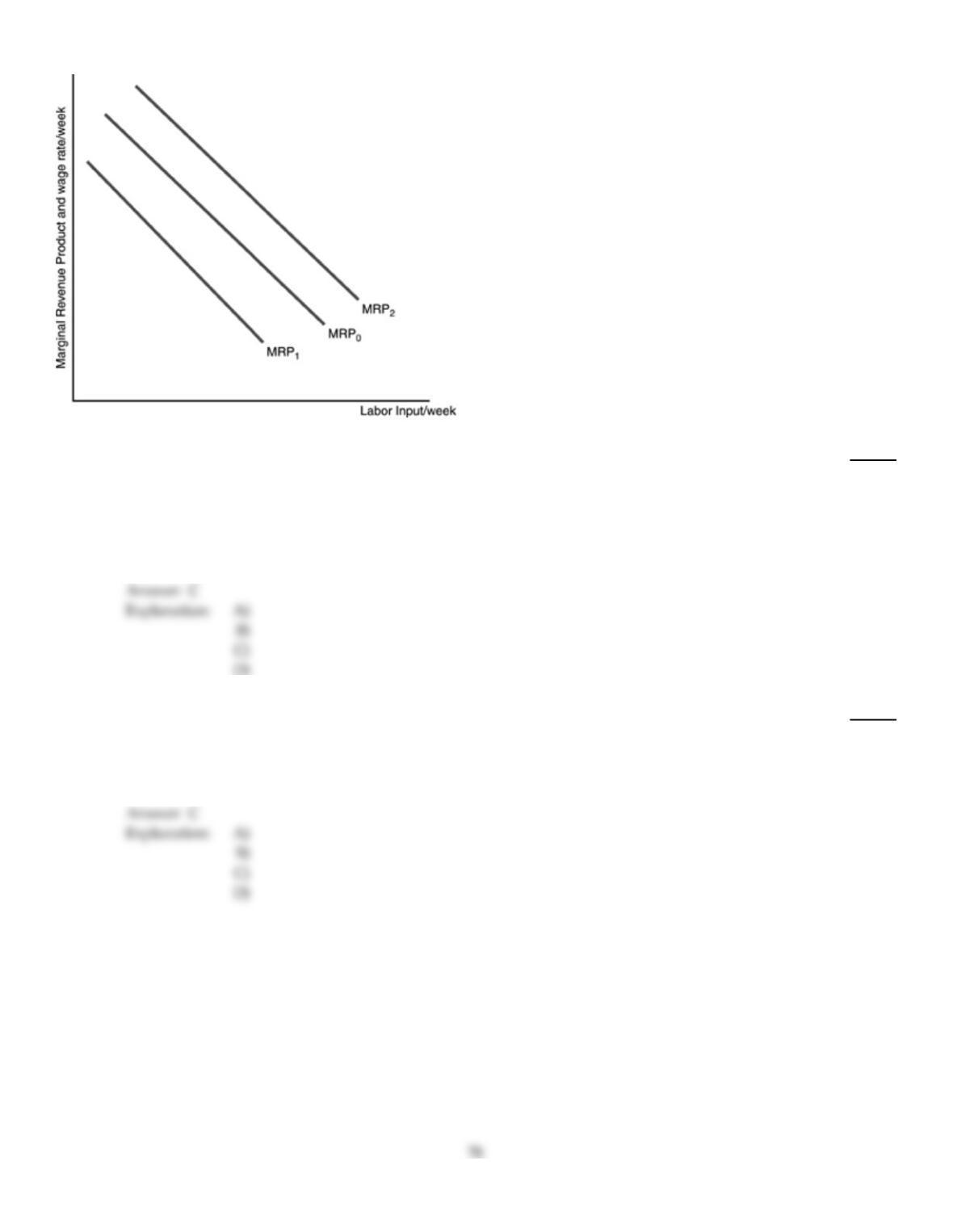
286)
Refer to the above figure. The firm is operating using MRP0. An increase in productivity has
occurred. The relevant curve for the firm after the increase in productivity
286)
A)
is MRP0.
B)
is MRP1.
C)
is MRP2.
D)
could be MRP1 or MRP2 depending upon whether the firm was earning a positive profit.
287)
Which of the following statements about a perfectly competitive market are TRUE?
I. The perfectly competitive industry faces an upward sloping labor supply curve.
II. The individual firm in a perfectly competitive industry faces a perfectly elastic labor supply
curve.
287)
A)
I only
B)
II only
C)
both I and II
D)
neither I nor II

288)
The firm’s demand curve for labor is
288)
A)
the marginal revenue product curve for labor.
B)
the marginal physical product curve for labor divided by the price of the good.
C)
the demand curve for the good produced divided by the price of the good.
D)
the marginal physical product curve for labor multiplied by the price of labor.
289)
The price elasticity of demand for a variable input will be greater
289)
A)
the easier it is for a particular input to be substituted for by other inputs.
B)
the fewer substitutes there are for the final product.
C)
the lower the price elasticity of supply of all other inputs.
D)
the smaller the proportion of total costs accounted for by a particular variable input.
A
290)
The demand curve for labor will shift whenever
290)
A)
the supply curve of labor shifts.
B)
the marginal factor cost changes.
C)
the wage rate changes.
D)
the demand for the final product changes.
D
291)
For a perfectly competitive firm, the value of the marginal product is
291)
A)
the same thing as marginal factor cost.
B)
marginal physical product times the wage rate.
C)
the same thing as marginal physical product.
D)
marginal physical product times the product price.
D
A

292)
Which of the following would cause the labor demand curve to shift to the right?
292)
A)
an increase in labor productivity
B)
a decrease in the price of a complimentary resource
C)
a decrease in demand for the product the labor is used to produce
D)
all of the above
293)
Employment of labor in a country other than the firm’s home country is called
293)
A)
employing guest workers.
B)
employing non–naturalized workers.
C)
employing illegal aliens.
D)
outsourcing.
294)
Suppose the market for pizza makers is initially in equilibrium, but then the equilibrium wage rate
and the equilibrium quantity of labor both increased. What happened in the market for pizza
makers?
294)
A)
The demand for pizza makers increased.
B)
The supply for pizza makers decreased.
C)
The supply for pizza makers increased.
D)
The demand for pizza makers decreased.
295)
The marginal revenue product of labor declines as the number of workers increases because
295)
A)
of the law of diminishing marginal product.
B)
of diseconomies of scale.
C)
firms hire the most efficient workers first and the least efficient workers last.
D)
firms must lower prices for the final product when they want to sell more units.