
145)
Assume that a perfectly competitive firm faces a fixed wage rate of $4 and a constant per–unit cost
of capital of $2. If the marginal product of labor and capital are 16 and 6, respectively, then to
maximize profits the firm should
145)
A)
decrease all inputs proportionately.
B)
use relatively less labor.
C)
increase all inputs proportionately.
D)
use relatively more labor.
146)
The marginal revenue product is
146)
A)
the change in total revenue resulting from a one–unit change in variable input.
B)
the change in marginal revenue resulting from a one–unit change in variable input.
C)
the change in total output resulting from a one–unit change in variable output.
D)
the change in marginal output resulting from a one–unit change in variable input.
147)
All of the following shift an industry’s labor supply curve EXCEPT changes in
147)
A)
working conditions.
B)
the demand for the final product.
C)
job flexibility.
D)
market wages offered in other industries.
148)
A monopolist will hire an additional unit of labor as long as
148)
A)
the marginal revenue product is less than the marginal factor cost.
B)
the marginal revenue product is larger than the marginal factor cost.
C)
the marginal revenue curve is above the demand curve.
D)
the additional cost of the worker is outweighed by the additional revenues made from selling
the output of theses workers.

149)
If a perfectly competitive firm is currently employing workers to the point where the value of the
last worker’s marginal product is equal to the wage rate, and the government imposes a minimum
wage higher than the value of the worker’s marginal product, we can predict that
149)
A)
the firm will no longer employ the marginal worker.
B)
the firm will increase its price.
C)
the firm will pay the higher wage rate and not change the number of workers hired.
D)
the firm will employ more workers.
150)
If the supply of labor to a firm is perfectly elastic at the going wage rate established by the forces of
supply and demand then
150)
A)
full employment exists in the labor market.
B)
the wage rate has been decreasing.
C)
the firm can only hire additional units of labor by driving the wage rate up.
D)
the firm is price taker.
D
Explanation:
151)
All of the following shift the labor demand curve EXCEPT changes in
151)
A)
the demand for the final product.
B)
labor productivity.
C)
prices of related factors.
D)
fringe benefits offered to employees.
D
Explanation:
152)
An increase in labor productivity will shift
152)
A)
MFC curve to the left.
B)
MFC curve to the right.
C)
MRP curve to the left.
D)
MRP curve to the right.
D
Explanation:
153)
A firm’s employment of labor outside the country in which the firm is located is called
153)
A)
featherbedding.
B)
dumping.
C)
a lockout.
D)
outsourcing.
D
Explanation:
A
Explanation:

154)
An outward shift in the consumer demand for wheat will
154)
A)
raise the price of wheat and shift inward the marginal revenue product of labor producing
wheat.
B)
lead to more capital and less labor used in producing wheat.
C)
lead to downward pressure on the wages of those producing wheat.
D)
raise the price of wheat and shift out the marginal revenue product of labor producing wheat.
155)
If the price of golf balls increases, what will likely happen to the demand for golf club
manufacturing employees?
155)
A)
It will decrease.
B)
It will increase.
C)
It will stay the same.
D)
Nothing, the two are not related.
156)
The marginal revenue product gives
156)
A)
the additional revenue obtained when an additional unit of a variable input is hired.
B)
the change in total product for an additional unit of a variable input.
C)
the amount that other inputs must increase by when labor increase by one unit.
D)
the additions to total cost when an additional unit of a variable input is hired.
157)
Since the demand for labor depends upon the demand for the final product, we say that labor is
157)
A)
a reverse demand.
B)
a positive demand.
C)
an “inverse” demand.
D)
a derived demand.

158)
Other things being equal, the behavior of a monopolist differs from that of a competitive industry
in that
158)
A)
the monopolist hires more labor.
B)
the monopolist does not attempt to maximize economic profit.
C)
the monopolist restricts output and hires less labor.
D)
the monopolist must consider fixed costs in deciding the optimal level of output to produce in
the short run.
159)
The profit–maximizing combination of resources in a perfectly competitive situation occurs at the
point at which
159)
A)
MRP of capital = price of capital (cost per unit of service).
B)
MRP of labor = price of labor (wage rate).
C)
MRP of land = price of land (rental rate per unit).
D)
All of the above are correct.
D
160)
The MRP of labor will shift to the left if
160)
A)
wages decrease.
B)
labor productivity increases.
C)
labor productivity decreases.
D)
wages increase.
C
161)
When market wages increase in a perfectly competitive market, then
161)
A)
the marginal product decreases.
B)
the marginal product increases.
C)
the marginal factor cost increases.
D)
the marginal factor cost decreases.
C
C

162)
An increase in the productivity of labor induces
162)
A)
a firm to offer a higher wage for workers since the workers are now more productive.
B)
an increase in the demand for labor.
C)
a firm to hire fewer workers since fewer workers are needed with the increase in productivity.
D)
an increase in the cost of labor.
Quantity of Marginal Physical Price of Marginal
Workers Total Product Product Final Product Revenue Product
1 7 $10
218 9
330 8
440 7
548 6
652 5
163)
In the above table, if the marginal factor cost is $48, how many workers would be hired?
163)
A)
6
B)
4
C)
3
D)
5
164)
The increase in output that results when one more unit of a variable input is hired is called
164)
A)
total physical product.
B)
average physical product.
C)
marginal physical product.
D)
marginal revenue.
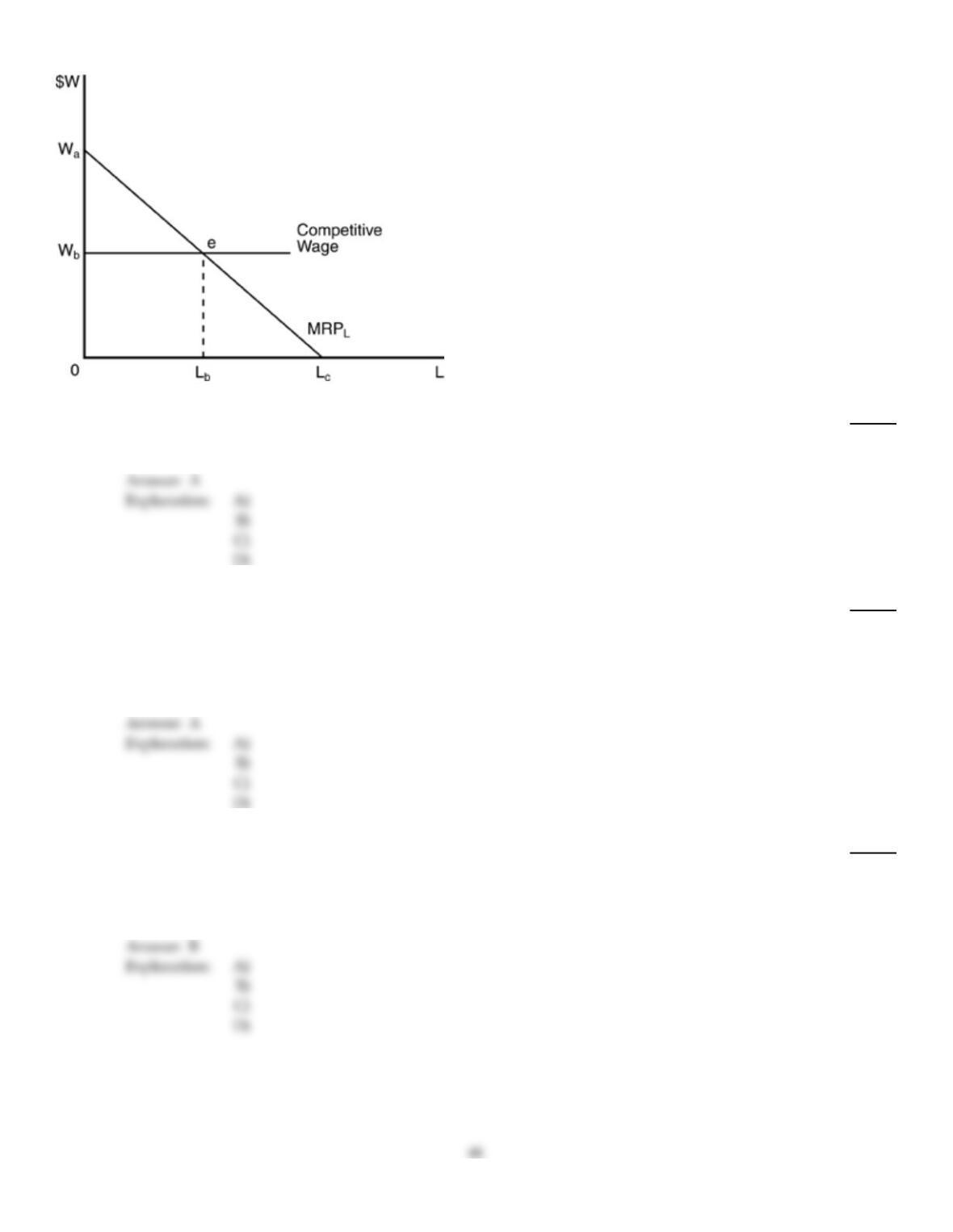
165)
In the above figure, the line labeled “MRPL” also represents the firm’s
165)
A)
demand curve.
B)
supply curve.
C)
marginal physical product curve.
D)
total physical product curve.
166)
Ajax Corporation has just decided to let managers work from home one day a week. This decision
will make working conditions better and will
166)
A)
lead to an increase in the supply curve of labor for managers.
B)
cause the demand curve for labor for managers to increase.
C)
leave the supply curve of labor unchanged.
D)
increase the elasticity of demand for labor for managers.
167)
If a firm faces perfectly competitive product and factor markets and the marginal product of labor
and capital are 4 and 9, respectively, while the wage rate is $2 and the rental rate on capital is $4,
the firm should
167)
A)
decrease all inputs proportionately.
B)
use relatively more capital.
C)
use relatively less capital.
D)
increase all inputs proportionately.

168)
If we assume competitive labor markets, the supply curve of labor when the firm is a monopoly is
168)
A)
downward sloping.
B)
vertical.
C)
horizontal.
D)
upward sloping.
169)
Other things being equal, the monopolist will
169)
A)
have lower profits than if the industry were perfectly competitive.
B)
hire fewer workers than if the industry were perfectly competitive.
C)
hire more workers than if the industry were perfectly competitive.
D)
hire the same number of workers as a perfectly competitive industry would.
170)
A firm in a competitive input market can
170)
A)
hire additional workers only by raising wages.
B)
hire additional workers only after a long search process.
C)
hire workers at the going wage.
D)
hire additional workers at lower wages because those who are still unemployed are anxious
to work.
171)
The demand for labor is considered a derived demand since it depends on
171)
A)
the consumer demand for the output produced.
B)
competitive markets.
C)
the market for capital.
D)
the supply of labor.
172)
The additional revenue earned from hiring one more worker is known as the
172)
A)
marginal factor cost of labor.
B)
marginal physical product of labor.
C)
marginal utility of labor.
D)
marginal revenue product of labor.

173)
If the price elasticity of demand is greater than 1, then consumer demand is
173)
A)
unrelated to the elasticity of demand.
B)
unitary elastic.
C)
elastic.
D)
inelastic.
174)
The price elasticity of demand for labor will be smaller, the
174)
A)
easier it is to employ substitute inputs in production.
B)
longer is the time period under examination.
C)
smaller is the price elasticity of demand for the final product.
D)
larger is the proportion of wage costs in the total cost of production.
175)
A decrease in the marginal factor cost of labor will
175)
A)
cause the value of the marginal product of labor to decrease.
B)
induce a firm to hire more workers.
C)
induce a firm to hire fewer workers.
D)
lead to an decrease in the quantity demanded of labor.
176)
Which of the following is an example of outsourcing?
176)
A)
A German firm hires an accountant in the U.S. to manage its payrolls.
B)
A U.S. firm moves a manufacturing plant from the U.S. to Thailand where the firm can hire
cheaper labor.
C)
All the above are examples of outsourcing.
D)
None of the above is an example of outsourcing.

177)
Absent government interference, the wage rate for labor in a competitive market is established
177)
A)
by the the market supply and market demand for labor.
B)
solely by the firm’s demand for labor.
C)
by both the demand for and supply of labor at each individual firm.
D)
solely by the market supply of labor.
178)
Which of the following will lead to a decrease in the firm’s short–run demand for labor?
178)
A)
an increase in price of the final product’s substitute good
B)
an increase in the price of the final product
C)
an increase in the number of buyers for the final product
D)
a decline in labor productivity
179)
Suppose that in a computer factory, if there is 1 worker, 80 computers are produced per week. If
there are 2 workers, 150 computers are produced per week. If there are 3 workers, 200 computers
are produced per week. Given this information, the marginal product of the third worker is
179)
A)
50 computers per week.
B)
60 computers per week.
C)
210 computers per week.
D)
70 computers per week.
180)
When the price of a product increases, the marginal revenue product curve in a perfectly
competitive market
180)
A)
becomes flatter.
B)
shifts to the left.
C)
does not change.
D)
shifts to the right.
181)
An increase in product price implies that
181)
A)
the wage rate the firm pays will increase.
B)
the firm’s marginal factor cost will increase.
C)
the firm’s demand for labor decreases.
D)
the firm’s demand for labor increases.
182)
As the wage rate rises, other things constant, perfectly competitive firms will employ
182)
A)
more workers.
B)
fewer workers.
C)
less capital.
D)
the same number of workers.
183)
Suppose there are four industries. Labor costs are 20 percent of total costs in A, 40 percent in B, 60
percent in C, and 80 percent in D. A ten percent increase in the price of labor will cause industry
________ to reduce quantity demanded of labor by the largest proportion.
183)
A)
A
B)
B
C)
C
D)
D
184)
When an input represents a small proportion of a firm’s total costs, then
184)
A)
the usage of the input cannot be varied in the production function.
B)
the input demand will vary significantly with a change in input price.
C)
demand for the input will tend to be less elastic.
D)
output demand will be highly elastic.

Labor Input Total Physical Product
(workers/day) (output/day)
10 500
11 600
12 690
13 760
14 800
185)
Refer to the above table. What does the marginal physical product equal when the amount of labor
goes from 12 to 13 units?
185)
A)
58.5
B)
690
C)
70
D)
760
186)
If a firm employs an extra unit of labor, the additional product generated by employing the extra
unit of labor is
186)
A)
total product.
B)
the marginal physical product of labor.
C)
the diminished marginal product.
D)
the outside edge.
B
187)
When 5 units of labor are employed, total product is 9 units; when 6 units of labor are employed,
total product is 11 units of output. If the price of output is $5 per unit, what is the marginal revenue
product of the 6th unit of labor?
187)
A)
$10
B)
$15
C)
$55
D)
$5
A
188)
If MFC > MRPL, the firm should
188)
A)
lower wages.
B)
get rid of some capital.
C)
hire more workers.
D)
reduce the number of workers.
D
C

189)
If a firm uses only capital and labor as inputs, then what should the firm do at a given rate of
production if the marginal physical product of labor per last dollar spent is higher than the
marginal physical product of capital per last dollar spent?
189)
A)
The firm should decrease the quantity of capital and increase the quantity of labor.
B)
The firm should increase both the quantity of capital and the quantity of labor.
C)
The firm should decrease both the quantity of capital and the quantity of labor.
D)
The firm should increase the quantity of capital and reduce the quantity of labor.
190)
When firms in a U.S. industry outsource some of their production,
190)
A)
U.S. labor demand remains unchanged, but U.S. wages fall.
B)
U.S. labor demand falls, but U.S. wages are not affected.
C)
U.S. labor demand falls, but U.S. wages increase.
D)
both U.S. labor demand and U.S. wages in the industry fall
D
191)
Which of the following is FALSE regarding the general rule for hiring?
191)
A)
If any firm hired fewer workers over time, profits would definitely increase at that firm.
B)
Virtually every optimizing rule in economics involves comparing marginal benefits with
marginal cost.
C)
The benefit from added workers is extra output and consequently more revenues.
D)
The firm hires workers up to the point at which the additional cost associated with hiring the
last worker is equal to the additional revenue generated by that worker.
A
192)
The addition to revenue obtained from firing an additional unit of labor is
192)
A)
marginal physical product of labor.
B)
marginal revenue product.
C)
total product.
D)
marginal factor cost.
B
A

193)
If a firm wants to maximize profits it should
193)
A)
hire the same number of units of all inputs.
B)
hire each factor of production up to the point at which the marginal factor cost per last dollar
spent is equalized.
C)
hire each factor of production up to the point at which the marginal physical product per last
dollar spent is equalized.
D)
hire each factor of production up to the point at which the marginal revenue product per last
dollar spent is equalized.
194)
Suppose the market for autoworkers is initially in equilibrium, but then the automakers purchase
capital goods that are a substitute for workers. What happens in the market for autoworkers?
194)
A)
The equilibrium wage rate and the equilibrium quantity of labor will both decrease.
B)
The equilibrium wage rate will increase and the equilibrium quantity of labor will decrease.
C)
The equilibrium wage rate will decrease and the equilibrium quantity of labor will increase.
D)
The equilibrium wage rate and the equilibrium quantity of labor will both increase.
195)
Which of the following would NOT shift an industry’s supply of labor curve?
195)
A)
Wage rates in industries using similar labor rise.
B)
Working conditions within the industry become less desirable.
C)
Wage rates in other industries fall.
D)
The wage rate in the particular industry falls.
196)
There are a number of reasons why labor supply curves will shift in a particular industry. Which
one of the following is NOT one of them?
196)
A)
Changes in working conditions in an industry affect the labor supply curve.
B)
job flexibility that determines the position of the labor supply curve
C)
Taxes on labor affect the labor supply curve.
D)
There is a change in the market wage rate.

197)
Assume that the labor market is perfectly competitive. An increase in the productivity of labor
197)
A)
causes an increase in the demand for labor.
B)
causes a reduction in the demand for labor since each worker is now more productive.
C)
generates a lower wage rate.
D)
causes the marginal factor cost of labor to decrease.
198)
Assume that a perfectly competitive firm faces a fixed wage rate of $4 and a constant per–unit cost
of capital of $2. If the marginal product of labor and capital are 16 and 6, respectively, then to
maximize profits the firm should
198)
A)
increase all inputs proportionately.
B)
decrease all inputs proportionately.
C)
use relatively more capital.
D)
use relatively less capital.
199)
The marginal revenue product of labor is
199)
A)
the marginal physical product multiplied by marginal revenue.
B)
total sales divided by total labor employed.
C)
total labor employed divided by total sales.
D)
the marginal revenue of output multiplied by the price of the input.
200)
If a firm is a perfectly competitive purchaser of factor inputs and the wage rate is $5, the marginal
factor cost for labor is
200)
A)
indeterminate.
B)
less than $5.
C)
$5.
D)
greater than $5.

Labor Input Total Physical Product
(workers/day) (output/day)
10 500
11 600
12 690
13 760
14 800
201)
Refer to the above table. If the price of the product is $1.50, what is the marginal revenue product of
the 12th worker?
201)
A)
$135
B)
$90
C)
$1.50
D)
$1035
202)
If an increase in the price of one input causes an increase in demand for labor, the two inputs are
202)
A)
substitutes.
B)
interchangeable.
C)
flexible.
D)
complementary.
Number of Total Number of Total
Workers Output Workers Output
0 0 6 945
1 200 7 1000
2 420 8 1025
3620 9 1035
4 770 10 1040
5 870
203)
Refer to the above table. Suppose the firm hires 4 workers and the price of the good sold is $4. The
marginal factor cost of labor must be
203)
A)
$3080.
B)
$150.
C)
$600.
D)
$4.

204)
If labor is 80 percent of total costs in industry A and 20 percent in industry B, then other things
equal, we would expect the elasticity of demand for labor to be
204)
A)
greater in industry A than in industry B.
B)
the same in both industries.
C)
uncertain since no general relationship exists between cost shares and elasticities.
D)
greater in industry B than in industry A.
205)
The MRP of labor will shift to the right if
205)
A)
wages decrease.
B)
labor productivity decreases.
C)
wages increase.
D)
labor productivity increases.
D
206)
A firm’s demand curve for labor is equal to the
206)
A)
marginal wage.
B)
marginal factor cost.
C)
total revenue product.
D)
marginal revenue product.
D
207)
Which of the following will cause a shift in the demand curve of labor?
207)
A)
a decline in the price of a complementary input
B)
an increase or decrease in the demand for the product labor produces
C)
an increase or decrease in the productivity of labor
D)
all of the above
D
208)
Which of the following will lead to an outward shift in the firm’s short–run demand for labor?
208)
A)
less capital per unit of labor
B)
a reduction in average consumer income
C)
an increase in the price of output
D)
a decline in labor productivity
C
A
209)
Which of the following statements is TRUE?
209)
A)
A movement along the market demand curve for labor does not require a change in the
product price.
B)
A firm can increase quantity demanded for labor when the wage rate falls without affecting
the product price but the industry cannot hire more workers without causing the product
price to fall.
C)
A firm cannot increase quantity demand for labor when the wage rate falls without causing
the product price to decline.
D)
Both a firm and the industry can move down their demand curves for labor without causing
product price to change.
210)
The equilibrium wage rate in an industry is determined by
210)
A)
finding where the market supply curve indicates that the substitution effect and income effect
of a wage increase are offsetting.
B)
the strength of the substitution effect relative to the elasticity of demand for labor.
C)
whether workers or management are better at negotiating.
D)
the intersection of the market demand curve for labor and the market supply curve for labor.
211)
A firm’s marginal revenue product of labor curve is also
211)
A)
its long–run input cost function.
B)
its labor demand curve.
C)
its marginal cost curve.
D)
its total revenue line.

Marginal Marginal
Labor Input Physical Product Revenue
(workers per week) (output per week) MR
25 150 9.00
26 140 8.50
27 130 8.00
28 120 7.50
29 110 7.00
212)
Refer to the above table. What does the marginal revenue product equal when 28 workers are hired
a week?
212)
A)
$1040
B)
$210
C)
$900
D)
$7.50
213)
Suppose the market for pizza makers is initially in equilibrium, but then the equilibrium wage rate
increased and the equilibrium quantity of labor will decreased. What happened in the market for
pizza makers?
213)
A)
The demand for pizza makers increased.
B)
The supply for pizza makers increased.
C)
The supply for pizza makers decreased.
D)
The demand for pizza makers decreased.
Labor Input Total Physical Product
(workers/day) (output/day)
10 500
11 600
12 690
13 760
14 800
214)
Refer to the above table. If the price of the good produced is $8, the marginal revenue product of
the 12th worker is
214)
A)
$800
B)
$560
C)
$5520
D)
$720

215)
The marginal revenue product curve shifts when
215)
A)
there is a change in the product price workers are producing.
B)
the wages paid exceed the price.
C)
wages rise.
D)
wages fall.
216)
If the marginal factor cost of hiring an additional worker is $10 while the marginal revenue product
is $15, then the firm should
216)
A)
stop hiring more workers.
B)
fire some workers.
C)
hire more workers.
D)
none of the above: insufficient information to answer the question.
C
217)
A change in a price of a substitute input for labor will cause
217)
A)
no change in the demand for labor.
B)
a change in the demand for labor in the opposite direction of the price change.
C)
a change in the supply of labor in the opposite direction of the price change.
D)
a change in the demand for labor in the same direction of the price change.
D
218)
Outsourcing is being practiced by
218)
A)
U.S. firms that want to keep jobs at home in the United States.
B)
governments but private firms are not allowed to outsource work.
C)
U.S. firms only.
D)
overseas firms hiring in the U.S. labor market and by U.S. firms hiring in foreign labor
markets with lower wages.
D
A

219)
The profit maximizing combination of resources
219)
A)
usually involves hiring more of some resources and less of other resources than the cost
minimizing combination of resources.
B)
usually involves less of each input hired than the cost minimizing combination of resources.
C)
is also the cost minimizing combination of resources.
D)
usually involves more of each input hired than the cost minimizing combination of resources.
220)
In the long run, input demand becomes more
220)
A)
unit–elastic.
B)
cost efficient.
C)
elastic.
D)
inelastic.
Number of Total Number of Total
Workers Output Workers Output
0 0 6 945
1 200 7 1000
2 420 8 1025
3620 9 1035
4 770 10 1040
5 870
221)
Refer to the above table. The marginal factor cost of labor is $200. To get the firm to hire 8 workers,
the
221)
A)
firm must be able to reduce wages below the marginal factor cost.
B)
eighth worker must be at least as productive as the seventh worker was.
C)
price of the good must be $8.
D)
wage rate must be a fraction of the marginal factor cost of labor.
222)
If a firm hires 215 workers it will produce 3,016 units of output. If it hires 216 workers it will
produce 3,128 units of output. The marginal physical product of labor equals
222)
A)
216.
B)
1.
C)
3,128.
D)
112.