
72)
When increased demand raises the price of the product, the
72)
A)
sales will fall.
B)
marginal revenue product will remain unchanged.
C)
marginal revenue product will fall.
D)
marginal revenue product will also increase.
73)
A profit–maximizing firm in a competitive market will continue to hire more workers when
73)
A)
the marginal factor cost is less than the marginal revenue product of the additional workers.
B)
the marginal factor cost is less than zero.
C)
the marginal factor cost exceeds the marginal revenue product of the additional workers.
D)
the marginal factor cost equals the marginal revenue product of the additional workers.
74)
The equilibrium wage rate in an industry is found by
74)
A)
the intersection of the market demand curve for labor and the marginal revenue product
curve of labor.
B)
the intersection of the market demand curve for labor and the market supply curve of labor.
C)
the intersection of the firm’s demand curve for labor and the firm’s supply curve of labor.
D)
negotiations between the union leadership and the managers of the firms.
75)
If labor productivity increases
75)
A)
the demand for labor increases.
B)
jobs will relocate.
C)
labor costs rise by equal increments.
D)
some workers will be laid off.

76)
The price elasticity of demand for labor equals
76)
A)
the slope of the demand curve for labor.
B)
the percentage change in the quantity demanded of labor divided by the percentage change in
the price of labor.
C)
the change in the quantity demanded of labor divided by the change in the price of labor.
D)
the percentage change in the price of labor divided by the percentage change in the supply of
labor.
77)
Which of the following will not cause the marginal revenue product of labor curve for a firm to
shift?
77)
A)
an increase in the productivity of workers
B)
a decrease in the price of the product
C)
an increase in the wage rate
D)
an increase in demand for the product
78)
We assume that when a firm hires additional workers, the marginal physical product of labor will
78)
A)
decrease because the new workers are likely to be less able than the previously hired ones.
B)
increase because large firms are more efficient.
C)
decrease because each worker now has less capital and other resources to work with.
D)
increase because more workers can always get more work done.
79)
The marginal revenue product
79)
A)
represents the incremental contribution to the firm’s total revenues obtained from an increase
in a variable input.
B)
gives the change in total product when an additional unit of a good is hired.
C)
gives the increase in cost when there is an increase in a variable input.
D)
always increases when there is an increase in a variable input.

80)
In an imperfectly competitive labor market, the firm is faced with a(n) ________ MPP curve and
a(n) ________ MR curve.
80)
A)
downward sloping; horizontal
B)
downward sloping; downward sloping
C)
upward sloping; downward sloping
D)
downward sloping; upward sloping
Labor Input Total Physical Product
(workers/day) (output/day)
10 500
11 600
12 690
13 760
14 800
81)
Refer to the above table. Suppose the price of the good sold is $10 and the marginal factor cost of
labor is $700, how many units of labor will the firm hire?
81)
A)
13
B)
10
C)
12
D)
11
A
82)
The practice of outsourcing has been given a boost by
82)
A)
sharp increases in the cost of overseas labor.
B)
firms that are becoming more risk–averse.
C)
support from organized labor.
D)
advances in telecommunications and computer networking.
D
83)
At a perfectly competitive firm, all of the following is true of the MRP curve EXCEPT
83)
A)
the MRP curve shifts rightward when the product price rises.
B)
the MRP curve shifts leftward when the demand for the final product falls.
C)
the MRP curve is the derived supply of labor.
D)
the MRP curve shifts leftward when labor productivity falls.
C
B

84)
A 20 percent increase in the wage rate induces firms in an industry to reduce quantity demanded
for labor by 5 percent in the first year. Five years later we would expect, other things constant,
84)
A)
the reduction in the quantity demanded of labor to be about 5 percent.
B)
the reduction in the quantity demanded of labor to be less than 5 percent.
C)
the quantity demanded of labor to be back to its original level.
D)
the reduction in the quantity demanded of labor to be much greater than 5 percent.
85)
As new substitutes for office productivity software are developed, the demand for workers in office
productivity software production should
85)
A)
become less elastic.
B)
be unchanged.
C)
become more elastic.
D)
change in an undetermined way.
86)
In a perfectly competitive labor market, the wage rate paid by the individual firm is
86)
A)
a function of the tax system.
B)
the equilibrium market wage rate.
C)
below the equilibrium market wage rate.
D)
dependent on the demand for the product.
87)
Coal is required to make steel. Hence, the price elasticity of demand for coal by steel manufacturers
will be
87)
A)
inelastic.
B)
elastic.
C)
perfectly elastic.
D)
unit elastic.
88)
For a firm in a perfectly competitive labor market
88)
A)
W > MRP.
B)
W = MFC.
C)
W > MFC.
D)
W < MFC.

89)
In a perfectly competitive labor market, the labor supply curve facing the firm will be
89)
A)
vertical.
B)
horizontal.
C)
upward sloping.
D)
downward sloping.
90)
In labor markets, the substitution effect occurs when
90)
A)
a substitute good also functions as a complement.
B)
a change in the price of a substitute input causes the demand for labor to change in the same
direction.
C)
a change in the price of a substitute input reduces the cost of capital.
D)
the cost of production falls enough that the firm will produce a larger amount of output.
B
91)
When the demand curve for an input is a derived demand this means that
91)
A)
the law of diminishing marginal product does not hold.
B)
the demand curve slopes upward.
C)
the demand curve is derived from the demand for the final product being produced.
D)
the demand curve depends upon the MFC.
C
92)
The change in output resulting from the addition of one more worker is
92)
A)
average revenue product.
B)
marginal revenue product.
C)
marginal physical product.
D)
average physical product.
C
B

93)
The price elasticity of demand for a variable input will be more elastic in all the following cases
EXCEPT
93)
A)
the shorter the time period being considered.
B)
the larger the proportion of total costs accounted for by a particular variable input.
C)
the easier it is for a particular variable input to be substituted for by other inputs.
D)
the greater the price elasticity of demand for the final product.
94)
Cost minimization suggests that two inputs should be employed to the point where
94)
A)
the marginal physical product per dollar spent on each input is identical.
B)
the marginal revenue product of each input is identical.
C)
the extra contribution to physical output of the inputs is identical.
D)
the marginal cost of each input is identical.
A
95)
Whenever an input makes up a large percentage of a good’s final cost, an increase in that input’s
price will
95)
A)
affect only accounting profits.
B)
affect total cost relatively more.
C)
not affect total revenues.
D)
cause the firm to shutdown.
B
96)
The MRP is
96)
A)
the demand curve for labor for the entire market.
B)
the supply curve of labor for an individual firm.
C)
the demand curve for labor for an individual firm.
D)
the supply curve of labor for the entire market.
C
A

97)
A perfectly competitive firm will hire workers up to the quantity at which the wage rate equals the
97)
A)
marginal revenue product of labor.
B)
marginal factor cost of labor.
C)
average physical product of labor.
D)
price of the extra output produced.
98)
A profit maximizing firm will hire additional workers until
98)
A)
the additional cost associated with hiring the last worker equals the additional revenue
generated by that worker.
B)
the additional cost associated with hiring the last worker equals the average wage rate of the
workers.
C)
the extra revenue generated by the last worker hired equals zero.
D)
the extra cost associated with hiring the last worker equals the price of the good produced.
99)
When the price of labor increases, the substitution effect will ________ the quantity of labor
demanded and the output effect will ________ it.
99)
A)
increase; decrease
B)
decrease; decrease
C)
increase; increase
D)
decrease; increase
Quantity of Marginal Physical Price of Marginal
Workers Total Product Product Final Product Revenue Product
1 7 $10
218 9
330 8
440 7
548 6
652 5
100)
In the above table, what is the marginal revenue product of the 2nd worker?
100)
A)
$9
B)
$99
C)
$110
D)
$70

101)
The price elasticity of demand for labor will be smaller, the
101)
A)
smaller is the proportion of wage costs in the total cost of production.
B)
easier it is to employ substitute inputs in production.
C)
longer is the time period under examination.
D)
greater is the price elasticity of demand for the final product.
Labor Input Total Physical Product
(workers/day) (output/day)
10 500
11 600
12 690
13 760
14 800
102)
Refer to the above table. If the price of the good produced is $7, the marginal revenue product of
the 11th worker is
102)
A)
$700
B)
$3500
C)
$630
D)
$4200
103)
When the supply of labor to a firm is perfectly elastic the marginal factor cost will equal the
103)
A)
marginal physical product.
B)
wage rate times the number of workers.
C)
market price of the product.
D)
wage rate.
104)
When an input represents a larger proportion of a firm’s total costs, then
104)
A)
the usage of the input cannot be varied in the production function.
B)
the input demand will not vary significantly with a change in input price.
C)
demand for the input will tends to be less elastic.
D)
demand for the input will tends to be more elastic.

105)
The marginal physical product (MPP) is calculated by
105)
A)
the difference between the output of skilled and unskilled workers.
B)
dividing the change in total physical product by the change in the input.
C)
dividing the change in total cost by the change in labor.
D)
dividing total physical product by labor.
106)
If the price of labor increases, the typical perfectly competitive firm in the short run will
106)
A)
hire more labor.
B)
hire less labor.
C)
produce more output.
D)
hire the same labor and produce the same output.
107)
A monopolist will hire fewer workers than a competitive firm, other things being equal, because
107)
A)
diminishing marginal productivity of labor is more severe for a monopolist.
B)
the monopolist exploits labor and other types of producers do not.
C)
the monopolist must take account of the declining product price that must be charged in
order to sell more units of the product.
D)
the monopolist is more efficient.
108)
In a perfectly competitive labor market, the least–cost combination rule for resource use
108)
A)
requires that the marginal physical product per dollar spent for each resource is equalized.
B)
assures the firm an economic profit.
C)
assures the firm a normal profit.
D)
requires that resources be used in combinations such that marginal products are equal.

109)
The individual firm operating in a perfectly competitive labor market
109)
A)
will pay less to the additional labor employed.
B)
can hire more labor only by offering a higher wage.
C)
faces an inelastic demand for labor.
D)
can buy all the labor it wants at the going market wage rate.
110)
For a worker to be potentially available, he or she must
110)
A)
be in the relevant geographic market and be willing to work for minimum wage.
B)
have the skills required by the firm and be in the relevant geographic market.
C)
know about the jobs available at a particular firm.
D)
have most of the skills required by the firm only.
111)
Profit–maximizing employment is the quantity of labor at which
111)
A)
marginal factor product is equal to product price.
B)
marginal factor cost is equal to marginal revenue.
C)
marginal revenue product is equal to product price.
D)
marginal revenue product is equal to marginal factor cost.
112)
If the demand for online banking increases, we would expect to see the
112)
A)
demand for workers that produce online–banking services to decrease.
B)
demand for workers that produce online–banking services to increase.
C)
supply of workers that produce online–banking services to increase.
D)
supply of workers that produce online–banking services to decrease.
113)
Which of the following would be the most likely outcome if all perfectly competitive firms in a
product market join together to form a monopoly?
113)
A)
Both the rate of output and the quantity of labor input employed will increase.
B)
The rate of output in the market will increase but the quantity of labor input will decrease.
C)
The rate of output in the market will decrease but the quantity of labor input will increase.
D)
Both the rate of output and the quantity of labor input employed will decrease.
114)
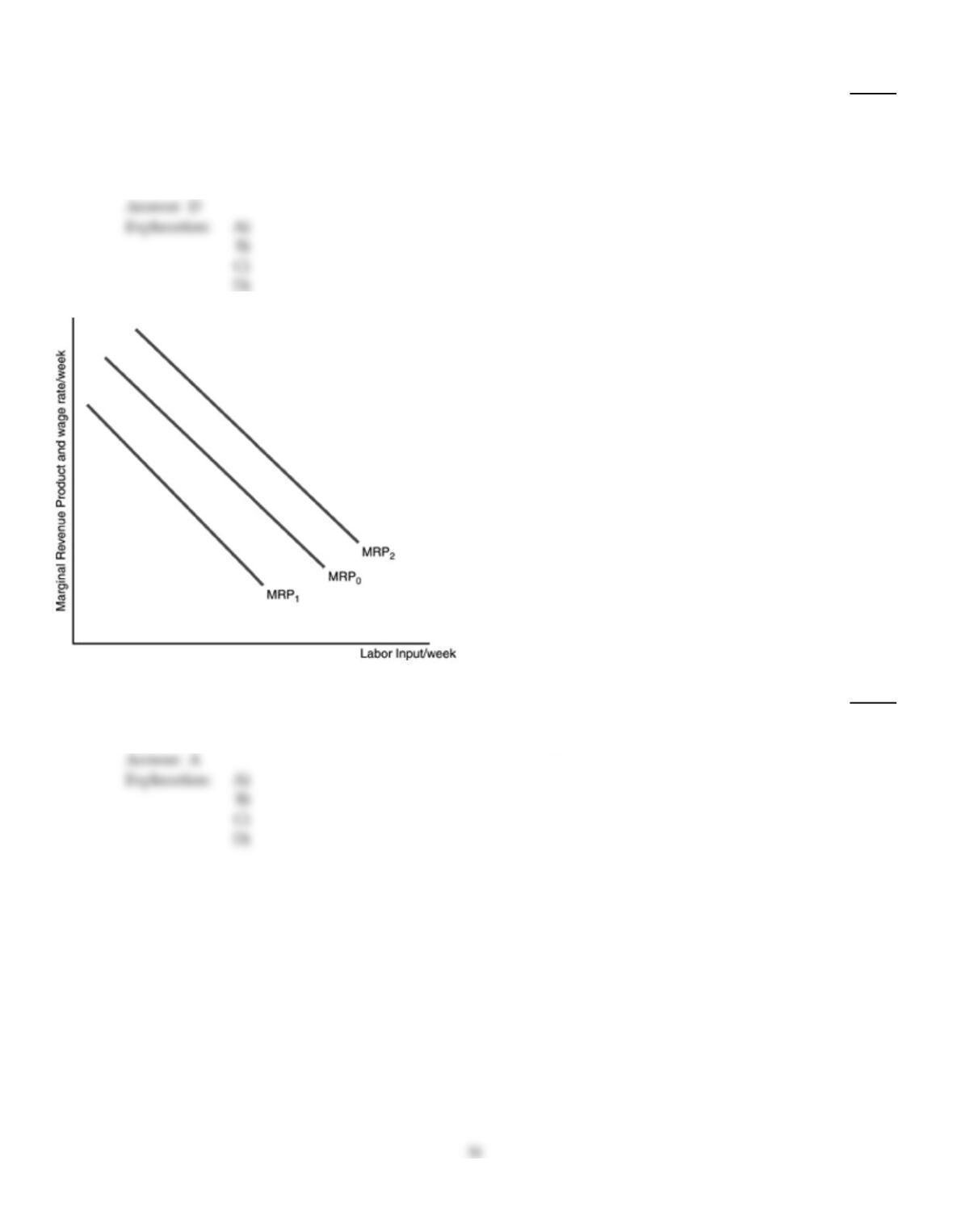
Refer to the above figure. MRP0 represents
114)
A)
the demand curve for labor.
B)
the supply curve for labor.
C)
the demand curve for the product.
D)
the supply curve for the product.
A
D

Quantity Total Marginal Marginal
of Workers Product Physical Product Revenue Product
0 0 – –
1 7
218
330
440
548
115)
In the above table, if this is a perfectly competitive firm and the market price of the product is $10,
what is the marginal revenue product of worker 4?
115)
A)
$411
B)
$100
C)
$120
D)
$210
116)
The individual demand curve for an input such as labor to a firm would be the downward sloping
portion of the firm’s
116)
A)
marginal revenue product curve.
B)
marginal revenue curve.
C)
total revenue curve.
D)
marginal physical product curve.
Marginal Marginal
Labor Input Physical Product Revenue
(workers per week) (output per week) MR
25 150 9.00
26 140 8.50
27 130 8.00
28 120 7.50
29 110 7.00
117)
Refer to the above table. What does the marginal revenue product equal when 26 workers are hired
a week?
117)
A)
$8.50
B)
$26
C)
$1190
D)
$221

118)
The supply of labor to an industry will decrease when
118)
A)
the price of leisure falls.
B)
the demand for labor falls in the industry.
C)
the income effect dominates the substitution effect.
D)
workers receive better employment opportunities in other industries.
119)
When manufacturing a car, parts must be soldered together. This work can be done by labor or by a
robot (capital). More robots will be hired when the price of labor increases. This is known as
119)
A)
the complementary effect.
B)
marginal revenue product.
C)
the effect of changing labor productivity.
D)
the substitution effect.
D
Quantity Total Marginal Marginal
of Workers Product Physical Product Revenue Product
0 0 – –
1 7
218
330
440
548
120)
In the above table, if this is a perfectly competitive firm and the market price of the product is $5
and the marginal factor cost of labor is $60, how many units of labor will the firm hire?
120)
A)
6
B)
2
C)
4
D)
3
D
D

121)
The cost–minimizing rule is that a firm should utilize inputs such that the marginal physical
product of an input divided by the price of the input is the same for all inputs. This is also the
profit–maximizing rule because
121)
A)
we obtain the profit–maximizing rule by multiplying each ratio by the marginal revenue
produced.
B)
we obtain the profit–maximizing rule by multiplying each ratio by the product price, which is
the same for each input.
C)
they are exactly the same.
D)
the profit–maximizing rule is just the inverse of the cost–minimizing rule.
122)
Which of the following statements is FALSE about the long–run effects of outsourcing?
122)
A)
Employment levels will decrease globally as the result of outsourcing.
B)
Globally wages will increase because of outsourcing.
C)
More goods and services can be produced than in the absence of outsourcing.
D)
Outsourcing allows countries to specialize in producing what they can produce most
efficiently.
Quantity Total Marginal Marginal
of Workers Product Physical Product Revenue Product
0 0 – –
1 7
218
330
440
548
123)
In the above table, if this is a perfectly competitive firm and the market price of the product is $8,
what is the marginal revenue product of worker 3?
123)
A)
$80
B)
$96
C)
$88
D)
$240

124)
The marginal factor cost is the
124)
A)
additional revenue obtained from a one–unit change in labor input.
B)
additional revenue obtained from a one–unit change in output.
C)
cost of using an additional unit of an input.
D)
change in output resulting from the addition of one more worker.
125)
An increase in the supply of labor generates
125)
A)
an offsetting increase in the demand for labor.
B)
increased unemployment.
C)
lower wages.
D)
a decrease in the quantity demanded of labor.
C
126)
If a monopolist has an output price of $10, marginal revenue equal to $4, and faces a fixed wage
rate of $8, then the monopolist should hire labor until the marginal revenue product is equal to
126)
A)
$8.
B)
$10.
C)
$4.
D)
$14.
A
127)
The cost of using an additional unit of an input is called the
127)
A)
marginal revenue product.
B)
marginal product of labor.
C)
marginal factor cost.
D)
marginal physical product cost.
C
128)
For a perfectly competitive firm, the value of the marginal product of labor falls as more workers
are hired because of the diminishing
128)
A)
marginal physical product of labor.
B)
output price.
C)
marginal cost of production.
D)
price of labor.
A
C

Labor Input Total Physical Product
(workers/day) (output/day)
10 500
11 600
12 690
13 760
14 800
129)
Refer to the above table. If the price of the good produced is $9, the marginal revenue product of
the 13th worker is
129)
A)
$810
B)
$6840
C)
$360
D)
$630
130)
Which of the following statements describes the long–run effects of global outsourcing?
130)
A)
Wages will increase globally and employment will stay the same.
B)
Wages and employment will increase globally.
C)
Wages for U.S. workers will decrease but wages in other countries will increase.
D)
Wages in all countries will remain the same as before the outsourcing.
131)
Suppose at the current level of labor used, MRP = $100 and MFC = $100. To maximize profits, the
firm should
131)
A)
maintain the current level of labor.
B)
hire more labor.
C)
shut down.
D)
reduce the level of labor.
132)
A firm that maximizes profits also
132)
A)
pays input prices lower than other firms do.
B)
uses the least–cost combination of resources.
C)
is inefficient.
D)
cuts corners in production processes so that its products are made too cheaply.

133)
A firm that wants to maximize profits should hire each input to the point where
133)
A)
its marginal revenue product divided by the price of the input equals one.
B)
its marginal physical product divided by the price of the input equals the product price.
C)
its marginal revenue product divided by the product price equals one.
D)
its marginal revenue product divided by its marginal physical product equals the wage.
134)
The demand for an input will be more inelastic when
134)
A)
the demand for the product being produced is elastic.
B)
the time period being considered is relatively long.
C)
it is difficult to substitute other inputs for this input.
D)
the cost of the input is a relatively large percentage of total production costs.
135)
In constructing the monopolist’s input demand curve, which of the statements is FALSE?
135)
A)
Marginal revenue is always positive.
B)
The demand curve has a negative slope due to the law of diminishing marginal product.
C)
A monopoly restricts output and hires fewer units of labor than a perfectly competitive firm.
D)
The supply curve a monopoly faces is horizontal because the monopoly is a price taker.
136)
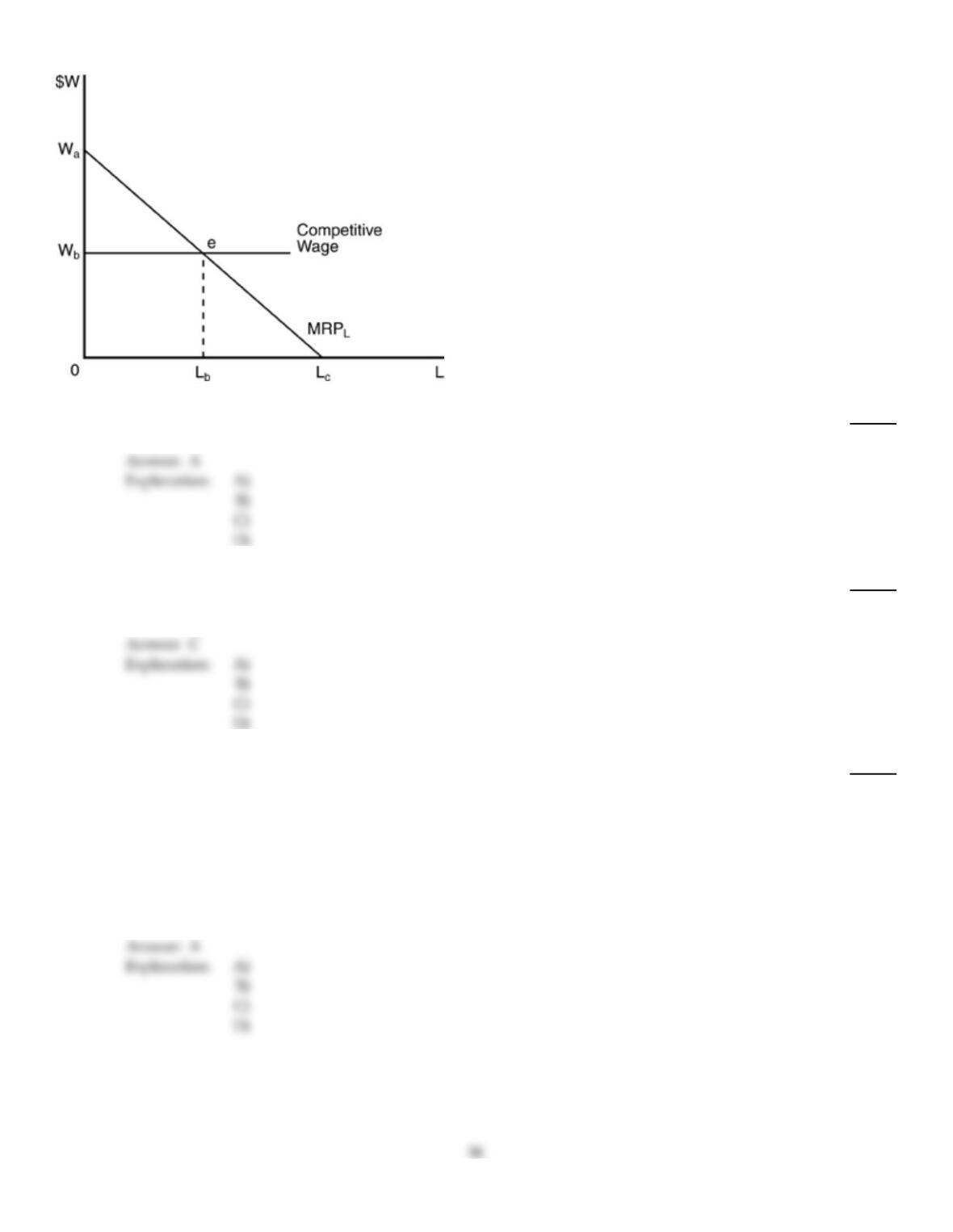
In the above figure, the competitive firm will employ the quantity of labor
136)
A)
equal to Lb.
B)
less than Lb.
C)
greater than Lc.
D)
equal to Lc.
137)
If a firm hires 312 workers it will produce 4,522 units of output. If it hires 313 workers it will
produce 4,786 units of output. The marginal physical product of labor equals
137)
A)
313.
B)
1.
C)
264.
D)
4,786.
138)
Suppose the market for autoworkers is initially in equilibrium, but then the demand for
automobiles increases and simultaneously the automakers allow autoworkers less flexibility
working at the plants. What happens in the market for autoworkers?
138)
A)
The equilibrium wage rate will increase and the equilibrium quantity of labor will increase,
decrease or stay the same.
B)
The equilibrium wage rate and the equilibrium quantity of labor will both decrease.
C)
The equilibrium wage rate will decrease and the equilibrium quantity of labor will increase.
D)
The equilibrium wage rate will increase, decrease or stay the same and the equilibrium
quantity of labor will increase.

139)
The greater the elasticity of demand for a final product, we find ________ the demand for the factor
inputs.
139)
A)
the greater will be
B)
that it will not impact
C)
the lower will be
D)
The answer cannot be determined.
Number of Total Number of Total
Workers Output Workers Output
0 0 6 945
1 200 7 1000
2 420 8 1025
3620 9 1035
4 770 10 1040
5 870
140)
Refer to the above table. Suppose the firm hires 5 workers and the price of the good sold is $3. The
marginal factor cost of labor must be
140)
A)
$300.
B)
$900.
C)
$100.
D)
$3.
A
141)
Which of the following will NOT lead to a change in the demand for labor?
141)
A)
a change in the supply of labor
B)
a change in demand for the final good
C)
a change in the price of a substitute input
D)
a change in labor productivity
A
142)
The market demand curve for labor
142)
A)
slopes upward.
B)
is vertical at the existing supply of labor.
C)
is horizontal at the going wage rate.
D)
slopes downward.
D
A
Labor Input Total Physical Product
(workers/day) (output/day)
10 500
11 600
12 690
13 760
14 800
143)
Refer to the above table. If the price of the product is $1.50, what is the marginal revenue product of
the 11th worker?
143)
A)
$900
B)
$13.64
C)
$150
D)
$1.50
144)
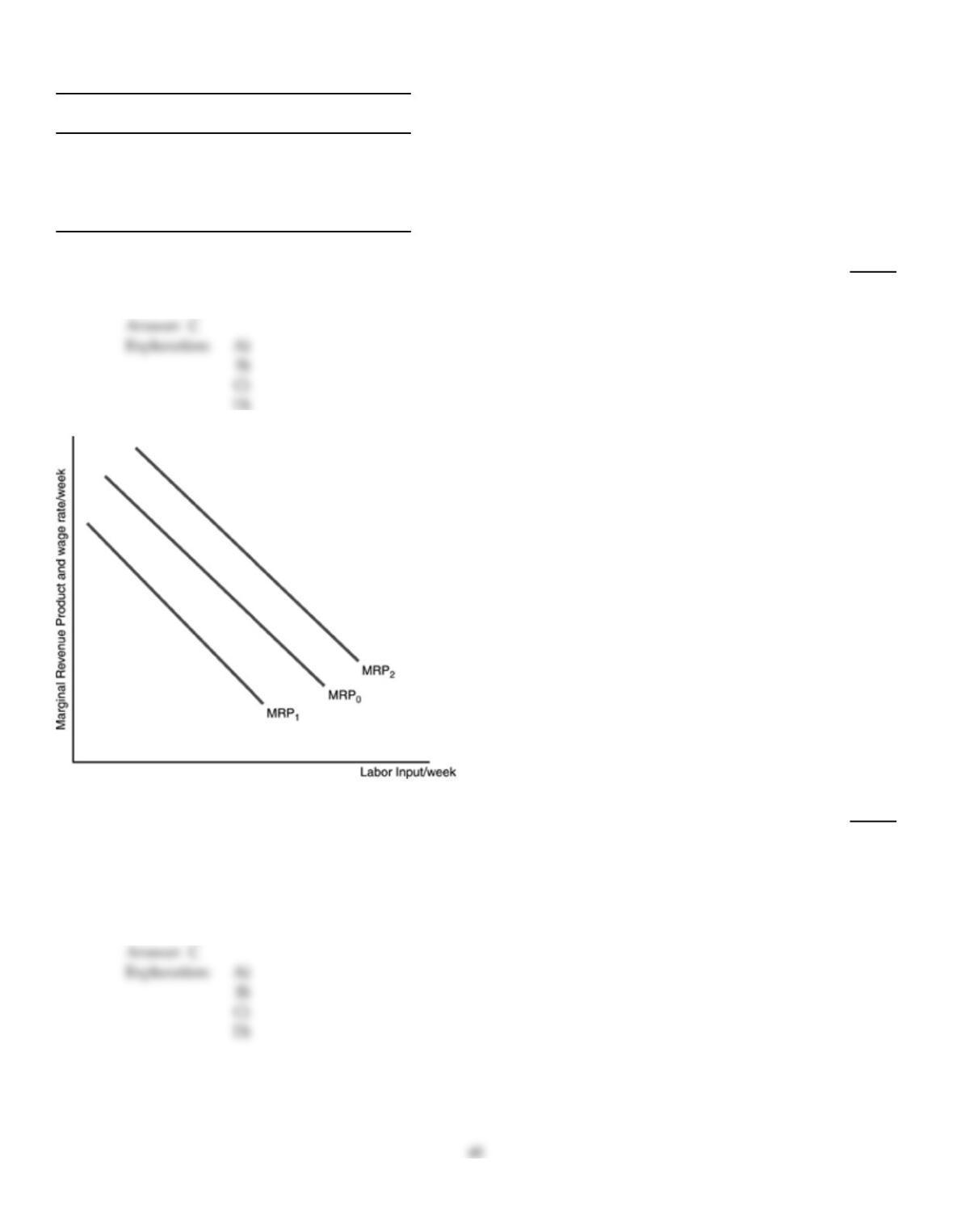
Refer to the above figure. The firm is operating using MRP0. An increase in demand for the
product has occurred. The relevant curve for the firm after the increase in price
144)
A)
is MRP0.
B)
is MRP1.
C)
is MRP2.
D)
could be MRP1 or MRP2 depending upon whether the firm was earning a positive profit.