
65)
When the price of labor increases, the substitution effect will ________ the quantity of labor
demanded and the output effect will ________ it.
65)
A)
decrease; increase
B)
decrease; decrease
C)
increase; decrease
D)
increase; increase
66)
An increase in the marginal factor cost of labor will
66)
A)
induce a firm to hire fewer workers.
B)
lead to an increase in the value of an additional worker.
C)
cause the value of the marginal product of labor to increase.
D)
lead to an increase in the quantity demanded of labor.
Number of Total Number of Total
Workers Output Workers Output
0 0 6 945
1 200 7 1000
2 420 8 1025
3620 9 1035
4 770 10 1040
5 870
67)
Refer to the above table. Suppose the firm hires 4 workers and the price of the good sold is $4. The
marginal factor cost of labor must be
67)
A)
$3080.
B)
$150.
C)
$600.
D)
$4.
68)
The marginal factor cost is the
68)
A)
additional revenue obtained from a one–unit change in output.
B)
change in output resulting from the addition of one more worker.
C)
cost of using an additional unit of an input.
D)
additional revenue obtained from a one–unit change in labor input.

Quantity of Marginal Physical Price of Marginal
Workers Total Product Product Final Product Revenue Product
1 7 $10
218 9
330 8
440 7
548 6
652 5
69)
In the above table, if the marginal factor cost is $96, how many workers would be hired?
69)
A)
4
B)
5
C)
2
D)
3
70)
Ajax has just discovered that the marginal revenue product generated by the last worker hired was
$50 while the marginal factor cost was $50. What should Ajax do?
70)
A)
Leave the level of production unchanged.
B)
Reduce the amount produced.
C)
Increase the amount produced.
D)
Collect more information before making a decision.
Labor Input Total Physical Product
(workers/day) (output/day)
10 500
11 600
12 690
13 760
14 800
71)
Refer to the above table. What does the marginal physical product equal when the amount of labor
goes from 10 to 11 units?
71)
A)
100
B)
500
C)
600
D)
54.5

72)
If the marginal productivity of labor decreases, then
72)
A)
the quantity of labor demanded at every possible wage rate will be higher.
B)
the quantity of labor demanded will not be affected.
C)
the quantity of labor demanded at every possible wage rate will be less.
D)
the demand curve for labor will shift upward and to the right.
Quantity Total Marginal Marginal
of Workers Product Physical Product Revenue Product
0 0 – –
1 7
218
330
440
548
73)
In the above table, if this is a perfectly competitive firm and the market price of the product is $8,
what is the marginal revenue product of worker 3?
73)
A)
$96
B)
$88
C)
$240
D)
$80
74)
When 4 units of labor are employed, total product is 6 units; when 5 units of labor are employed,
total product is 9 units of output. If the price of output is $5 per unit, what is the marginal revenue
product of the 5th unit of labor?
74)
A)
$3
B)
$15
C)
$5
D)
$45
75)
An industry utilizes capital and two types of labor. Unskilled labor is a substitute for capital while
the skilled labor is complementary to capital. An increase in the price of capital will
75)
A)
induce the firms in the industry to cut back on all levelscapital, unskilled and skilled labor.
B)
cause the wage of unskilled labor to rise relative to the price of skilled labor.
C)
cause the demand for labor to increase, raising wages of both skilled and unskilled labor.
D)
cause the demand for skilled labor to rise and the demand for unskilled labor to fall.

76)
A 20 percent increase in the wage rate induces firms in an industry to reduce quantity demanded
for labor by 5 percent in the first year. Five years later we would expect, other things constant,
76)
A)
the quantity demanded of labor to be back to its original level.
B)
the reduction in the quantity demanded of labor to be less than 5 percent.
C)
the reduction in the quantity demanded of labor to be much greater than 5 percent.
D)
the reduction in the quantity demanded of labor to be about 5 percent.
77)
The marginal physical product (MPP) is calculated by
77)
A)
dividing the change in total physical product by the change in the input.
B)
dividing the change in total cost by the change in labor.
C)
the difference between the output of skilled and unskilled workers.
D)
dividing total physical product by labor.
A
78)
The additional cost associated with hiring one additional unit of some factor input, such as labor, is
referred to as
78)
A)
marginal revenue cost.
B)
marginal factor cost.
C)
marginal physical product of labor.
D)
marginal revenue product.
B
79)
The demand for labor is
79)
A)
derived from the satisfaction that hiring labor provides the owner of the firm.
B)
derived from the satisfaction workers get for being employed.
C)
derived from a utility–maximizing process similar to that used to derive the demand curve
for all workers in a given industry.
D)
derived from the demand for the final product of the firm.
D
C

Labor Input Total Physical Product
(workers/day) (output/day)
10 500
11 600
12 690
13 760
14 800
80)
Refer to the above table. If the price of the product is $1.50, and the marginal factor cost of an
additional unit of an input is $105, how many units of labor should be hired?
80)
A)
14
B)
13
C)
11
D)
12
81)
If a firm faces perfectly competitive product and factor markets and the marginal product of labor
and capital are 4 and 9, respectively, while the wage rate is $2 and the rental rate on capital is $4,
the firm should
81)
A)
use relatively less labor.
B)
decrease all inputs proportionately.
C)
increase all inputs proportionately.
D)
use relatively more labor.
A
82)
At a perfectly competitive firm, all of the following is true of the MRP curve EXCEPT
82)
A)
the MRP curve shifts leftward when labor productivity falls.
B)
the MRP curve shifts leftward when the demand for the final product falls.
C)
the MRP curve is the derived supply of labor.
D)
the MRP curve shifts rightward when the product price rises.
C
83)
Which will NOT affect the elasticity of demand for labor?
83)
A)
the substitutability of capital for labor
B)
the elasticity of demand for the good
C)
the labor intensity of the production process
D)
the elasticity of supply for labor
D
B

84)
If the price of labor increases, the typical perfectly competitive firm in the short run will
84)
A)
hire less labor.
B)
hire the same labor and produce the same output.
C)
produce more output.
D)
hire more labor.
85)
The price elasticity of demand for labor will depend upon all but the
85)
A)
time period being considered.
B)
availability of substitutes for inputs.
C)
price elasticity of supply for the final product.
D)
price elasticity of demand for the final product.
C
86)
If the marginal revenue product of an input exceeds the marginal factor cost of the input, the firm
86)
A)
is not on its marginal cost curve.
B)
should increase its use of the input.
C)
should hire less of the input.
D)
is maximizing profit.
B
87)
What are the short–run economic effects when U.S. firms substitute labor outside of the U.S. for
labor inside the U.S.?
87)
A)
The demand curve for labor in the U.S. decreases, and the demand curve in the foreign
country will increase.
B)
The demand curve for labor in the U.S. decreases, and the demand curve in the foreign
country will decrease.
C)
The demand curve for labor in the U.S. increases, and the demand curve in the foreign
country will increase.
D)
The demand curve for labor in the U.S. increases, and the demand curve in the foreign
country will decrease.
A
A

88)
Suppose there are four industries. Labor costs are 20 percent of total costs in A, 40 percent in B, 60
percent in C, and 80 percent in D. A ten percent increase in the price of labor will cause industry
________ to reduce quantity demanded of labor by the largest proportion.
88)
A)
A
B)
B
C)
C
D)
D
89)
A firm purchases more capital equipment. We would expect to observe
89)
A)
an increase in the wage rate paid for labor by this firm.
B)
an increase in the demand for labor by this firm.
C)
an increase in the supply of labor for this firm.
D)
a decrease in the supply curve of labor to this firm.
B
90)
When manufacturing a car, parts must be soldered together. This work can be done by labor or by a
robot (capital). More robots will be hired when the price of labor increases. This is known as
90)
A)
marginal revenue product.
B)
the complementary effect.
C)
the substitution effect.
D)
the effect of changing labor productivity.
C
91)
The demand for computers increases. As a result,
91)
A)
the quantity demanded of workers increases, the wage rate rises, and the supply of labor
increases.
B)
the wage rate increases in the industry and the quantity supplied of workers increases.
C)
the demand for workers increases, hiring increases, but wages stay the same since each firm
faces a horizontal supply curve of labor.
D)
the wage rate increases in the industry and the quantity demanded of workers falls.
B
D
92)
Suppose the market for autoworkers is initially in equilibrium, but then the demand for
automobiles increases and simultaneously the automakers allow autoworkers workers less
flexibility working at the plants. What happens in the market for autoworkers?
92)
A)
The equilibrium wage rate and the equilibrium quantity of labor will both decrease.
B)
The equilibrium wage rate will decrease and the equilibrium quantity of labor will increase.
C)
The equilibrium wage rate will increase and the equilibrium quantity of labor will increase,
decrease or stay the same.
D)
The equilibrium wage rate will increase, decrease or stay the same and the equilibrium
quantity of labor will increase.
93)
A firm that wants to maximize profits should hire each input to the point where
93)
A)
its marginal physical product divided by the price of the input equals the product price.
B)
its marginal revenue product divided by the product price equals one.
C)
its marginal revenue product divided by the price of the input equals one.
D)
its marginal revenue product divided by its marginal physical product equals the wage.
C
94)
The change in output resulting from the addition of one more worker is
94)
A)
average revenue product.
B)
average physical product.
C)
marginal physical product.
D)
marginal revenue product.
C
95)
In the above table, what is the marginal revenue product of the 2nd worker?
95)
A)
$110
B)
$99
C)
$9
D)
$70
B
C
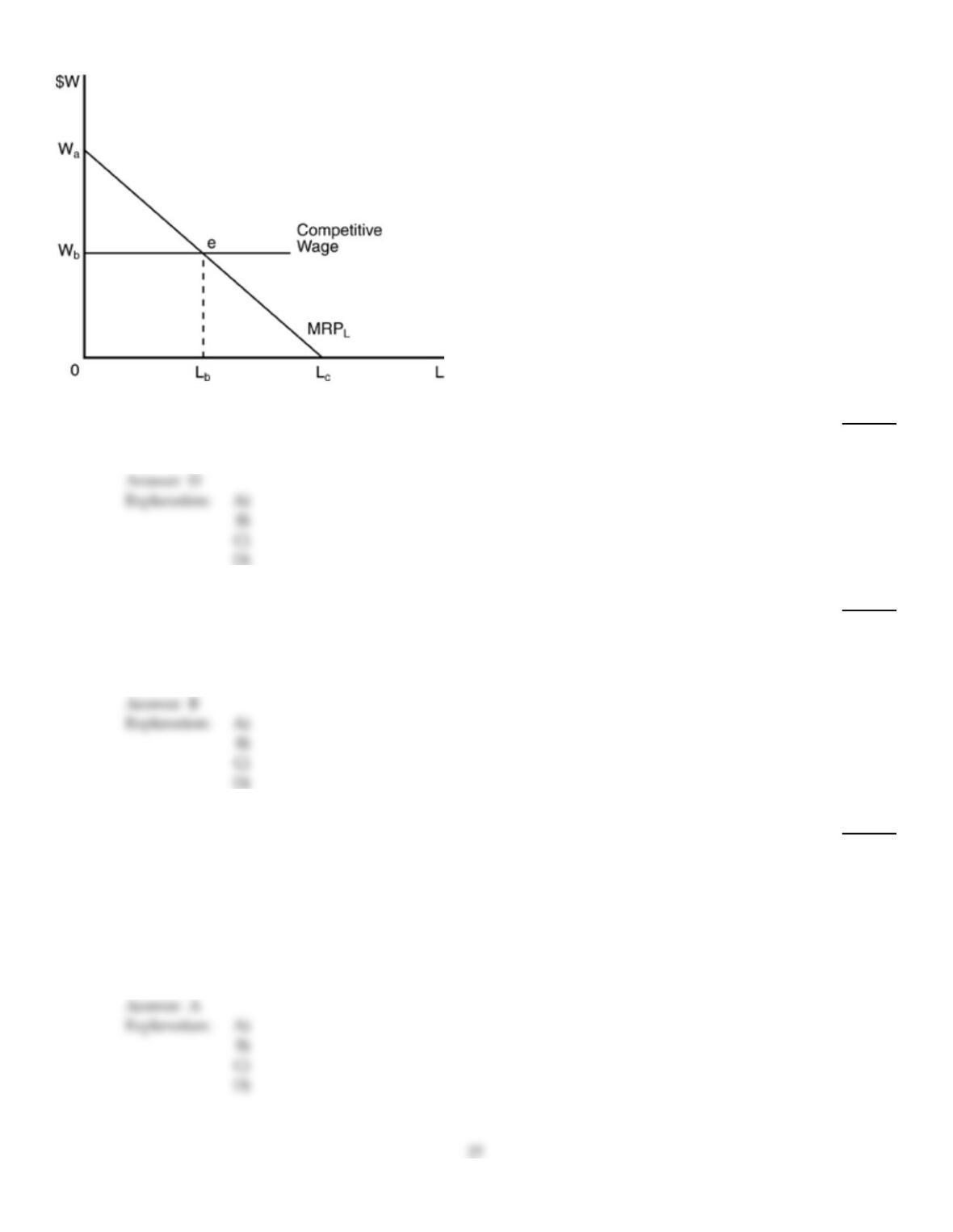
96)
In the above figure, the line labeled “MRPL” also represents the firm’s
96)
A)
marginal physical product curve.
B)
total physical product curve.
C)
supply curve.
D)
demand curve.
97)
Suppose that in a computer factory, if there is 1 worker, 80 computers are produced per week. If
there are 2 workers, 150 computers are produced per week. If there are 3 workers, 210 computers
are produced per week. Given this information and the fact that the firm receives $200 per
computer, the marginal revenue product of the third worker is
97)
A)
$14,000.
B)
$12,000.
C)
$10,000.
D)
$4,200.
98)
The demands for labor and other input factors are called
98)
A)
derived demands, because the demand for these inputs depends on the demand for goods
and services they are employed to produce.
B)
reverse demands, because the demand for these inputs varies inversely with the demand for
goods and services they are employed to produce.
C)
developed demands, because the demand for these inputs is developed from an analysis of
the costs of advertising products.
D)
indirect demands, because the demand for these inputs is indirectly related to the costs of
advertising products.

99)
Compared to the perfectly competitive firm , the monopolist’s input demand curve is
99)
A)
due to a constant per–unit price of the product.
B)
marginal factor cost.
C)
more inelastic.
D)
more elastic.
100)
If a firm sells its product in a monopolistic market, even though the firm operates in a perfectly
competitive labor market, the firm will employ workers up to the point where
100)
A)
the MRP = the wage rate.
B)
the MRP = the output price.
C)
TR = TC.
D)
the MRP = the marginal physical product of labor.
SHORT ANSWER. Write the word or phrase that best completes each statement or answers the question.
101)
Show how the profit–maximizing rule for hiring resources is equivalent to the
cost–minimizing rule.
101)
102)
Suppose the price elasticity of demand for iPods is inelastic. What would you expect about
the demand elasticity for workers producing iPods? Explain.
102)
103)
What is the marginal revenue product of labor (MRP)? What shape does the MRP curve
have? Why?
103)
104)
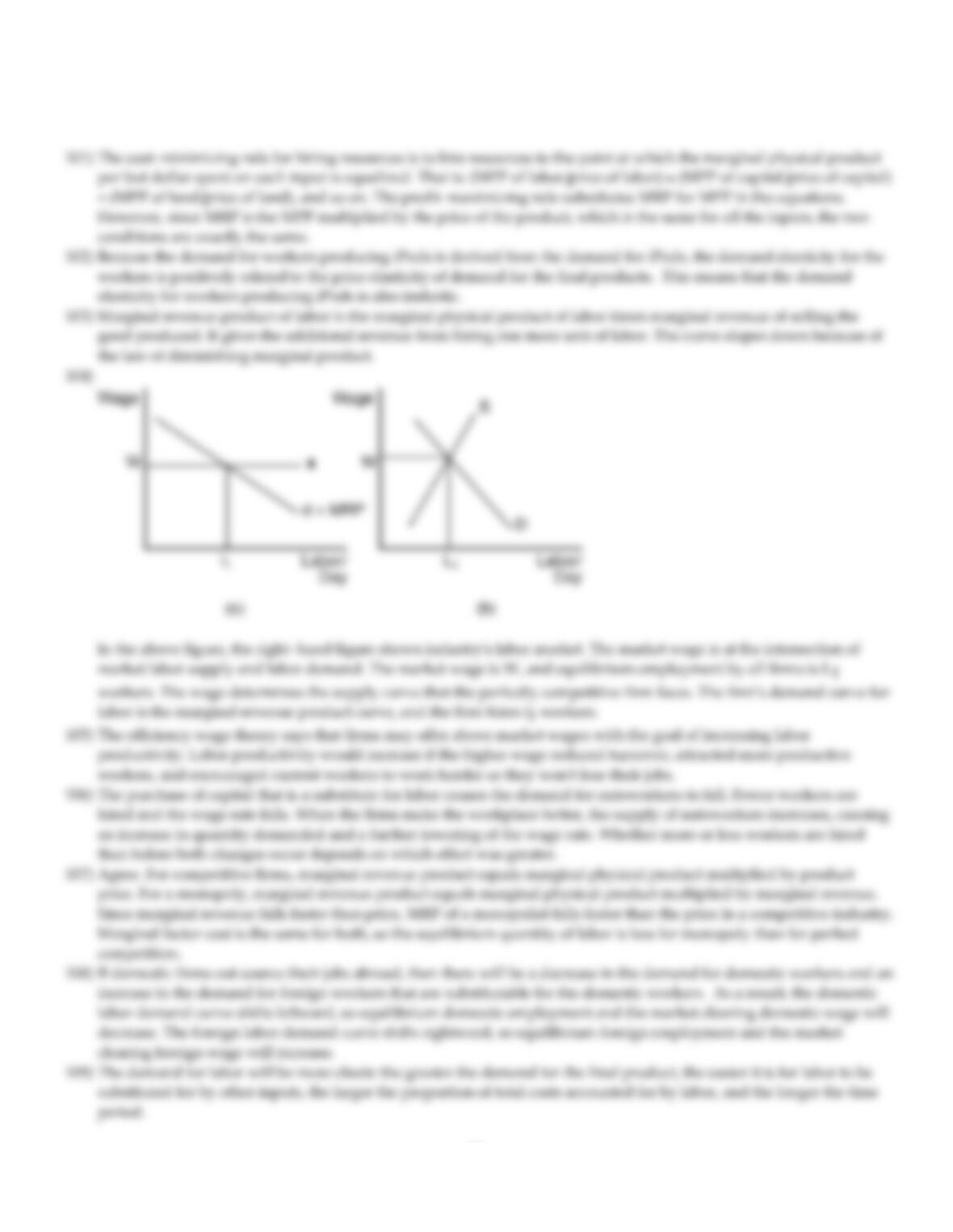
Explain how the equilibrium wage rate is determined for a perfectly competitive industry
and how a firm in that industry determines its profit maximizing employment level.
104)
105)
Explain the efficiency wage theory.
105)
106)
Suppose the market for autoworkers is initially in equilibrium, but then the automakers
purchase capital goods that are a substitute for workers. What happens in the market for
autoworkers? Explain. Now, suppose the automakers improve working conditions at the
plants. What are the effects? Explain.
106)

107)
“Other things being equal, the monopolist hires fewer workers than would be hired than a
perfectly competitive industry.” Do you agree or disagree? Why?
107)
108)
Explain the implications of outsourcing for employment and wages in the domestic and
foreign labor markets.
108)
109)
What would make the demand for labor more elastic?
109)
110)
Explain what the profit–maximizing combination of resources is for the perfectly
competitive firm.
110)
111)
Suppose a firm employs only capital and labor as inputs. Explain how the firm should
allocate its inputs in order to maximize profits in a perfectly competitive market.
111)
112)
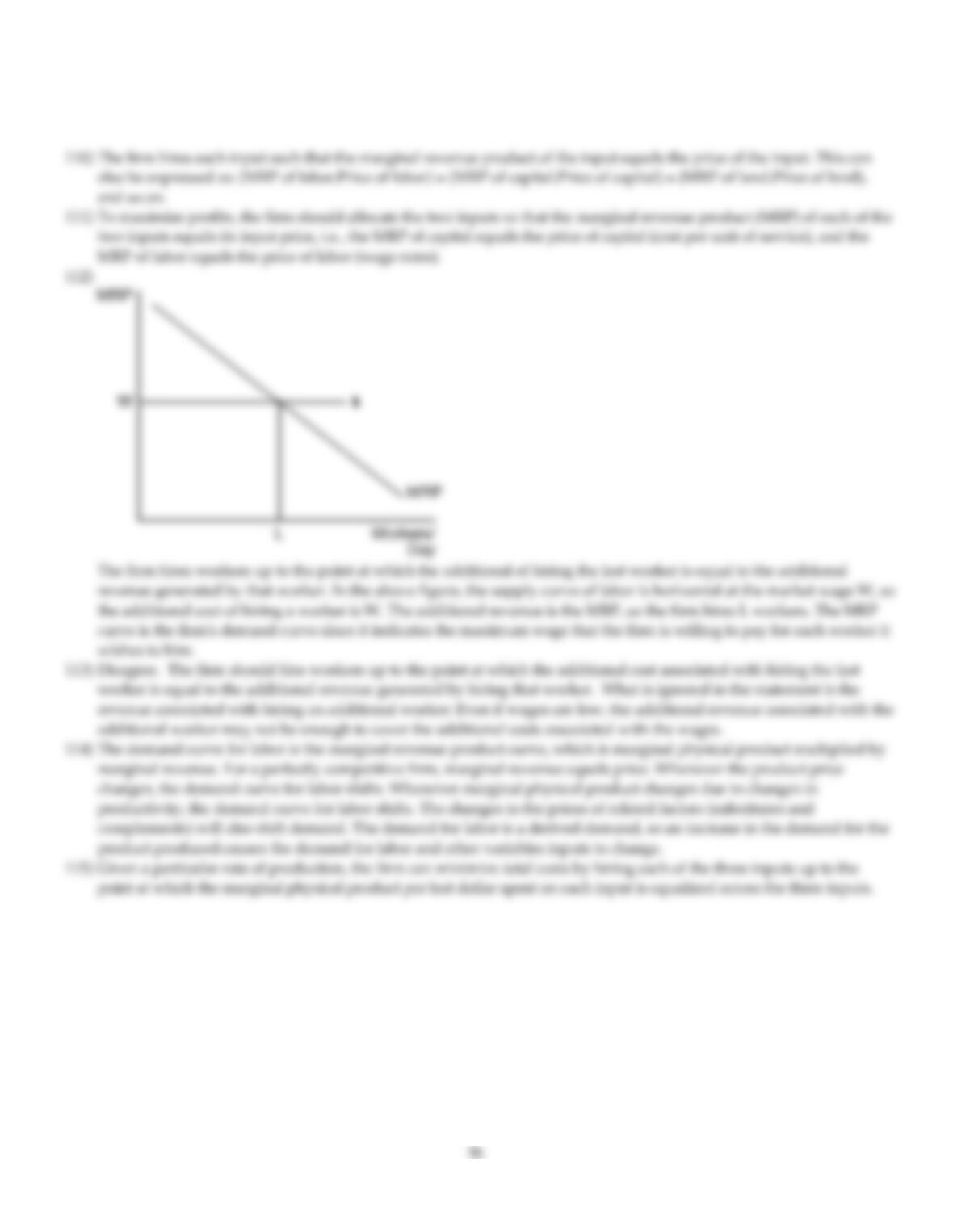
What is the general rule for hiring for a perfectly competitive firm? Show it on a graph.
What is the demand curve for labor on the graph? Explain.
112)
113)
“A firm should continue to hire more workers as long as wages are low.” Do you agree or
disagree? Why?
113)
114)
What can cause the demand curve for labor to shift? Explain.
114)

115)
For a firm that uses land, labor and capital as inputs, how should the inputs be utilized in
order to minimize total costs?
115)

Answer Key
Testname: C28
33

Answer Key
Testname: C28
34
Answer Key
Testname: C28
35
Answer Key
Testname: C28