60)
How are the metabolic needs of the implanted embryo provided for?
60)
61)
Briefly describe the physiological changes occurring in the mother during pregnancy.
61)
62)
Define Braxton–Hicks contractions.
62)
63)
What embryonic structure is the structural base for the umbilical cord?
63)
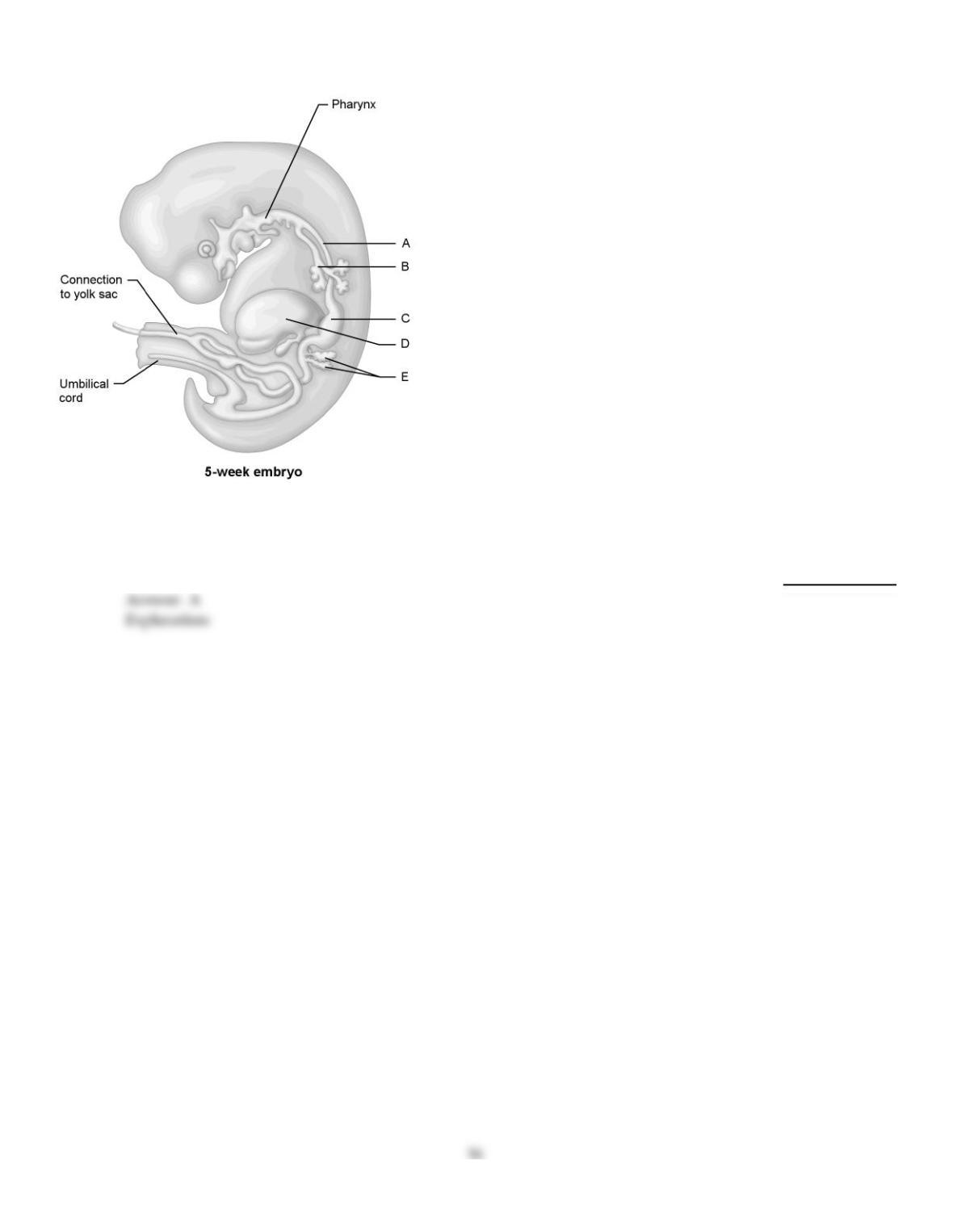
Figure 28.1
Using Figure 28.1, match the following:
64)
Esophagus.
64)
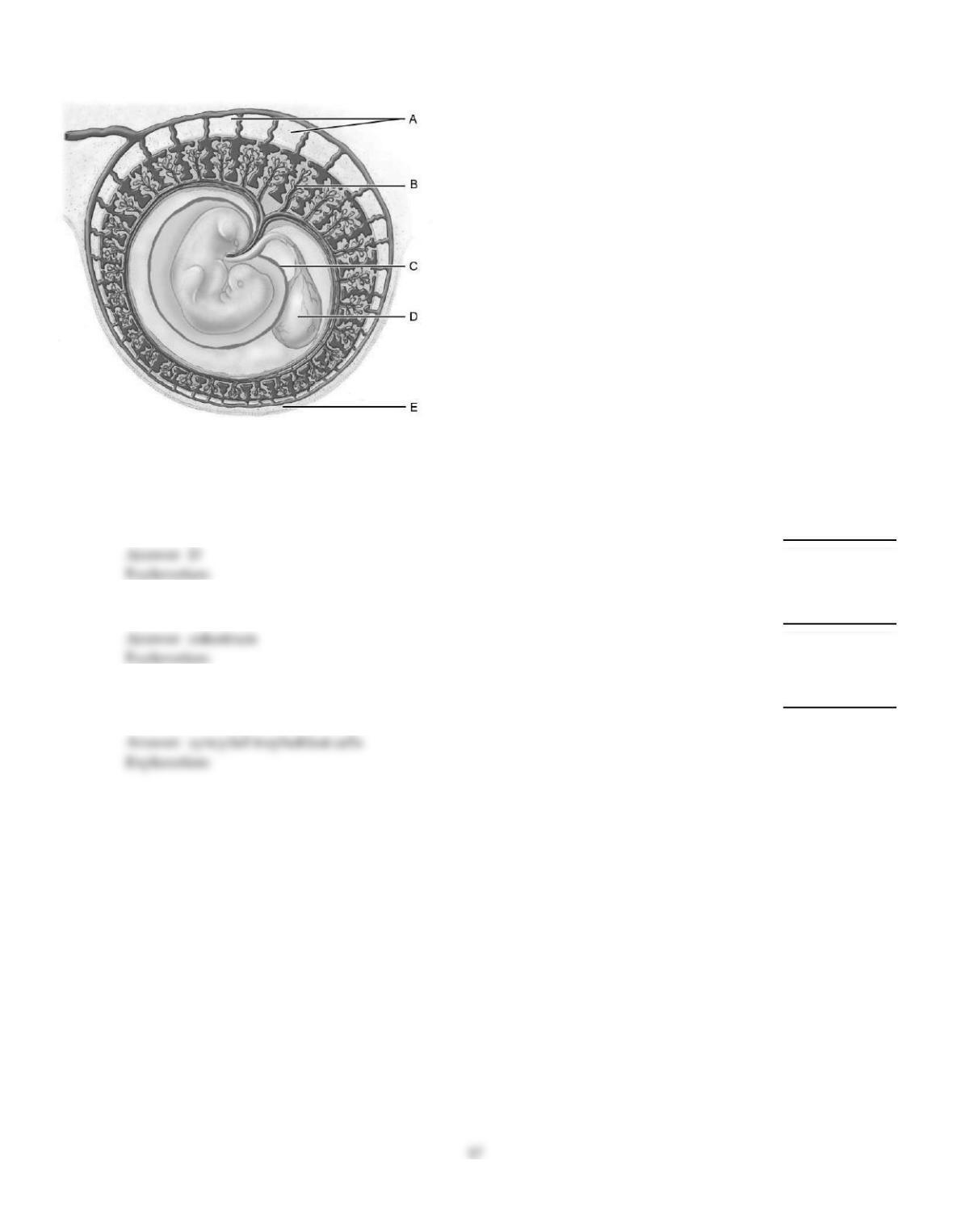
Figure 28.2
Using Figure 28.2, match the following:
65)
Site of early blood cell production, and forms part of the gut (digestive tube).
65)
66)
The first “milk” the mother produces is called ________.
66)
67)
Which cells invade the endometrium, digesting the uterine cells they contact, so that
implantation of the blastocyst can occur?
67)
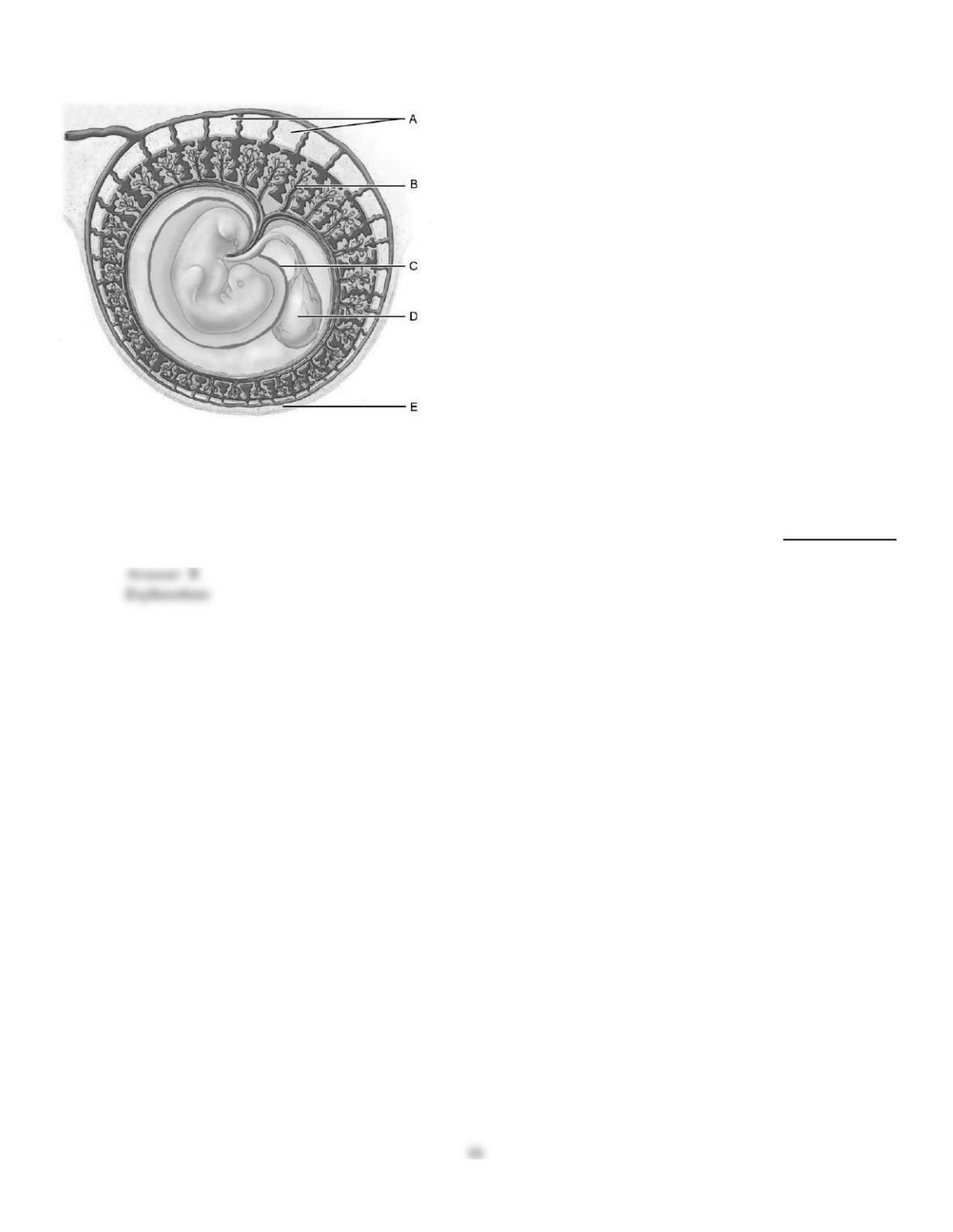
Figure 28.2
Using Figure 28.2, match the following:
68)
Extraembryonic membrane that develops from the trophoblast and some extraembryonic
mesoderm, and forms part of the placenta.
68)
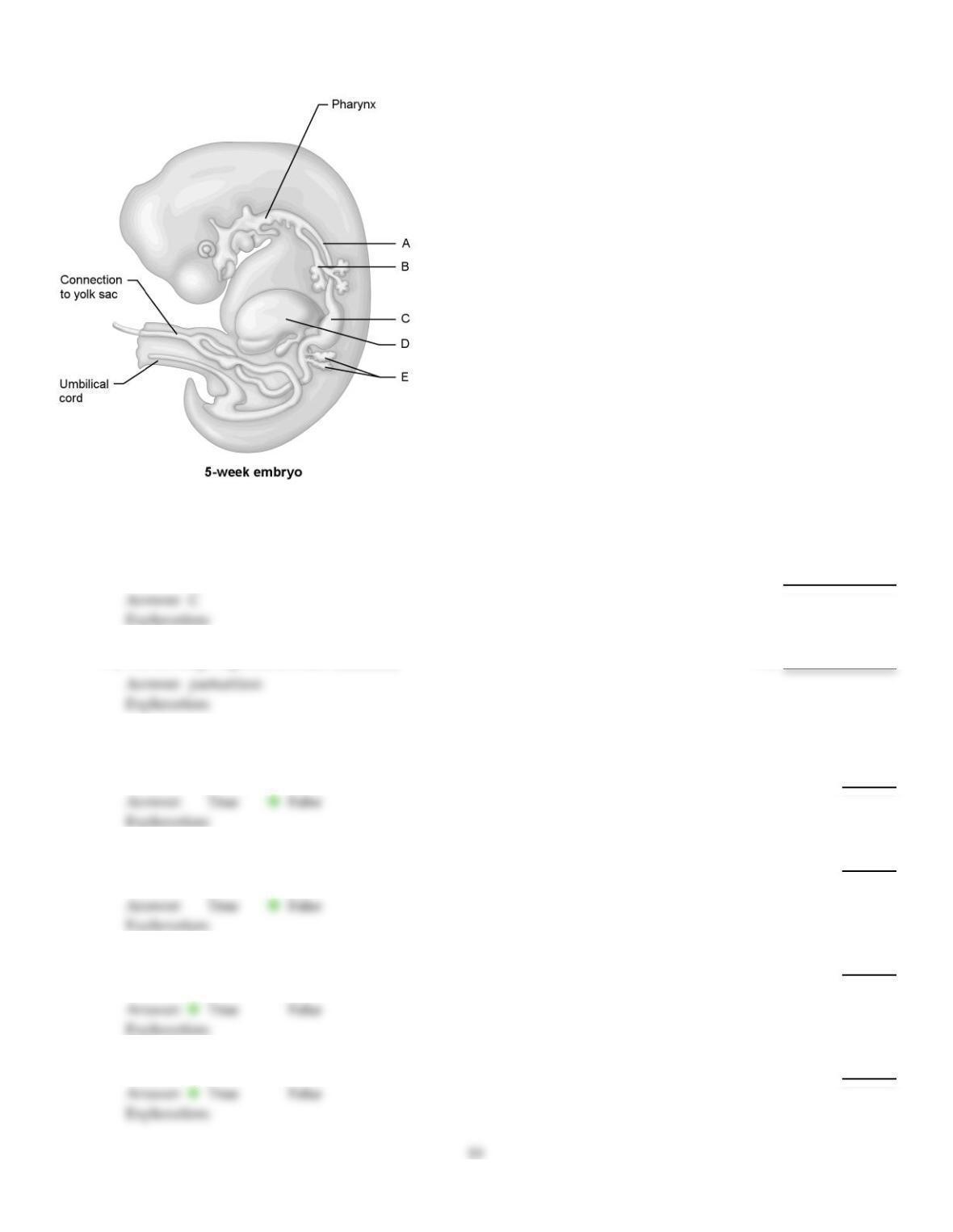
Figure 28.1
Using Figure 28.1, match the following:
69)
Stomach.
69)
70)
The act of giving birth is called ________.
70)
TRUE/FALSE. Write ‘T’ if the statement is true and ‘F’ if the statement is false.
71)
A zygote is usually formed within the uterus.
71)
72)
Surfactant production in premature infants is rarely a factor in providing normal respiratory
activity.
72)
73)
In fetal circulation, one way in which blood bypasses the nonaerated lungs is by way of the
foramen ovale.
73)
74)
The embryo is directly enclosed in and protected by the amnion.
74)
75)
A blastocyst is a hollow ball of cells, while the morula is a solid ball of cells.
75)
76)
The “fluid–filled, hollow ball of cells” stage of development is the blastocyst.
76)
77)
The embryonic stage lasts until the end of the eighth week.
77)
78)
The body systems of the developing embryo are present in at least rudimentary form at eight
weeks.
78)
79)
The period from fertilization through week eight is called the embryonic period.
79)
80)
Fertilization occurs while the egg is still in the ovarian follicle.
80)
81)
Implantation begins six to seven days after ovulation.
81)
82)
Conceptus is a term used to describe the developing human offspring.
82)
83)
An episiotomy is an incision made to widen the vaginal orifice, aiding fetal expulsion.
83)
84)
The placenta and its attached fetal membranes are collectively called the afterbirth.
84)
85)
Of the three germ layers, the mesoderm forms the most body parts.
85)
86)
Freshly deposited sperm are not capable of penetrating an oocyte.
86)
87)
By 72 hours after fertilization, the egg has divided into more than 160 cells and is called the morula.
87)
88)
Human placental lactogen initiates labor.
88)
Answer:
89)
A pregnancy test involves antibodies that detect GH levels in a woman’s blood or urine.
89)
Answer:
90)
A pregnant woman urinates more often than usual because the uterus compresses the bladder, and
she must also dispose of fetal metabolic wastes.
90)
Answer:
MATCHING. Choose the item in column 2 that best matches each item in column 1.
Match the following:
91)
Leads to enhancement of sperm
motility and increasing membrane
fragility to enable enzyme release
from acrosomes.
Answer:
A
A)
Capacitation
91)
Match the following:
92)
Forms the mother’s part of the
placenta.
Answer:
B
93)
A solid sphere of undifferentiated
cells.
Answer:
A
A)
Morula
92)
93)
Match the following:
94)
Leads to the development of a morula
and then a blastocyst.
Answer:
A
A)
Cleavage
94)
Match the following:
95)
Forms the chorion.
Answer:
A
96)
Surrounds the uterine cavity face of
the implanted embryo.
Answer:
C
97)
Forms the embryoblast.
Answer:
B
A)
Trophoblast
C)
Decidua capsularis
95)
96)
97)
Answer:
Match the following:
98)
Leads to the establishment of the three
primary germ layers.
99)
Embedding of the blastocyst in the
uterine wall.
100)
Leads to the formation of the first cell
of the new individual.
A)
Implantation
C)
Gastrulation
98)
99)
100)
ESSAY. Write your answer in the space provided or on a separate sheet of paper.
101)
Mrs. Phang, eight months pregnant with her first child, makes an appointment with her obstetrician to
investigate the cause of vaginal bleeding. Because it is actually more “spotting” than frank bleeding, and
painless, she is becoming worried. Ultrasound visualization of her abdomen shows that the placenta is formed
across the internal os of the cervix, and she is ordered to her bed for the remainder of the pregnancy. What
name is given to Mrs. Phang’s condition? Why is it an extremely serious condition? Why was she ordered to
have complete bed rest for the remainder of her pregnancy?
102)
A mother who has been nursing her infant for over seven months is beginning to have problems throughout the
day with nausea. Is there a connection?
103)
A 30–year–old woman is admitted to the emergency room. Her husband, who rode in the ambulance with her,
said that she had suddenly complained of severe pain in the right iliac region of her abdomen and then had
collapsed. Upon examination, she was shown to have signs of internal hemorrhage and her abdominal muscles
were rigid. Her menstrual history revealed that she had missed her last menstrual period. A diagnosis of
ruptured tubal, or ectopic, pregnancy was made and surgery scheduled. What is an ectopic pregnancy, and why
is it problematic?
104)
A 28–year–old woman has been in the first stage of labor for several hours. Her uterine contractions are weak,
and her labor is not progressing normally. Because the woman insists upon a vaginal delivery, the physician
orders that pitocin (a synthetic oxytocin) be infused. What will be the effect of pitocin? What is the normal
mechanism by which oxytocin acts to promote birth?
105)
A 19–year–old, single, sexually active college student, who has not used birth control on a regular basis, is in
her first trimester of pregnancy. She is at the OB/GYN clinic for her first prenatal visit. In assessing her nutrition,
the nurse discovers that the patient drinks heavily on a regular basis. She also states she does not like milk.
What information should the nurse give the patient regarding nutrition?
106)
The patient is in her first trimester of pregnancy. She complains of feeling nauseated and has vomited on
occasion. She tells the nurse that she did not have this with her first pregnancy. She asks the nurse, “What is
causing this and when will it end?” How should the nurse respond?
107)
The lactation nurse visits a first–time mother six hours after her delivery of a healthy 8–pound boy. The patient
is giving the baby boy a bottle of sugar water. She tells the lactation nurse that she does not seem to be
producing milk. What should the nurse say to the patient?

Answer Key
Testname: C28
Answer Key
Testname: C28
25
Answer Key
Testname: C28
26

Answer Key
Testname: C28