
Exam
Name___________________________________
MULTIPLE CHOICE. Choose the one alternative that best completes the statement or answers the question.
Number of Total Number of Total
Workers Output Workers Output
0 0 6 945
1 200 7 1000
2 420 8 1025
3620 9 1035
4 770 10 1040
5 870
1)
Refer to the above table. If the price of the good produced is $5, the marginal revenue product of
the 7th worker is
1)
A)
$5000.
B)
$125.
C)
$385.
D)
$55.
2)
In a perfectly competitive labor market, the labor supply curve facing the firm will be
2)
A)
vertical.
B)
horizontal.
C)
downward sloping.
D)
upward sloping.
3)
A firm in a competitive input market can
3)
A)
hire additional workers at lower wages because those who are still unemployed are anxious
to work.
B)
hire additional workers only after a long search process.
C)
hire additional workers only by raising wages.
D)
hire workers at the going wage.

4)
Suppose a new technology allows firms to substitute mechanical tomato pickers for farm laborers.
As a result, the demand curve for farm laborers will
4)
A)
shift to the right.
B)
become less elastic.
C)
become more elastic.
D)
not be affected.
Marginal Marginal
Labor Input Physical Product Revenue
(workers per week) (output per week) MR
25 150 9.00
26 140 8.50
27 130 8.00
28 120 7.50
29 110 7.00
5)
Refer to the above table. What does the marginal revenue product equal when 26 workers are hired
a week?
5)
A)
$1190
B)
$26
C)
$221
D)
$8.50
6)
When Canadian firms outsource accounting services to the United States, in markets for the labor
of accountants,
6)
A)
equilibrium employment and the market clearing wage rate will both increase in Canada and
in the United States.
B)
equilibrium employment and the market clearing wage rate will both decrease in Canada, but
equilibrium employment and the market clearing wage rate will both increase in the United
States.
C)
equilibrium employment and the market clearing wage rate will both increase in Canada and
in the United States.
D)
equilibrium employment and the market clearing wage rate will both increase in Canada, but
equilibrium employment and the market clearing wage rate will both decrease in the United
States.

7)
The price elasticity of demand for labor will be greater, the
7)
A)
shorter is the time period under examination.
B)
greater is the price elasticity of demand for the final product.
C)
more difficult it is to employ substitute inputs in production.
D)
smaller is the proportion of wage costs in the total cost of production.
8)
If the supply of labor to a firm is perfectly elastic at the going wage rate established by the forces of
supply and demand then
8)
A)
the wage rate has been decreasing.
B)
the firm is price taker.
C)
the firm can only hire additional units of labor by driving the wage rate up.
D)
full employment exists in the labor market.
9)
The demand curve for labor of a monopolist
9)
A)
slopes down for the same reason as the demand curve for labor of a perfectly competitive
firm.
B)
slopes down because of the law of diminishing marginal product and because the monopolist
must lower prices to sell additional units of the good.
C)
slopes upward because monopolists use more capital than do perfectly competitive firms.
D)
is horizontal even though the demand curve for labor for a competitive firm is downward
sloping.
10)
A firm that maximizes profits also
10)
A)
cuts corners in production processes so that its products are made too cheaply.
B)
uses the least–cost combination of resources.
C)
is inefficient.
D)
pays input prices lower than other firms do.

11)
We would expect that a fall in labor supply will have a proportionately larger effect on the market
wage rate when
11)
A)
the product produced in the industry has several close substitutes.
B)
labor represents a relatively small portion of total costs.
C)
capital goods exist that can replace many of the workers.
D)
the product produced in the industry makes up a large portion of most families’ budgets.
12)
An industry’s equilibrium wage rate is established
12)
A)
by the slope of the industry demand curve for labor alone.
B)
by the Labor Department and based on the cost of living in the area.
C)
by the industry supply curve for labor alone.
D)
by the intersection of the industry supply and demand curves for labor.
D
13)
Suppose the MRP of the 49th worker at a firm is $25 and that the market wage rate is $15. We know
that if this firm operates in perfectly competitive product and labor markets,
13)
A)
the firm would be more profitable if it hired more workers.
B)
the firm is paying wages above the minimum wages.
C)
the firm should use more capital.
D)
the firm’s profits would increase if it fired some workers.
A
14)
The additional revenue associated with hiring one additional unit of some factor input, such as
labor, is called
14)
A)
marginal factor cost.
B)
marginal cost.
C)
marginal revenue product.
D)
marginal physical product.
C
B

15)
The demand for an input will be more inelastic when
15)
A)
the time period being considered is relatively long.
B)
it is difficult to substitute other inputs for this input.
C)
the demand for the product being produced is elastic.
D)
the cost of the input is a relatively large percentage of total production costs.
16)
Since the demand for labor depends upon the demand for the final product, we say that labor is
16)
A)
an “inverse” demand.
B)
a derived demand.
C)
a reverse demand.
D)
a positive demand.
Number of Total Number of Total
Workers Output Workers Output
0 0 6540
1100 7600
2220 8650
3320 9 690
4 400 10 700
5475
17)
Refer to the above table. If the price of the good produced is $10 and the wage rate is $500, then the
marginal revenue product of the 5th worker is ________.
17)
A)
$750
B)
$4,750
C)
$10
D)
$50
18)
Which of the following will not cause the marginal revenue product of labor curve for a firm to
shift?
18)
A)
A decrease in the price of the product.
B)
An increase in the productivity of workers.
C)
An increase in the wage rate.
D)
An increase in demand for the product.

19)
Which of the following would NOT a reason for a shift in the labor demand curve?
19)
A)
A change in demand for the final product
B)
A change in the price of a related input
C)
A change in the market wage rate
D)
A change in labor productivity
Labor Input Total Physical Product
(workers/day) (output/day)
10 500
11 600
12 690
13 760
14 800
20)
Refer to the above table. If the price of the good produced is $7, the marginal revenue product of
the 11th worker is
20)
A)
$3500
B)
$700
C)
$4200
D)
$630
B
21)
In a perfectly competitive industry, an individual firm faces
21)
A)
a perfectly elastic labor supply curve.
B)
a perfectly vertical labor supply curve.
C)
a perfectly inelastic labor supply curve.
D)
none of the above.
A
22)
The MRP of labor will shift to the left if
22)
A)
wages decrease.
B)
labor productivity decreases.
C)
labor productivity increases.
D)
wages increase.
B
C

Marginal Marginal
Labor Input Physical Product Revenue
(workers per week) (output per week) MR
25 150 9.00
26 140 8.50
27 130 8.00
28 120 7.50
29 110 7.00
23)
Refer to the above table. How many worker will this firm hire if the weekly wage rate is $1350?
23)
A)
27
B)
25
C)
28
D)
26
24)
When a firm has monopoly power, it
24)
A)
hires more workers because its marginal revenue lies below the demand curve.
B)
hires fewer workers because its marginal revenue lies above the demand curve.
C)
hires more workers because its marginal revenue lies above the demand curve.
D)
hires fewer workers because its marginal revenue lies below the demand curve.
25)
An increase in product price implies that
25)
A)
the firm’s demand for labor decreases.
B)
the wage rate the firm pays will increase.
C)
the firm’s demand for labor increases.
D)
the firm’s marginal factor cost will increase.
26)
If a firm uses only capital and labor as inputs, then what should the firm do at a given rate of
production if the marginal physical product of labor per last dollar spent is higher than the
marginal physical product of capital per last dollar spent?
26)
A)
The firm should decrease the quantity of capital and increase the quantity of labor.
B)
The firm should decrease both the quantity of capital and the quantity of labor.
C)
The firm should increase the quantity of capital and reduce the quantity of labor.
D)
The firm should increase both the quantity of capital and the quantity of labor.

27)
The additional output from one more worker is known as
27)
A)
marginal factor cost.
B)
marginal revenue product.
C)
marginal physical product.
D)
marginal wage.
28)
When the price of a product decreases, the marginal revenue product curve in a perfectly
competitive market
28)
A)
does not change.
B)
shifts to the right.
C)
becomes flatter.
D)
shifts to the left.
D
29)
The marginal revenue product curve shifts when
29)
A)
there is a change in the product price workers are producing.
B)
wages fall.
C)
wages rise.
D)
the wages paid exceed the price.
A
30)
An increase in the supply of labor to an industry could be caused by
30)
A)
an increase in job flexibility in the industry.
B)
an increase of wages in another industry.
C)
increased productivity of labor.
D)
higher wages.
A
C

31)
Suppose that U.S. firms outsource plane manufacturing jobs to China, it is expected that
31)
A)
the wage rate for workers manufacturing planes will decrease in the U.S. but increase in
China.
B)
the wage rate for workers manufacturing planes will decrease in both the U.S. and China.
C)
the wage rate for workers manufacturing planes will increase in the U.S. but decrease in
China.
D)
the wage rate for workers manufacturing planes will increase in both the U.S. and China.
Marginal Marginal
Labor Input Physical Product Revenue
(workers per week) (output per week) MR
25 150 9.00
26 140 8.50
27 130 8.00
28 120 7.50
29 110 7.00
32)
Refer to the above table. How do we know that this is not a competitive firm?
32)
A)
Marginal physical product cannot be computed for competitive firms.
B)
The marginal revenue changes as output changes.
C)
The marginal revenue product decreases as the amount of labor increases.
D)
The marginal physical product decreases as the amount of labor hired increases.
33)
Which of the following would cause the labor demand curve to shift to the right?
33)
A)
A decrease in demand for the product the labor is used to produce
B)
A decrease in the price of a complimentary resource
C)
An increase in labor productivity
D)
All of the above

34)
In a perfectly competitive situation, the profit–maximizing hiring situation for all inputs being used
is where
34)
A)
the MRP of each input is equal to the price of each input.
B)
the MRP of each input is less than the price of each input.
C)
the MRP of each input is greater than the price of each input.
D)
There is no relationship between MRP and the prices of the inputs.
35)
If we assume competitive labor markets, the supply curve of labor when the firm is a monopoly is
35)
A)
horizontal.
B)
downward sloping.
C)
upward sloping.
D)
vertical.
36)
A short–run increase in the price of a firm’s output will typically
36)
A)
not impact the hiring of labor.
B)
lead to a movement along the firm’s demand for labor curve.
C)
lead to more employment in the competitive firm.
D)
make the demand for labor more inelastic.
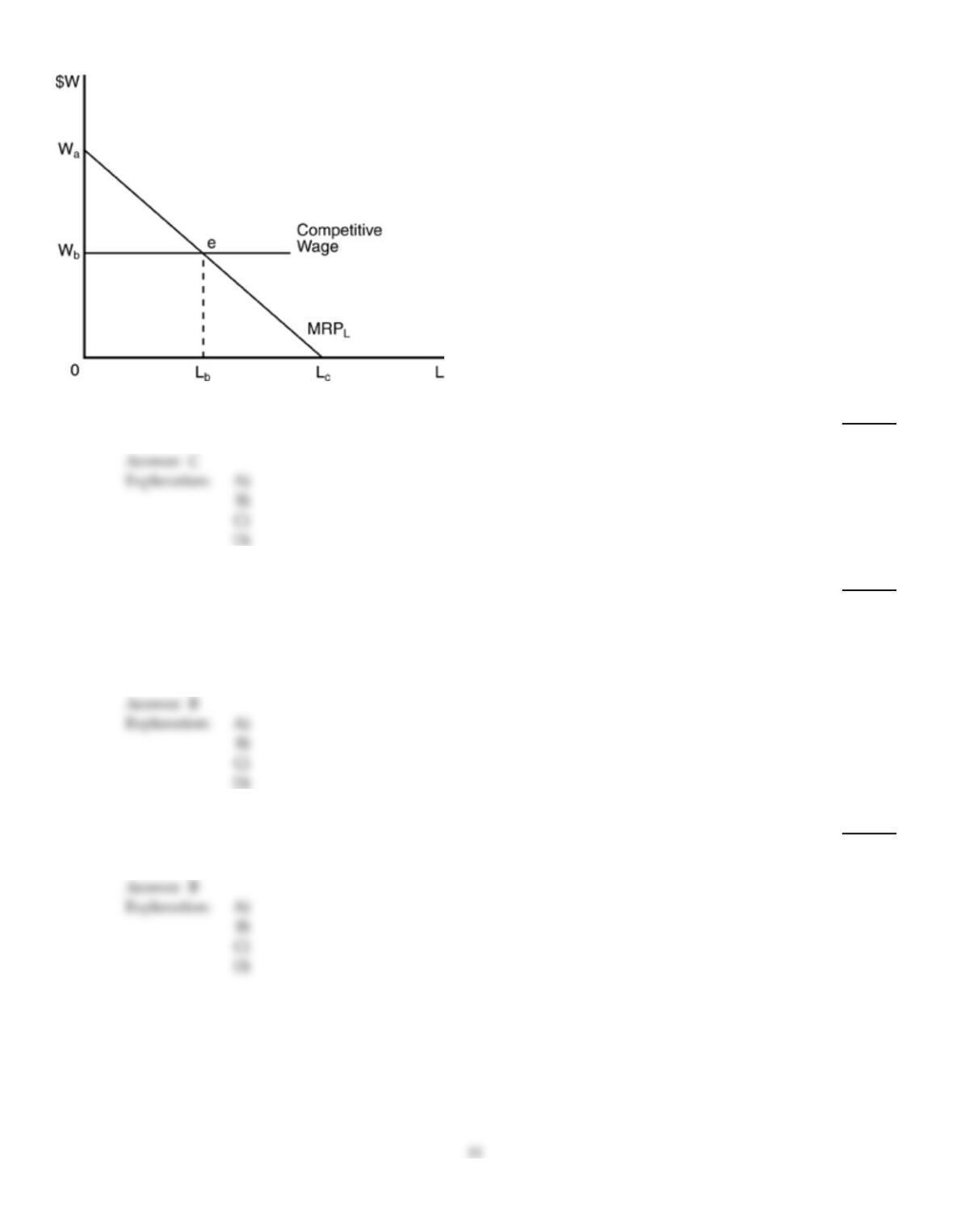
37)
In the above figure, the competitive firm will employ the quantity of labor
37)
A)
greater than Lc.
B)
equal to Lc.
C)
equal to Lb.
D)
less than Lb.
38)
As more workers are hired, the marginal physical product of labor eventually declines because
38)
A)
workers do not work well together when the number of workers increases.
B)
the amount of capital each worker has to work with declines as the number of workers
increases.
C)
less efficient workers are hired as the number of workers increases.
D)
of diseconomies of scale.
39)
The monopolist’s input demand curve is the
39)
A)
marginal factor cost.
B)
marginal revenue product curve.
C)
marginal physical product curve.
D)
marginal revenue curve.

40)
Suppose a U.S. computer company outsources its technical–support services to India. This will
cause
40)
A)
the demand for labor in the United States to increase, lowering U.S. wage rates, and the
demand for labor in India to fall, increasing Indian wage rates.
B)
the demand for labor in the United States to increase, increasing U.S. wage rates, and the
demand for labor in India to fall, decreasing Indian wage rates.
C)
the demand for labor in the United States to fall, lowering U.S. wage rates, and the demand
for labor in India to fall, decreasing Indian wage rates.
D)
the demand for labor in the United States to fall, lowering U.S. wage rates, and the demand
for labor in India to increase, increasing Indian wage rates.
Quantity of Marginal Physical Price of Marginal
Workers Total Product Product Final Product Revenue Product
1 7 $10
218 9
330 8
440 7
548 6
652 5
41)
In the above table, if the marginal factor cost is $48, how many workers would be hired?
41)
A)
6
B)
5
C)
3
D)
4
42)
The price elasticity of demand for labor will be smaller, the
42)
A)
easier it is to employ substitute inputs in production.
B)
longer is the time period under examination.
C)
greater is the price elasticity of demand for the final product.
D)
smaller is the proportion of wage costs in the total cost of production.

Number of Total Number of Total
Workers Output Workers Output
0 0 6 945
1 200 7 1000
2 420 8 1025
3620 9 1035
4 770 10 1040
5 870
43)
Refer to the above table. Suppose the marginal revenue product of the 7th worker is $1100. This
implies that
43)
A)
the price of the good is $1.
B)
the price of the good is $8.
C)
the price of the good is $20.
D)
we cannot tell what the price of the good is without more information.
44)
The wage rate for widget makers is currently $25 per hour and Ajax hires 20 widget makers. If the
wage rate were decreased to $20, what would happen to the marginal revenue product for labor at
Ajax?
44)
A)
It would remain the same.
B)
It would decrease since Ajax will hire more workers.
C)
It would increase since Ajax’s demand for labor curve will shift.
D)
It would increase since the price of widgets would decrease.
45)
A monopolist will hire an additional unit of labor as long as
45)
A)
the marginal revenue curve is above the demand curve.
B)
the additional cost of the worker is outweighed by the additional revenues made from selling
the output of theses workers.
C)
the marginal revenue product is larger than the marginal factor cost.
D)
the marginal revenue product is less than the marginal factor cost.

46)
The demand for labor is
46)
A)
totally unrelated to the demand curve for the final product.
B)
derived from the satisfaction that hiring the inputs provides the owner or manager of the firm
more money.
C)
derived from a utility maximizing process similar to that used to derive the demand curve for
goods and services.
D)
derived from the demand for the final product being produced.
47)
We would expect that a fall in labor supply will have a proportionately smaller effect on the market
wage rate when
47)
A)
workers can easily be replaced by capital goods.
B)
the product produced in the industry has very few substitutes.
C)
labor represents a relatively small portion of total costs.
D)
the product is produced in a perfectly competitive industry.
48)
Which of the following statements about a perfectly competitive market are true?
I. The perfectly competitive industry faces an upward sloping labor supply curve.
II. The individual firm in a perfectly competitive industry faces a perfectly elastic labor supply
curve.
48)
A)
I only
B)
II only
C)
Both I and II
D)
Neither I nor II

Quantity Total Marginal Marginal
of Workers Product Physical Product Revenue Product
0 0 – –
1 7
218
330
440
548
49)
In the above table, if this is a perfectly competitive firm and the market price of the product is $10,
what is the marginal revenue product of worker 4?
49)
A)
$210
B)
$120
C)
$411
D)
$100
50)
A rule of thumb in the employment of resources is to set
50)
A)
marginal revenue (MR) equal to marginal cost (MC).
B)
marginal revenue product (MRP) equal to marginal factor cost (MFC).
C)
marginal physical product equal to marginal resource cost.
D)
none of the above
51)
The price elasticity of demand for a variable input will be more elastic in all the following cases
EXCEPT
51)
A)
the greater the price elasticity of demand for the final product.
B)
the shorter the time period being considered.
C)
the easier it is for a particular variable input to be substituted for by other inputs.
D)
the larger the proportion of total costs accounted for by a particular variable input.
52)
An increase in labor productivity will shift
52)
A)
MRP curve to the left.
B)
MFC curve to the left.
C)
MRP curve to the left.
D)
MRP curve to the right.

53)
The equilibrium wage rate in an industry is determined by
53)
A)
whether workers or management are better at negotiating.
B)
the intersection of the market demand curve for labor and the market supply curve for labor.
C)
the strength of the substitution effect relative to the elasticity of demand for labor.
D)
finding where the market supply curve indicates that the substitution effect and income effect
of a wage increase are offsetting.
54)
Coal and iron ore are complements in the manufacture of steel. An increase in the price of coal
would lead to
54)
A)
an increase in the demand for iron ore as producers substitute more iron ore for coal in the
production process.
B)
an increase in the supply of iron ore as iron ore producers see an opportunity to expand their
markets.
C)
a decrease in the demand for iron ore as steel manufacturers reduce production of steel.
D)
no change in the demand for iron ore since the steel makers must use both iron ore and coal if
they are to make steel.
55)
The price elasticity of demand for a variable input will be greater
55)
A)
the easier it is for a particular input to be substituted for by other inputs.
B)
the lower the price elasticity of supply of all other inputs.
C)
the smaller the proportion of total costs accounted for by a particular variable input.
D)
the fewer substitutes there are for the final product.
56)
Assume that a perfectly competitive firm faces a fixed wage rate of $4 and a constant per–unit cost
of capital of $2. If the marginal product of labor and capital are 16 and 6, respectively, then to
maximize profits the firm should
56)
A)
use relatively more capital.
B)
increase all inputs proportionately.
C)
decrease all inputs proportionately.
D)
use relatively less capital.

57)
Cost minimization suggests that two inputs should be employed to the point where
57)
A)
the extra contribution to physical output of the inputs is identical.
B)
the marginal revenue product of each input is identical.
C)
the marginal cost of each input is identical.
D)
the marginal physical product per dollar spent on each input is identical.
58)
For a firm in a perfectly competitive labor market,
58)
A)
W < MFC.
B)
W = MFC.
C)
W > MFC.
D)
W > MRP.
59)
The equilibrium wage rate in an industry is found by
59)
A)
the intersection of the market demand curve for labor and the marginal revenue product
curve of labor.
B)
negotiations between the union leadership and the managers of the firms.
C)
the intersection of the market demand curve for labor and the market supply curve of labor.
D)
the intersection of the firm’s demand curve for labor and the firm’s supply curve of labor.
60)
Suppose at the current level of labor used, MRP = $100 and MFC = $50. To maximize profits, the
firm should
60)
A)
reduce the level of labor.
B)
hire more labor.
C)
maintain the current level of labor.
D)
shut down.

61)
Which of the following statements is true about the market and individual firm’s supply curve for
labor?
61)
A)
The market supply curve is more inelastic than the firm’s supply curve.
B)
The market supply curve is perfectly inelastic and the individual firm’s supply curve is
perfectly elastic.
C)
The market supply curve is perfectly elastic and the individual firm’s supply curve is
perfectly inelastic.
D)
The market supply curve is more elastic than the firm’s supply curve.
Number of Total Number of Total
Workers Output Workers Output
0 0 6540
1100 7600
2220 8650
3320 9 690
4 400 10 700
5475
62)
According to the above table, if the price of the good produced is $5 and the wage rate is $400, then
the marginal revenue product of the 7th worker is
62)
A)
$300.
B)
$400.
C)
$60.
D)
$12.
63)
An increase in the productivity of labor induces
63)
A)
an increase in the cost of labor.
B)
a firm to hire fewer workers since fewer workers are needed with the increase in productivity.
C)
a firm to offer a higher wage for workers since the workers are now more productive.
D)
an increase in the demand for labor.
64)
The increase in output that results when one more unit of a variable input is hired is called
64)
A)
marginal revenue.
B)
total physical product.
C)
average physical product.
D)
marginal physical product.