
Exam
Name___________________________________
MULTIPLE CHOICE. Choose the one alternative that best completes the statement or answers the question.
1)
A firm should hire workers up to the point where
1)
A)
MFC = P.
B)
MP = MRP.
C)
MFC = MRP.
D)
MP = P.
2)
A firm will not hire additional workers once
2)
A)
the company reaches its breakeven output level.
B)
it earns accounting profits.
C)
the additional cost of a worker equals the additional revenue from the worker.
D)
total product is rising.
3)
A profit–maximizing firm will hire workers up to the point at which
3)
A)
MRP > MFC.
B)
MRP = MFC.
C)
MRP = MPP.
D)
MRP < MFC.
4)
When there is an increase in the wages the banking industry offers accountants, what happens to
the supply of accountants available to other industries?
4)
A)
The supply to other industries increases.
B)
The supply curve for other industries shifts to the right.
C)
The supply to other industries falls.
D)
no change
5)
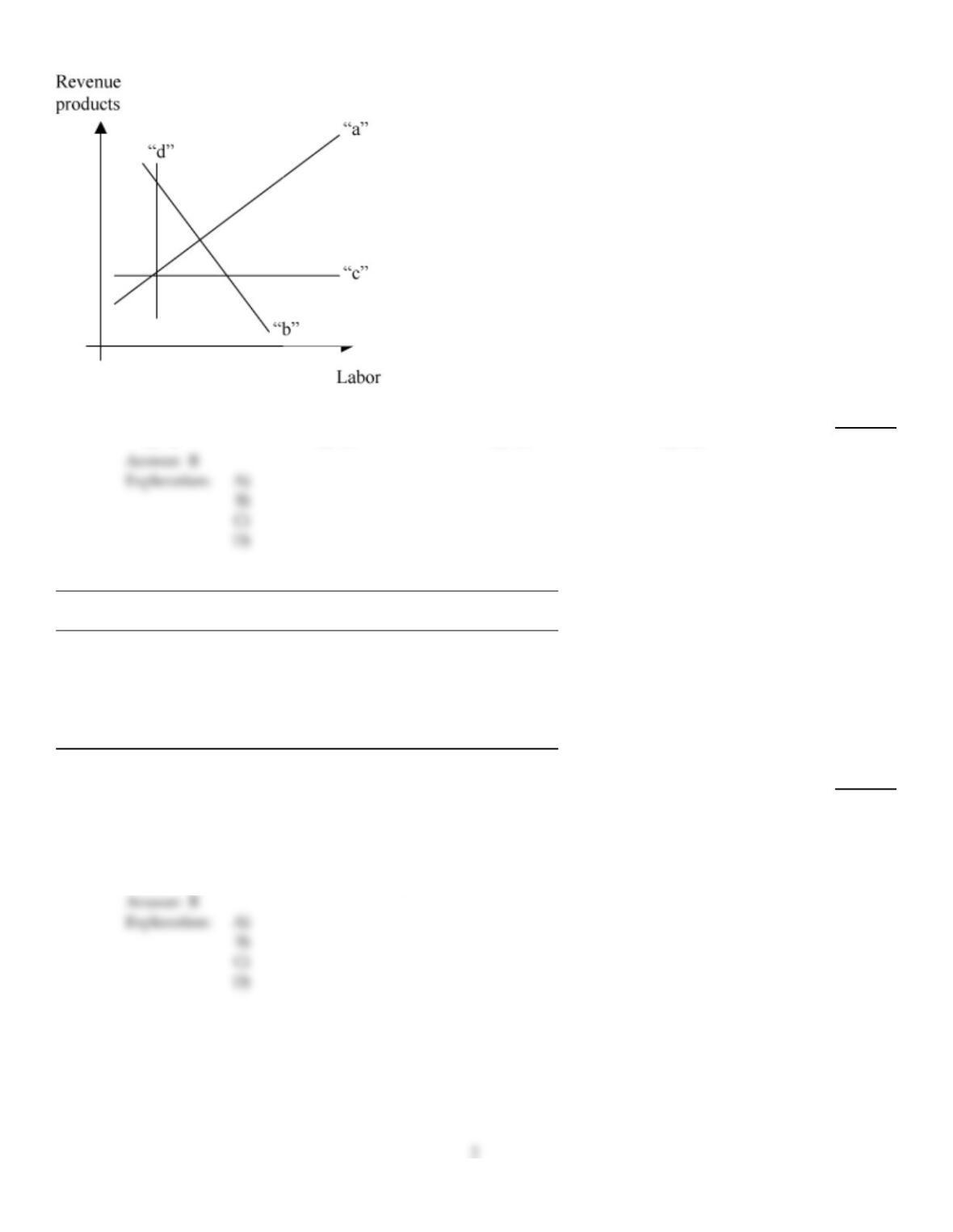
In the above figure, the marginal revenue product is represented by line
5)
A)
“a.”
B)
“b.”
C)
“c.”
D)
“d.”
Number of Total Number of Total
Workers Output Workers Output
0 0 6 945
1 200 7 1000
2 420 8 1025
3620 9 1035
4 770 10 1040
5 870
6)
Refer to the above table. Suppose the marginal revenue product of the 5th worker is $800. This
implies that
6)
A)
the price of the good is $5.33.
B)
the price of the good is $8.
C)
the price of the good is $70.
D)
we cannot tell what the price of the good is without more information.

7)
The firm’s demand for labor curve is its
7)
A)
marginal product of labor curve.
B)
average revenue product of labor curve.
C)
average product of labor curve.
D)
marginal revenue product of labor curve.
8)
We would expect that a fall in labor supply will have a proportionately smaller effect on the market
wage rate when
8)
A)
the product is produced in a perfectly competitive industry.
B)
workers can easily be replaced by capital goods.
C)
labor represents a relatively small portion of total costs.
D)
the product produced in the industry has very few substitutes.
9)
An increase in the price of a product
9)
A)
would probably decrease total revenues.
B)
automatically increases wages.
C)
increases productivity.
D)
raises the firm’s demand for labor.
10)
When a firm has maximized profits
10)
A)
the marginal product of each input is also maximized.
B)
it has also minimized total costs.
C)
the marginal physical product is greater than the input price for all inputs.
D)
its marginal cost is zero.

11)
Outsourcing is
11)
A)
one of the factors that shifts the supply of labor curve.
B)
when the change in the price of a complementary input causes the demand for labor curve to
shift in the opposite direction.
C)
when a firm employs labor outside the country in which the firm is located.
D)
the cost of using an additional unit of an input.
Labor Input Total Physical Product
(workers/day) (output/day)
10 500
11 600
12 690
13 760
14 800
12)
Refer to the above table. Which of the following statements is correct?
12)
A)
The table does not follow economic principles because the law of diminishing marginal
product predicts that increase in a variable input will eventually lead to an increase in the
marginal physical product.
B)
The table follows economic principles because the law of diminishing marginal product
predicts that increase in a variable input will eventually lead to a decrease in the marginal
physical product.
C)
The table does not follow economic principles because in an increasing cost industry,
increases in a variable input will lead to decrease in output.
D)
The table follows economic principles because in an increasing cost industry, increases in a
variable input will lead to increase in output.

13)
The following table depicts both the product and labor markets for imported coffee. What is the
total revenue when 15 workers per day are hired?
Labor Input Total Product
(workers per day) Physical Product Price ($)
10 100 50
11 110 49
12 120 48
13 130 47
14 140 46
15 150 45
13)
A)
$6,750
B)
$7,350
C)
$7,500
D)
$5,000
14)
An industry’s equilibrium wage rate is established
14)
A)
by the intersection of the industry supply and demand curves for labor.
B)
by the industry supply curve for labor alone.
C)
by the Labor Department and based on the cost of living in the area.
D)
by the slope of the industry demand curve for labor alone.
Marginal Marginal
Labor Input Physical Product Revenue
(workers per week) (output per week) MR
25 150 9.00
26 140 8.50
27 130 8.00
28 120 7.50
29 110 7.00
15)
Refer to the above table. How many workers will this firm hire if the weekly wage rate is $770?
15)
A)
26
B)
29
C)
27
D)
28

16)
Economic analysis indicates the net long–run effect of outsourcing for the United States is likely to
be
16)
A)
a decreased in the demand for labor in the United States in the short run.
B)
an increase in the supply of labor.
C)
an increased demand for labor due to economic growth.
D)
a decrease in the supply of labor.
17)
All of the following statements regarding the marginal revenue product (MRP) curve and the
demand for labor are true EXCEPT
17)
A)
under conditions of perfect competition, MRP equals marginal physical product multiplied
by the product’s price.
B)
an individual firm’s demand for labor is its MRP curve.
C)
the demand for labor is a derived demand.
D)
an increase in the market demand for a given product decreases the product’s price.
18)
If the demand for hamburgers increases, it is likely that the demand for fast–food employees will
18)
A)
stay the same.
B)
increase at first but then fall rapidly.
C)
decrease.
D)
increase.
Marginal Marginal
Labor Input Physical Product Revenue
(workers per week) (output per week) MR
25 150 9.00
26 140 8.50
27 130 8.00
28 120 7.50
29 110 7.00
19)
Refer to the above table. What does the marginal revenue product equal when 27 workers are hired
a week?
19)
A)
$216
B)
$16.25
C)
$8
D)
$1040

20)
If the marginal physical product (MPP) of the last dollar spent on labor is only half as large as the
MPP from the last dollar spent on capital, this firm should
20)
A)
increase its use of both labor and capital.
B)
increase its use of labor and employ less capital.
C)
maintain its current factor utilization pattern.
D)
employ more capital.
21)
Sam, who owns a carpentry shop, discovered that with 4 laborers he could produce 18 cabinets per
day. With 5 laborers he produced 25 cabinets and with 6 laborers he produced 36 cabinets. What
was the MPP of the 5th laborer?
21)
A)
7 cabinets
B)
4 cabinets
C)
6 cabinets
D)
8 cabinets
22)
A decrease in demand for a product, holding other things constant, will
22)
A)
decrease the marginal revenue product of labor.
B)
have an undetermined effect upon the marginal revenue product of labor.
C)
increase the marginal revenue product of labor.
D)
not change the marginal revenue product of labor.
23)
Which of the following will not lead to an increase in the demand for labor for a firm producing
automobiles?
23)
A)
an increase in the price of automobiles
B)
an increase in the demand for automobiles
C)
an increase in the price of robots that are used to solder parts of the car together
D)
a decrease in labor productivity

24)
The additional cost associated with the hiring of one more unit of labor is known as the
24)
A)
marginal utility of labor.
B)
marginal revenue product of labor.
C)
marginal physical product of labor.
D)
marginal factor cost of labor.
Marginal Marginal
Labor Input Physical Product Revenue
(workers per week) (output per week) MR
25 150 9.00
26 140 8.50
27 130 8.00
28 120 7.50
29 110 7.00
25)
Refer to the above table. How many worker will this firm hire if the weekly wage rate is $1350?
25)
A)
27
B)
25
C)
26
D)
28
Labor Input Total Physical Product
(workers/day) (output/day)
10 500
11 600
12 690
13 760
14 800
26)
Refer to the above table. For each level of employment of labor shown
26)
A)
marginal product rises.
B)
marginal product declines.
C)
marginal product holds constant.
D)
marginal product falls for all employees beyond the 10th unit of labor.

27)
The marginal revenue product represents
27)
A)
the worker’s contribution to the firm’s output.
B)
the marginal physical product of labor divided by the price of the good produced.
C)
the value of each additional unit of output.
D)
the worker’s contribution to the firm‘s total revenues.
28)
Other things held constant, after some point hiring additional units of labor will cause the marginal
physical product of labor to decline because
28)
A)
the supply of labor is perfectly elastic.
B)
of the law of diminishing marginal product.
C)
the firm is a price taker.
D)
the wage rate increases when additional workers are hired.
29)
A fall in the price of the final product produced by a firm will cause
29)
A)
a decline in the price of an input used to produce the good.
B)
a reduction in demand for an input used to produce the final product.
C)
a reduction in the supply of an input used to produce the final product.
D)
a movement down the demand curve for an input used to produce the final product.
Quantity Total Marginal Marginal
of Workers Product Physical Product Revenue Product
0 0 – –
1 7
218
330
440
548
30)
In the above table, what is the marginal physical product of worker 2?
30)
A)
10
B)
11
C)
9
D)
18

31)
Profit maximization requires that
31)
A)
the marginal factor cost of every input equals that input’s marginal physical product.
B)
the amount of one input hired divided by the amount of another input hired equals the total
costs of the first input hired divided by the total costs of the second input.
C)
the marginal factor cost of every input equals that input’s marginal revenue product.
D)
equal amounts of each input are employed.
32)
A firm wanting to maximize profits should operate in such a way that
32)
A)
marginal revenue must be equal to the marginal revenue product.
B)
the MRP of each input is equal to or greater than its MFC.
C)
MRP equal MFC in the input market but MC must exceed MR in the output market.
D)
none of the above.
B
33)
Which of the following statements is TRUE about the market demand curve for labor?
33)
A)
The market demand curve depends upon labor productivity, the wage rate and the price of
the final product.
B)
The market demand curve will be perfectly inelastic since firms need labor.
C)
The market demand curve is the sum of the individual firm’s demand curve.
D)
The market demand curve shows the quantities of labor demanded by all firms in the
industry at various marginal products.
A
34)
If workers in an industry become less productive, we would expect the
34)
A)
supply of workers to decrease.
B)
demand for workers to increase.
C)
demand for workers to decrease.
D)
supply of workers to increase.
C
C

35)
The market demand for labor will be
35)
A)
the inverse of the market demand for output.
B)
insensitive to the wage rate in the short run.
C)
downward sloping.
D)
perfectly inelastic.
36)
If a firm uses only capital and labor as inputs, then what should the firm do at a given rate of
production if the marginal physical product of labor per last dollar spent is lower than the marginal
physical product of capital per last dollar spent?
36)
A)
The firm should increase both the quantity of capital and the quantity of labor.
B)
The firm should decrease both the quantity of capital and the quantity of labor.
C)
The firm should decrease the quantity of capital and increase the quantity of labor.
D)
The firm should increase the quantity of capital and reduce the quantity of labor.
D
37)
As a firm hires more workers, holding capital and other factors constant, the marginal physical
product of labor declines because
37)
A)
the amount of other inputs each worker has to work with declines as the number of workers
increases.
B)
there are diseconomies of scale.
C)
workers don’t perform well in teams.
D)
less efficient workers are hired as the number of workers increase.
A
38)
The marginal physical product of labor for the most recent worker hired by Ajax is 286. If Ajax
were to hire an additional worker we would expect the marginal physical product of labor to
38)
A)
be above 286 by a small amount.
B)
be above 286 by a large amount.
C)
remain at 286.
D)
be below 286.
D
C

Labor Input Total Physical Product
(workers/day) (output/day)
10 500
11 600
12 690
13 760
14 800
39)
Refer to the above table. If the price of the product is $1.50, and the marginal factor cost of an
additional unit of an input is $135, how many units of labor should be hired?
39)
A)
14
B)
11
C)
13
D)
12
40)
What are the short–run economic effects when U.S. firms substitute labor outside of the U.S. for
labor inside the U.S.?
40)
A)
The demand curve for labor in the U.S. decreases, and the demand curve in the foreign
country will increase.
B)
The demand curve for labor in the U.S. decreases, and the demand curve in the foreign
country will decrease.
C)
The demand curve for labor in the U.S. increases, and the demand curve in the foreign
country will decrease.
D)
The demand curve for labor in the U.S. increases, and the demand curve in the foreign
country will increase.
Quantity of Marginal Physical Price of Marginal
Workers Total Product Product Final Product Revenue Product
1 7 $10
218 9
330 8
440 7
548 6
652 5
41)
In the above table, if the marginal factor cost is $20, how many workers would be hired?
41)
A)
6
B)
3
C)
5
D)
4
42)
Derived demand is
42)
A)
the demand for the factors of production that are used to produce goods and services.
B)
the demand for advertising to increase the sales of the product.
C)
a derivative of the demand curve.
D)
the demand for goods and services produced by companies using scarce resources.
43)
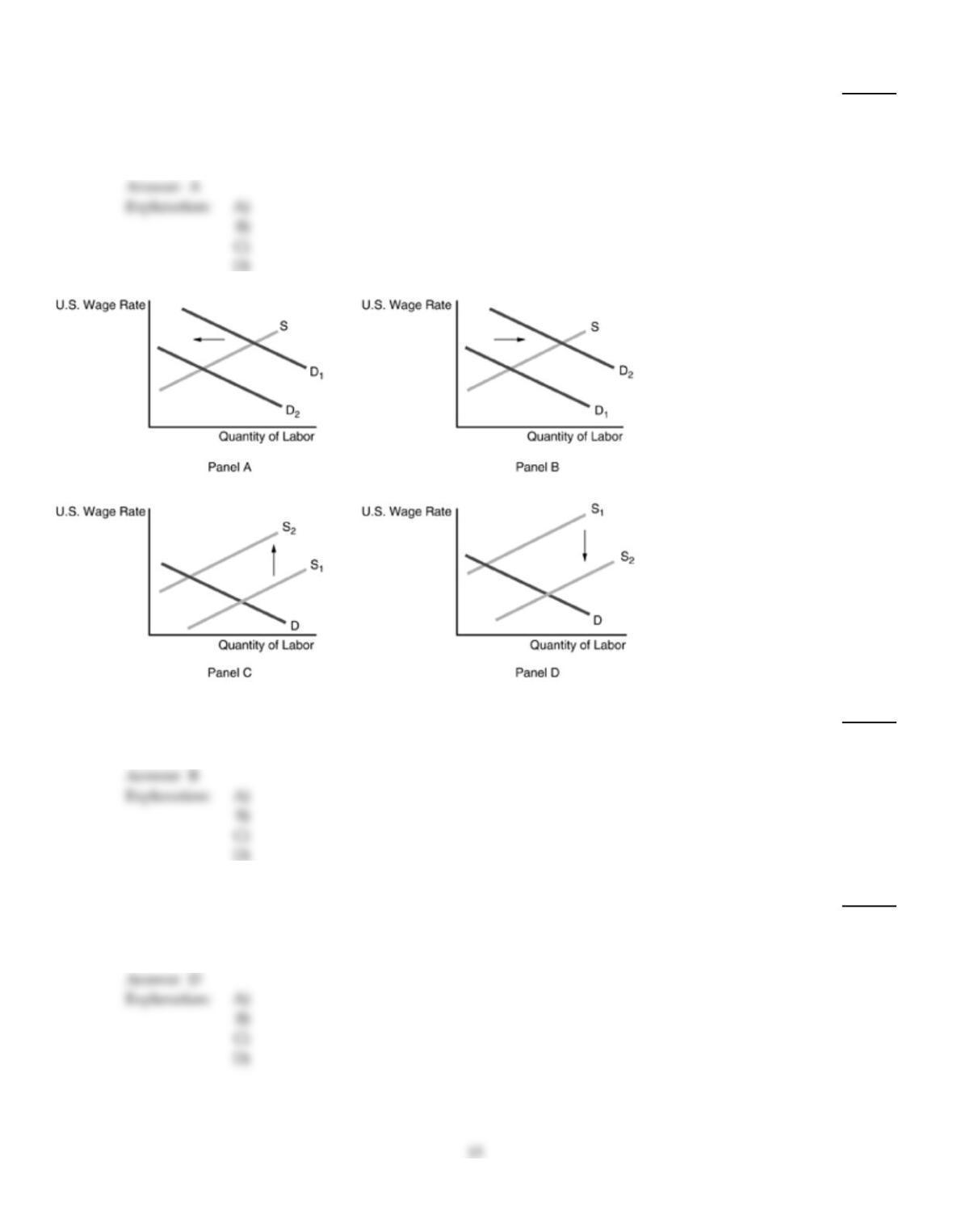
Refer to the above figure. Which panel represents what happens in the foreign job market in the
short–run when U.S. firms substitute labor outside of the U.S. for labor inside the U.S.?
43)
A)
Panel A
B)
Panel B
C)
Panel C
D)
Panel D
44)
When 4 units of labor are employed, total product is 6 units; when 5 units of labor are employed,
total product is 9 units of output. If the price of output is $5 per unit, what is the marginal revenue
product of the 5th unit of labor?
44)
A)
$3
B)
$45
C)
$5
D)
$15

45)
Suppose the MRP of the 49th worker at a firm is $25 and that the market wage rate is $15. We know
that if this firm operates in perfectly competitive product and labor markets
45)
A)
the firm would be more profitable if it hired more workers.
B)
the firm’s profits would increase if it fired some workers.
C)
the firm is paying wages above the minimum wages.
D)
the firm should use more capital.
46)
In a perfectly competitive situation, the profit–maximizing hiring situation for all inputs being used
is where
46)
A)
the MRP of each input is greater than the price of each input.
B)
the MRP of each input is less than the price of each input.
C)
the MRP of each input is equal to the price of each input.
D)
There is no relationship between MRP and the prices of the inputs.
47)
We would expect unions to have a more difficult time negotiating higher wages for their members
when
47)
A)
the product produced makes up a small portion of families’ budgets.
B)
there are not good substitutes for labor in the production process.
C)
labor represents a small portion of total costs.
D)
the product produced has several close substitutes.
48)
If a firm wants to maximize profits it should
48)
A)
hire lots of capital and very little labor since labor needs to be trained.
B)
equate the marginal revenue product for each input to the price of the input.
C)
hire unskilled labor rather than skilled labor since unskilled labor is cheaper.
D)
equate the marginal physical product for each input to the price of the input.
49)
The demand for labor is
49)
A)
totally unrelated to the demand curve for the final product.
B)
derived from a utility maximizing process similar to that used to derive the demand curve for
goods and services.
C)
derived from the satisfaction that hiring the inputs provides the owner or manager of the firm
more money.
D)
derived from the demand for the final product being produced.
50)
Suppose at the current level of labor used, MRP = $100 and MFC = $50. To maximize profits, the
firm should
50)
A)
maintain the current level of labor.
B)
shut down.
C)
reduce the level of labor.
D)
hire more labor.
D
51)
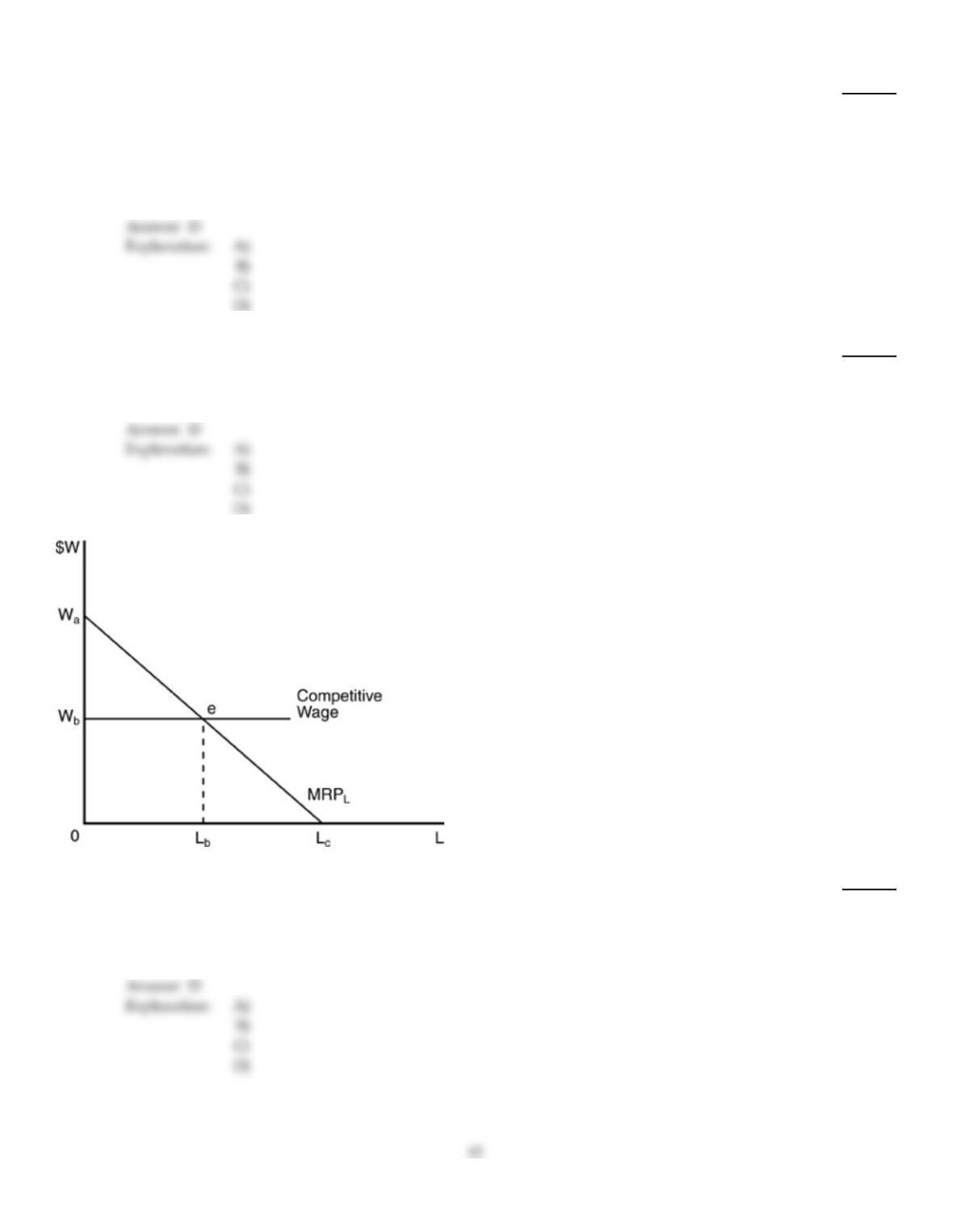
In the above figure, if the wage rate fell below Wb, in the short run the firm would
51)
A)
fire several workers.
B)
keep all its input levels the same as they were before.
C)
reduce its level of output.
D)
hire more workers.
D
D

52)
A firm will hire a unit of input up to the point where
52)
A)
the price of the input is equal to the price of output.
B)
the marginal physical product of the input is equal to the price of output.
C)
the marginal revenue product of the input is equal to the marginal factor cost of the input.
D)
the marginal cost of the input equals the marginal cost of output.
53)
Which of the following would cause the price elasticity of demand for a variable input to be
greater?
53)
A)
the longer the time period being considered
B)
the smaller the price elasticity of demand for the final product
C)
the smaller the proportion of total costs accounted for by the variable input
D)
The harder it is for a variable input to be substituted for by other inputs.
54)
For a firm in a perfectly competitive labor market, the supply curve of labor is
54)
A)
perfectly elastic.
B)
perfectly inelastic.
C)
elastic.
D)
inelastic.
Quantity of Marginal Physical Price of Marginal
Workers Total Product Product Final Product Revenue Product
1 7 $10
218 9
330 8
440 7
548 6
652 5
55)
In the above table, what is the marginal revenue product of the 4th worker?
55)
A)
$8
B)
$40
C)
$92
D)
$70

56)
The additional cost associated with hiring one additional unit of some factor input, such as labor, is
referred to as
56)
A)
marginal revenue cost.
B)
marginal physical product of labor.
C)
marginal factor cost.
D)
marginal revenue product.
57)
The elasticity of demand for labor will be less the
57)
A)
easier it is to substitute one input for another.
B)
longer the time period.
C)
less the demand elasticity for the final product.
D)
larger the share of total costs accounted for by labor.
C
58)
When the price of a product decreases, the marginal revenue product curve in a perfectly
competitive market
58)
A)
becomes flatter.
B)
does not change.
C)
shifts to the right.
D)
shifts to the left.
D
59)
If MFC < MRPL, the firm should
59)
A)
reduce the number of workers.
B)
hire more workers.
C)
lower wages.
D)
get rid of some capital.
B
C

60)
The wage rate for widget makers is currently $25 per hour and Ajax hires 20 widget makers. If the
wage rate were decreased to $20, what would happen to the marginal revenue product for labor at
Ajax?
60)
A)
It would increase since Ajax’s demand for labor curve will shift.
B)
It would increase since the price of widgets would decrease.
C)
It would decrease since Ajax will hire more workers.
D)
It would remain the same.
61)
If the marginal revenue product of an input exceeds the marginal factor cost of the input, the firm
61)
A)
should increase its use of the input.
B)
should hire less of the input.
C)
is not on its marginal cost curve.
D)
is maximizing profit.
A
62)
Derived demand means
62)
A)
labor demand is derived from demand for the product it produces.
B)
labor demand is determined by the supply of labor.
C)
the labor demand curve will be upward sloping.
D)
labor demand will shift about in a random fashion.
A
63)
Marginal factor cost is
63)
A)
the total value of factor cost divided by the one cost that is being held constant.
B)
the change in the value of output from using an additional unit of the factor.
C)
the cost of an additional unit of output.
D)
the cost of using an additional unit of an input.
D
C

64)
The demand for computers increases. As a result
64)
A)
the quantity demanded of workers increases, the wage rate rises, and the supply of labor
increases.
B)
the demand for workers increases, hiring increases, but wages stay the same since each firm
faces a horizontal supply curve of labor.
C)
the wage rate increases in the industry and the quantity supplied of workers increases.
D)
the wage rate increases in the industry and the quantity demanded of workers falls.
65)
Marginal factor cost is computed as
65)
A)
change in the total cost of the resource/total amount of the resource being used.
B)
change in the total cost of the resource/change in the amount of the resource being used.
C)
total cost of the resource/change in the amount of the resource being used.
D)
total cost of the resource/total amount of the resource being used.
66)
The demands for labor and other input factors are called
66)
A)
developed demands, because the demand for these inputs is developed from an analysis of
the costs of advertising products.
B)
reverse demands, because the demand for these inputs varies inversely with the demand for
goods and services they are employed to produce.
C)
derived demands, because the demand for these inputs depends on the demand for goods
and services they are employed to produce.
D)
indirect demands, because the demand for these inputs is indirectly related to the costs of
advertising products.
67)
A perfectly competitive firm discovers that its MRPL divided by the wage equals 1.25. The firm
should
67)
A)
hire more labor.
B)
check the MRP of the other inputs and divide them by their prices. If they are all equal to 1.25
it is maximizing profits.
C)
try to pay a lower wage rate.
D)
purchase more capital.

68)
Which of the following will NOT shift the MRP curve for labor?
68)
A)
a change in the productivity of labor
B)
a change in the demand for the product being produced
C)
a change in the wage rate in the market
D)
a change in the price of the product being sold
69)
A monopolist will hire fewer workers than a perfectly competitive firm because
69)
A)
the marginal product curve decreases as additional units of labor are hired for a monopoly
but not for a competitive firm.
B)
marginal revenue is greater than price for a monopoly while marginal revenue is equal to
price for a competitive firm.
C)
to sell an additional unit of the good the competitive firm will keep the price the same while
the monopolist must lower it on all units sold.
D)
there is a variety of employers in a competitive market and only one in a monopoly.
C
70)
If the additional revenue from hiring an additional worker equals the additional costs from hiring
the extra worker, then we know that
70)
A)
MFC/MRPL= 1.
B)
MFC = MPPL.
C)
MRPL/P = MFC.
D)
MFC/MPPL= wage.
A
71)
The cost of hiring one more worker, ceteris paribus, is known as
71)
A)
marginal revenue product.
B)
marginal wage.
C)
marginal physical product.
D)
marginal factor cost.
D
C