
College Physics: A Strategic Approach, 3e (Knight)
Chapter 28 Quantum Physics
28.1 Conceptual Questions
1) Two sources emit beams of microwaves. The microwaves from source A have a frequency of
10 GHz, and the ones from source B have a frequency of 20 GHz. This is all we know about the
two beams. Which of the following statements about these beams are correct? (There could be
more than one correct choice.)
A) Beam B carries twice as many photons per second as beam A.
B) A photon in beam B has twice the energy of a photon in beam A.
C) The intensity of beam B is twice as great as the intensity of beam A.
D) A photon in beam B has the same energy as a photon in beam A.
E) None of the above statements are true.
2) Two sources emit beams of light of wavelength 550 nm. The light from source A has an
intensity of 10 µW/m2, and the light from source B has an intensity of 20 µW/m2. This is all we
know about the two beams. Which of the following statements about these beams are correct?
(There could be more than one correct choice.)
A) Beam B carries twice as many photons per second as beam A.
B) A photon in beam B has twice the energy of a photon in beam A.
C) The frequency of the light in beam B is twice as great as the frequency of the light in beam A.
D) A photon in beam B has the same energy as a photon in beam A.
E) None of the above statements are true.
3) A beam of light falling on a metal surface is causing electrons to be ejected from the surface.
If we now double the frequency of the light, which of the following statements are correct?
(There could be more than one correct choice.)
A) The kinetic energy of the ejected electrons doubles.
B) The speed of the ejected electrons doubles.
C) The number of electrons ejected per second doubles.
D) Twice as many photons hit the metal surface as before.
E) None of the above things occur.

4) Light of a given wavelength is used to illuminate the surface of a metal, however, no
photoelectrons are emitted. In order to cause electrons to be ejected from the surface of this
metal you should
A) use light of a longer wavelength.
B) use light of a shorter wavelength.
C) use light of the same wavelength but increase its intensity.
D) use light of the same wavelength but decrease its intensity.
5) A blue laser beam is incident on a metallic surface, causing electrons to be ejected from the
metal. If the frequency of the laser beam is increased while the intensity of the beam is held
fixed,
A) the rate of ejected electrons will decrease and their maximum kinetic energy will increase.
B) the rate of ejected electrons will remain the same but their maximum kinetic energy will
increase.
C) the rate of ejected electrons will increase and their maximum kinetic energy will increase.
D) the rate of ejected electrons will remain the same but their maximum kinetic energy will
decrease.
6) Monochromatic light falls on a metal surface and electrons are ejected. If the intensity of the
light is increased, what will happen to the ejection rate and maximum energy of the electrons?
A) greater rate; same maximum energy.
B) same rate; greater maximum energy.
C) greater rate; greater maximum energy.
D) same rate; same maximum energy.
7) When the surface of a metal is exposed to blue light, electrons are emitted. If the intensity of
the blue light is increased, which of the following things will also increase?
A) the number of electrons ejected per second
B) the maximum kinetic energy of the ejected electrons
C) the time lag between the onset of the absorption of light and the ejection of electrons
D) the work function of the metal
E) all of the above
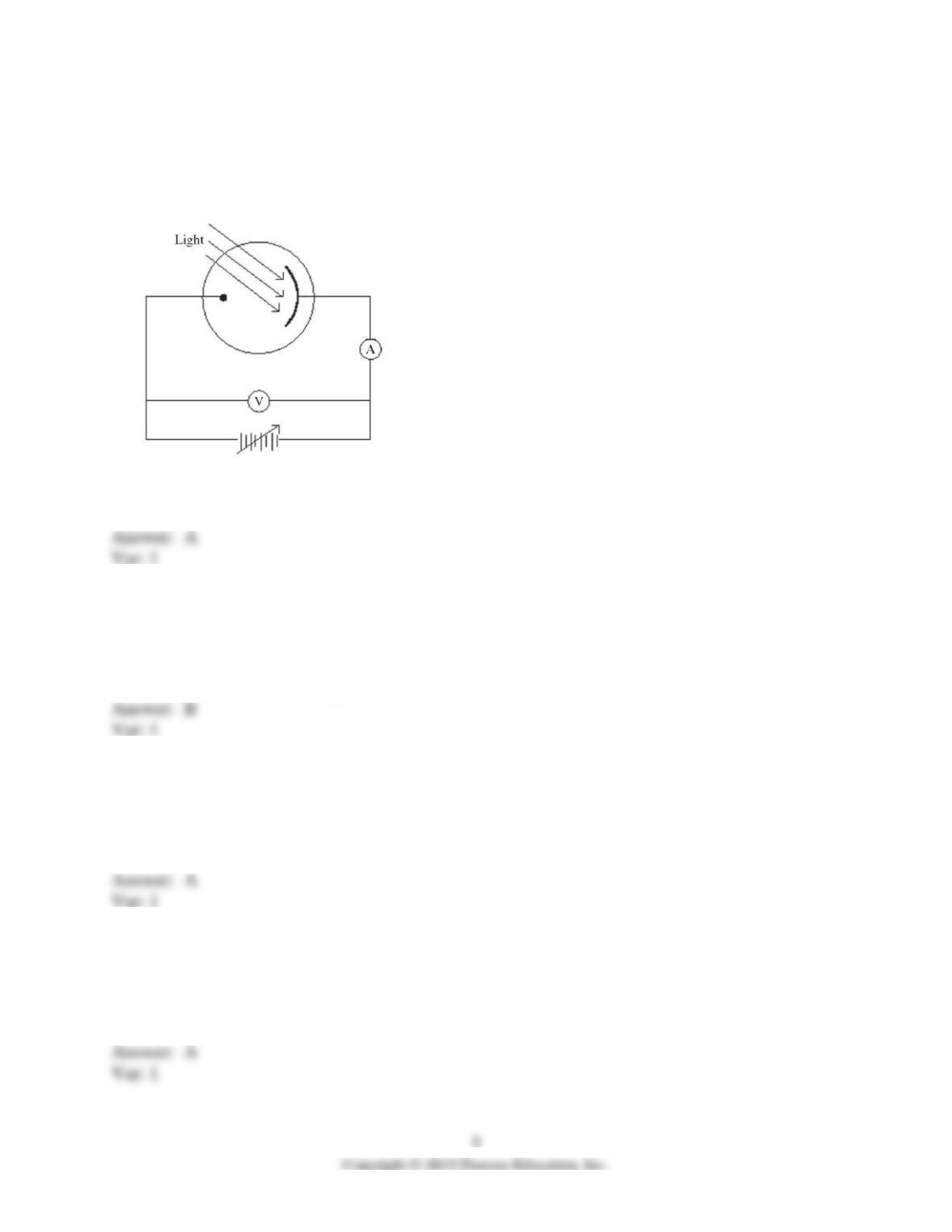
8) Monochromatic light is incident on a metal surface, and the ejected electrons give rise to a
current in the circuit shown in the figure. The maximum kinetic energy of the ejected electrons
is determined by applying a reverse (‘stopping’) potential, sufficient to reduce the current in the
ammeter to zero. If the intensity of the incident light is increased, how will the required stopping
potential change?
A) It will remain unchanged.
B) It will increase.
C) It will decrease.
9) If the wavelength of a photon in vacuum is the same as the de Broglie wavelength of an
electron, which one is traveling faster through space?
A) The electron because it has more mass.
B) The photon because photons always travel through space faster than electrons.
C) They both have the same speed.
10) If a proton and an electron have the same de Broglie wavelengths, which one is moving
faster?
A) the electron
B) the proton
C) They both have the same speed.
11) If a proton and an electron have the same speed, which one has the longer de Broglie
wavelength?
A) the electron
B) the proton
C) It is the same for both of them.

12) Which of the following actions will increase the de Broglie wavelength of a speck of dust?
(There could be more than one correct choice.)
A) Increase its mass.
B) Increase its speed.
C) Decrease its mass.
D) Decrease its speed.
E) Decrease its momentum.
13) Protons are being accelerated in a particle accelerator. When the energy of the protons is
doubled, their de Broglie wavelength will
A) increase by a factor of 4.
B) increase by a factor of 2.
C) decrease by a factor of 2.
D) increase by a factor of .
E) decrease by a factor of .
14) Protons are being accelerated in a particle accelerator. When the speed of the protons is
doubled, their de Broglie wavelength will
A) increase by a factor of 4.
B) increase by a factor of 2.
C) decrease by a factor of 2.
D) increase by a factor of .
E) decrease by a factor of .
15) A proton and an electron are both accelerated to the same final speed. If λp is the de Broglie
wavelength of the proton and λe is the de Broglie wavelength of the electron, then
A) λp > λe.
B) λp = λe.
C) λp < λe.
16) A proton and an electron are both accelerated to the same final kinetic energy. If λp is the de
Broglie wavelength of the proton and λe is the de Broglie wavelength of the electron, then
A) λp > λe.
B) λp = λe.
C) λp < λe.

17) If the maximum possible accuracy in measuring the position of a particle increases, the
maximum possible accuracy in measuring its velocity will
A) increase.
B) decrease.
C) not be affected.
18) If the maximum possible accuracy in measuring the velocity of a particle increases, the
maximum possible accuracy in measuring its position will
A) increase.
B) decrease.
C) not be affected.
28.2 Problems
1) A researcher is using x-rays to investigating a cubic crystal. He is looking at Bragg reflection
from the planes parallel to the cube faces. He finds that when using x-rays with a wavelength of
0.165 nm, a strong first maximum occurs when the beam makes an angle of 23.5° with the
planes. What is the spacing of adjacent atoms in this crystal?
2) Certain planes of a crystal of halite have a spacing of 0.399 nm. The crystal is irradiated by a
beam of x-rays. First order constructive interference occurs when the beam makes an angle of
20° with the planes of the crystal surface. What is the wavelength of the x-rays?
A) 0.14 nm
B) 0.17 nm
C) 0.21 nm
D) 0.24 nm
E) 0.27 nm
3) Certain planes of a crystal of halite have a spacing of 0.399 nm. The crystal is irradiated by a
beam of x-rays. First order constructive interference occurs when the beam makes an angle of
20° with the planes of the crystal surface. What angle does the beam make with the crystal planes
for second order constructive?
A) 37°
B) 40°
C) 43°
D) 46°
E) 49°

4) A crystal is irradiated with x-rays with a wavelength of 0.120 nm. The atomic planes in the
crystal are separated by 0.21 nm. At what angles of incidence with respect to the normal will the
x-rays reflect from the crystal?
A) 73°, 55°, 31°
B) only 55°
C) only 73° and 31°
D) only 73°
5) The lattice spacing of the principal Bragg planes in sodium chloride is 0.282 nm. For what
wavelength of x-rays will the first order reflected beam diffract at 55° with respect to the normal
to the crystal planes?
A) 0.323 nm
B) 0.530 nm
C) 0.662 nm
D) 0.150 nm
E) 0.462 nm
6) What is the wavelength of a 6.32-eV photon? (c = 3.00 × 10⁸ m/s, h = 6.626 × 10⁻³⁴ J ∙ s, 1
eV = 1.60 × 10⁻¹⁹ J)
A) 197 nm
B) 167 nm
C) 216 nm
D) 234 nm
7) Gamma rays are photons with very high energy. What is the wavelength of a gamma-ray
photon with energy 7.7 × 10⁻¹³ J? (c = 3.0 × 10⁸ m/s, h = 6.626 × 10⁻³⁴ J ∙ s)
A) 2.6 × 10⁻¹³ m
B) 3.9 × 10⁻¹³ m
C) 3.1 × 10⁻¹³ m
D) 3.5 × 10⁻¹³ m

8) Gamma rays are photons with very high energy. How many visible-light photons with a
wavelength of 500 nm would you need to equal the energy of a gamma-ray photon with energy
A) 1.0 × 10⁶
B) 1.4 × 10⁸
C) 6.2 × 10⁹
D) 3.9 × 10³
9) An 84-kW AM radio station broadcasts at 1000 kHz. How many photons are emitted each
second by the transmitting antenna? (h = 6.626 × 10⁻³⁴ J ∙ s)
A) 1.3 ×
B) 2.9 ×
C) 6.3 ×
D) 1.4 ×
10) A laser pulse of duration 25 ms has a total energy of 1.4 J. If the wavelength of this radiation
is 567 nm, how many photons are emitted in one pulse? (c = 3.00 × 10⁸ m/s, h = 6.626 × 10⁻³⁴ J
∙ s)
A) 4.0 × 10¹⁸
B) 9.9 × 10¹⁹
C) 4.8 × 10¹⁹
D) 1.6 × 10¹⁷
E) 3.2 × 10¹⁷
11) A laser emits a pulse of light that lasts 10 ns. The light has a wavelength of 690 nm, and each
pulse has an energy of 480 mJ. How many photons are emitted in each pulse? (c = 3.0 × 10⁸ m/s,
h = 6.626 × 10⁻³⁴ J ∙ s)
A) 1.7 × 10¹⁸
B) 2.1 ×
C) 2.6 ×
D) 3.1 ×

12) For what wavelength does a 100-mW laser beam deliver 1.6 × 10¹⁷ photons in one second?
(c = 3.0 × 10⁸ m/s, h = 6.626 × 10⁻³⁴ J ∙ s)
A) 320 nm
B) 330 nm
C) 340 nm
D) 350 nm
13) A helium-neon laser emits light at 632.8 nm. If the laser emits photons/second,
what is its power output in mW? (c = 3.00 × 10⁸ m/s, h = 6.626 × 10⁻³⁴ J ∙ s)
A) 57.2 mW
B) 28.6 mW
C) 37.2 mW
D) 45.7 mW
14) A photoelectric surface has a work function of 2.10 eV. Calculate the maximum kinetic
energy, in eV, of electrons ejected from this surface by electromagnetic radiation of wavelength
356 nm. (1 eV = 1.60 × 10⁻¹⁹ J, c = 3.00 × 10⁸ m/s, h = 6.626 × 10⁻³⁴ J ∙ s)
15) If the longest wavelength of light that is able to dislodge electrons from a metal is 373 nm,
what is the work function of that metal, in electron-volts? (1 eV = 1.60 × 10⁻¹⁹ J, c = 3.00 × 10⁸
m/s, h = 6.626 × 10⁻³⁴ J ∙ s)
16) A metallic surface is illuminated with light of wavelength 400 nm. If the work function for
this metal is 2.40 eV, what is the maximum kinetic energy of the ejected electrons, in electron-
volts? (1 eV = 1.60 × 10⁻¹⁹ J, c = 3.00 × 10⁸ m/s, h = 6.626 × 10⁻³⁴ J ∙ s)
17) A metal surface has a work function of 2.50 eV. What is the longest wavelength of light that
will eject electrons from the surface of this metal? (1 eV = 1.60 × 10⁻¹⁹ J, c = 3.00 × 10⁸ m/s, h
= 6.626 × 10⁻³⁴ J ∙ s)

18) The work function of a particular metal is What is the photoelectric cutoff
(threshold) wavelength for this metal? (c = 3.00 × 10⁸ m/s, h = 6.626 × 10⁻³⁴ J ∙ s)
A) 473 nm
B) 308 nm
C) 393 nm
D) 554 nm
19) What is the cutoff (threshold) frequency for a metal surface that has a work function of 5.42
eV? (1 eV = 1.60 × 10⁻¹⁹ J, h = 6.626 × 10⁻³⁴ J ∙ s)
A) 1.31 × Hz
B) 2.01 × Hz
C) 3.01 × Hz
D) 5.02 × Hz
E) 6.04 × Hz
20) The work function of a certain metal is 1.90 eV. What is the longest wavelength of light that
can cause photoelectron emission from this metal? (1 eV = 1.60 × 10⁻¹⁹ J, c = 3.00 × 10⁸ m/s, h
= 6.626 × 10⁻³⁴ J ∙ s)
A) 231 nm
B) 14.0 nm
C) 62.4 nm
D) 344 nm
E) 654 nm
21) A metal has a work function of 4.50 eV. Find the maximum kinetic energy of the
photoelectrons if light of wavelength 250 nm shines on the metal. (1 eV = 1.60 × 10⁻¹⁹ J, c =
3.00 × 10⁸ m/s, h = 6.626 × 10⁻³⁴ J ∙ s)
A) 0.00 eV
B) 0.37 eV
C) 0.47 eV
D) 0.53 eV

22) What is the longest wavelength of light that can cause photoelectron emission from a metal
that has a work function of 2.20 eV? (1 eV = 1.60 × 10⁻¹⁹ J, c = 3.00 × 10⁸ m/s, h = 6.626 × 10–
34 J ∙ s)
A) 417 nm
B) 257 nm
C) 344 nm
D) 565 nm
E) 610 nm
23) Light with a wavelength of 310 nm is incident on a metal that has a work function of 3.80
eV. What is the maximum kinetic energy that a photoelectron ejected in this process can have?
(1 eV = 1.60 × 10⁻¹⁹ J, c = 3.00 × 10⁸ m/s, h = 6.626 × 10⁻³⁴ J ∙ s)
A) 0.62 × 10⁻¹⁹ J
B) 0.21 × 10⁻¹⁹ J
C) 0.36 × 10⁻¹⁹ J
D) 0.48 × 10⁻¹⁹ J
E) 0.33 × 10⁻¹⁹ J
24) Light with a frequency of 8.70 × 10¹⁴ Hz is incident on a metal that has a work function of
2.80 eV. What is the maximum kinetic energy that a photoelectron ejected in this process can
have? (1 eV = 1.60 × 10⁻¹⁹ J, h = 6.626 × 10⁻³⁴ J ∙ s)
A) 8.7 × 10⁻¹⁹ J
B) 3.1 × 10⁻¹⁹ J
C) 1.3 × 10⁻¹⁹ J
D) 2.4 × 10⁻¹⁹ J
E) 4.5 × 10⁻¹⁹ J
25) If the work function of a metal surface is 2.20 eV, what frequency of incident light would
give a maximum kinetic energy of 0.25 eV to the photoelectrons ejected from this surface? (1 eV
= 1.60 × 10⁻¹⁹ J, h = 6.626 × 10⁻³⁴ J ∙ s)
A) 2.05 × 10¹⁴ Hz
B) 1.02 × 10¹⁴ Hz
C) 2.50 × 10¹⁴ Hz
D) 3.53 × 10¹⁴ Hz
E) 5.92 × 10¹⁴ Hz

26) A beam of light with a frequency range from 3.01 × 10¹⁴ Hz to 6.10 × 10¹⁴ Hz is incident
on a metal surface. If the work function of the metal surface is 2.20 eV, what is the maximum
kinetic energy of photoelectrons ejected from this surface? (h = 6.626 × 10⁻³⁴ J ∙ s, 1 eV = 1.60
× 10-19 J)
A) 0.33 eV
B) 0.21 eV
C) 0.42 eV
D) 0.16 eV
E) 0.48 eV
27) When it is struck by 240-nm photons, a metal ejects electrons with a maximum kinetic
energy of What is the work function of this material? (c = 3.00 × 10⁸ m/s, h = 6.626 ×
10-34 J ∙ s, 1 eV = 16.0 × 10⁻¹⁹ J)
A) 2.60 eV
B) 2.18 eV
C) 3.02 eV
D) 3.43 eV
28) When a metal is illuminated by light, photoelectrons are observed provided that the
wavelength of the light is less than 520 nm. What is the metal’s work function? (c = 3.00 × 10⁸
m/s, h = 6.626 × 10⁻³⁴ J ∙ s, 1 eV = 1.60 × 10⁻¹⁹ J)
A) 2.4 eV
B) 2.6 eV
C) 2.8 eV
D) 3.0 eV
29) What is the longest wavelength of electromagnetic radiation that will eject photoelectrons
from sodium metal for which the work function is 2.28 eV? (c = 3.00 × 10⁸ m/s, h = 6.626 × 10–
34 J ∙ s, 1 eV = 1.60 × 10⁻¹⁹ J)
A) 580 nm
B) 499 nm
C) 633 nm
D) 668 nm
E) 545 nm