
55) Your friend tells you that as long as you can track the exact day that a woman ovulates, and
as long as a woman does not have sexual intercourse on this day, then she will not get pregnant
even if no form of contraception is used. Is your friend correct? Why or why not?
A) Yes. Sperm can only fertilize an egg on the day that ovulation occurs, so as long as sexual
intercourse does not occur on this day, the woman will not become pregnant.
B) Yes. High levels of FSH and LH are needed for fertilization to occur, and the levels of FSH
and LH do not rise until the exact day that ovulation occurs.
C) No. Even after ovulation occurs, a woman’s egg remains in the uterus for at least a week and
is able to be fertilized by sperm during this time period.
D) No. Sperm can survive in the female reproductive tract, so having sexual intercourse a few
days before ovulation can result in pregnancy.
56) Which of the following would be the most likely outcome if androgen receptors on cells in
the hypothalamus and anterior pituitary suddenly could not bind androgen?
A) Sperm production would increase.
B) Sperm production would decrease.
C) FSH production would decrease.
D) HCG production would increase.
57) Suppose that diploid cells of the seminiferous tubules encounter errors during the cell cycle
and mitosis. This results in the primary spermatocytes having a 4n number of chromosomes.
Assuming that meiosis proceeds normally, which of the following would be true?
A) Sperm cells would have an n number of chromosomes.
B) Sperm cells would have a 2n number of chromosomes.
C) Secondary spermatocytes would have a 4n number of chromosomes.
D) Secondary spermatocytes would have an n number of chromosomes.

58) A vasectomy is a form of male sterilization in which each vas deferens is cut, but most of the
male’s reproductive physiology remains intact. Which of the following will not continue to occur
in a male who has had a vasectomy?
A) Sperm will be produced in the seminiferous tubules.
B) Seminal fluid will be ejaculated from the penis during orgasm.
C) Glandular secretions will be ejaculated from the penis during orgasm.
D) Sperm will be ejaculated from the penis during orgasm.
59) Home pregnancy test kits work by detecting the presence of a hormone in a woman’s urine.
Recently developed test kits include an indicator of how long the women has been pregnant (1-2,
2-3, or 3+ weeks). The presence of ________ would indicate that a woman is pregnant, and
________ levels of this hormone would indicate that she is farther along in her pregnancy.
A) HCG; low
B) HCG; high
C) FSH; low
D) FSH; high
60) Asthenozoospermia is a medical condition that is characterized by reduced sperm motility.
What structure of the sperm is likely affected in a man who has asthenozoospermia?
A) acrosome
B) head
C) middle piece
D) flagellum

61) The acrosome of sperm cells contains an enzyme called hyaluronidase. Which of the
following procedures would benefit from the addition of hyaluronidase?
A) ligating two strands of DNA together
B) helping a drug to pass through a cell membrane
C) assisting with mitotic division of skin cells
D) increasing levels of FSH released from the hypothalamus
62) You are observing a developing embryo under a microscope and see that it has a space in the
middle of the endoderm, but no features of a notochord are present. In which stage of
development is this embryo?
A) zygote
B) blastula
C) gastrula
D) fetus
63) A pregnant woman goes to her obstetrician for her first ultrasound. After the exam is over,
the doctor remarks, “It looks like the ribs are still developing, and I might even have seen some
tiny fingers and toes.” How many weeks pregnant is this woman?
A) less than 5 weeks
B) between 5 and 8 weeks
C) between 8 and 14 weeks
D) more than 14 weeks

64) Meconium is the clinical term used for the earliest stool (fecal matter) of a newborn human
infant, which is usually very sticky (like tar), almost completely odorless, and dark olive green in
color. Meconium takes this form due to materials that the fetus orally ingests while in the uterus.
Which of the following materials would the fetus likely ingest during development?
A) amniotic fluid
B) placental blood
C) digestive products from the mother
D) blood from the mother
65) If a woman has reached or passed her due date (the date that a woman is expected to give
birth), her obstetrician may inject her with hormones to help initiate labor. Which of the
following hormones would assist the most in the initiation of labor?
A) HCG
B) FSH
C) progesterone
D) oxytocin
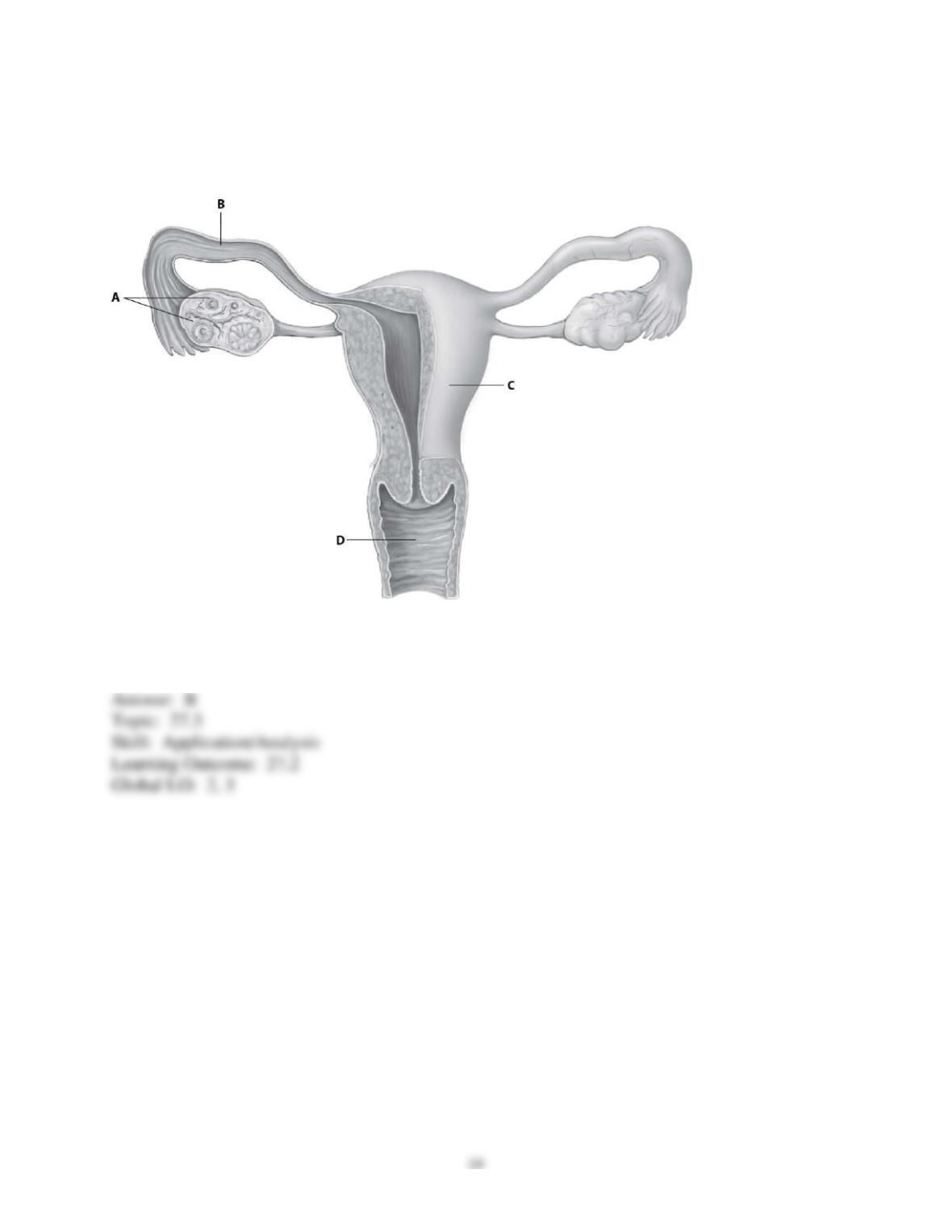
27.2 Art Questions
1) In which part of the human female reproductive system does fertilization normally take place?
A) part A
B) part B
C) part C
D) part D
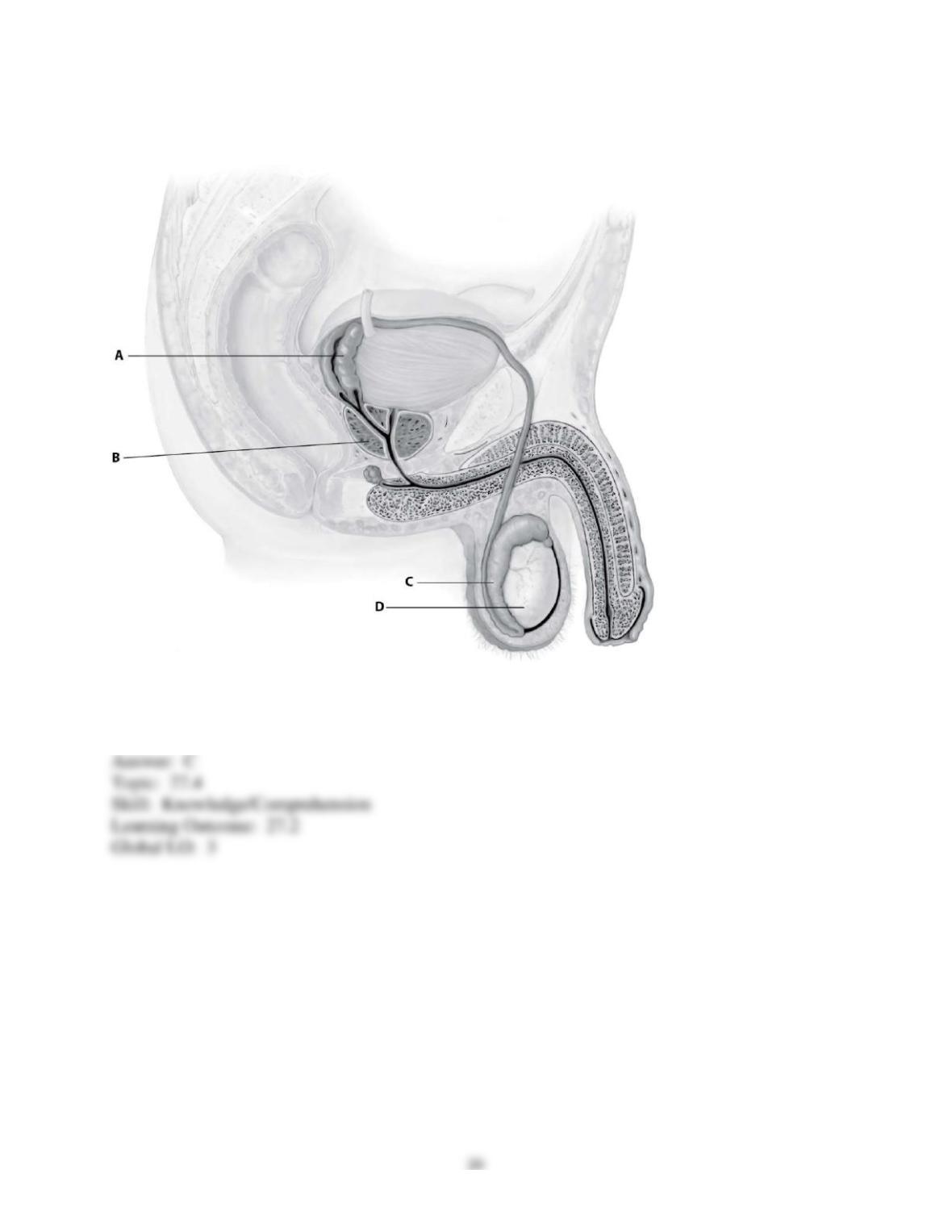
2) Which part of this figure depicting the human male reproductive system is the epididymis?
A) part A
B) part B
C) part C
D) part D
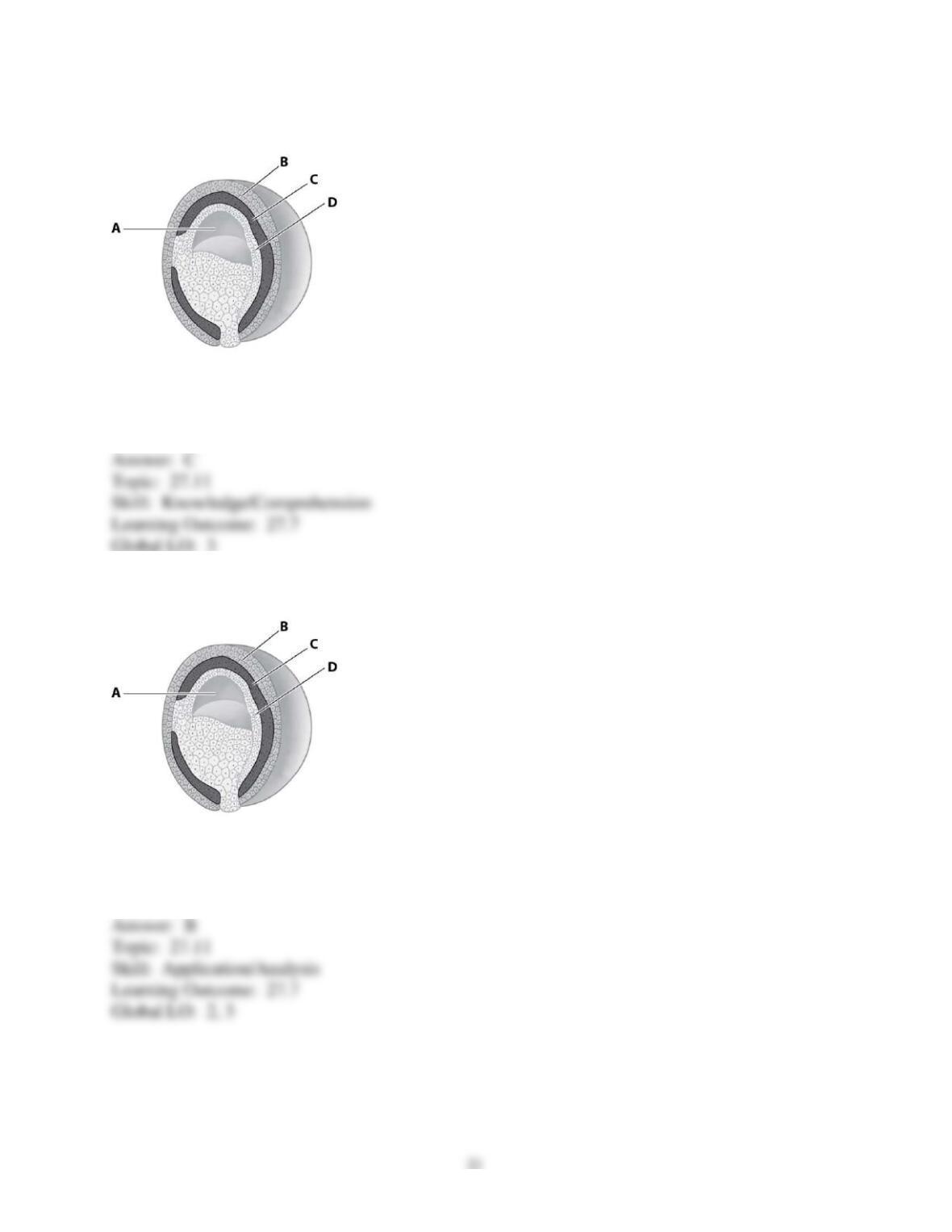
3) Which part of this figure depicting a gastrula is the mesoderm?
A) part A
B) part B
C) part C
D) part D
4) From which part of this figure will the nervous system develop?
A) part A
B) part B
C) part C
D) part D

5) What part in the figure below will develop into the placenta?
A) part A
B) part B
C) part C
D) part D
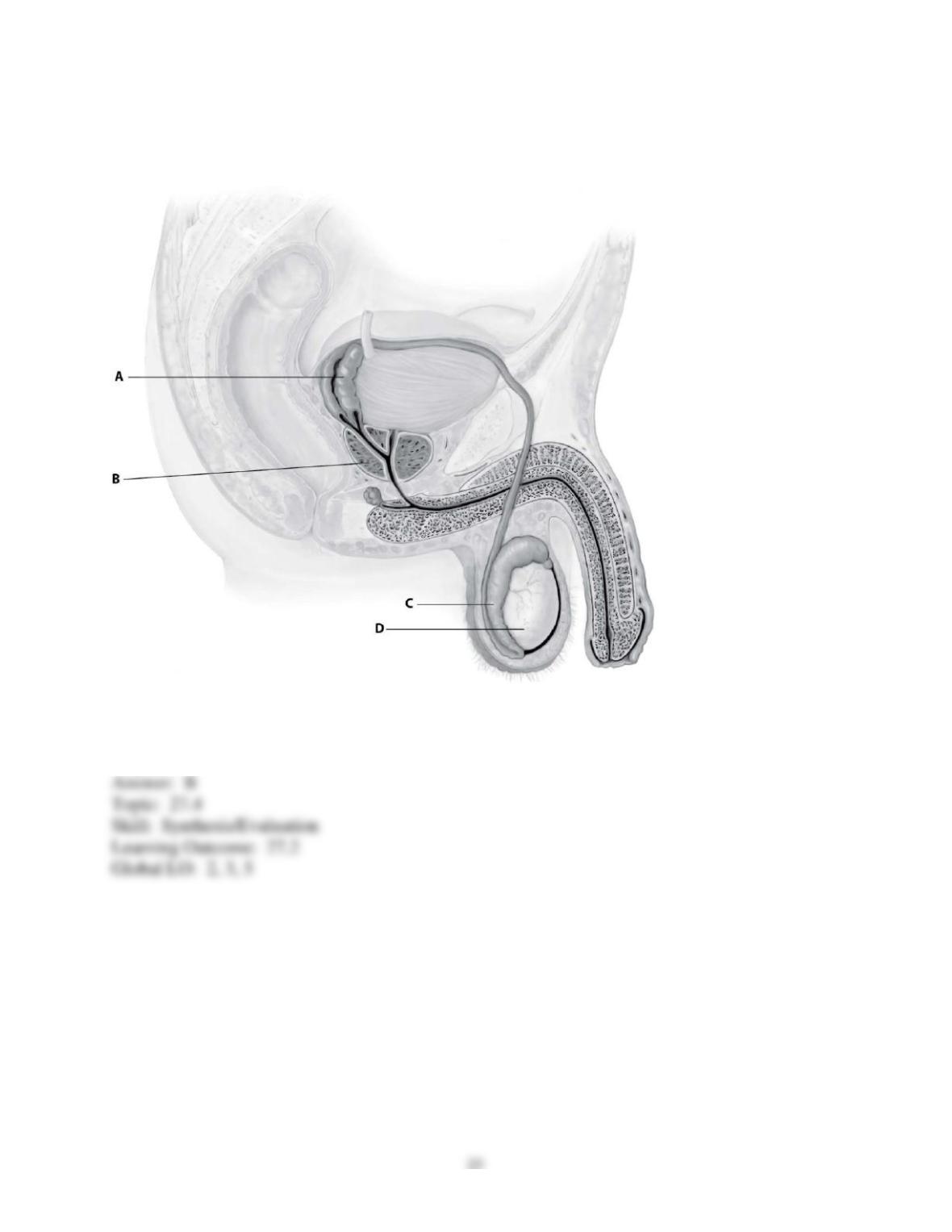
6) Which gland may swell due to common medical problems in older men and cause increased
frequency of urination?
A) part A
B) part B
C) part C
D) part D
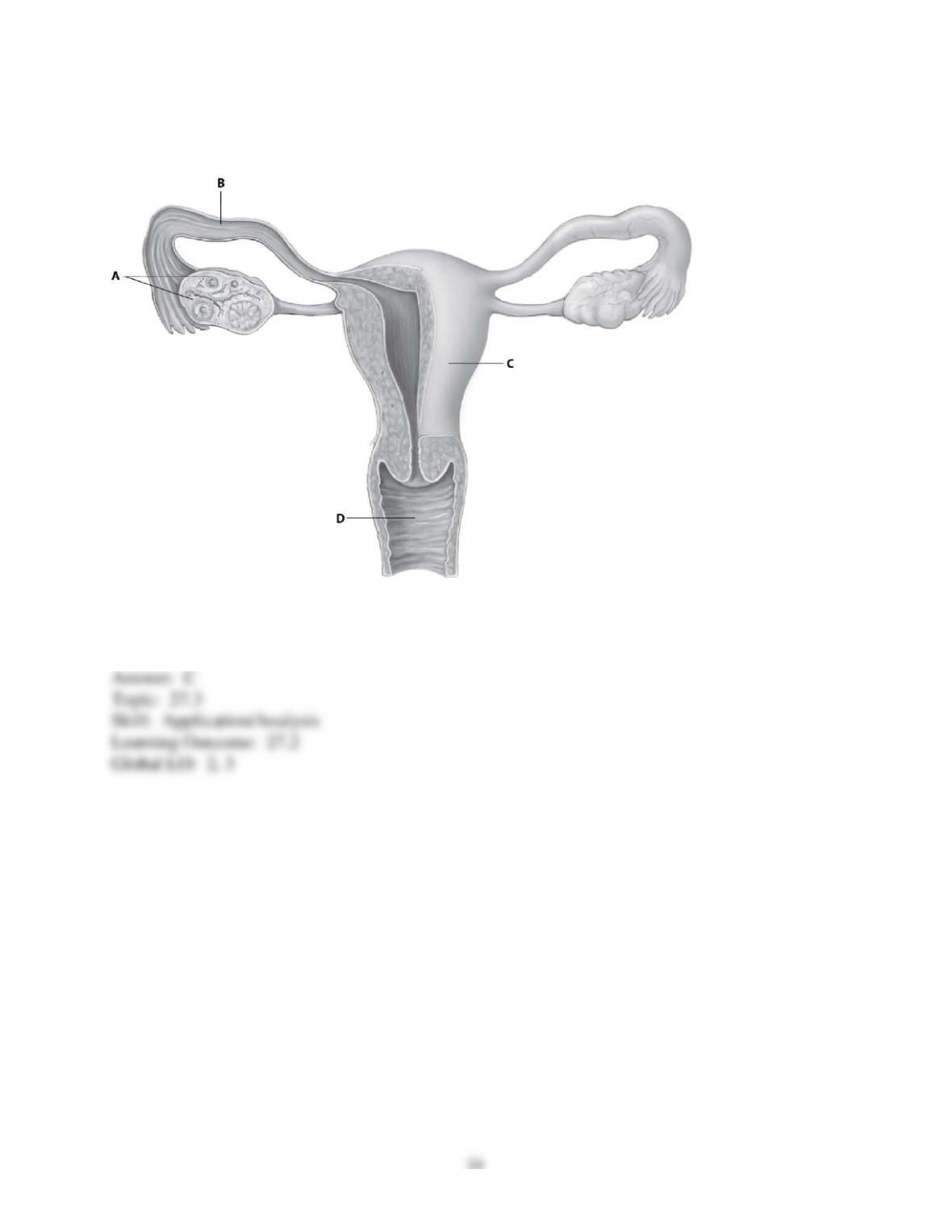
7) In which part of the human female reproductive system does implantation normally take
place?
A) part A
B) part B
C) part C
D) part D

27.3 Scenario Questions
After reading the paragraph below, answer the questions that follow.
Brittany’s family includes several individuals with a genetic disorder that affects primarily males.
Her husband Tony has no history of the disease. They have decided that their best chance to have
a healthy family is to have only daughters. Through a new type of assisted reproductive
technology, it is possible to separate sperm that will produce sons from those that will produce
daughters. Brittany’s eggs will be fertilized by in vitro fertilization (IVF) with sperm that can
produce only daughters. The developing female embryo can be implanted into her uterus to
complete development normally.
1) The daughter-producing sperm used to fertilize Brittany’s eggs should be
A) diploid primary spermatocytes.
B) haploid secondary spermatocytes.
C) haploid sperm cells.
D) diploid sperm cells.
2) For IVF to be completed successfully, several ________ should be removed from Brittany’s
ovaries.
A) primary oocytes
B) secondary oocytes
C) follicles
D) endometrial fragments

After reading the paragraphs below, answer the questions that follow.
Home pregnancy test kits can detect whether a woman is pregnant within one to three weeks of
her egg being fertilized. The test kits include a short strip of paper that extends from a plastic
case. After a woman urinates on the strip of paper and waits three to five minutes, a symbol is
displayed on a small window in the plastic case. Some tests show a single line to indicate the
woman is not pregnant (negative result) and two lines to indicate she is pregnant (positive result).
Others show a minus or plus sign (or some other variation) to indicate negative and positive
results.
The test reports a positive symbol if it detects the presence of HCG in the woman’s urine. In
order for HCG to be detected, it must be present in the urine at a concentration of at least 10 to
100 units per milliliter. Even though home pregnancy tests are well designed and have been
tested extensively, false negative and false positive results do occur. A false positive occurs
when a test tells a woman that she is pregnant when she really is not, and a false negative occurs
when a test tells a woman that she is not pregnant when she really is. Most home pregnancy test
kit manufacturers claim that their tests are over 99% accurate.
3) What would be the best experiment for a manufacturer to conduct in order to determine the
false negative rate of their test kits?
A) Have a group of women who are less than five weeks pregnant use the test and count the
number of false negative results.
B) Have a woman use the test before she is pregnant and again after she is pregnant and
determine whether the tests were positive or negative.
C) Have a group of women who are 32 weeks pregnant use the test and count the number of false
negative results.
D) Have a group of women who are not pregnant use the test and count the number of false
negative results.

4) What would be the best experiment for a manufacturer to conduct in order to determine the
false positive rate of their test kits?
A) Have a group of women who are less than five weeks pregnant use the test and count the
number of false positive results.
B) Have a woman use the test before she is pregnant and again after she is pregnant and
determine whether the tests were positive or negative.
C) Have a group of women who are 32 weeks pregnant use the test and count the number of false
positive results.
D) Have a group of women who are not pregnant use the test and count the number of false
positive results.
5) If you were designing a home pregnancy test kit, which of the following statements would you
include in the instructions in an attempt to minimize false negative results?
A) Use the test immediately after having sexual intercourse.
B) Drink several large glasses of water. Wait one hour and then take the test.
C) Take the test, and 30 seconds later check the results of the test.
D) Wait at least a week after missing the start of your menstrual flow to take the test.
6) If you were designing a home pregnancy test kit, which of the following statements would you
include in the instructions in an attempt to minimize false positive results?
A) If you are taking fertility drugs containing hormones, have your physician validate the results.
B) Take the test, and 3 hours later check the results of the test.
C) Wait at least a week after missing the start of your menstrual cycle to take the test.
D) If you are taking fertility drugs containing androgens, have your physician validate the
results.