Biology: A Guide to the Natural World, 5e (Krogh)
Chapter 27 Communication and Control 1: The Nervous System
1) The cells of the nervous system that transmit nervous system messages are the:
A) glial cells.
B) dendrites.
C) synapses.
D) neurons.
2) The parts of the central nervous system are the:
A) afferent and efferent.
B) nerves and receptors.
C) brain and spinal cord.
D) autonomic and somatic.
3) The autonomic nervous system is a part of the:
A) central nervous system.
B) somatic nervous system.
C) peripheral nervous system.
D) appendicular nervous system.
4) The portion of the nervous system that most directly controls skeletal muscles is the:
A) somatic.
B) autonomic.
C) sympathetic.
D) parasympathetic.
E) afferent.
5) Cells in the central nervous system that are important for functions such as memory are the:
A) interneurons.
B) sensory neurons.
C) motor neurons.
D) glial cells.
6) Which of the following would send a signal to the central nervous system that you had
touched a hot object?
A) motor neuron
B) sensory neuron
C) interneuron
D) glial cell
7) Which of the following does the central nervous system use for the action of pulling your
hand away from a hot object?
A) receptors
B) sensory neurons
C) motor neurons
D) glial cells
8) An organ or group of cells that responds to a motor neuron is a/an:
A) effector.
B) receptor.
C) glial cell.
D) sensory organ.
3
9) White matter areas of the nervous system mostly contain:
A) neuron cell bodies.
B) myelinated axons.
C) cerebrospinal fluid.
D) ganglia.
10) Nerves would be best described as:
A) collections of motor neuron dendrites and cell bodies.
B) collections of sensory neuron dendrites and cell bodies.
C) bundles of dendrites in the peripheral nervous system (PNS).
D) bundles of axons in the peripheral nervous system (PNS).
11) When a neuron is at its “resting potential,” which of the following is true about the
concentration of sodium ions?
A) Sodium ions have a greater concentration inside the neuron’s cell membrane.
B) Sodium ions have a greater concentration outside the neuron’s cell membrane.
C) The sodium concentration is the same outside and inside the neuron’s cell membrane.
12) Part of the reason for the charge difference inside and outside a neuron’s membrane is:
A) excess potassium outside the membrane.
B) excess sodium inside the membrane.
C) negatively charged proteins inside the membrane.
D) positively charged proteins inside the membrane.
E) positively charged proteins outside the membrane.
13) A section of a neuron’s membrane becomes temporarily positive on the inside when:
A) ion channels open and sodium ions rush in.
B) ion channels open and potassium ions rush in.
C) negatively charged proteins exit the cell.
D) neurotransmitters enter the cell.
14) Inrushing sodium ions trigger the opening of nearby channels and movement of sodium
inward at that neighboring section of the membrane. What is occurring?
A) normal resting potential
B) an action potential
C) neurotransmitter release
D) protein movement
15) Which statement best describes how one neuron stimulates another?
A) Sodium ions jump across to the next neuron’s membrane.
B) The neurons are physically connected, so the action potential continues movement.
C) Calcium ions diffuse across the synapse.
D) Neurotransmitter molecules diffuse across the synapse.
16) A drug that causes potassium to leak out of the neuron would:
A) make it harder to trigger action potentials in the neuron.
B) cause the inside of the neuron to become more positive.
C) cause the outside of the neuron to become more negative.
D) make it easier to trigger action potentials in the neuron.
17) Spinal nerves emerging from the spinal cord are named for:
A) their basic function.
B) the organ they supply.
C) the portion of the vertebral column around them.
D) strictly the number sequence 1—30.
18) Axons of motor neurons first leave the spinal cord through the:
A) spinal nerve.
B) ventral roots.
C) dorsal roots.
D) dorsal root ganglion.
19) In a reflex such as the “knee jerk” or patellar reflex, the efferent signal travels through the:
A) spinal cord.
B) motor neuron.
C) sensory neuron.
D) interneuron.
20) Any collection of nerve cell bodies in the PNS is called a:
A) ganglion.
B) afferent nerve.
C) efferent nerve.
D) dendrite.
21) Routine activities and energy conservation are controlled by the:
A) peripheral nervous system.
B) parasympathetic division.
C) sympathetic division.
D) thalamus.
22) Which of the following would be a function of the sympathetic division?
A) stimulate the stomach
B) constrict the pupils
C) stimulate the gallbladder
D) accelerate heart rate
6
23) You are giving first aid to a semiconscious person who (before your arrival) told a bystander
something about taking a drug overdose. The person has dilated pupils and a dry mouth. You
recall reading that many drugs “mimic” the effects of nervous system functions, and you quickly
size up which part of the nervous system is being mimicked here. The bystander is calling 911.
In order to save time and best advise the emergency dispatcher about the treatment EMTs should
be prepared to begin when they arrive, you tell the bystander to tell the 911 operator that the drug
taken probably mimics which nervous system division?
A) somatic
B) parasympathetic
C) sympathetic
D) sfferent
24) Which of the following best describes the structural aspect of the cerebral cortex?
A) a thin band of gray matter making the outer layer of the cerebrum
B) a thick band of white matter making the outer layer of the cerebrum
C) a core of fast, myelinated axons in the interior of the brain
D) a cap of white matter over the spinal cord, made mostly of the thalamus
25) Most sensory information is routed through which structure before arriving in the cerebrum?
A) pons
B) medulla oblongata
C) midbrain
D) hypothalamus
E) thalamus
26) Which part of your brain processes the information in this question and, you hope, retrieves
the information necessary to answer it?
A) cerebellum
B) cerebral cortex
C) pons
D) hypothalamus
E) midbrain
27) The term “brain dead” may refer to the fact that all brain centers have ceased to function
except the:
A) cerebrum.
B) cerebellum.
C) thalamus.
D) hypothalamus.
E) medulla oblongata.
28) Proprioceptors provide us with:
A) sight.
B) hearing.
C) the sense of touch.
D) information about the position of the joints.
29) Which of the following best describes sensory receptors?
A) Sensory receptors interpret sensation.
B) Sensory receptors translate action potentials into stimuli.
C) Sensory receptors translate stimulation into action potentials.
D) Sensory receptors work through efferent pathways.
30) The Pacinian corpuscle is important to:
A) sight.
B) hearing.
C) the sense of touch.
D) information about the position of the joints.
8
31) Our “oldest” sense, which works in a very similar way in insects, is the sense of:
A) vision.
B) hearing.
C) smell.
D) touch.
32) Which statement about the sense of smell in humans is most accurate?
A) Smell is about equally as strong as taste.
B) One hundred different receptor varieties allow us to discern about 100 scents.
C) Combinations of over 300 receptors allow us to discern thousands of scents.
D) Ciliated cells rapidly move scent molecules to the brain for rapid analysis.
33) The basic taste sensations are different in that each sensation works through:
A) a different chemical reaction route in a taste cell.
B) a similar chemical reaction route in a taste cell.
C) different ciliated receptor varieties, just like smell receptors.
D) different taste nerves.
34) A person is blindfolded and then given a piece of apple to eat while the scent of pineapple is
wafted around his or her nose. The person would most likely guess that he or she is eating a/an:
A) apple.
B) pineapple.
C) new type of fruit.
D) 50-50 mixture of apple and pineapple.
35) The cochlea is part of the:
A) inner ear.
B) outer ear.
C) brain.
D) eye.
36) The value of the three small bones of the middle ear is that they:
A) translate vibration into nerve impulses.
B) translate solid vibration into internal liquid vibration.
C) amplify vibrations by concentrating them into a smaller area.
D) connect the eardrum to the nerves of hearing.
37) How do hair cells of the cochlea translate vibration into nervous impulses?
A) Bending cilia lead to ion flow and neurotransmitter release.
B) Pulling hairs trigger an action potential.
C) Vibrating hairs open voltage sensitive channels.
D) Moving cilia break molecules at their bases.
38) The iris of the human eye is composed partly of:
A) nervous tissue.
B) empty space.
C) rods.
D) connective tissue.
E) smooth muscle.
39) Which part of the human eye detects colored light?
A) enzymes in ganglion cells
B) rhodopsin molecules
C) aqueous humor
D) cones
E) cornea
40) When light enters the eye, it is bent, or refracted, first by the:
A) retina.
B) cornea.
C) lens.
D) vitreous body.
41) The brain and the spinal cord make up the central nervous system (CNS).
42) Any nerve that carries messages from the brain and spinal cord is an afferent division of the
PNS.
43) Voluntary movement of the legs is controlled by the somatic nervous system.
44) Neurons are not true cells because they aren’t spherical in shape.
45) A nerve is larger than a neuron.
46) The neuron being stimulated by a neurotransmitter comes after the synaptic cleft.
47) When a neuron is resting, it has a higher concentration of Na+ ions inside the cell membrane
than outside.
48) The action potential moves across the synaptic cleft as an electrical signal.
49) The parasympathetic division of the autonomic nervous system would be key in preserving
an individual who is escaping from a dangerous situation.
50) Damage to the medulla oblongata in the brain could interfere with breathing.
51) The human body has more sensory input to the CNS than the traditional “five senses.”
52) If the left side of the body is paralyzed by a stroke or other brain injury, the damage occurred
on the left side of the brain.
53) Different parts of the tongue are responsive to different tastes.
54) The cilia that respond to sounds in the cochlea have “trapdoor” channels for K+ ions.
55) Our visual system creates images as well as perceiving them.
Match the following.
A) bundle of axons
B) carries signals away from the CNS
C) glial membrane wrapping
D) carries signals to the CNS
E) mostly neuron cell bodies
56) Nerve
Topic: Section 27.2
Skill: Knowledge/Comprehension
57) Gray matter
Topic: Section 27.2
Skill: Knowledge/Comprehension
58) Afferent neuron
Topic: Section 27.2
Skill: Knowledge/Comprehension
59) Efferent neuron
Topic: Section 27.2
Skill: Knowledge/Comprehension
60) Myelin
Topic: Section 27.2
Skill: Knowledge/Comprehension

Match the following. Answers may be used more than once.
A) somatic division
B) sympathetic division
C) parasympathetic division
61) Inhibits digestion
Topic: Section 27.5
Skill: Knowledge/Comprehension
62) Constricts pupils
Topic: Section 27.5
Skill: Knowledge/Comprehension
63) Stimulates skeletal muscles
Topic: Section 27.5
Skill: Knowledge/Comprehension
64) Stimulates salivation
Topic: Section 27.5
Skill: Knowledge/Comprehension
65) Accelerates heart
Topic: Section 27.5
Skill: Knowledge/Comprehension
Match the following.
A) the “bridge” to the cerebrum
B) motor control and balance
C) regulates breathing and blood pressure
D) regulation of drives
E) reasoning and memory
66) Hypothalamus
Topic: Section 27.2
Skill: Knowledge/Comprehension
67) Pons
Topic: Section 27.2
Skill: Knowledge/Comprehension
68) Cerebellum
Topic: Section 27.2
Skill: Knowledge/Comprehension
69) Medulla oblongata
Topic: Section 27.2
Skill: Knowledge/Comprehension
70) Cerebrum
Topic: Section 27.2
Skill: Knowledge/Comprehension
71) Motor neurons, which tell muscles to move, leave the spinal cord through the ________.
72) Which division of the autonomic nervous system stimulates digestion?
73) A person is diagnosed with a brain tumor that is treated with radiation. The treatment is
successful, but the doctor believes some brain damage occurred. The patient is constantly
complaining of being thirsty, even though she has had plenty of water to drink. Which part of the
brain is damaged in this patient and why?
74) Which part of the brain is probably most involved with dreaming?
75) Why are sensory receptors often called transducers?
76) In which part of the inner ear are vibrations converted into action potentials?
77) In which layer of cells in the eye is light converted into an electrical signal?
78) Novocain, or procaine, is a chemical that dentists use to numb your mouth before drilling.
The chemical blocks the sodium gates on sensory neurons, preventing them from opening.
Describe how this chemical decreases (One hopes!) the perception of pain.
79) Imagine a person’s spinal cord has been severed high enough that they feel nothing from
their legs. Do the sensory neurons in their legs stop functioning? Explain your answer.
80) Humans have sophisticated, highly evolved brains that would be useful in directing all body
activities. Yet we have the autonomic division and reflexes that intentionally bypass the
conscious centers of the brain and directly handle some responses. Evaluate why this is useful.
Also, propose situations to the contrary in which it might be useful to use the brain rather than an
autonomic response, and explain why we respond as such anyway.
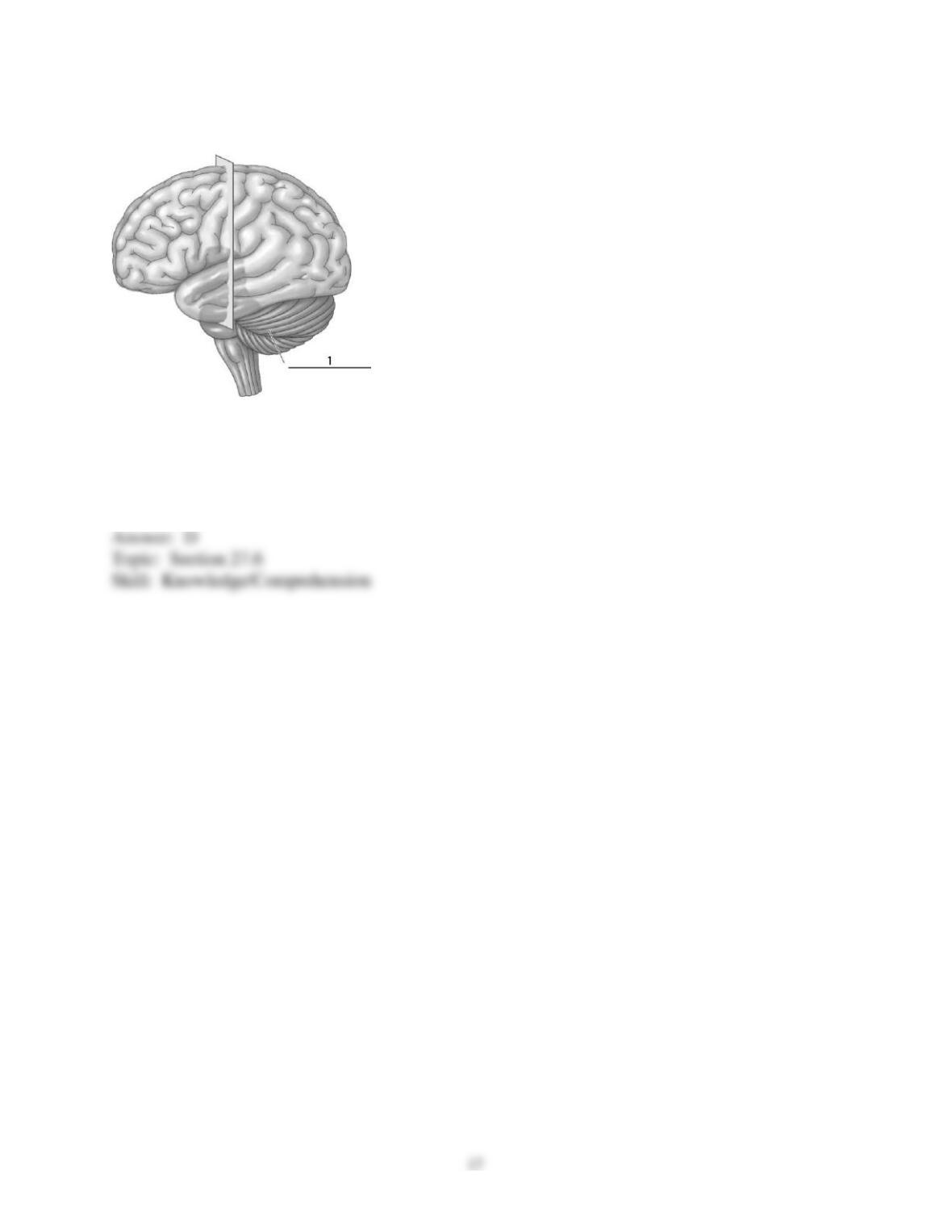
Refer to the figure below, and then answer the question that follows.
81) The part of the brain indicated by a “1” corresponds to the:
A) thalamus.
B) hypothalamus.
C) medulla oblongata.
D) cerebellum.
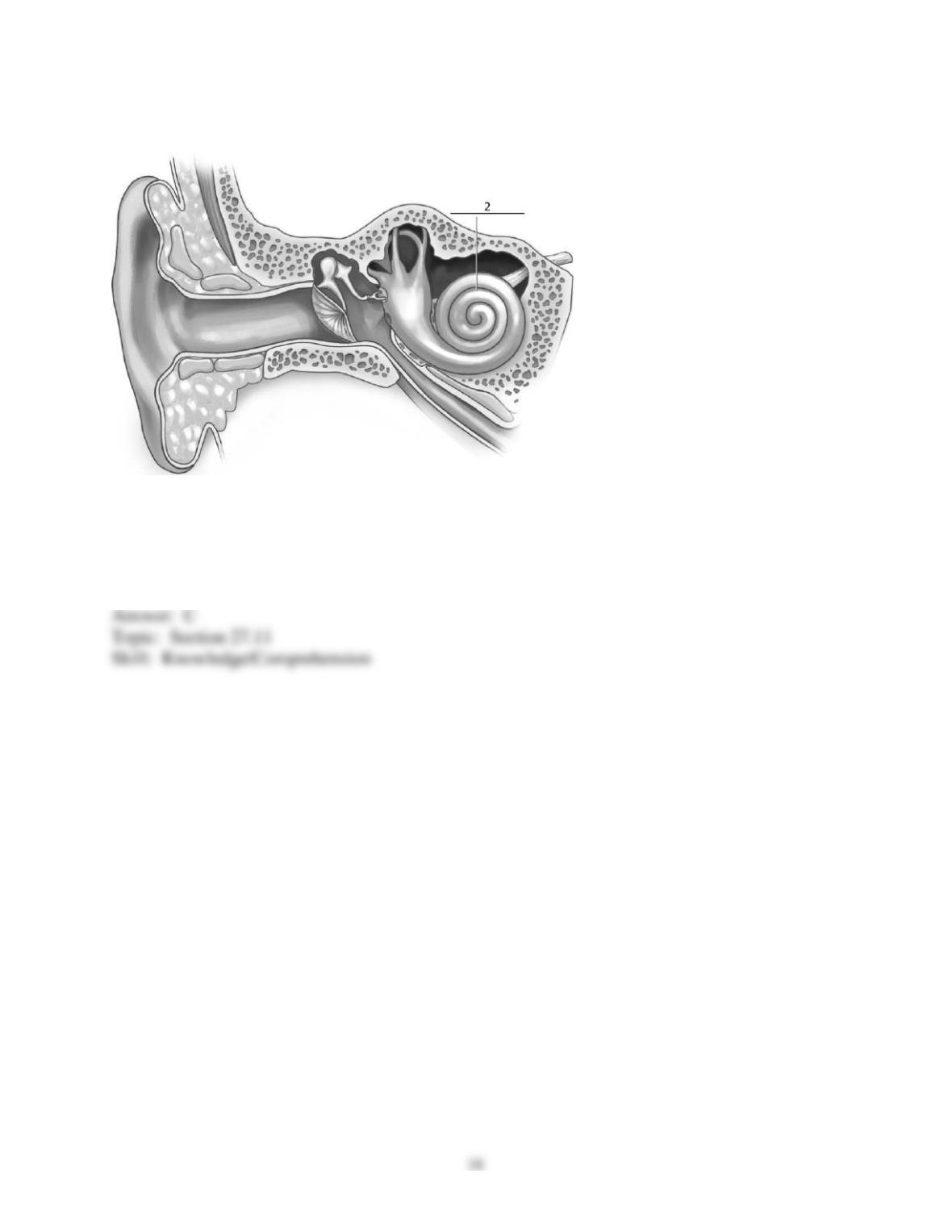
Refer to the figure below, and then answer the question that follows.
82) The missing label indicated by a “2” corresponds to the:
A) malleus.
B) oval window.
C) cochlea.
D) tympanic membrane.